


Sales teams often struggle to predict which deals will actually close. One enterprise opportunity may be described as “90% likely to close this quarter,” while another seemingly certain deal goes silent for weeks. Meanwhile, legal waits on contract terms, finance requires pricing approvals, and customer success teams are left uncertain about commitments made during the sale. This lack of coordination can lead to stalled deals, missed revenue, and frustrated teams.
Sales project management addresses this challenge by treating each sales opportunity as a structured project. Each deal moves through clearly defined stages with milestones, decision points, and explicit handoffs between teams. Repetitive tasks are automated, and cross-functional collaboration is centralized, turning a traditionally unpredictable process into a coordinated, transparent workflow.
This article will explore the core principles of effective sales project management. It will cover mapping the full sales lifecycle, creating custom workflows for different deal types, enabling seamless collaboration, and leveraging real-time data to improve forecasting and resource allocation. Readers will also learn seven actionable practices that reduce administrative work, prevent deals from stalling, and increase predictability across the pipeline.
Key takeaways
- Treat every deal like a project: map clear stages, milestones, and decision points to ensure opportunities progress predictably.
- Enable seamless cross-team collaboration: share information, document context, and define handoffs to prevent deals from stalling.
- Automate repetitive tasks: reduce administrative work with workflows, reminders, and status updates to let reps focus on selling.
- Use real-time data to manage risk and performance: dashboards and alerts help identify at-risk deals and optimize resource allocation.
- Centralize sales project management in one platform: solutions like monday CRM unify pipelines, workflows, and collaboration for consistent execution.
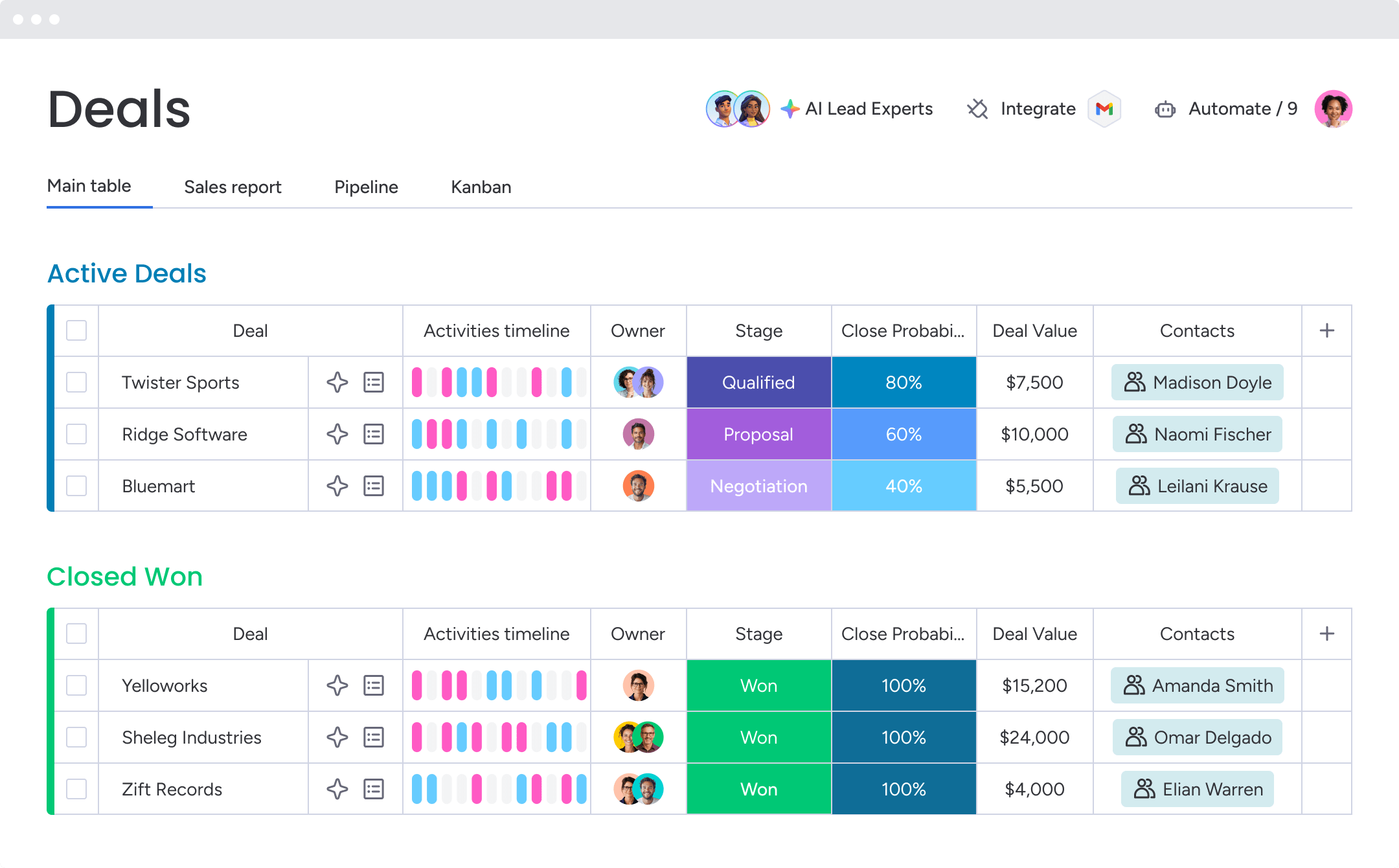
Sales project management involves planning, executing, and tracking sales activities like structured projects, with clear timelines, defined resources, and measurable deliverables. Each opportunity is treated as a coordinated initiative requiring milestones, cross-functional collaboration, and specific outcomes.
Traditional pipeline management focuses on deal stages and probability. Sales project management adds project execution discipline to revenue generation. Each deal or initiative becomes a distinct project with measurable milestones and success criteria.
Teams across sales, marketing, customer success, legal, and finance gain visibility into when their input is needed through effective cross-functional collaboration. With international bandwidth now four times larger than before the pandemic, digital collaboration has become the default. For organizations managing ten to one hundred sales reps, this approach solves predictability challenges, allowing leaders to know whether targets will be met before the quarter ends.
Sales project management reduces scattered communication and manual handoffs that cause opportunities to slip through cracks. It centralizes all deal-related activity, documentation, and communication in one place, ensuring everyone contributing to revenue sees the same information.
The evolution from traditional project management
Traditional project management originated in construction and software development, industries with fixed scopes, predictable timelines, and single deliverables. Sales project management operates in a fundamentally different environment.
Revenue teams manage multiple deals at varying stages, each with unique timelines and stakeholder dynamics. A deal that seemed close can stall unexpectedly, while a long-shot opportunity may accelerate when a champion emerges. Sales is relationship-driven, and outcomes depend on human decisions rather than task completion alone.
Here’s how traditional project management differs from sales project management:
| Dimension | Traditional project management | Sales project management |
|---|---|---|
| Timeline predictability | Fixed deadlines with sequential phases | Variable timelines driven by buyer readiness |
| Stakeholder involvement | Defined team with assigned roles | Multiple decision-makers with shifting influence |
| Success metrics | On-time, on-budget delivery | Revenue closed, forecast accuracy, customer retention |
| Resource allocation | Assigned at project start | Reallocation based on deal probability |
| Adaptability needs | Change management processes | Real-time pivots based on buyer signals |
Why sales projects need a different approach
Sales outcomes rely on human decision-making, organizational dynamics, and emotional factors that cannot be reduced to tasks. A prospect might value a product but face internal resistance, or a champion may leave mid-deal. Flexible workflows are essential because rigid project frameworks cannot accommodate these shifts.
Delayed deals impact quarterly targets, resource planning, and organizational confidence. Unlike a construction project slipping by two weeks, a delayed deal affects forecasts, compensation, board reporting, and strategic planning.
Sales projects require real-time collaboration with account management, legal, finance, and customer success. Deals cannot close until legal approves contracts, finance validates pricing, and implementation confirms timelines. Generic project platforms are not designed to handle these interdependencies.
Why sales teams need project management now
Sales cycles are lengthening as buying committees expand. Hybrid selling combines digital and in-person touchpoints that require coordination. Buyers expect personalized experiences, demanding detailed knowledge of their situation and needs. Informal approaches that worked with smaller teams and simpler deals now result in lost revenue.
The hidden cost of scattered sales tools
Sales reps often switch between CRM systems, email, project platforms, communication tools, and spreadsheets. Each context switch wastes time and creates information gaps. Roughlyroughly 90% of U.S. small and midsize merchants now use integrated software solutions, highlighting the trend toward consolidating workflows into a single source of truth.
- Lost deals from failed handoffs: critical context often gets lost when an SDR passes a lead to an account executive.
- Missed follow-ups from untracked action items: client calls generate tasks that are not centralized.
- Resource misallocation from fragmented data: leadership cannot identify which deals need attention because information is scattered.
For mid-market organizations, fragmentation prevents a single source of truth for all stakeholders. For small businesses, it leads to hours spent copying information instead of advancing deals.
From chaos to predictable revenue
Sales project management brings predictability by making deal progression visible and manageable. For CROs and VPs of sales, predictability enables accurate forecasting, confident executive reporting, and smart resource allocation before issues arise.
Teams shift from firefighting to proactive deal management. Without this system, deals stall without clear visibility, and problems surface only during pipeline reviews, often too late for intervention.
After implementation, automated alerts highlight at-risk deals based on inactivity, timeline slippage, or missing information. Manual status updates are replaced by real-time dashboards that display pipeline health instantly. Forecasts evolve from rep intuition to data-driven predictions using historical patterns, deal characteristics, and activity levels.
Building a scalable sales engine
Scaling sales without adding headcount requires repeatable processes and automation that handles administrative work. Sales project management creates this foundation by documenting workflows, standardizing handoffs, and centralizing communication.
- Repeatable workflows: new team members follow established processes from day one.
- Consistent handoffs: ensure opportunities move smoothly between reps and teams.
- Centralized collaboration: all deal information is in one location, improving visibility.
For mid-market organizations growing from ten to fifty sales reps, maintaining quality and predictability is challenging. Without structured processes, new reps invent their own methods, creating inconsistencies. Sales project management reduces ramp time from months to weeks and maintains uniformity in customer experience and outcomes.
Try monday CRM
7 sales project management best practices that actually work
These practices solve specific challenges in sales execution. Each addresses a real problem that causes deals to stall, forecasts to miss, or teams to spend excessive time on administrative work. Revenue teams can implement these strategies immediately to improve deal flow, predictability, and overall performance.
1. Map your complete sales project lifecycle
Mapping the lifecycle means documenting every stage from lead qualification through customer handoff, including all stakeholders and decision points. This goes beyond typical pipeline stages like “Qualified” or “Negotiation” to capture the full project workflow for each deal type.
A comprehensive lifecycle map includes four components that prevent deals from falling through the cracks:
- Qualification criteria: a lead becomes a project when budget is confirmed, decision-maker identified, timeline established, and need validated.
- Stakeholder touchpoints: each stage involves specific stakeholders with defined responsibilities.
- Decision gates: advancement requires specific approvals or achievements.
- Handoff protocols: transitions between teams require explicit protocols defining what information transfers.
Enterprise deals with complex approval chains require more detailed mapping than simpler SMB sales cycles. Even straightforward sales benefit from documenting processes clearly.
2. Create seamless handoffs between teams
Failed handoffs cause deal delays, customer frustration, and revenue leakage. When an SDR qualifies a lead but the AE lacks complete context, the first call starts poorly. When sales closes a deal but account management is unaware of promised commitments, implementation can stumble.
Seamless handoffs require four elements working together:
- Shared visibility: all teams see the same deal information and status.
- Automated notifications: relevant teams receive alerts when their involvement is needed.
- Documented context: customer requirements, commitments, and special considerations are captured centrally.
- Ownership transfers: handoffs happen explicitly, with the previous owner confirming completion and the new owner confirming they have what they need.
Modern platforms like monday CRM enable automated routing of customer context, implementation requirements, and promised deliverables to account management teams, eliminating manual email forwarding and information hunting.
3. Automate the repetitive work
Sales reps often spend hours on activities that do not advance deals. Data entry, status updates, follow-up reminders, task assignments, and report generation all consume time that could be spent on customer conversations.
Workflow automation addresses this through several mechanisms that work together to reduce administrative burden:
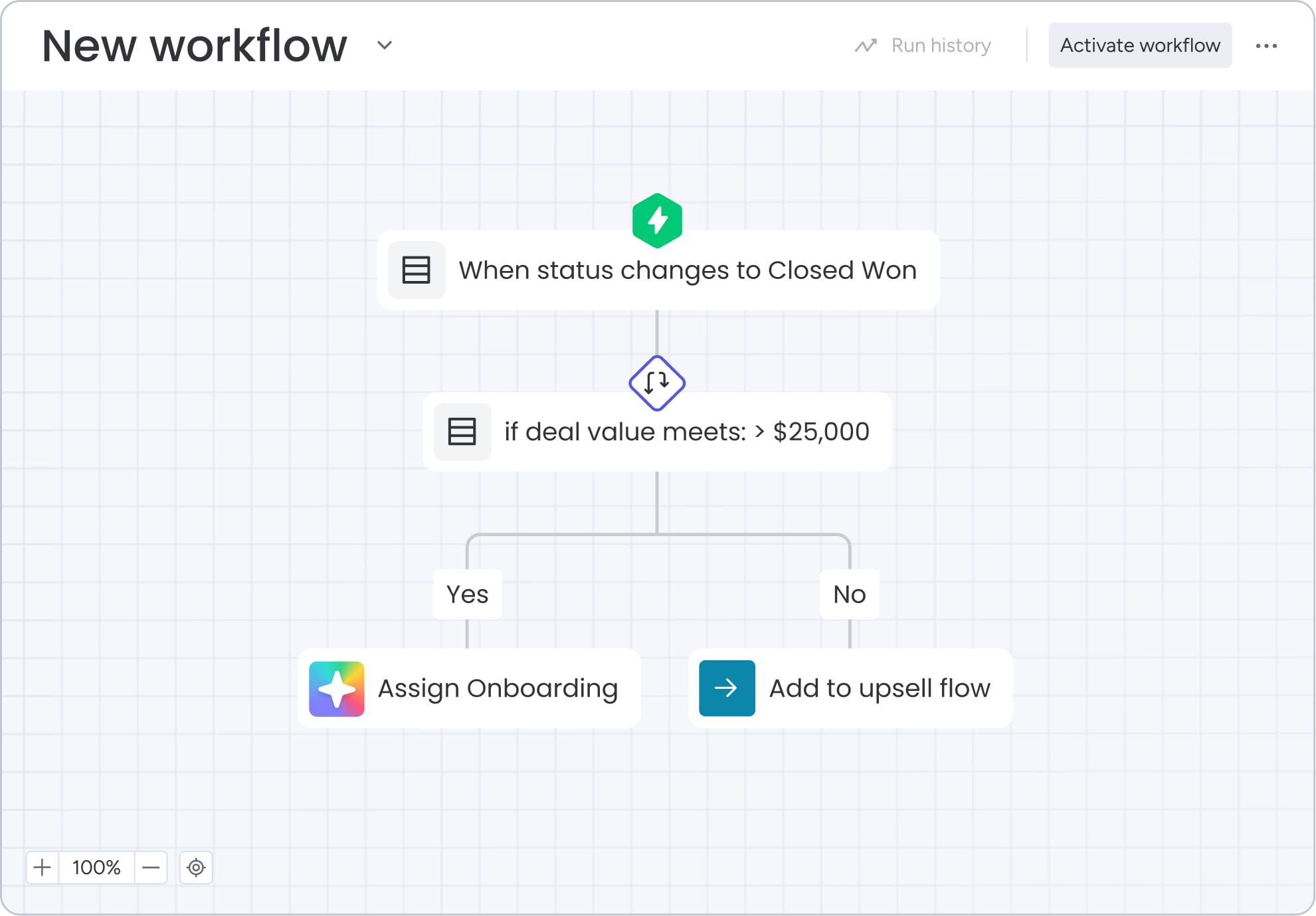
- Automatic task creation: when a deal reaches a specific stage, relevant tasks are created and assigned automatically.
- Status updates: deal progress informs stakeholders without manual reporting.
- Follow-up sequences: reminders trigger based on deal activity or inactivity.
- Data synchronization: information flows between systems without manual copying.
Sales managers can create these workflows without IT involvement using no-code automation builders, enabling teams to assign follow-ups when deals go inactive without technical skills.
4. Build custom workflows for each deal type
Not all deals follow the same path. Enterprise sales often involve technical validation, security reviews, and executive approvals, while SMB deals may not. New business acquisition also differs from renewal processes.
Custom workflows ensure each deal type receives the appropriate process:
- Enterprise deal workflow: technical validation with the customer’s IT team, security review, compliance documentation, legal approval of contract terms, and executive sign-off from both organizations.
- SMB deal workflow: discovery, demo, proposal, and close happen in two to four weeks with a single decision-maker, focusing on speed and simplicity.
5. Establish real-time project visibility
Real-time visibility allows leadership to see pipeline health, deal status, and team performance instantly. There is no waiting for weekly reports, manual compilation, or stale data.
Real-time visibility should include:
- Deal-level insight: current stage, blockers, next actions, and timeline for every opportunity.
- Team performance: activity levels, conversion rates, and velocity across reps.
- Pipeline health: distribution across stages, at-risk deals, and forecast accuracy.
- Resource allocation: which deals need support and which reps need coaching.
CROs and VPs gain confidence in executive reporting, sales managers identify coaching opportunities proactively, RevOps teams spot bottlenecks in real time, and individual reps understand their performance without waiting for manager feedback.
6. Set up proactive risk alerts
Proactive alerts flag potential problems before deals are lost, enabling timely intervention. Instead of discovering stalled deals during weekly pipeline reviews, automated alerts notify teams when warning signs appear.
Effective alert systems monitor multiple risk indicators simultaneously:
- Inactivity alerts: trigger when no customer engagement occurs for a defined period.
- Timeline slippage alerts: fire when expected close dates pass without advancement.
- Missing information alerts: ensure required fields or documents are completed by expected dates.
- Stakeholder change alerts: notify teams when key contacts leave the organization or new decision-makers join the process.
7. Use data to optimize continuously
Sales project management generates actionable data on what works and what does not. Conversion rates by stage, cycle times by deal type, and activities that correlate with wins all become visible.
Data enables continuous improvement through several analyses:
- Conversion rate analysis: reveals which stages have the highest drop-off.
- Cycle time analysis: shows how long deals spend in each stage compared with historical norms.
- Activity correlation analysis: identifies which actions correlate with won deals.
- Resource impact analysis: determines whether additional support improves close rates.
Modern platforms like monday CRM integrate these practices into a single system, giving sales teams visibility, automation, and insights that streamline processes, reduce administrative work, and improve predictability across the pipeline.
Core components of effective sales project management
Effective sales project management relies on foundational elements that work together to provide visibility, coordination, and predictability. These components enable revenue teams to manage deals more efficiently while improving overall outcomes. Understanding the role of each element helps teams build a framework that strengthens deal execution and performance.
Pipeline stages and milestones
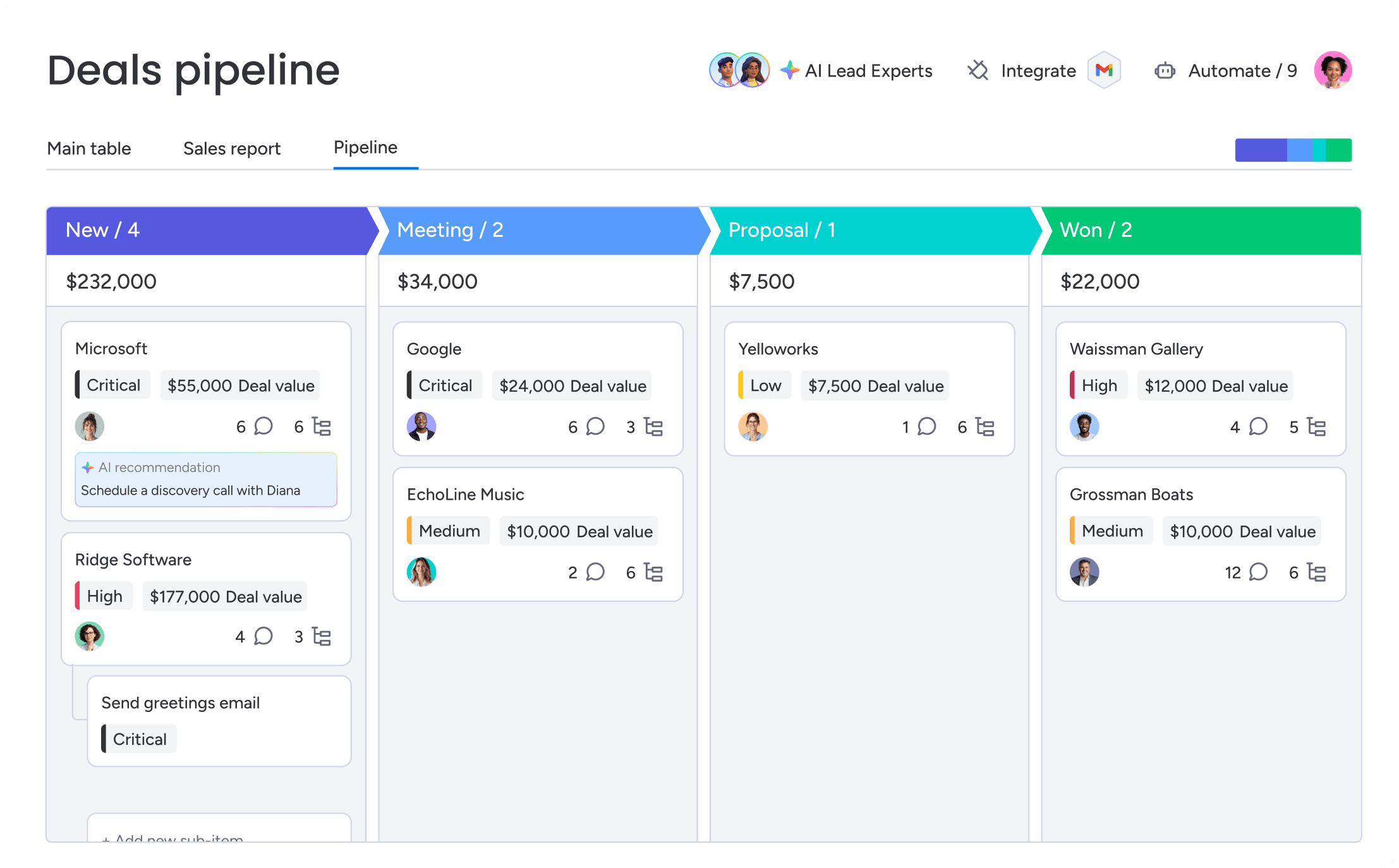
Pipeline stages map the journey of a deal, while milestones highlight critical progress points. Well-defined stages go beyond generic labels like “Qualified” or “Negotiation” to include entry and exit criteria, expected actions, and measurable objectives.
The following table illustrates how to structure pipeline stages with specific criteria:
| Stage | Duration | Entry criteria | Required actions | Exit criteria |
|---|---|---|---|---|
| Discovery | 5-7 days | Lead qualified, initial meeting scheduled | Needs assessment, stakeholder mapping | Requirements documented, decision-makers identified |
| Solution design | 10-14 days | Discovery complete | Technical requirements, proposal draft | Proposal approved internally, customer confirms fit |
| Negotiation | 7-10 days | Solution accepted | Pricing finalization, contract review | Terms agreed, contract ready for signature |
| Closing | 3-5 days | Negotiation complete | Signature collection, procurement processing | Contract signed, payment terms confirmed |
Smart resource allocation
Smart allocation matches resources to opportunities based on deal characteristics and probability. Larger deals require more support, while complex deals with multiple stakeholders benefit from cross-functional involvement. Deals with higher likelihood should receive priority attention.
Modern platforms like monday CRM provide visibility into deal requirements, team capacity, and performance data, enabling informed resource allocation. AI capabilities can recommend optimal team assignments based on skills, availability, and historical success patterns, ensuring that the right team members are engaged at the right time.
Cross-team collaboration
Sales rarely happens in isolation. Successful deals require input from marketing, legal, finance, implementation, and customer success teams. Effective collaboration involves several key practices:
- Shared workspaces: all stakeholders access the same deal information.
- Contextual communication: conversations happen in the context of specific deals.
- Centralized file management: documents and resources are stored in one location.
- Activity tracking: shows what has happened and what is next.
Centralizing deal communication, files, and updates eliminates scattered email threads. Team members can loop in stakeholders instantly, reducing silos and improving coordination.
Live performance dashboards
Dashboards provide at-a-glance visibility into sales performance, pipeline health, and team activity. They address reporting and predictability challenges by making current data available in real time.
Customizable dashboards with sales-specific widgets such as leaderboards and funnel views allow teams to identify strong and weak points in their pipeline. Teams can monitor quotas, track attainment over time, and make informed decisions with data that is always up to date.
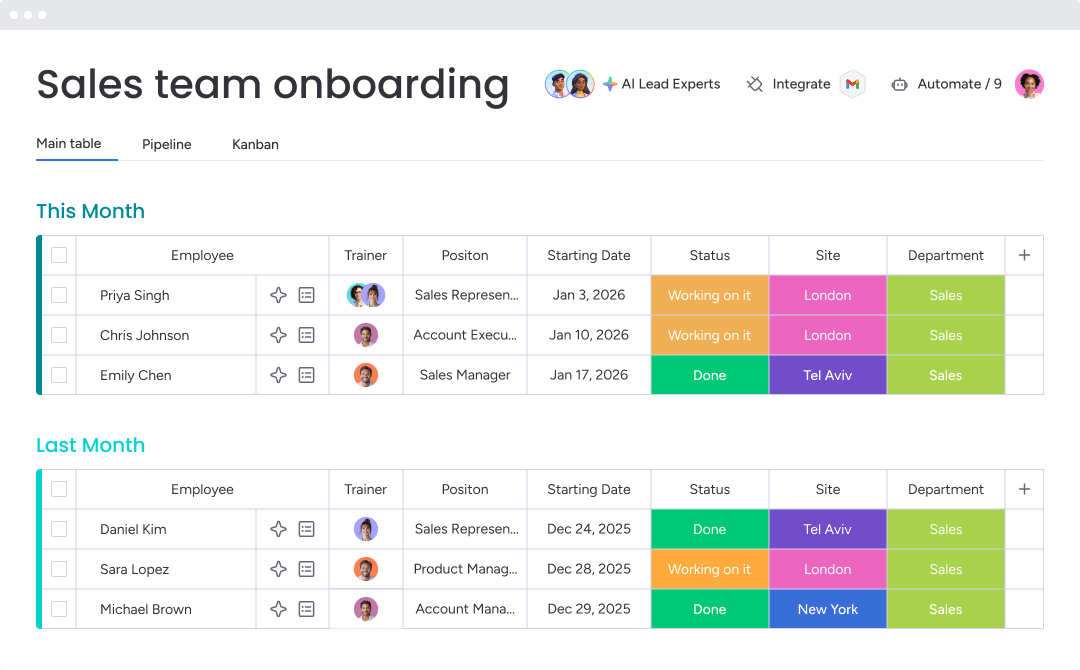
How to implement project management for sales teams
Implementing sales project management requires a structured approach. It is not about replacing existing systems overnight but about transitioning thoughtfully while addressing people, processes, and technology. The following roadmap guides organizations that want to shift from reactive sales operations to a proactive revenue strategy.
Audit your current sales process
Start by understanding your current sales operations. This foundational step highlights where opportunities are lost and where improvements will have the greatest impact.
Key activities include:
- Document opportunity flow: track how deals move from stage to stage.
- Identify participants: clarify who is involved at each stage and when.
- Locate communication gaps: find where context is lost or collaboration breaks down.
- Capture repetitive tasks: note administrative work that consumes team time.
- Gather feedback: collect insights from sales, management, and cross-functional teams.
Key audit questions include: where do deals stall most often, and why? What information is frequently missing or hard to access? Which handoffs between teams cause delays or errors?
Design your sales project framework
The framework defines how sales project management will operate. This step converts audit insights into actionable processes that address gaps and optimize efficiency.
Framework components include:
- Stage definitions: set objective criteria for each pipeline stage.
- Workflow templates: design processes for different deal types.
- Role assignments: define who owns each stage.
- Automation rules: identify repetitive tasks to automate.
- Collaboration protocols: outline how teams communicate and hand off work.
Select your technology platform
Choose a platform that supports your framework and is intuitive for your team. Focus on these capabilities:
- Sales-specific functionality: ensure the platform aligns with revenue workflows.
- Ease of use: the team should adopt it without friction.
- Customization without coding: allow process adjustments without IT intervention.
- Integration capability: connect seamlessly with existing tools.
- Visibility and reporting: access real-time insights into performance.
Modern platforms like monday CRM combine CRM and project management capabilities in a single workspace, eliminating the need for multiple systems. No-code customization ensures sales teams can manage processes independently, while automated workflows prevent deals from stalling.
Drive team adoption through training
Technology alone cannot create change. Adoption requires structured training, ongoing support, and clear expectations.
Successful adoption practices include:
- Tailored instruction: deliver role-specific guidance.
- Real examples: use actual deals for training, not abstract scenarios.
- Phased rollout: pilot with one team or deal type before full deployment.
- Champion identification: leverage enthusiastic early adopters to support peers.
- Ongoing support: provide resources for troubleshooting and questions.
Measure and refine
Implementation continues beyond launch. Regular monitoring ensures the system adapts to team needs and market shifts.
Track key metrics such as:
- Adoption metrics: verify consistent system use across teams.
- Process metrics: measure deal movement through stages.
- Outcome metrics: monitor close rates, sales cycle duration, and forecast accuracy.
- User feedback: assess what works well and what requires adjustment.
Transform your sales operations with structured project management
Sales project management is a shift from reactive deal chasing to proactive revenue generation. Teams implementing these practices often see faster deal velocity, improved forecast accuracy, and higher productivity.
The transformation works on multiple levels: individual reps spend more time with customers and less on administrative tasks. Sales managers gain pipeline visibility without constant status meetings. Revenue leaders report confidently using real-time data instead of relying on gut instinct.
Organizations using monday CRM find that combining CRM with project management creates a unified workspace where deals progress smoothly from first contact to closed-won. No-code customization empowers teams to adapt processes without waiting for IT, and automated workflows remove manual handoffs that cause delays.

“With monday CRM, we’re finally able to adapt the platform to our needs — not the other way around. It gives us the flexibility to work smarter, cut costs, save time, and scale with confidence.”
Samuel Lobao | Contract Administrator & Special Projects, Strategix
“Now we have a lot less data, but it’s quality data. That change allows us to use AI confidently, without second-guessing the outputs.”
Elizabeth Gerbel | CEO
“Without monday CRM, we’d be chasing updates and fixing errors. Now we’re focused on growing the program — not just keeping up with it."
Quentin Williams | Head of Dropship, Freedom Furniture
“There’s probably about a 70% increase in efficiency in regards to the admin tasks that were removed and automated, which is a huge win for us.“
Kyle Dorman | Department Manager - Operations, Ray White
"monday CRM helps us make sure the right people have immediate visibility into the information they need so we're not wasting time."
Luca Pope | Global Client Solutions Manager at Black Mountain
“In a couple of weeks, all of the team members were using monday CRM fully. The automations and the many integrations, make monday CRM the best CRM in the market right now.”
Nuno Godinho | CIO at Velvmonday CRM: Top project management features for sales teams
Modern platforms like monday CRM unify project management and sales operations. This integration allows revenue teams to manage deals from first contact to closed-won without switching tools.
Key features include:
- Customizable deal pipelines: create visual pipelines with drag-and-drop stages, custom fields, and deal-specific workflows.
- No-code automation: set workflows to assign tasks, send notifications, update stakeholders, and move deals forward without manual input.
- Real-time dashboards: access instant insights into pipeline health, team performance, and forecast accuracy using customizable dashboards with sales-specific widgets.
- Cross-functional collaboration: align sales, legal, finance, and customer success in shared workspaces where everyone sees the same deal information.
- AI-powered insights: leverage AI to optimize resource allocation, predict deal outcomes, and flag at-risk opportunities.
- Native integrations: sync with email, calendar, and communication tools to maintain up-to-date deal information.
- Mobile accessibility: manage deals, update information, and collaborate from anywhere using native mobile apps.
Frequently asked questions
What is the difference between sales project management and traditional CRM?
Traditional CRM tracks contacts, deals, and pipeline stages. Sales project management treats each deal as a project, with defined tasks, milestones, collaboration, and automated workflows that prevent errors and delays.
How long does implementation take?
Small businesses moving from spreadsheets can be operational within two to four weeks. Mid-market organizations migrating from existing CRMs usually need six to twelve weeks for process design, data migration, and training.
Which metrics should I track?
Monitor deal velocity, including average sales cycle, stage duration, and conversion rates. Track pipeline health through stage distribution, coverage ratio, and forecast accuracy. Measure productivity with activity levels, win rates, and quota attainment. Include customer outcomes such as onboarding speed and retention.
Can small businesses benefit from sales project management?
Small businesses often benefit most because they have the least capacity for manual work and the highest cost of missed opportunities. Intuitive platforms that don't require technical expertise make sales project management accessible to teams of any size.
How does sales project management integrate with existing tools?
Small businesses gain the most because they have limited capacity for manual work and high costs for missed opportunities. Intuitive platforms make structured sales management accessible for teams of any size.
What is the ROI of implementing sales project management?
ROI comes from higher win rates, shorter sales cycles, improved forecast accuracy, increased rep productivity, and stronger customer retention. Most organizations see a fifteen to twenty-five percent boost in sales productivity within the first year of implementation.

 Get started