Five hundred new leads should feel like momentum. Instead, it often feels like noise. Names pile up, inboxes fill, and reps are left guessing who is ready to buy and who is just browsing. Without a clear system, raw leads slow teams down instead of moving revenue forward.
The teams that win do not work harder on raw leads. They work smarter. They know where their best leads come from, how to qualify fast, what signals matter most, and when automation should take over. They turn incomplete contact data into clear next steps and real opportunities before interest fades.
This playbook breaks down how high-performing sales teams move raw leads through qualification, scoring, nurturing, and automation so nothing slips through the cracks. The result is faster follow-up, better conversations, and a pipeline that converts with intention instead of luck.
Key takeaways
- Move fast while interest is highest: respond to raw leads within minutes to boost qualification rates and beat competitors to the conversation.
- Focus effort where intent is strongest: prioritize leads showing buying signals like demo requests, pricing interest, or repeat engagement instead of treating every contact the same.
- Use scoring to remove guesswork: combine fit and behavior signals to quickly identify which raw leads deserve immediate sales attention.
- Automate research and routing early: enrich leads, assign owners, and trigger follow-ups automatically so reps spend time selling, not chasing data.
- Scale raw lead conversion with monday CRM: centralize lead capture, scoring, automation, and tracking in one system to turn volume into revenue consistently.
What are raw leads and how do they differ from qualified leads?
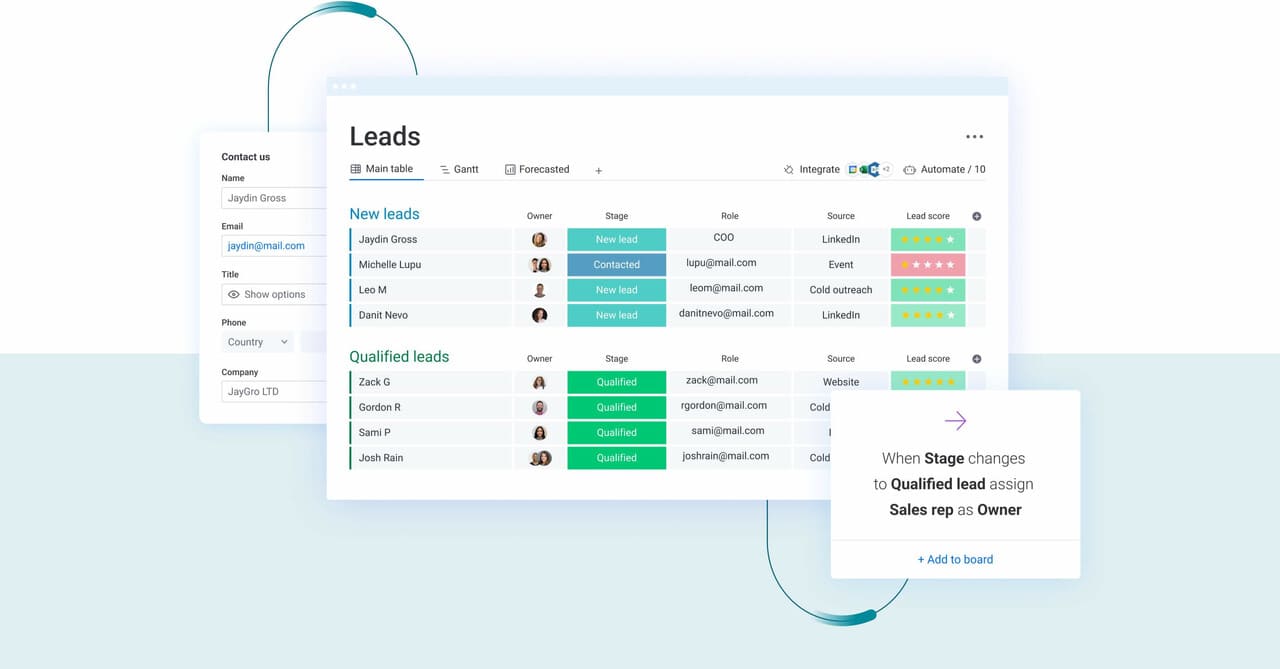
Raw leads sit at the top of your funnel — unqualified and unfiltered. They’re names, emails, maybe a company, but little else. No context on fit, intent, or readiness to buy. These contacts come from form fills, event sign-ups, social media, or purchased lists.
They’re the starting point, not the finish line.
The distinction between raw leads and other lead types determines how sales teams prioritize their time and resources. Raw leads sit at the top of the sales funnel, requiring more work to assess than leads that have already been qualified by marketing or sales teams.
| Lead type | Characteristics | Qualification status |
|---|---|---|
| Raw leads | Basic contact information only; unknown budget, authority, need, or timeline | Unqualified; requires initial vetting |
| Marketing qualified leads (MQLs) | Engaged with marketing content; scored for interest level based on behavior | Partially qualified; shows engagement signals |
| Sales qualified leads (SQLs) | Vetted by sales team; confirmed budget and decision-making authority | Fully qualified; ready for sales process |
Several signs indicate you’re looking at raw leads rather than qualified prospects. Spot these signs and you’ll know exactly what to do next:
- Minimal contact information: the lead provides only name, email, or phone number without additional context about their role, company, or specific needs.
- Unknown company details: no insight into company size, industry vertical, annual revenue, or organizational structure that would indicate fit with your ideal customer profile.
- Unclear intent signals: basic form fills or generic inquiries without specific product interest, use case mention, or indication of buying timeline.
- No engagement history: first-time interaction with your brand, with no previous content downloads, email opens, or website visits to indicate genuine interest level.
Where do high-converting raw leads come from?
Not all raw leads are created equal. Some sources consistently produce prospects with higher conversion potential and shorter sales cycles. Recognize which channels work best, and you’ll stop wasting time and money on the wrong ones.
Digital lead sources
Most raw leads come from digital channels — but not all channels convert equally. Where a lead comes from tells you how likely they are to close.
- Website contact forms: optimized for specific use cases generate higher-quality leads than generic “Contact Us” submissions. Forms that ask about pricing, demos, or technical needs give you context — not just contact info.
- Content downloads: attract prospects actively researching solutions. Gated whitepapers, case studies, industry reports, and templates indicate prospects are further along in their buying journey.
- Webinar registrations: signal genuine interest, as prospects willing to invest time in learning are more engaged than casual browsers.
- Demo requests: represent high-intent prospects who have typically completed initial research and are evaluating specific solutions. They’ve already identified a need. They’re ready to buy.
Social selling channels
Don’t just wait for leads to come to you — go find them on social. These proactive approaches help identify prospects before they enter active buying mode.
- LinkedIn outreach: through personalized connection requests and InMail campaigns targets specific roles, industries, or companies. You can start conversations with the exact people you want to reach.
- Social media engagement: builds relationships that eventually convert to sales opportunities. Commenting thoughtfully on prospect posts, sharing valuable industry content, and participating in relevant discussions positions sales professionals as helpful, trusted resources.
- Industry forums and specialized communities: provide access to target buyers in their natural habitat. Join the Slack channels and forums where your prospects hang out. Build real relationships.
Intent data and buying signals
The best leads are already showing buying signals online. Website behavior tracking reveals which prospects are seriously evaluating solutions.
Key buying signals include:
- Multiple visits to pricing pages: demonstrates serious evaluation of costs.
- Exploration of specific product features: shows detailed research into capabilities.
- Significant time spent on case studies: indicates interest in real-world applications.
- Third-party intent data: provides visibility into research activity across the web. When prospects read comparison articles, visit review sites, or consume competitor content, they’re actively evaluating solutions in your category.
- Technographic changes: signal opportunity. New implementations, technology stack updates, or recent funding rounds indicate companies are investing in new capabilities and may be open to additional solutions.
6 steps to qualify raw leads fast
Fast, systematic qualification is what separates teams that crush quota from teams that don’t. A solid process makes sure you spend time on the right leads — not the wrong ones. Here’s how to build a qualification system that moves prospects through your pipeline efficiently.
Step 1: capture every lead source
Know where each lead came from. It tells you which channels are worth doubling down on. To track this right, you need to:
- Set up UTM parameters in all marketing links.
- Add hidden form fields that capture referral sources.
- Ensure CRM integration automatically logs the original touchpoint.
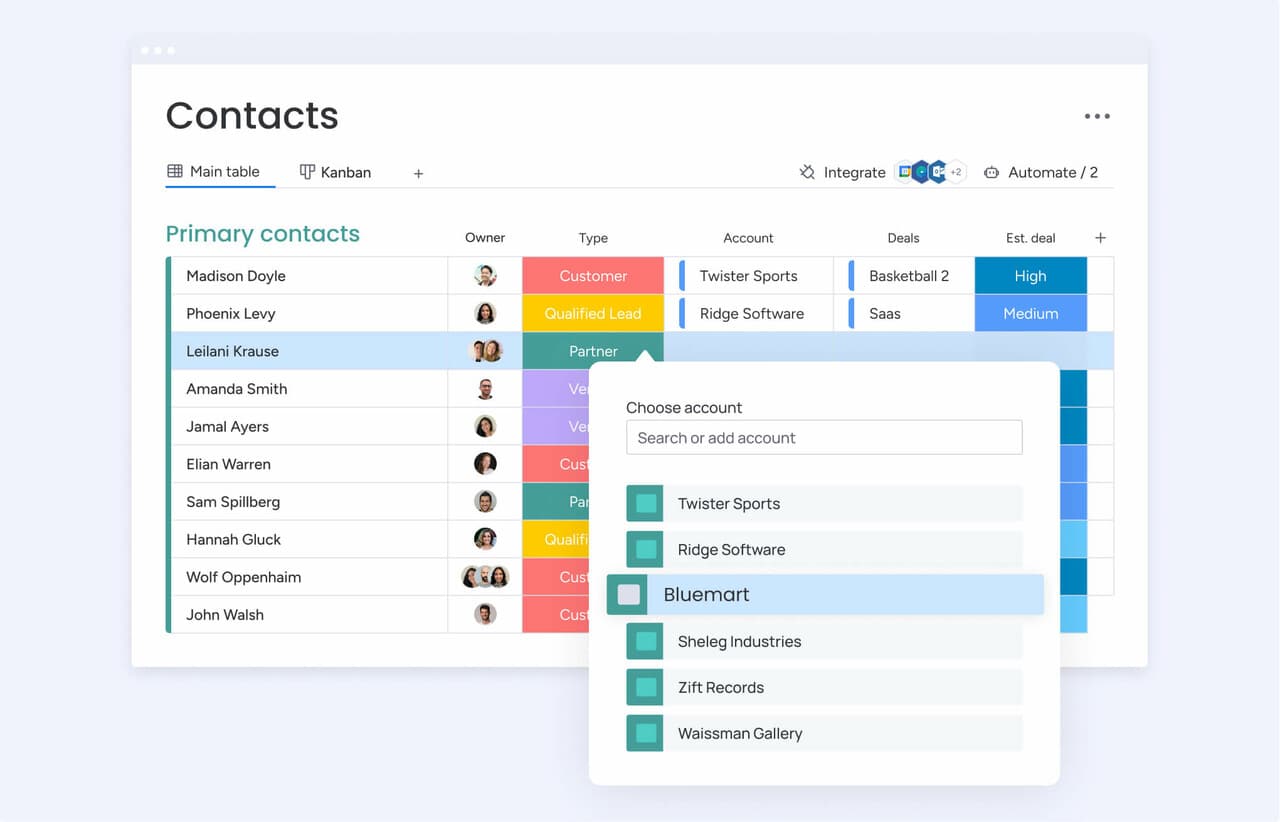
Revenue teams using platforms like monday CRM benefit from automatic lead source tracking in dedicated columns. This maintains complete visibility into which campaigns, content pieces, or channels generated each prospect without manual data entry.
Step 2: enrich with AI
Data enrichment turns a name and email into a full prospect profile. AI-powered enrichment provides company size, annual revenue, industry classification, technology stack, recent funding rounds, and employee count within seconds.
This approach aligns with current trends, as a McKinsey report notes that organizations with mature gen-AI marketing capabilities report 22% efficiency gains and expect 28% within two years.
AI Blocks within intelligent platforms like monday CRM automate data extraction from various sources. The platform pulls information from LinkedIn profiles, company websites, and third-party databases to build complete lead records without manual research time.
Step 3: score for sales readiness
Lead scoring tells you which leads to call first — based on fit and behavior. Fit criteria include company size, industry, role, and geographic location. Engagement signals track email opens, website visits, content downloads, and social interactions.
A simple scoring framework assigns points for ideal customer characteristics:
- Director-level titles: 20 points.
- Companies with 100-500 employees: 15 points.
- Target industries: 10 points.
- Demo requests: 30 points.
- Pricing inquiries: 25 points.
Leads exceeding a predetermined threshold automatically route to sales for immediate follow-up.
Step 4: route in real time
Automated lead routing based on territory, product interest, company size, or lead score ensures immediate assignment. Real-time routing cuts the lag between capture and contact — so you reach prospects while they’re still engaged.
Teams leveraging monday CRM’s automation capabilities enable instant lead distribution based on customizable criteria. Automatic notifications alert assigned reps the moment a qualified lead enters their pipeline.
Step 5: execute discovery calls
Use a simple framework on qualification calls: budget, authority, need, timeline — while building rapport. These calls turn raw leads into real opportunities — by confirming they’re serious and a good fit.
Key questions that uncover qualification criteria:
- What prompted them to reach out now? Establishes urgency.
- Who else is involved in evaluating solutions? Identifies decision-makers.
- What budget ranges are you considering? Qualifies financial capacity.
- What’s your ideal timeline for implementation? Determines sales cycle. length
Step 6: move to opportunity
Leads qualify as opportunities when they confirm budget availability, identify decision-makers, articulate specific business needs your solution addresses, and commit to a reasonable timeline for evaluation. Document everything — notes, next steps, and stakeholders — to ensure smooth and successful handoffs.
Building your raw lead scoring model
Good lead scoring mixes fit with behavior. You’ll know which leads to call now — and which to nurture with automation. A solid scoring model keeps your team focused on leads that’ll actually close.
Fit scoring criteria
Demographics tell you if a prospect fits your ideal customer profile. Points show how close they are to your best customers.
| Criteria | Point value | Rationale |
|---|---|---|
| Company size: 100-500 employees | 20 points | Sweet spot for mid-market solutions |
| Target industry vertical | 15 points | Industry-specific challenges align with product capabilities |
| Geographic location | 10 points | Matches sales team coverage and support capabilities |
| Director+ job title | 20 points | Decision-making authority and budget control |
| IT/Operations department | 15 points | Technical evaluation capability |
Intent and engagement signals
Behavior shows how serious prospects are about buying. Not all actions matter equally. Weight them based on what actually predicts a sale:
Website engagement scoring:
- Five points per page view (maximum 25 points).
- Ten points for pricing page visits.
- Fifteen points for return visits within 48 hours.
Content consumption signals:
- Ten points per content download.
- Fifteen points for case study views.
- Twenty points for video consumption beyond 50%.
Direct interactions carry the most weight:
- Thirty points for demo requests.
- Twenty-five points for pricing inquiries.
- Twenty points for sales conversations.
AI predictive scoring
Machine learning spots patterns in your closed deals that manual scoring might miss. AI examines hundreds of data points including job title combinations, company characteristics, engagement sequences, and time-to-conversion patterns to calculate conversion probability for each new lead.
Organizations using monday CRM access AI capabilities that provide predictive lead scoring. It learns from your deals and adjusts scoring based on what actually closes in your business.
Try monday CRM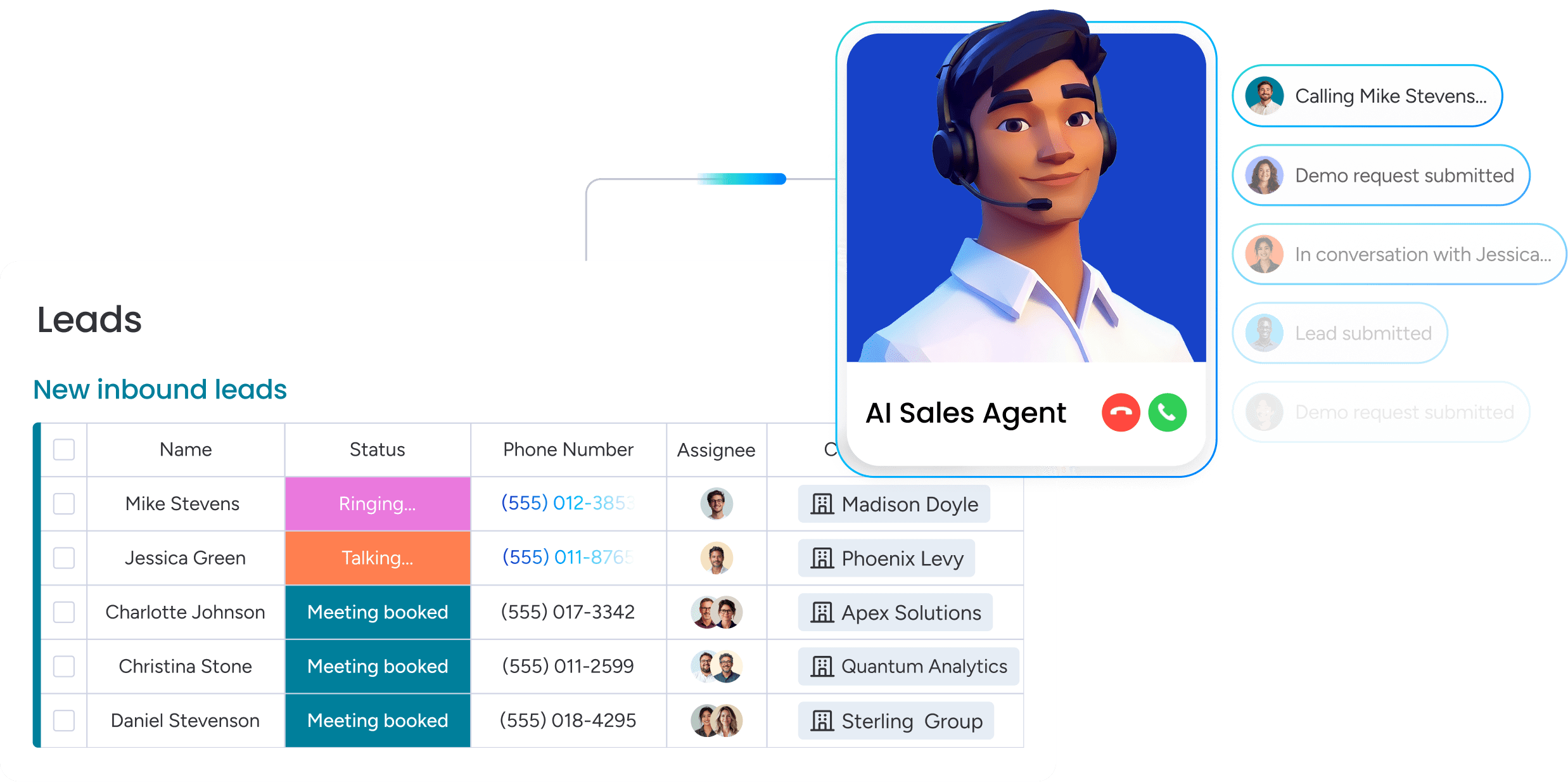
Raw lead nurturing that converts
Most raw leads aren’t ready to buy yet. Nurture them until they are. Good nurturing keeps prospects engaged without being pushy. Send the right message at the right time — based on where they are in the buying process.
Multi-touch email campaigns
Automated emails keep prospects engaged with useful content. Match content to where prospects are in their evaluation.
Educational content series establish your organization as a trusted resource:
- Industry insights and trend analysis.
- Best practices guides.
- Thought leadership content that demonstrates expertise without pushing products.
Product-focused messaging highlights features and use cases:
- Feature demonstrations with real-world applications.
- Customer success stories that show measurable outcomes.
- Use case examples that address specific challenges prospects face.
Personalization tactics ensure each prospect receives relevant messaging. Content based on industry vertical, job role, company size, or engagement history resonates more than generic broadcasts.
Social media engagement plays
Stay visible on social without pushing sales conversations. You’ll build trust without being salesy.
LinkedIn engagement strategies:
- Liking and commenting thoughtfully on prospect posts.
- Sharing prospect content to build reciprocal relationships.
- Positioning sales reps as helpful peers rather than pushy vendors.
Content sharing demonstrates expertise and keeps your brand top-of-mind:
- Posting valuable resources that prospects will find useful.
- Maintaining visibility during their evaluation process.
- Creating natural conversation starters through relevant content.
Personalized direct messages that reference recent interactions, shared connections, or relevant content create opportunities for meaningful dialogue.
Automated personalization at scale
Use automation to personalize at scale — without losing the human feel. Triggers send the right message based on what prospects do.
Trigger-based messaging examples:
- Pricing page visits trigger ROI calculators.
- Case study downloads trigger industry-specific follow-ups.
- Product page visits trigger feature-specific content.
Effective lead nurturing respects where prospects are in their decision process and meets them there, rather than forcing a conversation too early.
Track raw lead pipeline metrics
Track performance to see which channels are worth more budget — and which need fixing. See how each source performs, and you’ll know where to spend your budget. These metrics show you how to improve your entire lead process.
Conversion rates by source
| Metric | Calculation | Purpose |
|---|---|---|
| Lead source to qualified lead | Qualified leads divided by total raw leads | Identifies channels producing ideal prospects |
| Qualified lead to opportunity | Opportunities divided by qualified leads | Reveals sales team conversion effectiveness |
| Opportunity to closed deal | Closed deals divided by opportunities | Shows win rates by original source |
| Overall source-to-close | Closed deals divided by total raw leads | Complete picture of channel effectiveness |
Speed-to-lead performance
Track how fast your team responds to new leads. You’ll spot what’s slowing you down — and where to improve.
- Initial response time: measures how quickly leads receive first contact after entering the system, measured in minutes rather than hours.
- Qualification timeline: tracks time from lead capture to qualification decision. Responsive teams typically complete this process within 24-72 hours.
- Follow-up frequency: measures touchpoints before qualification or disqualification, with successful teams averaging five to seven contacts across multiple channels.
Revenue attribution
Connect leads to revenue, and you’ll prove which channels are worth the spend.
- Pipeline value by source: shows total opportunity value generated from each lead source, revealing which channels create the largest potential revenue beyond just lead volume.
- Average deal size: reveals whether certain sources produce larger contracts, justifying higher acquisition costs.
- Customer lifetime value: accounts for retention rates, expansion opportunities, and referral potential beyond the initial sale.
Automating your raw lead workflow
Automation reduces manual work and ensures lead handling is consistent. Your team can manage a higher volume of leads while maintaining speed and quality. Good automation makes lead capture to qualification smooth and fast.
Lead enrichment automation
Auto-append data to turn basic contact info into full profiles. It happens instantly — no manual work required.
Company information lookups append:
- Company size and employee count.
- Industry classification.
- Annual revenue estimates.
- Headquarters location.
- Recent funding rounds.
Contact detail enrichment adds:
- Phone numbers and LinkedIn profiles.
- Job titles and department information.
- Reporting structure and decision-making authority.
- Previous company experience.
Intent signal integration with data providers surfaces:
- Recent web activity and content engagement.
- Technology research patterns.
- Competitor evaluation activity.
AI qualification at scale
AI does the initial qualification work so your team doesn’t have to. You’ll qualify consistently — and free up time for real selling.
Automated scoring assigns priority levels instantly based on predefined criteria, ensuring high-value prospects receive immediate attention.
Intelligent routing matches leads with the optimal rep based on:
- Territory assignments.
- Industry expertise.
- Product specialization.
- Current workload distribution.
Predictive qualification identifies which leads are most likely to close based on historical pattern analysis.
Trigger-based follow-ups
Automated responses keep prospects engaged — without you watching every lead. Automation keeps prospects moving while reps focus on qualified leads.
Immediate acknowledgment emails provide professional first impressions and set expectations for follow-up timing.
Behavioral triggers automate outreach based on specific actions:
- Pricing page visits trigger ROI calculator delivery.
- Return website visits trigger personal check-ins.
- Content downloads trigger relevant follow-up resources.
Multi-touch nurture campaigns adapt based on engagement, with prospects who open emails receiving additional content while non-responders receive different messaging approaches.

“With monday CRM, we’re finally able to adapt the platform to our needs — not the other way around. It gives us the flexibility to work smarter, cut costs, save time, and scale with confidence.”
Samuel Lobao | Contract Administrator & Special Projects, Strategix
“Now we have a lot less data, but it’s quality data. That change allows us to use AI confidently, without second-guessing the outputs.”
Elizabeth Gerbel | CEO
“Without monday CRM, we’d be chasing updates and fixing errors. Now we’re focused on growing the program — not just keeping up with it."
Quentin Williams | Head of Dropship, Freedom Furniture
“There’s probably about a 70% increase in efficiency in regards to the admin tasks that were removed and automated, which is a huge win for us.“
Kyle Dorman | Department Manager - Operations, Ray White
"monday CRM helps us make sure the right people have immediate visibility into the information they need so we're not wasting time."
Luca Pope | Global Client Solutions Manager at Black Mountain
“In a couple of weeks, all of the team members were using monday CRM fully. The automations and the many integrations, make monday CRM the best CRM in the market right now.”
Nuno Godinho | CIO at Velv
“monday.com provides developmental flexibility, operational efficiency, and data transparency — all in one place. We became a company that moved from chasing data to leading with it.”
Hyunghan Lee | Team Lead, Sandbox Network
"monday.com brought every part of our business into one connected space. The harmony between work management and CRM has become our operating system — giving us the clarity and confidence to scale.”
Jennifer Chinburg | Executive Vice President of Corporate Development & Brand, Chinburg Properties
“We just weren’t getting value from our old CRM. With monday.com, it's a thousand times better. Our sales teams are more informed, more consistent, and far more connected."
James Arnold | Chief Operating Officer, CenversaTurn raw leads into revenue with the right system
Raw leads are not a problem to manage. They are an opportunity to win. The difference between teams that miss targets and teams that exceed them comes down to how quickly and consistently those leads are handled.
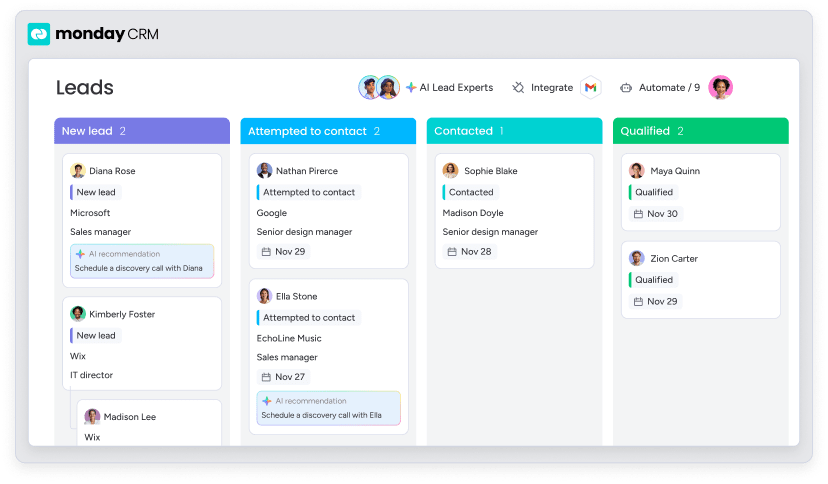
monday CRM gives revenue teams the structure and speed needed to turn early interest into real pipeline. Every lead is captured the moment it enters the system, enriched with context, scored for readiness, and routed to the right rep without manual effort.
With monday CRM, teams gain:
-
Instant visibility into every lead: visual pipeline boards show exactly where each lead stands and what needs to happen next.
-
Faster qualification with AI support: automated enrichment and scoring surface the most promising leads while removing guesswork.
-
Consistent follow-up at scale: built-in automations trigger outreach and tasks so no lead goes cold.
-
More selling, less admin: reps spend time in conversations that matter instead of researching, routing, or chasing data.
When speed, qualification, and automation work together, raw leads stop feeling overwhelming. They become a reliable source of momentum, pipeline, and revenue growth — all powered by monday CRM.
Try monday CRMFrequently asked questions
How many touchpoints does it take to convert a raw lead?
Most raw leads require 5-7 touchpoints across multiple channels before converting to qualified opportunities, though this varies by industry, deal size, and sales cycle complexity. However, teams must ensure compliance when reaching out to raw leads, as violations of telemarketing rules carry penalties of up to $53,088 per violation.
What's a good raw lead conversion rate?
Industry benchmarks show 2-5% of raw leads typically convert to closed deals, with 15-25% advancing to qualified opportunities depending on lead source quality and sales process effectiveness.
How quickly should sales teams respond to raw leads?
Responding within 5 minutes increases qualification rates significantly compared to waiting 30 minutes or longer, making speed-to-lead a critical competitive advantage.
Which CRM features matter most for raw lead management?
Essential features include automated lead scoring, real-time routing, comprehensive activity tracking, and integration capabilities with marketing and data enrichment sources.
How do you handle raw leads from different time zones?
Implement automated acknowledgment emails for immediate response, use round-robin routing to available reps regardless of location, and set up follow-up sequences that respect local business hours for calls.
Should every raw lead go into your CRM?
Yes, all raw leads should be captured in your CRM to maintain complete attribution tracking and prevent lost opportunities, even if they're immediately disqualified based on basic criteria.