


Sales teams are drowning in platforms. CRM for deals, email automation for outreach, scheduling apps for meetings, proposal generators for contracts. Each login eats time, data transfer creates gaps and new hire needs weeks to learn systems that barely talk to each other. Meanwhile, deals slip through cracks and forecasts stay guesswork.
A unified AI agent eliminates the platform juggling act by handling everything from lead qualification to deal closure in one place. It learns from every interaction, automates routine work, and gives complete visibility without the data gymnastics. Teams using this approach see 40-50% less manual work, faster onboarding, and forecasts they can actually trust.
In this article, you’ll find what happens when sales stacks get consolidated: 7 key benefits, real workflow transformations from lead gen to close, and proof that unified platforms outperform fragmented ones. Plus, how teams are preparing their sales operations for 2026 by choosing simplicity over complexity, often with a single, visual platform to manage it all.
Key takeaways
- Replace multiple sales platforms with one AI agent: cut costs by 30-50% and reduce training time from weeks to days by consolidating your entire sales stack into a unified system.
- Automate 40-50% of manual sales work: let AI handle lead scoring, follow-ups, and CRM updates so your team focuses on actual selling instead of administrative tasks.
- Get reliable forecasts with complete data visibility: stop making educated guesses about deals when all prospect interactions, engagement signals, and pipeline data live in one place.
- Scale revenue without hiring more reps: AI agents manage increased deal volume and complexity automatically, letting existing team members handle larger territories effectively.
- Build custom AI workflows without coding: use monday CRM AI blocks to categorize leads, extract key information, and summarize communications through simple drag-and-drop workflow creation.
What are AI agents for sales workflows?
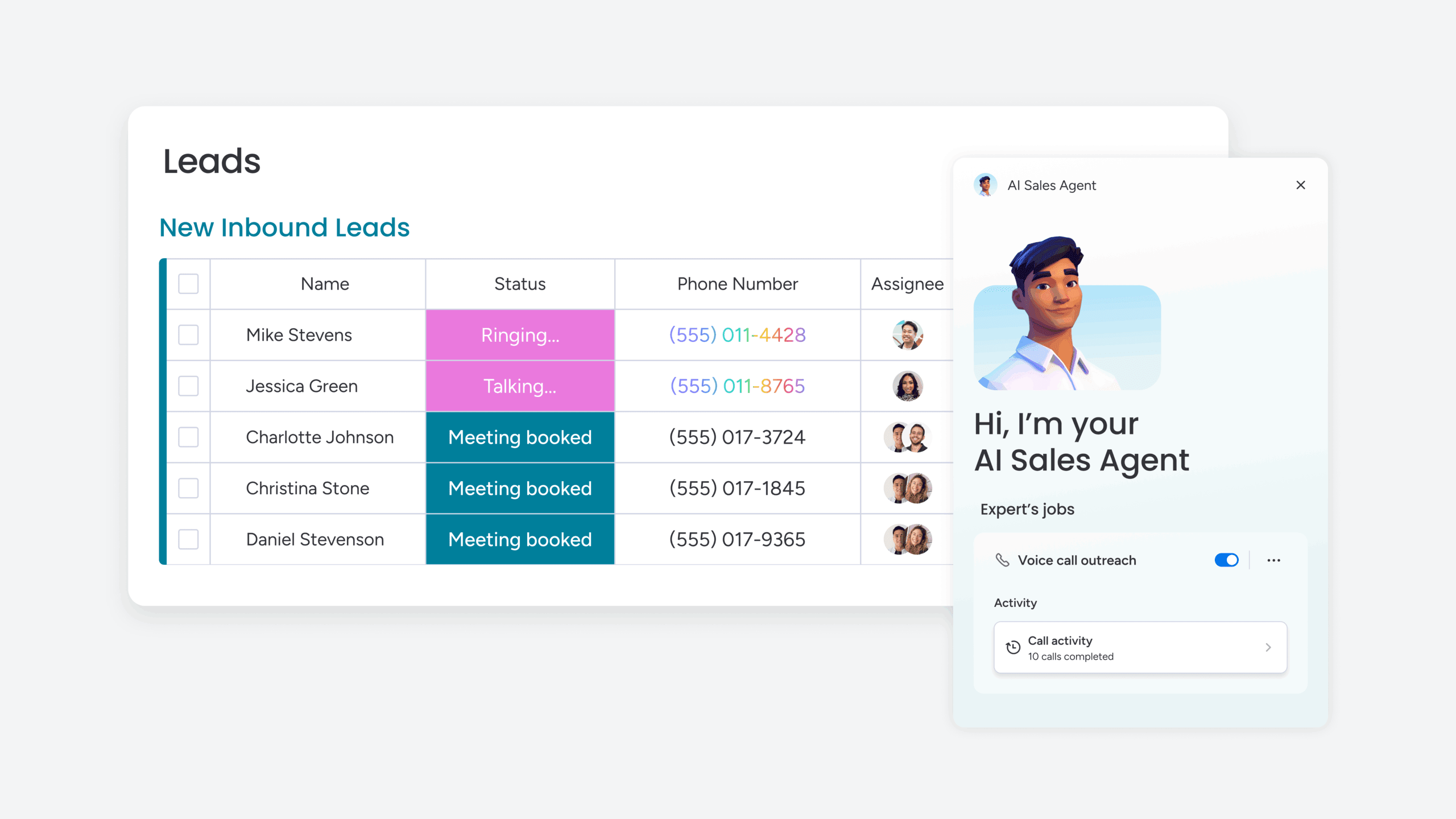
AI agents represent a fundamental shift from rigid automation to autonomous intelligence. While traditional systems follow fixed “if-then” rules, these agents analyze patterns and make judgment calls to achieve specific goals. By learning from every interaction, they operate with minimal oversight, evolving from simple tools into self-directed extensions of the sales team.
These intelligent assistants manage the full spectrum of sales activities by processing engagement signals and historical data. This constant analysis allows them to make contextual decisions, such as determining when a lead is truly qualified, without manual intervention.
For example, an agent can evaluate a prospect’s website activity and company profile to score their intent. It then identifies the optimal window for a follow-up based on timezone and historical response rates. If a prospect stops engaging, the agent detects the shift and automatically initiates a personalized re-engagement sequence.
By aggregating data from disparate sources simultaneously, these agents maintain a comprehensive view of every prospect. This level of granular, real-time tracking provides a scale of oversight that is physically impossible for human representatives to sustain manually.
Understanding AI agents vs chatbots and basic automation
The distinction is critical: AI agents analyze context and adapt their responses, while simple automation executes predetermined scripts. Analyzing it clarifies whether your systems possess the capacity for intelligent decision-making or are limited to executing fixed, pre-defined rules.
| Feature | Basic automation/chatbots | AI agents |
|---|---|---|
| Decision making | Rule-based responses following predetermined scripts | Adaptive learning enabling autonomous decisions based on context and historical patterns |
| Task complexity | Simple, predefined actions like sending scheduled emails | Multi-step workflows requiring judgment calls and complex problem-solving |
| Learning capability | Static programming requiring manual updates | Continuous improvement from interactions, outcomes, and changing conditions |
| Integration scope | Limited to specific functions within single platforms | Cross-platform workflow management connecting all sales activities |
While basic automation executes predetermined responses, AI agents evaluate multiple factors to choose the most effective action for each unique situation. Traditional chatbots answer FAQs, whereas AI agents manage entire deal cycles from qualification to close.
Key differences include:
- Intelligent decision-making: AI agents qualify leads, personalize outreach, and coordinate stakeholders.
- Risk identification: they spot potential deal obstacles before they derail opportunities.
- Contextual responses: every action considers the full prospect history and current situation.
Why do sales teams need AI agents now?
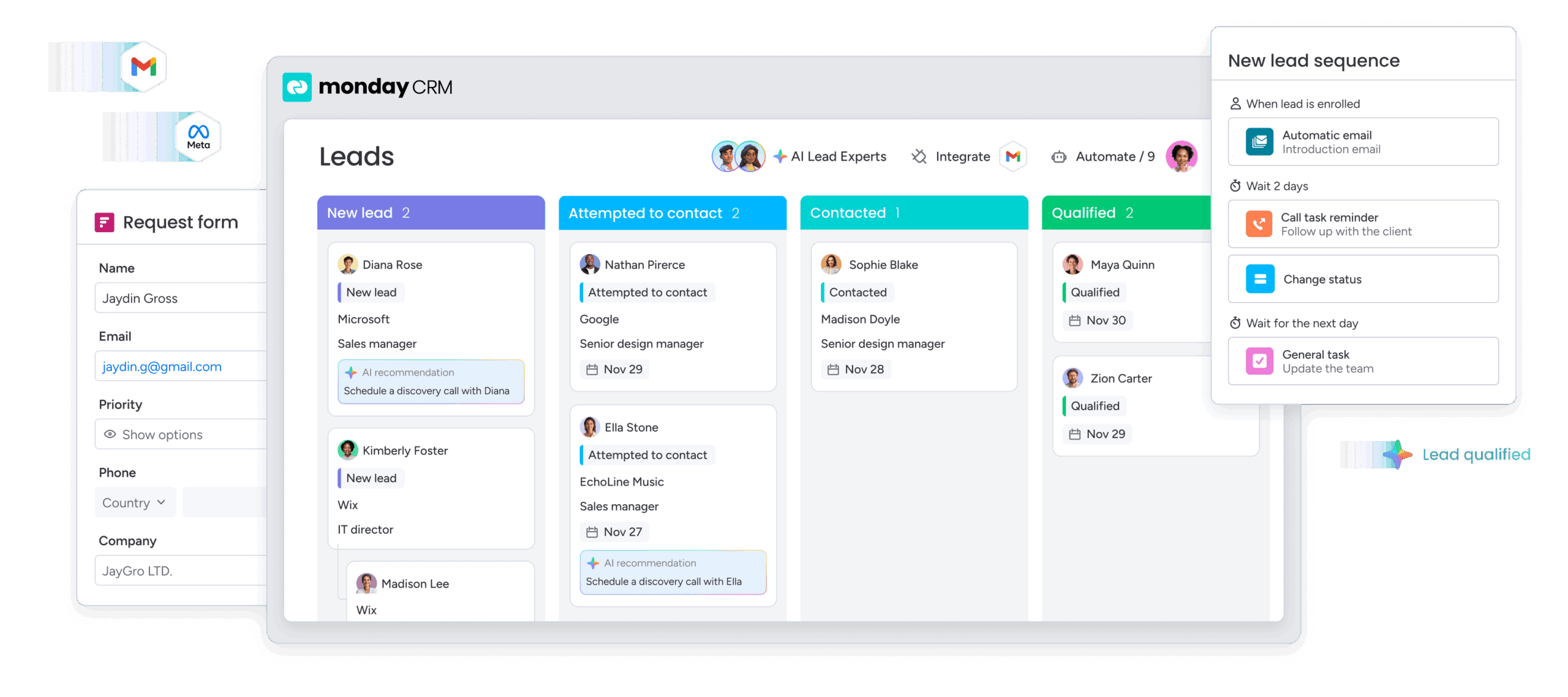
Three forces are hitting sales teams hard right now, colliding at once. Fragmented technology stacks create more work than they eliminate, buyers expect personalized experiences at every touchpoint, and administrative burdens prevent sales representatives from actually selling.
Most sales teams operate with five to ten disconnected platforms. Separate systems for CRM, email automation, meeting scheduling, proposal generation, contract management, and analytics each require their own login, interface, and data management approach.
As a result, sales representatives spend two to three hours daily switching between platforms, manually transferring information, and reconciling conflicting data across systems.
And the hidden costs add up fast:
- Context switching: sales reps waste time searching for prospect information before calls.
- Data inconsistency: deal information doesn’t sync automatically, making forecasts unreliable.
- Training overhead: each platform requires separate training, extending onboarding from days to weeks.
Rising buyer expectations and sales complexity
Buyers reach out everywhere: email, phone, video, social, in-person. They expect sales representatives to remember previous conversations, understand their specific challenges, and provide relevant information at exactly the right moment. To keep up, you’re tracking dozens of data points per prospect.
Consider what sales teams must manage for each prospect:
- Role and responsibilities: understanding their position and decision-making authority.
- Company priorities: knowing their strategic initiatives and budget cycles.
- Engagement history: tracking all previous interactions across channels.
- Content preferences: identifying which resources resonate most.
- Decision timeline: understanding their evaluation and purchase process.
A single enterprise deal might involve 8-12 stakeholders, each with different concerns and communication preferences. Without smart systems, personalizing at scale is just not possible.
The productivity crisis in sales
Sales representatives spend most of their time on administrative work rather than customer-facing activities, which is why the right sales enablement platform has become essential. They update CRM records, schedule meetings, draft follow-up emails, prepare proposals, generate reports, and coordinate with internal stakeholders.
Research shows that AI assistance can save knowledge workers an average of 56 minutes per working day, freeing up significant time for revenue-generating activities. The admin burden keeps growing because every new ‘efficiency’ process just adds more work.
Hiring additional representatives doesn’t address this fundamental challenge. It simply increases the number of people spending the majority of their time on activities that don’t directly generate revenue.
The solution lies in intelligent automation that manages administrative tasks independently, allowing your team to focus on work that requires human judgment and expertise.
One AI agent vs multiple sales platforms
More sales platforms often mean less productivity. Even though every new platform promises to help, it buries you in integration headaches, training time, and data management that kills the upside.
When you’re juggling disconnected platforms, four problems kill your effectiveness:
- Data silos: customer information fragments across platforms, with contact details in the CRM, communication history in email systems, meeting notes in separate apps, and deal documents in cloud storage.
- Manual data entry: representatives spend hours weekly copying information between systems, updating the CRM after calls, and manually generating reports from multiple sources.
- Training complexity: onboarding requires teaching five to ten different platforms, each with unique interfaces and workflows.
- Integration failures: platforms that don’t communicate effectively create gaps where information disappears or becomes outdated.
How do unified AI agents eliminate fragmentation?
One AI agent works across all sales functions at once pulling from every source without manual data entry. When a prospect opens an email, visits the pricing page, and schedules a demo, the AI agent sees these signals together and understands their combined meaning.
With everything in one place, you make more informed decisions at every stage:
- Complete prospect histories: sales representatives see full context before calls.
- Content resonance tracking: understanding which materials work with each stakeholder.
- Pattern recognition: identifying successful approaches across similar deals.
A unified data source ensures every opportunity is captured. When all prospect interactions flow through one system, nothing falls through the cracks. Follow-ups happen on schedule, stakeholder preferences get remembered, and deal risks surface before they become fatal problems.
Cost and efficiency comparison
The true cost of sales technology extends beyond subscription fees to include training time, integration maintenance, and productivity losses from system complexity.
| Approach | Monthly costs | Training time | Data management | Integration maintenance |
|---|---|---|---|---|
| Multiple platforms (5-7) | $200-500 per user | 15-20 hours per new hire | Manual synchronization across systems | Ongoing IT support required |
| Unified AI agent | $100-200 per user | 3-5 hours per new hire | Automatic data flow | Minimal maintenance |
Organizations typically pay for each specialized platform, quickly accumulating significant monthly costs. Unified platforms consolidate these capabilities at lower total cost while eliminating redundant features.
Each additional platform adds hours to onboarding timelines as new hires learn different interfaces and workflows. A unified platform reduces this to a single learning curve, getting representatives productive in days rather than weeks.
7 key benefits of using one AI agent for sales workflows
Unified AI agents improve every part of sales ops with measurable results. The benefits stack up as the AI learns what works and gets better at recommending next steps.
1. Reduce manual work by 40-50%
AI agents automate the repetitive work that consumes most of a sales representative’s day. They update CRM records after calls, score new leads based on fit and engagement, draft personalized emails, and generate progress reports.
Instead of spending hours daily on data entry and administrative activities, sales representatives redirect that time toward prospect conversations and strategic account planning. In documented implementations, AI agents have delivered 40% higher conversion rates when managing end-to-end sales workflows.
This extends beyond simple automation to intelligent decision-making:
- Smart scheduling: determines optimal timing based on prospect engagement patterns and response history.
- Personalized content: drafts emails based on prospect industry, role, and previous interactions.
- Contextual follow-ups: triggers appropriate next steps based on deal stage and prospect behavior.
2. Gain real-time visibility across all sales activities
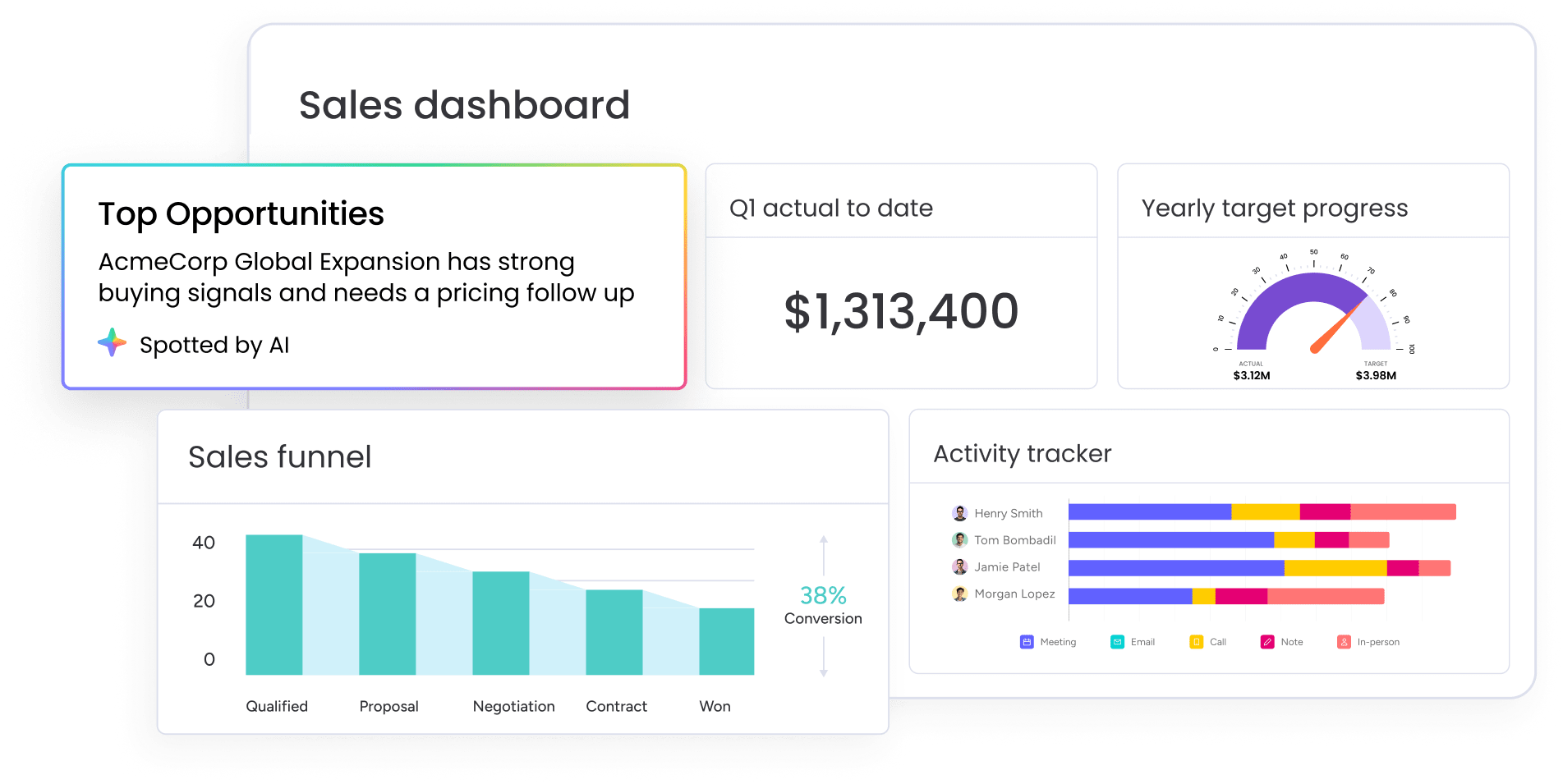
Sales leaders see which deals are progressing, which prospects have gone silent, and which representatives need support. Every interaction, document, and milestone appears in one view, updated in real-time as activities occur. With full visibility, sales managers spend their time differently:
- Proactive coaching: focus on team members and removing obstacles instead of gathering information.
- Early risk detection: identify problems immediately rather than during weekly pipeline reviews.
- Resource optimization: intervene before deals stall rather than after they’re lost.
3. Deploy faster without IT dependencies
Traditional sales platforms take months to set up. Configuring integrations, migrating data, customizing workflows, and testing functionality across multiple platforms adds complexity and extends timelines as IT teams manage dependencies and troubleshoot compatibility issues.
However, unified AI agents streamline this process dramatically. Most organizations complete full deployment within two to four weeks, including data migration, workflow configuration, and team training. Faster deployment means IT can focus on strategy instead of babysitting integrations.
4. Achieve higher team adoption through simplified interface
Most sales tech fails because reps don’t use it. Representatives revert to spreadsheets and email when platforms feel too complex or time-consuming. The problem gets worse when teams juggle multiple platforms, each with different interfaces and workflows.
A single, intuitive interface eliminates this adoption barrier:
- Unified learning: sales representatives learn one system that handles all their needs.
- Reduced cognitive load: no need to remember which platform handles which function.
- Mental energy optimization: more focus on strategic thinking and relationship-building.
5. Improve forecast accuracy with unified data
Forecasts built on partial data from multiple systems lack the accuracy needed for reliable planning. When deal information resides in the CRM, engagement signals exist in marketing automation, and communication history remains in email platforms, sales leaders must make educated guesses about which opportunities will close.
When all sales data consolidates in one place, forecasts become significantly more accurate. You gain clear visibility into deal status and progression. The AI agent analyzes historical data to identify which signals correlate with closed deals and which indicate risk, then applies these patterns to current opportunities.
6. Scale revenue without adding headcount
AI agents handle increased sales volume and complexity without requiring additional team members. As pipeline grows, the agent manages more leads, coordinates more follow-ups, and tracks more deals without degrading quality or response time. This scalability enables existing team members to manage larger territories or more prospects effectively.
This matters most when you’re growing fast and can’t hire quickly enough to handle the pipeline. Instead of letting leads go cold or deals slip through cracks, the AI agent ensures every opportunity receives appropriate attention.
7. Lower total cost of ownership
The savings go way beyond subscription costs. Organizations reduce training expenses, integration costs, and IT support requirements. These savings compound over time as teams grow.
Adding a new sales representative to a fragmented stack requires:
- Platform provisioning: access to multiple systems.
- Integration configuration: connecting various tools.
- Extensive training: learning five to ten different interfaces.
Adding someone to a unified platform takes hours instead of days.
How do AI agents transform sales workflows?
AI agents fundamentally transform sales operations by introducing intelligence and automation at every stage of the process. Rather than incremental improvements, this represents a comprehensive shift in how sales teams operate enabling them to manage increased complexity with reduced effort while maintaining personalized customer interactions.
From lead generation to deal closure
At every stage of the sales cycle, AI agents tackle the specific challenges that come up:
- Lead qualification: the agent automatically scores new leads based on demographic fit, behavioral signals, and similarity to previous successful deals.
- Initial outreach: rather than sending generic templates, the agent personalizes messaging based on prospect research and determines optimal channel and timing.
- Follow-up management: the agent identifies when prospects need follow-up based on engagement patterns and deal stage, then suggests appropriate content and approach.
- Deal progression: as opportunities advance, the agent identifies next steps required to move toward closure and flags potential obstacles.
- Closing support: during final negotiations, the agent manages contract generation, approval workflows, and stakeholder coordination.
Automated follow-ups and personalization at scale
AI agents maintain personalized communication with hundreds of prospects simultaneously by analyzing each prospect’s unique context and determining the most relevant message for their current situation.
The agent evaluates whether follow-up is appropriate based on recent engagement, adjusts messaging based on demonstrated interests, and varies the approach based on what’s working with similar prospects.
The automation helps human connection instead of replacing it:
- Strategic focus: sales representatives concentrate on high-value conversations and relationship-building.
- Routine automation: the agent handles follow-up and information sharing.
- Enhanced insights: surface data that helps representatives personalize their direct interactions.
Intelligent pipeline management and forecasting
AI agents analyze deal patterns across the entire pipeline to predict outcomes and identify at-risk opportunities with greater accuracy than manual review. The agent considers dozens of factors that influence deal success, including engagement frequency, stakeholder involvement, time in stage, competitive presence, and similarity to historical deals.
With these insights, sales managers use their resources smarter:
- Focused coaching: target opportunities where intervention will have the greatest impact.
- Skill development: identify which representatives need help with specific areas.
- Executive involvement: determine which deals require senior leadership attention.
- Resource prioritization: focus on higher-probability wins while deprioritizing lower-value opportunities.
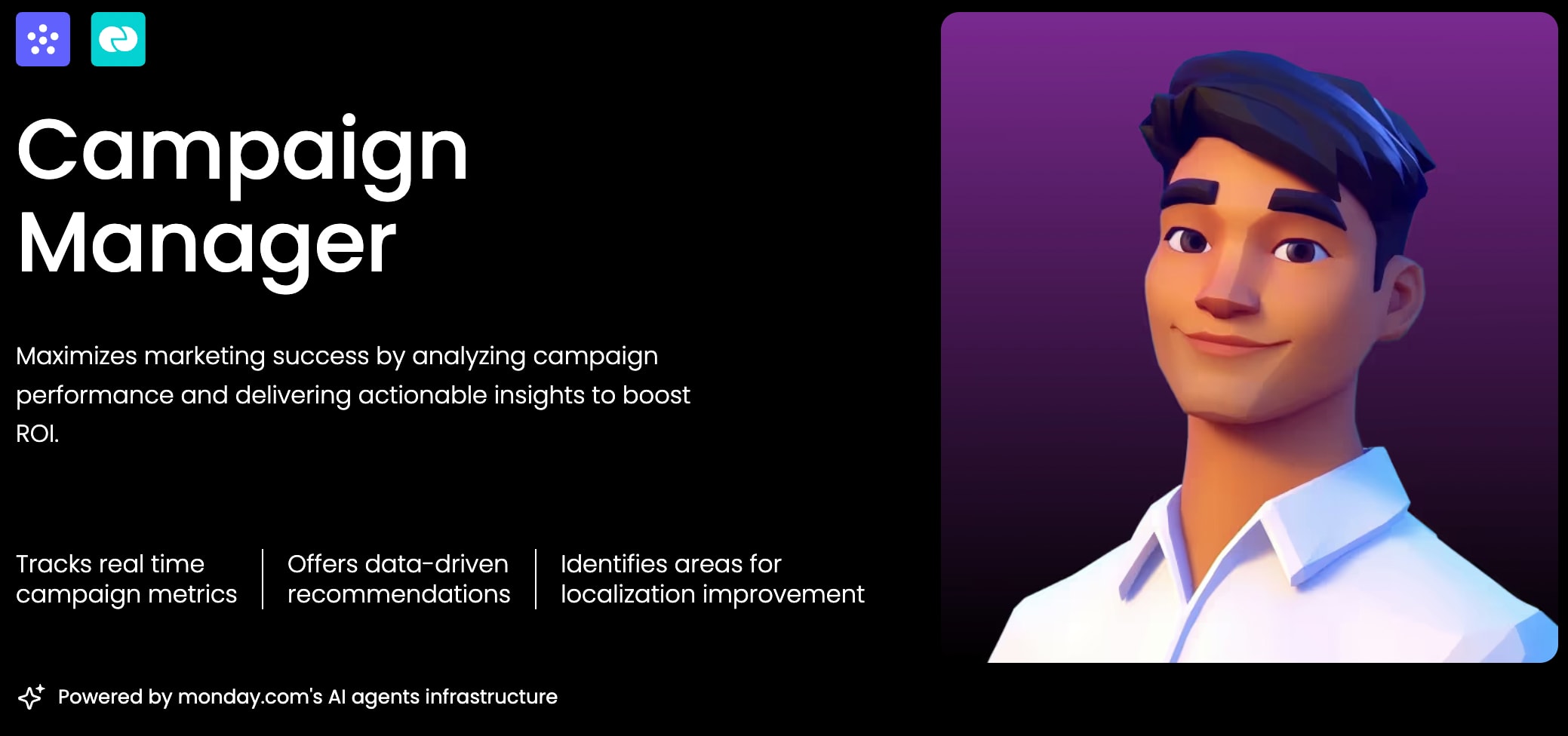
How does monday CRM power unified AI agents for sales?
With AI-powered sales capabilities in one intuitive platform, monday CRM brings visual workflows and smart automation together. Everything you need lives in one system: AI connects with deal tracking, communication, and reporting without the fragmentation.
AI blocks for instant sales intelligence
AI blocks in monday CRM enable sales teams to add intelligent capabilities to their workflows without technical expertise or coding knowledge. Think of them as plug-and-play AI tools you can drop into any workflow to automate tasks or get instant insights.
Key AI block capabilities include:
- Categorize: automatically sorts leads by priority, industry, deal size, or custom criteria.
- Extract info: scans documents and communications to identify important information like contact details, budget figures, and decision timelines.
- Summarize: condenses long email threads and complex documents into concise summaries highlighting key points.
- Detect sentiment: analyzes prospect communication tone to identify positive signals and negative indicators.
These AI blocks combine to build smart workflows that run complex sales processes on their own. Teams using monday CRM leverage these capabilities to eliminate manual data entry while ensuring complete prospect records and timely follow-ups.
Visual pipeline integration with AI capabilities
Visual project management blends with AI within monday CRM, so you see deal progression and insights in one place. The visual interface shows not just current deal status but AI-powered predictions about outcomes and recommendations for next steps.
Color-coding and visual indicators highlight:
- Deals requiring attention: opportunities that need immediate action.
- Progressing opportunities: deals moving smoothly through the pipeline.
- Risk indicators: situations requiring intervention before they become problems.
Build custom AI workflows without writing code
With monday CRM’s no-code builder, sales teams customize automation without waiting on IT. The visual workflow builder enables users to create sophisticated AI-powered processes by connecting blocks and defining logic through an intuitive interface.
The AI adapts to your team’s workflow, so you don’t have to change how you work to fit the tech. Organizations can create workflows for their unique sales motions, whether complex enterprise deals with multiple stakeholders, high-velocity transactional sales, or specialized industry processes.
Why do unified AI agents win over fragmented sales stacks?
Fragmented technology stacks do more than consume time; they undermine organizational predictability. By consolidating sales activity into a single AI agent, leadership gains immediate visibility, administrative burdens on representatives are reduced, and forecasts achieve a new level of reliability. This integration is no longer a luxury; it is a critical competitive advantage.
Transitioning from disparate platforms to a unified AI agent represents a fundamental evolution in revenue operations. This shift enables teams to scale efficiently while maintaining personalized engagement. The primary benefit is a redirection of effort: representatives focus on high-value strategic work rather than manual data entry.
Furthermore, this consolidation allows managers to base decisions on comprehensive datasets rather than isolated snapshots. Consequently, forecasts serve as dependable guides for strategic planning rather than speculative estimates. These advantages compound over time as the AI agent identifies successful patterns and refines its recommendations.
Organizations utilizing unified AI agents are positioned to manage increasing complexity without expanding headcount or software overhead. Simplified technology stacks consistently outperform bloated ones, allowing teams to adapt more rapidly to market changes.
If an organization is currently managing excessive platforms or facing inaccurate forecasting, consolidating the tech stack is a necessary step toward achieving predictable growth and operational confidence.

“With monday CRM, we’re finally able to adapt the platform to our needs — not the other way around. It gives us the flexibility to work smarter, cut costs, save time, and scale with confidence.”
Samuel Lobao | Contract Administrator & Special Projects, Strategix
“Now we have a lot less data, but it’s quality data. That change allows us to use AI confidently, without second-guessing the outputs.”
Elizabeth Gerbel | CEO
“Without monday CRM, we’d be chasing updates and fixing errors. Now we’re focused on growing the program — not just keeping up with it."
Quentin Williams | Head of Dropship, Freedom Furniture
“There’s probably about a 70% increase in efficiency in regards to the admin tasks that were removed and automated, which is a huge win for us.“
Kyle Dorman | Department Manager - Operations, Ray White
"monday CRM helps us make sure the right people have immediate visibility into the information they need so we're not wasting time."
Luca Pope | Global Client Solutions Manager at Black Mountain
“In a couple of weeks, all of the team members were using monday CRM fully. The automations and the many integrations, make monday CRM the best CRM in the market right now.”
Nuno Godinho | CIO at VelvFrequently asked questions
How does one AI agent handle complex multi-step workflows?
AI agents handle multi-step workflows by understanding context and how each step connects. They know when to wait for one step to finish before starting the next and they learn from what works to get better.
What's the learning curve for sales teams using AI agents?
Unified AI agents take three to five hours to learn vs. 15-20 hours for traditional multi-platform setups. Natural language interfaces make it easier for non-technical users to get started.
Can AI agents integrate with existing CRM systems?
Most AI agents connect to existing systems through APIs and built-in integrations, so data flows between platforms. Unified platforms often provide smoother integration experiences than point solutions.
How do AI agents ensure data security and compliance?
Enterprise AI agents come with encryption, access controls, role-based permissions, and compliance built in. Unified platforms provide consistent governance policies across all sales activities.
What's the typical ROI timeline for AI agent implementation?
Most teams see productivity gains within four to six weeks of going live. Full ROI usually hits within three to six months as teams dial in workflows and see the full impact.
How much does implementing one AI agent cost compared to multiple platforms?
Unified AI agents typically cost 30-50% less than maintaining multiple specialized platforms when factoring in licensing fees, integration costs, training expenses, and ongoing IT maintenance.

 Get started