


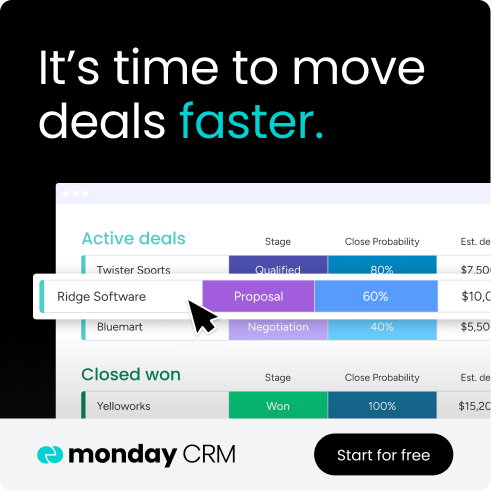
Your clients trust you with their biggest risks. Their homes, their businesses, their families. But when renewal dates slip through the cracks, or a cross-sell opportunity gets buried in a spreadsheet, that trust takes a hit. Most CRMs weren’t built for insurance. They don’t understand policy lifecycles, multi-carrier relationships, or the compliance requirements that keep you up at night. An insurance agent CRM changes that equation. It’s a platform designed for how agencies actually work, where a single client might have five policies across three carriers, and every touchpoint matters.
This guide breaks down what separates a true insurance CRM from generic sales platforms. We’ll compare the top five options for agencies in 2025 and walk through the features that actually move the needle on retention and revenue. You’ll see how platforms like monday CRM help agencies automate the busywork and keep client relationships front and center.
Try monday CRMWhat insurance agents really need in a CRM platform
Generic CRMs just don’t get insurance. They weren’t built for the chaos of juggling hundreds of clients, multiple policy types, and renewal dates that stretch for years. A standard contact list simply wasn’t designed for that kind of complexity.
Your world isn’t a neat sales funnel; it’s a web of long-term relationships, strict compliance rules, and dozens of different carrier portals. Without a system built for this reality, your team gets stuck doing manual data entry. That’s a sales drag that kills momentum. You need a platform that works for your agency, not the other way around.
Revenue teams find success using monday CRM to build workflows that fit their exact process.
This allows them to automate routine tasks and keep compliance visible, all without needing a technical team to make it happen.
Insurance CRM vs agency management system
Here’s the thing: knowing which system does what keeps your team from wasting time in the wrong platform. Use the wrong one for the wrong job, and you’ll end up with messy data and a team that can’t move fast.
Your CRM is your growth engine. It’s the front-office tool for attracting prospects, managing your pipeline, and building relationships that last. An agency management system (AMS) is your admin workhorse; it handles back-office processes like policy administration, claims, and commissions for the business you’ve already won.
Here’s a simple breakdown of what each platform handles.
| Function type | CRM handles | AMS handles |
|---|---|---|
| Client acquisition | Lead tracking, pipeline management, quote follow-up | Policy binding, premium calculations |
| Communication | Marketing campaigns, renewal reminders, relationship building | Carrier communications, policy documents, claims notices |
| Sales process | Opportunity tracking, cross-sell identification, proposal management | Policy issuance, endorsements, cancellations |
| Reporting | Sales metrics, pipeline forecasts, agent performance | Commission tracking, loss ratios, policy counts |
| Data focus | Prospect and client relationship data | Policy details, coverage specifics, carrier information |
The best agencies make both platforms work together. Instead of agents toggling between systems and duplicating data, a connected setup gives you one source of truth. Teams discover that monday CRM enables them to sync with their existing AMS, keeping sales and service perfectly aligned. You get a full picture of your business, without the headache.
5 best CRM platforms for insurance agencies
A great CRM gives you a comprehensive view of your entire sales cycle. We compared the top options for insurance teams based on speed, customization, and features that actually get the job done.
The table below gives you a quick breakdown of the top platforms, but for a more detailed overview, keep reading.
| Platform | Use case | Key insurance features | Starting price | Notable limitations |
|---|---|---|---|---|
| monday CRM | Agencies prioritizing fast implementation and customization | AI-powered automation, no-code workflows, visual pipeline management, mobile access, flexible integrations | Starts at $12/user/month | Requires initial workflow configuration |
| Decerto Agent Portal | Agencies needing pre-built insurance templates | Policy tracking, renewal management, carrier-specific workflows | Custom pricing | Limited customization, dated interface |
| Applied Epic | Large enterprises with technical resources | Comprehensive feature set, extensive carrier integrations, advanced reporting | $150+/user/month | Complex implementation, steep learning curve |
| AgencyBloc | Mid-market agencies focused on life and health | Commission tracking, policy management, basic automation | $50/user/month | Limited AI capabilities, rigid workflows |
| Vertafore AMS360 | Agencies needing combined AMS/CRM | Policy administration, accounting integration, carrier connectivity | $100+/user/month | Stronger on AMS than CRM functionality |
1. monday CRM
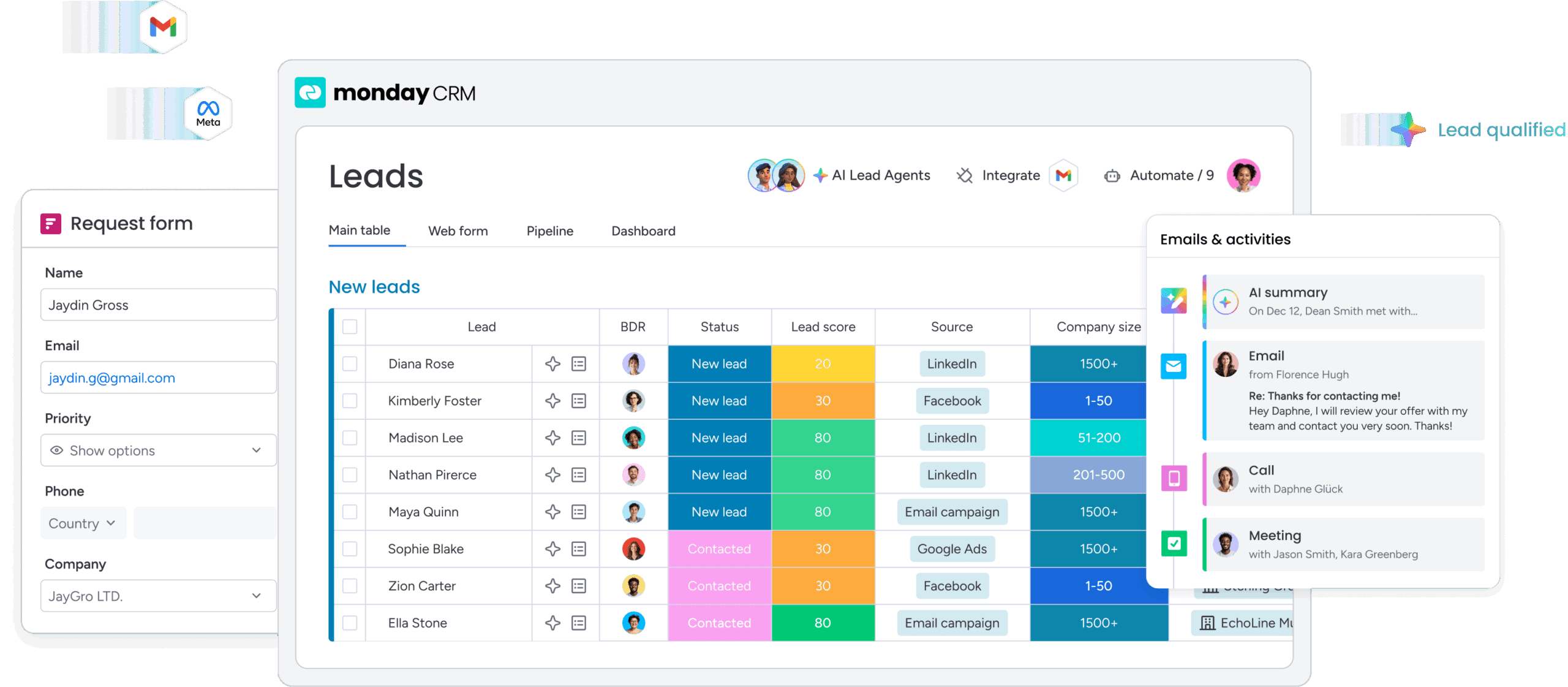
monday CRM helps insurance agencies manage the full client journey in one place, from first inquiry to renewal. You get a flexible CRM your team can configure without heavy technical work, plus AI capabilities (available on Standard, Pro, and Enterprise plans when an admin enables them) to cut down the manual work that slows agents down.
Example:
Insurance agencies use monday CRM to keep every client interaction and document tied to the right account, while automations and AI handle the busywork. Think: renewals that stay on schedule, handoffs that don’t drop details, and cross-sell outreach that’s based on real context, not gut feel.
Key features:
- Emails & Activities + AI Timeline Summary: Log and track interactions in one timeline, then generate a short summary of emails, calls, meetings, and notes for fast account review
- Autofill with AI (AI actions): Auto-populate columns using actions like Extract information, Detect sentiment, Assign label, and Assign person (with starred actions able to use data from Emails & Activities)
- Account and contact management: See relevant account and contact details in an expanded item view, including connected deals, accounts, contacts, and related work
- Deal management: Run a visual pipeline, customize deal stages with drag-and-drop, and automate actions based on your own conditions
- Dashboards and sales analytics: Track pipeline status, forecasting, activity, and team performance with code-free dashboards, including sales-focused widgets like the leaderboard and funnel
Pricing:
- Basic: $15/month per user (annual billing)
- Standard: $17/month per user (annual billing)
- Pro: $28/month per user (annual billing)
- Enterprise: Contact sales for custom pricing
- Annual billing saves 18% compared to monthly plans
- Minimum 3 seats required for all paid plans
Why it stands out:
- Your agency can adapt the CRM to your process: monday CRM is built for revenue teams who need to adjust fields, stages, and workflows as the business changes
- Communication stays centralized: Team members can log emails, meetings, and notes in a single timeline, so service and sales stay aligned
- AI that’s practical, not performative: Summarize long histories, extract data from files, and classify text without rebuilding your process
- Dedicated mobile experience: Agents can keep work moving while they’re in the field
Advanced AI features:
- AI email assistant in Emails & Activities: Draft outreach like renewal reminders or coverage check-ins based on the context in your timeline, then edit and send
- AI Timeline Summary: Get a quick read on the full communication history before a renewal call or a claims-related follow-up
- Autofill with AI actions:
- Detect sentiment: Categorize text as Positive, Negative, or Neutral to spot relationships that need attention
- Extract information: Pull structured details from files like
.pdf,.docx, and.xlsx, plus images like.pngand.jpg, and write the results into your columns - Assign person: Route new leads or renewal work by letting AI assign the right agent to a People column, based on a defined source and role descriptions
Automations:
With monday CRM, agencies can automate the repeatable steps that drag down selling and service. The point is simple: the platform follows your rules so agents can stay focused on clients.
- Renewal follow-up workflows: Automatically create renewal activities and keep every step tied to the account record
- Sales stage automation: Trigger actions when a deal stage changes, so handoffs and internal follow-ups happen on time
- Email follow-ups: Automate follow-up sequences after outreach, and keep the engagement tracked
Integrations:
If you’re tired of jumping between systems, this is where monday CRM earns its keep. You can connect lead sources, communication, and reporting workflows so your data doesn’t live in pockets.
- Lead management inputs: Collect leads from website forms, social ad campaigns, or other sources
- Data enrichment: Auto-enrich lead data using external database
- Centralized outreach: Send individual and mass emails using dynamic fields and templates, then track performance
Insurance agent CRM features:
Insurance teams use monday CRM as a CRM+ setup, because selling and service rarely live in separate worlds. You can keep policies, renewals, and account work connected to the same client record.
- Mass email and tracking: Send individual and mass emails with templates and dynamic fields, then track metrics like open rates and link clicks
- Visual pipeline visibility: Use a pipeline view to see where deals stand, spot bottlenecks, and adjust fast
- Post-sales workflows: Track onboarding progress and manage renewals from the same platform that manages your pipeline
2. Decerto Agent Portal
Decerto Agent Portal delivers insurance-specific CRM functionality built for agencies that need to hit the ground running. The platform specializes in pre-configured workflows for policy tracking, renewals, and multi-carrier operations, making it ideal for small to mid-sized agencies with standard processes.

Use case:
Perfect for agencies that want insurance-specific features without months of customization work.
Key features:
- Pre-built templates for common agency workflows including policy tracking and renewal management
- Multi-carrier support with single login access for quoting, selling, and servicing
- Real-time dashboards and commission transparency down to the policy level
Pricing:
- Custom pricing: Contact sales for quote based on agency size and feature requirements
- Implementation typically takes 4-8 weeks for setup and data migration
Considerations:
- Limited customization options may restrict agencies with unique processes or specialized integration needs
- The interface lacks the intuitive design found in newer platforms.
3. Applied Epic
Applied Epic delivers comprehensive agency management with embedded CRM capabilities for large insurance organizations. The platform consolidates sales automation, policy management, and carrier connectivity in one system, making it the go-to choice for enterprise agencies with complex operational requirements.

Use case:
Applied Epic serves enterprise insurance organizations with 50+ employees who need sophisticated reporting, extensive carrier integrations, and dedicated technical resources to manage implementation and ongoing administration.
Key features:
- Native sales automation with role-based dashboards, pipeline forecasting, and opportunity management integrated directly into the agency management system
- Comprehensive carrier connectivity with hundreds of insurance company integrations for seamless quoting and binding workflows
- Advanced analytics through Epic Dashboards with embedded reporting capabilities and AI-powered features like Book Builder for commercial risk enrichment
Pricing:
- Contact for quote: Pricing starts around $150 per user per month
- Implementation costs: Expect 6-12 months implementation timeline with substantial consulting fees
- Total cost of ownership: Often reaches six figures for mid-sized agencies including training and ongoing support
Considerations:
- The steep learning curve requires extensive training for team members to become proficient with the comprehensive feature set.
- Complex implementation process with significant upfront investment in time and resources before seeing full value
4. AgencyBloc
AgencyBloc is an agency management system built from the ground up for life, health, benefits, and senior market insurance agencies. The platform combines CRM functionality with commission tracking and policy management, making it a go-to for agencies that have outgrown generic sales platforms.

Use case:
Perfect for established agencies (10-50 employees) focused on life and health products that need to nail commission processing and compliance without the clunky workarounds.
Key features:
- Native VoIP system with automatic call recording and compliance message capabilities
- Sophisticated commission tracking with hierarchical splits, overrides, and bonus calculations
- Pre-configured compliance workflows for Medicare SOA, ACA consent forms, and attestations
Pricing:
- Official pricing is quote-based, but reports suggest a starting point of around $50 per user per month.
- Volume-based packages for Commissions+ and Quote+ modules.
- Heads up: insurance agency websites and some third-party integrations cost extra.
Considerations:
- It’s laser-focused on life, health, benefits, and senior markets — this isn’t the tool for P&C agencies.
- You won’t find a public pricing page. While estimates exist, you’ll need to get a custom quote for exact numbers.
5. Vertafore AMS360
Vertafore AMS360 combines agency management with CRM capabilities, serving as the backbone for established insurance agencies. The platform excels at policy administration and carrier connectivity while offering foundational CRM features through native tools and strategic integrations. You can use their built-in CRM tools or connect something else without ripping out your entire system.

Use case:
Perfect for established agencies with mature books of business that prioritize comprehensive policy administration alongside relationship management capabilities.
Key features:
- Policy administration and accounting: Handles complex commercial and personal lines with integrated premium financing, commission tracking, and financial reporting.
- Activity and suspense management: Configurable action types with automatic checkpoints and permanent activity history for E&O defense.
- Flexible CRM pathways: Choose between embedded tools (target lists, email campaigns, proposal builder) or deep integrations with AgencyZoom and Salesforce.
Pricing:
- Custom pricing available through sales consultation.
- Additional licensing required for InsurLink portal, custom data export, and batch suspense utilities.
- AgencyZoom offers a 20% discount for SIAA members on new accounts.
Considerations:
- Advanced CRM features require third-party integrations or add-ons, increasing complexity and potential costs.
- Email campaigns rely on Microsoft Word mail-merge functionality rather than modern email builders found in dedicated CRM platforms.
Must-have insurance CRM features that drive results
The right features turn your CRM from a glorified contact list into something that actually closes deals. Find a platform that gets how insurance actually works: long sales cycles, strict compliance, and clients who stick around for years.
Automated renewal management

Renewals should be your easiest revenue stream. The right automations turn that chaos into a predictable, revenue-generating machine.
- Automated reminders: Set up renewal alerts at 90, 60, and 30 days so your agents focus on conversations, not follow-ups.
- Churn prediction: AI spots clients likely to shop around based on their history and engagement patterns.
- Coverage gap detection: Automatically identify upgrade opportunities and turn every renewal into a chance to increase policy size.
Policy cross-selling intelligence
The most profitable clients hold multiple policies. Smart cross-selling intelligence does the work for you.
- Life event triggers: AI flags major life changes like new homes, businesses, or drivers to surface timely opportunities.
- Coverage analysis: Compare client policies against similar profiles to identify underinsured areas.
- Product recommendations: AI predicts which products each client is most likely to buy next based on their profile and behavior.
Built-in compliance tracking
Getting compliance wrong is expensive and risky. A good CRM makes it almost impossible to mess up.
- Automatic activity logging: Every email, call, and text is captured automatically for complete E&O audit trails.
- Workflow checkpoints: Build compliance checks directly into your sales process so deals can’t advance until requirements are met.
- License management: Track agent licenses and continuing education credits with automatic expiration alerts.
Mobile access for field agents
An agent in the field without the right info is just an agent who has to say, “I’ll get back to you.” That hesitation kills deals.
- Complete client history: Access full client records, policies, and notes during meetings without returning to the office.
- Real-time updates: Log notes and update deal stages from your phone so the whole team stays in sync.
- Document sharing: Send proposals and policy documents directly from your device to close deals on the spot.
Carrier system integration
Your agents work with a dozen different carrier systems. Stop wasting time copying and pasting the same information.
- Single data entry: Connect your CRM to carrier systems so client information flows automatically across platforms.
- Multi-carrier quoting: Pull quotes from multiple carriers without leaving your CRM to find the best option in seconds.
- Automatic sync: Policy changes in carrier portals update in your CRM automatically, keeping your data current with zero manual work.
Selecting CRM software by insurance agency type
A solo agent needs something totally different than a 50-person brokerage. Size and growth stage change everything. Pick the right platform for where you are now and where you’re headed. It’ll save you from an expensive switch later.
| Agency type | Independent agents & small brokerages | Growing multi-line agencies | Large insurance organizations |
|---|---|---|---|
| Primary challenge | Need fast setup and immediate results without months of configuration | Scaling quickly while existing processes and workarounds break down | Meeting enterprise security, compliance, and integration requirements |
| Key priorities | Quick wins in week one No-code DIY setup Affordable pricing that scales Intuitive workflows | Easy customization without consultants Unified client view across teams Automated routine tasks Real-time pipeline visibility | Handle thousands of clients and users Advanced security and permissions Deep integrations with existing tools Multi-dimensional performance analytics |
| Best approach | Visual, no-code platform that delivers value immediately and scales as you grow | Flexible Work OS that evolves from simple contact management to advanced automation | Enterprise-grade platform with intuitive interface that drives adoption at scale |
Matching the tool to your specific stage of growth ensures high adoption rates and a faster return on investment.
5 steps to fast CRM implementation
Rolling out a new CRM doesn’t have to shut down your agency for months. Take it step by step, and your team can keep selling while you build out the new system.
Step 1: Audit your current data
Dirty data in means dirty data out. Importing a mess just creates a bigger, more expensive mess later. That spreadsheet swamp isn’t going to organize itself.
Round up every client list, from email databases to those sticky notes on your top agent’s monitor. Hunt down duplicates, fix bad formatting, and get your data clean before it goes anywhere. Focus on active clients and hot prospects to make the biggest impact fast.
Step 2: Map your insurance workflows
Your CRM should mirror how your best agents already operate. Forcing your team into a rigid structure designed for someone else’s business creates friction and kills adoption.
Document your actual process from start to finish. What qualifies a lead? How do deals progress from first contact to signed policy? Capturing what already works becomes the blueprint for a CRM that accelerates your team instead of slowing them down.
Step 3: Configure core features first
Complexity is the enemy of adoption. Activating every feature on day one overwhelms users and guarantees low engagement. Deliver quick wins instead.
Launch with the essentials: contact management and pipeline tracking. Layer in a few high-impact automations (new lead alerts, renewal reminders) and build from there. monday CRM makes it easy to create simple dashboards that demonstrate immediate value, getting everyone on board without the overwhelming learning curve.
Step 4: Train your champions
Real adoption spreads peer-to-peer, not top-down. Mandates from leadership rarely stick. What works is finding the respected agents who embrace new tools and can bring others along.
Give them early access and involve them in building the workflows. When your best people advocate for a new way of working, the rest of the team listens. That organic buy-in beats any company-wide mandate.
Step 5: Scale gradually
Prove the concept before expanding. Roll out the CRM to a pilot group of 5-10 users and refine based on their feedback before going team-wide. This builds momentum and ensures the system works for the people who use it every day.
Master the basics first. Once your team consistently uses contact and pipeline management, then introduce more advanced automations and AI features. monday CRM’s flexibility supports this incremental growth (you only pay for what you use, when you need it).
How monday CRM accelerates insurance agency growth
The agencies winning right now? They move fast and adjust on the fly. monday CRM keeps up with how fast your agency changes, without the baggage that slows other platforms down. You get AI that works out of the box, no-code customization that adapts to your process, and a complete Work OS that runs your entire operation. This isn’t just another CRM. It’s a platform built for insurance teams that need to scale without the friction.
AI that handles the busywork
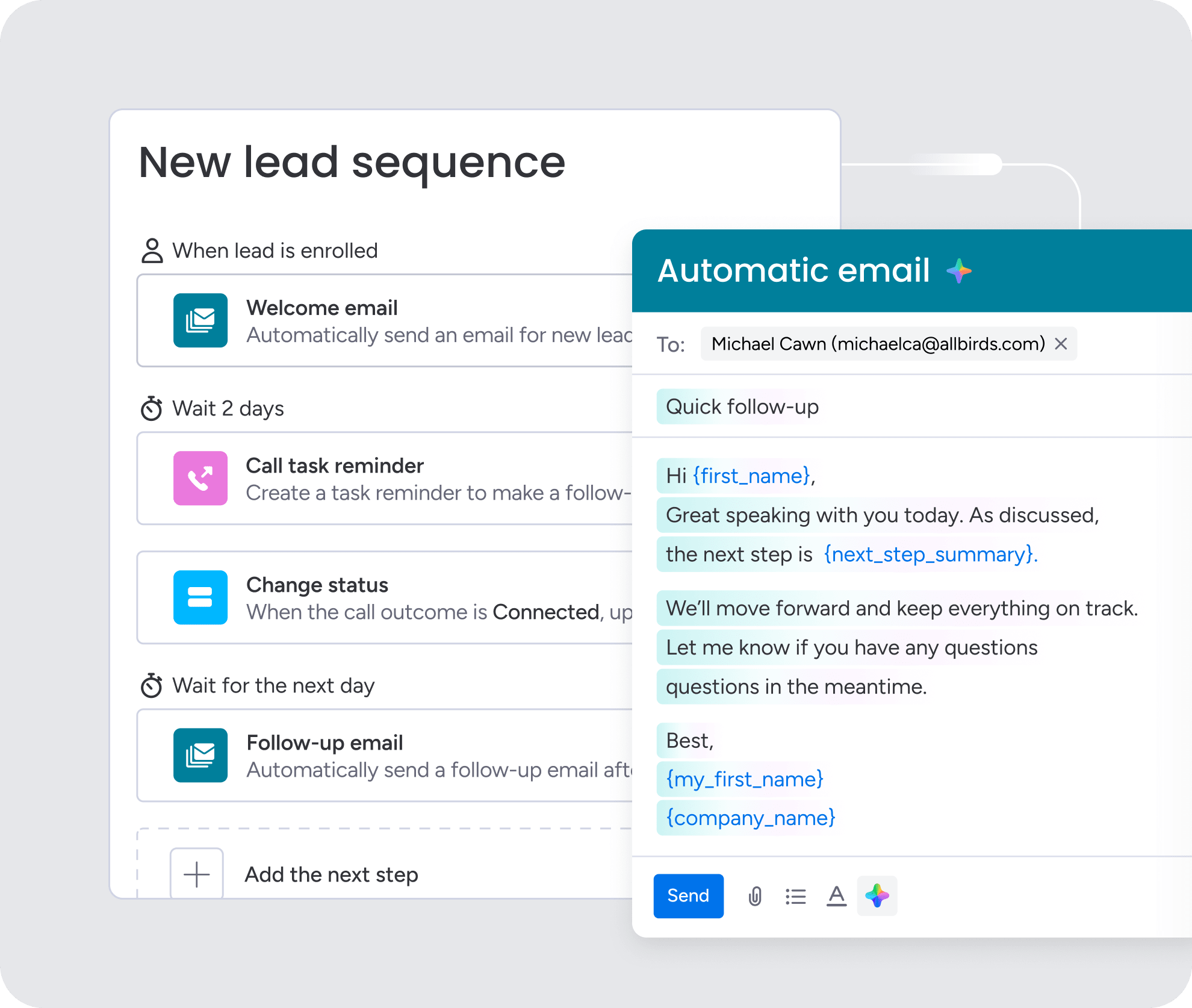
monday CRM’s AI features tackle the repetitive tasks that eat up your agents’ week, freeing them to focus on building relationships and closing deals. No training data, no complex setup. Just results.
- AI Timeline Summary: Summarizes emails, calls, meetings, and notes so your agents walk into every conversation prepared.
- AI email assistant: Drafts renewal reminders and coverage check-ins based on timeline context, cutting email time in half.
- Extract information: Pulls key details from PDFs, Word docs, Excel files, and images straight into the CRM.
- Detect sentiment: Categorizes text as Positive, Negative, or Neutral so you know when clients are shopping around.
- Assign person: Routes new leads to the right agent based on insurance type, urgency, and value.
- Autofill with AI actions: Auto-populates columns using actions that extract data, detect sentiment, assign labels, and route work.
No-code platform built for revenue teams

Your agency, your rules. monday CRM lets you build the exact workflows you need without writing a single line of code or waiting on IT. The visual builder lets you create custom sales pipelines with insurance-specific stages in minutes.
Create sophisticated automations with simple if-this-then-that logic. When a policy enters the renewal window, the system can automatically create a task, email the client, and notify a manager. It’s powerful logic, made simple.
Rigid data models kill momentum. monday CRM lets you track what actually matters to your business, whether that’s carrier appointments, licensing details, or any other data point. When your process changes, your platform changes with you, instantly.
Complete Work OS beyond just CRM
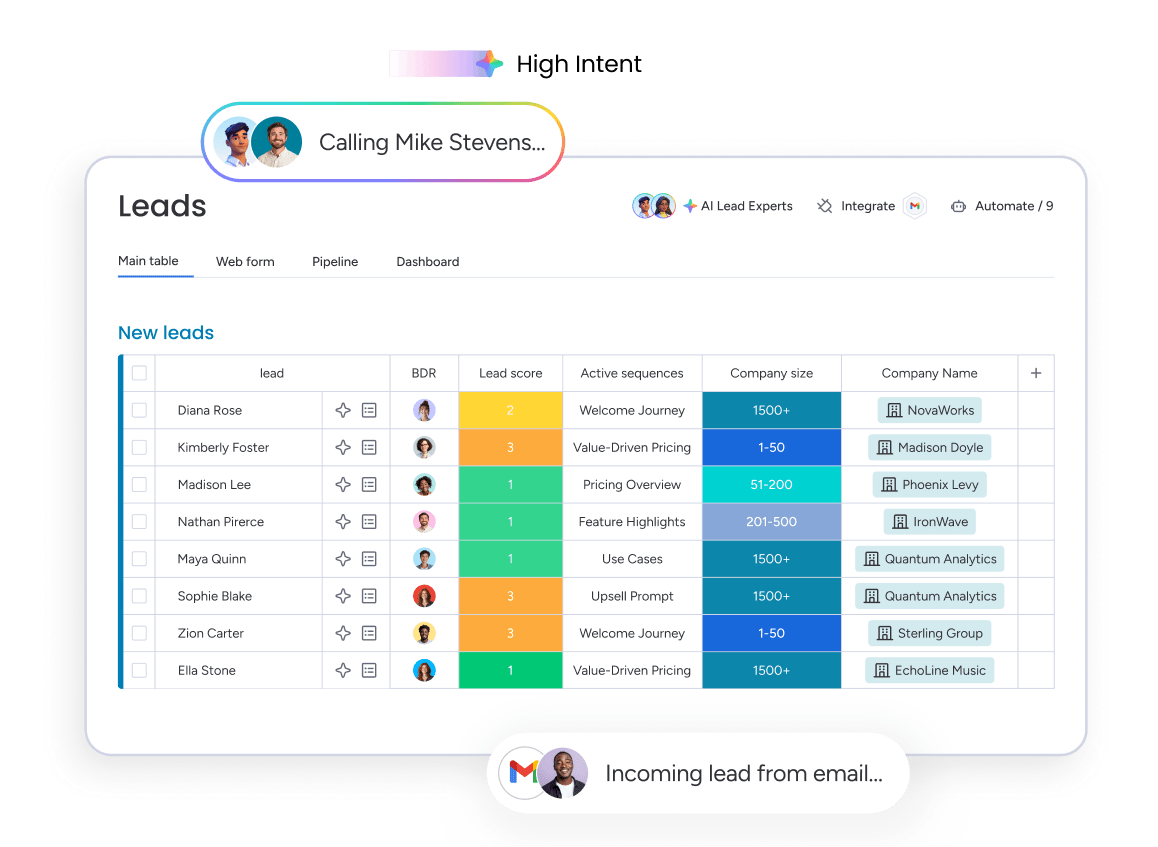
Tired of juggling a dozen different apps? monday CRM is part of a Work OS that runs your entire agency, not just your client list. Marketing campaigns, team projects, and HR onboarding all live in the same place, ending the chaos of disconnected platforms.
This means you get a single platform that grows with your business, not just another CRM that limits how you work.
Fast, flexible, and smart. That’s how you get ahead instead of just keeping pace.

“With monday CRM, we’re finally able to adapt the platform to our needs — not the other way around. It gives us the flexibility to work smarter, cut costs, save time, and scale with confidence.”
Samuel Lobao | Contract Administrator & Special Projects, Strategix
“Now we have a lot less data, but it’s quality data. That change allows us to use AI confidently, without second-guessing the outputs.”
Elizabeth Gerbel | CEO
“Without monday CRM, we’d be chasing updates and fixing errors. Now we’re focused on growing the program — not just keeping up with it."
Quentin Williams | Head of Dropship, Freedom Furniture
“There’s probably about a 70% increase in efficiency in regards to the admin tasks that were removed and automated, which is a huge win for us.“
Kyle Dorman | Department Manager - Operations, Ray White
"monday CRM helps us make sure the right people have immediate visibility into the information they need so we're not wasting time."
Luca Pope | Global Client Solutions Manager at Black Mountain
“In a couple of weeks, all of the team members were using monday CRM fully. The automations and the many integrations, make monday CRM the best CRM in the market right now.”
Nuno Godinho | CIO at Velv
“monday.com provides developmental flexibility, operational efficiency, and data transparency — all in one place. We became a company that moved from chasing data to leading with it.”
Hyunghan Lee | Team Lead, Sandbox Network
"monday.com brought every part of our business into one connected space. The harmony between work management and CRM has become our operating system — giving us the clarity and confidence to scale.”
Jennifer Chinburg | Executive Vice President of Corporate Development & Brand, Chinburg Properties
“We just weren’t getting value from our old CRM. With monday.com, it's a thousand times better. Our sales teams are more informed, more consistent, and far more connected."
James Arnold | Chief Operating Officer, CenversaBuild a predictable revenue engine
Generic CRMs don’t get the insurance world. They can’t handle complex policy relationships or multi-year renewals, leaving your team tangled in workarounds. You need a platform that speaks your language from day one. A clunky system slows everyone down and makes hitting targets feel like guesswork.
monday CRM automates the busywork and centralizes communication, from client intake to policy renewal. Finally, your agents can focus on selling, not on data entry. This isn’t just about efficiency. It’s about predictability. When all your pipeline data lives in one place, you can forecast what’s coming and make calls with confidence.
Try monday CRMFAQs
What is the difference between insurance CRM and a regular CRM?
The difference between an insurance CRM and a regular CRM is that an insurance CRM includes industry-specific tools for policy tracking, renewals, and compliance that regular CRMs lack. It's built for the unique lifecycle of insurance, not just a standard sales pipeline.
How much does insurance CRM software cost including hidden expenses?
Insurance CRM software costs range from $12 to over $150 per user monthly. Hidden expenses like implementation, data migration, and custom integrations can significantly increase the total cost.
Can insurance agents use CRM without an agency management system?
Yes, smaller agencies can use a CRM without an agency management system (AMS), but growing agencies often need both. A CRM drives sales and relationships, while an AMS handles policy administration and commissions.
Which CRM platforms integrate with insurance carrier systems?
The most effective CRM platforms use flexible APIs and webhooks to connect with any carrier system. monday CRM excels at building these custom integrations, adapting to your needs instead of locking you into rigid, pre-built options.
How quickly can insurance agencies implement new CRM software?
CRM implementation can take anywhere from a few weeks to over six months. monday CRM gets agencies fully operational in weeks, not months, thanks to its intuitive and flexible platform.
What AI features in CRM actually work for insurance agents today?
AI features that deliver real value include automated data extraction from documents, email drafting, and intelligent lead routing. monday CRM's AI-powered meeting summaries and communication analysis save time and surface opportunities that might otherwise slip through the cracks.