


Sales teams drown in manual work. Reps spend two hours building prospect lists that AI could create in fifteen minutes. Individual emails get crafted when intelligent sequences could handle personalization at scale. Follow-ups get missed, qualified leads slip through cracks, and top performers hit capacity limits that no amount of effort can overcome.
Outbound sales automation changes this equation entirely. Instead of choosing between volume and quality, automation delivers both by handling the mechanical work while preserving the human elements that build relationships and close deals. As a result, teams achieve significant productivity gains, compress sales cycles, and scale revenue without proportional headcount increases.
How to deploy AI agents for prospecting, build sequences that adapt to buyer behavior, score leads intelligently, and consolidate tech stacks so everything actually works together? The answers you’ll find below. Whether running a 5-person team or a 50-person org, these strategies help growth happen without the chaos, especially when managed from a single, visual platform.
Key takeaways
- Replace manual prospecting with AI agents that work 24/7: automate prospect research, lead enrichment, and trigger detection to free up 60% of your reps’ time for actual selling conversations.
- Build multi-channel sequences that adapt to buyer behavior: create intelligent workflows that adjust messaging, timing, and channels based on how prospects engage with your outreach.
- Scale revenue without adding headcount through unified automation: visual workflow builders let you manage 300-500 prospects per rep while maintaining personalized engagement across your entire pipeline.
- Focus on pipeline velocity metrics that prove ROI: track lead-to-opportunity conversion rates and time savings rather than vanity metrics to demonstrate real business impact within 30-60 days.
- Avoid platform sprawl by consolidating your entire revenue process: eliminate data gaps and workflow handoffs that cause potential deals to fall through the cracks by using one platform like monday CRM for prospecting, outreach, and pipeline management.
What does outbound sales automation mean for revenue teams in 2026?
Outbound sales automation replaces manual, repetitive tasks with intelligent workflows that run 24/7. Instead of reps spending hours on prospect research, email drafting, and follow-up tracking, automation handles these activities while your team focuses on conversations that actually close deals.
For mid-market revenue leaders, automation delivers predictability and efficiency. Predictability comes from ensuring every prospect receives timely, relevant outreach regardless of team capacity. Efficiency results from eliminating low-value activities that consume rep time without advancing deals forward.
Consider how this translates to actual workflows:
- Manual prospect research: from two hours to fifteen minutes with automated enrichment.
- Follow-up sequences: run themselves instead of requiring constant monitoring.
- Lead qualification: from 30 minutes per prospect to instant automated scoring.
Understand the evolution from manual tasks to AI-powered workflows
Traditional outbound is manual at every step. Reps browse LinkedIn for hours building prospect lists, research each company individually, send batch emails with minimal personalization, and track responses in spreadsheets. This limits each rep to 20-30 quality touches per day and creates inconsistent messaging across your team.
So how do AI-powered workflows change the equation? Instead of manual LinkedIn browsing, AI agents scan multiple data sources simultaneously to identify prospects matching your ideal customer profile for B2B sales. They validate contact information and surface relevant triggers like funding announcements or executive changes.
Rather than generic batch emails, intelligent sequences adjust messaging, timing, and channel selection based on individual prospect behavior. The operational difference is significant: manual processes force reps to choose between volume and quality, while AI workflows deliver both by automating mechanical work and preserving the human touch that builds relationships.
Identify core components every scaling team needs
Scalable outbound automation needs four components that work together. Know these building blocks so you can spot what your team actually needs versus what vendors want to sell you.
- Lead generation and enrichment systems: these automated processes identify prospects from multiple sources based on your ideal customer profile criteria, validate email addresses and phone numbers, then enrich records with firmographic data and buying signals.
- Multi-channel sequence orchestration: coordinates outreach across email, LinkedIn, and phone to create consistent prospect experiences instead of managing separate campaigns across different platforms.
- Response classification and routing: uses AI to automatically categorize prospect responses and route qualified leads to appropriate reps without manual inbox scanning or delayed responses.
- Performance tracking and optimization: provides real-time visibility into conversion rates at each sequence step so you can see which messages resonate, which channels perform best, and where prospects drop off.
Recognize why traditional outbound methods hit a ceiling
Manual outbound hits hard capacity limits that effort alone can’t fix. Know these limitations so you can justify the automation investment and set realistic expectations.
- Time constraints: each rep maxes out at 20-30 quality touches per day, creating a linear relationship where more pipelines require more headcount, making scaling expensive and slow.
- Inconsistent messaging quality: without standard frameworks, message quality swings wildly based on rep skill and workload, with top performers sending compelling outreach while struggling reps send generic messages that hurt your brand.
- Delayed follow-ups: manual tracking causes reps to miss optimal follow-up windows, responding to engaged prospects hours or days late while interested prospects slip through the cracks due to missed buyer signals across channels.
The business case for outbound automation
Revenue leaders need concrete proof of business impact, not just generic efficiency claims. The ROI comes down to three measurable outcomes that directly hit your bottom line.
Increase rep productivity by 60%with smart workflows
Automation cuts specific time-wasters that keep reps from focusing on revenue-generating work. You get productivity gains from measurable time savings across core daily workflows.
These specific time savings are delivered by automation:
- Prospect research: from two hours to fifteen minutes for 50 qualified contacts.
- Sequence management: saves one hour daily per rep on follow-up tracking.
- Lead qualification: from 30 minutes per lead to instant scoring.
- Email composition: from five minutes to 30 seconds with AI assistance.
These time savings mean more revenue capacity. A rep who previously spent 60% of their time on administrative tasks, now spends 70% of their time on discovery calls, demos, and deal progression without working longer hours.
Cut sales cycles while improving forecast accuracy
Automation speeds up deals through three mechanisms that move prospects through your pipeline faster. Each one fixes a different bottleneck in traditional sales.
- Faster response times: automated systems respond to prospect engagement within minutes rather than hours or days, triggering immediate follow-up while interest remains high when prospects download content or visit your pricing page.
- Consistent follow-up cadences: automated nurture sequences keep you engaged with all prospects, even during long evaluation cycles, preventing deals from stalling that manual processes let die.
- Improved lead qualification: automated scoring evaluates prospects based on demographic fit, behavioral signals, and engagement patterns so reps focus their time on prospects most likely to convert rather than chasing unqualified leads.
Scale revenue without growing headcount
Automation changes the revenue-to-headcount equation by letting each rep manage way more pipeline without sacrificing quality. The unit economics beat anything traditional approaches can deliver.
A 5-person team using intelligent automation matches a 10-person manual team through:
- Increased prospect capacity: each automated rep manages 300-500 active prospects simultaneously compared to 50-100 for manual reps.
- Maintained personalization: the system maintains personalized, timely engagement across all prospects while reps focus on high-value activities.
- Reduced overhead: comprehensive automation platform costs $500-2,000 per rep monthly while delivering productivity gains equivalent to adding multiple reps.
The financial impact hits fast. Adding a new sales rep costs $150,000-200,000 annually when you factor in salary, benefits, and management overhead.
7 proven strategies to scale outbound sales with automation
These strategies give you a system for scaling outbound operations. Each builds on the last to create an automation system that changes how your team works. Implementation should follow this sequence rather than attempting all strategies simultaneously.
Strategy 1: deploy AI agents for autonomous prospecting
AI agents transform prospecting from a manual, time-intensive activity into an automated process that runs continuously. These agents scan multiple data sources simultaneously to identify prospects matching your ideal customer profile criteria while your reps focus on selling.
They operate systematically to ensure every prospect is a high-quality fit. The autonomous prospecting workflow follows a specific sequence to move from broad market scanning to targeted outreach lists.
- Company identification: AI agents first identify companies matching firmographic criteria like industry, size, and revenue.
- Signal validation: they then validate that these companies exhibit buying signals such as recent funding or executive changes.
- Contact mapping: finally, they identify specific contacts within these companies based on role and decision-making authority.
Trigger event detection separates AI prospecting from basic list building. When a company announces Series B funding, AI agents identify this trigger, research the funding details, and add relevant contacts to outreach sequences focused on growth-stage challenges. This ensures your outreach arrives at the perfect moment with relevant messaging.
Strategy 2: build multi-channel sequences that adapt to buyer signals
Intelligent sequence orchestration moves beyond static email cadences to create campaigns that adjust based on prospect behavior. The system tracks engagement across email, LinkedIn, phone, and website visits, using this data to optimize each subsequent touchpoint.
Adaptive sequences differ fundamentally from traditional approaches:
| Dimension | Static sequences | Adaptive sequences |
|---|---|---|
| Personalization | Generic messaging with basic tokens | Content based on engagement patterns |
| Timing | Fixed intervals regardless of behavior | Adjusts based on engagement signals |
| Channel selection | Predetermined channel mix | Shifts to highest-engagement channels |
| Response handling | Manual rep intervention required | Automated classification and routing |
The adaptive logic operates through behavioral triggers:
- Low email engagement: if a prospect opens multiple emails but never clicks links, the system increases LinkedIn engagement.
- High website activity: if website visits spike after an email, the sequence accelerates timing and shifts to more direct calls-to-action.
- Response patterns: different response types trigger appropriate follow-up workflows automatically.
Strategy 3: implement intent-based lead scoring at scale
Automated lead scoring combines demographic data, behavioral signals, and intent indicators to prioritize prospects systematically. The scoring methodology evaluates three dimensions that predict conversion likelihood, ensuring your team focuses effort where it matters most.
- Company fit scoring: evaluates how well a prospect matches your ideal customer profile, including company size, industry alignment, technology stack compatibility, and growth indicators so prospects from your target industries with the right company size score higher than those outside your sweet spot.
- Engagement level scoring: tracks prospect behavior across all touchpoints like email opens, content downloads, website visits, and social media interactions where multiple touchpoints within a short timeframe indicate rising interest.
- Buying signal detection: identifies specific actions indicating near-term purchase intent such as job postings for relevant roles, mentions of competitors in public forums, or searches for pricing information that suggest active evaluation.
The scoring system triggers different automation workflows based on total scores:
- 80+ points: immediate rep assignment and accelerated outreach.
- 50-79 points: standard nurture sequences with regular touchpoints.
- Below 50 points: long-term nurture with minimal rep involvement.
Strategy 4: automate follow-ups that feel personal
Maintaining personalization at scale requires moving beyond basic mail merge to dynamic content that references prospect-specific context. This means incorporating recent company activities, addressing industry-specific challenges, and adapting messaging based on previous interactions.
Behavioral triggers enable follow-ups that reference specific prospect actions:
- Content engagement: “I noticed you downloaded our guide on sales automation ROI…”.
- Pricing page visits: “Since you were checking out our pricing, I wanted to share…”.
- Multiple email opens: “Looks like this topic resonates with your team…”.
- LinkedIn profile views: “Thanks for checking out my profile after our last email…”.
The key is creating templates that allow for dynamic insertion while maintaining a conversational tone. Each follow-up should feel like a natural continuation of the conversation rather than a generic blast.
Strategy 5: use conversation intelligence for real-time coaching
AI analyzes sales calls, emails, and meetings to provide immediate feedback and sales enablement coaching opportunities. The system processes conversations in real-time, identifying patterns and surfacing areas for improvement without requiring manager review of every interaction.
- Sentiment detection: evaluates prospect tone throughout conversations, flagging moments when prospects express frustration, excitement, or confusion so reps understand how their messaging lands and adjust their approach accordingly.
- Pattern recognition: identifies successful talk tracks and messaging that consistently moves deals forward, surfacing insights when certain phrases or approaches correlate with positive outcomes for the entire team to leverage.
- Coaching insights: scale manager effectiveness by highlighting which reps need support, providing visibility into performance patterns across teams so managers can focus coaching time on specific skill gaps rather than general feedback.
Strategy 6: create triggered workflows based on buying behavior
Automated responses to specific buyer actions ensure timely, relevant engagement without requiring manual monitoring. The system watches for behavioral triggers across all channels and executes pre-built workflows when conditions are met.
Common trigger-based workflows include:
- Pricing page visit: send ROI calculator and customer success stories.
- Case study download: follow up with similar customer examples.
- Email engagement spike: accelerate sequence timing and notify rep.
- Website return visits: trigger targeted content based on pages viewed.
- Competitor mention: send competitive differentiation materials.
These workflows ensure prospects receive relevant information at the exact moment they need it, accelerating their evaluation process while demonstrating your responsiveness.
Strategy 7: consolidate your tech stack into one platform
Teams often accumulate five to ten different platforms for various sales activities. This fragmented approach creates significant hidden costs beyond just subscription fees that compound over time and reduce overall efficiency.
The true cost of disconnected tools includes:
- Data inconsistencies: information differs across systems.
- Workflow gaps: manual handoffs between platforms.
- Training overhead: 40-60 hours per rep across multiple tools.
- Integration maintenance: constant troubleshooting of connections.
Consolidating into a unified platform eliminates these issues while reducing total cost of ownership. All prospect data, interaction history, and analytics live in one system. Teams spend 15-20 hours learning one platform instead of 40-60 hours across multiple tools.
Choose the right automation platform for your team
Evaluating automation platforms requires focusing on capabilities that directly support scaling outbound operations. The decision framework should prioritize essential features, integration compatibility, and adoption characteristics that determine long-term success.
Step 1: identify must-have features for scaling outbound
Strategic platform capabilities directly facilitate the automation workflows that drive revenue growth. Systems lacking these core functionalities often require manual workarounds that undermine the efficiency gains of automation.
- Unified multi-channel orchestration: centralize email, LinkedIn, and telephonic outreach within a single interface to prevent the fragmentation caused by managing disconnected campaigns.
- Automated behavioral personalization: utilize AI to insert dynamic content based on prospect signals and firmographic data, moving beyond basic mail merge to address specific role-based pain points.
- Predictive performance analytics: access real-time conversion metrics to identify high-performing messaging and pinpoint exact stages where prospects exit the sales funnel.
- Native CRM architecture: prioritize platforms with built-in CRM functionality to maintain a single source of truth and eliminate the data silos typical of external integrations.
Step 2: evaluate integration with your current tech stack
Platform compatibility with existing systems determines whether automation enhances or disrupts current workflows. Start by mapping your current tools and understanding what data needs to flow between systems.
Key integration considerations include:
- Data synchronization: how quickly do updates propagate?
- Field mapping: can you sync custom fields?
- Bi-directional flow: does data update in both systems?
- Error handling: what happens when syncs fail?
Common integration challenges to avoid include data getting trapped in one system, synchronization delays causing reps to work with outdated information, and field mapping limitations preventing critical data from syncing.
Step 3: ensure team adoption from day one
Platform capabilities remain secondary to consistent user engagement and the application of CRM best practices. Organizational resistance often presents a greater risk to automation initiatives than technical limitations, making user adoption the most critical factor in platform selection.
Successful adoption requires a coordinated approach across three core areas:
- Strategic phased rollouts: introducing automation gradually prevents operational disruption and allows leadership to prove value through specific use cases before expanding across the entire organization.
- Internal champion programs: identifying early adopters helps evangelize the benefits of the platform to skeptical colleagues. These champions serve as internal subject matter experts and facilitate peer-to-peer troubleshooting.
- Visibility of success metrics: tracking adoption progress and sharing performance wins publicly reinforces the platform’s value. Demonstrating how automation directly assists representatives in achieving their quotas encourages long-term engagement.
“With monday CRM, we’re finally able to adapt the platform to our needs — not the other way around. It gives us the flexibility to work smarter, cut costs, save time, and scale with confidence.”
Samuel Lobao | Contract Administrator & Special Projects, Strategix
“Now we have a lot less data, but it’s quality data. That change allows us to use AI confidently, without second-guessing the outputs.”
Elizabeth Gerbel | CEO
“Without monday CRM, we’d be chasing updates and fixing errors. Now we’re focused on growing the program — not just keeping up with it."
Quentin Williams | Head of Dropship, Freedom Furniture
“There’s probably about a 70% increase in efficiency in regards to the admin tasks that were removed and automated, which is a huge win for us.“
Kyle Dorman | Department Manager - Operations, Ray White
"monday CRM helps us make sure the right people have immediate visibility into the information they need so we're not wasting time."
Luca Pope | Global Client Solutions Manager at Black Mountain
“In a couple of weeks, all of the team members were using monday CRM fully. The automations and the many integrations, make monday CRM the best CRM in the market right now.”
Nuno Godinho | CIO at Velv
Build your automation strategy without tool sprawl
Adding automation platforms without strategic planning creates fragmented workflows that reduce efficiency rather than improving it. The goal is building cohesive systems spanning the entire revenue process that work together seamlessly.
Step 1: calculate the true cost of disconnected point solutions
Tool sprawl creates compound problems that extend far beyond subscription costs. Each additional platform adds complexity that reduces rather than improves efficiency, creating hidden costs that accumulate over time.
- Data inconsistencies: prospect information lives in multiple systems where a contact’s details update in the prospecting platform but not the CRM, leading to bounced emails and frustrated reps wasting time troubleshooting.
- Workflow gaps: handoff points between platforms require manual transfers when prospects respond to automated sequences, creating opportunities for deals to fall through cracks during CRM migration.
- Training overhead: new reps must learn five to ten different systems with unique interfaces and workflows, extending training time from two to three weeks to six to eight weeks and delaying productivity.
Step 2: create a unified revenue operations system
Integrated workflows spanning the entire revenue process eliminate handoffs and data gaps. A unified platform connects prospecting, outreach, pipeline management, and reporting in one environment.
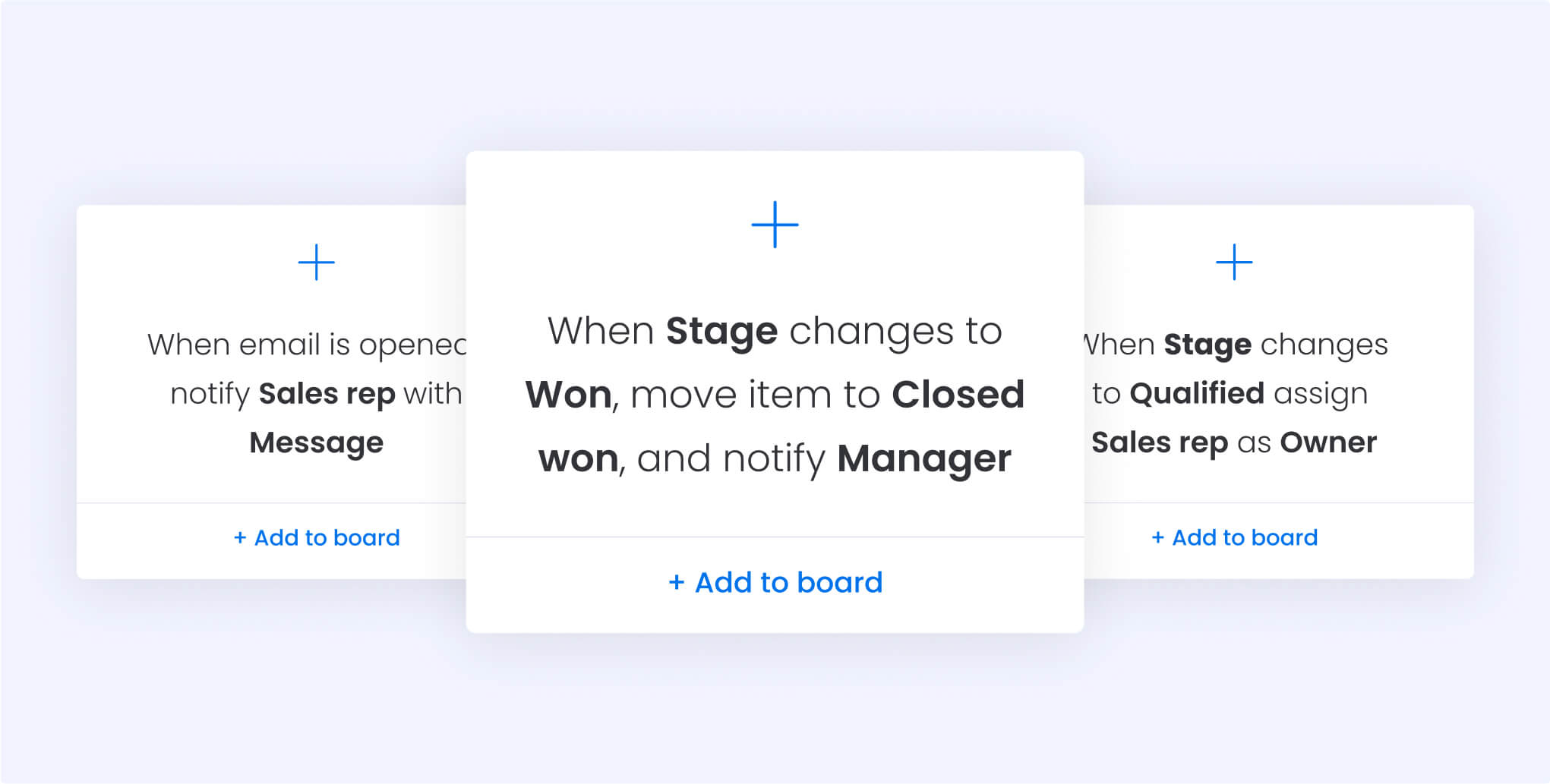
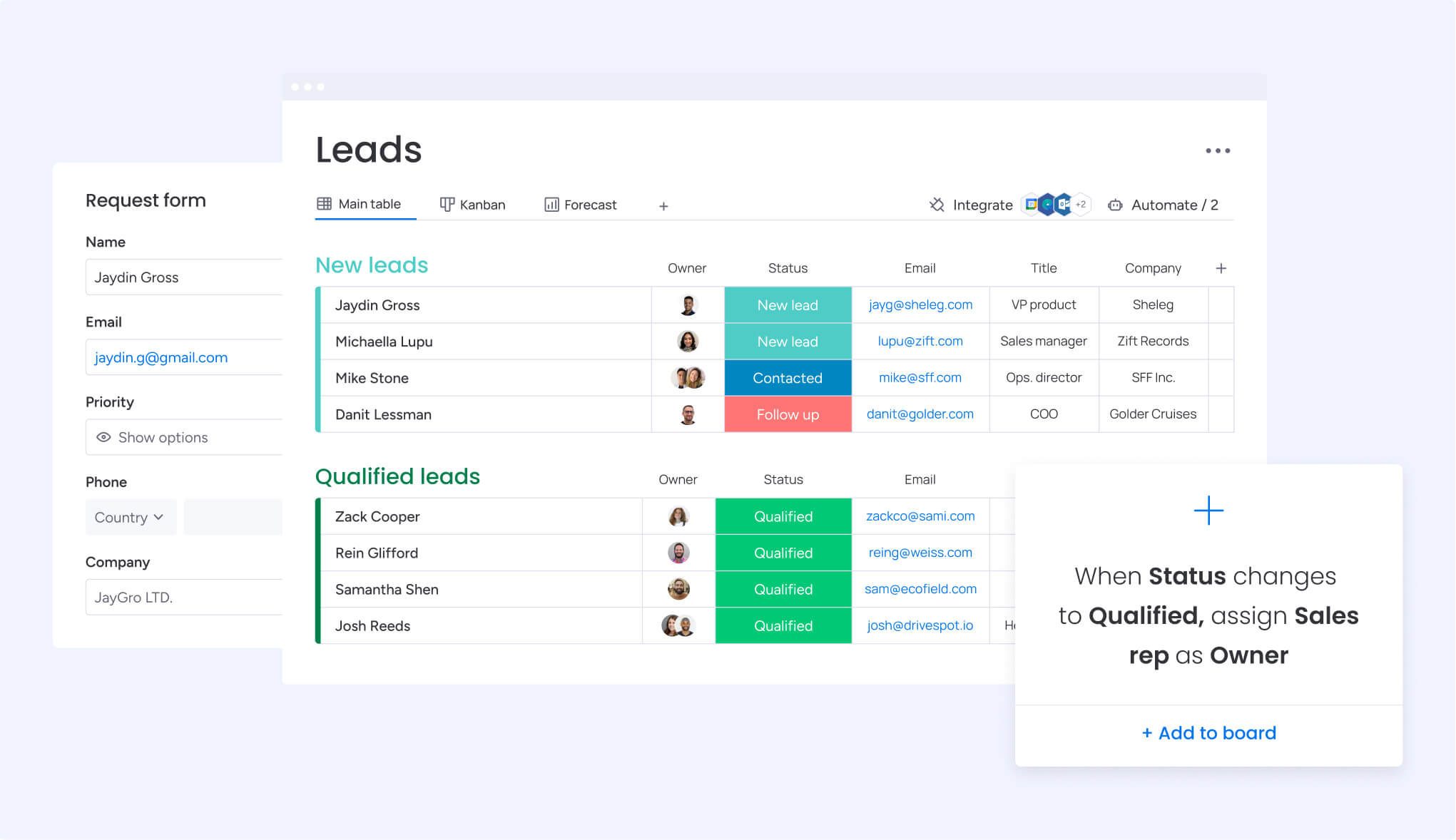
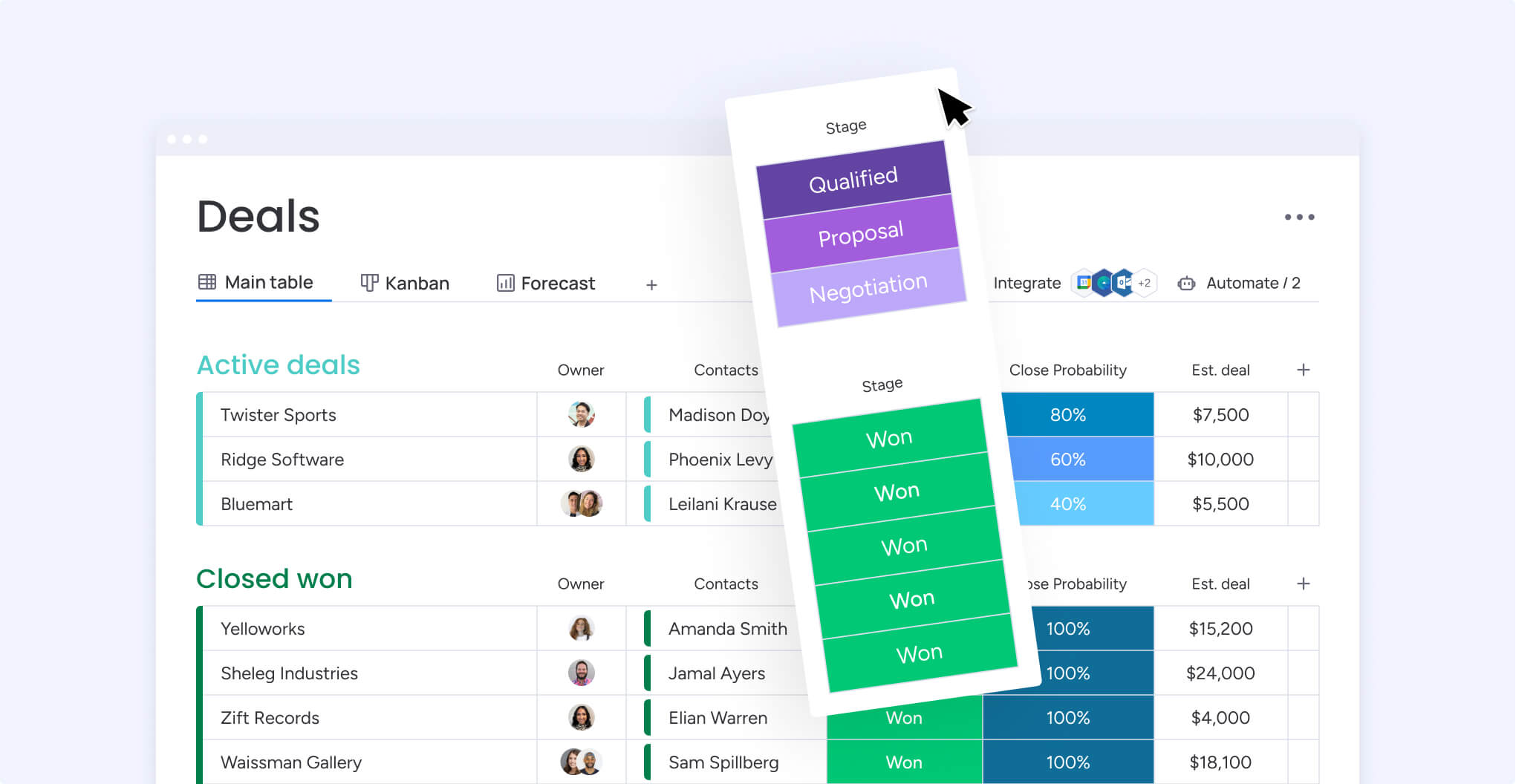
Teams using solutions like monday CRM can build these integrated workflows visually without coding expertise. The platform’s automation capabilities handle data flow between stages automatically. When a prospect responds to an outreach sequence, they automatically move to the appropriate pipeline stage with all context preserved.
This unified approach provides complete visibility into your revenue engine. Leaders see how many prospects enter the funnel, where they convert or drop off, and which activities drive results. This visibility enables data-driven decisions about resource allocation and process optimization.
Step 3: follow your 90-day implementation roadmap
Successful automation implementation follows a phased approach that builds capability systematically while maintaining team productivity. This roadmap ensures you avoid common pitfalls while maximizing adoption.
- Days 1-30: Foundation: audit current workflows and document existing processes, define automation objectives and success metrics, select and configure your primary platform, then import and clean existing data to ensure accuracy.
- Days 31-60: Pilot: build initial sequences for your primary use case, set up lead scoring and routing rules, configure basic reporting dashboards, and train core team members on daily workflows and best practices.
- Days 61-90: Scale: analyze performance data and optimize workflows based on results, expand automation to additional use cases, train remaining team members, then document lessons learned and plan next phase expansion.
Measure what matters in outbound automation
Tracking the right metrics demonstrates business impact and identifies optimization opportunities. Focus on indicators showing revenue outcomes rather than vanity metrics that don’t connect to business results.
Track pipeline velocity and conversion metrics
These metrics reveal how effectively automation moves prospects through your sales process and where bottlenecks occur. Those patterns help you optimize workflows for maximum impact.
- Lead-to-opportunity conversion rates: show how efficiently your system qualifies and advances prospects so you can track this metric overall and by segment to identify which prospect types respond best to automation.
- Time from first touch to qualified lead: measures how quickly automation moves prospects through awareness and consideration stages where manual processes often take 30-60 days while automated sequences compress this to 10-20 days.
- Pipeline progression velocity: shows how quickly deals move through sales stages after qualification by measuring average days in each stage and total cycle length from opportunity creation to close.
Monitor rep productivity and time savings
Measuring productivity gains requires tracking specific activities and time allocation. Document baseline metrics before implementation, then measure improvements after automation deployment to prove ROI.
Key productivity metrics include:
- Activities per rep daily: calls, emails, meetings booked.
- Time on selling activities: conversations vs. admin work.
- Pipeline generated per rep: number and value of opportunities.
- Quota attainment: percentage hitting targets.
These metrics reveal whether automation actually frees reps to sell more or just shifts their time to other non-selling activities.
Analyze revenue growth vs. headcount ratios
These efficiency metrics demonstrate automation’s impact on your business model and help justify continued investment in automation capabilities.
- Revenue per employee: demonstrates automation’s impact on unit economicsby dividing total revenue by sales team headcount where tracking this quarterly reveals whether automation drives real efficiency gains or just shifts costs.
- Growth efficiency metrics: show whether you’re scaling sustainably when revenue grows 40% while headcount grows only 15%, automation enables efficient scaling but if both grow proportionally, you’re not achieving leverage from your automation investment.
- Pipeline coverage ratios: indicate whether automation generates sufficient opportunities by tracking pipeline value relative to quota where automation should increase coverage without adding reps, proving its ability to scale output beyond linear headcount growth.
Upgrade your outbound sales with intelligent automation
The shift to automated outbound sales represents more than just efficiency gains — it fundamentally changes how revenue teams operate and scale. Teams that embrace this transformation position themselves for sustainable growth while those clinging to manual processes face increasing competitive disadvantage.
The evidence is compelling across every metric that matters. Productivity gains of 60% or more, compressed sales cycles, and the ability to scale revenue without proportional headcount increases create a new model for sales operations. These aren’t theoretical benefits; they’re measurable outcomes achieved by teams implementing the strategies outlined above.
The unified platform needed to realize these benefits without the tool sprawl and adoption challenges that derail many automation initiatives comes from monday CRM. The visual workflow builders, AI-powered personalization, and comprehensive revenue operations capabilities enable teams to implement sophisticated automation while maintaining the human touch that builds relationships and closes deals.
Frequently asked questions
How quickly can I expect ROI from outbound sales automation?
You can expect to see an initial ROI from outbound sales automation within 30-60 days in the form of productivity gains. Full financial ROI typically arrives within six to twelve months, depending on your team's size and the complexity of your automation setup.
What budget should I allocate for outbound sales automation?
For your outbound sales automation budget, you should plan to allocate 3-5% of your annual revenue for platforms and implementation. Typical mid-market teams invest $500-2,000 per rep monthly for a comprehensive platform.
Can outbound sales automation work for small sales teams?
Automation particularly benefits small teams because it allows two to three reps to achieve the output of larger manual teams through intelligent workflows that handle routine activities.
How do I keep outbound outreach personalized at scale with automation?
Automation platforms maintain personalization through AI-powered content insertion based on prospect attributes, behavioral triggers that adjust messaging, and contextual references to company-specific information.
What if my sales team lacks technical skills for automation setup?
If your sales team lacks technical skills, you can still succeed with automation setup by choosing the right platform. Visual automation platforms like monday CRM require no coding skills and provide drag-and-drop workflow builders that non-technical users can master quickly.
Which outbound workflows should I automate first when scaling?
Start with lead enrichment and basic email sequences because these workflows deliver immediate time savings and demonstrate value quickly, building team confidence in automation.

 Get started