


A big deal closes, the numbers look great, and the quarter feels locked in. Then a few weeks later, the pipeline looks thin, and the next set of opportunities is harder to spot. Many sales teams fall into this feast-or-famine cycle because prospecting gets treated like a spare-time activity, not the engine that keeps revenue predictable.
Learning how to prospect for sales leads is not about perfecting cold calls or writing the perfect email: in 2026 it’s about building a systematic approach that consistently fills your pipeline with qualified opportunities..
This guide shines a light on some of the top prospecting methods that actually work — from AI-assisted lead scoring to multichannel campaigns. You will learn how to build scalable workflows, track what matters, and create a predictable pipeline that helps teams hit targets month after month, without relying on last-minute heroics.
Key takeaways
- Sales prospecting works best as a repeatable system, not an occasional activity: Consistent workflows, clear qualification criteria, and disciplined execution prevent feast-or-famine pipelines and support predictable revenue.
- Quality-focused prospecting outperforms high-volume outreach: Researching prospects and prioritizing fit leads to higher response rates, better conversations, and stronger prospect-to-opportunity conversion.
- Multichannel prospecting increases engagement and recall: Combining email, phone, LinkedIn, content, and events helps reach prospects where they are most responsive and reinforces your message over time.
- Measurement and optimization are essential for sustained improvement: Tracking metrics like reply rates, connection rates, and conversion rates enables teams to refine messaging, timing, and targeting continuously.
- The right CRM platform supports scalable, consistent prospecting: Solutions like monday CRM help centralize data, automate cadences, and maintain visibility across prospecting activities without sacrificing personalization.
What is sales prospecting?
Sales prospecting is the process of finding and reaching out to potential customers who may benefit from what you sell. It keeps the sales pipeline moving, and it supports more predictable revenue when outreach stays consistent over time.
Prospecting matters because it helps create repeatable pipeline generation and long-term growth. When sales teams deprioritize prospecting, performance often becomes cyclical, with periods of momentum followed by slowdowns when opportunities fall through.
Effective prospecting fills the pipeline with qualified opportunities, which improves visibility and forecasting accuracy. The gap between random outreach and strong prospecting typically comes down to strategy, systems, and disciplined execution across channels.
Successful prospecting also requires clarity on who to target, why the message matters, and how to engage efficiently. High-performing teams treat prospecting as a measurable discipline, using data to refine what works and improve results over time.
Sales prospect vs leads: know the difference
Understanding the difference between leads and prospects is not just semantics. It shapes how teams prioritize outreach, allocate time, and focus energy on actions that move deals forward efficiently.
A lead is someone who shows initial interest in your company but has not been qualified. They might download content, attend a webinar, or fill out a form, signaling curiosity without confirming fit.
A prospect is a lead who has been researched and qualified as a potential match for your product. Prospects align with your ideal customer profile, including company type, role relevance, and challenges your solution can address.
The key distinction is simple: prospects are vetted, while leads are still unqualified. Think of it like a retail store: leads are people who walk in and browse, while prospects are those asking specific questions about products they’re seriously considering.
Understand the progression from lead to prospect to opportunity
The sales funnel moves through three stages, each reflecting higher engagement and stronger qualification. Understanding this progression helps teams focus effort where it matters most at each point in the journey.
Stage definitions:
- Lead: initial contact or interest shown through marketing activity, website visits, or event attendance. Leads enter your system through different sources, but they have not been qualified for fit or intent.
- Prospect: qualified lead that matches your ideal customer profile and shows signals worth sales engagement. Prospects meet basic fit requirements, and they demonstrate enough interest to justify targeted outreach.
- Opportunity: prospect who is actively evaluating your solution and engaged in the sales process. Opportunities have confirmed needs, a defined timeline, and concrete steps that indicate movement toward purchase.
Moving contacts through these stages requires consistent qualification at each step. Leads become prospects when they match ICP criteria and show buying signals, while prospects become opportunities when evaluation begins and the sales process is underway.
Apply qualification criteria at each stage
Qualification should become more specific as contacts move through the funnel. At every stage, the goal is to answer one question clearly: is this contact worth more time and follow-up from the team?
This is explained more clearly in the table below:
| Stage | Budget | Authority | Need | Timeline |
|---|---|---|---|---|
| Lead | Budget indicators present (company size, funding) | Basic role identification | General pain points or interests | No defined timeline |
| Prospect | Budget range confirmed or strongly indicated | Decision-making influence identified | Specific pain points confirmed | Rough timeline established |
| Opportunity | Budget allocated or approval process defined | Key decision-makers engaged | Requirements documented and aligned | Timeline with milestones |
This staged approach reduces time spent on poor-fit contacts and supports cleaner pipeline movement. When qualification stays consistent, strong prospects progress faster, and forecasting becomes more reliable.
10 proven methods to prospect for sales leads
It’s important to establish that successful prospecting depends on using multiple approaches together rather than relying on a single tactic. High-performing sales teams combine several methods strategically, aligning each approach with how their target audience prefers to research, engage, and buy.
Each method below delivers the strongest results when integrated into a broader prospecting strategy. When combined thoughtfully, these approaches create consistent pipeline growth while improving lead quality and conversion rates.
Method 1: Cold email outreach that actually converts
Cold email prospecting begins with research that goes beyond job titles. Use LinkedIn, company websites, and industry directories to find decision-makers and gather relevant background information before crafting your first message.
To ensure your emails get opened and read, every message must contain a few key components. These elements then work together to capture attention, demonstrate relevance, and guide prospects toward a response.
- Personalized Email subject line: Reference specific details about the prospect’s company or recent activity to stand out in crowded inboxes.
- Relevant opening: Show you’ve done homework by mentioning a specific challenge their company faces.
- Value proposition: Articulate exactly how you help companies like theirs solve specific problems.
- Specific call-to-action: Request a concrete next step like a 15-minute call on specific dates.
- Professional signature: Include your full name, title, company, and contact information.
Effective cold email sequences typically include three to five messages sent over two to three weeks. Each follow-up should introduce new value rather than repeating the same request or asking if the previous email was seen.
Method 2: Social selling through LinkedIn
LinkedIn prospecting works best when the focus is on relationship-building rather than direct selling. Start with a professional headshot and a headline that addresses common prospect challenges instead of listing a job title.
The systematic LinkedIn approach:
- Identify prospects: Use Sales Navigator to find decision-makers matching your ideal customer profile.
- Engage before connecting: Comment meaningfully on their posts and share their content with thoughtful additions.
- Personalize connection requests: Reference specific content they’ve shared or mutual connections.
- Nurture relationships: Share valuable industry insights and establish yourself as a helpful resource.
LinkedIn messaging should remain conversational and concise. Remember to focus on offering value, keep messages brief, and use soft calls to action such as asking whether a short conversation would be useful.
Method 3: Strategic cold calling
Cold calling remains effective when supported by preparation. Before dialing, understand the company’s background, recent announcements, and the challenges typically faced by someone in the prospect’s role.
Effective call structure:
- Strong opening: Capture attention in the first 10 seconds by mentioning a specific trigger event or relevant insight.
- Qualifying questions: Understand their current situation through open-ended questions encouraging dialogue.
- Tailored value proposition: Connect your solution directly to specific challenges they’ve mentioned.
- Next steps: Propose a specific follow-up action like scheduling a discovery call.
When prospects respond with hesitation, asking clarifying questions often reveals the real objection. If they request information, offer something specific and relevant after confirming what would be most helpful.
Method 4: AI-powered lead scoring
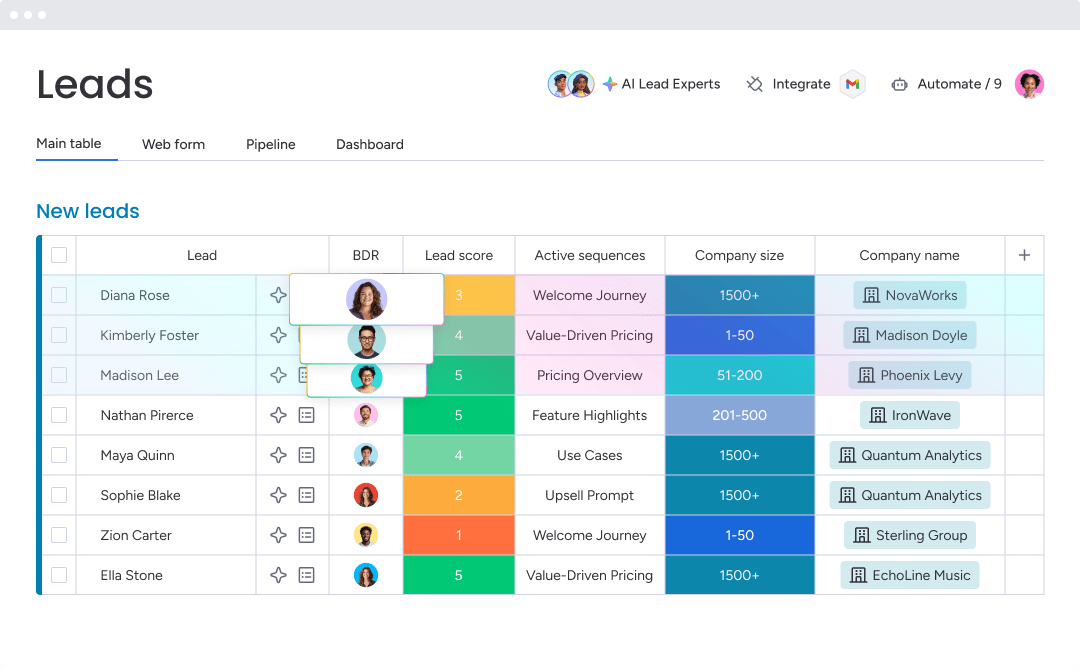
AI lead scoring assigns value to prospects based on who they are and how they engage. This approach ensures sales teams prioritize leads with the highest likelihood of converting.
Traditional scoring models typically consider several factors.
- Demographic information: Company size, industry, and job title determines whether the prospect matches your ideal customer profile.
- Behavioral data: Website visits, email opens, and content downloads indicates interest level.
- Engagement level: Social media interactions and meeting attendance demonstrates active interest.
However, AI transforms lead scoring from static rules into a learning model that improves accuracy over time. AI-powered scoring analyzes patterns across successful deals to determine which characteristics and behaviors most strongly predict conversion.
Further, the system continuously learns from new inputs, refining scores based on real outcomes and measurable performance.
Modern revenue teams using monday CRM can apply AI capabilities that evaluate multiple data points at the same time. These AI features categorize leads based on fit, extract key details from communications, and detect sentiment signals to prioritize high-intent prospects (without relying on manual scoring work or rigid, one-size-fits-all rules).
Method 5: Multi-channel prospecting campaigns
Relying on email alone limits reach and response rates. Multi-channel prospecting connects with prospects where they are most likely to engage — across inbox, phone, LinkedIn, and video messages. The goal is not maximum presence; it’s choosing the channel where your message lands with clarity and relevance.
A coordinated channel strategy keeps outreach consistent while matching the prospect’s preferences.
- Email: Delivers detailed information and supporting context.
- Phone calls: Enable real-time conversation and fast qualification.
- LinkedIn: Builds professional relationships and sustained visibility.
- Video messages: Add personal connection at scale and improve recall.
A sample sequence may include a personalized LinkedIn connection request on day one, an initial email on day three, and a phone call attempt on day six, followed by timed messages spaced appropriately.
Consistent themes across channels reinforce the value proposition, while touchpoints spaced three to five days apart maintain visibility without feeling intrusive.
Method 6: Referral-based prospecting
Referrals convert at higher rates than most prospecting methods because trust is established before the first conversation. A reliable referral motion requires a repeatable process that begins by identifying satisfied customers who have achieved measurable results and clear outcomes.
Strong referral execution depends on specificity, simplicity, and speed.
- Ask for specific introductions: Request defined roles or companies instead of broad, generic questions.
- Make referrals easy: Provide short email templates or simple referral forms to reduce effort.
- Follow up quickly: Contact referral leads within 24 hours and acknowledge the referrer by name.
Referral types:
- Customer referrals: Come from satisfied clients who introduce you to peers.
- Partner referrals: Originate from complementary service providers.
- Internal referrals: Come from other departments within your company.
Method 7: Content-driven inbound prospecting
Inbound prospecting attracts prospects through valuable content rather than interrupting them with outreach. This approach positions the company as a trusted expert while generating leads who are already engaged with the topic and receptive to guidance.
High-converting content types:
- Blog posts: Address common industry challenges and recurring blockers.
- Whitepapers: Provide research insights and structured frameworks.
- Webinars: Feature expert knowledge and real-time interaction.
- Case studies: Show successful outcomes with proof and context.
Each asset should deliver actionable takeaways and frameworks readers can implement immediately. Follow-up for content leads starts with an immediate thank-you email that delivers the promised resource, continues with a nurture sequence that shares relevant content, and transitions to sales outreach when prospects display buying signals.
Method 8: Intent data and trigger-based outreach
Intent data shows when prospects are actively researching solutions like yours, making outreach more timely and relevant. Intent signals typically fall into three categories — website behavior such as pricing page views, content engagement such as whitepaper downloads, and external triggers such as job postings or funding announcements.
Practical applications:
- Respond to pricing interest: Reach out after a pricing page visit with a message that acknowledges active research.
- Act on funding triggers: Contact newly funded companies with congratulations and insights on how similar teams invested capital.
Method 9: Event and webinar prospecting
Events and webinars create concentrated opportunities to connect with multiple prospects in a short time. Effective event prospecting follows three phases: pre-event research to identify target prospects, in-event networking focused on relationship-building, and post-event follow-up within 48 hours.
Webinar prospecting approach:
- Topic selection: Address specific pain points the target audience faces.
- Engagement tactics: Use polls and Q&A sessions to keep attendees active and reveal priorities.
Method 10: account-based prospecting
Finally, account-based prospecting targets specific high-value accounts rather than casting a wide net. Account selection begins by identifying companies that match the ideal customer profile and researching their organizational structure, priorities, and internal stakeholders.
Multi-contact outreach engages multiple people within the same organization using coordinated, role-specific messaging. For example, a VP of Sales may receive messaging tied to strategic outcomes, while a director of sales operations may receive content focused on implementation, adoption, and long-term execution.
How to build your sales prospecting workflow
Creating a systematic, repeatable sales prospecting workflow is absolutely vital for generating consistent pipeline growth. Teams that approach prospecting as a discipline — rather than an ad hoc activity — achieve more predictable outcomes and stronger long-term performance.
By documenting processes, aligning on priorities, and measuring results, sales teams can scale prospecting efforts without sacrificing quality. The steps below outline a framework that supports consistency, clarity, and growth as teams expand.
Step 1: Define your ideal customer profile
An ideal customer profile (ICP) is the foundation of effective sales prospecting. Without a clearly defined ICP, teams spend time engaging prospects who are unlikely to convert or who create friction after closing.
A strong ICP helps sales teams focus effort where it matters most. It aligns outreach with real value and ensures time is spent on opportunities with genuine potential.
ICP components include three key categories, outlined below.
Company characteristics:
- Industry verticals where your solution delivers value.
- Company size ranges with budget and complexity to justify your solution.
- Revenue ranges indicating financial capacity.
- Geographic locations you can serve.
Role characteristics:
- Job titles and seniority levels of decision-makers.
- Specific responsibilities aligning with your solution’s benefits.
- Reporting structures indicating decision-making authority.
Situational factors:
- Pain points your solution addresses.
- Budget availability.
- Timing factors creating urgency.
- Technology environments affecting implementation.
Building an ICP starts with analysis. Review high-performing customers who closed quickly and achieved meaningful results. Identify shared traits across company attributes, buyer roles, and situational context to uncover patterns worth replicating.
Step 2: Map your prospecting process
A documented prospecting process creates consistency across the team and shortens ramp time for new hires. It also ensures experienced reps follow best practices rather than relying on instinct alone.
Phase 1: Research
- Identify target accounts matching your ICP criteria using tools like linkedIn sales navigator.
- Find contact information for key decision-makers through email finding tools or professional networks.
Phase 2: Outreach
- Make initial contact through your chosen channel with personalized messaging demonstrating research and offering value.
- Execute follow-up sequences with 5-8 touchpoints across multiple channels.
Phase 3: Qualification
- Ask discovery questions to understand their current situation and challenges.
- Assess needs alignment between their challenges and your solution’s capabilities.
- Evaluate fit based on budget indicators, decision-making authority, and timeline factors.
Phase 4: Handoff
- Transition qualified prospects to the sales process with documentation of everything learned during prospecting.
- Schedule discovery calls or demos with appropriate sales team members.
Step 3: Create automated prospecting cadences
Prospecting cadences are structured sequences of outreach designed to maintain momentum without overwhelming prospects. When planned carefully, cadences balance persistence with respect.
Cadence structure:
- Include 8-12 touchpoints over two to three weeks using varied communication channels.
- Start with closer touchpoints early in the sequence and extend to wider spacing later.
- Use templates for structure and core messaging, but customize the opening paragraph with specific research about each prospect.
- Reference trigger events or mutual connections to demonstrate genuine interest.
How to measure prospecting success
Prospecting performance improves only when it is measured consistently. High-performing teams focus on metrics (outlined below) that reveal clear opportunities for improvement rather than relying on surface-level activity counts.
Step 1: Track key prospecting metrics
To improve prospecting, you need clarity on where performance is strong and where it drops off. The table below highlights the core metrics that signal effort, engagement, and conversion so you can focus on the numbers that truly move the pipeline forward.
| Metric | Definition | Benchmark range | Why it matters |
|---|---|---|---|
| Prospects contacted | number of new prospects reached out to | 20-30 per day | ensures consistent pipeline feeding |
| Email open rate | percentage of emails opened | 20-30% | indicates subject line effectiveness |
| Email reply rate | percentage of emails receiving replies | 5-10% | shows message relevance and value |
| Call connection rate | percentage of calls reaching prospects | 10-20% | reflects calling timing and persistence |
| Prospects to opportunities | percentage of prospects becoming opportunities | 10-20% | shows qualification effectiveness |
| Opportunity to close rate | percentage of opportunities that close | 20-30% | indicates prospect quality |
Tracking frequency:
- Activity metrics: Track daily to ensure consistent effort.
- Response metrics: Review weekly to identify trends.
- Conversion metrics: Analyze monthly to assess overall effectiveness.
Step 2: Optimize your prospecting performance
Improvement requires a structured approach. Start by establishing baseline metrics, then isolate underperforming areas, test targeted changes, and measure results before scaling adjustments.
Email performance improvements:
- A/B test subject lines.
- Experiment with different email lengths.
- Test various calls-to-action.
- Refine targeting.
Call effectiveness improvements:
- Experiment with different calling times.
- Test various opening statements.
- Refine qualifying questions.
- Adjust follow-up timing.
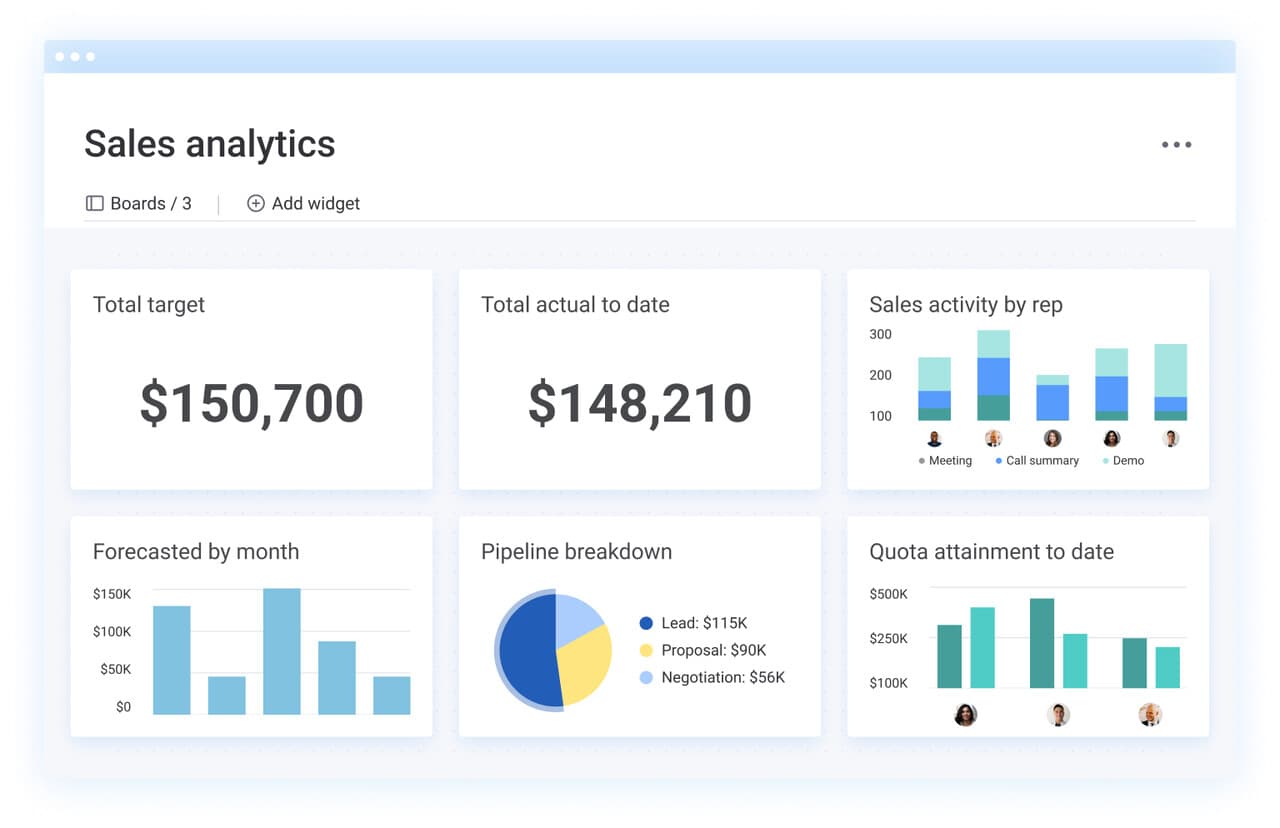
Organizations using intuitive solutions like monday CRM achieve improved visibility through customizable dashboards showing key prospecting metrics and pipeline health in real-time, giving sales leaders the insights needed to coach effectively.
Revolutionize your prospecting with monday CRM
As this guide has already touched on, effective prospecting depends on systems that reduce manual effort while preserving a human approach. Sales teams often struggle with fragmented data, disconnected sales prospecting tools, and limited insight into performance.
Modern platforms like monday CRM bring prospecting activities into one centralized workspace. By connecting outreach, qualification, and reporting, teams gain clarity and coordination without added complexity.
Automate your entire prospecting workflow
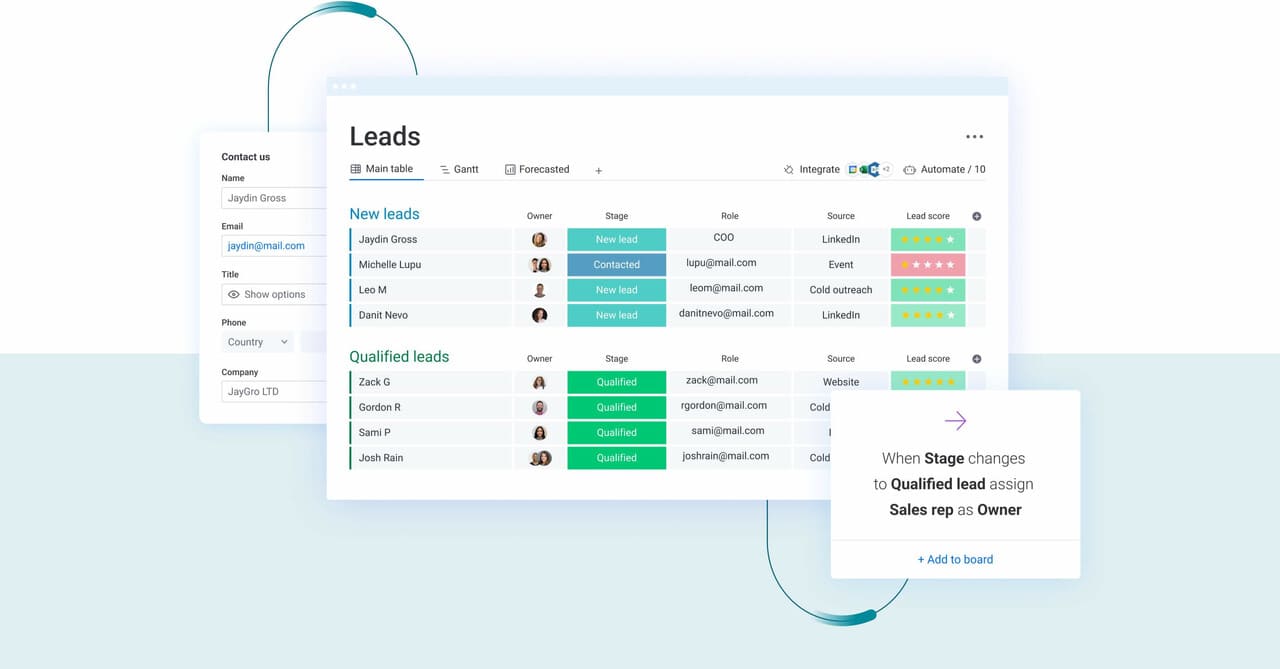
Automation reduces repetitive work while maintaining relevance. AI-powered lead scoring prioritizes prospects based on fit and engagement, helping reps focus on high-impact opportunities.
AI actions integrate directly into prospecting workflows:
- Categorize action: Automatically sorts leads by industry or company size.
- Extract information action: Pulls key details from prospect communications, populating your CRM automatically.
AI that actually helps you sell
AI capabilities support prospecting success with practical functionality that improves over time based on team performance and engagement trends. AI-powered lead scoring prioritizes the most promising prospects using historical outcomes and behavioral signals.
AI recommendations also help improve outreach consistency. By analyzing when prospects engage and which channels they respond to, the platform suggests optimal contact timing and the best communication channels for each prospect.
Real-time pipeline visibility
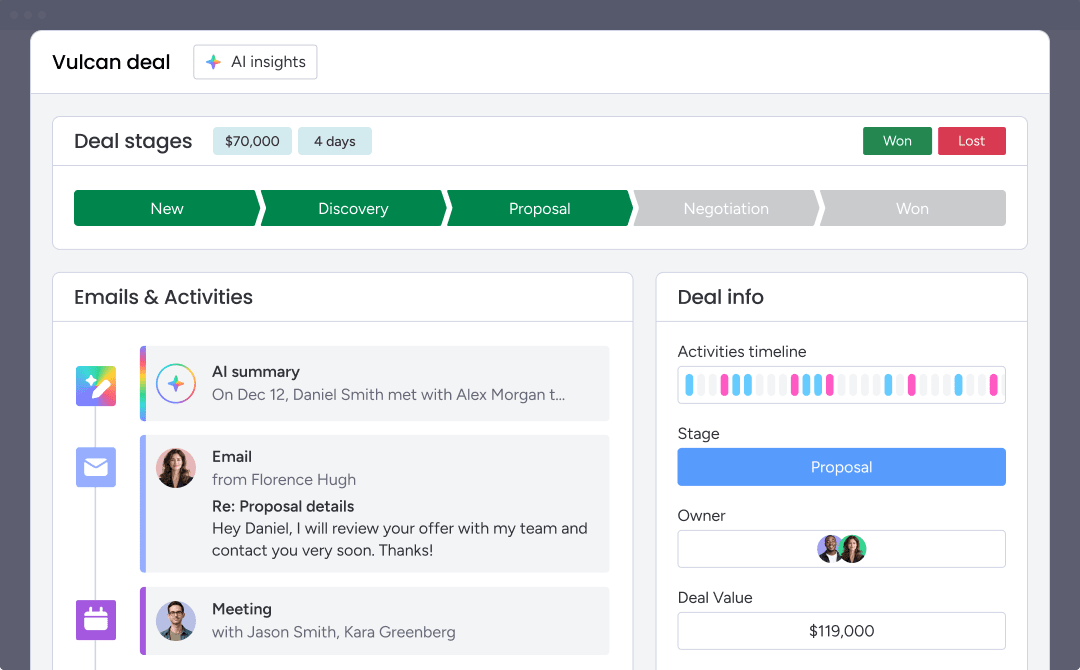
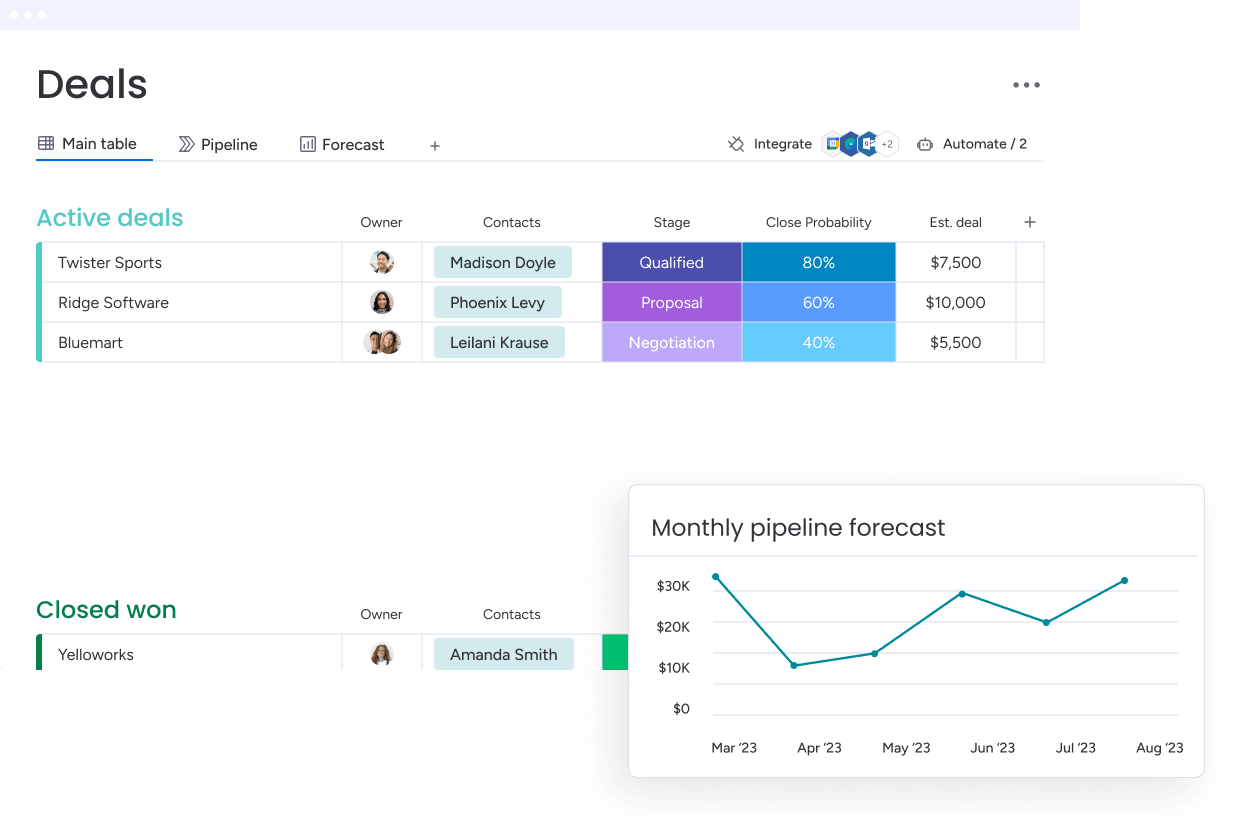
Clear visibility into prospecting activity removes the black box that makes pipeline creation unpredictable in many organizations. Customizable dashboards track key prospecting metrics and pipeline health in real time, helping leaders identify trends and coach effectively.
Additionally, real-time tracking captures engagement across channels in one centralized place. With a visual project management approach, it becomes easier to understand where each prospect stands, what actions are needed next, and how progress is moving through the pipeline.

“With monday CRM, we’re finally able to adapt the platform to our needs — not the other way around. It gives us the flexibility to work smarter, cut costs, save time, and scale with confidence.”
Samuel Lobao | Contract Administrator & Special Projects, Strategix
“Now we have a lot less data, but it’s quality data. That change allows us to use AI confidently, without second-guessing the outputs.”
Elizabeth Gerbel | CEO
“Without monday CRM, we’d be chasing updates and fixing errors. Now we’re focused on growing the program — not just keeping up with it."
Quentin Williams | Head of Dropship, Freedom Furniture
“There’s probably about a 70% increase in efficiency in regards to the admin tasks that were removed and automated, which is a huge win for us.“
Kyle Dorman | Department Manager - Operations, Ray White
"monday CRM helps us make sure the right people have immediate visibility into the information they need so we're not wasting time."
Luca Pope | Global Client Solutions Manager at Black Mountain
“In a couple of weeks, all of the team members were using monday CRM fully. The automations and the many integrations, make monday CRM the best CRM in the market right now.”
Nuno Godinho | CIO at VelvBuild a prospecting system that actually works today
Effective prospecting depends on building a repeatable process that consistently generates qualified opportunities, rather than refining a single technique. The strongest sales teams combine several prospecting methods, measure performance, and continuously improve based on results.
Start with the fundamentals: define an ideal customer profile, select 2–3 prospecting methods that match where prospects spend time, and set up tracking that shows what is working. Prioritize quality over volume, since meaningful conversations with 20 well-researched prospects typically outperform generic outreach to 200 poor-fit contacts.
Consistent prospecting drives predictable growth when it is treated as an ongoing discipline. Teams that execute regularly, learn from performance data, and adapt their approach build sustainable pipelines that support long-term revenue.
Frequently asked questions
How many prospects should I contact daily?
The ideal number of prospects to contact each day is between 20–30 for most sales professionals. This typically includes a mix of email, phone calls, and social media outreach. The exact volume depends on your industry, average deal size, and the level of personalization required for each contact.
What's the best time to prospect for sales leads?
The best times to prospect for sales leads are Tuesday through Thursday between 10:00–11:00 a.m. and 2:00–3:00 p.m., when prospects are more likely to be available and responsive. Testing different time windows is recommended, as optimal prospecting times vary by industry and geographic location.
How do I prospect without being pushy?
Effective sales prospecting focuses on providing value and addressing problems rather than promoting a product in initial outreach. Lead with insights relevant to the prospect’s business, ask thoughtful questions, and position yourself as a helpful resource.
What are good sales prospecting ideas for beginners?
Begin with warm prospecting through referrals and LinkedIn connections, then gradually add cold email prospecting with highly personalized messages. Focus on mastering one or two prospecting methods before expanding to multichannel outreach.
How long should I follow up with prospects?
Follow up with prospects for 2–3 weeks using 5–8 touchpoints across multiple channels, then move them into a longer-term nurture sequence. If there is no response, wait 3–6 months before re-engaging with updated messaging.
What's the difference between warm and cold prospecting?
Warm prospecting involves contacting individuals who already have some connection to you or your company, such as referrals or website visitors. Cold prospecting refers to reaching out to prospects with no prior relationship. Warm prospects typically deliver higher response rates and shorter sales cycles due to existing familiarity.

 Get started