


Your sales team is crushing activity metrics, but the pipeline tells a different story — leads aren’t converting, deals are stalling, and forecasts feel more like guesswork. The problem isn’t effort; it’s that most B2B lead generation still targets individual decision-makers when today’s purchases involve 6 to 10 stakeholders across finance, IT, and operations.
This guide covers 10 strategies for generating B2B sales leads that actually convert to revenue. You’ll learn how to engage entire buying groups from day 1, use AI to scale personalization, and track the metrics that predict pipeline growth — plus how the right CRM helps you manage every stakeholder relationship across complex deals.
Try monday CRMKey takeaways
- Focus on buying groups because B2B purchases typically require buy-in from 6-10 stakeholders across departments like finance, IT, and operations.
- Define your ideal customer profile with precision data, map all buying group stakeholders, and identify high-intent signals to avoid wasting resources on unqualified prospects.
- Use AI to scale personalization and qualification by deploying digital workers for 24/7 lead scoring, generate hyper-personalized outreach in seconds.
- Track how many key decision-makers you’ve engaged per account and monitor pipeline velocity to predict revenue outcomes accurately.
- With monday CRM, you can centralize buying group engagement, monitor intent signals in real-time, and use AI to compose personalized emails based on lead data and conversation history.
What B2B lead generation looks like today: Buying groups vs. individual leads
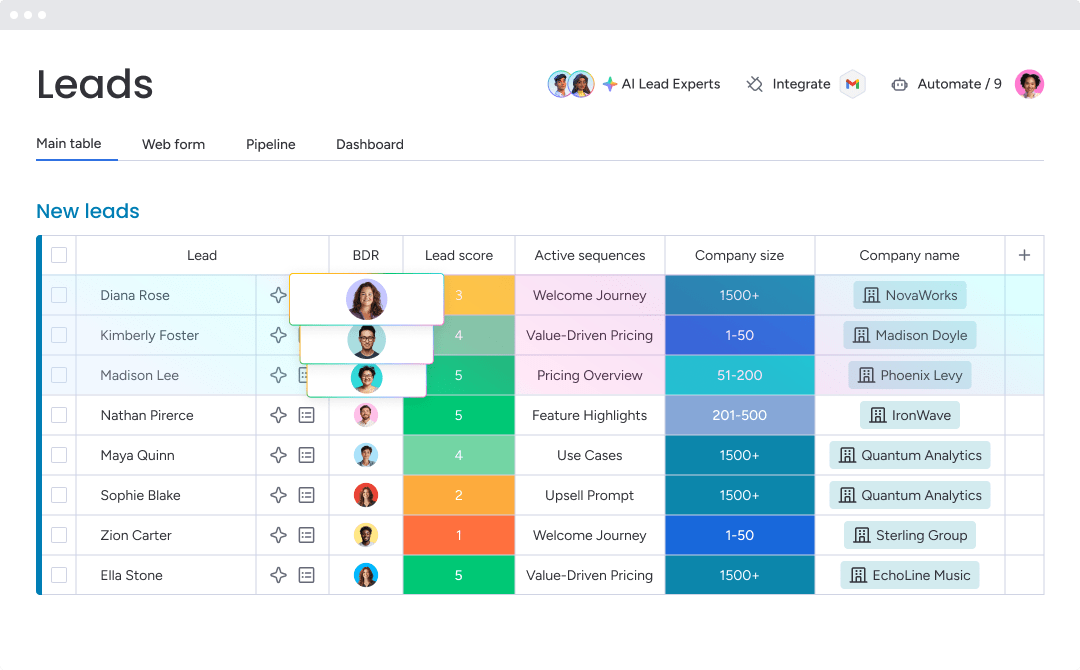
B2B lead generation is the process of identifying and engaging companies that are likely to buy — not just individual contacts. Today, purchase decisions are made by buying groups made up of multiple stakeholders across finance, IT, operations, and end-user teams. Generating leads today means building early awareness and engagement across that entire group, not relying on a single decision-maker to carry the deal forward.
This shift matters because B2B purchases now involve higher scrutiny, larger budgets, and more cross-functional approval. A single “lead” rarely has the authority to buy on their own. Finance evaluates ROI, IT reviews security and integration requirements, operations assesses implementation impact, and end users determine whether the solution will actually be adopted. If those stakeholders aren’t engaged early, deals slow down or stall later in the process.
From a revenue perspective, lead generation sets the quality of your entire pipeline. When sales teams engage multiple stakeholders early, they reduce single-threaded risk, shorten sales cycles, and increase close rates. Deals with broader buying group engagement move faster because internal alignment happens in parallel — not sequentially. That’s why effective B2B lead generation isn’t about producing more leads, but about creating opportunities that are structurally more likely to convert.
3 steps for building a foundation for quality B2B sales leads
This prep work determines whether you generate high-quality prospects or waste resources on unqualified leads. Here are 3 steps to set the stage for successful lead generation:
Step 1: Define your ideal customer profile with precision data
An ideal customer profile (ICP) describes the companies that get the most value from your product and are most likely to buy. Unlike buyer personas, an ICP focuses on company characteristics that predict whether they’ll succeed with your solution.
To build an accurate ICP, gather specific data about your best customers. Document these essential elements:
- Company size: Revenue range ($10M to $100M) and employee count (50 to 500) that indicates sufficient budget and complexity to need your solution
- Industry: Specific sectors where your solution solves critical problems, such as professional services, technology, manufacturing, and financial services
- Technology stack: Current platforms they use, especially existing CRM systems and whether they’re frustrated with complexity
- Growth indicators: Hiring trends, recent funding rounds, geographic expansion, or new product launches signal companies actively investing in growth infrastructure
- Pain points: Specific challenges they face, including lack of pipeline visibility, manual data entry consuming rep time, or difficulty forecasting revenue accurately
Start by analyzing your best current customers. Identify the 20% of customers who generate 80% of your revenue, renew consistently, and require minimal support. Document their common characteristics across all 5 data points.
Step 2: Map all stakeholders in your buying groups
Stakeholder mapping helps you understand every person who might influence the purchase decision. It prepares you for complex B2B sales where up to 22 people can influence the buying decision. Your goal is to identify potential influencers and prepare for their involvement.
Knowing the different stakeholder categories lets you tailor your approach to each group’s concerns:
- Economic buyers: Control budget and final approval, caring about ROI, total cost of ownership, and strategic alignment with business goals
- Technical evaluators: Assess implementation and integration requirements, including IT, RevOps, and Sales Ops professionals evaluating security, data migration complexity, and system connections
- End users: Will use the product daily, including sales reps, SDRs, BDRs, and account managers who determine whether the platform actually improves their workflow
- Champions: Internal advocates who push for your solution and do internal selling on your behalf
- Blockers: Stakeholders who may resist change or prefer competitors
Identify 3 to 5 primary stakeholders for each target account first, then expand your map as you learn more.
Step 3: Identify high-intent signals worth acting on
Intent signals show when a prospect is actively researching solutions like yours. Here are some to watch:
| Signal type | Specific behaviors | Intent level |
|---|---|---|
| Website behavior | Multiple visits to pricing pages, product comparison pages, or case studies within 7 days | High |
| Content engagement | Downloading buying guides, attending product webinars, requesting demos | High |
| Job changes | New hires in revenue leadership roles (CRO, VP Sales, RevOps) | Medium-high |
| Company events | Funding rounds, rapid growth announcements, leadership changes | Medium |
| Email engagement | Opening emails multiple times, clicking through to multiple pages | Medium |
Catch these signals at the right moment and you’ll improve conversion rates while prioritizing the right outreach. See multiple high-intent signals together? Act within 24 to 48 hours.
10 proven B2B lead generation strategies that drive results
These strategies work across different company sizes and industries because they’re based on how buyers actually behave. Success comes from strategic implementation — not trying everything at once. You don’t need all 10 at once. Pick 3 to 4 that match your resources and where your target audience spends time.
1. Optimize your digital experience for self-serve buyers
Most sales and marketing leaders agree: 70% of the buying journey happens in a “silent phase” before you even speak to a potential buyer. Because of this, your website needs to educate, qualify, and capture leads without human intervention.
What does an optimized digital experience look like? Here are the essentials:
- Clear next steps on every page: Product pages should offer demo requests, blog posts should promote relevant content downloads, and pricing pages should enable direct contact with sales
- Value-driven lead magnets: Provide calculators, assessments, or tools that deliver immediate value in exchange for contact details
- Buying group content: Include content that speaks to different stakeholder concerns across departments
- Streamlined forms: Minimize form fields to essential information only, as every additional field reduces conversion rates
2. Execute multi-touch outbound sequences that convert

Multi-touch sequences mean reaching out across multiple channels over a set period. Prospects need 8 to 12 touchpoints before responding. Varied channels boost visibility and prevent message fatigue. In fact, buyers now use an average of 10 different channels across the purchasing cycle, reinforcing the need for multi-channel orchestration.
Structure your sequences intentionally:
- Touches 1-3: Focus on education, addressing a specific pain point with no sales pitch
- Touches 4-6: Introduce social proof through case studies showing results for similar companies
- Touches 7-9: Present your direct value proposition and invitation to conversation
- Touches 10-12: Offer different angles or alternative offers
Send messages 2 to 3 days apart, alternating between email, LinkedIn, and phone calls. Always reference specific details about the prospect’s company, role, or recent activity.
3. Deploy interactive content that captures qualified intent
Interactive tools generate higher-quality leads than static content because they demand engagement and deliver personalized results. Someone who spends 5 minutes on an assessment is way more qualified than someone who downloads a PDF and never opens it.
Effective interactive tools include:
- ROI calculators: Show potential cost savings based on prospect’s specific situation.
- Maturity assessments: Help prospects benchmark their current processes against industry standards.
- Product configurators: Let buyers explore options before talking to sales.
- Comparison tools: Enable objective evaluation against alternatives.
Design tools that deliver real value. Keep interactions short (5 to 7 questions) and follow up immediately with personalized insights.
4. Build topic clusters that dominate search results
Topic clusters are a content strategy where you create a comprehensive “pillar” page on a broad topic, supported by multiple detailed “cluster” pages on related subtopics, all interlinked. Search engines reward content that covers a subject thoroughly and stays organized.
Here’s the approach:
- Identify 3-5 broad topics your ideal customers search for.
- Create comprehensive guides (2,500 to 4,000 words) that overview each core topic.
- Write 8-12 detailed articles on specific subtopics for each pillar.
- Link all cluster articles to the pillar page and to related cluster content.
This internal linking tells search engines you’ve covered the topic thoroughly.
5. Use intent data to time your outreach perfectly
Intent data reveals when prospects are actively researching solutions like yours as a lead source, even before they visit your website. Different types of intent data give you different levels of insight into buyer readiness.
Common types of intent data include:
- First-party intent: Captures behavior on your own properties
- Third-party intent: Reveals research activity across the broader web
- Technographic data: Shows changes to their technology stack
- Hiring signals: Indicate job postings for roles that typically drive purchases
Create tiered response protocols based on intent level:
- High intent (3+ signals in 7 days): Immediate personalized outreach within 24 hours
- Medium intent (2 signals in 14 days): Personalized email sequence within 48 hours
- Low intent (single signal): Add to nurture sequence
6. Launch account-based campaigns for high-value targets
Account-based marketing (ABM) treats individual high-value accounts as “markets of 1,” creating personalized campaigns for each target company. This works for enterprise deals or any situation where a single customer represents serious revenue potential.
Here’s how to execute ABM:
- Select 10-50 high-value companies that match your ICP perfectly
- Research each account’s business challenges, recent initiatives, and buying committee
- Develop custom content that addresses each account’s specific situation
- Execute coordinated outreach to multiple stakeholders through targeted ads, personalized direct mail, and strategic messaging
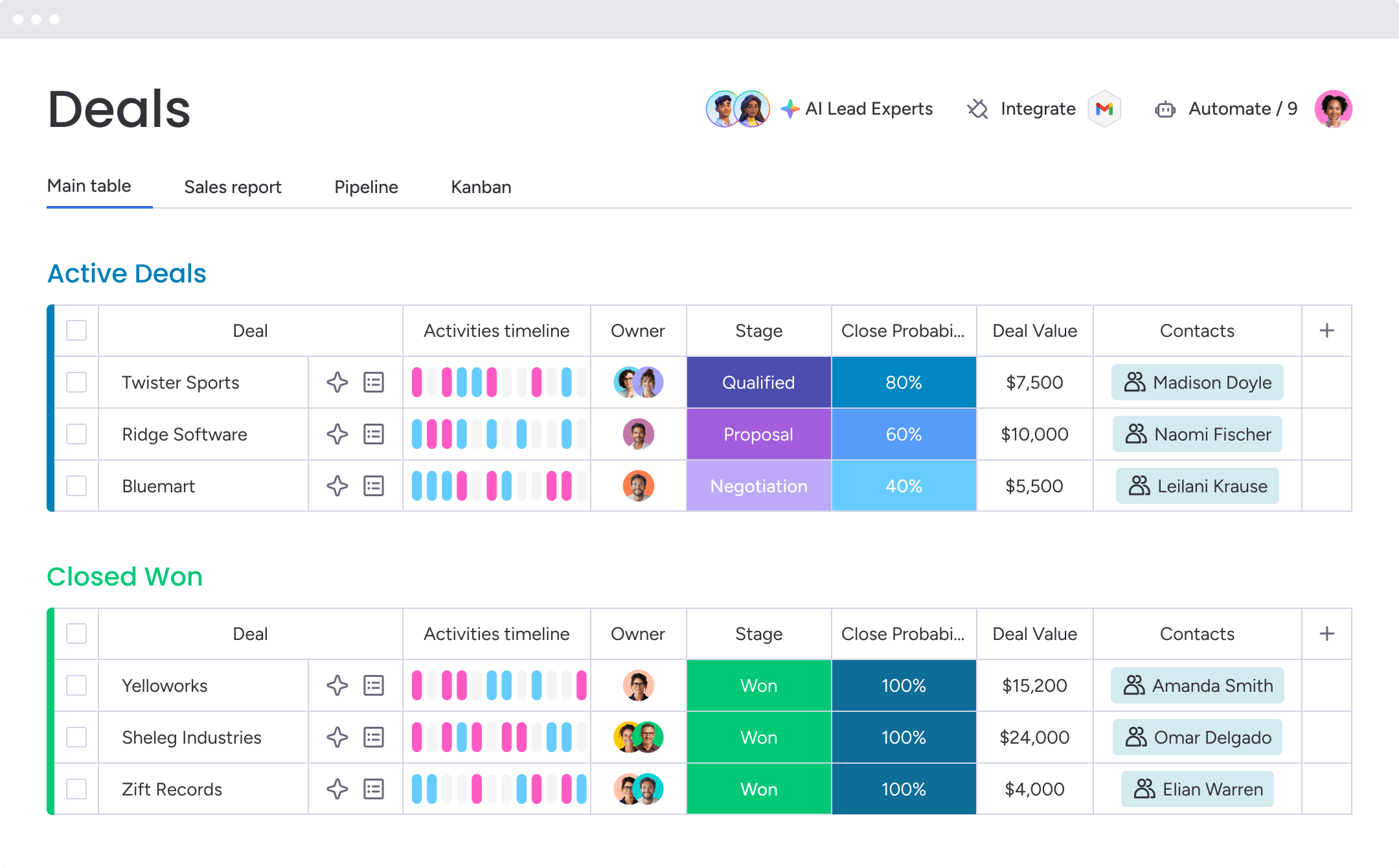
Organizations using monday CRM track all touchpoints across buying group members in a single account view with lead generation software, showing which stakeholders are engaged and which need attention.
7. Turn customer success into your lead generation engine
Your existing customers are your most credible source of new leads — through referrals, case studies, and advocacy. Happy customers can generate leads at a fraction of the cost of other B2B lead generation channels, and referred leads convert at higher rates because they come with built-in trust.
Build a customer advocacy program:
- Formal referral program: Incentives for customers who refer qualified prospects
- Detailed case studies: Document specific results customers achieved
- Video testimonials: Capture customers explaining their challenges and results
- Review site advocacy: Enable customer advocacy on review platforms and social media
- Customer events: Host gatherings where prospects can meet happy customers in person
8. Scale personalization with AI-powered messaging
Personalization improves response rates, but manually personalizing outreach to hundreds of prospects doesn’t scale. AI lets you deliver personalized messaging at scale by analyzing prospect data and generating relevant content in seconds.
AI capabilities for lead generation include:
- Personalized content creation: Analyze prospect information and create customized email copy, LinkedIn messages, or ad content
- Optimal timing: Determine the best send times based on recipient behavior patterns
- Message testing: Generate multiple message versions for A/B testing
- Pattern recognition: Analyze successful conversations to identify what resonates
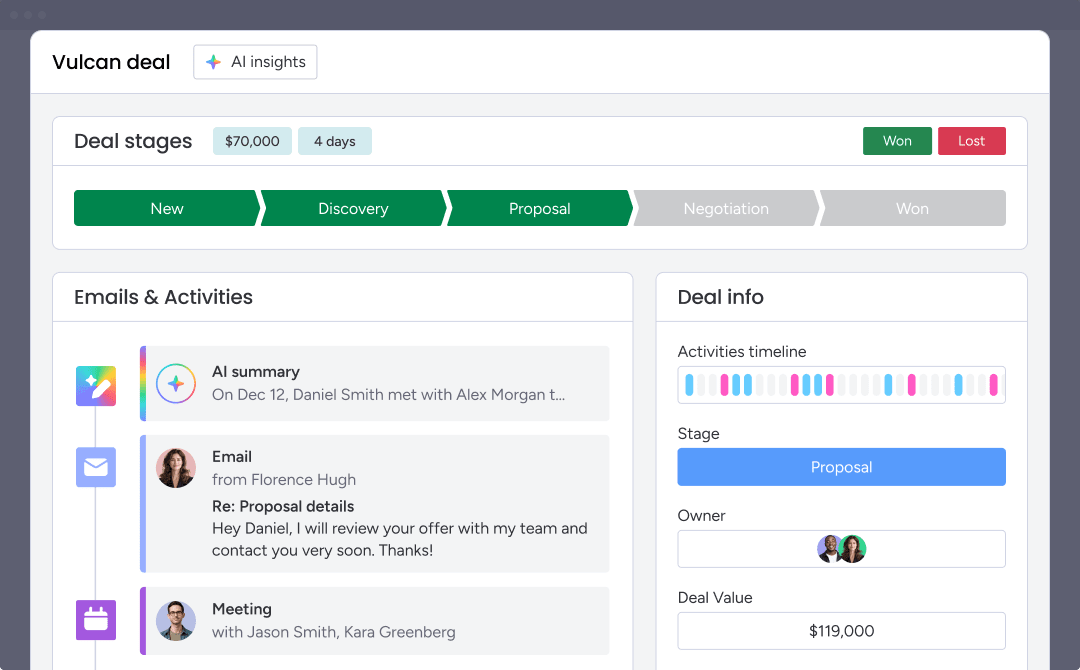
Teams using monday CRM’s AI compose personalized emails based on lead data and conversation history, summarize communication timelines instantly, and extract key information from files. The platform’s autofill features detect sentiment, translate content, and assign labels based on context — no manual effort needed.

9. Position your team as trusted industry advisors
Thought leadership builds trust and attracts inbound leads from prospects who want to work with recognized experts. This works especially well for complex B2B sales where buyers need education and guidance before deciding.
Build thought leadership through:
- Original research: Survey your industry and share unique insights
- Speaking engagements: Present at industry events where your target audience gathers
- Industry publications: Contribute to respected online platforms and trade publications
- Educational webinars: Teach prospects about challenges and best practices
- Social engagement: Participate consistently in industry conversations on LinkedIn and relevant forums
10. Create buyer enablement content that travels
Buyer enablement content is material your champions can share internally to build consensus with their buying group. This content “travels” through the organization without your direct involvement, extending your reach and influence.
Effective buyer enablement content:
- Addresses multiple stakeholder concerns in one comprehensive document
- Provides comparison frameworks for objective evaluation
- Includes ROI justification and business case templates
- Anticipates common objections and provides responses
- Formats easily for sharing across different communication channels
Ask your sales team what questions prospects struggle to answer internally. Then create content that makes your champion look smart when they share it.
Accelerate B2B sales lead generation with AI

AI accelerates B2B lead generation by handling high-volume, time-sensitive work that sales and marketing teams struggle to scale manually — without replacing human judgment or relationship-building. Used well, AI helps teams prioritize the right accounts faster, personalize outreach more consistently, and respond to buying signals in real time.
The biggest impact comes from applying AI at 2 critical moments: qualification and prioritization.
Automate lead qualification without losing context
AI-powered qualification analyzes behavioral, firmographic, and engagement data as it happens — scoring leads continuously instead of relying on static rules or manual review. This allows teams to react while buyer intent is still high, rather than days later.
Common qualification inputs include:
- Website behavior: Pricing page visits, comparison views, and repeat sessions
- Content engagement: Webinar attendance, guide downloads, and demo requests
- Firmographic signals: Company size, industry, growth indicators, and tech stack
- Engagement patterns: Email opens, replies, and interaction frequency
Instead of treating all leads equally, AI updates lead scores dynamically as new signals appear — triggering immediate sales outreach for high-intent accounts and automated nurture for early-stage prospects.
Use predictive scoring to focus sales effort where it matters most
Predictive lead scoring goes beyond basic engagement metrics by learning from historical outcomes. By analyzing patterns across won and lost deals, AI identifies which combinations of signals actually correlate with conversion — not just activity.
Effective predictive scoring models evaluate:
- Which behaviors consistently precede closed-won deals
- How intent signals cluster across buying group members
- When engagement spikes tend to stall versus convert
- Which lead sources produce revenue, not just volume
The result is a prioritized pipeline where sales teams spend time on opportunities that are structurally more likely to close, rather than chasing every inbound lead in order of arrival.
Scale personalization without manual overhead
Personalized outreach improves response rates, but manually tailoring messages across hundreds of accounts doesn’t scale. AI helps generate role-specific messaging based on account data, stakeholder role, and recent activity — while still leaving final review and relationship management to humans.
At scale, AI can support:
- Drafting personalized email and LinkedIn outreach by role
- Summarizing account engagement history before sales conversations
- Testing message variations to identify what resonates by persona
- Flagging sentiment or objections in ongoing conversations
When paired with human oversight, this approach increases relevance without sacrificing quality or trust.
Deploy digital workers for round-the-clock qualification
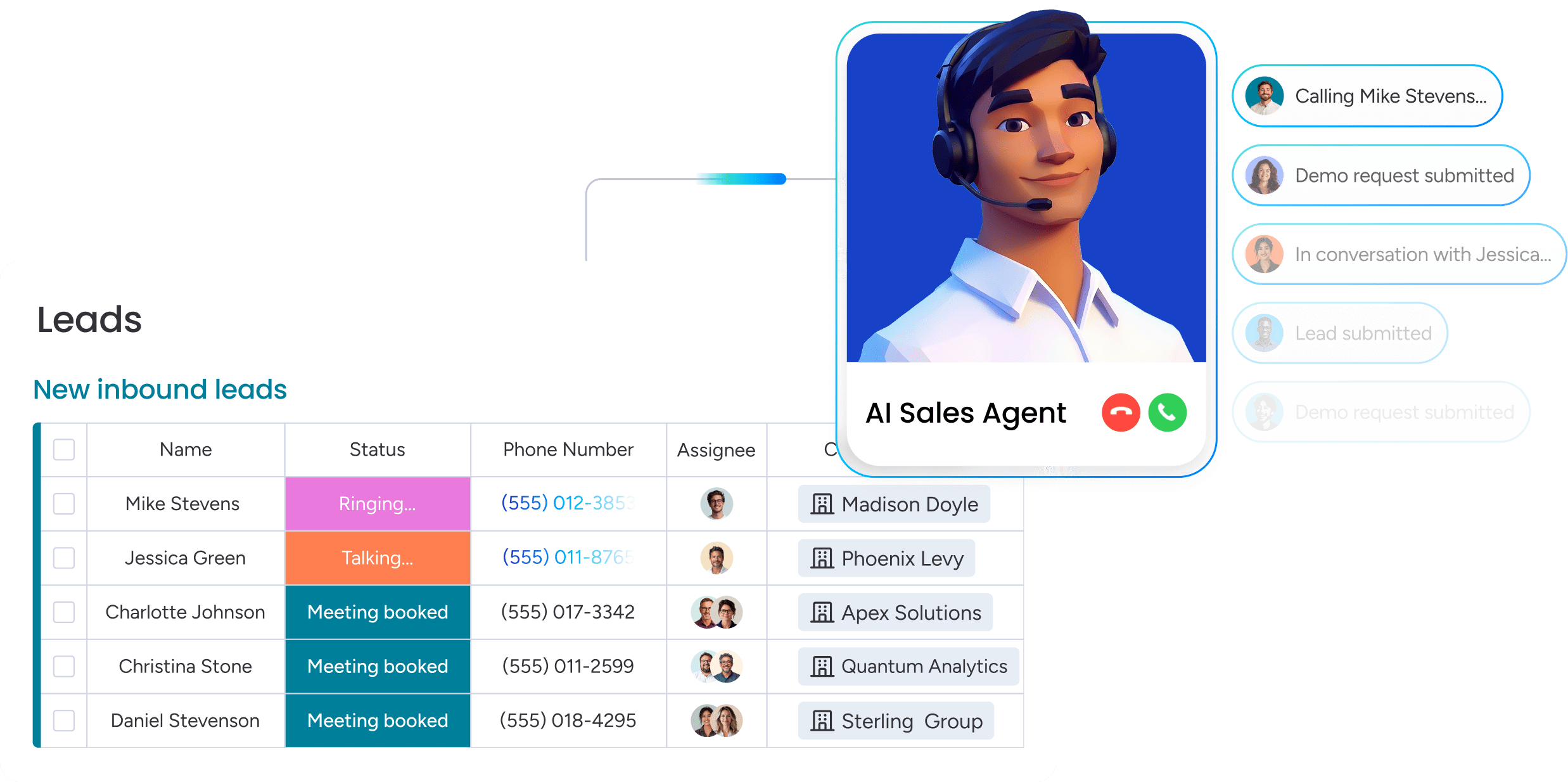
AI-powered assistants are designed to handle specific, well-defined workflows — such as lead qualification and prioritization — at scale. Instead of relying on static rules or manual review, digital workers continuously process incoming signals and update lead status in real time.
In the context of B2B lead generation, their value isn’t autonomy for its own sake — it’s speed and consistency. They ensure that high-intent activity is acted on immediately, regardless of time zone or team capacity, while lower-intent leads are routed into appropriate nurture paths.
Typical lead generation use cases include:
- Always-on lead qualification: Monitor behavioral, firmographic, and engagement signals as they occur and adjust lead priority dynamically.
- Signal-based routing: Trigger sales alerts or workflow changes when intent thresholds are met, without manual intervention.
- Engagement support: Surface relevant context — recent activity, stakeholder role, past interactions — so sales teams enter conversations informed.
- Pattern learning over time: Refine scoring and prioritization logic based on patterns observed in closed-won and closed-lost deals.
Used this way, digital workers don’t replace sales or marketing teams. They remove latency from the lead qualification process, helping teams respond while buyer intent is still high — and preventing qualified opportunities from sitting idle.
Track lead generation success with metrics that matter

Measuring the right metrics is essential for improving lead generation performance and proving ROI to leadership. Vanity metrics like total leads or website traffic don’t predict revenue outcomes. Instead, focus on metrics that connect directly to sales results and provide actionable insights for optimization.
Measure buying group coverage not just lead volume
Traditional lead generation metrics focus on individual lead volume, but B2B sales require engaging multiple stakeholders. Buying group coverage measures how many key decision-makers you’ve identified and engaged within each target account.
Track these coverage metrics:
- Stakeholder identification rate: Percentage of key roles identified per account
- Multi-threading depth: Average number of engaged contacts per opportunity
- Role coverage: Distribution across economic buyers, technical evaluators, and end users
- Engagement breadth: How many stakeholders actively participate in conversations
Deals with 4+ engaged stakeholders close at significantly higher rates than deals with single-threaded relationships. Teams can visualize buying group coverage across their pipeline with monday CRM, showing which accounts need additional stakeholder engagement.
Try monday CRMMonitor pipeline velocity across your sales process

Pipeline velocity is the speed at which leads move through your sales process from first contact to closed deal. This metric reveals bottlenecks and helps you forecast revenue more accurately than static pipeline value.
Key velocity metrics to track:
- Stage conversion rates: Percentage of leads advancing from each stage
- Time in stage: Average duration leads spend in each phase
- Stage-specific bottlenecks: Where deals consistently slow down or stall
- Velocity by lead source: How different channels affect deal speed
Establish baseline metrics for your current pipeline velocity. Identify your slowest-moving stage and focus improvement efforts there first. If you know your average pipeline velocity, you can predict when current opportunities will close and how many new leads you need to hit revenue targets.
Calculate real ROI on every lead source
Not all lead source options are equally valuable. Some generate high volumes of low-quality leads while others produce fewer leads that convert at higher rates. Calculating ROI by source helps you allocate budget to the most effective channels and eliminate underperforming investments.
Measure these ROI metrics:
- Cost per lead: Total spend divided by leads generated
- Cost per qualified lead: Investment required for sales-ready prospects
- Cost per opportunity: Expense to generate qualified sales opportunities
- Cost per customer: Total acquisition cost including sales time
- Customer lifetime value: Long-term revenue potential by source
Track every lead’s source from first touch through closed deal. Compare cost per lead, cost per opportunity, and cost per customer across sources to identify where to invest more and where to pull back.
Use monday CRM to generate more qualified B2B sales leads
With monday CRM, revenue teams gain the tools to execute modern B2B lead generation strategies effectively. The platform centralizes buying group engagement, tracks intent signals in real-time, and uses AI to scale personalization — all in 1 workspace.
- Buying group visibility: Track every stakeholder across complex deals with customizable contact and account views that show engagement status, concerns, and influence level.
- AI-powered personalization: Compose personalized emails based on lead data and conversation history, with AI that understands context and generates relevant messaging in seconds.
- Intent signal monitoring: Centralize behavioral data, website activity, and engagement patterns to identify high-intent prospects ready for outreach.
- Pipeline velocity tracking: Visualize how leads move through your sales process, identify bottlenecks, and forecast revenue with accuracy.
- Multi-channel orchestration: Coordinate email sequences, LinkedIn outreach, and phone calls from a single platform that keeps your entire team aligned.

Start generating qualified leads that convert to revenue
Effective B2B lead generation in 2026 means engaging entire buying groups — not individual contacts — because modern purchases involve many stakeholders across departments. Success comes from building strong foundations first: define your ideal customer profile with precision, map all stakeholders in your buying groups, and identify high-intent signals worth acting on. Then implement 3-4 strategies that align with your resources and where your target audience spends time.
Ready to generate qualified leads that actually convert? Try monday CRM to centralize buying group engagement, track intent signals in real-time, and use AI to scale personalization across your entire sales process.
Try monday CRM
“With monday CRM, we’re finally able to adapt the platform to our needs — not the other way around. It gives us the flexibility to work smarter, cut costs, save time, and scale with confidence.”
Samuel Lobao | Contract Administrator & Special Projects, Strategix
“Now we have a lot less data, but it’s quality data. That change allows us to use AI confidently, without second-guessing the outputs.”
Elizabeth Gerbel | CEO
“Without monday CRM, we’d be chasing updates and fixing errors. Now we’re focused on growing the program — not just keeping up with it."
Quentin Williams | Head of Dropship, Freedom Furniture
“There’s probably about a 70% increase in efficiency in regards to the admin tasks that were removed and automated, which is a huge win for us.“
Kyle Dorman | Department Manager - Operations, Ray White
"monday CRM helps us make sure the right people have immediate visibility into the information they need so we're not wasting time."
Luca Pope | Global Client Solutions Manager at Black Mountain
“In a couple of weeks, all of the team members were using monday CRM fully. The automations and the many integrations, make monday CRM the best CRM in the market right now.”
Nuno Godinho | CIO at VelvFAQs
What is the fastest way to generate B2B leads?
The fastest way to generate B2B leads is combining intent data monitoring with multi-touch outbound sequences in B2B lead generation, allowing you to reach prospects at the exact moment they're actively researching solutions.
How many touchpoints does it take to convert a B2B lead?
B2B leads typically require 8 to 12 touchpoints across multiple channels before responding, with varied channels increasing visibility while preventing message fatigue.
What is the difference between MQL and SQL?
A Marketing Qualified Lead (MQL) has shown interest through content engagement or website behavior, while a Sales Qualified Lead (SQL) has been vetted by sales and confirmed as ready for direct sales conversation.
How do you qualify B2B leads effectively?
Effective B2B lead qualification involves assessing fit against your Ideal Customer Profile, evaluating buying intent signals, and confirming budget, authority, need, and timeline through discovery conversations.
What is account-based marketing in B2B?
Account-based marketing (ABM) is a focused strategy where you treat individual high-value accounts as "markets of 1," creating personalized campaigns that engage multiple stakeholders within each target company.
How do you measure B2B lead generation success?
Measure B2B lead generation success through buying group coverage, pipeline velocity, stage conversion rates, and cost per customer by source rather than focusing solely on total lead volume.

 Get started