

A structured sales funnel transforms unpredictable revenue into consistent, forecasted growth. With the right funnel in place, you gain visibility to spot bottlenecks fast, forecast accurately, and create the discipline that turns pipeline chaos into predictable results.
This guide walks you through 5 practical steps to build a sales funnel your team will actually use. You’ll learn how to define your ideal customer, design lead capture that works across channels, build qualification criteria your reps will follow, create nurture sequences that move deals forward, and track performance with real-time visibility.
Key takeaways
- Map your 5 funnel stages to how customers actually research and buy, then track conversion rates between each stage to spot bottlenecks.
- Analyze your most profitable accounts for patterns in company size, industry, and buying behavior instead of guessing who should buy from you.
- Set up behavioral email sequences and lead scoring that respond to prospect actions, so your team focuses on selling instead of administrative tasks.
- Focus on conversion rates between stages, sales velocity, and forecast accuracy to identify what’s actually slowing down your deals.
- Create funnel stages that match how you actually sell with monday CRM’s customizable pipeline stages, automated follow-ups based on deal progression, and real-time visibility through sales-specific dashboards.
What is a sales funnel?
A sales funnel is a visual representation of the customer journey from initial awareness to purchase and beyond. It maps how prospects move through stages as they progress toward becoming customers, with the number of prospects typically narrowing at each stage as some drop off and others advance.
For revenue teams struggling with predictability, a well-built sales funnel shows you which deals will close this quarter. Instead of guessing whether targets will be hit, teams can see exactly where opportunities sit in the pipeline and what’s required to move them forward. This visibility turns forecasting from guesswork into something you can actually trust.
The funnel shows you exactly where prospects get stuck. When conversion rates drop between specific stages, teams can identify the bottleneck and fix it. This visibility allows you to allocate resources based on evidence instead of gut feeling.
The reality of B2B buying journeys
B2B buying isn’t linear anymore. Buyers research independently before talking to sales, engage across multiple channels simultaneously, and involve multiple stakeholders in decisions. A single deal might include website visits, content downloads, email exchanges, social media interactions, and calls with different team members before a proposal is even requested.
This complexity means you need to track every touchpoint. Without a structured funnel, teams lose visibility into buyer behavior. Follow-up opportunities get missed. Sales, marketing, and account management struggle to coordinate because no one has the complete picture.
The challenge compounds when communication is scattered across email inboxes, spreadsheets, and disconnected systems. A prospect might have a great conversation with one rep, then receive a generic email from marketing that ignores everything discussed. These disconnects erode trust and slow deals.

5 benefits of building an effective sales funnel
An effective sales funnel does more than organize your deals. When built right, it becomes your operating system for revenue — giving teams the structure to work smarter and leaders the data to make more informed decisions.
Here’s what a sales funnel does for revenue teams:
- Predictable revenue forecasting: Track conversion rates and velocity at each stage to calculate expected revenue with confidence rather than hoping targets will be met.
- Resource allocation optimization: Assign the right people to the right opportunities, with high-value deals in late stages getting senior attention while early-stage prospects receive appropriate nurturing.
- Bottleneck identification: Reveal where prospects get stuck, enabling targeted improvements when you see specific drop-off patterns between stages.
- Team accountability: Define clear entry and exit criteria for each stage so everyone knows what qualifies a lead for advancement and who owns each opportunity.
- Data-driven decision making: Use funnel metrics to inform strategy adjustments with evidence, shifting resources based on actual conversion data.
Understanding the 5 sales funnel stages that drive revenue
Some models use 3-4 stages, others use 7+. Our 5-stage framework hits the sweet spot, matching how buyers actually buy and how your team actually sells. Each stage requires a different approach because buyers have different needs.
| Stage | What happens | Goal | Key metrics |
|---|---|---|---|
| Awareness | Prospects discover your brand through content, ads, or outreach | Generate interest and traffic | Website traffic, impressions, CTR |
| Interest | Prospects engage with your content and learn more | Capture leads and build interest | Time on page, content downloads, engagement rate |
| Consideration | Leads evaluate your solution against alternatives | Move leads toward intent | Demo requests, email engagement, MQLs |
| Conversion | Prospects make a purchase decision | Close deals | Conversion rate, win rate, sales cycle length |
| Expansion | Customers renew, upgrade, or refer others | Increase lifetime value | Retention rate, upsell rate, LTV |
Now let’s take a deeper look at each stage.
1. Awareness: Building problem recognition
Awareness is where potential buyers recognize they have a problem and discover your company exists. They’re not evaluating solutions yet. They’re still defining their challenge and understanding what’s possible.
Key activities include:
- Content marketing and SEO
- Social media presence and paid advertising
- Events and referrals
Don’t sell here. Educate and build credibility. Success means the prospect acknowledges their problem and remembers your brand as a potential resource.

2. Interest: Generating solution curiosity
In the Interest stage, prospects actively research solutions and engage with your content or team. They’re researching options but not yet narrowing down vendors. Their questions shift from “What’s my problem?” to “What solutions exist?”
Key activities include:
- Providing educational resources like guides and webinars
- Responding to inquiries
- Nurturing through email sequences
- Qualifying basic fit
Success means the prospect engages repeatedly with your content or requests more information.
3. Consideration: Evaluating specific options
In Consideration, prospects evaluate specific vendors, comparing features, pricing, and fit. They’re building a shortlist and involving decision-makers. The question shifts to “Which solution is right for us?”
Key activities include:
- Product demonstrations
- Detailed proposals
- Addressing objections
- Providing ROI calculations
- Facilitating conversations with multiple stakeholders
Success means the prospect includes you in their final evaluation and introduces you to key decision-makers.
4. Decision: Finalizing the purchase
In Decision, prospects finalize their choice, negotiate terms, and commit to purchase. This includes contract review, final approvals, and addressing last-minute concerns.
Key activities include:
- Contract negotiation
- Legal review coordination
- Final pricing discussions
- Implementation planning
- Securing executive sign-off
Success means a signed contract and defined next steps for onboarding.
5. Retention and expansion: Maximizing customer value
Retention is about keeping customers successful, preventing churn, and finding upsell opportunities. This stage gets overlooked, but it’s where sustainable revenue growth happens.
Key activities include:
- Onboarding support
- Regular check-ins
- Usage monitoring
- Gathering feedback
- Identifying expansion opportunities
- Facilitating renewals
Success means high product adoption, positive customer health scores, and identification of expansion opportunities.
Try monday CRMHow to build a sales funnel that actually converts
Building a high-converting sales funnel requires more than mapping stages. You need a structured system that connects your ideal customer, lead capture, qualification, and nurturing into a cohesive process.
These 5 steps break down how to build a funnel that consistently generates and converts demand:
Step 1: Define your ideal customer without overcomplicating
You can’t build an effective sales funnel without knowing who you’re targeting. The goal is a customer definition clear enough to guide daily decisions. Knowing your ideal customer is the foundation for effectively qualifying leads, creating relevant content, and prioritizing opportunities.
This foundation shapes everything — your messaging, your qualification criteria, your entire approach. Teams that skip this step end up chasing prospects who never convert or take forever to close.
Mine your best customers for insights
The most reliable way to define your ideal customer is analyzing your existing customer base. Look for patterns among your most successful, profitable, and satisfied customers. This approach beats guessing who should buy from you.
| Stage | Primary metrics | Why it matters |
|---|---|---|
| Awareness | Traffic, impressions | Measures reach and visibility |
| Interest | Engagement rate, leads | Shows content effectiveness |
| Consideration | MQL to SQL rate | Indicates lead quality |
| Conversion | Close rate, deal value | Tracks revenue generation |
| Expansion | Retention, LTV | Measures long-term growth |
Start with CRM data analysis. Pull reports on your top customers by revenue and look for commonalities. Conduct customer interviews to understand why they bought and what problems you solved. Sales team input adds qualitative context that data alone can’t provide.
Create buyer personas teams actually use
Buyer personas should be practical tools that focus on the different roles involved in buying decisions. Each persona needs specific elements that tell your team how to approach that buyer.
Essential persona elements include:
- Role and responsibilities: What they’re accountable for in their organization
- Challenges and pain points: The specific problems they face daily
- Goals and success metrics: How they measure their own performance
- Buying behavior: How they research and evaluate solutions
- Common objections: The concerns they typically raise
Document personas in a simple, accessible format. One-page summaries are more effective and accessible than lengthy reports. Share them across sales, marketing, and customer success teams so everyone operates from the same understanding.
Step 2: Build lead capture that converts across channels

Once you know your ideal customer, you need systems to capture leads from every channel where they engage. Fragmented lead capture creates data silos, duplicate records, and deals that slip through the cracks.
The challenge is creating a unified system that captures leads consistently, no matter where they first engage. This means thinking strategically about what motivates prospects to share their info, then executing across multiple touchpoints.
Design lead magnets people want
Lead magnets are valuable resources offered in exchange for contact information. Effective lead magnets solve a specific problem and deliver value immediately. These formats work:
- Problem-specific guides: Address one specific challenge your ideal customer faces with actionable solutions
- Templates and frameworks: Provide ready-to-use resources that save time and eliminate guesswork
- Assessment tools: Help prospects evaluate their current situation while qualifying them for your solution
Match the lead magnet to where the prospect is in their buying journey. Early-stage prospects want educational content while later-stage prospects need evaluation tools.
Create landing pages that convert
Landing pages are dedicated pages designed to convert visitors into leads by focusing on a single offer. Effective landing pages remove distractions and communicate value clearly.
Essential elements include:
- A headline stating the specific benefit
- A concise value proposition
- Relevant visuals that reinforce the offer
- Minimal form fields requesting only essential information
- Strong action-oriented button text
Landing pages should match the messaging and design of the source that drove traffic. A prospect clicking from a LinkedIn ad should see consistent messaging on the landing page.
Set up omnichannel capture points
Leads enter your funnel through multiple channels. The challenge? Capturing and centralizing this information consistently. Website forms, chatbots, social media lead forms, events, email signatures, and referral tracking all need to feed into a unified system.
Centralizing lead capture ensures no lead falls through the cracks and gives teams a unified view of which channels drive the most valuable results. Using a centralized CRM allows you to integrate these various channels to automatically capture and centralize lead data, ensuring every lead enters the same system regardless of source.
Step 3: Implement qualification your team will actually follow
Some leads are worth more than others. Qualification separates good-fit prospects from time-wasters. The challenge? Creating a system that’s objective and consistently applied.
What does “qualified” mean on your team, in writing, not vibes? Without defined criteria, qualification becomes subjective and inconsistent. Some reps chase every lead while others are too selective, creating unpredictable pipeline flow.

Define qualification criteria
Qualification criteria are the attributes and behaviors that show a prospect is a good fit and likely to buy. Criteria should be objective and observable.
| Criteria | Description | Example |
|---|---|---|
| Fit | Matches your ideal customer profile | Industry, company size |
| Interest | Demonstrates engagement | Downloads, email clicks |
| Authority | Has decision-making power | Job title, role |
| Budget | Can afford your solution | Revenue range |
| Timing | Ready to buy soon | Requested demo, urgent need |
Common frameworks like BANT or MEDDIC provide starting points. Customize these frameworks based on your specific sales process. Document the criteria clearly so every team member applies the same standards.
Build a simple lead scoring system
Lead scoring ranks prospects based on their fit and engagement level, helping teams prioritize who to contact first. Keep your scoring system simple enough to understand and maintain.
Key components include:
- Assign point values to fit criteria and engagement behaviors
- Define scoring thresholds for sales-ready versus marketing-qualified leads
- Weight criteria appropriately based on buying signals
- Update scores automatically as prospects take actions
A demo request might be worth 30 points while an email open might be worth 1. A robust CRM can automate lead scoring based on defined criteria, updating scores in real-time as prospects take actions. The platform’s Autofill with AI feature can assign labels and route leads to the right team members based on text analysis from emails and activities.
Try monday CRMStep 4: Design nurture sequences that move deals forward
Most prospects aren’t ready to buy immediately. They need education, trust-building, and timely follow-up. Nurture sequences keep prospects engaged without requiring constant manual outreach.
Stay top-of-mind by providing value at each stage of the buyer’s journey. Effective nurturing feels helpful, not pushy, and responds to prospect behavior rather than following rigid timelines.
Match content to funnel stages
Prospects need different information at different funnel stages. Sending the wrong content at the wrong time creates confusion or pushes too hard.
| Funnel stage | Content types | Purpose |
|---|---|---|
| Awareness | Blog posts, industry reports, problem-focused guides | Build credibility and educate prospects on key challenges |
| Interest | Solution overviews, webinars, case studies | Demonstrate your approach and establish expertise |
| Consideration | Product demos, feature comparisons, ROI calculators | Support evaluation and differentiate your solution |
| Decision | Pricing pages, implementation guides, executive briefings | Facilitate approval and remove friction from the buying process |
Content delivery should be triggered by stage progression, not just time intervals. When a prospect moves from interest to consideration, they should immediately receive consideration-stage content.
Create behavioral email workflows

Behavioral email workflows are automated sequences triggered by what prospects do (or don’t do). These workflows respond to actual engagement rather than arbitrary timelines.
Key workflow components include:
- Trigger definition: What action starts the sequence
- Sequence structure: Number and timing of emails
- Personalization elements: Dynamic content based on prospect data
- Defined next steps: Clear calls-to-action for each email
- Re-engagement paths: What happens if prospects don’t respond
Organizations using monday CRM benefit from automated email follow-ups and mass email tracking including open rate and link clicks, ensuring consistent execution without manual intervention.
Use AI for personalization at scale

Personalization improves engagement and conversion, but manually personalizing outreach for hundreds of prospects is impossible. AI makes personalization scalable by analyzing prospect data and behavior to customize messaging.
Teams discover that monday CRM’s AI capabilities support this personalization effectively:
- AI Timeline Summary: Creates a short summary of all communication events, helping sales teams save valuable time before calls
- Detect sentiment: Analyzes prospect responses to gauge interest level
- Compose emails: Helps reps draft personalized emails based on prospect context and conversation history
Step 5: Track performance with real-time visibility

Building a sales funnel only matters if you can measure its performance and spot what needs fixing. The right metrics show you what’s working and what’s not.
If conversion dips this month, do you know what lever to pull, or do you just demand “more activity”? Defined metrics empower teams to address root causes instead of reacting to symptoms.
Choose metrics that matter
Effective funnel tracking focuses on metrics that actually drive decisions. The right metrics vary by business model and sales cycle, but certain categories matter for everyone.
- Volume metrics: Track leads by stage, conversion rates, and time in stage to reveal pipeline health and flow.
- Velocity metrics: Monitor sales cycle length, response time, and progression speed to understand deal momentum and efficiency.
- Quality metrics: Measure lead-to-opportunity rate and opportunity-to-close rate to assess lead source and qualification effectiveness.
- Revenue metrics: Analyze pipeline value, forecast accuracy, and win rate to gauge business performance and predictability.
Conversion rates between each funnel stage tell you exactly where deals stall. A low awareness-to-interest conversion rate indicates a lead quality or messaging problem. A low consideration-to-decision rate suggests competitive or pricing issues.
Build dashboards for daily decisions
Dashboards visualize funnel metrics in real-time, so you can quickly assess performance and spot issues. The best dashboards are built for specific roles and drive action.
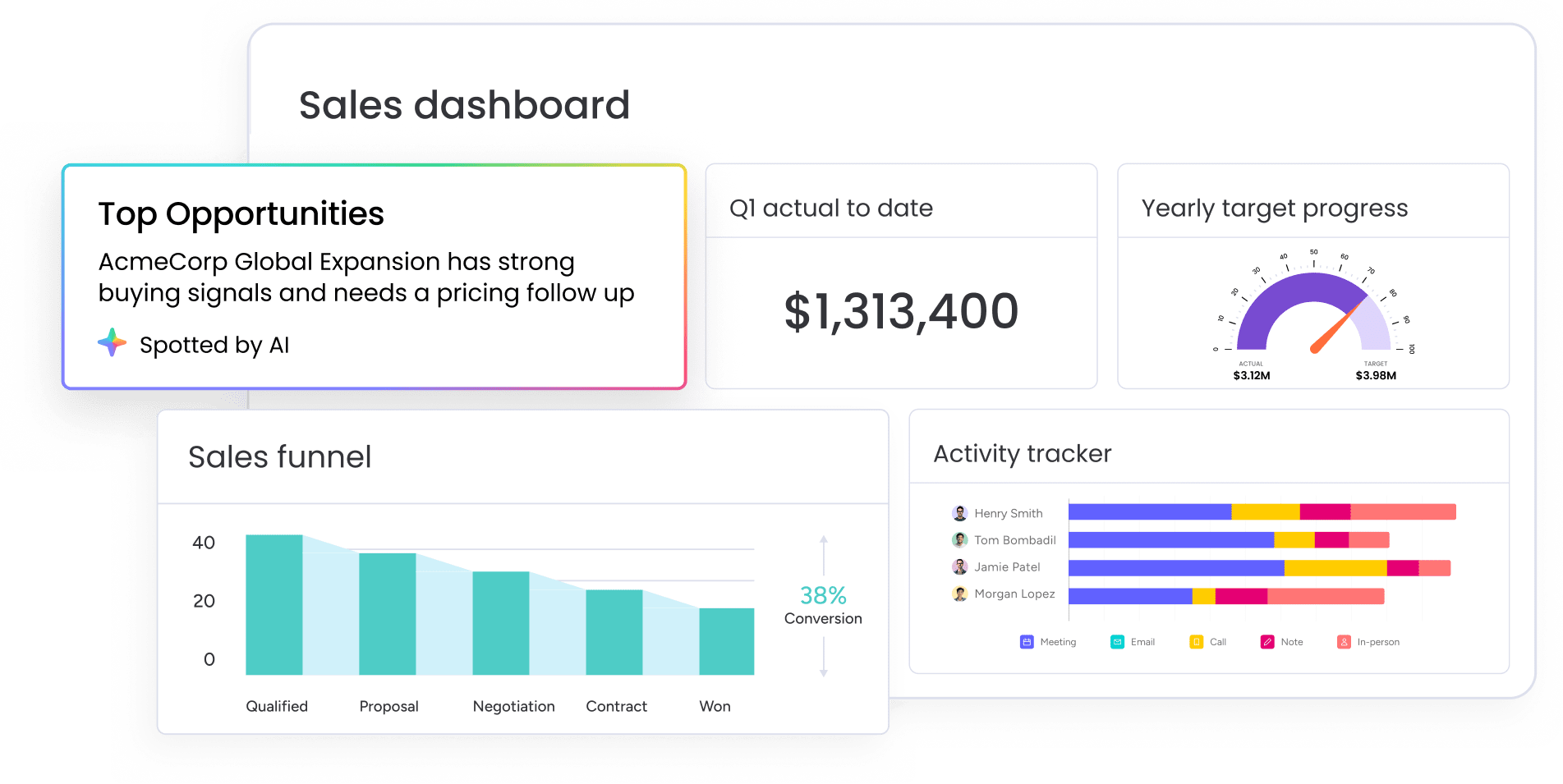
Revenue teams achieve more predictable results by leveraging customizable dashboards with real-time data. The platform includes sales-specific widgets like the leaderboard and funnel to see the strong and weak points in your pipeline. Teams gain immediate insights into sales pipeline status, sales forecasting, team performance, and activity status with code-free, customizable dashboards.
How monday CRM transforms your sales funnel
Strategy alone won’t build an effective sales funnel. You need a platform that makes execution easy without the complexity that kills adoption.
Revenue teams need tools that adapt to their process rather than forcing them into rigid frameworks. The platform should eliminate manual work while giving leaders the visibility they need to make better decisions.

Customizable pipeline stages that match your process
Teams using monday CRM can define funnel stages that reflect how their buyers actually buy and how their sellers actually sell. Customize your pipeline with drag-and-drop deal stages and automate actions based on custom conditions. Each stage can include:
- Entry criteria that must be met
- Required activities before progression
- Automated notifications to relevant team members
- Time-based triggers for follow-up actions
Centralized communication that eliminates silos
Every customer interaction lives in one timeline visible to everyone who needs it. When a prospect moves from marketing to sales to account management, the full history travels with them. The AI Timeline Summary simplifies the research process by creating a short summary of all communication events.
This eliminates the disconnects that erode trust and slow deals. No more prospects receiving generic emails that ignore previous conversations or reps starting from scratch because they can’t find the interaction history.
Automation that removes manual work
The platform’s automation capabilities handle the repetitive work that slows teams down, freeing them to focus on high-value activities. For example, you can automate:
- Email follow-ups: Automatically send sequences based on prospect behavior
- Lead routing: Assign leads to the right team members based on defined rules
- Task creation: Generate follow-up tasks when deals reach specific stages
- Data entry: The Autofill with AI feature extracts information from files like invoices, resumes, or contracts, eliminating manual input
Real-time dashboards for instant visibility
Pre-built and customizable dashboards provide the visibility that revenue leaders need. Use sales-specific widgets like the sales funnel widget and sales pipeline widget to see pipeline health at a glance. Track forecast vs. actual sales and drill down by month, sales rep, or any other criteria.
Building funnels that actually work for your team
Sales funnels aren’t just theoretical frameworks. They’re practical systems that create predictable revenue growth. The difference between teams that hit their targets consistently and those that struggle often comes down to funnel discipline.
Teams that succeed with sales funnels focus on execution over perfection. They start with a simple framework, measure what matters, and iterate based on real data. They use technology to eliminate manual work while maintaining the human touch that builds relationships.
Choose tools that support your process instead of forcing you into someone else’s idea of how sales should work. When your team can focus on selling instead of fighting their systems, results follow naturally.
Try monday CRMFAQs
What is the difference between a sales funnel and a sales pipeline?
The difference between a sales funnel and a sales pipeline is their focus: a sales funnel represents the buyer's journey from awareness to purchase, while a sales pipeline represents the seller's process and the specific steps sales teams take to close deals.
How long should a sales funnel be?
Sales funnel length depends on deal complexity, price point, and buyer behavior. Simple purchases might have a funnel measured in days while complex enterprise deals might span 6-18 months.
How do I know if my sales funnel is working?
A working sales funnel shows consistent conversion rates between stages, predictable velocity, and forecasts that match actual results. Warning signs include deals clustering in certain stages without progressing.
What is the best CRM for managing a sales funnel?
The best CRM for managing a sales funnel is one that your team will actually use. Look for customizable pipeline stages, automation that reduces manual work, real-time visibility into funnel metrics, and integration with your existing systems. Look for customizable pipeline stages, automation that reduces manual work, real-time visibility into funnel metrics, and integration with your existing systems.
How often should I review and update my sales funnel?
Review funnel performance weekly through dashboards and metrics. Conduct deeper analysis monthly to identify trends and update funnel structure quarterly based on what you've learned.
Can I have multiple sales funnels for different products or segments?
Yes, different products, customer segments, or sales motions often require different funnel structures. The key is ensuring funnels share common data and reporting so leadership has unified visibility across all segments.

 Get started