


SDRs are often overwhelmed by manual execution. Hours are lost to prospect research, email drafting, and CRM maintenance: time that should be dedicated to high-value conversations with potential customers. As quotas increase and competition intensifies, the traditional model faces a mathematical impossibility: reaching a larger volume of prospects within the same limited time frame.
AI fundamentally changes this dynamic. By managing repetitive tasks such as initial research, data entry, and routine follow-ups, AI allows SDRs to prioritize the human interactions that drive deal closure. Rather than replacing the SDR, technology handles the operational burden so the representative can focus on strategy.
The following seven steps outline how to automate SDR workflows: from lead research to performance tracking. This guide identifies the specific tasks best suited for automation and provides a framework for implementation within a flexible Work OS.
Key takeaways
- Prioritize high-impact automation wins: focus on lead research, email personalization, and follow-up sequences first. These optimizations save fifteen or more hours weekly while significantly boosting response rates.
- Assign data tasks to AI and relationships to humans: allow AI to manage research, scoring, and scheduling. This shift enables SDRs to concentrate on building authentic connections and closing deals.
- Adopt technical solutions without complexity: solutions likie monday CRM allows teams to add AI blocks to workflows, automate data entry, and create custom sequences using visual builders with no coding required.
- Measure ROI through time savings and pipeline velocity: track hours reclaimed, accelerated deal progression, and improved conversion rates to demonstrate the value of automation within 60 days.
- Implement systematically through pilot programs: begin with a small group of two or three SDRs and a limited number of automations. Scale successful workflows across the entire organization to ensure sustainable adoption.
What can AI automate in SDR workflows today?
AI automation for SDRs has moved past basic email templates into sophisticated capabilities that handle complex research, personalization, and decision-making. The technology works behind the scenes, managing repetitive tasks while SDRs focus on relationship-building and strategic selling.
Understanding which tasks AI handles effectively versus which still need human judgment matters. While AI excels at pattern recognition and data-intensive execution, strategic success depends on knowing when to step in. But what happens when a conversation requires nuanced understanding or the ability to read a room?
Automate lead research and enrichment
AI pulls prospect data from everywhere: social profiles, company databases, public records. It builds full lead profiles without you lifting a finger. The system pulls company size, recent news, funding rounds, key decision-makers, technology stack, and competitive positioning without manual searching. Research time drops from 15-20 minutes per lead to under two.
AI automates the time-consuming data gathering that previously occupied hours of an SDR’s day. For leaders, this means your team’s resources are reallocated from manual research to high-value, revenue-generating activities.
Key data categories AI enriches automatically:
- Company firmographics: revenue, employee count, industry classification, and growth trajectory pulled from business databases
- Recent company activity: news mentions, product launches, executive changes, and funding announcements aggregated from news sources
- Technology stack identification: current software the prospect uses, revealing integration opportunities and competitive positioning
- Social media insights: linkedIn activity, professional interests, and engagement patterns that inform personalization strategies
- Contact verification: email validation, phone number verification, and direct dial discovery that improve connection rates
With advanced platforms like monday CRM, AI enriches lead data right inside your workflow. All lead data is enriched directly within a single, unified workflow.
Scale email personalization with AI
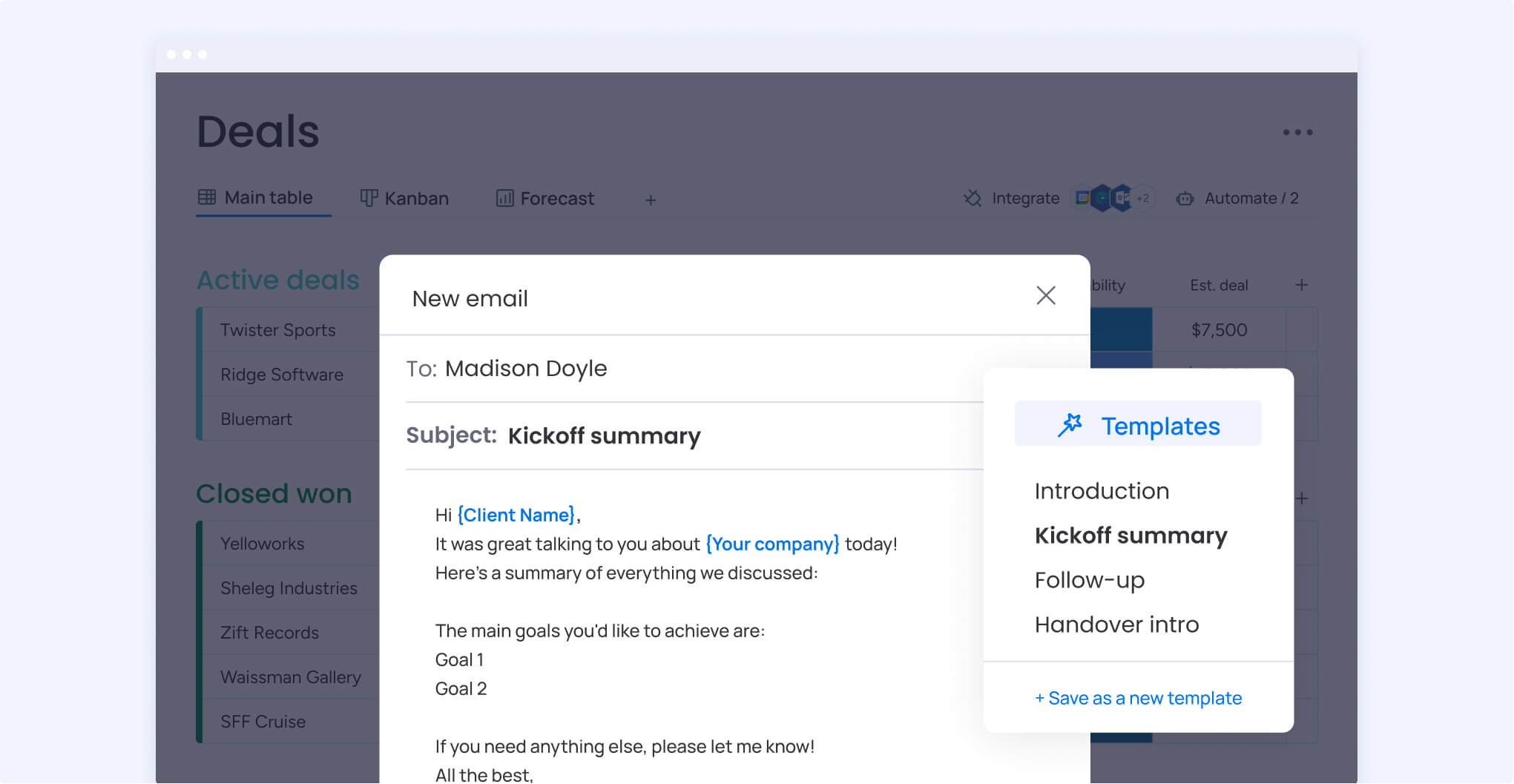
AI analyzes prospect data to create personalized AI email content that goes far beyond inserting a first name. The system examines company industry, recent achievements, mutual connections, shared interests, and specific pain points to craft messages that feel individually written.
This isn’t template personalization, where you just swap in variables. AI reads context, so a prospect who just raised funding gets different messaging than one whose company announced layoffs. The system adapts tone, focus, and value proposition based on the prospect’s current situation and likely priorities.
How AI personalization works:
- Context analysis: reviews company news, industry trends, and recent events affecting the prospect.
- Behavioral insights: examines past engagement patterns to determine messaging preferences.
- Performance learning: identifies which personalization elements drive engagement and refines approach over time.
Implement automated follow-up sequences
AI triggers follow-ups based on how prospects behave: opens, clicks, responses. The system monitors email opens, link clicks, website visits, and content downloads to determine the next action. A prospect who opened your email three times but didn’t respond gets different follow-up than one who clicked through to your pricing page.
Sequences adapt based on what prospects do. No more one-size-fits-all drip campaigns.
Behavioral triggers that drive sequence decisions:
- Engagement signals: open rates, click-through behavior, and time spent on linked content determine follow-up timing and messaging.
- Response patterns: AI identifies prospects showing buying signals versus those needing more nurturing.
- Channel preference: the system notes which communication channels generate responses and shifts follow-up accordingly.
- Optimal timing: machine learning identifies the days and times to reach specific prospects based on their historical engagement.
Streamline meeting scheduling and calendar management
AI handles the scheduling back-and-forth. Time zones, availability, preferences: all automatic. The system suggests optimal meeting times based on both parties’ calendars, handles rescheduling requests, and sends automatic reminders.
No more three to four email exchanges just to book one meeting. It updates CRM records automatically when meetings are booked, moved, or done. Your pipeline stays current without manual work.
For SDRs managing 50+ prospects simultaneously, this automation saves five to seven hours per week previously spent on scheduling logistics, according to research from HubSpot (2023).
Automate lead scoring and qualification
AI scores leads automatically using behavior, company data, and engagement patterns. The system evaluates website visits, content consumption, email engagement, company fit, and buying signals to identify sales-ready leads.
Scoring covers behavior and company fit, giving SDRs the full picture of lead quality.
| Scoring category | What AI evaluates | Impact on prioritization |
|---|---|---|
| Behavioral indicators | Website visit frequency, pages viewed, pricing page visits | High engagement signals active evaluation |
| Engagement quality | Email open rates, content downloads, webinar attendance | Consistent engagement indicates genuine interest |
| Firmographic fit | Company size, industry, revenue, growth stage | Alignment with ideal customer profile |
| Buying signals | Job changes, company expansion, technology evaluations | Active buying intent indicators |
| Historical patterns | Similarities to past converted customers | Predictive conversion likelihood |
AI refines its scoring based on which leads convert. It gets smarter over time and adapts to market shifts.
6 high-impact AI SDR tasks that drive revenue
AI can automate numerous SDR responsibilities, though six core areas provide the highest return on investment. Leading sales teams automate these workflows first to maximize time savings and revenue output. In traditional models, these tasks act as productivity bottlenecks where manual labor hinders scalability.
By shifting these to an automated framework, teams achieve greater consistency and more effective prospect engagement.
Task 1: intelligent lead prioritization
AI ranks prospects by conversion likelihood using behavior, company fit, and buying signals. It’s way smarter than traditional lead scoring. The system evaluates dozens of data points simultaneously: website visit patterns, content engagement, company growth indicators, technology stack changes, and behavioral similarities to past customers who converted.
In contrast to traditional lead scoring that uses fixed rules, AI updates in real time as new info comes in, so SDRs always focus on the hottest prospects.
Key prioritization signals AI evaluates:
- Intent signals: recent website visits to pricing pages, product comparison content, or case studies indicating active evaluation.
- Engagement velocity: increasing frequency of interactions suggesting growing interest and urgency.
- Timing indicators: job changes, company expansions, funding rounds, or other events creating buying windows.
- Competitive context: technology stack analysis revealing incumbent solutions and potential switching opportunities.
With solutions like monday CRM, revenue teams use AI to label and prioritize leads based on custom criteria. No technical setup needed.
Task 2: multi-channel outreach automation
AI coordinates outreach across email, LinkedIn, and phone based on how prospects respond. The system determines the channel for each prospect by analyzing their historical engagement, professional role, and communication patterns.
A prospect who consistently ignores emails but engages on LinkedIn gets more LinkedIn outreach. Someone who responds to phone calls gets more call attempts. As a result, response rates jump because you’re reaching prospects where they actually want to talk.
Task 3: real-time call summaries
AI listens to calls and creates summaries, action items, and next steps. No manual notes, nothing missed. The system captures key pain points discussed, budget information, decision-making process details, timeline expectations, and competitive considerations.
Summaries update CRM records automatically. Your pipeline stays current without the admin work. This saves SDRs 30-45 minutes daily previously spent on call documentation while improving data quality.
AI timeline summary provided by solutions like monday CRM creates quick recaps of all communication: emails, calls, meetings, notes. Sales teams save hours on research and context.
Task 4: adaptive email sequences
AI adjusts email sequences in real time based on what prospects do. No more static drip campaigns. The system monitors email opens, link clicks, website visits, content downloads, and social media engagement to determine the next message.
A prospect who clicked your pricing link gets different follow-up than one who downloaded a case study. Sequences adapt content, timing, and intensity based on buying signals.
Task 5: automated CRM data entry
AI captures and updates prospect info, interaction history, and deal progress automatically. No more spending 30-45 minutes a day on data entry.
The system extracts information from emails, calls, meetings, and LinkedIn conversations to keep CRM records current. This includes contact details, company information, interaction summaries, next steps, and deal stage updates.
Autofill with AI pulls data from files, emails, and messages straight into board columns, with zero manual input needed.
Task 6: performance analytics and coaching
AI analyzes SDR performance to spot coaching opportunities. It goes beyond activity metrics to show what actually drives results. The system spots trends in successful outreach, optimal timing, effective messaging, and winning behaviors.
It shows specific improvements that drive outcomes; no guessing, no anecdotes.

“With monday CRM, we’re finally able to adapt the platform to our needs — not the other way around. It gives us the flexibility to work smarter, cut costs, save time, and scale with confidence.”
Samuel Lobao | Contract Administrator & Special Projects, Strategix
“Now we have a lot less data, but it’s quality data. That change allows us to use AI confidently, without second-guessing the outputs.”
Elizabeth Gerbel | CEO
“Without monday CRM, we’d be chasing updates and fixing errors. Now we’re focused on growing the program — not just keeping up with it."
Quentin Williams | Head of Dropship, Freedom Furniture
“There’s probably about a 70% increase in efficiency in regards to the admin tasks that were removed and automated, which is a huge win for us.“
Kyle Dorman | Department Manager - Operations, Ray White
"monday CRM helps us make sure the right people have immediate visibility into the information they need so we're not wasting time."
Luca Pope | Global Client Solutions Manager at Black Mountain
“In a couple of weeks, all of the team members were using monday CRM fully. The automations and the many integrations, make monday CRM the best CRM in the market right now.”
Nuno Godinho | CIO at Velv7 steps to implement AI SDR automation
Successful implementation requires a phased transition rather than an immediate overhaul. Following a step-by-step framework reduces complexity and delivers rapid ROI. As these initial successes stabilize, the team can scale automation efforts with greater confidence and institutional knowledge.
Step 1: map your current SDR workflow
Start with mapping out your current SDR process: from lead gen to AE handoff. You’ll spot manual tasks, bottlenecks, and repetitive work perfect for automation.
Use time-tracking for one week to quantify how much time SDRs spend on each activity. Most teams discover that 60-70% of SDR time goes to tasks that could be automated, revealing significant opportunity for efficiency gains.
Step 2: identify quick win opportunities
Once mapping is done, prioritize automation based on time saved, ease of setup, and revenue impact. Quick wins prove value and make it easier to get buy-in for bigger automation later.
| Criteria | Weight | Scoring method |
|---|---|---|
| Time savings potential | 35% | Hours saved per week × number of SDRs affected |
| Implementation complexity | 25% | Technical requirements, integration needs, training time |
| Revenue impact | 30% | Expected improvement in conversion rates or deal velocity |
| User adoption likelihood | 10% | Change management difficulty, user enthusiasm |
Common quick wins include email personalization, lead enrichment, and follow-up scheduling.
Step 3: select your AI SDR platform
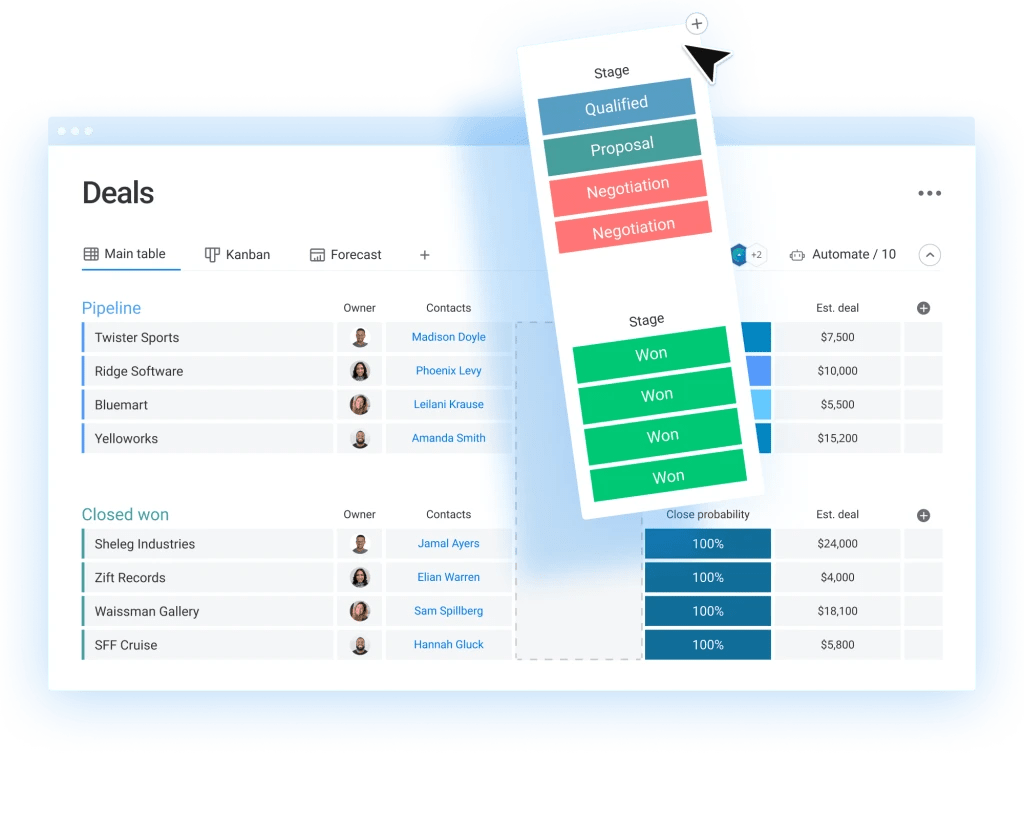
Evaluate AI sales automation platforms based on integration capabilities, ease of use, scalability, and pricing models. The right platform packs AI power but stays easy for non-technical users.
No-code customization matters. Teams can build and tweak workflows without waiting on dev. With monday CRM, revenue teams build custom automation using visual tools.
Step 4: prepare your data and integrations
AI’s only as good as your data. Clean it up first. Clean your data, set up integrations, and establish data flow before you launch automation.
Common data quality issues include duplicate records (affecting 20-30% of typical CRM databases), outdated contact information, and inconsistent data formats that prevent automation from working correctly.
Step 5: launch a pilot program
Start small and test with a few SDRs and limited automation before rolling out company-wide. Pilots catch issues when stakes are low.
Pilot program best practices:
- Select a specialized pilot group: identify two or three SDRs who demonstrate high technical proficiency and a proactive approach to process evolution.
- Prioritize high-impact workflows: focus the initial implementation on one or two high-value automations rather than attempting a comprehensive system overhaul.
- Establish a formal evaluation period: conduct the pilot program for a duration of four to six weeks to ensure the collection of statistically significant performance data.
Step 6: train your team
Train SDRs on the tech and the mindset shift. Address fears about AI replacing jobs. Frame it as a tool that frees SDRs to focus on high-value work.
Keep training short and focused. Skip the day-long workshops. Let SDRs practice with real prospects, not slide decks.
Step 7: scale and optimize
Roll out what works to the full team. Add more AI capabilities as you prove results. Scaling isn’t just adding users, so keep improving your workflows.
Track long-term success through SDR productivity, pipeline quality, and revenue. Good automation keeps improving over 6-12 months. Watch for gains that fade.
Choosing the right AI SDR platform for your team
Platform selection is the primary determinant of successful adoption. The ideal solution balances advanced AI capabilities with an intuitive user interface, ensuring that sophisticated automation is accessible without the requirement of specialized technical expertise.
Essential integration requirements
You need integrations with your CRM, email, calendar, and communication tools. Bad integrations create data silos, manual work, and broken automation.
Must-have integrations for SDR automation:
- CRM connectivity: bi-directional data sync that updates records in real-time.
- Email platforms: native integration with Gmail or Outlook capturing all communications automatically.
- Calendar systems: two-way sync for automated meeting management.
- Data enrichment: connections to data providers that automatically enhance lead information.
The integration ecosystem provided by advanced platforms like monday CRM connects with popular email, calendar, and communication tools natively.
No-code customization features
No-code customization lets you adapt AI to your team without dev help. Most teams customize lead scoring, email sequences, workflow triggers, and dashboards.
Furthermore, the visual workflow builder gives revenue leaders visibility and control. Because you can iterate quickly without IT intervention, your leadership can optimize workflows based on real-time performance and shifting market demands.
Scalability and pricing considerations
Check how pricing scales with team size, features, and data. Avoid surprise costs that force a platform switch later. Remember that transparent pricing helps you budget without surprises.
Building effective human-AI collaboration
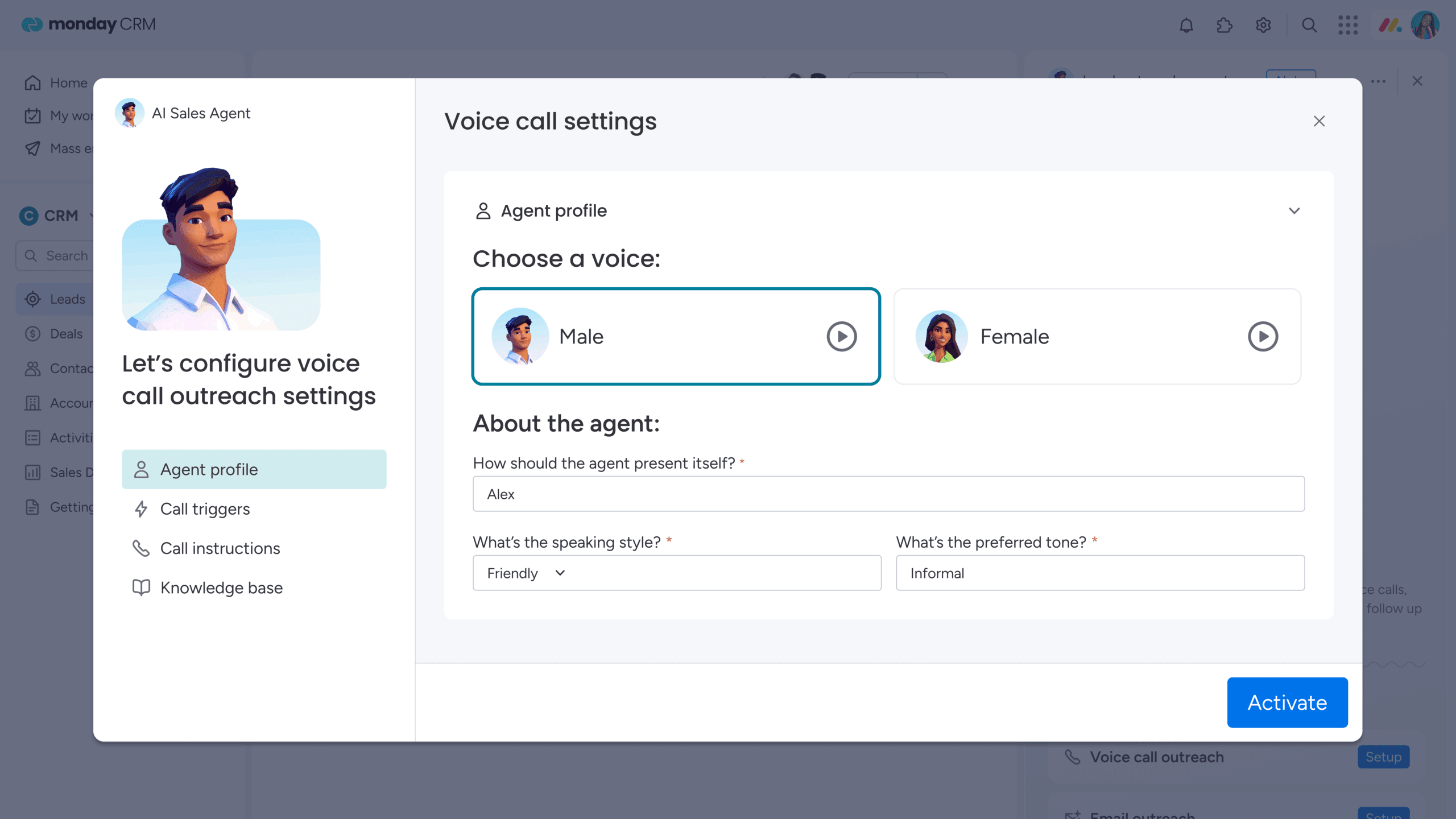
AI serves as a strategic partner to the human sales force, enabling a division of labor based on specialized strengths. This transition is not merely about increasing the velocity of current tasks; it is about empowering SDRs to function as strategic consultants within the sales cycle.
Redesigning SDR workflows for AI success
Rebuild SDR processes to use AI where it helps and keep humans where they matter. Figure out what AI handles (speed, consistency) and what needs humans (creativity, empathy, strategy).
| Task type | AI handles | Humans handle |
|---|---|---|
| Research | Data gathering, company information | Identifying unique insights, strategic implications |
| Personalization | Data-driven customization | Creative messaging, emotional resonance |
| Outreach | Timing optimization, follow-up triggers | Relationship building, complex conversations |
| Qualification | Initial scoring, pattern recognition | Nuanced questioning, reading between the lines |
| Documentation | Data entry, call summaries | Strategic insights, coaching opportunities |
Upskilling your team for AI partnership
SDRs need new skills to work with AI: less task execution, more strategic thinking. Not technical skills. Capabilities that complement what AI does well.
Focus on data interpretation, strategic thinking, consultative selling, and emotional intelligence. These skills become more important as AI handles tactical execution.

Measuring the ROI of automated SDR workflows
Measuring ROI proves crucial for justifying AI investment and identifying optimization opportunities. ROI measurement should include both quantitative metrics and qualitative improvements that impact team performance.
- Recaptured productivity and operational savings: calculate the total value of time savings by multiplying recovered hours by the fully loaded cost of a representative. If automation reclaims twelve hours per week for a 10-person team, the organization gains 120 hours of weekly productivity. At a rate of $50 per hour, this represents $312,000 in annual recaptured value.
- Pipeline velocity acceleration: measure gains in deal progression speed and the overall reduction in the sales cycle duration. AI automation typically increases velocity through instantaneous response times, enhanced qualification accuracy, and standardized follow-up cadences.
- Conversion rate optimization: track specific improvements in lead-to-opportunity and opportunity-to-close ratios. The integration of high-level personalization, precise timing, and consistent engagement typically yields significant increases in conversion performance across the funnel.
Common AI SDR implementation mistakes to avoid
Common implementation mistakes can derail success and waste time, money, and team goodwill. Most failures stem from poor planning, inadequate change management, or unrealistic expectations rather than technology limitations.
- Establishing measurable objectives: implementing AI without predefined goals often leads to suboptimal platform selection and inconsistent results. Organizations should define specific KPIs that align with broader business outcomes prior to evaluating technology solutions.
- Prioritizing strategic change management: resistance from personnel is a primary driver of implementation failure. Leadership must proactively address concerns regarding job displacement by positioning automation as a tool for professional enhancement rather than a replacement for human expertise.
- Ensuring data integrity and quality: substandard data quality directly undermines the effectiveness of AI systems. Comprehensive data cleanup processes including deduplication, format standardization, and information validation, should be completed before the integration of AI tools.
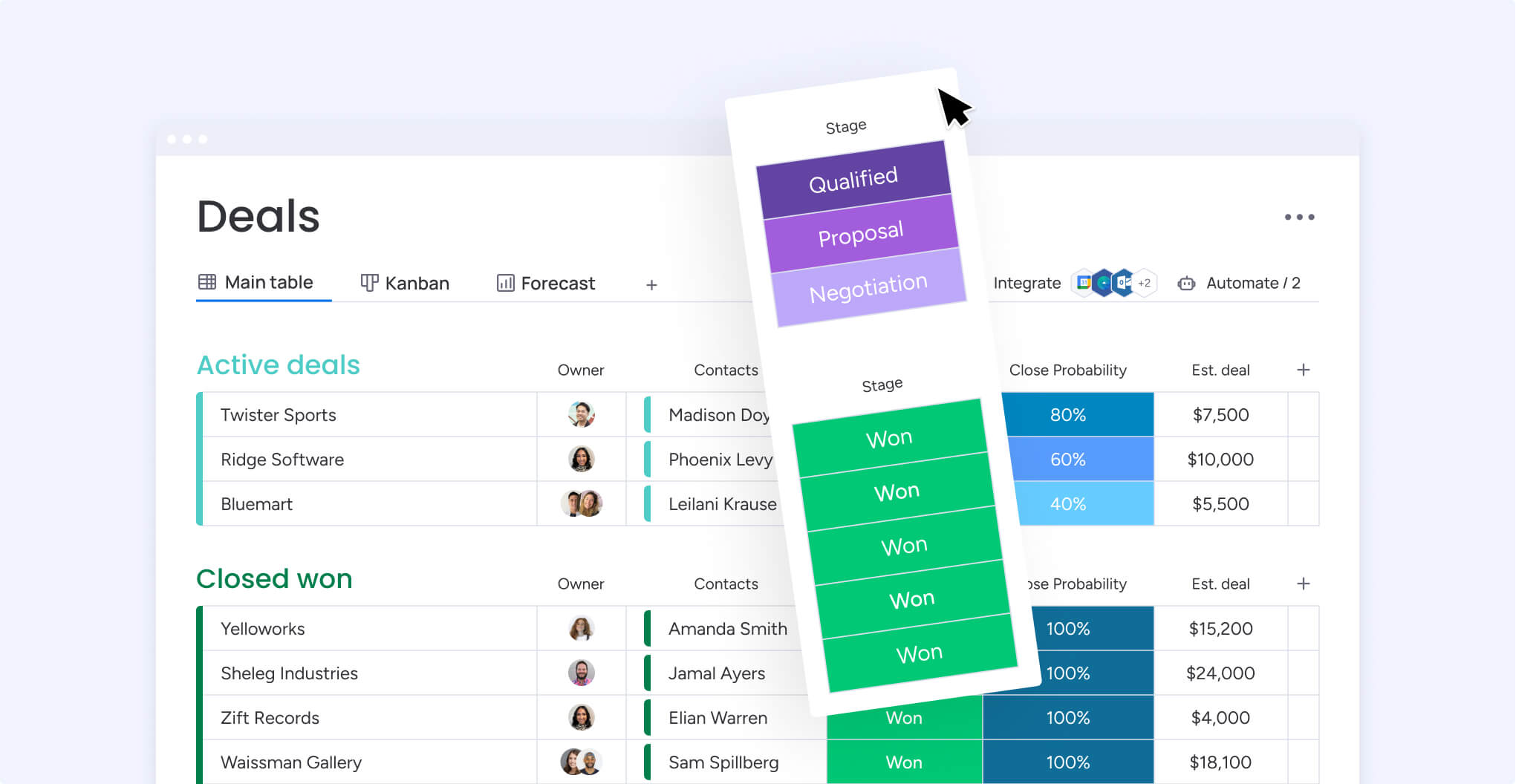
How monday CRM powers AI-driven SDR success?
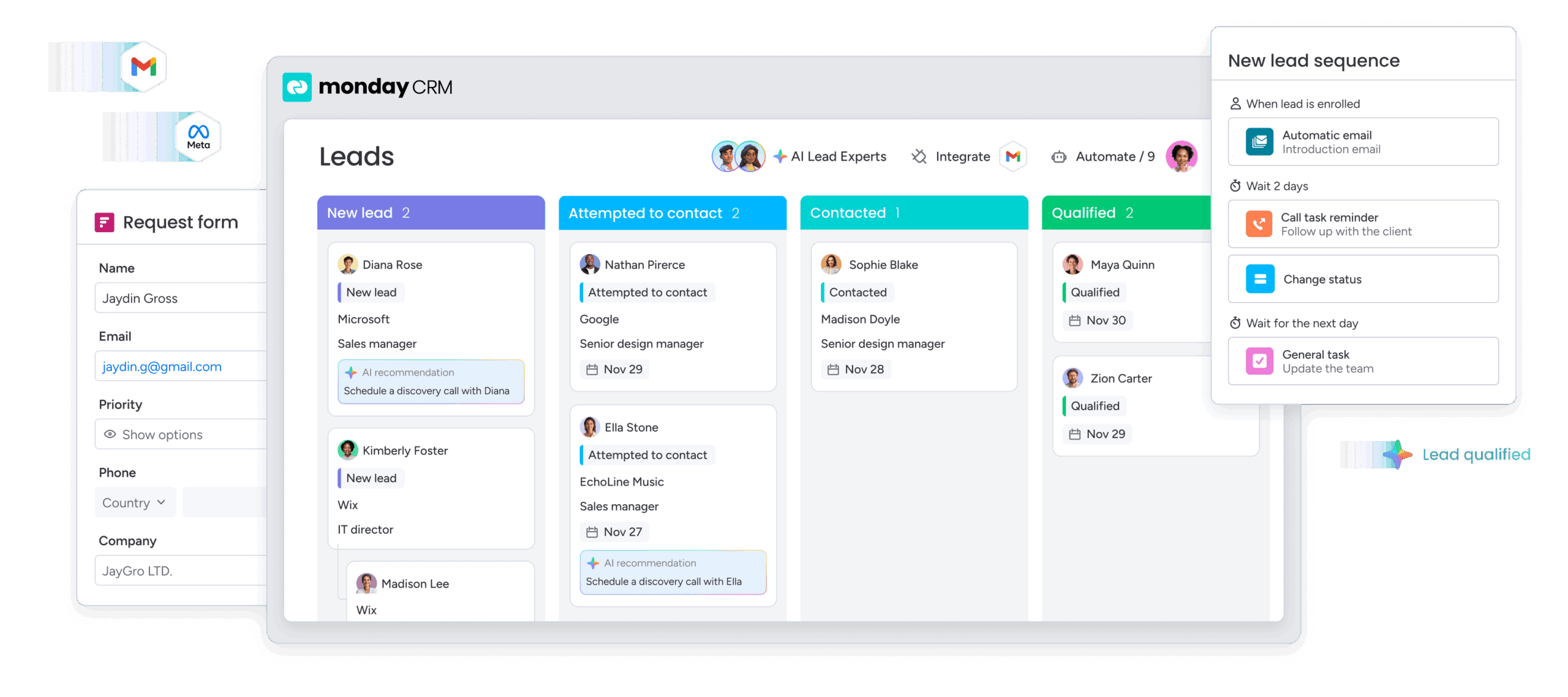
Teams discover that monday CRM makes AI SDR automation accessible without technical expertise through a comprehensive platform that combines powerful AI capabilities with user-friendly customization.
AI blocks for instant workflow automation
The platform’s AI capabilities enable SDRs to add AI to their workflows without coding. These include detecting sentiment, extracting information from documents, summarizing communications, and using custom AI actions tailored to specific needs.
The writing assistant feature allows teams to provide prompts that guide AI to generate appropriate text, with options to adjust tone and length. Custom actions let teams give specific instructions to AI while referencing any column on their board for input.
Custom SDR workflows without code
The visual workflow builder allows teams to create sophisticated SDR automation without technical expertise. Teams can customize lead scoring criteria, create industry-specific sequences, and build automated handoff workflows.
This flexibility proves especially valuable as teams learn what works and refine their approach. Initial workflows rarely prove optimal; the ability to adjust quickly based on real-world results drives continuous improvement.
Real-time performance visibility
Comprehensive visibility into SDR performance, AI automation effectiveness, and pipeline health comes through customizable dashboards. Real-time data helps managers identify coaching opportunities while they’re still relevant.
Performance data connects directly to revenue outcomes, showing how automation improvements translate to business results.
Accelerating SDR success with AI automation
AI automation transforms SDR workflows from manual, time-intensive processes into efficient, data-driven operations that scale with your business. The technology handles repetitive tasks while freeing SDRs to focus on relationship-building and strategic selling activities that drive revenue.
Success comes from implementing automation systematically, starting with high-impact tasks like lead prioritization and email personalization before expanding to more complex workflows. Teams that measure ROI consistently see significant improvements in productivity, pipeline quality, and conversion rates within three to six months.
Revenue teams using monday CRM gain access to powerful AI capabilities without technical complexity, enabling rapid implementation and continuous optimization based on real-world results.
Frequently asked questions
How much does AI SDR automation typically cost?
The cost of AI SDR automation typically ranges from $50-200 per user per month, depending on platform capabilities. Most platforms offer tiered pricing based on team size and automation complexity.
What's the average implementation timeline for AI SDR automation?
Most teams can implement basic AI SDR automation within two to four weeks, while full implementation with advanced automation typically takes six to eight weeks depending on system complexity.
Can AI SDR platforms integrate with existing phone and email systems?
Most AI SDR platforms integrate with popular phone systems and email providers including Gmail and Outlook through APIs or native connections, though integration capabilities vary by platform.
Do teams need technical skills to implement AI SDR automation?
Modern no-code platforms eliminate the need for specialized technical skills. Sales leaders can design and deploy sophisticated automations using intuitive visual builders and pre-configured templates.
Will AI automation replace human SDRs entirely?
AI automation enhances SDR productivity by handling routine tasks, but human SDRs remain essential for relationship building, complex problem-solving, and strategic thinking.
How quickly can teams see ROI from AI SDR automation?
Most teams see initial ROI within 30-60 days through time savings and improved lead quality, with full ROI typically achieved within three to six months.

 Get started