


Your rep just got a new lead. Name, email, company. That’s it. Now they’re spending the next 20 minutes bouncing between LinkedIn, the company website, and 3 browser tabs trying to figure out if this person is worth a call. Meanwhile, the lead’s already talking to someone else.
Sound familiar? Contact records sit half-empty, reps waste hours on manual research, and hot leads go cold before anyone picks up the phone. Data enrichment software fixes this. It automatically fills in the gaps, pulling verified details like direct dials, company size, tech stack, and buying signals, so your team can skip the detective work and start selling.
We’ll show you what makes enrichment software worth buying, the 7 features that matter, and 15 platforms built for real sales teams and budgets. Plus, how to pick the right tool and build a strategy that moves pipeline.
Try monday CRMWhat is contact data enrichment software?
You have an email address. Now what? Contact data enrichment software turns that email into a real person you can call. It fills in the details: who they are, what their company does, and what they need. Skip the guesswork and start the conversation.
It’s not magic. It’s smart automation. The software scans databases and fills in what’s missing. Now every call starts with context.
The right platform transforms a simple email address into a complete profile. You’ll gain access to critical details that provide context for every conversation:
- Who they are: Their direct phone number, verified email, and social profiles.
- Where they work: Company size, industry, and annual revenue.
- The tools they use: Their current tech stack and buying patterns.
- What they’re looking for: Real buying signals and research activity.
- What’s happening in their world: Recent job changes or company news.
Think about the time your team wastes on research. Now imagine getting it all in 3 seconds. That’s what enrichment does. It frees your team from data entry so they can focus on what they do best: selling.
7 features that make or break a data enrichment platform
A data enrichment platform either pays for itself or collects dust. The difference? Features that help your team sell faster, not marketing promises. Here’s what separates a tool that works from one that sits unused.
- Real-time enrichment: Speed wins deals. Batch processing takes hours. Competitors don’t wait. You need data the second a lead lands. Your team can act before the trail goes cold.
- Data from multiple sources: One database means incomplete profiles and missed deals. Platforms that pull from multiple sources fill the gaps and give reps the full picture.
- Built-in compliance: Non-compliant data isn’t just risky. It’s a lawsuit waiting to happen. Your platform should handle GDPR and consent tracking automatically. You focus on selling, not compliance.
- No-code automation: Your sales team can’t wait on engineering for every change. A good platform lets revops build and tweak workflows without code. Adapt on the fly, not next quarter.
- AI-powered data quality: Bad data kills CRM adoption and wastes reps’ time. You need AI that flags stale data, verifies accuracy, and keeps everything fresh. Stop letting outdated job titles derail your team’s efforts.
- Deep CRM integration: If your enrichment platform doesn’t work inside your CRM, it’s just another silo. Native, 2-way sync works with your workflows, not against them. No middleware, no custom code, no headaches.
- Clear pricing: Confusing credit systems and hidden fees are a budget nightmare. You need transparent pricing that shows exactly what you’re paying for. Predictable pricing means no surprise bills to explain to finance.
These features are the difference between fighting with data and closing more deals. The most effective platforms centralize this work, eliminating the usual integration headaches and data silos.
Real-time vs. batch enrichment trade-offs
Slow leads are dead leads. The choice between real-time and batch data enrichment comes down to one thing: speed. Real-time gives you the full story the second a lead comes in, while batch processing handles big lists on a schedule.
| Factor | Real-time enrichment | Batch enrichment |
|---|---|---|
| Speed to lead | Instant insights for an immediate response. | A delay of hours or days means hot leads go cold. |
| Cost per record | Premium speed comes with a higher price tag. | Saves you 30–50% by processing in bulk. |
| Best for | Hot inbound leads and high-value prospects. | Big database cleanups and low-priority lists. |
| Tech needs | Requires an always-on API connection. | Runs on a simple, scheduled job. |
| Data freshness | The data is fresh the moment you get it. | Information could be hours or days old. |
| Error handling | Fix issues as they happen, one by one. | Tackle all errors in a single, consolidated report. |
15 best tools to automate contact research and data enrichment
Your pipeline is only as good as the data in it. The problem? Most data enrichment tools promise the world but deliver a mess of tabs and confusing pricing. Here’s what actually works.
The platforms below are built for different sales plays, from enterprise teams managing complex accounts to smaller crews just starting out. The key differences come down to data coverage, cost, and how well they plug into your existing workflow.
| Platform | Use case | Free plan? | Notable feature | Starting price |
|---|---|---|---|---|
| monday CRM | Revenue teams that want enrichment inside their CRM workflow | No | Crunchbase enrichment built into your CRM | $12/user/month |
| ZoomInfo | Large enterprise teams managing complex deal structures | No | 321M+ professional profiles with intent data | $34,995/year |
| Apollo.io | Outbound sales teams building prospecting lists | Yes | Integrated sequences for email and call cadences | $49/user/month |
| Cognism | International sales teams targeting European prospects | No | Phone-verified mobiles with GDPR compliance | Custom pricing |
| Lusha | SMB sales teams needing fast contact discovery | Yes | One-click enrichment from LinkedIn profiles | $29/user/month |
| Clay | RevOps teams combining multiple data sources | Yes | Waterfall enrichment across 150+ providers | $134/month |
| Crunchbase | Sales teams targeting high-growth startups | No | Funding intelligence and predictive insights | $588/year |
| Datanyze | Technology vendors targeting specific tech stacks | Yes | Technographic tracking across 31,000+ technologies | $21/month |
| Clearbit | Product-led growth companies identifying website visitors | No | Real-time form enrichment and visitor identification | HubSpot-based pricing |
| Skrapp.io | Sales teams building prospecting lists from LinkedIn | Yes | LinkedIn email extraction with verification | $30/month |
| Hunter.io | Sales teams running outbound campaigns | Yes | Domain search with email pattern recognition | $49/month |
| LeadGenius | Enterprise organizations with complex data requirements | Yes (limited) | Human-verified research | Custom pricing |
| FullContact | Marketing teams building unified customer views | No | Cross-device identity resolution | Custom pricing |
| Persana AI | Account executives managing strategic deals | Yes | AI-generated insights and buying signal detection | $68/month |
| Alation | Enterprise data teams managing complex data environments | No | Behavioral metadata enrichment | $60,000/year |
1. monday CRM
Tired of juggling a CRM and a separate enrichment tool? monday CRM brings enrichment into the same place your team already works, so reps can qualify, route, and follow up without living in 12 tabs. Teams use monday CRM to collect leads, enrich core company details, and keep every interaction tied to the right record. That means less hunting for context, and more time acting on it.
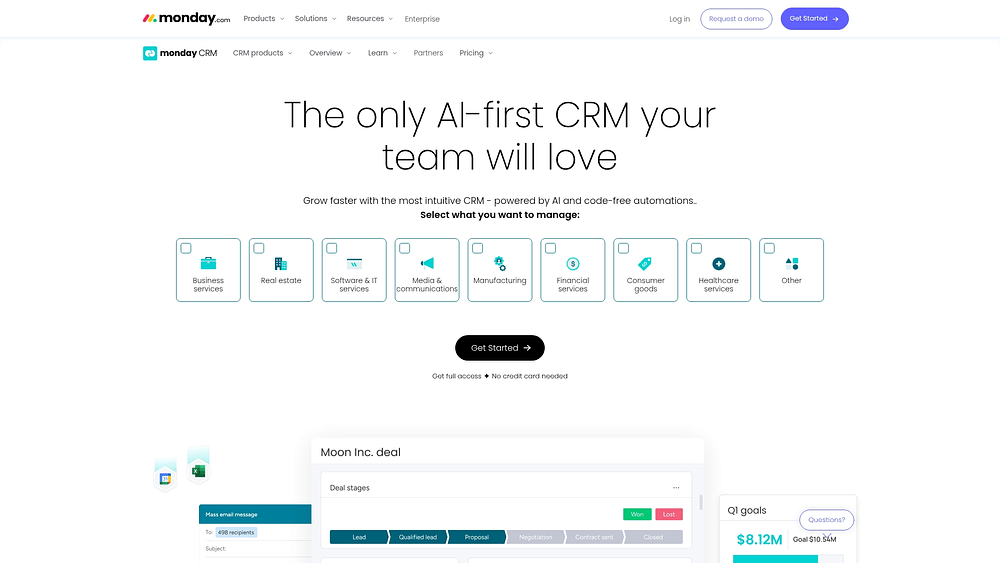
Use case: Revenue teams that want data enrichment software capabilities inside their CRM workflow, so lead intake, qualification, outreach, and handoffs happen in one place
Key features
- Crunchbase enrichment: Automatically pull company data like funding, employee count, and industry details directly into your CRM records.
- AI-powered data extraction: Turn emails, documents, and images into structured CRM fields without manual data entry.
- Smart automations: Trigger enrichment workflows based on lead actions, so your team always has fresh context when it matters most.
Pricing
- Basic: $12/user/month (billed annually)
- Standard: $20/user/month (billed annually)
- Pro: $28/user/month (billed annually)
- Enterprise: Contact sales for a quote
- Annual discount: 18% off when paying yearly
- Minimum users: Plans start at 3 users
Why it stands out
- Built for revenue teams who need control: monday CRM adapts to your sales process with customization, automations, and AI, not the other way around.
- One place for the full customer journey: Beyond selling, teams can keep account management work connected, so handoffs come with context, not guesswork.
2. ZoomInfo
ZoomInfo operates the world’s largest proprietary B2B contact database with over 321 million professional profiles and 104 million company records, making it a comprehensive sales intelligence platform. The platform combines contact data with intent signals, technographics, and organizational charts to provide comprehensive account intelligence. Enterprise sales teams choose ZoomInfo when database size and data depth matter more than cost.
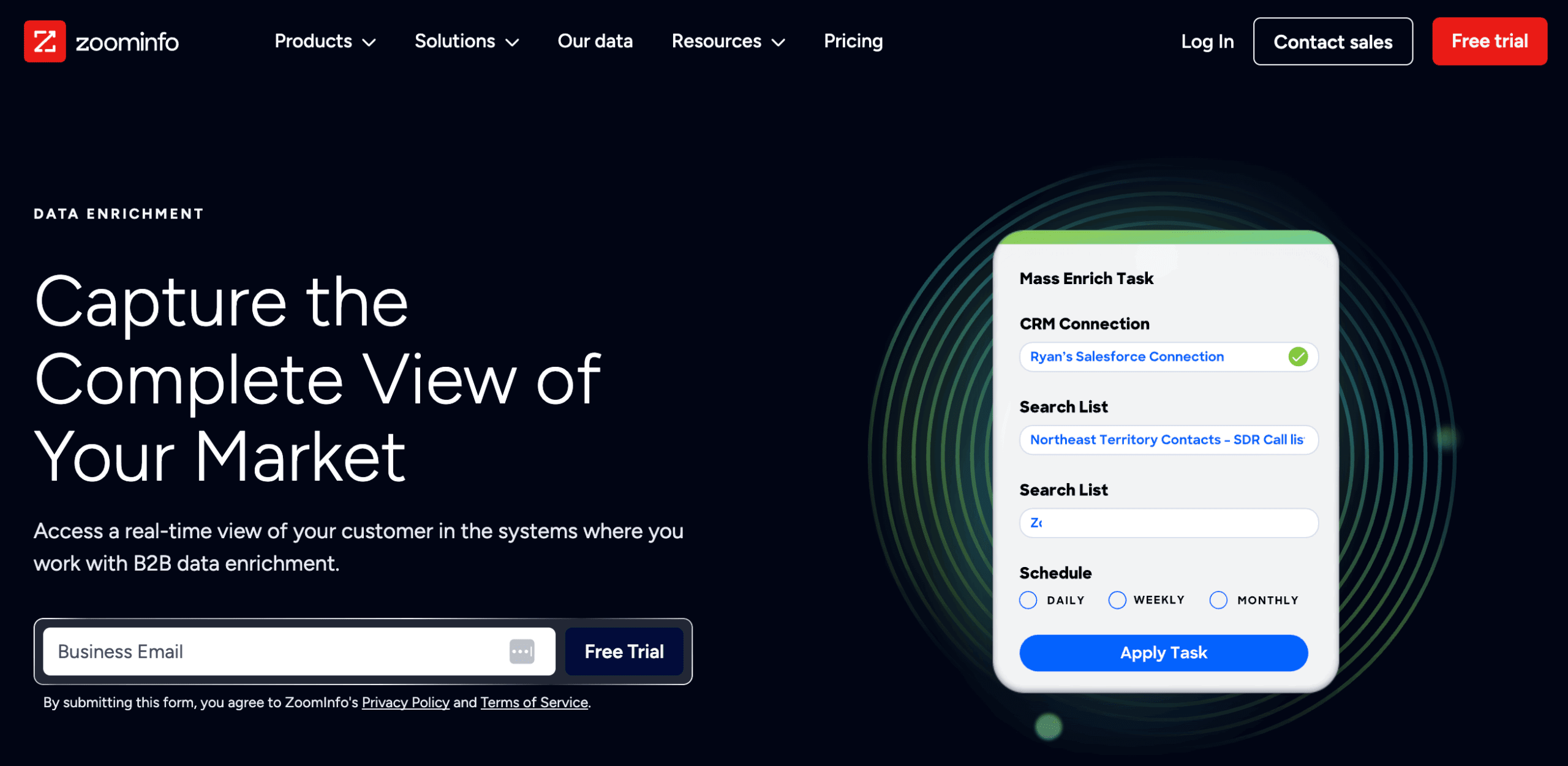
Use case: Large enterprise teams managing complex deal structures across multiple stakeholders where comprehensive data coverage justifies premium pricing
Key features
- Intent data integration: Tracks prospect research activity across 10,000+ websites to identify buying signals and timing.
- Organizational charts: Maps reporting structures and decision-maker relationships within target accounts for strategic selling.
- Technographic intelligence: Identifies technology stack and IT infrastructure for targeted prospecting and competitive positioning.
Pricing
- Sales: $34,995/year (12-month contract)
- Marketing: $69,995/year (12-month contract)
- Operations (Enrich Premium+, 0-250k records): $39,000/year (12-month contract)
- Talent: $15,000/year (12-month contract)
- Custom pricing available for enterprise deployments with minimum user commitments
- Multi-year terms (24/36 months) available with potential volume discounts
Considerations
- High cost creates ROI pressure for smaller teams and may not be cost-effective for organizations with limited budgets
- Data accuracy varies by region, with strongest coverage in North America, potentially limiting effectiveness for global operations
Learn more: Zoominfo alternatives
3. Apollo.io
Apollo.io combines data enrichment with sales engagement in a single platform, offering 275 million contacts and 60 million companies. The platform appeals to outbound-focused teams who want prospecting, enrichment, and outreach capabilities without juggling multiple systems. Apollo’s freemium model makes it accessible to teams testing enrichment for the first time.

Use case: Outbound sales teams building prospecting lists and running multi-touch campaigns who want combined enrichment and engagement without separate platform costs
Key features
- Integrated sequences: Build email and call cadences directly within the enrichment platform
- Email verification: Real-time verification reduces bounce rates and protects sender reputation.
- Buying intent signals: Identifies accounts showing research behavior indicating purchase readiness.
Pricing
- Free tier: 50 credits monthly
- Basic plans: Start at $49 per user per month
- Unlimited enrichment: Available at higher tiers
- Annual commitments typically reduce per-seat costs
Considerations
- Data accuracy lags behind premium providers in some regions, particularly for non-US mobile coverage.
- Free tier limitations push most serious users toward paid plans quickly, with credit consumption adding cost unpredictability as enrichment scales.
Compare: Apollo alternative
4. Cognism
Cognism delivers GDPR-compliant data enrichment with phone-verified mobile numbers that actually connect. The platform specializes in European market coverage and regulatory compliance, making it the go-to choice for international sales teams navigating strict privacy regulations. Their Diamond Data verification process ensures higher connect rates than standard database providers.

Use case: International sales teams targeting European prospects who need verified contact data with built-in compliance tracking and governance workflows
Key features
- GDPR-compliant data: Built-in consent tracking and right-to-erasure workflows for European market compliance.
- Phone-verified mobiles: Human verification of mobile numbers increases connect rates through Diamond Data asset.
- Intent data partnership: Integrates Bombora intent signals for buying behavior insights and timing optimization.
Pricing
- Custom pricing: Quote-based pricing with annual commitments and quarterly business reviews
- Two plan families: Grow and Elevate tiers configured per customer requirements
- Add-ons available: Enrichment credits, Diamonds-on-Demand verification, and intent topic expansions
- Average discounts: Approximately 15% off list pricing according to buyer reports
Considerations
- Limited coverage outside Europe compared to global providers, particularly in APAC markets.
- Higher per-contact costs than mass-market alternatives due to premium verification processes.
5. Lusha
Lusha delivers instant contact enrichment through its browser extension, making prospecting as simple as one click on LinkedIn. The platform specializes in self-serve data access with credit-based pricing, ideal for SMB sales teams who need accurate contact information without enterprise complexity.

Use case: Small to midmarket sales teams needing fast, accurate contact discovery without the overhead of enterprise platforms or complex implementation processes.
Key features
- Browser extension enrichment: One-click contact discovery directly from LinkedIn profiles, company websites, and business directories.
- Multi-channel enrichment options: API endpoints, CSV bulk processing, and native CRM integrations for flexible data workflows.
- Compliance-first approach: ISO 27701, SOC 2 Type II, and GDPR alignment with ethical data sourcing that avoids social network scraping.
Pricing
- Free plan: 5 credits monthly with basic contact enrichment
- Pro plan: Starting at $29 per user per month with increased credit allowances
- Premium and Scale plans: Custom pricing with advanced features like CSV enrichment and higher bulk processing limits
- Credits refresh monthly with no rollover on monthly plans; annual plans provide all credits upfront
Considerations
- Credit-based pricing can become expensive for phone-heavy enrichment workflows (10 credits per phone number vs. 1 credit per email).
- Data depth and accuracy varies significantly by geography and industry, with stronger coverage in core markets.
6. Clay
Clay reimagines data enrichment as a spreadsheet-style workspace where revenue teams build custom data operations without engineering resources. The platform aggregates data from 150+ sources and uses AI-powered research to fill gaps that traditional databases miss — ideal for teams who need maximum coverage and flexibility.

Use case: Revenue operations teams and growth professionals who want to combine multiple data sources strategically while maintaining control over costs and data quality
Key features
- Waterfall enrichment: Query multiple providers in sequence until finding complete data, improving coverage by up to 3x.
- AI-powered research: GPT-4 integration extracts custom signals from websites, forms, and documents that databases can’t capture.
- Bulk CRM enrichment: Update millions of records with automated workflows that sync directly to Salesforce and other systems.
Pricing
- Free: $0/month with 1,200 annual credits and unlimited users
- Starter: $134/month (annual billing) includes phone enrichments and bring-your-own API keys
- Explorer: $314/month adds HTTP API, webhooks, and email sequencing integrations
- Pro: $720/month includes CRM integrations and higher monthly credits
- Enterprise: Custom pricing with Snowflake, SSO, and dedicated support
Considerations
- Steeper learning curve than point-and-click platforms, requiring understanding of spreadsheet formulas and data operations concepts.
- Credit consumption can be difficult to predict and manage without proper governance, especially for teams new to usage-based pricing.
7. Crunchbase
Crunchbase delivers private-market intelligence that goes beyond basic firmographics, tracking funding rounds, acquisitions, and growth signals across 2.9 million companies. The platform specializes in predictive insights and venture-sourced data, ideal for sales teams targeting funded startups and high-growth enterprises.

Use case: Sales teams targeting high-growth startups and venture-backed companies who need funding intelligence and growth signals to prioritize accounts and time their outreach
Key features
- Funding intelligence: Track Series A through IPO rounds with detailed investor relationships and deal histories.
- Predictive insights: Access AI-powered predictions for funding, exits, growth trajectories, and potential layoffs.
- Growth indicators: Identify rapidly scaling companies through hiring patterns, news mentions, and market activity.
Pricing
- Pro: $588/year (introductory offer) or $99/month with up to 2,000 row exports
- Business: Quote-based pricing with CRM integrations, SSO, and up to 5,000 row exports
- API/Enterprise: Custom pricing for bulk data access and full predictive packages
- Data Boost add-on: $360/year for 55+ additional filters including technographics and IT spend data
- Contact packages: Starting at $29/month for 100 contacts (Pro users get 10 contacts included)
Considerations
- Limited contact-level data requires pairing with other enrichment platforms for complete prospect profiles.
- Salesforce enrichment requires API-enabled editions, and HubSpot integration isn’t currently available.
8. Datanyze
Datanyze delivers technographic intelligence, revealing the tech stacks of over 35 million companies. It tracks 31,000+ technologies and pairs that data with a massive contact database of 120 million people, including 84 million emails and 63 million direct dials. A powerful combination for sales teams who need to know what tech a prospect uses and who to call.
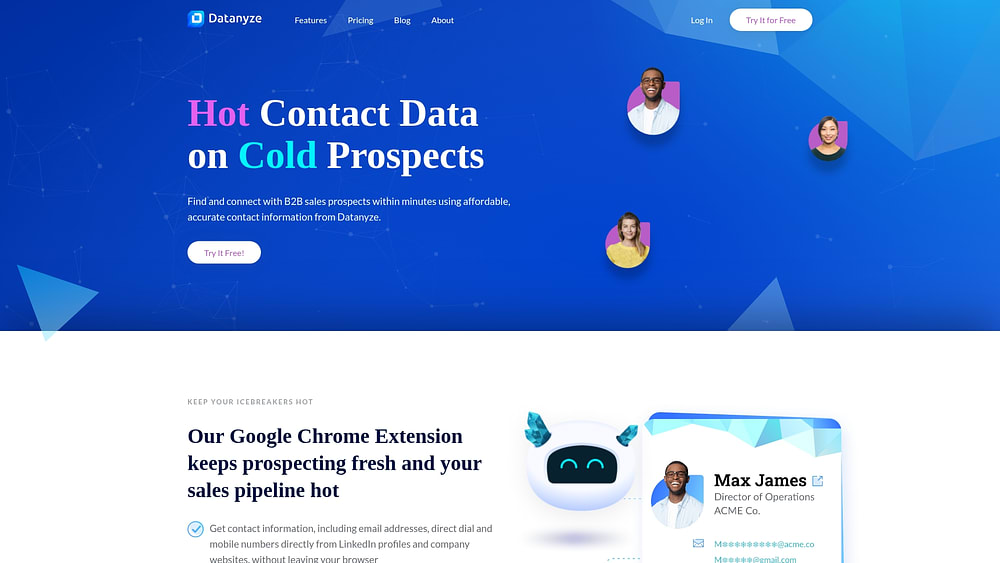
Use case: Technology vendors and sales teams who need to connect with the right people at companies using a specific tech stack.
Key features
- Technology tracking: Identifies 31,000+ technologies across 35M+ websites.
- Contact database: Access to 120M+ people, 84M emails, and 63M direct dials.
- Buying signals: Track technology additions, removals, and upgrades to find sales opportunities.
- Chrome extension: Instant technographic and contact intelligence while browsing prospect websites and LinkedIn profiles
Pricing:
- Nyze Lite: Free 90-day trial with 10 credits per month
- Nyze Pro 1: $21/month billed annually (960 credits/year) or $29/month billed monthly (80 credits/month)
- Nyze Pro 2: $39/month billed annually (1,920 credits/year) or $55/month billed monthly (160 credits/month)
- Annual billing provides significant discounts with credits delivered upfront
Considerations
- Its core strength is technographics, so while the contact database is large, it may not fully replace a dedicated contact data platform for every team.
- No native CRM integrations currently available, requiring manual CSV export workflows for data transfer.
9. Clearbit
Clearbit delivers real-time data enrichment that transforms anonymous website visitors into qualified leads instantly. The platform specializes in form shortening and visitor identification, well-suited for product-led growth companies looking to personalize experiences without friction. Clearbit brings enterprise-grade data intelligence to revenue teams who need to act fast on every opportunity.

Use case: Product-led growth companies that need to identify website visitors before they convert and enrich lead data in real-time to enable instant personalization and intelligent routing
Key features
- Real-time form enrichment: Collect minimal information while enriching complete profiles behind the scenes.
- Visitor identification: Identify companies browsing your website before they convert with confidence scoring.
- Reveal API: Programmatic access for custom enrichment workflows and seamless integration across your tech stack.
Pricing
- HubSpot integration: Pricing handled through HubSpot’s credit system (no public pricing available)
- Legacy standalone plans: No longer available for new customers
- Enterprise: Custom pricing for high-volume implementations
Considerations
- New standalone subscriptions are no longer offered — access requires HubSpot integration.
- EU data coverage may be limited due to GDPR suppression settings that block person-level enrichment.
10. Skrapp.io
Skrapp.io turns LinkedIn prospecting into a data enrichment powerhouse, extracting verified emails and company details directly from profiles and searches. The platform specializes in LinkedIn-first workflows with embedded verification, built for sales teams and recruiters who live in LinkedIn but need enriched, CRM-ready data. With its Fair Credits policy, you only pay for deliverable results — no wasted spend on invalid emails.

Use case: Sales teams building prospecting lists from LinkedIn searches and recruiters sourcing candidates who need verified contact data with minimal manual work
Key features
- LinkedIn email extraction: Find verified email addresses from LinkedIn profiles, Sales Navigator, and Recruiter with one-click Chrome extension.
- Bulk processing with AI enrichment: Upload CSV files or LinkedIn URLs for batch processing, plus AI-powered fields like buying role, seniority, and function.
- Real-time verification and CRM sync: Embedded email verification shows delivery status instantly, with direct sync to HubSpot, Salesforce, and other CRMs.
Pricing
- Free: 100 email credits per month with basic LinkedIn integration
- Professional: $30/month (annual billing) for 1,000 credits, 2 users, multi-page enrichment, and CRM sync
- Enterprise: $262/month (annual billing) for 50,000 credits, 15 users, API access, and dedicated support
- Annual billing saves 25% across all paid plans
Considerations
- Some users report occasional verification accuracy issues, with “verified” emails still bouncing due to recipient-side factors.
- LinkedIn-centric workflows may be sensitive to platform rule changes and daily connection limits.
11. Hunter.io
Hunter.io turns email discovery into a science, helping sales teams find and verify professional email addresses at scale. The platform combines domain search capabilities with pattern-based email generation, a go-to choice for teams running outbound campaigns.

Use case: Sales teams who need to build prospect lists quickly and verify email deliverability before launching outbound campaigns
Key features
- Domain search: Discover all public email addresses associated with any company domain.
- Email finder: Generate likely email addresses using name and company pattern recognition.
- Bulk verification: Clean existing email lists to remove invalid addresses and protect sender reputation.
Pricing
- Free: 50 credits monthly with basic domain search and 1 connected email account
- Starter: $49/month (or $34/month annually) with 24,000 credits yearly, auto-verification, and AI writing assistant
- Growth: $149/month (or $104/month annually) with 120,000 credits yearly and 10 connected accounts
- Scale: $299/month (or $209/month annually) with 300,000 credits yearly and 20 connected accounts
- Enterprise: Custom pricing with dedicated account management
- Annual billing offers 30% discount across all plans
- Non-profits receive 30% monthly discount
Considerations
- Coverage depends entirely on publicly available data, which can leave gaps for companies with limited online presence.
- Pattern-based email generation may fail for organizations using non-standard email formats.
12. LeadGenius
LeadGenius combines AI-powered automation with human research teams to deliver custom data enrichment that goes beyond standard database offerings. The platform targets enterprise revenue teams who need verified, vertical-specific data for niche markets where automated platforms fall short. Their human-in-the-loop approach ensures accuracy for complex research requirements that typical enrichment platforms can’t handle.

Use case: Enterprise organizations with complex data requirements that need custom research for niche industries, private companies, or specific decision-maker identification
Key features
- Human-verified research: Research teams validate and enhance automated enrichment with custom data projects tailored to specific industries and criteria.
- Personalized web crawler: Configurable extraction for vertical-specific data beyond standard firmographics, including advertising signals and social presence indicators.
- Real-time API integration: Self-serve enrichment API with webhook delivery, automated dashboard plays, and in-context browser extensions for CRM and LinkedIn workflows.
Pricing
- Freemium tier: Limited to 2 campaigns and 1,000 records for evaluation purposes
- Enterprise pricing: Custom cents-per-record pricing displayed at campaign level, requires sales consultation for full production access
- API access: Subscription-based pricing through sales team
Considerations
- Higher costs than self-service platforms due to human verification component.
- Longer turnaround times for custom research projects compared to instant database lookups.
13. FullContact
FullContact specializes in identity resolution, connecting fragmented customer data across devices, channels, and touchpoints to create unified customer profiles. The platform uses deterministic matching backed by graph theory and machine learning, ideal for marketing teams who need cross-device identity matching for personalization. With 248 million U.S. profiles and 30+ million daily updates, FullContact helps organizations understand complete customer journeys.

Use case: Marketing teams building unified customer views and organizations needing cross-device identity matching for personalization campaigns
Key features
- Identity resolution: Match customer data across email, phone, social, and device IDs using deterministic graph-based matching.
- Cross-device tracking: Connect desktop, mobile, and tablet activity to single profiles with persistent PersonID technology.
- Privacy compliance: Built-in consent management, permission APIs, and opt-out controls for data governance.
Pricing
- Custom pricing: Quote-based contracts with volume and use case considerations
- Annual commitments: Typically required for enterprise access
- Snowflake Native App: Available through Snowflake Marketplace with standard marketplace terms
Considerations
- Identity resolution differs from traditional B2B enrichment, requiring more complex implementation compared to simple enrichment platforms
- Match rates can vary by input quality and audience segment, with some users reporting lower matches for certain demographics
14. Persana AI
Persana AI transforms prospect research with autonomous agents that dig deeper than standard contact data. The platform analyzes digital footprints, social activity, and company signals to surface buying opportunities and conversation starters that actually matter. Built for sales teams who need personalized outreach at scale, not just another database of emails.

Use case: Account executives managing strategic deals who need deep prospect intelligence and personalized outreach angles to break through inbox noise
Key features
- AI-generated insights: Machine learning identifies relevant talking points and engagement opportunities from prospect digital activity.
- Buying signal detection: Tracks job changes, funding news, and trigger events across 100+ data sources with real-time validation.
- Waterfall enrichment: Configurable provider sequences that cascade through multiple sources to maximize match rates while minimizing credit waste.
Pricing
- Free: $0/month with 50 credits, 50 emails, and basic waterfall templates
- Starter: $68/month (billed annually) with 24,000 credits per year
- Growth: $151/month (billed annually) with 60,000 credits and email sequencing integrations
- Pro: $400/month (billed annually) with 216,000 credits, CRM integrations, and intent signals
- Unlimited: $600/month (billed annually) with 600,000 credits and AI agents
- Enterprise: Custom pricing with dedicated account team and advanced features
- Annual billing saves 20%, with additional discounts available for ABM buyers
Considerations
- AI-generated insights require human review and judgment to avoid generic or irrelevant outreach suggestions.
- Newer platform with smaller user base compared to established enrichment providers, which may impact data coverage in niche markets.
15. Alation
Alation transforms how enterprises understand and trust their data through intelligent metadata enrichment. The platform specializes in behavioral analytics and automated governance, ideal for large organizations managing complex data environments across multiple systems.

Use case: Enterprise data teams that need to automatically enrich metadata with usage patterns, lineage tracking, and governance context
Key features
- Behavioral metadata enrichment: Captures real usage patterns, popularity metrics, and user interactions to surface the most relevant data assets.
- Automated lineage mapping: Tracks data flow across systems and transformations to show complete data relationships.
- AI-assisted documentation: Generates human-readable descriptions and titles while maintaining steward oversight and approval workflows.
Pricing
- Enterprise pricing: Custom quotes based on data volume and user count
- AWS Marketplace: Starting at $60,000 per year for basic subscriptions
- Annual commitments: Required for most enterprise implementations
- Enhanced connectors: Additional licensing fees may apply for advanced integrations
Considerations
- Focuses on metadata enrichment rather than traditional sales contact data enrichment.
- Requires significant technical implementation and data engineering resources for optimal deployment.
How to choose the right data enrichment platform
Does your tool even match your sales motion? Inbound teams need instant enrichment the second a lead lands. Outbound crews need massive, verified contact lists more than speed. Choosing the wrong fit is a fast way to burn cash on a platform no one uses.
Now, the real cost — vendors love hiding fees in the fine print. Credit-based plans can charge you for failed lookups, and per-seat pricing often ropes in read-only users. Always ask about setup fees, mandatory services, and overage penalties before you sign anything.
| Pricing model | Advertised cost | Hidden fees to investigate |
|---|---|---|
| Credit-based | $0.10 per credit | Failed lookups, credit expiration, overage charges, minimum purchases |
| Per-seat subscription | $49/user/month | Read-only user costs, admin licenses, integration fees, data export charges |
| Tiered usage | $499/month for 5,000 contacts | Overage penalties, feature restrictions by tier, annual commitment requirements |
| Enterprise custom | “Contact sales” | Implementation fees, training costs, minimum user counts, multi-year locks |
Never trust a vendor’s sample data. Demand a trial using your own contacts and manually spot-check the results against real sources like LinkedIn. A tool with 95% accuracy for US tech might be useless for European manufacturing, so test for your market.
Don’t just take a vendor’s accuracy claims at face value. To properly evaluate a platform, you need to test it against your own data and measure what truly impacts your sales process. Here are the metrics that actually matter:
- Accuracy rate: What percentage of the data is correct? Aim for 90% or more.
- Coverage: How much of your database can the tool actually enrich? Look for 80%+.
- Data freshness: Was the data verified in the last 90 days? Anything older is stale.
- Match rate: How often does it find a match versus coming up empty? Target 85%+.
Build your data enrichment strategy in 3 steps
Jumping into data enrichment without a plan is a great way to burn cash. You end up with a bloated database and a budget that vanishes before you see any results. Here’s how to build a smarter strategy.
Step 1: Audit your current data gaps
First, figure out what you’re actually missing. What information gaps are slowing your team down the most? An audit shows you where to focus your efforts for the biggest, fastest impact.
Pull a sample of 500-1,000 contacts and see what’s there, and what isn’t through a lead enrichment audit. Check for critical fields that directly help you close deals, like direct dials and mobile numbers; accurate job titles; and company size and industry.
Before you change anything, get your baseline. Track your current time-to-first-contact, conversion rates, and deal size. This is how you’ll prove the investment was worth it later.
Step 2: Design your enrichment workflows

Enrichment isn’t a one-time fix; it’s a process. Map your data flow to find the perfect moments to add information. Think real-time enrichment for inbound forms so reps get the full picture instantly.
This is where you stop doing things the hard way. Revenue teams find success using monday CRM to build these workflows without needing a developer. You can create automations like, “when a lead enters the pipeline, enrich their contact info and assign them to the right rep,” all in one go.
Step 3: Measure the impact on your pipeline
Did it work? The only way to know is to measure. Keep an eye on a few key metrics to see if your enriched data is actually making your team faster and more effective.
Track the before-and-after. You’re looking for real movement in the numbers that matter most, from how fast you follow up to how quickly you close.
| Metric | Pre-enrichment baseline | Post-enrichment target | Measurement method |
|---|---|---|---|
| Time-to-first-contact | 4.2 hours | <2 hours | CRM timestamp analysis from lead creation to first activity |
| Lead-to-opportunity conversion | 12% | >18% | Cohort analysis comparing enriched vs. non-enriched leads |
| Average deal size | $47,000 | >$55,000 | Revenue analysis by enrichment completeness score |
| Sales cycle length | 87 days | <75 days | Days between opportunity creation and closed-won |
AI and semantic enrichment capabilities

A CRM full of bad data is just a glorified spreadsheet. While most platforms stop at basic company info, AI digs deeper into the messy, unstructured data where real buying signals are hiding. This intelligence changes how your team finds opportunities, prioritizes prospects, and times their outreach perfectly.
How does it work? CRM automation AI reads the things that old-school data scrapers can’t, like press releases, job postings, and even presentation slides. It pulls out key details — like who the real decision-makers are or what tech a company needs — turning scattered information into clean, usable data for your team.
This allows you to move beyond basic lead scoring that just checks a few boxes. Revenue teams find success using monday CRM to analyze hundreds of signals, from prospect behavior to market trends, to predict who is most likely to convert through effective CRM data management. The platform learns from your past wins, getting smarter and more accurate with every closed deal.
Teams discover that monday CRM enables them to stop chasing data and start acting on it. With AI built right into your workflows, you can:
- Extract info instantly: Pull key details from documents, emails, and images directly into your CRM fields. No more soul-crushing manual data entry.
- Flag at-risk accounts: Automatically analyze email tones and customer feedback to get a heads-up on unhappy customers before it’s too late.
- Improve forecast accuracy: Let AI find the hidden patterns in your sales data to show you what’s really happening in your pipeline. Zero guesswork, just insights.
- Get intel when it matters: Trigger data enrichment based on key events, like a prospect getting funding or a competitor losing a key account. Your team gets fresh intelligence, right when they need it.
Learn more: AI customer data platform
Why monday CRM changes the enrichment game

Juggling enrichment tools is a mess. You’ve got platform sprawl, surprise costs, and data that dies the second it moves between systems. That’s why monday CRM builds intelligent data enrichment right into your workflow, creating one system that actually works.

Instead of stitching together different platforms, you get one that does the work for you. Revenue teams find success using monday CRM to automate enrichment and focus on what matters. Here’s how:
| Aspect | monday CRM approach | Traditional enrichment platforms |
|---|---|---|
| Integration depth | Built right into your workflow | A separate platform you have to patch in |
| No-code customization | Build it yourself, no code needed | Requires developers or a big budget |
| Unified platform | One platform for the whole journey | Disconnected tools, broken handoffs |
| Transparent pricing | Included in your CRM subscription | Surprise fees for enrichment and integrations |
| AI capabilities | AI that extracts the info you actually need | Generic data fields you can't change |
| Workflow automation | Triggers that work with your sales process | Rigid automation that needs another tool |
Whether your team is all-in on ABM, running inbound plays, or cleaning up a database, the platform adapts to you. You build the enrichment workflow that fits your sales process — not the other way around.
Turn cold contacts into closed deals
Your reps are spending hours digging for contact info instead of selling. Good data is the line between hitting your number and explaining why you missed. Start with a quick audit to see what data actually closed deals, ask your reps what missing info slows them down, and spot-check your current records for accuracy.
Once you know what you need, revenue teams find success using monday CRM to automate this entire process without writing a line of code. You can measure the impact on your sales cycle and see everything in one place — no more juggling platforms or guessing if your data is working.
Try monday CRMFAQs
How much should sales teams budget for enrichment tools?
The amount sales teams should budget for enrichment platforms is typically $50–$150 per user each month, but costs vary based on your team's size and data needs.
What's the accuracy rate of B2B data enrichment platforms?
The accuracy rate of top B2B data enrichment platforms is typically 85–95%, though this can change depending on the industry and location.
Can enrichment software update existing CRM records?
Yes, enrichment software can update existing CRM records automatically in real time or through scheduled batches, keeping your data fresh without manual work.
How do waterfall enrichment strategies improve data coverage?
Waterfall enrichment strategies improve data coverage by checking multiple providers in sequence to find missing information, filling gaps that a single source would miss.
Which data enrichment tools are GDPR compliant?
Data enrichment platforms that are GDPR compliant are those that offer consent tracking, data processing agreements, and regional data residency to meet legal requirements.
What's the difference between contact and company data enrichment?
The difference between contact and company data enrichment is that contact enrichment adds details about people, like emails and phone numbers, while company enrichment adds firmographic data like revenue and employee count.
