


Your sales rep just spent 20 minutes researching a single prospect — LinkedIn for the job title, company website for employee count, Google for recent funding news. Data enrichment fixes this bottleneck by automatically filling gaps in your CRM with verified information from external sources in seconds.
In this guide, you’ll learn how enrichment transforms incomplete contact entries into comprehensive profiles that enable faster qualification, personalized outreach, and more accurate forecasting.
Try monday CRMKey takeaways
- Data enrichment automatically fills missing contact details, job titles, and company information so reps can reclaim valuable sales time and focus on selling instead of googling prospects.
- Enriched firmographic and behavioral data reveals which prospects fit your ideal customer profile and shows active buying signals worth pursuing immediately, transforming incomplete leads into qualified opportunities instantly.
- Rich contact data enables hyper-targeted messaging based on industry, role, and recent company activity that drives higher response rates than generic emails, letting you personalize every outreach at scale.
- Enriched CRM records eliminate guesswork in sales forecasting by providing up-to-date contact information and engagement signals that predict deal outcomes, boosting forecast accuracy with real-time, complete pipeline data.
What is data enrichment?
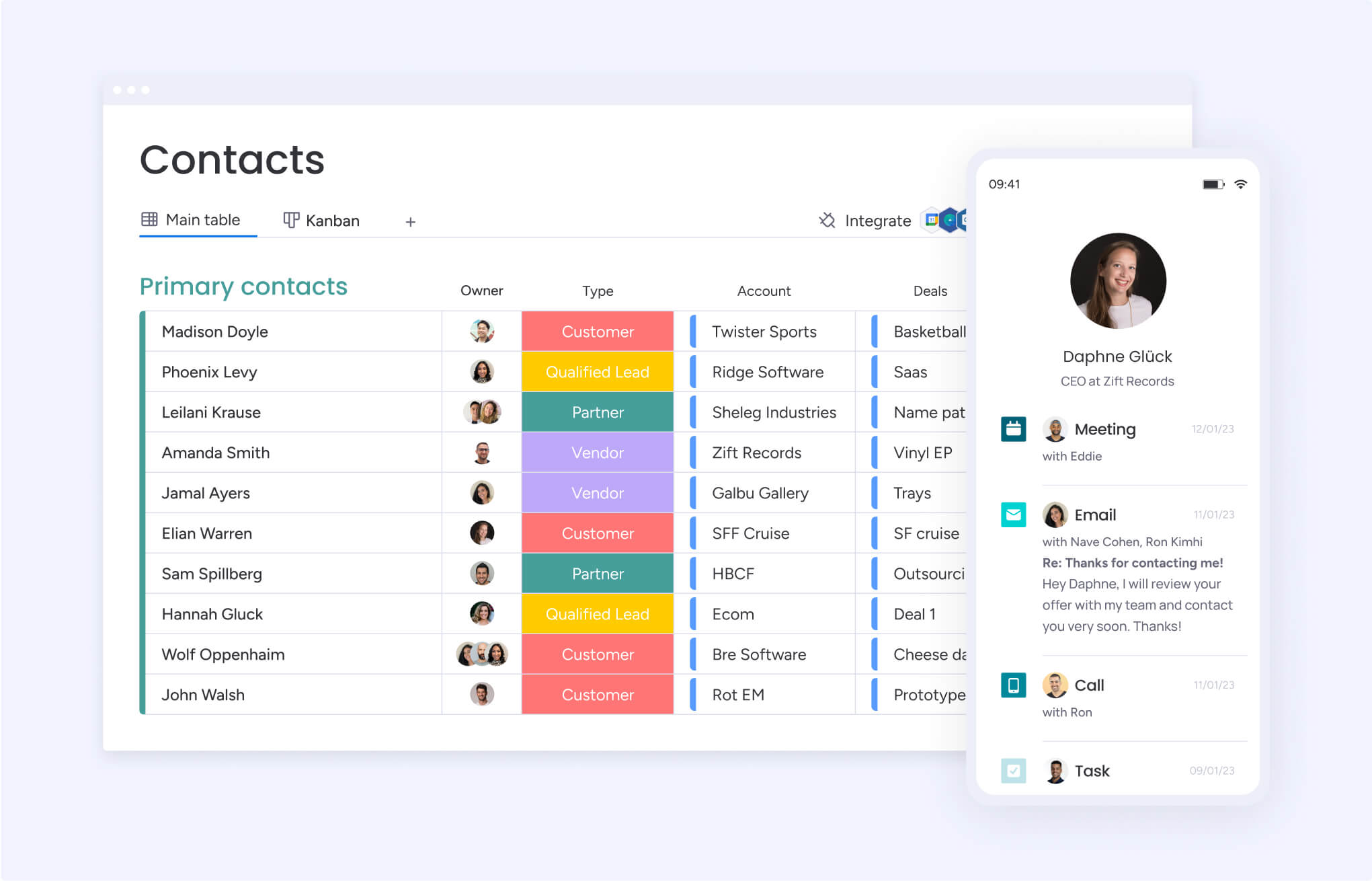
Data enrichment is the process of enhancing existing customer or prospect data by adding verified information from external sources, improving accuracy, completeness, and usability in systems like CRMs. Think of it like auto-complete for your CRM.
Here are the types of data that get enriched:
- Job titles and seniority levels: Know whether you’re talking to a decision-maker or an influencer
- Company firmographics: Size, industry, revenue, and growth stage that determine deal potential
- Direct contact information: Verified emails, phone numbers, and LinkedIn profiles that actually work
- Behavioral signals: Website visits, content downloads, and engagement patterns that reveal buying intent
First-party vs. third-party enrichment data
First-party data is information your organization collects directly from customer interactions: website visits, email opens, form submissions, purchase history, and product usage. First-party enrichment combines this proprietary behavioral data with external third-party sources to create complete customer profiles.
Here’s how this combination works: A prospect downloads your pricing guide. That’s a first-party signal. Enrichment adds their job title and company size from third-party data. Your rep now knows they’re dealing with a qualified decision-maker actively researching solutions, not just a curious browser.

How does data enrichment work?
Data enrichment connects your CRM or database to external data providers through APIs (application programming interfaces). These connections let different data enrichment software systems share information automatically.
A new lead enters your CRM with minimal information like name and email. The enrichment system searches trusted databases for matching records. It validates the data, then automatically populates empty fields in your CRM with verified information. The entire process takes seconds. It happens in real-time as records are created or in scheduled batches.
AI-powered enrichment goes beyond this. It analyzes patterns, predicts missing information, and continuously updates records as external data changes.
Step 1: Data ingestion and identification
The enrichment workflow has 5 steps that transform incomplete records into actionable profiles. A new record enters your system through a lead form, imported contact list, or manually created CRM entry. The enrichment system scans the record and identifies empty or incomplete fields. It flags the record for enhancement.
Step 2: Data matching and lookup
The system searches external databases using email domain, company name, or LinkedIn profile URL. Algorithms determine which external records match your contact. Matching algorithms account for variations in company names, email formats, and other identifiers. This ensures accurate matches. The system cross-references multiple data points to confirm identity before validation.
Step 3: Data validation and verification
Found data doesn’t get added automatically. The system validates accuracy by cross-referencing multiple sources for consistency. This validation process checks data freshness, verifies contact information through multiple channels, and evaluates data reliability using multiple validation checks. Only validated, high-quality data gets added to your CRM records.
Step 4: Field population and integration
Verified data automatically populates empty CRM fields based on your mapping rules. External “job_title” fields map to your CRM’s “Title” field, while “employee_count” maps to “Company Size.” The system respects existing data in your CRM. It fills empty fields unless you configure it to update outdated information. Custom field mapping puts enriched data exactly where your team expects it.
Step 5: Continuous monitoring and updates
Enrichment continues working after the initial data pull. The system monitors external sources for changes and refreshes your CRM records based on your settings. When a contact changes jobs, their new title and company appear within days.
This ongoing monitoring prevents data decay. Your team always works with current information. Automated alerts notify reps when key contacts change roles or companies. That’s an immediate outreach opportunity.
Manual vs. automated database enrichment
Manual enrichment means sales reps or ops teams search LinkedIn, company websites, and databases to find missing information, then copy data into CRM fields one record at a time. This approach works for very small teams with minimal lead volume. But the limitations show up fast at any scale.
The power of AI-driven data enrichment
Unlike rules-based enrichment that relies on static lookups, AI-driven enrichment can infer missing attributes, adapt to new patterns, and improve accuracy over time.
AI-powered enrichment adds prediction, inference, and continuous learning on top of traditional lookups. This approach makes enrichment smarter and more predictive.
- Pattern recognition and prediction: AI analyzes existing complete records to infer likely missing attributes (for example, inferring seniority when most contacts from a company domain have “Director” or higher titles).
- Natural language processing: AI extracts structured fields from unstructured inputs like email signatures, meeting notes, and document uploads—turning things like business card images into CRM-ready data.
- Continuous learning: AI improves over time by learning from corrections and feedback, helping it identify which sources and patterns tend to be most reliable.
- Intent signal detection: AI identifies engagement patterns that suggest buying intent and can enrich records with intent indicators to help reps prioritize outreach.
Data enhancement vs. data enrichment
Data enrichment adds new, external information to existing records — filling gaps with missing data points that help sales teams understand prospects better. Data enhancement covers a broader set of data improvement activities, including data cleansing (removing duplicates, fixing errors), data standardization (consistent formatting), and data validation (verifying accuracy).
Try monday CRM4 types of data enrichment
Different types of enrichment support different data needs across the sales process.
1. Demographic data enrichment
Demographic enrichment adds individual-level personal and professional information about contacts. This data helps sales reps understand who they’re talking to and personalize outreach.
Key demographic data points include professional details, experience indicators, and communication preferences. These details help reps gauge decision-making authority and tailor messaging to role-specific pain points.
2. Firmographic data enrichment
Firmographic enrichment adds company-level information about the organizations your contacts work for. This data helps sales teams qualify accounts and segment markets. Essential firmographic data points include company metrics, market position, and tech profile.
These details show whether an account fits your ideal customer profile. They reveal which product tier to recommend based on company size and resources. A 50-person startup needs different solutions than a 5,000-employee enterprise.
3. Behavioral data enrichment
Behavioral enrichment adds information about how contacts and accounts interact with your brand and digital properties. This data reveals buying intent and engagement levels.
Critical behavioral signals include website activity, content engagement, and product usage. A lead who visited your pricing page 3 times this week shows active evaluation behavior and should be contacted immediately. Someone who downloaded multiple case studies demonstrates serious research intent.
4. Geographic data enrichment
Geographic enrichment adds location-based information about contacts and their companies. This data supports territory management, localization, and compliance with regional regulations.
Important geographic data points include location details, market information, and compliance factors. This information enables automatic lead routing to the correct regional sales rep and prevents reps from calling at inappropriate local times.
Try monday CRM5 key benefits of data enrichment for sales success
Data enrichment delivers measurable impact across multiple dimensions of sales performance. These 5 benefits directly address the challenges that keep sales leaders up at night, from rep productivity to forecast accuracy.
1. Save valuable sales rep time
Manual prospect research consumes massive amounts of selling time. Without enrichment, reps spend hours searching LinkedIn for job titles, visiting company websites for employee counts, and cross-referencing multiple sources to verify accuracy.
If a 10-person sales team saves ~5 hours per rep each week through CRM automation AI gains 50 hours of selling capacity — equivalent to adding more than one full-time rep without increasing headcount costs.
2. Improve lead scoring accuracy
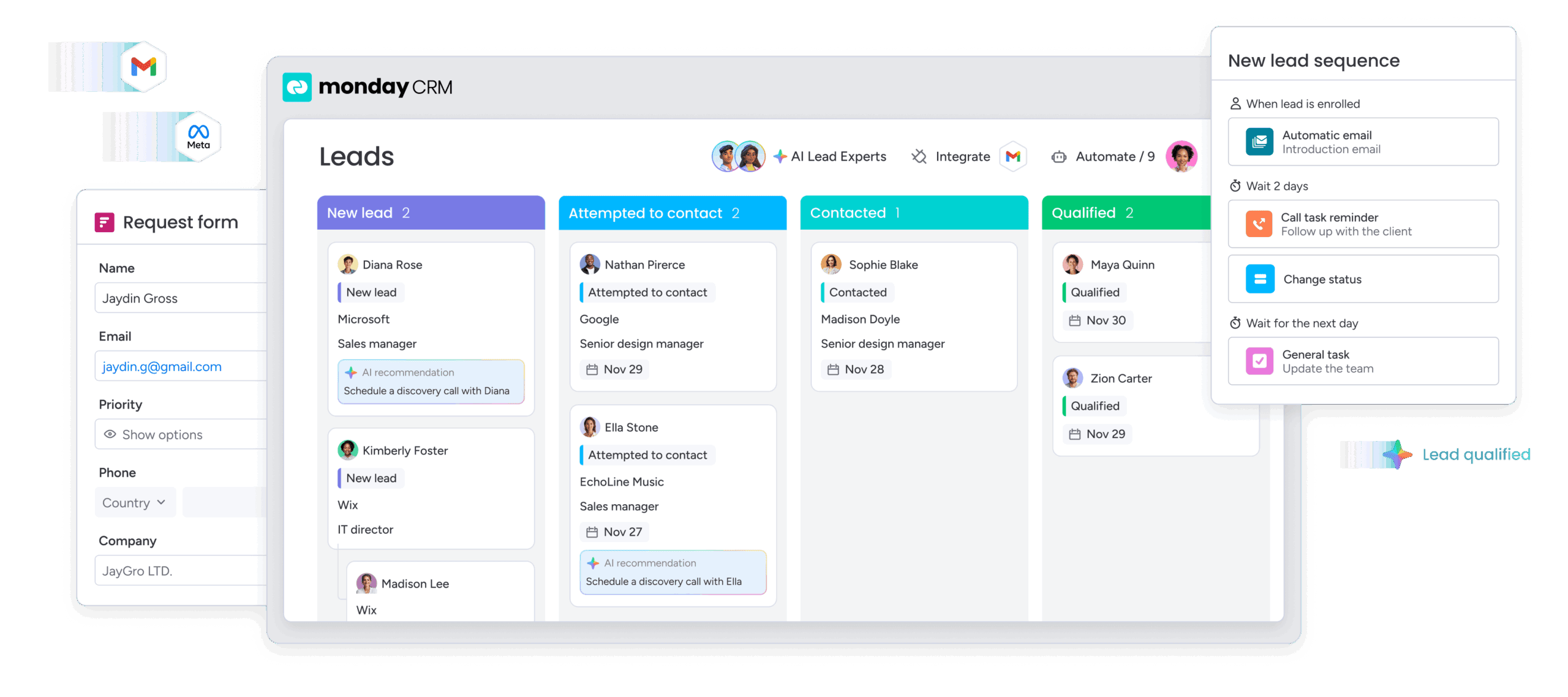
Lead scoring models need complete, accurate data to predict which prospects will convert. Incomplete records lead to mis-scored leads where high-value prospects get ignored while low-fit leads receive attention.
Enrichment improves scoring accuracy by providing:
- Complete firmographic data: Company size, industry, revenue for ICP matching
- Verified demographic data: Job title and seniority for authority assessment
- Real-time behavioral signals: Engagement patterns that indicate buying readiness
Scoring models finally have the complete information needed to make accurate predictions about conversion likelihood. Marketing qualified leads become truly qualified, and sales teams focus their energy on prospects most likely to close.
3. Accelerate deal velocity

Deal velocity measures how quickly opportunities move through your sales pipeline from first contact to closed-won. Enriched data accelerates deals by eliminating delays caused by missing information and enabling faster qualification.
Complete firmographic and demographic data allows reps to instantly determine prospect fit. No more spending the first call collecting basic company details — reps can move qualified leads directly to needs assessment and value demonstration.
Behavioral enrichment data reveals buying signals that help reps time their outreach perfectly. When a prospect downloads pricing information or visits competitor comparison pages, reps can engage immediately while interest is highest.
4. Enable hyper-personalization
Generic outreach gets ignored. Relevant, tailored messaging drives engagement. Enriched data provides the insights needed to personalize every touchpoint at scale.
Hyper-personalization becomes possible when you have:
- Industry-specific context: Tailored messaging that speaks to sector challenges
- Role-based value props: Benefits that resonate with specific job functions
- Timely triggers: Outreach based on recent company news or events
- Relevant social proof: References from similar companies in their industry
Personalized outreach generates significantly higher response rates than generic messaging, turning cold prospects into warm conversations. Reps can reference specific pain points, mention relevant case studies, and demonstrate understanding of the prospect’s business context.
5. Boost forecast reliability

Accurate sales forecasting depends on complete, up-to-date pipeline data. When CRM records are incomplete or outdated, forecasts become guesswork. Targets get missed, resources get misallocated, and credibility with leadership erodes.
Enrichment improves forecast accuracy through several mechanisms:
- Complete opportunity data: Full contact and company information for more precise deal assessment
- Real-time updates: Changes that impact deal probability get captured immediately
- Behavioral signals: Engagement patterns that indicate deal health
- Historical pattern analysis: AI learns from past deals to predict outcomes
How monday CRM enriches your data automatically

With monday CRM, enrichment capabilities are woven directly into your sales workflow without requiring teams to manage separate enrichment tools. The system’s AI-powered features eliminate manual data entry and keep records current automatically.
Key enrichment capabilities include:
- Extract Info feature: Automatically pulls structured data from unstructured documents like invoices, contracts, resumes, and business cards, populating CRM fields without manual typing. Upload a signed contract or business card image, and the system instantly parses relevant details into the appropriate fields—no copy-pasting required.
- AI timeline summaries: Generates concise overviews of all communication history, emails, and activities so reps understand engagement context instantly. Instead of scrolling through months of email threads and meeting notes, reps get a digestible summary that highlights key moments, decisions, and next steps.
- Custom AI Blocks: Enables teams to build tailored enrichment workflows that match specific business processes without coding. Sales ops can configure custom automation rules that trigger enrichment based on deal stage, lead source, or any other criteria relevant to your unique sales motion.
- Real-time updates: Enrichment happens invisibly as reps work, keeping records current without triggering manual updates or switching platforms. When a contact changes jobs or a company announces new funding, those updates flow into your CRM automatically—no manual refresh needed.
This integrated approach means enrichment becomes part of your natural workflow rather than an additional step. Reps get complete, accurate data exactly when they need it, directly within the CRM they already use daily. The result is a sales process where data quality improves continuously without adding friction, manual tasks, or context-switching that slows teams down.

“With monday CRM, we’re finally able to adapt the platform to our needs — not the other way around. It gives us the flexibility to work smarter, cut costs, save time, and scale with confidence.”
Samuel Lobao | Contract Administrator & Special Projects, Strategix
“Now we have a lot less data, but it’s quality data. That change allows us to use AI confidently, without second-guessing the outputs.”
Elizabeth Gerbel | CEO
“Without monday CRM, we’d be chasing updates and fixing errors. Now we’re focused on growing the program — not just keeping up with it."
Quentin Williams | Head of Dropship, Freedom Furniture
“There’s probably about a 70% increase in efficiency in regards to the admin tasks that were removed and automated, which is a huge win for us.“
Kyle Dorman | Department Manager - Operations, Ray White
"monday CRM helps us make sure the right people have immediate visibility into the information they need so we're not wasting time."
Luca Pope | Global Client Solutions Manager at Black Mountain
“In a couple of weeks, all of the team members were using monday CRM fully. The automations and the many integrations, make monday CRM the best CRM in the market right now.”
Nuno Godinho | CIO at Velv
“monday.com provides developmental flexibility, operational efficiency, and data transparency — all in one place. We became a company that moved from chasing data to leading with it.”
Hyunghan Lee | Team Lead, Sandbox Network
"monday.com brought every part of our business into one connected space. The harmony between work management and CRM has become our operating system — giving us the clarity and confidence to scale.”
Jennifer Chinburg | Executive Vice President of Corporate Development & Brand, Chinburg Properties
“We just weren’t getting value from our old CRM. With monday.com, it's a thousand times better. Our sales teams are more informed, more consistent, and far more connected."
James Arnold | Chief Operating Officer, CenversaTransform your sales process with enriched data
Data enrichment transforms incomplete CRM records into comprehensive profiles that support faster, more confident sales decisions. By automatically filling gaps with verified contact details, firmographic data, and behavioral signals, enrichment eliminates hours of manual research and lets your sales team focus on what they do best — selling.
With monday CRM, you get built-in enrichment capabilities that work seamlessly within your existing workflow, from AI-powered document extraction to automated timeline summaries. Experience how enriched data accelerates your sales process.
Try monday CRMFAQs
What is data enrichment in simple terms?
Data enrichment automatically adds missing information to your customer and prospect records from external sources. When a new lead enters your CRM with just a name and email, enrichment fills in job title, company size, phone number, and other details without manual research.
What is an example of data enrichment?
A prospect fills out a form with their name and work email. Data enrichment automatically adds their job title (VP of Sales), direct phone number, company size (500 employees), industry (SaaS), recent funding information ($20M Series B), and LinkedIn profile URL to their CRM record.
What is the difference between data enrichment and data cleansing?
Data enrichment adds new information to existing records from external sources. Data cleansing improves the quality of existing data by removing duplicates, fixing errors, and standardizing formats without adding new information.
How often should CRM data be enriched?
CRM data should be enriched continuously rather than as a one-time project. Contact information changes frequently, with people changing jobs or companies updating their details. Real-time enrichment for new records combined with periodic refresh of existing records prevents data degradation.
