


AI-powered SDR tools are transforming lead generation by automating repetitive prospecting work while adapting to real prospect behavior in real time. Instead of spending over half their day on data entry and manual tasks, sales teams can now focus on what actually drives revenue: building relationships and closing deals.
This guide breaks down the top AI SDR tools to watch, what separates strong performers like monday CRM from overhyped software, and how revenue teams can implement them to see measurable results in weeks rather than quarters. You’ll learn which platforms deliver the best ROI, what features matter most, and how to choose the right solution for your team’s specific needs.
What are AI SDR tools for lead generation?
Sales teams today have a clear opportunity to spend more time selling and less time managing manual work. Many SDRs can shift their focus away from repetitive prospecting tasks and data entry toward activities that create momentum and help them reach quota. AI SDR tools automate this foundational work, freeing teams to concentrate on what drives revenue.
AI SDR platforms manage the entire top-of-funnel process. They identify leads, personalize outreach, manage follow-ups, and qualify interest automatically. Unlike basic automation, these systems learn from real engagement data and adapt based on what resonates with prospects over time.
Try monday CRMAI SDR vs. traditional sales automation
Traditional sales automation relies on rigid workflows. These systems follow simple if and then rules that cannot interpret context or adapt when conversations move off script. The result is automation that executes tasks but lacks intelligence.
AI SDR platforms take a different approach. They analyze prospect behavior, interpret intent, and make informed decisions in real time. These systems determine when to continue outreach, when to change channels, and when a lead is ready for a human conversation. This shift changes how pipeline is built and sustained.
Core capabilities that drive faster results
AI SDR platforms accelerate pipeline growth through a set of complementary capabilities. Together, these features create a prospecting engine that scales efficiently without feeling automated or impersonal.
- Intelligent lead scoring analyzes firmographic data, engagement history, and behavioral signals to prioritize prospects most likely to convert.
- Personalized outreach at scale researches each prospect to reference company updates, role-specific challenges, and relevant pain points.
- Multichannel engagement automatically shifts between email, LinkedIn, and calls based on response patterns.
- Real-time response handling provides instant replies to common questions about pricing, features, or scheduling.
- Predictive analytics forecasts conversion likelihood and timing to improve pipeline visibility.
10 best AI SDR platforms for accelerating lead generation
The AI SDR market includes a wide range of platforms, each promising significant results. Choosing the right solution helps protect budget while improving sales performance. The most effective platforms combine strong AI capabilities with workflows that align with real revenue team needs.
The list below highlights ten platforms that deliver measurable impact across different sales motions and team sizes.
| Platform | Use case | Free plan? | Notable feature | Starting price |
|---|---|---|---|---|
| monday CRM | Revenue teams needing AI-powered lead management integrated into core sales workflows | No | Native AI embedded directly into CRM workflows with no integration complexity | $12/user/month |
| Saleshandy | High-volume email campaigns requiring strong deliverability safeguards | No | Inbox Radar with automated placement tests and auto-pause triggers | $25/month |
| Apollo.io | Mid-market teams needing broad prospecting data with automated sequences | Yes | Access to 275+ million verified B2B contacts with natural language search | $49/user/month |
| Agent Frank | Organizations seeking maximum automation with AI agents handling full workflows | No | Fully autonomous prospecting with minimal human intervention required | $499/month |
| Waalaxy | Teams prioritizing LinkedIn as their primary prospecting channel | Yes | LinkedIn-first automation with AI-powered message personalization | $21/month |
| Seamless.ai | Organizations struggling with inconsistent or outdated prospect data | Yes | Real-time contact discovery with 10-step verification process | Custom pricing |
| Salesforce | Large enterprises requiring advanced AI SDR capabilities with deep customization | No | Einstein Lead Scoring with predictive insights and Data Cloud integration | $25/user/month |
| Outreach | Mid-market to enterprise teams requiring end-to-end revenue orchestration | No | AI Revenue Agent with automated account prioritization and contact sourcing | ~$100/user/month |
| AiSDR | Organizations seeking full automation of prospecting workflows at scale | No | Signal-driven prospecting based on LinkedIn engagement and website visits | $900/month |
| Conversica | Mid-market and enterprise teams handling high lead volumes | No | Natural language conversations with automated lead qualification | ~$3,000/month |
1. monday CRM
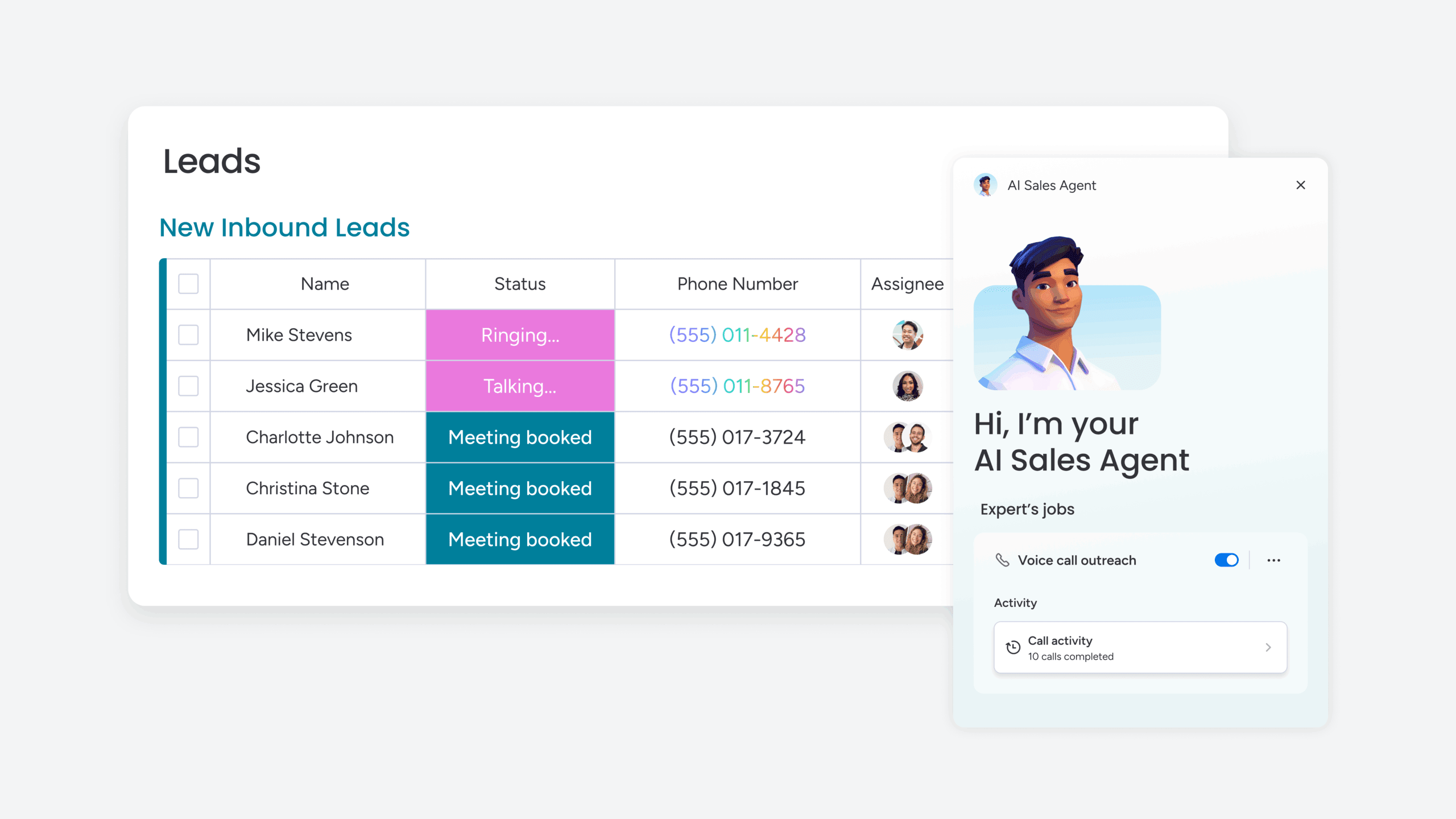
Modern revenue teams benefit from having AI-assisted lead generation directly connected to their CRM workflows. With monday CRM, you get core sales processes with built-in AI, allowing teams to capture, qualify, and progress leads without switching platforms.
Use case: Revenue teams that need AI-powered lead management directly integrated into their core sales workflows without switching between multiple platforms or managing complex integrations
Key features
- Automated lead capture and intelligent qualification: Centralize inbound leads from forms, social campaigns, and integrations, then automatically assigns and qualifies them based on fit and intent signals.
- AI-powered lead enrichment: Enrich prospect records instantly using Crunchbase data to surface firmographic details, funding status, and company insights without manual research.
- Connected email tracking with full context: Log every outreach attempt and prospect reply directly on the deal timeline, giving reps complete visibility into engagement history before follow-up.
Pricing
- Basic: $12 per seat per month, billed annually
- Standard: $17 per seat per month, billed annually
- Pro: $28 per seat per month, billed annually
- Ultimate: contact sales for pricing
- Minimum of 3 seats is required
- AI features operate on a transparent credit-based model
Why it stands out
- AI in monday CRM supports the daily work reps already perform, including writing, summarizing, and updating records. These features are available on Standard, Pro, and Enterprise plans when enabled by admins.
- For teams focused on speed, personalization, and accurate pipeline visibility, monday CRM delivers AI support where it matters most.
2. Saleshandy
Saleshandy focuses on email deliverability and personalization at scale, helping teams run high-volume campaigns without sacrificing sender reputation. The platform is designed to protect inbox placement while supporting aggressive outbound strategies. Built for lead generation agencies and sales teams, it combines B2B data, AI-driven personalization, and deliverability controls in one unified environment.

Use case: Teams running high-volume email campaigns that require strong deliverability safeguards and AI-powered personalization
Key features
- AI-powered prospect discovery and enrichment: Natural language AI Search identifies ideal prospects from more than 700 million contacts, while AI enrichment generates personalized icebreakers and company-level insights.
- Advanced deliverability protection: Inbox Radar runs automated placement tests with auto-pause triggers, ESP matching routes emails effectively, and text-only sending options help avoid spam filters.
- Unified outreach automation: AI Sequence Copilot builds multi-email campaigns from company websites, with one-click variants and coordinated multichannel workflow management.
Pricing
- Outreach starter: $25 per month with annual billing
- Outreach pro: $69 per month with annual billing
- Outreach scale: $139 per month with annual billing
- Lead finder starter: $29 per month with annual billing, including 6,000 credits per year
- Lead finder pro: $59 per month with annual billing, including 12,000 credits per year
- All plans include unlimited email accounts and allow credit rollover, supporting long-term planning and predictable usage
Considerations
- LinkedIn actions require manual execution to protect account safety, which adds operational overhead for teams running multichannel campaigns.
- Phone number discovery uses significantly more credits than email lookup, which can increase costs for phone-heavy outreach strategies.
3. Apollo.io
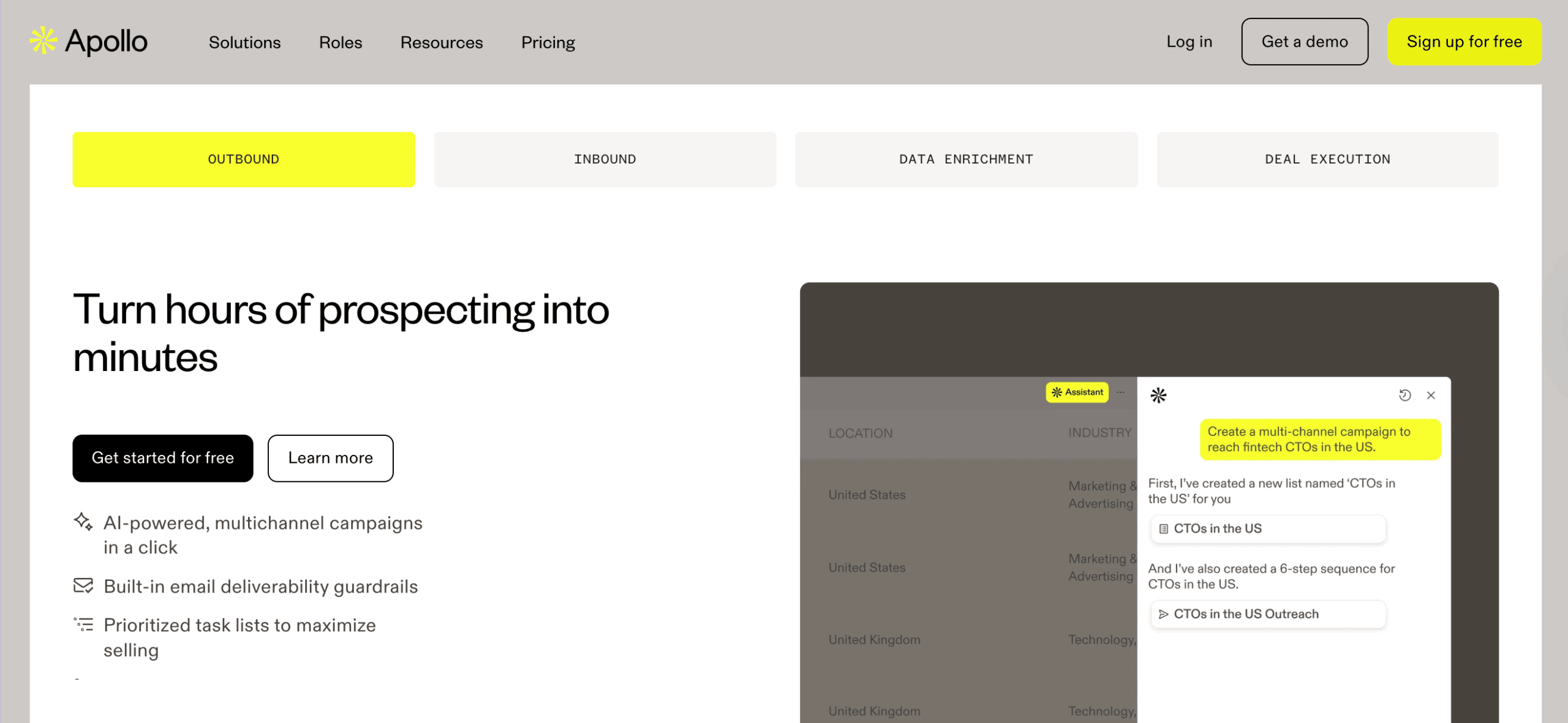
Apollo.io combines large-scale B2B data with AI-powered lead scoring to support end-to-end sales workflows. The platform serves more than 40,000 paying customers by unifying prospecting, outreach, and pipeline management. This makes it a strong option for teams seeking comprehensive lead generation without managing multiple systems.
Use case: Mid-market sales teams that need broad prospecting data paired with automated, multichannel sequences
Key features
- AI-powered prospecting at scale: Search through more than 275 million verified B2B contacts using natural language queries aligned with your ideal customer profile.
- Automated multichannel sequences: Coordinate email and LinkedIn outreach that adjusts messaging based on responses and engagement signals.
- Real-time lead scoring: Prioritize prospects using transparent AI criteria based on firmographic data, technographic signals, and behavioral patterns.
Pricing
- Free plan: basic access with limited features
- Basic: $49 per user per month with annual billing
- Professional: $79 per user per month with annual billing
- Organization: $119 per user per month with annual billing
- The platform uses a credit-based system for verified emails and phone numbers
- Additional costs for advanced dialer capabilities and international calling
Considerations
- Credits expire at the end of each billing cycle, which can increase costs for high-volume prospecting teams.
- Data accuracy varies by region, with some users reporting inconsistent contact quality outside core markets.
4. Agent Frank by Salesforge.ai
Agent Frank provides fully autonomous AI SDR capabilities that manage the entire prospecting workflow with minimal oversight. The platform targets SMBs and mid-market organizations with ACVs between $5k and $100k, emphasizing deliverability-first infrastructure to protect inbox placement. It operates within the broader Forge ecosystem, combining AI prospecting with dedicated infrastructure support.
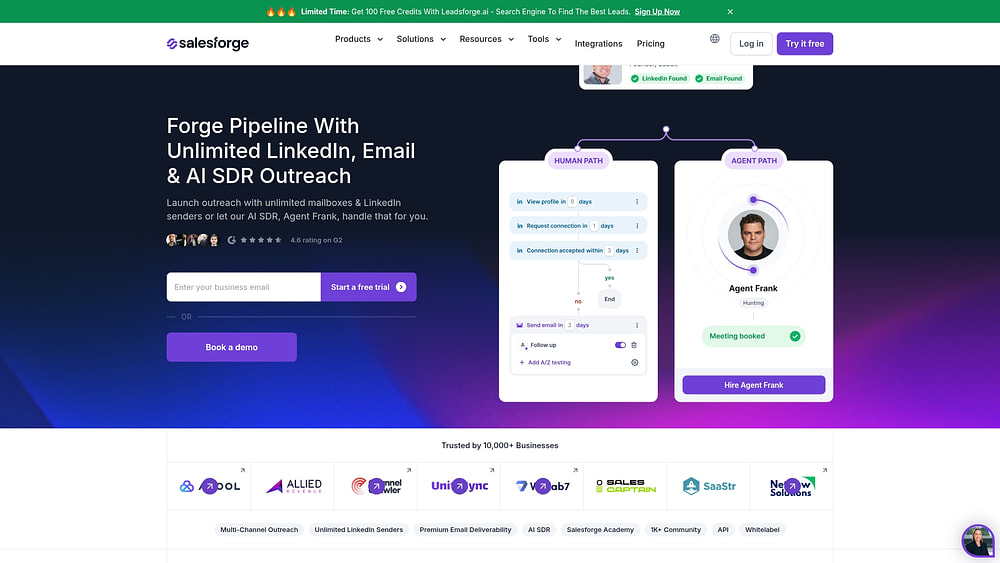
Use case: Organizations seeking maximum automation and AI agents to handle prospecting, outreach, and meeting booking
Key features
- Fully autonomous prospecting and outreach: AI manages the complete lead generation workflow with minimal human intervention.
- Multichannel engagement: Coordinate email, LinkedIn, and phone touchpoints based on prospect preferences and engagement patterns.
- Natural language prospect research: Analyze company challenges and tailor messaging to specific business pain points.
Pricing
- Agent Frank subscription: $499 per month with annual or quarterly billing, or $599 per month with monthly billing
- Infraforge add-on: starting at $33 per month for ten mailboxes with annual billing
- Megaforge add-on: starting at $69 per month for twenty mailboxes
- A demo is required before activation
- No free trial is available for the core agent
Considerations
- The platform requires a 2-week warm-up before full-speed activation, which delays immediate results.
- Infrastructure add-ons increase the total investment beyond the base subscription price.
5. Waalaxy
Waalaxy combines LinkedIn automation with email outreach to help B2B teams connect with decision-makers on their most active channels. The platform emphasizes LinkedIn-first prospecting supported by AI-powered message personalization.
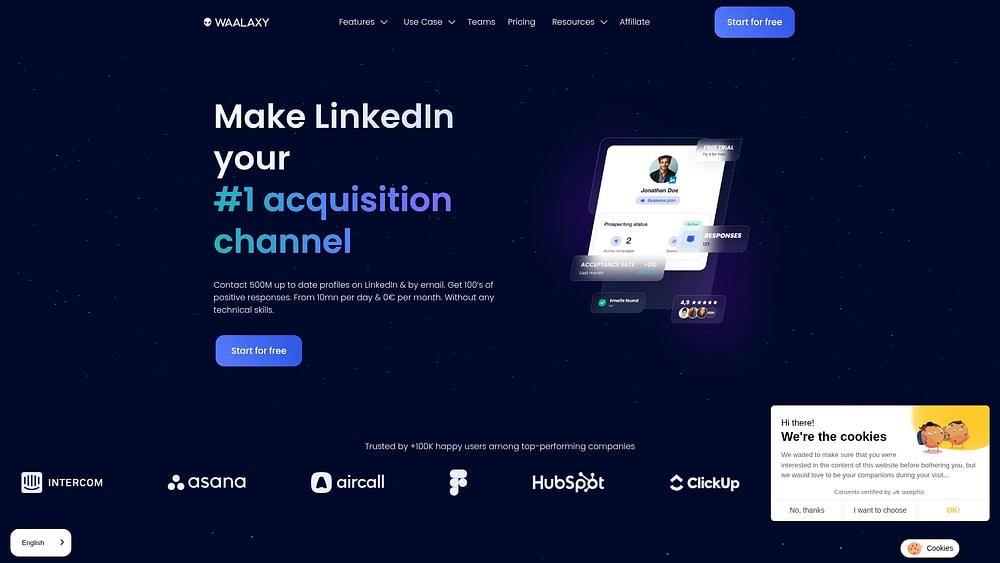
Use case: Teams that prioritize LinkedIn as their primary prospecting channel
Key features
- LinkedIn connection and messaging automation: Scale outreach while staying within LinkedIn usage limits to protect account health.
- AI-powered message personalization: The Waami AI assistant analyzes profiles and recent activity to craft relevant, personalized messages.
- Multistep campaign sequences: Coordinate LinkedIn and email touchpoints based on engagement patterns across channels.
Pricing
- Freemium: $0 per month with basic LinkedIn outreach quotas and starter features
- Pro: $21 per month with automated follow-ups, unlimited campaigns, and CSV or CRM sync
- Advanced: $54 per month with higher monthly actions and live chat support
- Business: $76 per month, adding cold email sequences and multiple sender accounts
- Enterprise: custom pricing for 5 or more seats with shared workspaces and analytics
- Annual billing offers discounts of up to 50% compared to monthly pricing
Considerations
- The LinkedIn-first focus means additional platforms are required for advanced email deliverability or phone outreach.
- Several AI capabilities are marked as coming soon, which may limit current automation depth.
6. Seamless.ai
Seamless.ai focuses on real-time contact discovery and AI-powered data verification to address data quality challenges in outbound sales. The platform specializes in finding accurate contact information quickly while validating emails and phone numbers before outreach begins. This makes it useful for teams dealing with outdated databases and high bounce rates.

Use case: Organizations struggling with inconsistent or outdated prospect data
Key features
- Real-time contact and company discovery: Identify accurate contact details instantly using AI that scans public data sources.
- AI-powered verification and enrichment: Validate contact accuracy through a ten-step verification process and enrich records with firmographic data.
- Chrome extension prospecting: Discover and save contact information directly from LinkedIn, company websites, and other web pages.
Pricing
- Free: 50 credits for one user
- Pro: Quote-based pricing with daily credit refresh
- Enterprise: Quote-based pricing with unlimited users and custom credit allocations
- Additional add-ons are available for buyer intent, job changes, autopilot features, data enrichment, and API access
Considerations
- Data quality varies by segment, with some users reporting outdated or inaccurate contacts that require manual review.
- The higher price point focuses on data discovery rather than full SDR workflows, requiring additional platforms for sequencing and lead management.
7. Salesforce
Salesforce delivers enterprise-grade AI SDR capabilities through Einstein AI, bringing predictive lead scoring and automated outreach into the world’s most widely adopted CRM. The platform focuses on unifying data across sales, marketing, and service teams, supported by sophisticated AI governance through the Einstein Trust Layer. Designed for large organizations with complex sales processes, Salesforce supports deep customization and a broad ecosystem of third-party integrations.
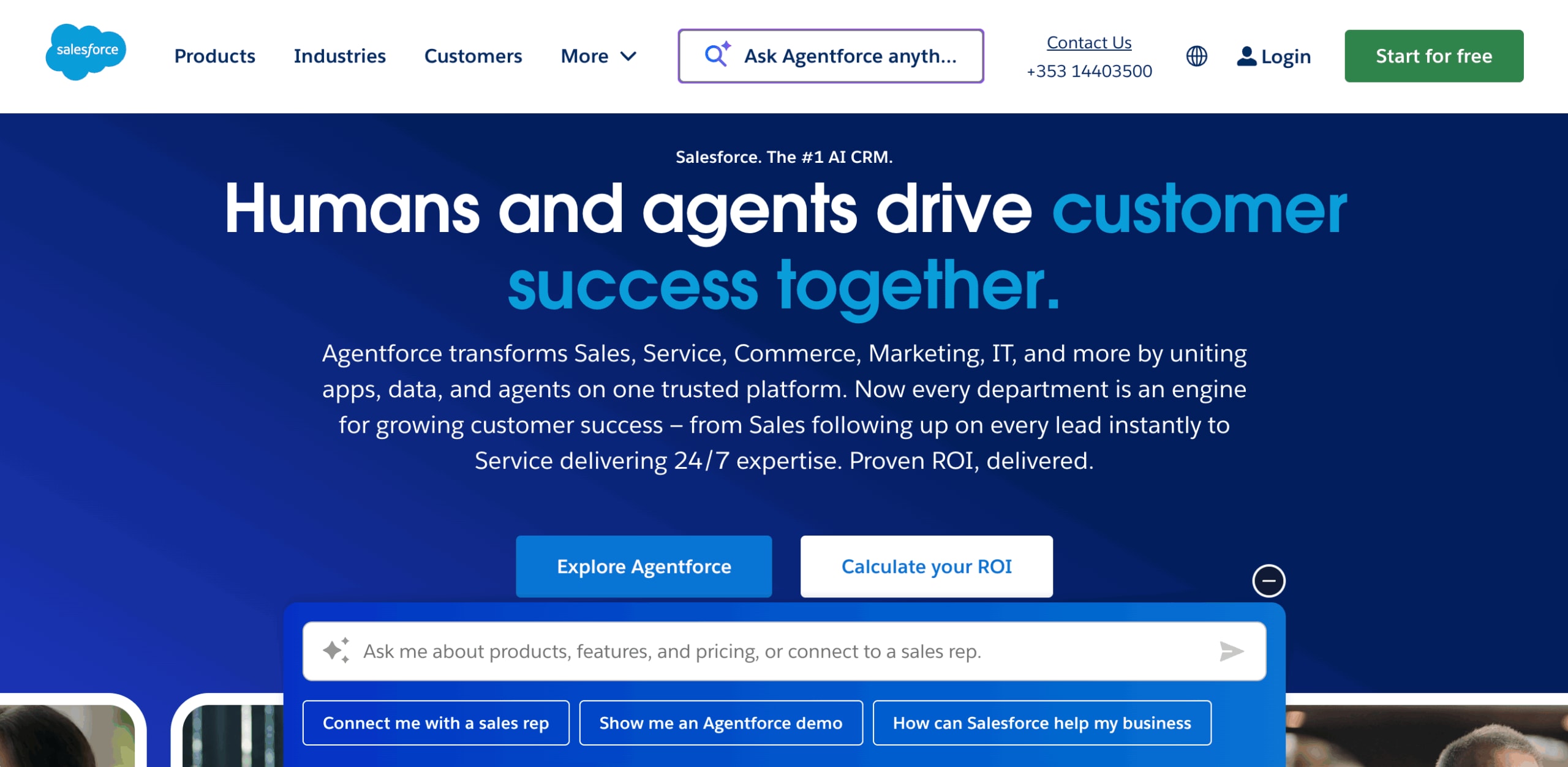
Use case: Large enterprises with dedicated Salesforce administrators and budgets for extensive customization that require advanced AI SDR capabilities
Key features
- Einstein Lead Scoring with predictive insights: Analyze historical performance data and external signals to prioritize prospects based on conversion likelihood, with scores updating continuously as new information becomes available.
- AI-powered email templates and scheduling: Optimize outreach timing and messaging by learning from recipient behavior patterns, historical engagement, and response trends.
- Comprehensive automation with Data Cloud integration: Unify structured and unstructured data to ground AI recommendations in governed first-party data, supported by zero-retention commitments.
Pricing
- Starter Suite: $25 per user per month, providing access to basic CRM functionality
- Professional: $100 per user per month with annual billing, expanding core sales and automation features
- Enterprise: $175 per user per month, with AI capabilities available as additional purchases
- Unlimited: $350 per user per month, including access to predictive AI features
- Agentforce one Sales: $550 per user per month, bundling advanced AI functionality with usage credits
Considerations
- Requires significant setup time and dedicated administrators to manage configuration, governance, and ongoing customization.
- Higher-tier plans and add-ons are often required for full AI value, with costs increasing quickly for mid-market teams seeking faster time to value.
8. Outreach
Outreach provides AI-powered sales execution that reshapes how revenue teams prospect, engage, and close deals. The platform combines agentic AI with comprehensive sales engagement capabilities, making it a strong fit for enterprise teams running complex, multi-touch sales motions. It is built for organizations that need advanced automation while maintaining operational control and compliance.
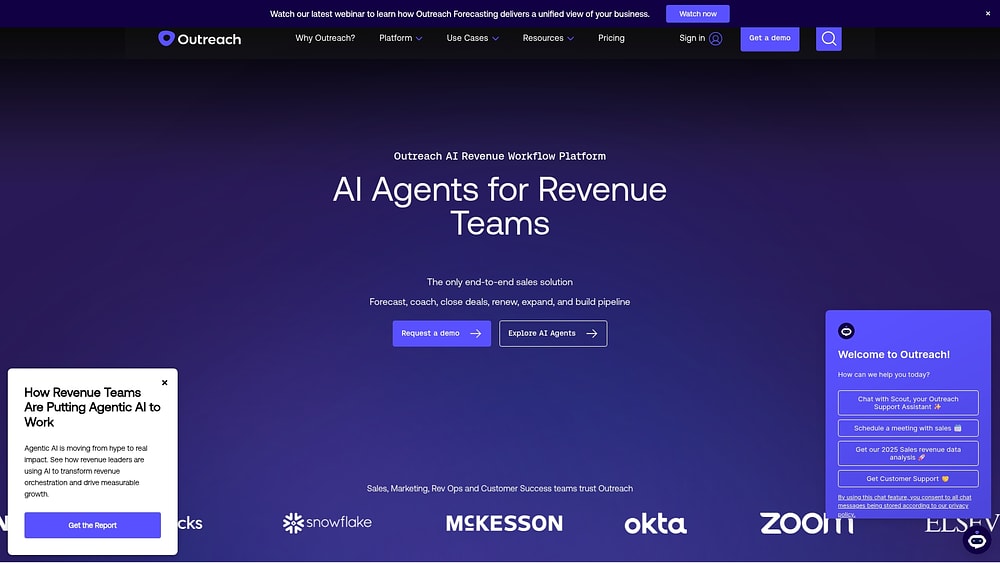
Use case: Mid-market to enterprise sales teams with dedicated sales operations resources that require end-to-end revenue orchestration
Key features
- AI Revenue Agent: Automate account prioritization, contact sourcing, and personalized outreach across multiple channels using configurable ICP rules.
- Research Agent: Extract buyer signals from public sources and engagement data, writing insights directly into CRM fields for immediate use in sequences and personalization.
- Smart Email Assist: Draft contextual emails and replies within Outreach, Gmail, and Outlook, with tone controls and awareness of ongoing conversations.
Pricing
- Custom pricing: Quote-based plans typically starting around $100 per user per month, depending on team size and selected features
- AI features (Amplify): Credit-based consumption model with overage notifications triggered at 102% usage
- Voice integration: Billed through pay-per-use pricing or subscription models for minutes and phone numbers
- Support tiers: Plus and Enterprise support levels are available, with optional Technical Account Manager services
Considerations
- The software requires significant training and ongoing management due to platform depth and learning curve.
- Credit-based AI usage and variable voice pricing can make total spend harder to forecast.
9. AiSDR
AiSDR offers autonomous AI prospecting that manages lead generation, qualification, and outreach with minimal human oversight. Backed by Y Combinator, the platform focuses on signal-driven opportunities through LinkedIn engagement tracking and website visitor identification. It is designed for teams prepared to automate top-of-funnel workflows at scale.
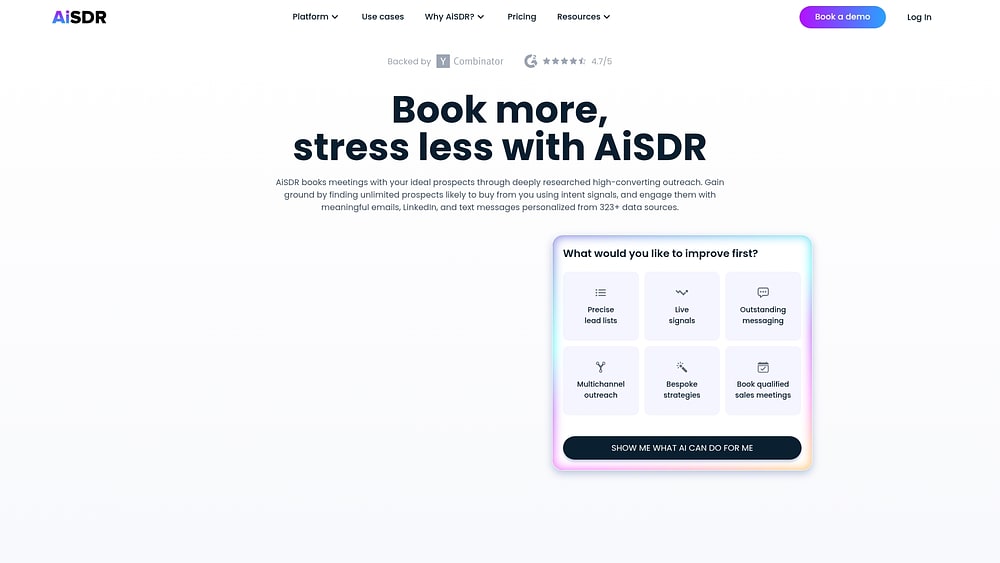
Use case: Organizations seeking full automation of prospecting workflows, supported by dedicated onboarding and willing to commit to quarterly plans for deliverability optimization
Key features
- Signal-driven prospecting: Identify prospects based on LinkedIn engagement, website visits, and intent signals to enable timely outreach.
- Multichannel automation: Coordinate email, LinkedIn, and SMS sequences with built-in deliverability controls.
- AI-powered personalization: Generate customized messaging using over 323 data sources and behavioral profiling.
Pricing
- Explore: $900 per month billed quarterly, including 1,200 lead credits and 1,200 AI messages
- Grow: $2,500 per month billed quarterly, including 4,500 credits and messages, plus AI videos and voice notes
- Enterprise: Custom pricing with access to website visitor tracking and dedicated support
- Annual plans: Offer approximately 20% savings compared to quarterly billing
Considerations
- Salesforce integration appears more limited than HubSpot, requiring validation for Salesforce-dependent workflows.
- Quarterly commitments may feel restrictive for smaller teams testing AI SDR performance.
10. Conversica
Conversica provides AI-powered Revenue Digital Assistants that manage lead follow-up and qualification through natural, human-like conversations. The platform focuses on persistent multichannel engagement across email, SMS, and web chat, helping teams manage large inbound volumes before handing qualified leads to sales.

Use case: Mid-market and enterprise teams handling high lead volumes that need automated qualification and persistent follow-up to improve conversion rates.
Key features
- Natural language conversations: Engage prospects through contextual email and SMS exchanges that interpret intent and respond to objections.
- Automated lead qualification: Analyze conversations to detect buying signals and routes high-intent leads directly to the appropriate sales representatives.
- Deep CRM and MAP integration: Connect with existing sales and marketing systems to keep data aligned and up to date.
Pricing
- Quote-based pricing: Conversica does not publish list prices and provides custom quotes based on expected conversation volume
- Proven ROI: G2 data reports a median 9-month payback period, with users citing an average 10% discount
Considerations
- Web chat currently supports English only, while email and SMS assistants offer multilingual support.
- Higher pricing means consistent inbound lead volume is needed to justify the investment.
Key AI SDR features that close deals faster
Not all AI sales development representatives deliver the same results. Some overload inboxes with noise, while others actively shorten sales cycles and support real revenue growth. The difference comes down to a focused set of capabilities that address the most common points of friction in modern sales processes. Understanding these features helps teams invest in AI that supports strategy rather than creating more clutter.
Instant lead response and 24/7 engagement
Responding to a high-intent lead within 5 minutes has a measurable impact on conversion rates. An AI SDR makes this achievable by engaging prospects around the clock, ensuring that interest is captured the moment it appears and turned into a meaningful interaction.
An AI SDR operates continuously, responding the second a prospect takes action, whether that happens late at night or in the middle of a busy workday. Instead of sending a generic confirmation email, the message reflects the specific action the prospect just completed. This immediate relevance helps conversations start naturally rather than feeling automated or disconnected.
Context continuity plays an equally important role. When a prospect re-engages weeks later, the AI retains full awareness of prior interactions and conversation history. Revenue teams often see stronger results when using monday CRM to support AI-driven email drafts that draw on complete engagement data, helping every message feel informed, timely, and personal.
Intelligent lead scoring and prioritization

Sales teams cannot afford to spend time on opportunities that lack real buying intent. Traditional scoring models often rely on surface-level actions that do not accurately reflect readiness to purchase, leading teams to chase leads that ultimately stall.
AI-driven scoring evaluates a wider range of behavioral and firmographic signals at once, including website activity, content engagement, and shifts in a company’s technology stack. These inputs create a dynamic, continuously updated view of lead quality that adapts as behavior changes.
When a prospect visits a pricing page or shows other high-intent behavior, their score adjusts immediately and alerts the appropriate sales representative. Many organizations rely on monday CRM to support this process, using AI to automatically score, route, and prioritize opportunities so teams can focus attention where it is most likely to result in a closed deal.
Multi-channel outreach coordination
Prospects interact with brands across far more than just email. They engage on LinkedIn, respond to phone calls selectively, and move between channels depending on context and timing. An effective AI SDR coordinates outreach across these touchpoints to maintain consistency and relevance.
This approach goes beyond automation. The AI evaluates engagement patterns and adjusts outreach methods accordingly. If a prospect ignores emails but interacts on LinkedIn, the system shifts its focus rather than repeating ineffective tactics.
The result is a balanced cadence that maintains momentum without overwhelming prospects. Messages are spaced thoughtfully, channels are varied intentionally, and conversations progress in a way that feels supportive rather than intrusive. These capabilities ensure that technology reinforces sales strategy instead of working against it.
Try monday CRMHow to select the right AI SDR for your revenue team
Choosing an AI SDR is a strategic investment in the future of your pipeline. The right platform creates clarity, predictability, and momentum across the sales process. The wrong choice adds cost, complexity, and frustration without delivering meaningful results.
Separating solutions that deliver measurable impact from those that rely on marketing claims requires a disciplined evaluation. Focusing on practical criteria helps teams identify platforms that support long-term growth rather than short-term experimentation.

7 critical evaluation criteria
When evaluating AI SDR platforms, focus on these seven criteria to separate solutions that deliver real impact from those that create unnecessary complexity:
- Implementation speed: How quickly the platform can be deployed and start delivering value without prolonged technical setup
- Integration complexity: Whether the solution connects natively with your CRM or requires ongoing custom maintenance
- AI accuracy: The availability of clear metrics, benchmarks, and references that demonstrate real qualification performance
- Customization flexibility: The ability to reflect your sales process, brand voice, and qualification logic without sounding generic
- Scalability and pricing: Transparency around how costs change as lead volume, users, and data grow
- Training and support: Access to responsive guidance when adjustments, troubleshooting, or optimization are needed
- Compliance and security: Adherence to data protection standards and communication regulations across regions
CRM integration requirements
Tight CRM integration is essential for AI SDR success. When systems operate in isolation, teams face duplicated work, inconsistent data, and reduced trust in reporting. Once trust erodes, representatives often revert to manual processes that undermine adoption.
Team readiness assessment
Even the strongest platform cannot compensate for unclear processes or low adoption. Before implementing AI, organizations should evaluate whether sales workflows are consistent, documented, and measurable.
Team readiness also includes mindset. Reps who understand AI as a support system rather than a replacement are more likely to adopt it effectively. Successful rollouts involve sales teams early, provide clear training, and highlight early wins to build confidence and momentum across the organization.
Fast-track your AI SDR implementation
AI SDR initiatives often fall short due to execution rather than technology. Treating implementation as a strategic change, not just a software rollout, is critical for long-term success. Planning, testing, and iteration determine outcomes far more than features alone.
Set the foundation
Before activating AI outreach, review and prepare your data. AI amplifies existing patterns, which makes data quality a prerequisite for success.
- Configure your platform: Define brand voice guidelines, messaging frameworks, and qualification rules that align with how your team sells.
- Train the AI: Provide historical performance data so the system understands what successful outcomes look like.
- Establish baselines: Document current response times, qualification rates, and conversions to measure improvement accurately.
Run a pilot test
Start with a limited rollout that includes a small lead segment and a subset of sales representatives. Monitor performance daily to identify gaps early and compare AI outcomes with existing workflows.

Use insights from this phase to refine messaging, scoring logic, and handoff processes. Feedback from sales teams helps validate lead quality and ensures that AI output aligns with real-world selling conditions.
Get your data right
AI performance depends on reliable inputs. Before scaling, confirm that foundational data requirements are met.
- Contact information: At least 90% of leads include accurate email addresses, 70% include phone numbers, and 60% include LinkedIn profiles
- Lead source tracking: Every lead has a clearly documented origin
- Interaction history: All past communications are stored in a single system
- Firmographic data: Company size, industry, and technology details are current
- Behavioral data: Website activity, downloads, and engagement signals are consistently tracked
Investing in data cleanup before rollout prevents misleading results and accelerates time to value.
Scale with confidence
Gradual expansion reduces risk. Begin by assigning AI to twenty to 30% of inbound leads, monitor performance, then increase coverage in stages. This approach allows teams to correct issues before they affect the entire pipeline.
Key strategies for a successful implementation
Most AI SDR challenges follow predictable patterns. Addressing them early improves outcomes significantly.
- Over-automating: Start with high-impact actions such as initial responses before expanding automation.
- Ignoring personalization: Ensure the AI can access relevant data to support meaningful conversations.
- Clumsy handoffs: Define clear qualification thresholds and transfer full context to sales representatives.
- Set-it-and-forget-it mindset: Review performance regularly and optimize based on measurable results.
Many organizations rely on monday CRM to centralize prospect data, monitor AI performance, and manage sales handoffs in one place. Treating AI SDR adoption with the same discipline as any major sales initiative leads to stronger, more sustainable results.
Try monday CRMMeasuring AI SDR performance and ROI
An AI SDR remains an expensive experiment until its business impact is clearly measured. Revenue leaders need visibility into pipeline contribution, conversion quality, and financial outcomes, not hype or surface-level indicators. Proving value requires focusing on metrics that connect activity directly to revenue performance and long-term growth.

The only metrics that matter
To understand whether an AI SDR is driving real results, teams should concentrate on a focused set of performance indicators. These metrics highlight engagement quality, efficiency, and downstream impact on revenue outcomes.
- Response rates: Track whether prospects are engaging with outreach, segmented by channel and message, to identify what resonates and what needs refinement.
- Qualification accuracy: Measure how many AI-qualified leads convert into legitimate opportunities, since low accuracy creates wasted effort for sales teams.
- Time to first response: Monitor how quickly new leads are engaged, because faster responses consistently outperform slower follow-ups.
- Cost per qualified lead: Compare AI-driven efficiency against human-led efforts to understand true cost advantages and productivity gains.
- Human handoff success: Evaluate whether leads continue progressing after transfer, indicating whether the AI provides sales teams with actionable context.
What does “good” look like?
Performance benchmarks vary by industry, deal size, and sales cycle length. Understanding realistic expectations helps teams set achievable targets and evaluate progress accurately across different business models.
- Tech and SaaS: Higher engagement is common, with cold response rates around 20% to 30% and response times under 5 minutes.
- Professional services: Outreach is typically more targeted, producing response rates between fifteen and 25% with higher lead value.
- Manufacturing: Longer sales cycles shift focus toward consistent engagement, with response rates around 10% to 20% and strong long-term qualification.
Early improvements in response rates often appear within a few weeks. Full return on investment typically materializes within 3 to 6 months, depending on volume and cycle length.
Calculating real cost vs. value
Evaluating ROI requires a clear comparison between total investment and measurable returns. On the cost side, include subscriptions, setup expenses, integration fees, and internal time spent managing the platform.
On the value side, account for reclaimed sales rep time, incremental pipeline generated, and acceleration in deal velocity. When tracked consistently, these factors often show that the revenue impact outweighs the initial investment by a wide margin.
How monday CRM's native AI accelerates lead generation
Effective AI adoption works best when intelligence is embedded directly into daily workflows. Built into the sales workspace, monday CRM’s AI capabilities support lead generation without adding technical complexity or integration overhead.

AI Blocks for instant automation
AI Blocks act as configurable assistants that slot directly into existing workflows. Teams can select the blocks they need and activate automation without code, ensuring AI supports work rather than disrupting it.
- Extract what matters: Pull key details such as budget or timeline from emails and documents, automatically updating lead records with accurate context.
- Assign labels that stick: Categorize leads based on behavior so the right opportunities reach the right reps at the right time.
- Read the room: Detect sentiment in prospect communication to flag urgency, frustration, or interest before momentum is lost.
Digital workforce for round-the-clock prospecting
Always-on prospecting ensures no opportunity slips through the cracks. A digital workforce monitors pipeline activity continuously and responds when signals appear.
- Your personal sales advisor: Analyze pipeline health, surface at-risk deals, and recommend next actions to keep opportunities moving forward.
- A research assistant on call: Enrich prospect profiles with buying signals and trigger events such as funding announcements or competitive activity.
The zero-integration advantage
Standalone AI solutions often introduce fragmented data, ongoing maintenance, and operational friction. Consolidating intelligence within a single platform removes these barriers and keeps information consistent. With everything in one place, teams gain full AI value immediately while avoiding unnecessary complexity. This allows sales teams to focus on closing deals instead of managing tools.
Build a pipeline that runs itself
AI SDRs support consistency as much as efficiency. Automating the top of the funnel ensures every lead receives timely attention, while human teams concentrate on strategy, negotiation, and relationship building. Starting with clean data and choosing a platform that fits existing workflows transforms a CRM into a dependable revenue engine that scales with the business.
Try monday CRMFAQs
How quickly can AI SDR tools deliver ROI?
Most teams see early traction within weeks, with full ROI achieved in 3 to 6 months based on sales cycle length and lead volume.
Do AI SDRs integrate with existing CRM systems?
Many solutions offer integrations, though complexity varies. Native AI within monday CRM eliminates the need for separate integration projects.
What's the difference between AI SDRs and marketing automation?
AI SDRs enable personalized, one-to-one conversations that adapt in real time, while marketing automation focuses on broad, rule-based campaigns.
Can non-technical teams implement AI SDR tools?
Modern platforms are designed for business users, allowing teams to launch and manage AI workflows without technical support.
How do AI SDRs personalize outreach at scale?
They analyze prospect data across multiple sources to tailor messaging, timing, and follow-up for each individual.
Which industries see the fastest results with AI SDRs?
Industries with high lead volume and shorter sales cycles, such as technology, professional services, and B2B software, tend to see results sooner.

 Get started