


The sales team just finished a promising call. The prospect mentioned budget, timeline, and a clear pain point. Twenty minutes later, those details exist somewhere else — in someone’s head, scribbled on a notepad, or buried in a recording no one will transcribe.
That is the gap AI voice agent platforms are designed to close. These platforms handle calls, qualify leads, and book meetings without human intervention. But here is the catch: a voice agent that does not sync with a CRM creates more problems than it solves. Another data silo is created, more manual entry is required, and sales reps walk into follow-ups blind.
This article breaks down eleven AI voice agent platforms based on how well they actually connect to a sales workflow. It highlights what separates platforms that plug in cleanly from those that create extra work and which features help turn conversations into closed deals.
Key takeaways
- AI voice agents automate routine calls and lead qualification: they reduce manual work, capture key details, and free sales teams to focus on closing deals.
- CRM integration is critical for real value: without seamless syncing, call data remains trapped, leading to errors, inefficiencies, and lost context for follow-ups.
- Different platforms serve different use cases: some focus on high-volume outbound sales, others on enterprise customer support, multilingual interactions, or advanced conversation intelligence.
- ROI depends on tracking the right metrics: lead response time, qualification rate, deal velocity, and team capacity provide a clear picture of performance and revenue impact.
- monday CRM centralizes voice AI and sales data: it automatically converts call notes and transcripts into structured CRM information, enabling actionable next steps and consistent pipeline visibility.
What is an AI voice agent platform?
An AI voice agent functions as another member of your sales team. It handles the calls that consume your reps’ time — qualifying leads, scheduling meetings, and answering repeated questions. This allows your sales team to focus on closing deals rather than repetitive tasks.
These agents are not simple scripts or automated recordings. An AI voice agent understands customer responses and engages naturally, moving prospects forward without a human needing to answer the phone.
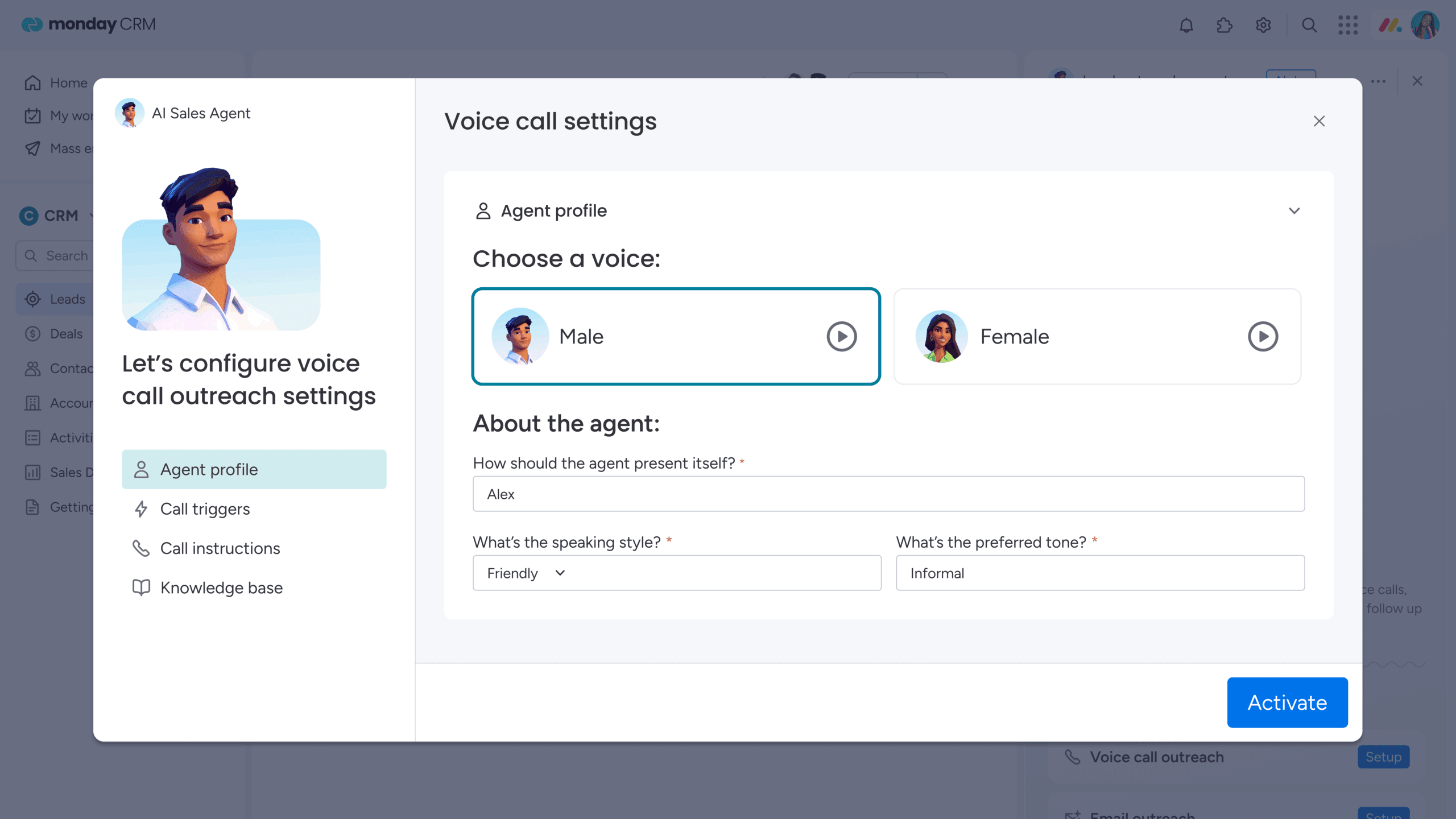
However, a voice agent without deep CRM integration adds more noise than value. The best platforms not only converse but also sync every call, update customer records, and trigger the next steps automatically. This ensures your team has a complete view of each interaction instead of managing siloed data.
The value of connecting voice agents to your CRM
A voice agent that does not integrate with your CRM traps critical information and wastes resources. Disconnected systems obscure call details, forcing your team to reconstruct conversations before follow-ups. This slows momentum and often results in repeated questions that frustrate customers.
Manual data entry is the common workaround, but it introduces three main issues:
- It consumes time: Reps spend hours typing call notes instead of selling.
- It introduces errors: Human mistakes undermine automation and reduce data accuracy.
- It reduces visibility: Teams cannot track which calls lead to revenue, limiting ROI measurement.
Without a direct connection to your CRM, a voice agent creates more busywork rather than more sales opportunities.
11 best AI voice agent platforms for seamless CRM connectivity
If your AI voice agent cannot sync with your CRM, it functions like an expensive answering machine. While some vendors promise easy connections, many require complex APIs and custom coding, which slows adoption. The right platform integrates smoothly with your CRM without technical headaches.
The platforms below are organized by primary strength, helping you choose one that matches your team size, tech stack, and objectives.
| Platform | Primary use case | Key CRM integrations | Starting price range | Notable AI features |
|---|---|---|---|---|
| monday CRM | Unified sales workflow automation with native AI | Native platform with universal integration capabilities | $12/user/month | AI blocks for extraction, categorization, summarization, custom actions |
| Retell AI | Real-time voice conversation handling | Salesforce, HubSpot, custom APIs | $99/month | Advanced natural language understanding, sentiment analysis |
| SquadStack AI | Outbound sales call automation | Salesforce, Zoho, custom webhooks | Custom pricing | Predictive dialing, conversation intelligence |
| PolyAI | Enterprise customer service automation | Salesforce, ServiceNow, Microsoft Dynamics | Custom pricing | Multilingual support, complex dialogue handling |
| Bland AI | Rapid voice agent deployment | HubSpot, Pipedrive, Zapier connections | $0.09/minute | Quick setup, conversational templates |
| Voiceflow | Visual conversation design | Salesforce, HubSpot, custom APIs | $40/month | No-code builder, multi-channel deployment |
| Sierra AI | Customer experience automation | Salesforce, Zendesk, custom integrations | Custom pricing | Context-aware responses, escalation intelligence |
| Replicant | Contact center automation | Salesforce, Five9, Genesys | Custom pricing | Thinking AI, autonomous problem-solving |
| ElevenLabs | Voice synthesis and cloning | API-based integration | $5/month | Ultra-realistic voice generation, emotion control |
| Synthflow AI | No-code voice workflow automation | HubSpot, Salesforce, Airtable | $29/month | Visual workflow builder, pre-built templates |
| Ada.cx | Automated customer support | Salesforce, Zendesk, Shopify | Custom pricing | Proactive engagement, multilingual AI |
These platforms differ in approach. Focus on solutions that integrate with your workflow and help your team close deals faster rather than chasing every new feature.
1. monday CRM
monday CRM helps revenue teams capture the value of voice conversations after a call by turning unstructured inputs such as transcripts, notes, and follow-up emails into structured CRM data that teams can act on. Instead of leaving call details scattered across systems, teams consolidate conversation context in monday CRM and use built-in AI and automations to keep deals progressing.
When voice agent platforms provide transcripts, summaries, or call notes, monday CRM gives teams a centralized location to store, standardize, and transform them into actionable next steps. Sales reps spend more time selling and less time rewriting call notes.

Example:
Revenue teams input call outcomes into monday CRM and generate consistent pipeline updates. After a discovery call, teams can add a transcript or notes to the deal record, and AI extracts budget, timeline, stakeholders, and next steps directly into the correct columns.
Key features:
- Emails & activities: AI Timeline Summary: creates a concise summary of communication events including emails, calls, meetings, and notes so reps and managers understand the full story quickly.
- Emails & activities: AI email assistant: helps reps draft follow-up emails directly in Emails & Activities, informed by the deal’s context.
- Autofill with AI (AI actions on columns): applies AI to Text, Date, Number, Dropdown, People, and Status columns to maintain complete and consistent CRM data.
- Visual sales pipeline: shows deal status, allows stage customization with drag-and-drop, and keeps teams aligned on next steps.
- Mass email and tracking: sends individual or bulk emails using dynamic fields and templates, then tracks opens and link clicks.
Pricing:
- Basic: $12/month per user (billed annually).
- Standard: $17/month per user (billed annually).
- Pro: $28/month per user (billed annually).
- Ultimate: custom pricing (contact sales).
- Annual discount: 18% off when billed yearly.
- AI credits: approximately $1.50 per five-minute call, $0.30 per SMS.
Why it stands out:
- AI integrated into workflow: AI in monday CRM supports core sales activities, such as summarizing Emails & Activities, composing emails, and filling columns automatically.
- Flexible CRM setup: revenue leaders adapt boards, pipelines, and automations to align with their sales process without imposing rigid structures.
- Centralized customer context: teams track deals, accounts, contacts, and communication history in one platform, making handoffs and deal reviews smoother.
Advanced AI features:
- Detect sentiment: categorizes text as positive, negative, or neutral, ideal for call notes, transcripts, and follow-up messages.
- Extract information: pulls structured details from text, images, and files including .pdf, .docx, and .xlsx, populating board columns automatically.
- Summarize and improve text: shortens long call notes and polishes internal summaries for leadership review.
- Translate: ensures consistent updates across regions for multi-language deals.
- Custom action: allows AI to use board column data as input and write output to the correct column.
Automations:
- AI-powered column updates: configure columns to autofill with AI actions, keeping data consistent across new and existing items.
- Process-based follow-through: combine AI-filled fields with CRM workflows to trigger ownership assignments, stage updates, or follow-up actions.
- Smarter routing with Assign person: define teammate roles or skills, then let AI assign the right owner based on Emails & Activities content.
Integrations:
- Bring voice outputs into CRM: transcripts or call notes from voice platforms can be stored on deal, contact, or account records to maintain context.
- All customer info in one place: combine deal data with communication history in Emails & Activities for full visibility.
- Dashboards and permissions for scale: leaders use custom dashboards and permissions to share the right information with the right teams.
AI voice agent platform features:
- Conversation-to-CRM consistency: AI Timeline Summary recaps Emails & Activities before follow-ups or pipeline reviews.
- From transcript to fields: Extract information populates monday CRM columns without manual copy-paste.
- Fast categorization: Assign label tags deals based on AI analysis using allowed Status or Dropdown labels.
- Visibility into AI actions: admins review Run history if AI returns “No result” and adjust instructions.
Note: AI capabilities in monday CRM are available to team members on Standard, Pro, and Enterprise plans whose admins have enabled AI.
Try monday CRM2. Retell AI
Retell AI manages real phone calls with sub-second response times. Its LLM-native voice processing handles interruptions, background noise, and natural turn-taking in live call conditions. This platform is ideal for teams managing high call volumes who need advanced conversation intelligence without building custom infrastructure.

Use case:
Built for organizations handling thousands of customer calls, Retell AI automates routine interactions while maintaining conversation quality.
Key features:
- Real-time function calling: integrates pre-built tools for call transfers, calendar booking, and SMS.
- Knowledge base retrieval: optimized to impact live conversations in under 100 milliseconds.
- Advanced telephony integration: supports SIP trunking with providers such as Twilio and Vonage.
Pricing:
- Pay-as-you-go: start at $0 with $10 free credits included.
- Usage-based components: voice engine ($0.07–$0.08/min), LLM costs vary by model, telephony (~$0.015/min for US calls).
- Enterprise plan: available for $3,000+/month volumes with dedicated support and discounts.
- Add-ons: knowledge base usage ($0.005/min), branded caller ID ($0.10/outbound call), verified numbers ($100/month).
Considerations:
- Retell-managed numbers support only fifteen countries for international calling.
- EU data residency requirements may affect compliance for some organizations.
3. SquadStack AI
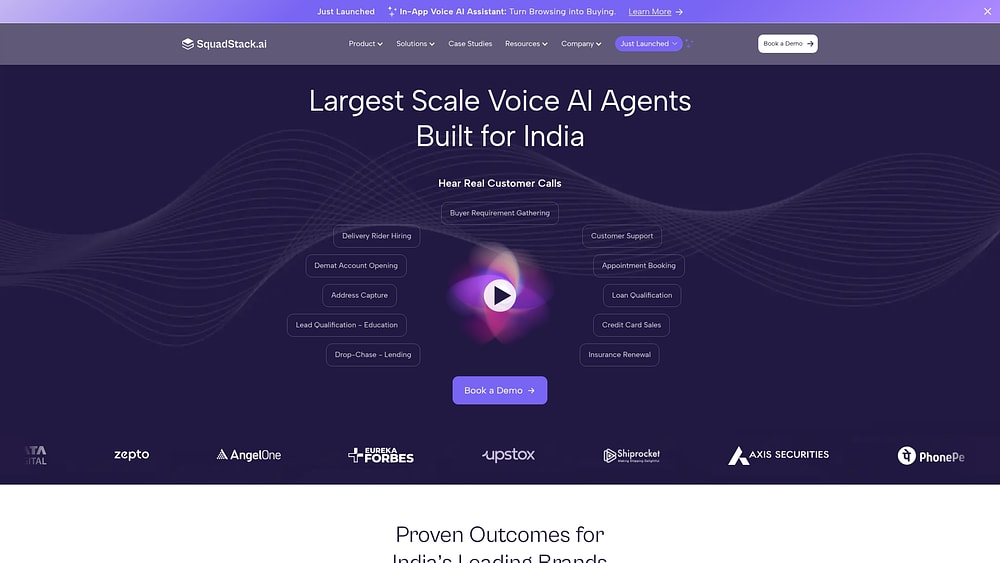
SquadStack AI creates voice agents for outbound sales calls, combining AI automation with human oversight to maximize conversions. Focused on India-first voice automation, it blends AI agents with managed human expertise for BFSI, healthcare, and e-commerce organizations. Native support for Indian languages and accents allows handling of over 750,000 daily conversations.
Use case:
Designed for Indian enterprises running high-volume outbound campaigns, SquadStack AI ensures consistent messaging, rapid follow-up, and multilingual support.
Key features:
- Omnichannel orchestration: voice agents move conversations across WhatsApp, SMS, and email with shared context and smart routing.
- Atlas Reasoning Engine: no-code agent builder with deep CRM integrations and real-time conversation intelligence analyzing successful calls.
- Multilingual voice capabilities: native support for Hindi, English, Tamil, Telugu, Kannada, Marathi, Punjabi, and Bengali with mid-conversation language switching.
Pricing:
- AI voice agent pricing is available via custom quote following a sales demo.
- Public pricing applies only to human-led telecalling packs, not AI products.
Considerations:
- India-centric architecture limits data hosting options in the US or EU.
- Performance metrics are company-provided with limited third-party validation.
4. PolyAI
PolyAI builds enterprise-grade voice agents that handle complex customer conversations in over forty-five languages. Its primary focus is large organizations in regulated industries such as banking, utilities, and healthcare, where call quality and compliance are critical.

Use case:
Ideal for global enterprises managing high-volume, multilingual customer service, PolyAI offers sophisticated dialogue handling and tight integration with contact center infrastructure.
Key features:
- Agent Studio platform: configure voice latency, barge-in controls, and A/B test conversations.
- Deep integrations: connects with major CCaaS platforms like Genesys, NICE, Five9, and Amazon Connect, and CRMs such as Salesforce, ServiceNow, and Microsoft Dynamics.
- Proprietary technology stack: includes patented dialogue management, ConveRT NLU, and United ASR for context-aware speech recognition.
Pricing:
- Usage-based per-minute pricing with 24/7 support and 99.9% uptime SLA.
- Enterprise plans are quote-only via sales team.
- Available through AWS Marketplace for Amazon Connect users.
Considerations:
- No public pricing or self-serve option for smaller businesses.
- Separate Agent Studio setups are required for multilingual projects.
5. Bland AI
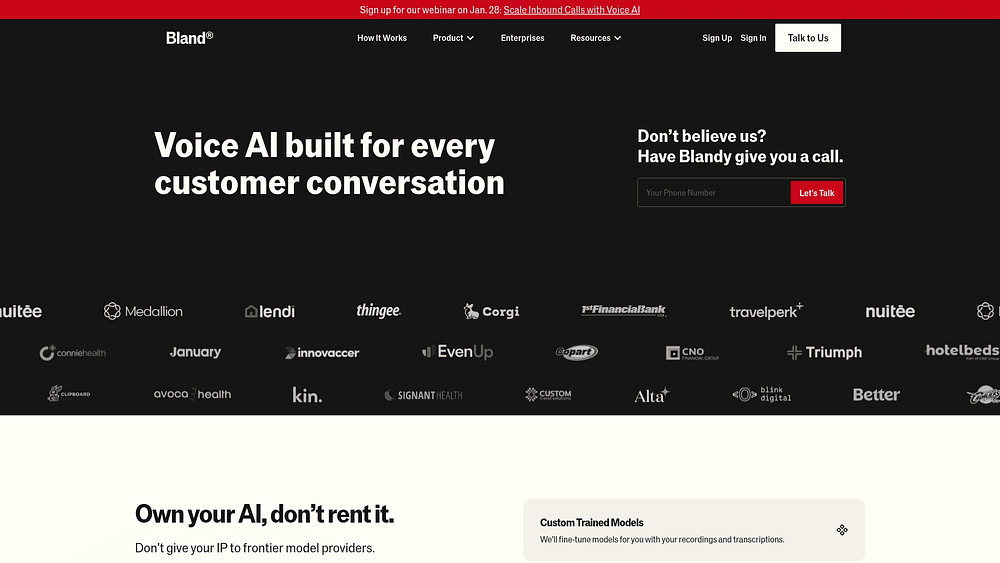
Bland AI provides enterprise-grade voice agents on self-hosted infrastructure with dedicated servers. Healthcare and financial services organizations benefit from built-in HIPAA, SOC 2, and GDPR compliance. The “Conversational Pathways” feature maps visual logic flows to keep AI agents aligned during complex interactions.
Use case:
Large enterprises needing compliant, high-volume voice automation for customer service, appointment scheduling, and payment processing can rely on Bland AI while warming complex cases to human agents.
Key features:
- Self-hosted AI models: dedicated infrastructure ensures data privacy and regulatory compliance.
- Visual Conversational Pathways: map decision trees and guardrails to guide agent behavior.
- Enterprise telephony integrations: support SIP, BYOT (Bring Your Own Twilio), and warm transfers with full context.
Pricing:
- Start: free with 100 calls/day, 10 concurrent calls, $0.14/min connected time.
- Build: $299/month with 2,000 daily calls, 50 concurrent calls, $0.12/min connected time.
- Scale: $499/month with 5,000 daily calls, 100 concurrent calls, $0.11/min connected time.
- Enterprise: custom pricing with unlimited usage and advanced features such as warm transfer and custom code nodes.
Considerations:
- Warm transfers and advanced dialing are included only in enterprise tiers.
- Per-minute rates are higher than API-first competitors but include full infrastructure and compliance.
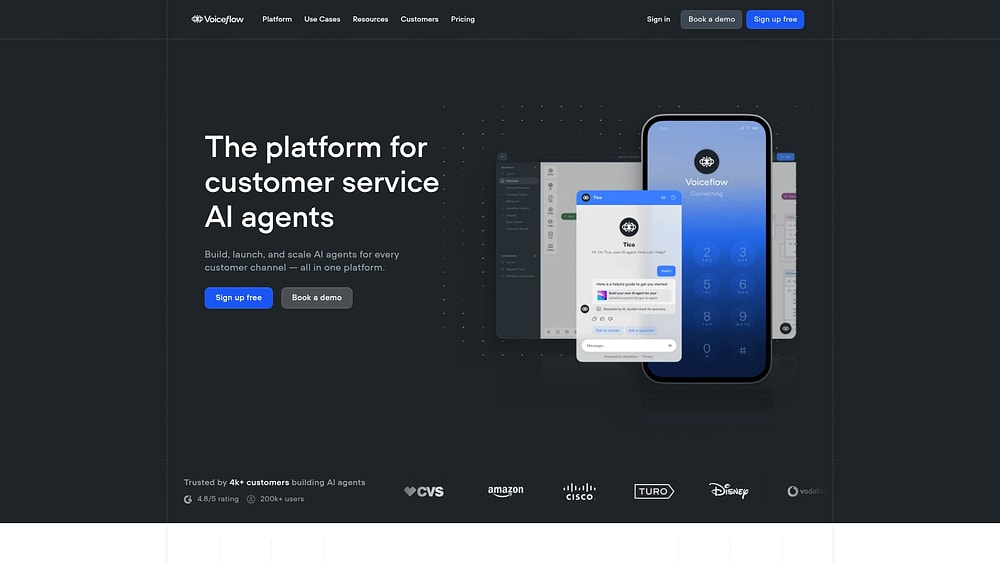
6. Voiceflow
Voiceflow provides a visual conversation design platform, allowing teams to build voice agents using drag-and-drop components without coding. Marketing and sales teams can design conversation flows and deploy them across phone systems, web interfaces, and messaging platforms in weeks.
Use case:
Teams needing flexible design capabilities can maintain control over agent behavior without relying on developer resources.
Key features:
- Visual drag-and-drop builder: design conversation flows collaboratively in real time without coding.
- End-to-end voice delivery: deploy from web widgets to enterprise telephony with inbound/outbound calling via Twilio and Vonage.
- Multi-LLM support: provides fallback across OpenAI, Anthropic, and Gemini models to avoid vendor lock-in.
Pricing:
- Starter: free with 100 credits, one workspace, two agents, and one concurrent voice call.
- Pro: $60/month (annual $648) with 10,000–20,000 credits, two workspaces, up to 20 agents, and five concurrent voice calls.
- Business: $150/month (annual $1,620) with 30,000–100,000+ credits, LLM fallback, unlimited agents, and 15 concurrent voice calls.
- Enterprise: custom pricing with unlimited usage, Agent CMS, private cloud options, and SSO.
- Voice calls cost approximately $0.05/min plus pass-through AI service fees.
- Additional editor seats are available for $50/month.
Considerations:
- Web voice input is limited to Chrome browsers.
- Credits do not roll over, and heavy usage can increase costs with separate telephony charges.
7. Sierra AI
Sierra AI develops enterprise-grade voice agents that navigate complex customer scenarios using context-aware responses. Organizations that require AI capable of understanding account history, previous interactions, and business context to minimize escalations represent their primary audience.
Use case:
Organizations focused on delivering exceptional customer experiences benefit from Sierra AI’s voice agents, which handle nuanced scenarios while maintaining high resolution rates and customer satisfaction scores.
Key features:
- Voice Sims technology: provides large-scale simulated phone interactions to test agents before deployment, preparing them for real-world conditions such as latency and background noise.
- Multi-model reliability: uses a constellation of LLMs with supervisory layers, automatically switching providers to maintain continuity and performance.
- Intelligent handoff: transfers context seamlessly to human agents with AI-generated summaries, ensuring customers never repeat information.
Pricing:
- Custom enterprise pricing: quote-only with an outcome-based pricing model.
- Implementation timeline: four to six weeks, including conversation design, integration setup, and agent training.
- Pricing model: pay for completed work and resolutions rather than flat subscriptions.
Considerations:
- Pricing transparency: quote-only model lacks the clarity of platforms with published rate cards.
- Accessibility: enterprise focus and complex implementation may limit suitability for smaller organizations.
8. Replicant
Replicant powers contact center automation through “Thinking AI,” which autonomously solves customer problems without rigid scripts or decision trees. The platform integrates with major contact center solutions such as Salesforce, Five9, and Genesys, connecting voice interactions to complete customer service workflows. Voice agents handle complex scenarios by reasoning through solutions rather than following predetermined paths.
Use case:
Large contact centers aiming to automate high volumes of customer service interactions can maintain quality and reduce operational costs with Replicant’s autonomous voice agents.
Key features:
- Autonomous problem-solving: voice agents reason through solutions rather than following scripts or decision trees.
- Enterprise integrations: prebuilt connectors for major CCaaS platforms, CRM systems, and telephony solutions.
- Multi-language support: operates across thirty-plus languages with sub-one-second response latency and ninety-six percent inference accuracy.
Pricing:
- Quick Start: GenAI Answers, CCaaS integration, premium transcription, ten concurrent calls.
- Professional: unlimited concurrent calls, six-language support, and two additional system integrations.
- Enterprise: unlimited integrations, A/B testing, PCI/HIPAA compliance, thirty-five-plus languages, named delivery resources.
- Contract options: month-to-month or multi-year agreements, with outcome-based pay-as-you-go structures.
- Add-ons: omnichannel automation available.
Considerations:
- Performance metrics: public materials show inconsistent metrics, making benchmarking challenging.
- Cost perception: some reports suggest high pricing, though ROI case studies and money-back guarantees provide reassurance.
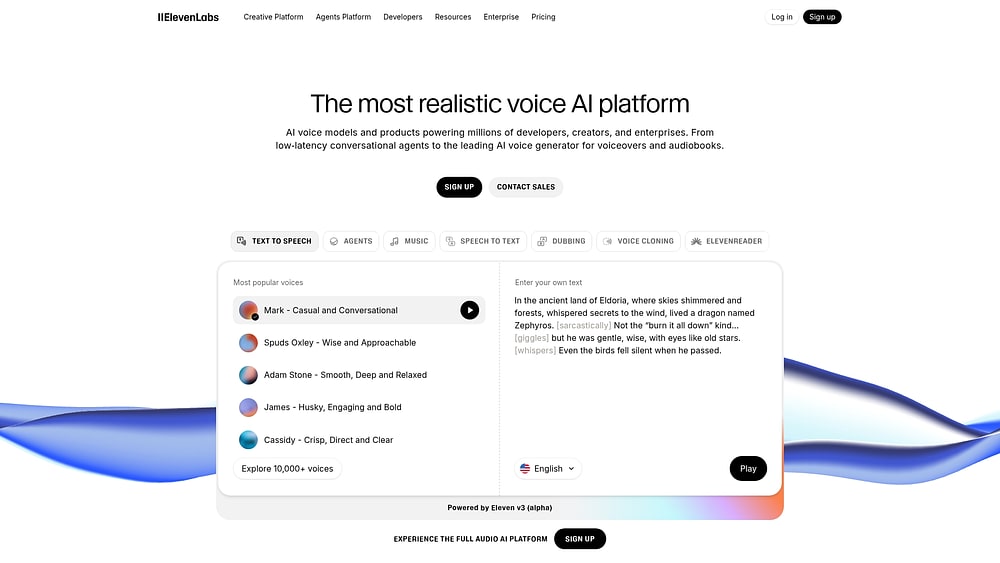
9. ElevenLabs
ElevenLabs specializes in ultra-realistic voice synthesis and cloning, producing voice agents that sound remarkably human. Enterprises and developers creating real-time voice and chat agents for customer support, sales, and operations are the primary audience. Its all-in-one audio platform combines speech-to-text, AI conversation management, and text-to-speech, reducing the need to manage multiple vendors.
Use case:
Organizations prioritizing voice quality and brand consistency benefit from ElevenLabs, particularly those with technical resources for custom integration work.
Key features:
- Real-time turn-taking: WebRTC audio pipeline enables natural conversation flow with interruption handling.
- Professional voice cloning: verified voice models available through the Voice Library marketplace.
- Multi-channel deployment: supports web widgets, telephony, WhatsApp, and custom SDKs, with built-in analytics and testing.
Pricing:
- Free: 10,000 credits included.
- Starter: $5 per month with conversational AI at $0.10 per minute.
- Creator: additional features for higher-tier usage.
- Pro: advanced capabilities at $0.10 per minute for conversational AI.
- Business: $0.08 per minute on annual plans.
- Enterprise: custom pricing with EU data residency and enhanced security.
- Additional costs: telephony fees and eventual LLM charges.
Considerations:
- Implementation complexity: integration requirements typically take three to six weeks.
- Cost evolution: LLM expenses may eventually increase total cost of ownership.
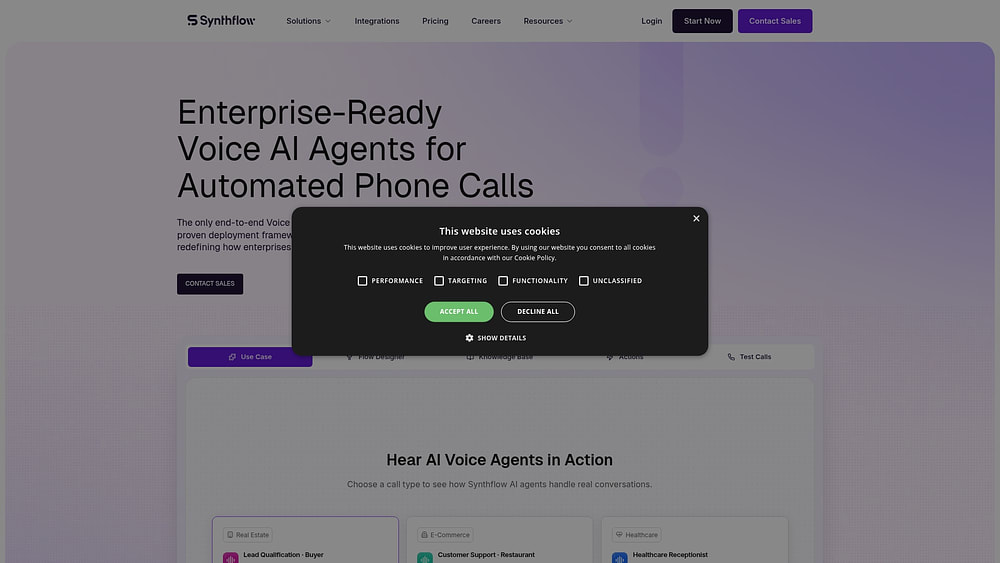
10. Synthflow AI
Synthflow AI combines enterprise-ready voice automation with a no-code workflow builder for rapid deployment. Deterministic conversation logic and in-house telephony infrastructure suit mid-market organizations seeking reliable voice agents without technical complexity. Over two hundred integrations and sub-500ms response times support tasks from appointment scheduling to lead qualification.
Use case:
Mid-market teams requiring flexible voice automation without extensive technical resources benefit from Synthflow AI’s deterministic workflow approach.
Key features:
- Visual Flow Designer: deterministic logic for auditable conversation paths and compliance requirements.
- In-house telephony: SIP trunking with regional points-of-presence ensures low latency and enterprise SLA guarantees.
- Integrations: over 200 connectors, including Salesforce, HubSpot, Zendesk, and major CCaaS platforms.
Pricing:
- Pay-as-you-go: free to start, then $0.09 per minute for voice engine plus LLM costs ($0.02-$0.05 per minute).
- Telephony options: BYO Twilio ($0.00 per minute), Synthflow-managed Twilio ($0.02 per minute), or native telephony (enterprise only).
- Add-ons: performance routing ($0.04 per minute), global low latency edge ($0.04 per minute), white label toolkit ($2,000 per month).
- Enterprise: custom pricing for 10,000-plus minutes per month with 99.99% SLA and unlimited concurrency.
Considerations:
- Call limits: maximum call length is forty minutes, limiting extended conversation use cases.
- Enterprise gating: features such as SIP integration and automated data exports may require higher-tier plans.
11. Ada.cx
Ada.cx automates customer support with proactive engagement that initiates conversations based on customer behavior and context. Integrations with Salesforce, Zendesk, and Shopify connect voice interactions to full customer journeys across support, sales, and e-commerce touchpoints. Multilingual AI ensures consistent service quality across regions.

Use case:
E-commerce and SaaS companies managing high-volume support across multiple channels benefit from Ada.cx’s omnichannel automation and proactive engagement.
Key features:
- Real-time voice: natural interruption handling with low-latency responses for immediate call answering.
- Contact center interoperability: SIP integration with Genesys, Five9, and Twilio Flex for seamless agent handoffs.
- Omnichannel intelligence: context is shared across voice, chat, and email for consistent customer experiences.
Pricing:
- Enterprise: custom quote-based pricing with usage-based billing.
- Telephony: Ada-managed Twilio provisions telephony expenses (BYO Twilio option available).
- ROI outcomes: companies report 6.7x ROI in the first year, with potential annual savings of $2.7 million.
Considerations:
- Voice channels: may require a separate subscription add-on.
- Language support: seven voice languages compared with fifty-plus text languages.
ROI, for real: what to measure and what it costs
Vague promises will not suffice. Real ROI comes from tracking the right metrics and understanding total cost, not just license fees. Measuring effectively ensures value is visible, while failing to track the right metrics risks wasted investment.
Your first 90 days: proving the value
Most teams see returns within 60 to 90 days, but only with a smart starting point. Target quick wins like after-hours lead capture rather than complex workflows that create delays. Time-to-value depends entirely on choosing the right battles first.
Which metrics actually reveal impact? Track these from day one:
Which metrics actually reveal impact? Track these from day one:
- Lead response time: the gap between first contact and a real conversation.
- Qualification rate: the increase in leads your team genuinely wants to pursue.
- Deal velocity: how much faster deals progress between stages.
- Team capacity: more leads handled per rep without adding headcount.
The true cost: beyond the license fee
The monthly fee is just the beginning, as hidden costs like custom integrations and lengthy training can drain your budget before you see a return. Avoid surprise bills by accounting for everything upfront:
- Platform licensing: monthly or annual service fees.
- Integration setup: one-time costs for connecting systems.
- Conversation design: time invested in building effective chat flows.
- Team training: hours spent getting everyone up to speed.
- Ongoing tweaks: monthly time for analysis and performance improvements.
Revenue teams using monday CRM avoid most of these headaches. Platforms that work together from the start eliminate expensive custom work and data cleanup.
How to calculate actual revenue impact
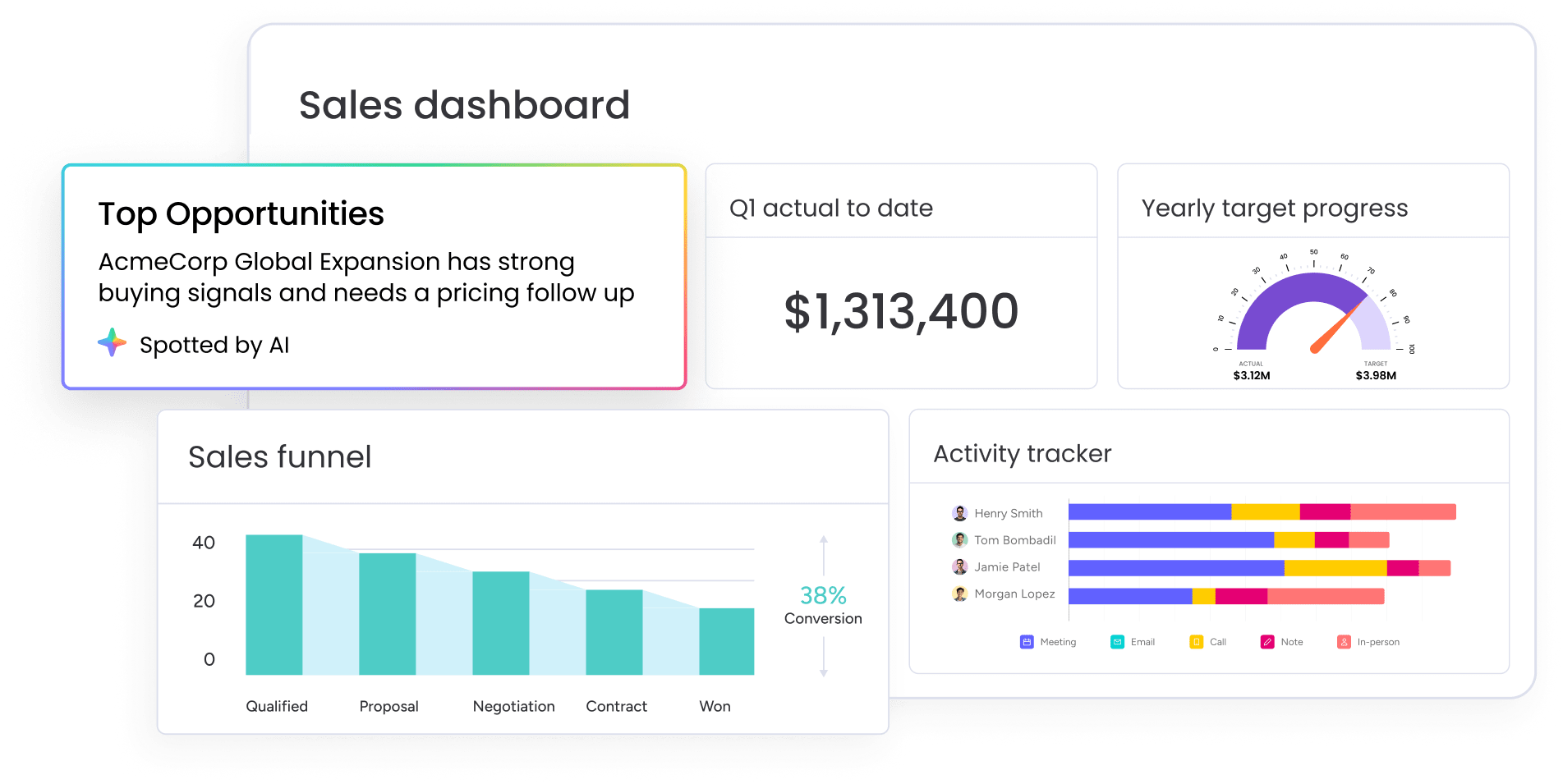
More leads are good, but more revenue is the goal. Start with simple math: capturing 20 extra qualified leads monthly with a 15% close rate results in three new deals. What is your average deal size?
Do not stop there. A modest conversion rate increase, from 15% to 18%, can generate substantial returns on existing lead flow. That is where real impact lives.
- Establish your baseline: know current lead volume, conversion rates, and deal size.
- Track capacity gains: count new leads handled without additional hires.
- Measure conversion lifts: monitor rate changes at each pipeline stage.
- Connect deals to agents: use your CRM to link closed deals directly to voice agent interactions.
Essential features for revenue-driving voice AI
Voice AI saturates the market. Most of it is noise. The real question: which platforms actually help close deals, and which are expensive distractions? The difference lies in the details, not demos.
Flashy features distract from what matters. Effective voice AI focuses on revenue drivers: perfect CRM sync, automations that genuinely save time, and analytics revealing the money trail. Everything else is a distraction.
CRM sync that actually works
Your CRM should reflect AI activity instantly. When a voice agent qualifies a lead, that data — including notes and next steps—should appear in your CRM immediately. No copy-pasting notes. No waiting for nightly syncs. This keeps your team aligned and your data trustworthy.
The AI should also pull the latest customer information before a call, personalizing every conversation with account history and deal status. Revenue teams using monday CRM achieve this through native voice AI integration that keeps all systems unified.
Automations that do the work for you
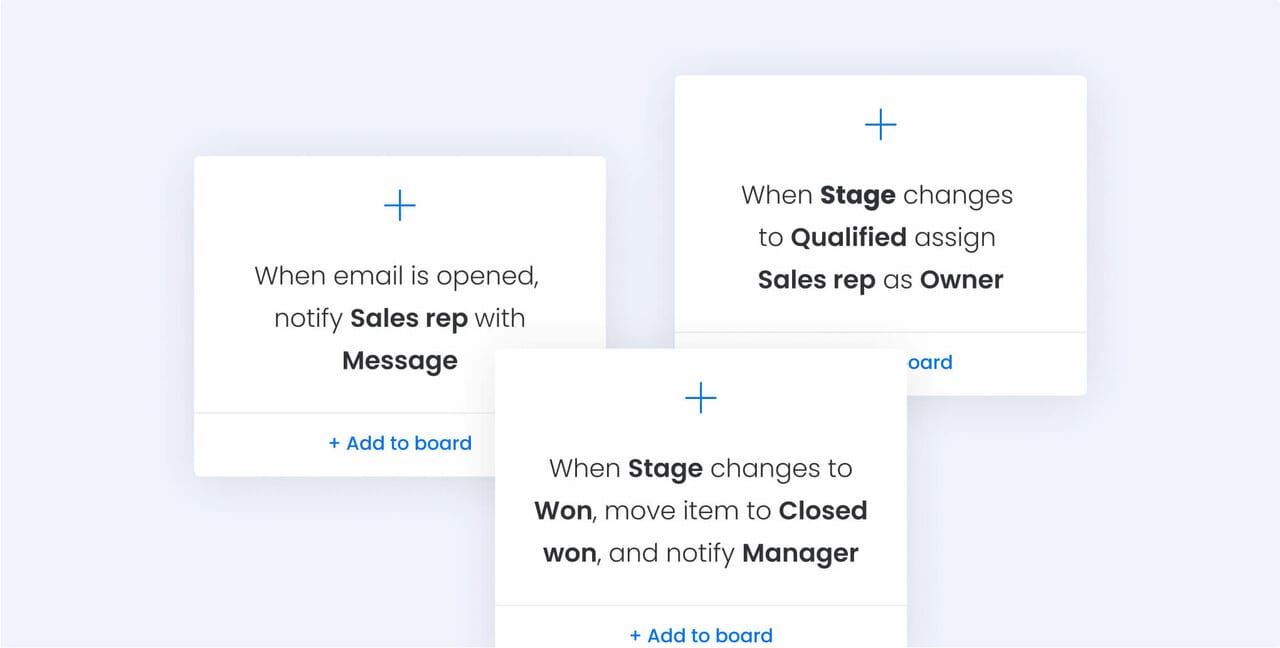
A booked meeting should trigger everything downstream: calendar invites sent, the right rep assigned, reminders scheduled. Automation should feel invisible and instant.
Strong systems leverage context intelligently. Budget mentioned? The AI sends an ROI guide. Competitor mentioned? The conversation is flagged for review. Workflows should react to conversations rather than follow rigid scripts.
Know what’s working, right now
Visibility into which calls result in closed deals is essential. Real-time dashboards should connect voice agent performance directly to revenue. Stop guessing and start seeing what drives results.
Focus on impact, not call volume. Analyze which conversation paths lead to wins and identify what top performers say differently. These insights help scale success and correct weaknesses.
Keep your data safe and compliant
Customer conversations involve sensitive information. Platforms must provide strong encryption and access controls, ensuring only authorized personnel access recordings or customer details.
Compliance is essential. Systems should handle consent and recording rules for different regions, such as GDPR and CCPA, automatically. This protects customer trust and provides peace of mind.
Top examples of voice AI for sales and support
Repetitive calls and manual follow-ups slow revenue teams. Voice AI handles high-volume, low-complexity tasks, freeing reps to focus on closing deals. Matching the right tasks to the right resource — human or bot — drives efficiency.
- Lead capture and qualification: capture and qualify leads 24/7. Voice AI asks the right questions about budget, timeline, and fit, and manages scheduling without endless emails.
- Automated re-engagement: re-engage stalled deals with automated follow-up calls timed for maximum effect.
Revenue teams using monday CRM get all context logged automatically: qualification notes, meeting history, and more. The pipeline is clean and ready for human connection.
Try monday CRMHow to evaluate integration capabilities
Every platform promises seamless CRM integration, but reality often brings data headaches. Strong integration starts with solid technical foundations. Ask specific questions:
- Real-time data flow: ensure two-way sync without delays or rate limits.
- Rock-solid security: look for modern authentication like OAuth 2.0; basic API keys may indicate vulnerabilities.
- Granular control: control which data can be accessed or modified down to the field level.
Test connections with real-world pilots, not demos. Measure:
- Sync speed and accuracy: how quickly do updates appear, and is any data lost?
- Error handling: deliberately break data and observe the system’s response. Helpful error messages are essential.
- Implementation time: request a detailed project plan. Platforms with pre-built connectors and clear onboarding accelerate results.
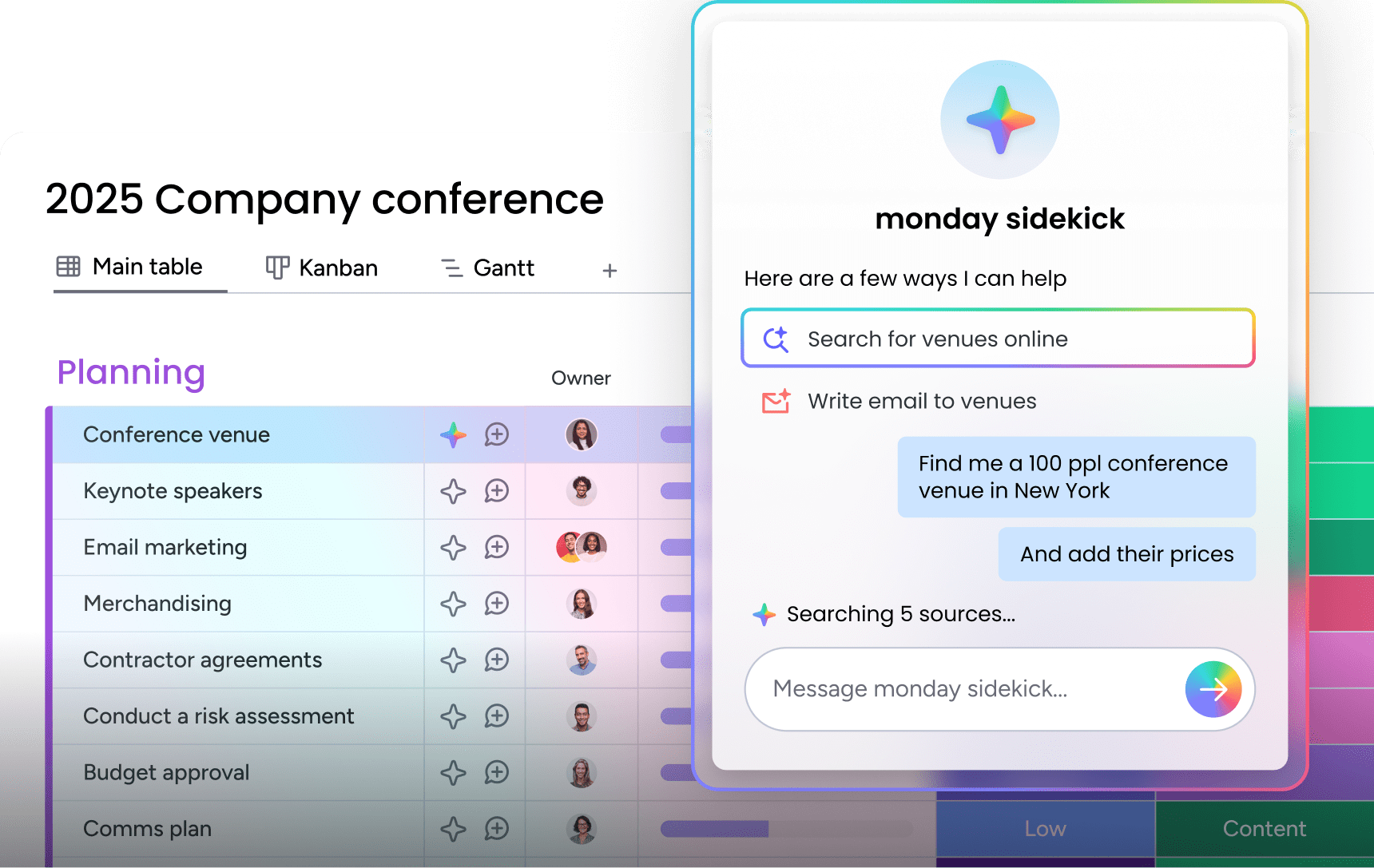
5 strategies for deploying voice agents fast
Organizations are eager to use AI to handle sales calls, but rushed implementation often creates chaos. Confused bots, frustrated customers, and little return on investment are common outcomes. These strategies focus on achieving quick wins and scaling intelligently, building voice agents that deliver results.
Start with one high-impact workflow
Avoid the temptation to automate everything at once. Begin with a single workflow that delivers significant value without unnecessary complexity. After-hours lead capture is a strong choice, solving the problem of losing prospects when the sales team is offline.
How do you identify the right workflow? Look for processes that are:
- High-volume: occurs often enough to justify automation.
- High-value: improving it drives revenue or saves considerable time.
- Easy to standardize: conversations follow predictable paths.
Map the current conversation flow and define success before deploying AI. Perfect execution of one workflow is more impactful than multiple poorly executed attempts.
Give your agent the right context
A voice agent without context reads scripts but cannot hold meaningful conversations. Agents perform better when they know who they are speaking with, their company history, and relevant priorities. This requires mapping data flow between the agent and your CRM.
Consider these questions: What information should the agent have before each call? Where should new information be stored after the call? Teams using monday CRM can connect these data points without complex coding, giving agents the context they need for every conversation.
Get your tech talking
Next, link your voice agent with your CRM. Use the data map from the previous step to ensure real-time information sharing. This is more than a connection — it is about sending the right data to the right place.
Verify that the agent has the correct permissions to view and update customer records. Test the setup with real-world scenarios. Broken connections lead to broken conversations, so confirm that every link is solid.
Test the waters with a pilot
Before full deployment, route a small percentage of interactions — typically ten to twenty percent — to the new agent. This approach identifies issues without risking revenue or customer satisfaction.
Track metrics such as completion rates, customer feedback, and data accuracy. Determine if the agent qualifies leads correctly and listens to insights from both customers and the sales team. Feedback at this stage is critical to refine workflows before scaling.
Scale with confidence, not guesswork
Pilot results reveal what works and what requires adjustment. Use these insights to expand intelligently, adding new workflows one at a time. Each rollout becomes faster and smoother as teams apply lessons from previous launches.
Continuously monitor performance and look for improvement opportunities. Test different conversation scripts to identify what resonates most. The goal is not speed, but building a system that drives measurable results and sustainable success.
How monday CRM makes voice AI actually work for you
Voice AI promises simplicity, but many teams struggle with disconnected systems and messy data. What if voice agents could function seamlessly and integrate directly into your workflow? Teams using monday CRM turn conversations into actionable insights without manual effort.
Here’s how revenue teams leverage monday CRM to get voice AI right:
- Turn talk into data automatically: AI blocks extract key call details — budget, timelines, pain points — and populate the corresponding CRM fields. No manual entry required.
- Connect voice to your sales process: When an agent qualifies a lead, automated workflows trigger follow-ups, task creation, or meeting scheduling using a drag-and-drop builder.
- Get the full customer story: View every voice interaction alongside emails, meetings, and deal updates in a single timeline. Sales reps enter calls fully informed.
- Work confidently with security: SOC 2 Type II certification and role-based access controls protect sensitive data, ensuring compliance and safe AI deployment.
Success with voice AI is about integrating it naturally into existing workflows. Teams achieve stronger results when AI is connected, not siloed.

“With monday CRM, we’re finally able to adapt the platform to our needs — not the other way around. It gives us the flexibility to work smarter, cut costs, save time, and scale with confidence.”
Samuel Lobao | Contract Administrator & Special Projects, Strategix
“Now we have a lot less data, but it’s quality data. That change allows us to use AI confidently, without second-guessing the outputs.”
Elizabeth Gerbel | CEO
“Without monday CRM, we’d be chasing updates and fixing errors. Now we’re focused on growing the program — not just keeping up with it."
Quentin Williams | Head of Dropship, Freedom Furniture
“There’s probably about a 70% increase in efficiency in regards to the admin tasks that were removed and automated, which is a huge win for us.“
Kyle Dorman | Department Manager - Operations, Ray White
"monday CRM helps us make sure the right people have immediate visibility into the information they need so we're not wasting time."
Luca Pope | Global Client Solutions Manager at Black Mountain
“In a couple of weeks, all of the team members were using monday CRM fully. The automations and the many integrations, make monday CRM the best CRM in the market right now.”
Nuno Godinho | CIO at VelvTurn conversations into closed deals
A voice agent that does not sync with your CRM leaves conversations as unstructured data. Maximum value occurs when every interaction becomes actionable and contributes directly to your sales process.
Standalone AI platforms often create silos, requiring manual data handling. Revenue teams using monday CRM connect calls to their workflows, enabling real insights without technical roadblocks.
A focused, stepwise approach wins with voice AI. Begin with a single workflow, validate its effectiveness, and scale gradually to deliver measurable business impact.
Try monday CRMFrequently asked questions
How fast can I integrate voice AI with my existing CRM?
Integration timelines vary based on the platform you choose. Native solutions can be implemented within a few days, while custom-built integrations may take several weeks to complete.
Which voice AI platforms support multiple languages?
Enterprise-grade platforms typically provide the widest language coverage. Voice quality should always be tested for specific languages, as performance can vary significantly between providers.
What happens when an AI voice agent needs human help?
When escalation is required, the agent transfers the call along with the full conversation history and customer context, ensuring a seamless handoff to a human agent.
Do I need technical expertise for voice AI implementation?
No-code platforms remove the need for technical expertise. Custom API-based solutions, however, require dedicated developer resources for setup and maintenance.
How do voice platforms ensure data security and compliance?
Security is maintained through end-to-end encryption, role-based access controls, and compliance with standards such as SOC two and GDPR.
Which AI voice agent works for small businesses?
Small businesses benefit most from platforms with simple pricing, fast no-code setup, and intuitive interfaces that do not require technical teams to manage daily operations.
How does monday CRM's AI integration compare to standalone voice platforms?
With native AI built directly into monday CRM, teams can start immediately without complex or costly API work, avoiding the friction of connecting separate voice platforms to an external CRM.

 Get started