


Sales teams often work harder without seeing better results. Reps spend large parts of their day on manual tasks like updating records, managing follow-ups, and keeping pipelines in sync. While that work adds up, it doesn’t always move deals forward. High-intent leads wait too long for a response, and strong opportunities lose momentum.
AI sales assistant software helps remove this friction. By automating lead scoring, outreach, conversation tracking, and CRM updates, these tools free reps to focus on the work that actually drives revenue — having real conversations and moving deals toward close.
Getting value from AI assistants isn’t just about features. The software needs to fit naturally into how sales teams already work and be easy to adopt across the organization. In the sections ahead, we’ll break down what AI sales assistants do, the capabilities that matter most for modern revenue teams, and the key factors to consider when choosing a solution that works inside a unified, flexible workspace.
Key takeaways
- Focus on solving specific pain points, not chasing features: choose AI that automates your biggest time drains like data entry and follow-ups rather than platforms with the most capabilities.
- Look for no-code implementation that your team can manage: avoid platforms requiring IT support or weeks of setup as the best AI sales assistants work within hours, not months.
- Unified workflow integration: strategic capabilities should be accessible directly within a centralized environment. Solutions like monday CRM provide integrated AI tools for timeline summaries, email composition assistance, and sentiment detection without the need for platform switching.
- Test integration with your existing systems before committing: verify that AI syncs seamlessly with your CRM, email, and communication platforms using real data, not just demos.
- Measure success through productivity gains and revenue impact: track time saved per rep, conversion rate improvements, and adoption rates to ensure your AI investment delivers measurable ROI.
What do AI sales assistants actually do for revenue teams?
AI sales assistants automate the repetitive stuff like data entry, follow-ups, lead scoring, and highlight what your team needs to know to close more deals. They handle routine work like data entry, lead scoring, and follow-ups. Meanwhile, they analyze thousands of interactions to figure out what actually closes deals.
This technology functions as a continuous analytical engine, processing vast datasets with a speed and accuracy that surpasses human capacity. This efficiency allows professionals to prioritize high-value customer interactions over record maintenance.
The primary strategic advantage also lies in the platform’s ability to recognize complex patterns across thousands of interactions, identifying the specific behaviors that lead to successful outcomes.
AI monitors prospect behavior across channels, flags hot opportunities, and executes actions based on triggers you set. Teams using AI spend way less time on admin work and see conversion rates climb within the first quarter.
In fact, In fact, according to McKinsey’s 2023 “The state of AI” report, 66% of organizations that regularly use generative AI in marketing and sales report revenue increases, with some seeing gains of more than 10%.
Lead scoring and prioritization
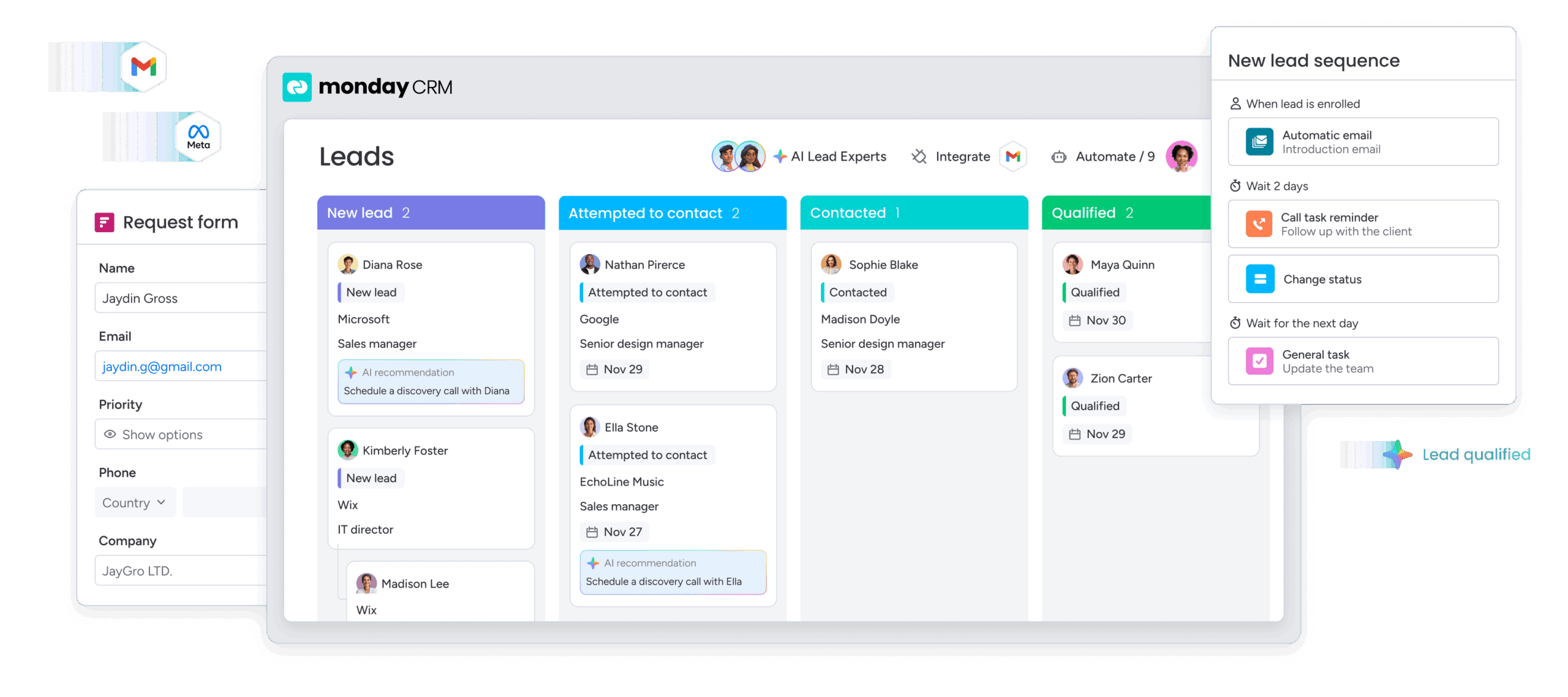
AI analyzes prospect behavior, company data, and past conversion patterns to rank leads by close probability. It tracks email engagement, website behavior, and demographic signals, then assigns scores that update in real-time.
Effective AI scoring extends beyond simple demographic matching. The following elements drive meaningful prioritization:
- Behavioral pattern matching: compares current prospect actions against thousands of past deals to identify buying signals that human reps might miss.
- Engagement velocity tracking: measures how quickly prospects respond and interact, flagging hot leads that need immediate attention.
- Fit scoring with predictive elements: combines ideal customer profile matching with AI predictions about deal size and close probability.
Teams using AI-powered lead scoring respond faster to high-value opportunities and convert prioritized leads at higher rates than those relying on manual qualification. A global industrials company that deployed an AI-enabled growth engine achieved 40% higher conversion rates and 30% faster lead execution within just a few months.
Automated follow-ups and outreach
AI handles email sequences, social media touches, and meeting scheduling based on prospect responses and predetermined business rules. It sends personalized messages at the right time, adjusts based on previous interactions, and hands off to reps when prospects show buying intent.
It’s not just email drips. AI monitors prospect activity across channels and triggers appropriate follow-ups:
- Behavioral follow-up orchestration: sophisticated platforms move beyond simple email drips by monitoring prospect activity across multiple channels to trigger contextually relevant actions.
- Automated content delivery: the system identifies specific engagement milestones, such as a whitepaper download, to instantaneously provide relevant case studies that advance the evaluation process.
- Intelligent sequence adjustment: AI maintains communication consistency by automatically scheduling demo invitations during engagement spikes or pausing outreach when a prospect becomes non-responsive.
- Resource optimization through rules-based logic: strategic automation ensures that communication remains persistent without overwhelming the prospect or consuming the representative’s time with manual follow-up tracking.
It keeps communication consistent without overwhelming prospects or eating up your reps’ time.
Real-time sales coaching and insights
AI analyzes sales calls, email performance, and deal progression to provide immediate feedback during active conversations and after key interactions. The system transcribes calls in real-time, highlights competitor mentions, surfaces relevant case studies, and suggests responses based on what has worked in similar situations.
After calls, AI gives you:
- Call summaries: action items, sentiment analysis, and coaching recommendations.
- Talk-time ratio analysis: identifies when reps dominate conversations versus asking discovery questions.
- Objection handling suggestions: surface proven responses when prospects raise common concerns.
- Next-step recommendations: analyze the deal stage and prospect signals to suggest optimal follow-up actions.
Deal intelligence and forecasting
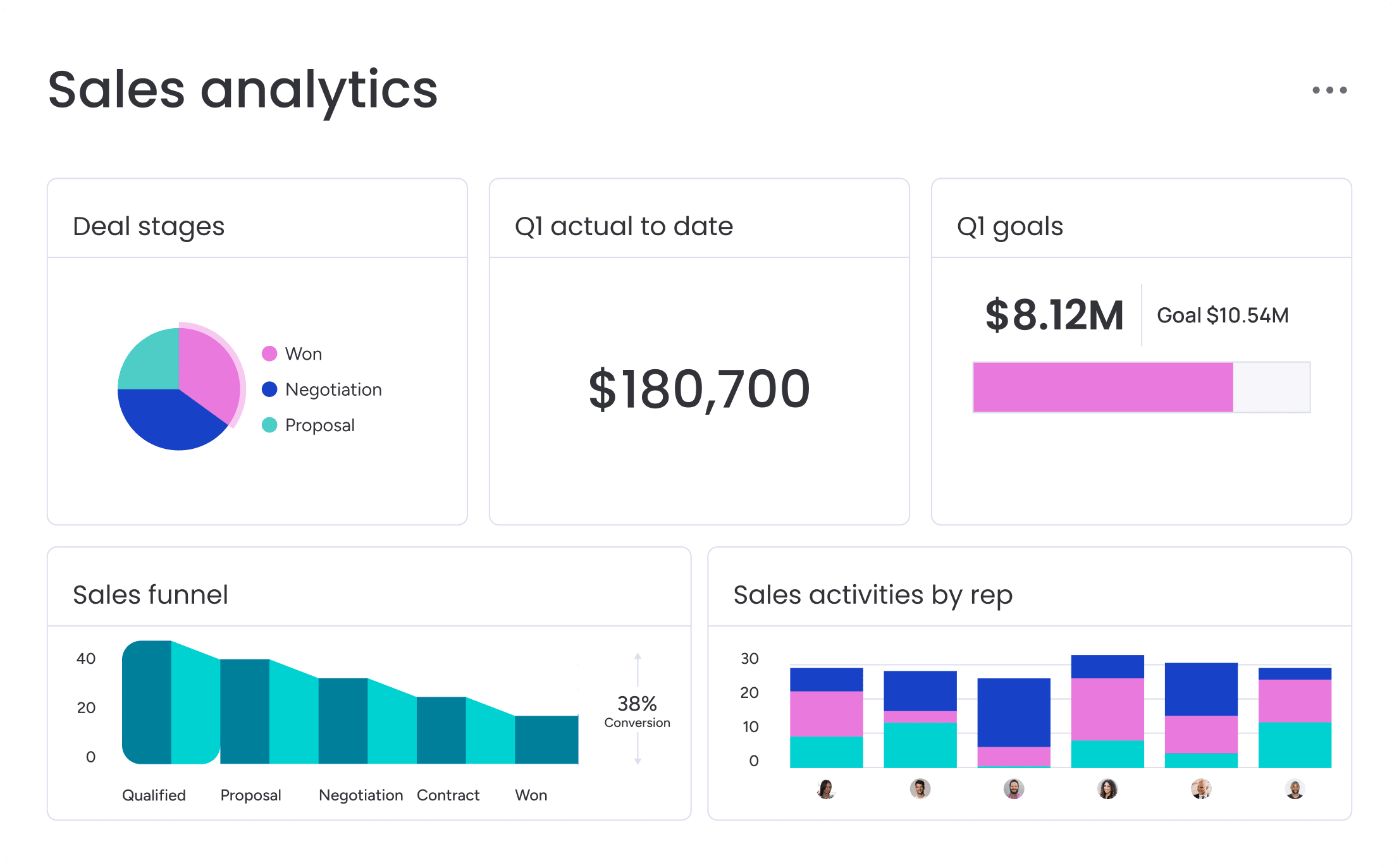
AI predicts deal outcomes, identifies at-risk opportunities, and generates revenue forecasts based on pipeline data and historical patterns. It analyzes hundreds of variables to calculate close probability and close dates more accurately than gut feel.
It flags deals that need attention before they stall. When engagement drops, key stakeholders go silent, or deal velocity slows compared to similar opportunities, AI alerts managers to take action. Forecasts get more accurate as AI learns from each closed deal.
Administrative process automation
AI handles the grunt work: data entry, CRM updates, meeting notes, and reports. It logs emails, calls, and meetings automatically, pulls key info from conversations to update records, and generates summaries for pipeline reviews.
This frees reps from manual data entry. As reps talk to prospects across email, phone, and meetings, AI captures what matters and updates records in real-time. CRM data stays current without reps switching systems or doing admin work.
Essential AI sales assistant capabilities
Five capabilities separate good AI sales assistants from basic automation. These capabilities determine whether AI actually understands sales contexts, makes accurate predictions, integrates with your workflows, adapts to your process, and keeps customer experiences consistent.
Understanding these capabilities helps you evaluate platforms based on what they do, not what they promise. Each one solves real problems sales teams deal with every day: from managing customer comms to predicting deal outcomes.
| Capability | Basic automation | AI-powered approach | Business impact |
|---|---|---|---|
| Customer communication | Template-based responses | Natural language understanding with context awareness | Faster response times, higher engagement rates |
| Sales forecasting | Historical averages | Predictive analytics using 50+ variables | Improved forecast accuracy |
| CRM management | Manual data entry with some auto-fill | Automatic data capture and enrichment | Significant reduction in administrative time |
| Workflow customization | IT-dependent configuration | No-code, drag-and-drop setup | Hours vs. weeks for implementation |
| Channel coordination | Separate platforms per channel | Unified AI across all touchpoints | Consistent customer experience, ensuring every signal is captured |
Natural language processing for customer interactions
AI reads customer messages like word choice, sentence structure, context to figure out intent and sentiment. It pulls key info from emails and call transcripts, then categorizes it automatically. No data entry required.
Natural language processing lets AI spot urgency in messages, flag questions that need human attention, and draft responses that keep the conversation flowing. It recognizes when prospects express concerns, show buying intent, or ask for specific info and then triggers workflows or alerts the right people.
Predictive analytics and sales forecasting
AI uses historical deal data, current pipeline information, and external signals to predict outcomes with statistical confidence levels. It analyzes thousands of closed deals to figure out which activities, stakeholders, timelines, and engagement patterns lead to wins.
Forecasts become more accurate as more deals close. AI figures out which variables matter most for different deal types, adjusts for seasonal patterns, and flags deals that aren’t progressing normally. Revenue leaders using AI forecasting see fewer pipeline surprises and make smarter decisions about where to spend resources.
CRM integration and data synchronization
Data flows between AI and your existing sales systems automatically, so everything stays current without manual updates. AI captures data from emails, calendars, call recordings, and other sources, then maps it to the correct CRM fields and opportunity records in real-time.
It’s more than basic data sync. AI enriches CRM records with external data, spots duplicates, and flags incomplete or outdated info to keep your data clean. Teams using integrated AI see cleaner CRM data and spend way less time hunting for information.
Customizable workflows without code
Sales teams set up AI-powered processes using visual interfaces. Sales teams can manage the setup themselves. Drag-and-drop builders let you define triggers, conditions, and actions. AI handles the rest.
Pre-built templates provide starting points for common sales workflows that teams customize to match their specific processes. No-code means sales ops can build and tweak AI workflows in hours, not weeks waiting for IT.
Multi-channel communication management
AI coordinates customer interactions across email, phone, social media, and messaging to keep experiences consistent and prevent conflicting outreach. It tracks all touchpoints with each prospect, spaces out communications appropriately, and adjusts messaging based on channel preferences.
When a prospect engages on LinkedIn, AI updates the email sequence to reference that interaction. If someone books a meeting, AI pauses automated outreach and alerts the assigned rep. This prevents prospects from getting generic emails hours after detailed conversations with reps.
How to evaluate AI sales assistant software
Evaluating AI sales assistant software means balancing technical capabilities with whether your team will actually use it. Start by understanding your current workflows and pain points. Then assess how different platforms solve specific problems while considering total costs, integration needs, and vendor support.
Common mistakes derail implementations before they start. Testing AI without involving the reps who’ll use it daily kills adoption. Focusing solely on feature lists rather than measuring how features solve specific business problems creates misaligned expectations. Underestimating implementation time and change management requirements delays time-to-value.
Step 1: map your current sales process
Document existing workflows by shadowing sales reps for full deal cycles, recording every step from lead assignment through closed-won. Identify specific pain points where reps lose time, deals stall, or information gets lost between handoffs. Quantify the time spent on each activity category to establish baseline metrics.
Determine where AI can add the most value by analyzing which activities consume disproportionate time relative to their revenue impact. Workflows involving data entry, routine follow-ups, research, and report generation typically offer the highest ROI for AI automation. Activities requiring relationship building, complex problem-solving, and strategic negotiation remain suited for human expertise.
Step 2: define success metrics
Establish measurable goals for AI implementation across three categories: productivity gains, revenue impact, and adoption rates.
- Productivity metrics: time saved per rep per week, reduction in administrative activities, increase in customer-facing activities.
- Revenue metrics: conversion rate improvements, deal velocity changes, average deal size shifts.
- Adoption metrics: active user percentage, feature utilization rates, user satisfaction scores.
Set realistic targets based on your current baseline. Track leading indicators weekly and lagging indicators monthly to identify issues early and course-correct.
Step 3: calculate total cost of ownership
Subscription fees represent only a portion of true AI implementation costs. Additional expenses include:
- Data migration and architectural cleanup: this involves the costs associated with auditing, cleaning, and transferring legacy data into the new AI-powered environment to ensure high-quality outputs.
- System integration and technical interoperability: financial planning must include the resources required to synchronize the AI assistant with existing CRM, email, and communication infrastructures.
- Comprehensive training and change management: successful adoption necessitates dedicated sessions to educate representatives on new workflows and manage the organizational transition from manual to automated processes.
- Ongoing optimization and technical support: organizations should budget for the iterative refinement of lead scoring models, automation triggers, and routine system maintenance.
Calculate payback period by dividing total implementation costs by monthly productivity gains plus revenue improvements.
Most AI sales assistant implementations achieve positive ROI within six to nine months. Companies implementing AI-powered customer experience programs report 5–8% revenue uplift, 15–20% gains in customer satisfaction, and 20–30% reductions in cost-to-serve.
Step 4: test integration capabilities
Evaluate how AI connects with existing CRM, marketing automation, communication platforms, and data sources through hands-on testing with real data. Request sandbox environments that mirror production systems, then test bidirectional data sync, field mapping accuracy, real-time update speeds, and error handling when systems experience downtime.
Verify that integrations maintain data integrity across systems. Test scenarios where the same record updates in multiple places simultaneously, ensure duplicate prevention works correctly, and confirm that deleted records sync appropriately. Ask vendors about API rate limits, webhook availability, and support for custom integrations beyond pre-built connectors.
Step 5: assess vendor support quality
Implementation support determines whether AI delivers value quickly or languishes unused. Evaluate vendors on onboarding process structure, training comprehensiveness, and technical assistance availability.
Request references from companies similar in size and industry, asking specifically about implementation timeline accuracy, support responsiveness during critical issues, and vendor willingness to customize solutions for unique requirements.
Test support quality during the evaluation process by asking complex technical questions and measuring response time and answer quality.
7 factors for choosing AI sales assistant software your team will use
Seven factors determine whether AI sales assistant software gets adopted and delivers value versus sitting unused while teams revert to familiar manual processes. These factors balance technical capabilities with human considerations, recognizing that the most sophisticated AI provides zero value if sales teams refuse to use it.
Understanding these adoption factors helps revenue leaders select platforms that teams will actually embrace rather than resist. Each factor addresses a specific barrier that prevents sales teams from successfully implementing new technology.
Factor 1: implementation speed without IT dependencies
Sales teams need platforms they can deploy independently, without waiting weeks or months for IT resources. Self-service setup with pre-built integrations connects to existing systems in hours.
The best platforms provide:
- Configuration wizards: guide team members through initial setup.
- Data import templates: simplify migration from existing systems.
- Default workflows: deliver immediate value before any customization.
Implementation speed directly impacts adoption. Teams that start seeing value within the first week maintain momentum and enthusiasm, while those facing lengthy implementations lose interest and revert to old habits. Advanced platforms like monday CRM enable sales teams to begin using AI capabilities on day one, with no technical expertise required for basic setup and common examples.
Factor 2: intuitive interface your team will embrace
User experience factors determine whether sales reps adopt AI or find workarounds to avoid it. Interfaces should feel familiar to team members already comfortable with consumer software, require minimal clicks to complete common activities, and work seamlessly on mobile devices for reps who spend significant time outside the office.
Visual workflow builders with drag-and-drop interfaces make process automation comprehensible to non-technical team members. Contextual AI suggestions that appear at the moment of need rather than requiring team members to seek them out increase usage. Core functionality accessible within 30 minutes of first login, with advanced features discoverable progressively, reduces the learning curve.
Factor 3: scalability as your business grows
AI platforms must handle increasing data volumes, more complex processes, and expanding team sizes without performance degradation or requiring platform migrations. Scalability encompasses technical capacity and functional flexibility.
Evaluate scalability by asking vendors about:
- Proven enterprise implementation capacity: evaluate the platform’s ability to support large-scale operations by requesting case studies of their most significant customer deployments.
- Documented performance benchmarks: analyze how the system maintains processing speed and accuracy across varying data volumes to prevent latency during periods of rapid growth.
- Architectural flexibility for expansion: investigate the underlying technical approach to handling increased load, ensuring the system can scale without requiring disruptive platform migrations.
- Transparent pricing and migration pathways: confirm that moving between pricing tiers or expanding user seats does not necessitate complex data transfers or fundamental changes to existing automation rules.
Request information about whether scaling up requires data migration or platform changes that would disrupt operations.
Factor 4: data security and compliance standards
Sales environments handle sensitive customer information, financial data, and competitive intelligence that require robust security measures. Essential security features include:
- End-to-end encryption: for data in transit and at rest.
- Role-based access controls: limiting information visibility appropriately.
- Audit logs: tracking who accessed what data when.
- Compliance certifications: for relevant regulations (GDPR, CCPA, SOC 2, ISO 27001).
Verify that AI vendors maintain data residency options for organizations with geographic restrictions, provide data portability for easy export, and offer defined data retention and deletion policies.
Factor 5: balance of customization and ready-to-use features
The optimal AI sales assistant provides immediate value through pre-built workflows while allowing customization for unique business requirements. Out-of-the-box functionality should cover common sales activities without any configuration.
Customization options enable teams to adapt AI to specific sales methodologies, industry requirements, and company processes. Look for platforms offering flexible field structures, custom automation rules, personalized dashboards, and configurable reporting without requiring coding skills. Solutions like monday CRM deliver this balance through pre-built sales templates that teams can deploy immediately, then customize using visual builders as their needs evolve.
Factor 6: transparent performance analytics
AI platforms must provide metrics showing what the technology does, how it makes decisions, and what impact it delivers. Transparency includes confidence scores on AI predictions, explanation of factors influencing recommendations, and performance tracking over time.
Essential analytics capabilities include:
- AI decision explanations: rationale for specific actions.
- Accuracy tracking: historical performance data.
- Impact measurement: before-and-after comparisons demonstrating productivity gains and revenue improvements.
Factor 7: future-ready AI capabilities
Assess vendors’ AI development roadmap and commitment to advancing their technology by examining recent feature releases, investment in AI research, and integration of emerging capabilities. Vendors actively developing AI typically release significant new capabilities quarterly and publish roadmaps showing planned enhancements.
Ask about the vendor’s approach to incorporating new AI technologies as they emerge, their process for training AI models on customer data, and whether they offer beta programs allowing early access to new features.
How does monday CRM power AI for sales teams?
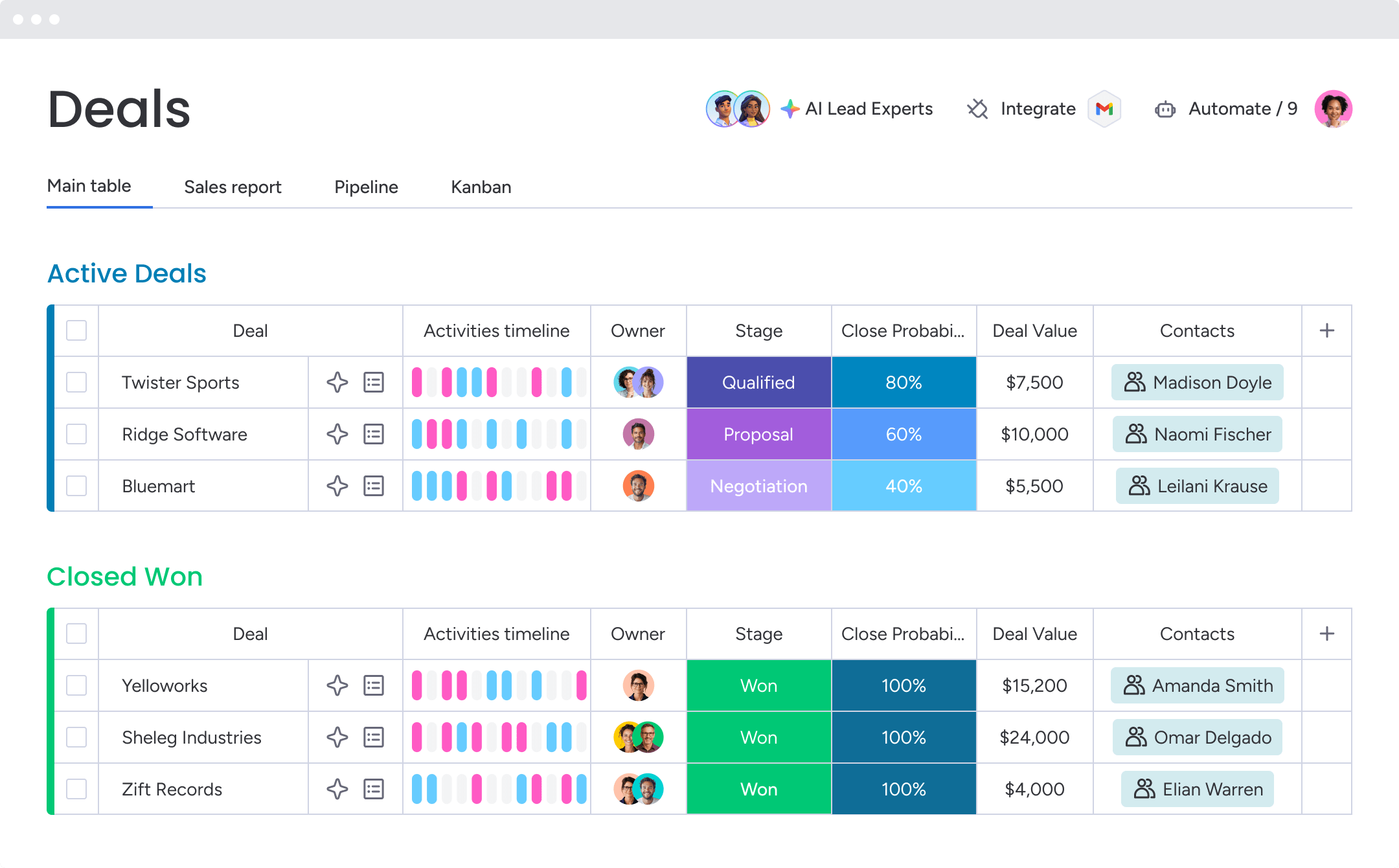
AI capabilities are delivered by monday CRM through integrated features that work together to automate routine activities, surface actionable insights, and enable sales teams to work more efficiently. The platform combines AI capabilities for data analysis and content generation with features that enhance core CRM functionality with intelligence.
Revenue teams using monday CRM access AI capabilities directly within their existing workflows, with no-code configuration that sales operations can manage independently. The platform’s AI features include timeline summaries that create short, clear summaries of all communication events like emails, calls, meetings, and notes. This helps sales and support teams save valuable time understanding client history.
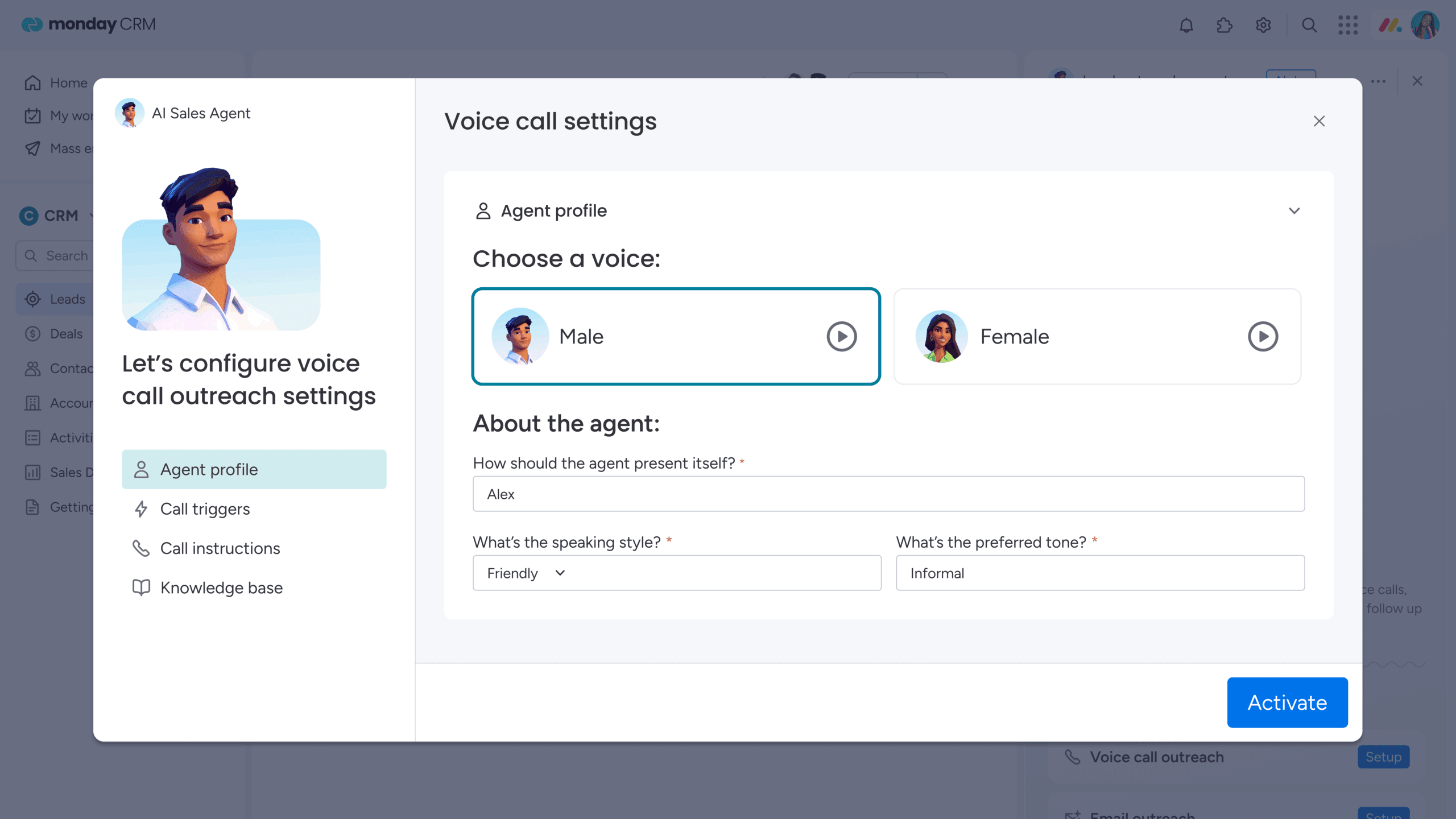
The AI email assistant helps compose emails directly within the platform, while the autofill capabilities work with text, date, number, dropdown, people, and status columns. Teams can apply AI actions like detecting sentiment, extracting information from documents, improving text, summarizing content, translating messages, and creating custom automations based on their specific needs.
AI that adapts to your unique process
AI capabilities within monday CRM accommodate different sales methodologies without requiring technical expertise or rigid process conformity. Teams using consultative selling, transactional sales, or account-based approaches configure AI to support their specific workflows using the same underlying platform.
The platform’s modular AI functionality lets teams combine capabilities based on their needs:
- Detect sentiment capability: categorizes text as positive, negative, or neutral.
- Extract information capability: automatically pulls and organizes key information from invoices, resumes, or contracts directly into board columns.
- Summarize capability: condenses text into shorter content that’s faster to scan
- Writing assistant: provides simple prompts that guide AI to write text for columns, choosing tone and length
- Assign label capability: analyzes text sources and assigns appropriate labels to status or dropdown columns
- Assign person capability: bases assignments on sources like emails and activities, with team members defining each teammate’s role or key skills to help AI accurately assign the right person
No-code implementation in hours
Sales teams deploy monday CRM’s AI capabilities without IT involvement or technical expertise, using visual configuration options that make AI accessible to business team members. Pre-built templates provide starting points for common sales workflows that teams customize using drag-and-drop builders.
The platform connects with existing email systems, calendar applications, communication platforms, and data sources through native integrations that require only authentication, not custom development. Teams begin seeing AI value on day one, with basic automation and insights available immediately and advanced capabilities added progressively as team members build confidence.

“With monday CRM, we’re finally able to adapt the platform to our needs — not the other way around. It gives us the flexibility to work smarter, cut costs, save time, and scale with confidence.”
Samuel Lobao | Contract Administrator & Special Projects, Strategix
“Now we have a lot less data, but it’s quality data. That change allows us to use AI confidently, without second-guessing the outputs.”
Elizabeth Gerbel | CEO
“Without monday CRM, we’d be chasing updates and fixing errors. Now we’re focused on growing the program — not just keeping up with it."
Quentin Williams | Head of Dropship, Freedom Furniture
“There’s probably about a 70% increase in efficiency in regards to the admin tasks that were removed and automated, which is a huge win for us.“
Kyle Dorman | Department Manager - Operations, Ray White
"monday CRM helps us make sure the right people have immediate visibility into the information they need so we're not wasting time."
Luca Pope | Global Client Solutions Manager at Black Mountain
“In a couple of weeks, all of the team members were using monday CRM fully. The automations and the many integrations, make monday CRM the best CRM in the market right now.”
Nuno Godinho | CIO at VelvPut AI to work for your sales team today
AI sales assistants can change how revenue teams work, but real impact comes from how well the technology fits into daily workflows. The biggest gains happen when AI removes busywork, highlights the right insights, and helps teams spend more time selling — not managing systems.
That’s why choosing the right platform matters. Sales teams see better results when AI integrates easily with their existing processes, doesn’t require technical expertise to manage, and delivers value quickly while still scaling as the business grows. Focusing on specific pain points, rather than chasing features, leads to faster adoption and stronger ROI.
With monday CRM, sales teams can put AI to work without added complexity. No-code workflows and built-in automations make it easy to get started right away, while flexible customization ensures the platform grows alongside your sales process.
Frequently asked questions
How long before we see ROI from AI sales assistants?
Regarding the time to see ROI from an AI sales assistant, most sales teams see initial productivity gains within 30 to 60 days of implementation, with measurable revenue impact typically appearing within three to six months as processes optimize and adoption increases.
Do AI sales assistants work with industry-specific compliance requirements?
AI sales assistant platforms include compliance features for industries like healthcare (HIPAA) and finance (SOX, FINRA), though you should verify specific regulatory requirements with vendors before implementation.
What happens when AI makes mistakes with customers?
Quality AI sales assistants include confidence scoring and human oversight features that flag uncertain decisions for review, while most customer-facing communications can be configured to require human approval before sending.
Can AI sales assistants handle complex B2B negotiations?
AI excels at preparation and analysis for complex deals but cannot replace human judgment in negotiations, instead providing data insights, conversation summaries, and strategic recommendations to support human negotiators.
Do we need technical staff to manage AI sales assistant software?
AI sales assistants are designed for business team members with no-code interfaces and self-service setup, though having technical support available can help with advanced integrations and customizations.
How does monday CRM's AI differ from other sales assistant platforms?
The platform integrates AI capabilities directly into customizable workflows without requiring separate platforms or technical implementation, allowing sales teams to add AI functionality to their existing processes in hours rather than months.

 Get started