


Your sales team closes at 10 p.m. on a Tuesday. A qualified lead calls at 10:03 p.m. Nobody picks up. That lead moves on to the next company, and your team never knows what they missed. The gap between when prospects reach out and when someone responds often determines who wins the deal. AI call center agents exist precisely for this gap: software that handles real phone conversations, qualifies leads, books meetings, and logs everything in your CRM, around the clock, without a rep on the line.
The best revenue teams use AI call center agents to handle predictable, high-volume work like inbound qualification, scheduling, and follow-up so their reps can focus on conversations that actually require human judgment. The result is a pipeline that moves faster and a team that spends less time on admin. Here’s what AI call center agents are, how they work, and where they fit into your revenue operation with a CRM like monday CRM.
Key takeaways
- AI call center agents do the repetitive work so your reps don’t have to: Agents qualify leads, book meetings, and log every call automatically.
- Speed is a competitive advantage: AI agents respond to every inbound lead instantly, 24/7, which directly increases your chances of converting before a competitor does.
- Start small, then scale: Begin with your highest-volume, most predictable workflows, like inbound qualification and demo scheduling, before expanding to more complex scenarios.
- AI works best alongside your team, not instead of it: Humans own the complex negotiations and relationship moments; AI handles the volume and prep work that slows reps down.
- monday CRM connects AI directly to your pipeline: Lead scoring, automated call summaries, and trigger-based workflows all run natively, no heavy IT setup required
What is an AI call center agent?
An AI call center agent is software that handles customer phone conversations without human intervention, essentially an AI phone call agent for customer interactions.
These systems use speech recognition, natural language processing, and real-time CRM data to qualify leads, answer questions, book meetings, and route complex requests to the right person.
It’s like having a team member who never sleeps, speaks every language, and remembers every customer interaction. The difference? This agent can handle thousands of calls at once without dropping quality or missing details.
Here’s how AI call center agents differ from older technologies you might know:
| Technology | Voice handling | Understanding | CRM integration | Workflow completion |
|---|---|---|---|---|
| Basic IVR | Menu-based only | Keywords only | None | Cannot complete tasks |
| Chatbot | Text only | Limited patterns | Rarely | Single actions only |
| AI call center agent | Full conversations | Context and intent | Real-time access | Multi-step workflows |
AI agents interpret what callers actually mean, not just what they say. When someone mentions “pricing concerns” alongside “enterprise deployment,” the agent recognizes this as a qualified opportunity requiring specific documentation and routes accordingly.
How AI call center agents work
AI call center agents combine multiple technologies to handle conversations from greeting to follow-up. Below are the four core capabilities that make these agents genuinely useful.
Speech recognition that follows the full conversation
Modern AI agents understand how people actually talk, pick up on frustration or excitement, and respond like a real person would. They follow the full conversation, not just isolated sentences.
When a caller jumps between topics or uses industry-specific terminology, the agent follows along naturally. It can:
- Detect frustration in tone and adjust its approach
- Recognize excitement and capitalize on momentum to book a meeting
- Track context across topic shifts without losing the thread
Real-time CRM data access during every call
Before answering, AI agents check the caller’s full history in your CRM. During the call, they’re updating records, checking inventory, verifying pricing, and pulling from your knowledge base in real time.
Picture a support call where the customer has an open ticket, a recent purchase, and an upcoming renewal. The AI agent sees all three contexts simultaneously, then:
- Prioritizes the urgent issue
- Offers relevant renewal options
- Logs everything for the account team
Knowledge grounding for accurate, compliant responses
AI agents pull from your approved docs, pricing sheets, and company policies so every answer stays accurate and up to date. Every answer stays accurate and consistent, every time.
For regulated industries, this matters even more. An AI agent answering pricing questions pulls from your current rate cards and approved discount policies, staying compliant without slowing down deals.
Automated workflow execution from first call to follow-up
AI agents don’t just talk. They complete tasks during and after every call. They create deals, assign owners, schedule meetings, send confirmations, and trigger follow-up sequences based on conversation outcomes.
After qualifying a lead, the agent:
- Creates a deal record in your CRM
- Assigns it based on territory rules
- Books a demo for the next available slot
- Sends a calendar invite with relevant materials attached
AI call center agents vs. chatbots and IVR systems
Here’s how AI call center agents stack up against older technologies. Each serves different purposes and delivers different results. Choosing the right one helps you save time and grow pipeline.
| Technology | How it works | What it can't do | Best for |
|---|---|---|---|
| Chatbot | Predetermined text-based conversation flows | Process voice calls or complete complex workflows | FAQs, ticket routing |
| IVR system | Touch-tone menus or simple voice commands | Understand natural language or access CRM data | Basic call routing |
| Traditional call center AI | Real-time coaching and sentiment analysis for human reps | Handle calls independently | Rep enablement, quality review |
| AI call center agent | Full voice conversations with CRM integration and workflow execution | N/A | End-to-end call handling |
Here’s what that looks like in practice:
- A chatbot provides a pricing page link. An AI call center agent asks qualifying questions, determines the right plan, and books a consultation.
- An IVR asks callers to “Press 1 for sales.” An AI agent asks “How can I help you today?” and routes based on the actual response plus account history.
- Traditional call center AI flags an upset customer for review. An AI call center agent detects frustration immediately and offers solutions or escalates proactively.
What AI call center agents do for revenue teams
AI call center agents handle the high-volume, repeatable work that consumes your team’s selling time. Here’s what they take off your reps’ plates:
Lead qualification and prioritization
AI agents handle every inbound lead call, asking about budget, timeline, and decision authority to score leads instantly and route high-value prospects to the right rep. This ensures your team focuses on the opportunities most likely to convert.
Meeting scheduling without friction
Agents check calendar availability across your team, book the meeting, send confirmations with agenda items, and drop prep notes into your CRM. Meetings get booked in a single interaction with confirmations sent automatically, eliminating the back-and-forth that typically delays scheduling.
Automatic call documentation
Every call gets logged with a structured summary that includes key points, objections, and next steps, all in your CRM. Reps never miss critical details or spend time on data entry, allowing them to stay focused on selling.
Personalized follow-up sequences
Based on call outcomes, AI agents draft follow-up emails, attach relevant case studies, and schedule check-ins. Every message pulls from the actual conversation, ensuring follow-ups feel personal and contextually relevant.
Seamless handoffs between teams
When deals close, AI agents notify customer success, create onboarding tasks, schedule kickoff calls, and hand over full context. New customers get immediate attention with no manual effort required from your team, creating a smooth transition from sales to implementation.
Real-time sentiment and signal detection
Agents flag competitor mentions so you can respond fast, spot expansion opportunities for account managers, and alert leadership to at-risk accounts before they churn. This real-time intelligence helps your team act on signals that matter most to revenue.
Types of AI call center agents
Different AI agent types fit different revenue scenarios. Understanding these categories helps you choose the right approach for each situation. In many cases, the best setups combine more than one.
- Voice agents: Voice agents handle inbound and outbound calls on their own. They qualify prospects, book demos, handle tier-one support, and run surveys. These agents work 24/7 across time zones and languages.
- Messaging agents: Text-based agents manage website chat, SMS, WhatsApp, and social messaging. They keep track of the conversation as customers switch channels and escalate to voice when needed.
- Agent assist tools: Copilot systems support human reps during live calls. They suggest responses, surface relevant docs, and flag compliance risks. They make reps more effective without replacing human judgment.
- Analysis agents: Post-call agents review recordings to extract insights, measure sentiment, track objections, and spot coaching opportunities. They turn every conversation into insights you can actually use.
- Hybrid workflows: What’s the best approach? AI handles initial qualification and data gathering, while humans take over for negotiation and relationship building. AI handles volume while humans handle complexity.
Benefits of AI call center automation
AI call center agents improve your entire revenue operation in ways you can measure. Here’s what changes when AI handles routine interactions:
- Instant lead response: Every inbound lead gets immediate attention, no matter the time or volume. Faster response means higher conversion rates.
- Consistent quality at scale: Every caller gets the same professional experience: accurate information, solid qualification, and timely follow-up.
- Complete pipeline visibility: Automatic logging of every interaction, update, and outcome gives leadership real-time insight into pipeline health and conversions.
- Freed rep capacity: Eliminating data entry, call logging, and routine qualification frees hours each week so reps can focus on closing deals.
- Actionable conversation data: Capturing objections, pain points, and buying signals gives you coaching insights and shows you where to improve.
How AI agents work alongside your team
AI call center agents make your team more effective, not smaller. The most successful deployments create a clear division of labor where AI handles what’s predictable and humans own what’s complex. Here’s how that split works in practice:
Strategic decisions remain human
Your team defines qualification criteria, sets routing rules, approves messaging, and makes the judgment calls that shape how AI agents operate. AI follows those rules consistently, executing the strategy your team creates without deviation or interpretation.
AI handles predictable volume
Routine tasks like initial qualification, appointment setting, and follow-up emails happen automatically with a virtual inside AI sales agent. This frees your team to focus on complex negotiations and relationship building where human judgment creates the most value.
Managers maintain oversight
Every AI action creates an audit trail that managers can review at any time. They track performance, adjust workflows, and monitor quality through dashboards and exception reports, maintaining full visibility into how AI agents are performing and where improvements are needed. With platforms like monday, these oversight capabilities integrate directly into your existing CRM, giving managers a single source of truth for both AI and human performance.
Humans own critical moments
Complex objections, pricing negotiations, and strategic account discussions stay with experienced reps who have the context and expertise to navigate nuanced situations. AI provides context and support throughout these interactions but doesn’t make these decisions independently.
Try monday CRM6 steps to implement AI call center technology
Successful AI call center deployment needs a clear plan. Start small, prove value, then scale based on results. These six steps take your team from first pilot to full rollout.
Step 1: Identify your highest-volume workflows
Start with repetitive, predictable interactions that consume time. Inbound lead qualification, appointment scheduling, and FAQ responses deliver quick wins while building confidence when handled by AI inbound call agents.
Step 2: Connect your data and knowledge sources
AI agents need access to accurate information. Connect your CRM for customer context, your knowledge base for answers, and your product docs for technical details. Clean data produces better results.
Step 3: Define escalation triggers
Determine when AI should hand off to humans. Set clear rules for:
- Complex or multi-part questions
- Upset or high-emotion customers
- Enterprise-level opportunities
- Specific competitor mentions
Step 4: Test with real scenarios before going live
Run AI agents through actual customer situations before launch. Test common objections, edge cases, and difficult questions. Refine responses based on results.
Step 5: Train your team on working with AI agents
Help reps understand how to work alongside AI. Show them how to:
- Review AI-generated call summaries
- Handle escalations with full context already in hand
- Provide feedback that improves AI responses over time
Step 6: Monitor performance and optimize continuously
Track conversion rates, escalation frequency, and customer satisfaction. Adjust qualification logic, routing rules, and response templates based on data.
Security and governance for AI-powered contact centers
Revenue teams handling sensitive customer data need strong governance for AI call center agents. These controls ensure compliance while preserving flexibility. For regulated industries, they’re non-negotiable.
- Role-based permissions: AI agents respect existing CRM permissions and only access the data they need. Sales agents see different information than support agents.
- Data privacy compliance: Ensure AI systems meet GDPR, CCPA, and industry-specific requirements. Customer data stays within your control, never training third-party models.
- Complete audit trails: Every AI action gets logged with timestamp, rationale, and outcome. Managers can review any decision and understand exactly what happened.
- Industry-specific compliance: Financial services, healthcare, and other regulated industries need additional controls for recording consent, data retention, and disclosure requirements.
- Defined action boundaries: Specify what AI can do independently versus what requires approval. Agents might qualify leads automatically but need permission to offer discounts.
AI call center trends shaping revenue operations
The next 12–18 months will bring major advances in AI call center capabilities. Revenue leaders who understand what’s coming can build systems today that scale without major rework tomorrow.
- Autonomous workflow completion: AI agents will move beyond single tasks to running entire processes. An agent might qualify a lead, create a proposal, get internal approvals, and schedule implementation without human intervention.
- No-code customization: Revenue teams will configure AI agents through simple interfaces without IT involvement. Drag-and-drop builders and conversation designers will make AI deployment accessible to any team.
- Unified customer intelligence: AI agents will access data across sales, support, marketing, and success platforms. Every interaction will have full organizational context.
Transform AI call center capabilities with monday CRM
With monday CRM, you have the foundation to deploy AI call center workflows without complex integration or heavy IT requirements. The platform’s native AI capabilities and flexible automation engine enable revenue teams to build an AI voice agent platform that connects sophisticated call handling processes directly to their pipeline.
AI-powered lead scoring and rep routing

monday CRM’s AI analyzes inbound communications, scores leads based on your criteria, and routes high-priority prospects to the right rep automatically. The platform’s customizable boards let you define qualification stages, ownership rules, and follow-up triggers that match your exact sales process.
Automated call summaries with structured next steps
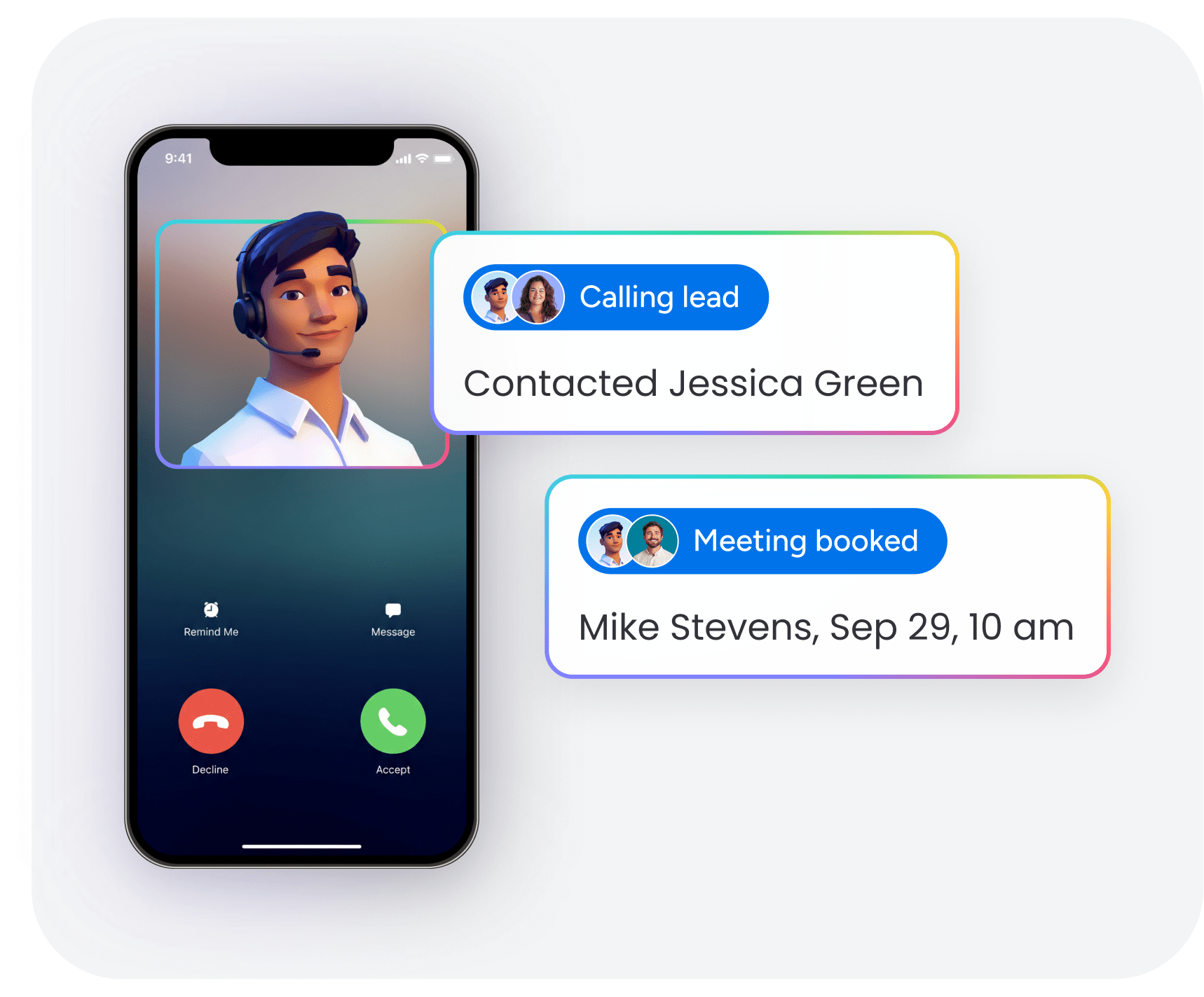
The platform’s AI processes call transcripts, extracts key information, and populates CRM fields automatically. After each call, monday CRM can generate summaries highlighting pain points, budget discussions, and timeline mentions while creating follow-up actions for the rep.
Trigger-based workflow automation tied to call outcomes

monday CRM’s automation capabilities trigger actions based on call outcomes. When an AI agent qualifies a lead, the platform can create a deal, assign an owner, schedule a demo, and send a personalized follow-up email.
Real-time dashboards for pipeline and AI performance visibility
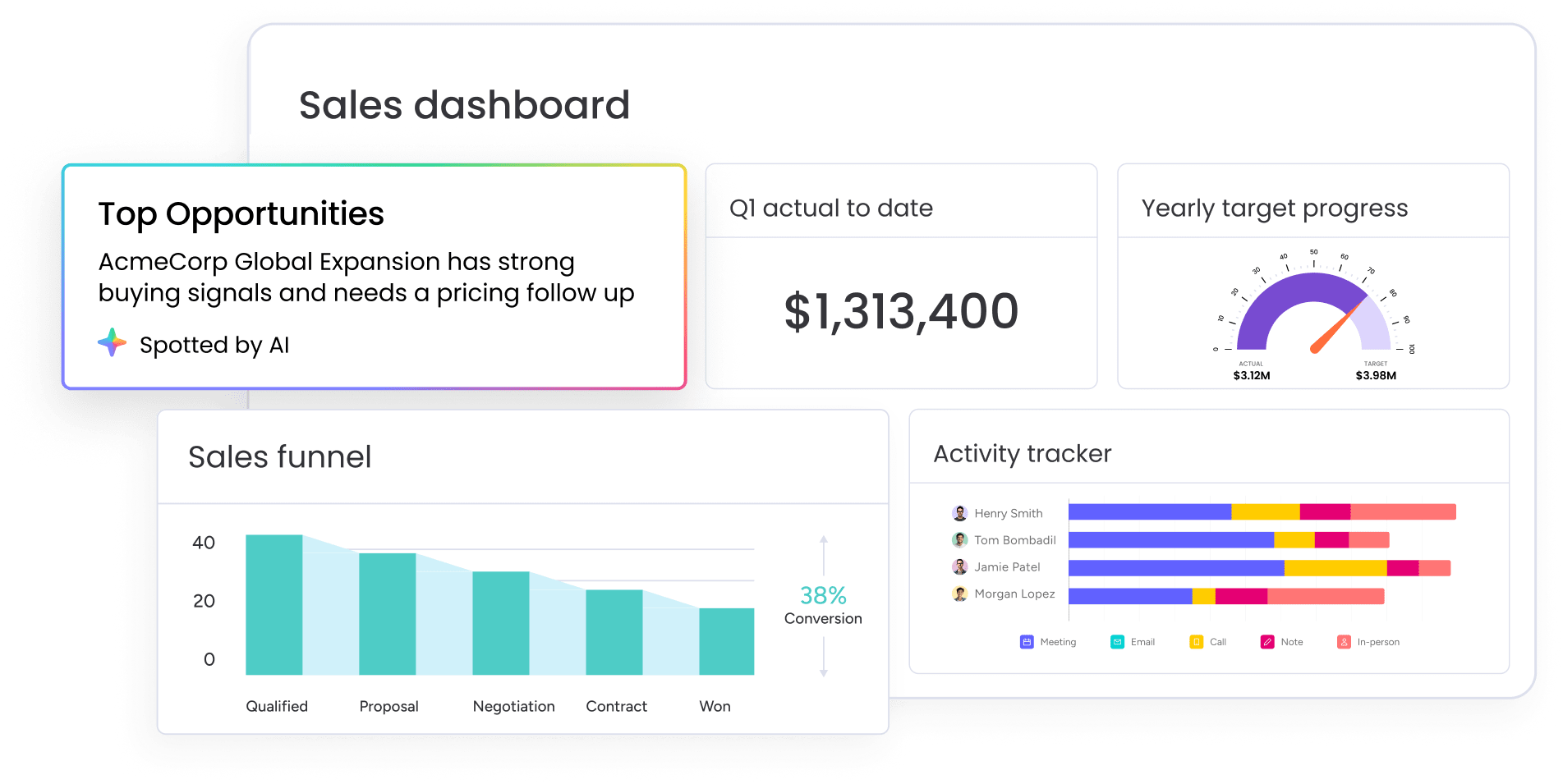
Customizable dashboards in monday CRM show call volume, conversion rates, and pipeline impact in real time. Revenue leaders can track AI agent performance, identify bottlenecks, and optimize processes through visual analytics that update automatically.
Full-context handoffs that keep deals moving
When AI agents escalate to human reps, monday CRM maintains complete context. The platform’s timeline view shows all interactions, the AI’s assessment, and recommended next steps, ensuring smooth transitions without information loss.
Put AI to work in your revenue operation
AI call center agents are here today: a practical way to handle more volume, respond faster, and give your reps back the time they need to close deals. The teams seeing the biggest gains aren’t replacing their people; they’re giving them better support. When your AI agents connect directly to your CRM, every call becomes a data point, every handoff stays in context, and every rep walks into a conversation already knowing what matters.
Revenue teams that move now build a compounding advantage. Each optimized workflow, each automated follow-up, and each clean handoff adds up to a pipeline that moves faster. With monday CRM’s AI capabilities, these improvements compound over time as your system learns from every interaction and refines your revenue operation.
Try monday CRMFAQs
What exactly is an AI call center agent?
An AI call center agent is autonomous software that handles customer phone calls using speech recognition, natural language processing, and CRM integration. It qualifies leads, answers questions, books meetings, and completes workflows without human intervention, operating 24/7 to ensure no opportunity gets missed.
How do AI call center agents differ from chatbots?
AI call center agents handle full voice conversations, access real-time CRM data, and complete multi-step workflows from qualification through follow-up. Chatbots typically manage text-only interactions with limited integration and single-action capabilities, making them less effective for complex revenue operations.
Can AI call center agents replace human sales reps?
No, AI agents complement human reps by handling repetitive tasks like qualification and scheduling. This allows humans to focus on complex negotiations, relationship building, and strategic decisions that require judgment and empathy—the high-value work that actually closes deals.
What workflows should revenue teams automate first?
Start with high-volume, predictable interactions like inbound lead qualification, demo scheduling, and basic support questions. These workflows deliver quick wins and build confidence before expanding to more complex scenarios, allowing your team to prove value early.
How do AI agents handle complex or emotional situations?
AI agents detect complexity and emotion through sentiment analysis and keyword recognition, then escalate to human reps with full context and recommendations. This ensures customers receive appropriate support without repetition, maintaining quality while protecting the relationship.
What security measures protect customer data with AI agents?
AI call center agents use role-based permissions, encryption, audit trails, and compliance frameworks to protect data. These systems meet GDPR, CCPA, and industry-specific regulations without compromising functionality, ensuring your customer information stays secure.
