


Imagine handing every team member a set of master keys to your building; convenient, until you realize no one tracked who has which key or which doors they open. That’s the reality of vibe coding today: anyone on your team can build a working app in minutes without writing a single line of code, and the speed is genuinely valuable.
The catch is that AI-generated code prioritizes function over safety. Apps get built quickly, often by people who aren’t thinking about authentication gaps, exposed credentials, or dependencies that haven’t been updated in years, and traditional security review processes weren’t designed for this pace.
This guide walks through the most common vibe coding security risks, why standard security approaches miss them, and which controls actually reduce exposure without slowing your team down. You’ll also see what to prioritize when choosing a platform, including how monday vibe approaches governance and security by default.
Try monday vibeKey takeaways
- AI-generated code prioritizes speed over security: AI builds for function first, so protections like input validation and authentication need to be explicitly requested
- Your prompt is your first security control: Include specific security requirements in every prompt so the AI builds exactly what you need
- Not all vibe coding carries the same risk: Internal dashboards and prototypes are low-stakes. Anything touching payments, health data, or public users needs a full security review before shipping
- Human review adds what traditional scanning cannot: Most automated approaches focus on syntax, so pairing them with human review of authentication and authorization logic gives you full coverage
- monday vibe builds security into the environment: Apps are private by default, publishing requires admin approval, and data access ties directly to your existing permissions. Governance is part of the foundation, not an afterthought
What is vibe coding?
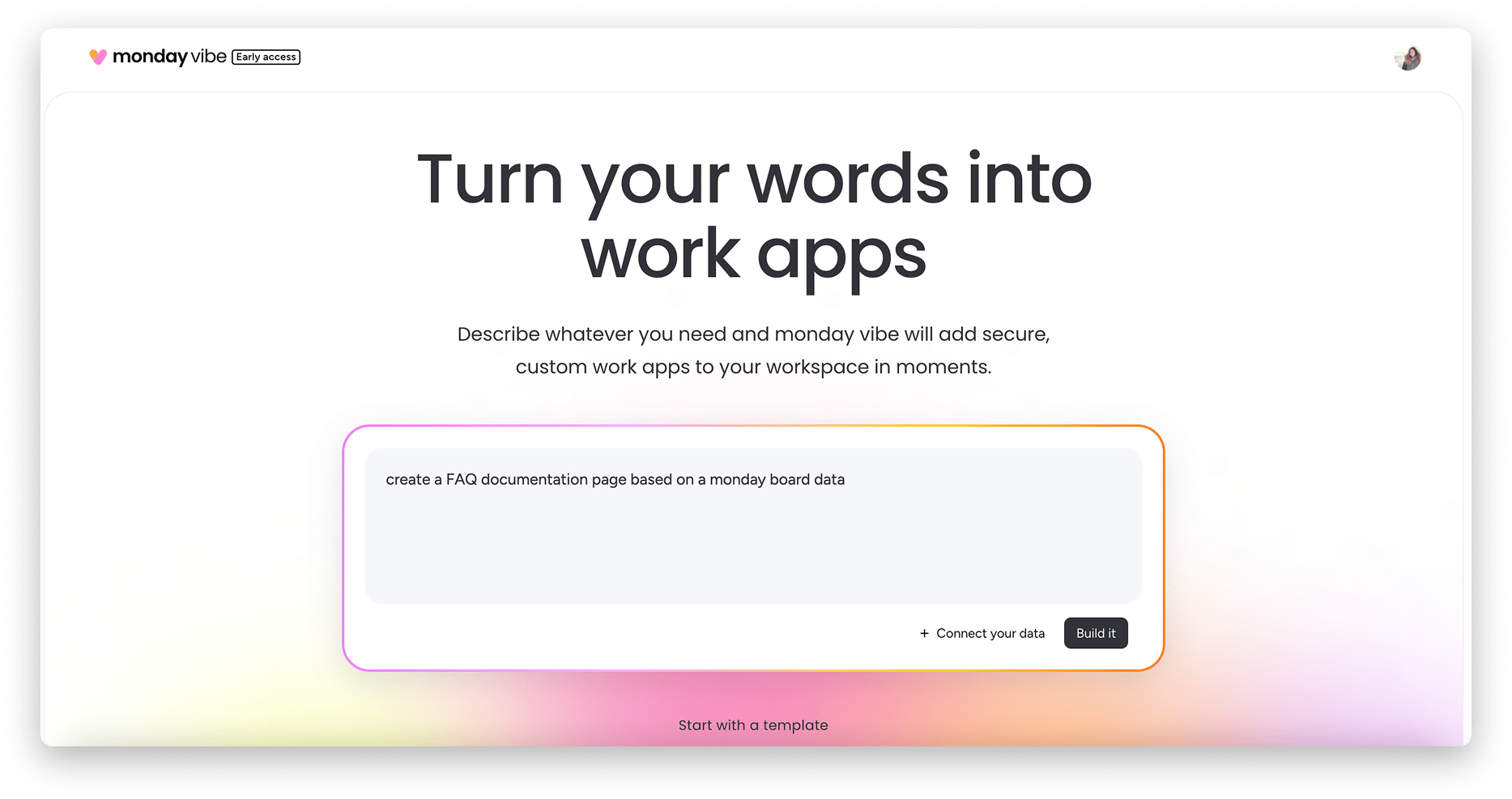
Vibe coding is building software applications by writing natural-language prompts instead of traditional code. You describe what you need in plain language. An AI model interprets the prompt and generates the application automatically. The team member never needs to see, write, or understand a single line of code.
It removes the traditional barrier between having an idea and having a working application. Non-technical team members, including operations leads, marketers, sales managers, and HR coordinators, can now build functional apps by describing what they need in everyday language.
What once required a developer and weeks of lead time can now happen in minutes. That speed creates real tension. When anyone can generate working software in minutes, the deployment advantage introduces security concerns most teams aren’t ready for. The scale of this exposure is significant: the World Economic Forum’s Global Cybersecurity Outlook 2026 found that 87% of respondents identified AI-related vulnerabilities as the fastest-growing cyber risk over the course of 2025. Here’s what those risks are, where they come from, and which controls actually work.
Learn more: Vibe coding for non-coders
Where vibe-coded apps need extra security attention
Vibe coding shifts code writing from trained developers to AI models responding to prompts. That shift creates structural areas where security attention becomes essential, regardless of platform or AI model.
Three things make vibe-coded applications inherently less secure than traditionally developed software:
- AI-generated code ships faster than teams can review it. When a working app can be generated in minutes, teams naturally ship it immediately. Traditional software development life cycle phases include code review, security testing, and staging environments. Vibe coding typically bypasses these phases in favor of speed
- The same prompt produces different code every time. AI code generation is non-deterministic. The same prompt can produce structurally different code each time. A prompt that produced secure code yesterday could produce insecure code today
- AI models learn from outdated and insecure training data. AI models train on large datasets of publicly available code, including billions of lines from open-source repositories. Much of this training data contains known vulnerabilities and deprecated libraries
Seven vibe coding security risks every team should know
These seven risks are the most common and consequential security vulnerabilities introduced by vibe coding. Understanding them helps you build safely with AI-generated code. Each one can appear in any vibe-coded application, no matter the platform or builder’s intent.
Risk 1: Insecure AI-generated code with missing security controls
AI-generated code frequently omits security controls trained developers include by default. These missing controls include:
- Input validation
- Output encoding
- Error handling that does not expose system information
- Proper authentication checks on every request
AI models optimize for functionality, not security. The prompt says “build a login form,” and the model builds one that logs users in. Security controls aren’t part of the functional requirement unless the builder explicitly requests them.
Risk 2: Vulnerable and unverified dependencies
A dependency is a pre-built code library the application relies on to perform specific functions. AI models frequently include dependencies in generated code without verifying whether those packages are actively maintained, up to date, or free of known vulnerabilities.
- Actively maintained
- Up to date
- Free of known vulnerabilities
Some AI models have been documented generating references to packages that do not exist at all. Attackers can exploit this by publishing malicious packages under those fabricated names.
Risk 3: Hard-coded secrets and unsafe configuration
Hard-coded secrets are sensitive credentials (API keys, database passwords, authentication tokens) written directly into the application’s source code. AI models often generate code with placeholder or example credentials embedded in the source.
The risk multiplies when code is pushed to shared or public repositories. Automated scanners continuously crawl public code repositories looking for exposed credentials. A single exposed key can compromise an entire system.
Risk 4: Remote code execution from generated scripts
Remote code execution (RCE) is a vulnerability that lets attackers run arbitrary commands on the server hosting the application. RCE vulnerabilities are some of the most severe security flaws because they give attackers system administrator-level control.
AI-generated code can introduce RCE vulnerabilities in two common ways:
- Generating functions that execute user-supplied input as code
- Calling system commands without proper sanitization of inputs
Risk 5: Injection flaws including SQL injection and cross-site scripting
An injection flaw lets attackers insert malicious code into an application’s inputs, which the application then executes as legitimate instructions. Two of the most common types are:
- SQL injection: Malicious database queries inserted through form fields
- Cross-site scripting (XSS): Malicious scripts injected into web pages viewed by other users
AI-generated code often constructs database queries and renders user input without protective measures like parameterized queries or output escaping.
Risk 6: Over-reliance on AI output and gaps in code comprehension
This risk is behavioral rather than technical. When an AI generates a working application from a prompt, builders naturally assume the output is correct and complete. The person deploying the app hasn’t written, read, or understood the underlying code.
This tendency has a name: automation bias. Vulnerabilities persist because no one with security knowledge ever examines the output.
Risk 7: Automatic dependency insertion and supply chain exposure
AI models automatically pull in chains of dependencies without the builder knowing or consenting. The application’s supply chain expands in ways the builder can’t see or control. Each dependency in the chain may itself depend on other packages. This creates a tree of code the builder never requested and can’t audit. This risk extends well beyond individual apps: according to the World Economic Forum’s Global Cybersecurity Outlook 2026, 65% of large companies now cite third-party and software supply-chain vulnerabilities as their greatest security challenge, up from 54% in 2025.
Try monday vibeWhere traditional security approaches fall short with vibe coding
Most organizations rely on established security testing methods built for traditionally written code. These approaches weren’t built for the patterns and failure modes unique to AI-generated applications, and that gap matters.
Where static analysis falls short
Static analysis scans source code to identify known vulnerability patterns without actually running the application. Static analysis falls short with AI-generated code because the vulnerabilities in vibe-coded apps are often context-dependent. The code pattern itself may look acceptable in isolation but becomes dangerous depending on how the application uses it.
Why architectural flaws go undetected
Many vibe coding vulnerabilities are architectural, not syntactic. An architectural vulnerability is a flaw in how the application is designed and structured, not a specific line of bad code. Examples include:
- Missing authentication on entire API endpoints
- Data flowing between components without access controls
Automated scanners find specific code-level bugs. They don’t evaluate whether an application’s overall design is secure.

How agentic AI changes vibe coding security requirements
Agentic AI refers to AI systems that can take autonomous actions, make decisions, and interact with external services without human intervention at each step. When vibe-coded applications incorporate agentic capabilities, the security risks multiply. According to McKinsey’s State of AI Trust in 2026, nearly two-thirds of organizations cite security and risk concerns as the top barrier to fully scaling agentic AI, with 72% identifying cybersecurity as a highly relevant AI risk.
Prompt injection attacks
Prompt injection is a technique where attackers craft input that causes an AI agent to override its original instructions and follow the attacker’s instructions instead. These attacks are hard to defend against because the malicious input looks like normal data to every system except the AI agent.
Overly broad permissions
Autonomous AI agents often operate with the permissions of whoever deployed them. If those permissions are overly broad, a compromised or malfunctioning agent can access, modify, or delete data far beyond its intended function.
When to use vibe coding and when to add extra review
Vibe coding is safe in the right contexts. The risk level depends on what you’re building, what data it accesses, and what controls surround it. Knowing the boundaries helps teams move fast without creating unnecessary exposure.
Vibe coding works well for
Applications where the security consequences of a vulnerability are limited and the app operates within a controlled environment with existing security infrastructure.
- Internal dashboards and reporting apps that visualize data team members already have access to
- Prototypes and proof-of-concept apps for testing ideas before committing to a full development cycle
- Workflow automation within secured platforms that operate within an enterprise platform’s existing security boundary
- Team-facing operational apps like time trackers, project status boards, or event portals used internally
Vibe coding requires extensive security review for
Apply rigorous review before shipping vibe-coded apps that handle payment data, healthcare information, authentication systems, personally identifiable information, or public-facing scenarios.
- Payment data
- Healthcare information
- Authentication systems
- Personally identifiable information
- Public-facing applications without a security review layer
Six controls for secure vibe coding that actually work
These six controls are practical measures you can implement immediately to reduce the security risks of vibe coding. They work together as a layered defense, not standalone fixes.
Control 1: Treat every prompt as a security design document
The prompt is the only input you control, making it your first and most important security control. Include specific security requirements in every prompt:
- Authentication requirements
- Data access boundaries
- Input validation expectations
- Exclusions for sensitive data handling
Control 2: Standardize secure patterns with rules files and guardrails
Rules files are configuration files that instruct the AI code generator to follow specific coding standards and security patterns each time it generates code. They act as persistent security instructions that apply to every prompt, removing the need to re-specify security requirements each time.
Control 3: Enforce secrets management across the development pipeline
Secrets management is the practice of storing sensitive credentials in dedicated secure storage systems instead of in application code. Enforcement must happen at three levels:
- The development environment
- The code repository
- The deployment pipeline
Control 4: Add real-time dependency scanning with fresh vulnerability data
Dependency scanning must happen continuously, not just during initial code generation. The scanner should flag:
- Direct dependencies included in the generated code
- The entire dependency tree, including transitive packages
- Any packages flagged in current vulnerability databases
Control 5: Require human review for authentication and authorization logic
Authentication and authorization are the two most critical security functions in any application. AI-generated authentication and authorization code should never be deployed without review by someone with security expertise. This is one step where thoroughness should lead over speed.
Control 6: Govern who can publish and what data apps can access
Organizational governance is your final control layer. This means implementing publishing permissions that restrict who can make apps available to others, controls rooted in data governance that limit what information an app can reach, and audit trails for what apps were published, by whom, and what data they access.
- Publishing permissions that restrict who can make apps available to others
- Controls rooted in data governance that limit what information an app can reach
- Audit trails for what apps were published, by whom, and what data they access
What to look for in a secure vibe coding platform
The platform on which vibe coding happens is itself a critical security control. A platform that builds security into its infrastructure reduces the burden on individual builders to get security right on their own. Not all platforms approach this equally, and the comparison below shows what separates work-native platforms from standalone vibe coding environments.
A secure vibe coding platform separates the ability to create apps from the ability to publish them. Apps should be private by default, meaning a newly created app is visible only to its creator until explicitly shared.

How monday vibe helps teams build secure apps without slowing down
With monday vibe, teams can build apps at the speed of natural language while operating within the security framework their organization already trusts on monday.com.
Every app built with monday vibe runs on monday.com’s existing infrastructure. This means vibe-coded apps automatically inherit the platform’s security architecture, including encryption, network security, and compliance certifications. The platform’s dedicated Trust Center provides detailed security documentation.
Teams building on monday vibe gain governance controls that keep vibe coding secure by default:
- Private by default: Every app created with monday vibe is visible only to its creator until explicitly published
- Admin-controlled publishing: Account admins control who has the “Publish vibe apps” permission. On Enterprise accounts, this permission can be granted to specific user roles
- Draft mode: Team members can create, test, and iterate on apps in draft mode without affecting any live version
The permission model ties app data access directly to the organization’s existing board-level permissions. Members and guests can view vibe apps that display board information only if they already have access to those boards. Account admins retain full control over AI features and can turn them on or off from the Administration section.
How to build with confidence: vibe coding security from day one
Security in vibe coding depends on environment and governance, not just code quality. The risks covered in this guide, from missing security controls to supply chain exposure to agentic AI vulnerabilities, are familiar vulnerabilities appearing faster than traditional review processes can catch them.
monday vibe addresses these challenges by combining the speed of AI-generated applications with the security infrastructure teams already trust on monday.com. The platform builds security into every layer: apps are private by default, publishing requires explicit admin permission, and data access ties directly to your existing board-level permissions. This means security-aware prompts and organizational governance work together with platform controls that are already in place, addressing the majority of vibe coding risks without sacrificing the speed and accessibility that make vibe coding valuable in the first place.
Teams evaluating vibe coding platforms should prioritize default visibility, publishing controls, permission models, data boundaries, and admin oversight. monday vibe delivers on each of these dimensions structurally, not just procedurally. Apps inherit enterprise-grade infrastructure automatically, admins control who can publish, and every app respects the permissions your organization has already configured. That distinction matters at scale.
As vibe coding becomes a standard approach for operations teams, product managers, and department leaders, the organizations that succeed will be those that enable builder autonomy while maintaining governance. monday vibe makes this possible by building security into the environment from day one, so teams can move fast without creating unnecessary exposure.
Try monday vibeFrequently asked questions
Is vibe coding safe for production applications?
Vibe coding can be safe for production applications when the platform provides built-in security controls, apps are reviewed before publishing, and the application operates within an environment with existing authentication and permission structures.
What is the biggest security risk of vibe coding?
The biggest security risk is the combination of AI-generated code that omits security controls and builders who lack the expertise to identify those omissions, resulting in applications that function correctly but are vulnerable to common attacks.
How do you make AI-generated code secure?
Securing AI-generated code requires writing security-aware prompts, enforcing secrets management, scanning dependencies against current vulnerability databases, requiring human review of authentication logic, and deploying apps on platforms with built-in governance controls.
Does vibe coding introduce supply chain risk?
Vibe coding introduces supply chain risk because AI models automatically include third-party dependencies without the team member's awareness, and each dependency may itself rely on additional packages that could contain vulnerabilities.
How does monday vibe handle security for vibe-coded apps?
monday vibe builds apps on monday.com's enterprise-grade infrastructure with private-by-default visibility, admin-controlled publishing permissions, and granular data access tied to existing board-level permissions, so apps inherit the platform's security and compliance controls automatically.
 Get started