


Creative teams drive the campaigns, visuals, and content that shape how customers experience a brand, but too much of their time gets swallowed by the work around the work. Adobe research found that 44% of creatives spend half their week on repetitive design tasks, while 71% report project management challenges that pull them away from meaningful creative work.
Closing that gap takes more than creative talent. Clear roles, better briefs, visible workloads, and structured workflows give creative teams more room to do the work they were hired to do. This guide covers how to structure a creative team, the roles you need, the challenges to plan for, and eight practical ways to manage creative work without managing the creativity out of it.
Key takeaways
- Creative teams combine specialized roles: Creative directors, designers, copywriters, content writers, and UX professionals work together to produce brand-aligned content and campaigns
- Team structure shapes how creative work gets done: Centralized, embedded, pod-based, and hybrid models each affect speed, consistency, and cross-functional alignment differently
- Operational friction gets in the way of creative work: Unclear briefs, feedback bottlenecks, workload imbalance, and difficulty measuring impact are common challenges
- Good creative management creates structure around creativity: Clear briefs, protected creative time, defined ownership, and connected workflows help teams deliver without unnecessarily constraining how they create
- Connected work reduces creative admin: monday AI Workspace gives teams visibility, automations, and integrations that can reduce coordination and leave more time for creative work
What is a creative team?

A creative team is a group of specialists responsible for turning business and brand objectives into the content and experiences customers see, read, and interact with. Depending on the organization, that can include campaigns, brand design, copy and content, video, social assets, websites, product experiences, and more.
What makes creative teams different from many other project teams is that the work isn’t simply executed against a fixed set of instructions. It involves ideation, interpretation, experimentation, and iteration. A brief establishes the goal and constraints, but the team still needs space to determine the best creative response.
That makes structure particularly important. Creative teams need enough process to clarify requests, ownership, deadlines, and approvals without turning the creative process itself into a rigid checklist. The strongest teams standardize the coordination around creative work so their people can spend more time on the thinking and making that actually requires them.
Seven key roles on a creative team
The roles on a creative team vary by organization size, but most high-performing teams include a mix of strategic leadership, visual design, content creation, and production management. Here are seven core roles that keep creative work moving from concept to completion.
1. Creative director
The creative director sets the vision for all creative output and ensures every piece aligns with brand strategy. They make final calls on concepts, guide the team through creative challenges, and serve as the bridge between business objectives and artistic execution.
2. Art director
Art directors translate the creative director’s vision into specific visual direction for individual projects. They oversee design consistency across campaigns, select imagery and typography, and mentor junior designers on brand standards.
3. Graphic designer
Graphic designers produce the visual assets that bring campaigns to life, from social media graphics and website elements to print materials and presentations. They’re the execution engine for most visual content a brand produces.
4. Copywriter and content writer
Copywriters and content writers both shape how a brand communicates, but the distinction is usually about purpose rather than length. Copywriting is primarily designed to persuade someone to take an action, whether that’s clicking an ad, signing up, buying a product, or responding to a campaign. Content writing is primarily designed to inform, educate, or build trust through formats such as articles, guides, reports, and thought leadership.
In practice, the roles often overlap. A content writer may write conversion-focused copy, and a copywriter may produce long-form work. What matters is having someone responsible for turning the brand’s ideas into clear, consistent messaging across the customer journey.
5. UX/UI designer
UX/UI designers focus on digital experiences, designing interfaces that are both visually appealing and functionally intuitive. They conduct user research, build wireframes and prototypes, and collaborate with developers to deliver products that users actually want to use.
6. Video producer
Video producers manage the end-to-end creation of video content, from scripting and storyboarding to filming and post-production. With video consumption growing rapidly across all digital channels, this role has become essential for teams that need to produce content for YouTube, social media, and product demos.
7. Project and traffic manager
The project or traffic manager keeps creative work organized and on schedule. They manage intake requests, assign work based on team capacity, track deadlines, and clear blockers so creatives can focus on producing rather than coordinating. Without this role, creative teams typically spend too much time managing work and not enough time doing it.
Creative team structure: Four common models
How you organize your creative team structure directly affects the quality of work, the speed of delivery, and the extent to which creative output aligns with business goals. Most organizations use one of four models, each with distinct strengths and trade-offs.
| Structure | How it works | Best for | Main trade-off |
|---|---|---|---|
| Centralized | All creatives sit in one department and serve the entire organization | Brand consistency, resource efficiency | Can create bottlenecks and slow response times |
| Embedded (decentralized) | Creatives are assigned directly to business units or product teams | Speed, deep domain knowledge | Brand inconsistency, duplicated roles |
| Pod-based | Small cross-functional pods (designer + writer + strategist) work on specific projects | Agile workflows, campaign-based work | Hard to scale, potential skill gaps in small pods |
| Hybrid | Core centralized team with embedded specialists in high-demand business units | Large organizations balancing consistency with speed | Requires strong coordination and clear governance |
- The centralized model works well for smaller organizations or companies where brand consistency is the top priority. All creative requests go through a single team, which ensures unified quality but can slow delivery when demand spikes
- The embedded model places creatives directly within business units, giving them deep context into that team’s goals. Marketing, product, and sales each get dedicated creative support, but without a shared brand owner, visual and tonal consistency can drift
- Pod-based structures pair a small group of complementary creatives (often a designer, a writer, and a strategist) to tackle specific projects from start to finish. This approach works especially well for campaign-driven work where speed and cohesion matter more than scale
- The hybrid model combines a central creative team that owns brand standards with embedded specialists in high-demand departments. It’s the most common structure for mid-size and enterprise organizations because it balances consistency with speed, though it requires clear workflows and communication channels to work effectively
Five common creative team challenges
Even talented creative teams struggle when operational problems go unaddressed. These five challenges come up consistently across industries and team sizes.
- Scope creep and unclear briefs: According to Adobe’s State of Creativity report, 27% of creatives cite a lack of clarity around changing project requirements as a top challenge. When briefs are vague or incomplete, teams waste hours chasing down details before work even begins. Projects then expand beyond the original scope because expectations were never properly defined
- Feedback bottlenecks: Creative work requires review and approval cycles, but those cycles often stall. Assets sit in email inboxes waiting for stakeholder feedback. Multiple rounds of revisions pile up because reviewers weren’t aligned on the direction from the start. The result is missed deadlines and frustrated creatives
- Balancing creative freedom with brand consistency: Creatives do their best work when they have room to experiment, but organizations need consistent brand output. Finding the right balance between creative latitude and brand standards is a constant tension, especially when multiple teams produce content simultaneously
- Workload imbalance: Some team members end up overloaded while others are underutilized, simply because managers lack visibility into who’s working on what. Without a clear picture of team capacity, work assignments become reactive rather than strategic
- Measuring creative impact: Creative teams often struggle to prove their value in business terms. A campaign might look great, but if you can’t connect it to pipeline, engagement, or revenue outcomes, it’s hard to justify headcount and budgets. Teams that tie creative output to data-driven storytelling and measurable KPIs earn a strategic seat at the leadership table rather than being treated as an order-taking service
Benefits of a well-managed creative team
When creative teams operate with clear structure and strong management, the business impact extends far beyond better-looking deliverables.
- Faster time to market: Structured workflows and clear approval processes reduce the back-and-forth that delays campaigns. Teams ship creative assets in days rather than weeks
- Stronger brand consistency: Defined guidelines and centralized oversight ensure every piece of content reinforces the same brand identity, regardless of which team member produces it
- Higher creative quality: When creatives aren’t buried in admin and coordination, they have the headspace for deeper ideation and more polished execution
- Better resource utilization: Visible workloads and capacity planning prevent burnout on one side and idle time on the other, which translates to higher output per team member
- Measurable business results: Teams that connect creative output to business metrics (conversions, engagement, pipeline) can demonstrate ROI and secure investment for future projects
- Improved cross-functional collaboration: A well-managed creative team builds trust with stakeholders by delivering on time, responding to feedback efficiently, and aligning creative decisions with business goals

How to manage a creative team: Eight proven principles
Managing a creative team effectively means building systems that protect creative energy while keeping work aligned with business outcomes. The best creative managers don’t choose between structure and freedom. They design workflows that deliver both. Here are eight principles that consistently produce results.
1. Set clear creative briefs for every project
A strong creative brief is the single most impactful tool for reducing rework and scope creep. Every brief should include the project objective, target audience, key messages, deliverables, timeline, and success metrics. When everyone starts on the same page, fewer surprises emerge later.
For example, instead of asking a designer to “make a landing page for the new feature,” a structured brief specifies the conversion goal, the audience segment, the tone, required brand assets, and the review deadline. This level of clarity saves hours of back-and-forth. Learn more about building repeatable processes in our guide to creative project management.
2. Build a structured feedback and approval process
Feedback bottlenecks kill creative momentum. Define who reviews what, in what order, and by when. Set a maximum number of revision rounds for each project type, and establish clear criteria for what “approved” means.
One approach that works well is to route feedback through a single designated reviewer per stakeholder group, rather than opening the floor to everyone. This reduces conflicting directions and keeps approvals moving. For a deeper look at structuring team processes, explore these team management strategies.
3. Protect creative time and manage workloads
Creative work requires focused, uninterrupted blocks of time. Most creative professionals report spending more time on coordination, status updates, and administrative tasks than on the skilled work they were hired to do. Managers can counter this by blocking dedicated creative time, batching meetings, and making workload distribution visible.
This is also where a shared work platform can remove some of the coordination that eats into creative time. With monday AI Workspace, managers can use workload management views to see assignments and capacity across the team in real time, making it easier to redistribute work before someone becomes overloaded. Automations can also handle routine reminders, assignments, and status changes, reducing the amount of project administration creatives need to manage themselves.
4. Define roles, ownership, and decision rights
Ambiguity about who owns what leads to duplicated effort, dropped balls, and team friction. For each project, clarify who’s responsible for execution, who provides input, and who has final approval. A simple RACI framework (Responsible, Accountable, Consulted, Informed) works for most creative teams.
When a designer knows they own the visual direction and the copywriter owns the messaging, both can move faster without waiting for permission that was never clearly assigned.
5. Foster a culture of creative experimentation
High-performing creative teams test ideas before committing to them. Build space for experimentation by running small creative sprints, A/B testing designs, or dedicating a percentage of team time to exploratory projects.
Some of the most successful creative organizations run small experiments before committing to a direction, testing variations and measuring engagement before scaling the winner. The principle applies at every level: give your team permission to try, measure what works, and iterate.
6. Align creative work with business goals
Every creative project should connect to a measurable business outcome, whether that’s increasing conversion rates, building brand awareness, or driving pipeline. When creatives understand the “why” behind their work, they make better decisions about concept, tone, and execution.
Hold regular alignment sessions where the creative team reviews business performance alongside campaign results. This closes the feedback loop and positions the creative team as a strategic partner rather than an order-taking service.
7. Standardize workflows without stifling creativity
Templates and automations handle the repetitive parts of creative work, so your team can focus on the parts that actually require creative thinking. Standardize your intake process, file naming conventions, review cycles, and delivery checklists.
On monday AI Workspace, you can build automations that route requests to the right team member, notify reviewers when assets are ready, and update project status without anyone lifting a finger. Templates for recurring project types (social campaigns, product launches, quarterly reports) eliminate setup time and ensure nothing gets missed.
8. Invest in the right tools and integrations
Creative teams already use specialized tools for design, writing, video, communication, and asset storage. The goal isn’t to replace those tools with one giant platform. It’s to make sure the work around them stays connected.
Look for a work management platform that can act as the operational layer around creative work, bringing briefs, ownership, deadlines, approvals, and project status into one place while connecting to the tools people already use. monday AI Workspace supports integrations with platforms such as Slack, Microsoft Teams, Gmail, Google Drive, and other common business tools, so creative work can stay in the applications built for it while the workflow around that work remains visible.
How monday AI Workspace helps creative teams spend more time creating
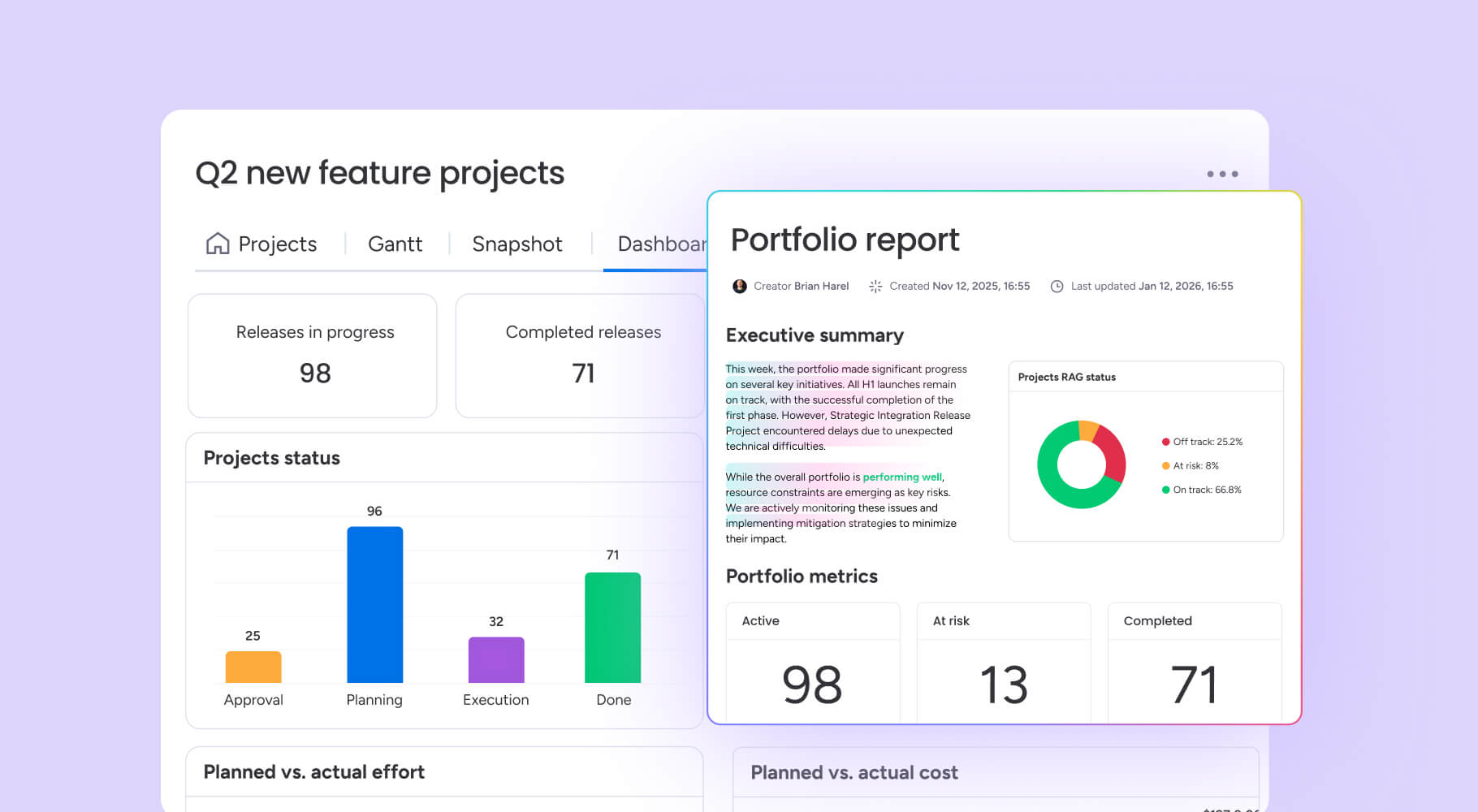
The management principles above all point to the same operational challenge: creative teams need structure around the work without adding more work to the creative process. monday AI Workspace brings briefs, ownership, workload, approvals, project status, and performance into one connected environment, while automations and AI can take on more of the repetitive coordination happening around them.
That gives creative leaders visibility into what’s moving, what’s blocked, and where capacity is stretched without requiring the team to spend half its day producing status updates.
- Workload widget for balanced capacity: The Workload widget gives managers a visual breakdown of each team member’s current assignments. Instead of guessing who’s available, you can see capacity in real time and redistribute work before anyone burns out. This directly solves the workload imbalance problem that most creative teams face
- Dashboards for full visibility: Custom dashboards pull together project status, deadlines, and performance metrics in one view. Stakeholders get the transparency they need without interrupting creatives for status updates. Dashboards bring campaign timelines, workload, review cycles, and project status into one live view, so creative leaders can see where work is moving and where it’s getting stuck without rebuilding reports manually
- Automations for repetitive tasks: Set up automations to handle the admin that eats into creative time. Automatically assign tasks when a brief is submitted, notify reviewers when assets are uploaded, send deadline reminders, and update statuses when items move through stages. Automations handle routine coordination in the background, including reminders, assignments, approvals, and status changes, leaving the team with fewer administrative steps to manage manually
- Forms for clearer briefs: monday workdocs lets teams collaborate on briefs, campaign plans, and creative documentation while keeping that context connected to the work it supports
- Integrations that reduce tool fragmentation: monday AI Workspace connects with Slack, Figma, Adobe Creative Cloud, and dozens of other tools so your creative workflow stays in one place. Notifications, file updates, and task assignments sync automatically, resulting in fewer context switches and less information loss
monday AI Workspace also includes AI capabilities like monday sidekick and AI agents that help creative teams work even faster. Sidekick can generate project summaries, suggest task assignments based on team capacity, and surface relevant information so you spend less time searching and more time executing. Teams can start with monday.com templates for recurring campaigns, content production, project planning, and other creative workflows rather than setting up every process from scratch.
Get started with monday.comBuild a creative team that delivers results
A great creative team isn’t just about hiring talented people. It’s about building the structure, workflows, and management practices that let talent thrive. Start by defining clear roles and choosing the right team structure. Then invest in the management principles that protect creative time, eliminate bottlenecks, and connect every project to business outcomes.
The creative teams that consistently deliver high-impact work share a common pattern: they pair creative freedom with operational discipline. Whether you’re building a new creative team from scratch or improving an existing one, the principles in this guide will help you move from reactive firefighting to strategic, repeatable execution.
FAQs
What does a creative team do?
A creative team develops visual, written, and multimedia content that communicates a brand's message to its audience. This includes everything from campaign concepts and graphic design to video production, copywriting, and UX design.
What is the ideal structure for a creative team?
The ideal structure depends on your organization's size and goals. Most mid-size and enterprise companies use a hybrid model that combines a centralized brand team with embedded specialists in high-demand departments.
How do you manage a creative team effectively?
Start with clear creative briefs, structured feedback processes, and visible workload management. Protect dedicated creative time, define roles and decision rights, and connect every project to measurable business outcomes.
What tools do creative teams need?
Creative teams typically need design software (Figma, Adobe Creative Cloud), a work management platform, communication tools (Slack), file storage, and feedback/proofing tools. The key is to connect these tools so that information flows automatically.
How do you measure creative team performance?
Track a mix of operational and outcome metrics: on-time delivery rate, average revision cycles, project throughput, and the business impact of creative work (engagement, conversions, pipeline influenced). Combine these for a complete picture.
How does monday AI Workspace support creative teams?
monday AI Workspace provides workload visibility, automated workflows, standardized intake forms, custom dashboards, and integrations with creative tools like Figma, Slack, and Adobe Creative Cloud. AI features like monday sidekick and AI agents further accelerate execution.
 Get started