



Product teams face relentless pressure to deliver features that resonate with users. Yet even the most promising ideas often lose clarity as they move from discovery to development, resulting in solutions that fall short and drain engineering resources. This disconnect between insight and execution creates bloated backlogs and stalled momentum.
A structured approach using product discovery templates bridges this divide. These frameworks establish a common language across product, engineering, and leadership functions, aligning everyone around the problem before any solution takes shape. By standardizing how teams gather, validate, and share insights, organizations move faster with heightened confidence.
This article explores 15 adaptable templates for various workflows, a four-step implementation plan, and methods for connecting discovery insights directly to development pipelines.
Key takeaways
- Structured frameworks: product discovery templates eliminate guesswork and accelerate decision-making while maintaining research quality, turning chaotic discovery into repeatable, scalable processes.
- Prevent costly mistakes: teams waste significant time and resources without structured discovery processes, often building features that miss the mark; templates ensure consistent data collection and validation.
- Implementation approach: successful implementation requires auditing current processes, selecting appropriate templates, establishing regular discovery rhythms, and measuring results. Start small with targeted templates rather than overhauling everything at once.
- Essential components: templates must include user research frameworks, prioritization tools, validation playbooks, and communication standards to ensure comprehensive outcomes regardless of team size or experience level.
- Seamless alignment: connecting discovery insights directly to development workflows keeps product and engineering teams aligned from research to delivery. Platforms like monday dev offer flexible templates that adapt to different methodologies, creating shared visibility across the entire product lifecycle.
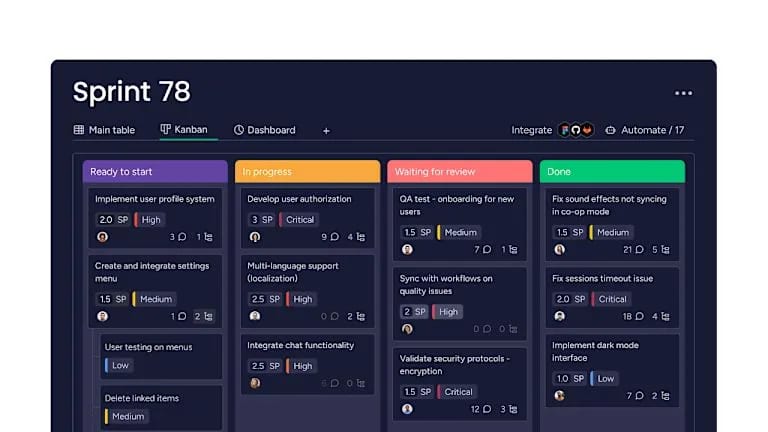
What are product discovery templates?
Product discovery templates are structured frameworks that guide teams through identifying user problems, validating ideas, and deciding what to build. They provide repeatable formats for research, prioritization, and documentation that keep your discovery work consistent and actionable.
These templates serve as structured blueprints for understanding users and their needs. Rather than starting from scratch with each initiative, teams follow proven methodologies to gather insights, evaluate opportunities, and make informed decisions about product direction.
Effective templates balance structure with flexibility. They provide sufficient guidance to accelerate progress while avoiding rigid processes that may not align with specific organizational contexts. The following elements contribute to their effectiveness:
- Research protocols: step-by-step guides for interviews and surveys that ensure consistent data collection.
- Prioritization frameworks: clear criteria for evaluating ideas based on impact, effort, and strategic fit.
- Documentation standards: consistent formats for capturing insights that everyone can understand and act on.
- Validation playbooks: structured methods for testing ideas before committing development resources.
Why product teams need discovery templates in 2026?
Product teams face mounting pressure to deliver faster and with greater precision. As markets shift and user expectations evolve, teams without structured discovery waste time reinventing research or building features that miss the mark.
- Accelerate discovery without sacrificing quality: templates eliminate guesswork by providing ready-made interview guides and validation frameworks. This reduces preparation time from hours to minutes, allowing for faster experimentation and confident decision-making.
- Align engineering and product teams early: establish a shared language and clear handoff points. Precise documentation ensures engineering receives concrete requirements rather than vague requests, while product confirms technical feasibility before development begins.
- Build scalable, repeatable processes: as organizations grow, templates prevent knowledge loss and simplify onboarding. They maintain consistency across expanding departments while offering the flexibility to adapt to different team sizes and project scopes.
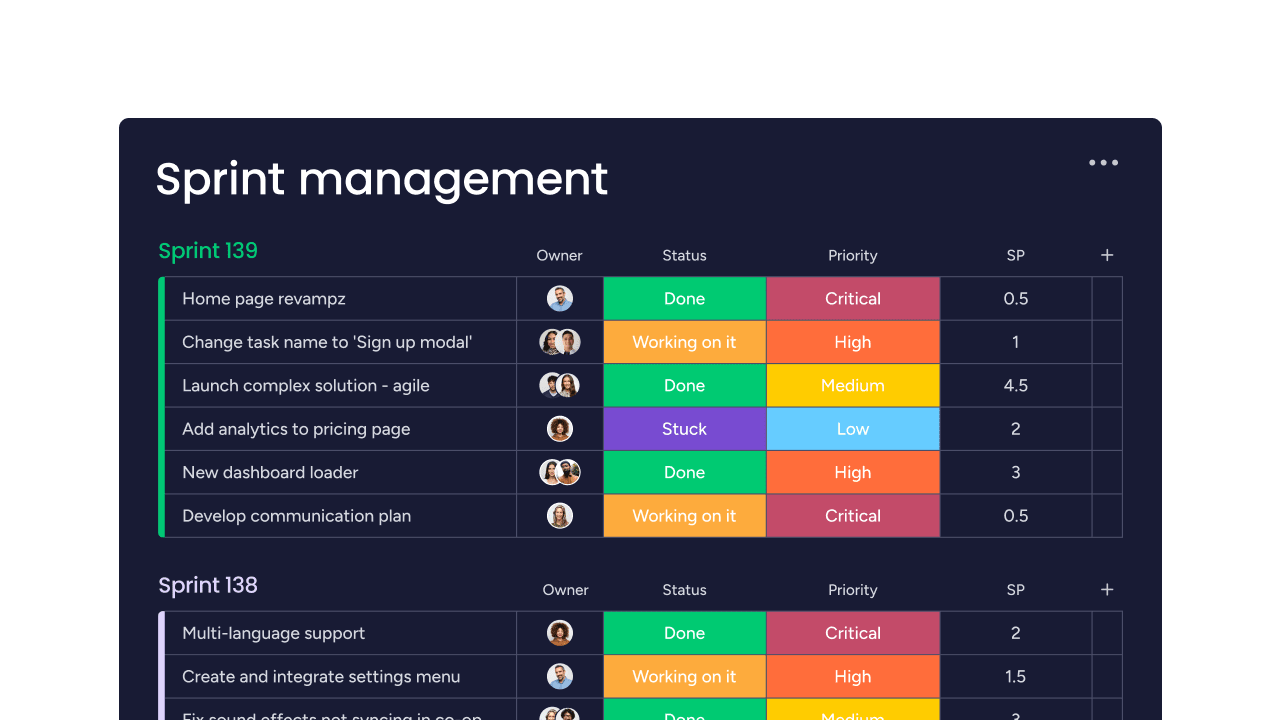
Essential discovery template components
Not all discovery templates deliver equal value. The most effective ones share core components that ensure comprehensive outcomes regardless of team size or experience level. These building blocks transform generic frameworks into powerful tools that drive consistent results.
User research and interview frameworks
Strong research frameworks ensure every team member collects data consistently. They include:
- Research objectives: clear questions that keep efforts focused.
- Participant criteria: specifications for which users to target.
- Question banks: pre-written prompts that reduce interviewer bias.
- Analysis methods: structured approaches for interpreting findings.
Problem prioritization frameworks
Prioritization frameworks prevent teams from chasing every problem. They establish transparent criteria for making decisions. Different methods suit different contexts:
| Method | Best Use Case | Key Benefits |
|---|---|---|
| Impact/Effort Matrix | Quick evaluation of multiple options | Simple visualization, highlights quick wins |
| RICE Scoring | Large backlogs | Balances reach, impact, confidence, effort |
| Kano Model | Understanding satisfaction drivers | Differentiates basic vs. delight features |
| MoSCoW | Early-stage sorting | Clarifies must-haves vs. nice-to-haves |
Solution validation playbooks
Validation playbooks test whether solutions address real problems. They include hypothesis templates, experiment designs, success metrics, and decision frameworks.
These components reduce development risk. As a result, teams avoid building features users don’t want because validation happens before significant investment.
Cross-team communication templates
Discovery involves multiple stakeholders. Communication templates standardize how information flows:
- Regular updates: weekly summaries keep everyone informed.
- Decision logs: clear documentation builds trust.
- Shared artifacts: common reference points reduce confusion.
15 product discovery templates to transform your process
The right template accelerates discovery without sacrificing depth. Each framework below addresses specific challenges teams face, from understanding user needs to validating solutions before development begins. Choose templates that match your product stage, team structure, and immediate pain points.
1. Continuous discovery template
This template integrates ongoing research into regular development cycles. It emphasizes weekly user touchpoints and iterative learning. Best for established products with regular user access.
2. Jobs-to-be-done framework
JTBD focuses on the underlying job users hire products to accomplish. The template includes job mapping, outcome prioritization, and competitive analysis. Ideal for new product development.
3. Customer journey mapping template
Journey maps visualize experiences across every touchpoint. Components include stage definitions, emotion tracking, and touchpoint analysis. Perfect for improving existing experiences.
4. Opportunity solution tree
This visual framework connects outcomes to solutions through opportunities. It prevents jumping to solutions before understanding problems. Valuable for complex challenges with multiple paths.
5. Design sprint blueprint
Design sprints compress months of work into five days. The blueprint provides daily agendas and validation protocols. Use when testing concepts quickly or breaking decision deadlock.
6. User interview guide template
Structured guides ensure consistent research. They balance structure with natural conversation flow. Essential for any team conducting user research.
7. Feature prioritization matrix
This matrix enables systematic evaluation of potential features. It provides scoring frameworks and decision documentation. Best for managing backlogs and planning roadmaps.
8. Discovery workshop template
Workshop templates structure collaborative sessions. They include agendas, activities, and decision capture methods. Ideal for cross-functional alignment.
9. Assumption testing canvas
These canvases systematically validate hypotheses. Components include assumption mapping, experiment planning, and results analysis. Useful for high-uncertainty projects.
10. Customer discovery template
Customer discovery templates help understand target users. They include interview structures, segmentation, and problem validation. Essential for early-stage products.
11. Proof of concept framework
POC frameworks support minimal implementations to test feasibility. They cover hypothesis formation and evaluation metrics. Best for validating technical approaches with a proof of concept.
12. Empathy mapping template
Empathy maps capture what users say, think, do, and feel. They structure perspective capture and team alignment. Valuable for building user understanding.
13. Problem definition canvas
This canvas articulates problems worth solving. It structures problem statements and impact assessments. Most useful at discovery beginnings.
14. Discovery backlog template
Discovery backlogs organize research questions and validation needs. They track discovery work alongside development. Essential for continuous discovery teams.
15. Dual-track agile template
Dual-track templates coordinate parallel discovery and delivery. They manage synchronization and handoffs. Best for teams adding systematic discovery to existing workflows.
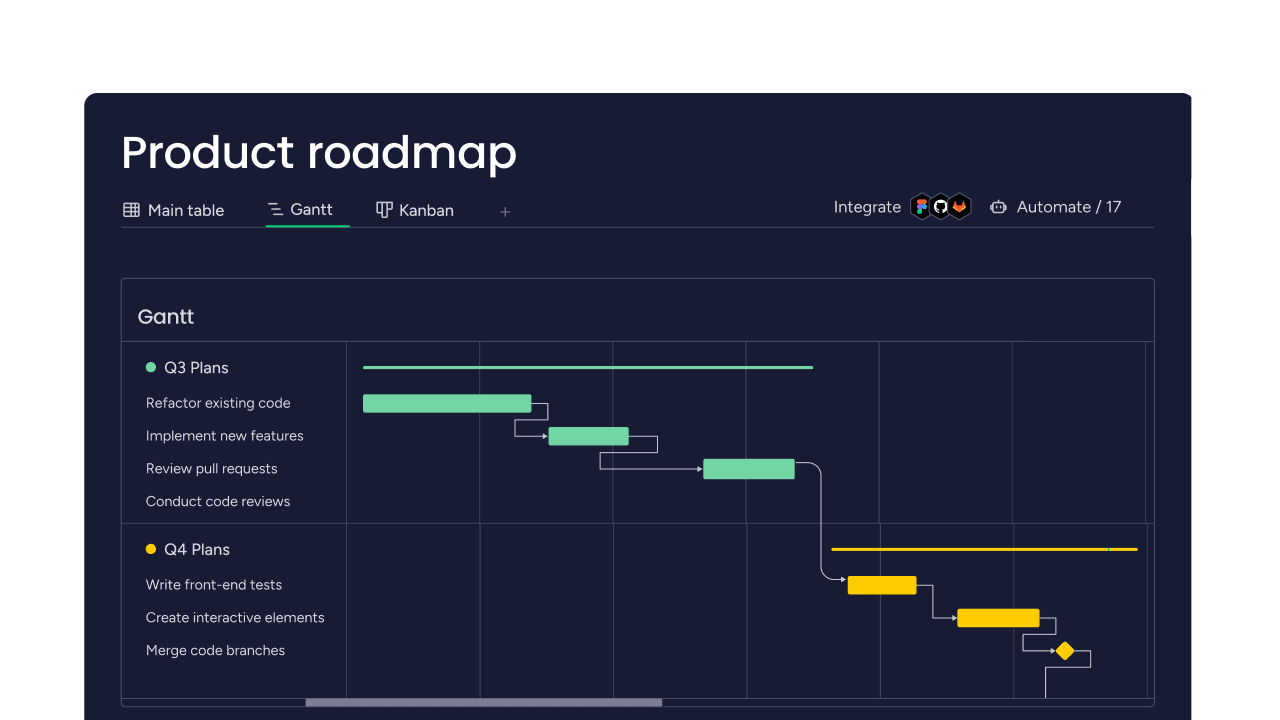
How to implement discovery templates in 4 steps?
Adopting discovery templates doesn’t require a complete process overhaul. The most successful implementations follow a structured approach that builds on existing workflows while addressing specific pain points. These four steps guide teams from initial assessment through continuous improvement, ensuring templates deliver measurable value from day one.
Step 1: audit your current discovery process
Begin by conducting a comprehensive assessment of your current discovery practices. Document existing workflows, identify specific pain points such as unclear objectives or duplicated efforts, and evaluate the time allocated to discovery activities.
Consider the following questions: are research activities properly documented? How are insights distributed across teams? Where do process bottlenecks occur? Analyzing these patterns will inform your template selection and implementation strategy.
Step 2: select templates that fit your workflow
Choose templates that address your biggest pain points. Consider these factors:
- Team experience: match complexity to current skills.
- Product stage: select based on ideation, growth, or maturity.
- Resource constraints: consider time and tools needed.
- Integration needs: ensure compatibility with existing workflows.
Modern solutions like monday dev provide flexible frameworks that adapt to different methodologies. Start with a few targeted templates rather than overhauling everything.
Step 3: establish discovery rhythms and rituals
Consistency drives results. Add discovery activities to regular cadences:
- Schedule activities: weekly interviews, bi-weekly validation reviews.
- Assign ownership: clear responsibility for each activity.
- Review cycles: regular assessment of template effectiveness.
- Documentation standards: consistent capture and sharing.
Common challenges include maintaining momentum and ensuring participation. Solutions include automated reminders and visible progress tracking.
Step 4: measure and iterate on your approach
As a last step, track metrics to assess impact. Compare timelines before and after adoption. Assess decision confidence and outcome success rates. Survey team members about effectiveness. Modify templates when metrics reveal bottlenecks or confusion. This iterative approach ensures continuous improvement.
Customizing templates for your unique workflow
No two product teams operate identically. Your methodology, team size, and product complexity shape how discovery templates should function in practice. The most effective implementations adapt standard frameworks to match your specific context rather than forcing workflows into rigid structures.
This section explores how to customize templates across different methodologies, scale them as your organization grows, and build hybrid approaches for complex product environments.
Adapting templates for different methodologies
Templates can be adapted to Agile, Lean, and Design Thinking frameworks. However, each methodology requires distinct modifications to match its cadence, structure, and expected outputs.
| Methodology | Adaptation | Timing | Output |
|---|---|---|---|
| Agile | Weekly backlog grooming | Sprint-based | User stories |
| Lean | Rapid testing cycles | Continuous | Experiment logs |
| Design Thinking | Workshop empathy maps | Project-based | Journey maps |
Scaling from small teams to enterprise
Small teams need lightweight templates. Medium teams add coordination layers. Enterprises implement governance frameworks while allowing local adaptation. Templates evolve as organizations grow. What starts simple becomes comprehensive with approval workflows and automated reporting.
Building hybrid approaches for complex products
Complex products often need multiple templates. B2B teams might blend customer interviews, journey mapping, and prioritization matrices. Hardware teams combine POC frameworks with empathy mapping. Maintain coherence through clear documentation standards and regular cross-team reviews.

"monday dev empowered us to optimize our GTM approach, resulting in faster, more dependable deliveries"
Steven Hamrell | Director of Product Management
"monday dev empowers us to manage the entire development process on one platform so we can speed up product delivery and improve customer satisfaction"
Mitchel Hudson | Head of Technology
"We're operating in an open, deep trusting, transparent environment with no silos of information. It's about completely opening access to everyone who needs it."
Alan Schmoll | Executive Vice President, Vistra PlatformConnect discovery insights directly to development
Discovery insights lose value when they remain disconnected from development workflows. The gap between research findings and actual implementation creates misalignment, delays, and features that drift from validated user needs.
Bridging this divide requires structured processes that translate insights into actionable development work while maintaining visibility across product and engineering teams.
- Create discovery-to-sprint pipelines: structure discovery outputs for seamless sprint integration: research findings become user stories, and validated assumptions convert to technical requirements. Advanced solutions like monday dev automate these handoffs, connecting discovery boards directly to development workflows to ensure insights influence what gets built.
- Maintain real-time visibility across teams: shared dashboards provide up-to-date status, decision logs create transparent records, and clear milestones keep everyone focused. When everyone sees what’s been learned, coordination happens naturally without constant meetings.
- Turn insights into actionable development items: use structured templates for user stories, maintain shared backlogs both teams reference, and hold regular reviews where teams align on learnings and implications, guided by a PRD template.
AI-powered discovery templates for smarter decisions
Artificial intelligence transforms how teams process discovery insights, turning hours of manual analysis into minutes of automated pattern recognition. AI-powered templates don’t replace human judgment; they amplify it, handling repetitive analysis tasks so product teams can focus on strategic decisions.
The following capabilities show how AI enhances discovery workflows without sacrificing the nuanced understanding that only human researchers provide.
- Automate pattern recognition in user feedback: AI identifies themes across large feedback volumes, flagging emerging pain points and sentiment shifts. Human interpretation remains essential for context and relevance.
- Predict feature success with data-driven templates: AI analyzes historical data to predict adoption and estimate impact. Teams use predictions as one input among many, combining AI insights with human judgment.
- Scale research analysis without adding headcount: AI processes transcripts and surveys at scale, summarizing hundreds of responses in minutes. Teams focus on decision-making rather than manual processing.
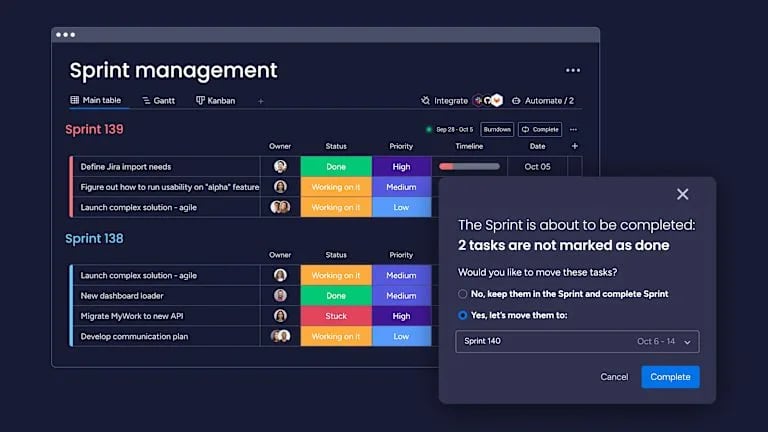
Improve your discovery process with monday dev
The right platform makes all the difference when implementing discovery templates. Without proper tooling, even the best frameworks become difficult to maintain, insights get lost in scattered documents, and teams struggle to stay aligned.
A unified workspace that connects discovery directly to development eliminates these friction points, turning structured templates into living workflows that drive real results.
Work your way with flexible templates
Powerful customization options let you adapt monday dev to your discovery methodology. Custom fields capture exactly the data you need. Automation rules eliminate repetitive tasks like status updates and notifications. Board modifications let you tailor processes without losing structure.
Whether using continuous discovery or design sprints, frameworks you can adapt to your context come built into monday dev. Visual boards organize research findings, prioritization matrices, and validation experiments in one place. Drag-and-drop functionality makes reorganization effortless as your process evolves.
Bridge product and engineering teams seamlessly
Shared visibility between discovery and development flows through connected boards and dashboards in monday dev. Integrated workflows link research insights directly to sprint planning. Real-time updates keep teams aligned from research through delivery without constant status meetings.
Discovery insights flow directly into development planning through automated item creation and dependencies. Both teams work from the same source of truth, with customizable views that show each stakeholder exactly what they need. Built-in communication tools like updates, mentions, and file sharing eliminate context switching between platforms.
Get started with monday dev
Pre-built templates you can customize in minutes make it easy to leverage monday dev for setting up workflows. Onboard team members quickly with intuitive interfaces that require minimal training. Integrate discovery with development using native connections to tools like Jira, GitHub, and Slack.
Advanced features like timeline views visualize discovery phases alongside development sprints. Reporting dashboards track key metrics like time-to-validation and feature success rates. Flexible templates and collaboration features available in monday dev make it ideal for transforming product discovery at any scale.
The content in this article is provided for informational purposes only and, to the best of monday.com’s knowledge, the information provided in this article is accurate and up-to-date at the time of publication. That said, monday.com encourages readers to verify all information directly.
Frequently asked questions
How often should product teams run discovery sessions?
Product teams should run discovery sessions as frequently as their product stage and team capacity allow. Continuous discovery involves weekly user touchpoints, while project-based discovery occurs monthly or at major initiative starts.
What's the difference between continuous discovery and project-based discovery?
Continuous discovery integrates research into regular development cycles through weekly user interactions. Project-based discovery focuses on discrete phases tied to specific initiatives like major features or launches.
Who should own the product discovery process in an organization?
Product managers usually lead discovery, but success requires active participation from engineering, design, and business stakeholders. Shared ownership creates more comprehensive outcomes than siloed discovery.
How do teams measure discovery ROI and effectiveness?
Teams measure discovery ROI by tracking time to validated insights, decision confidence scores, and success rates of outcomes informed by discovery. Both quantitative metrics and qualitative feedback provide a complete picture.
Can discovery templates work effectively for hardware products?
Discovery templates adapt for hardware by accounting for longer cycles, manufacturing constraints, and physical prototyping needs. Hardware teams integrate methods like pilot runs and usability labs into standard templates.
Which discovery method works best for early-stage startups?
Early-stage startups benefit from lightweight methods that maximize learning with minimal resources. Customer discovery and assumption testing frameworks help validate hypotheses quickly while conserving limited time and budget.

 Get started