



Large software projects often start with clear goals but quickly become complex and difficult to manage. As teams grow and requirements become more intricate, progress slows down, deadlines slip, and stakeholders lose visibility into what’s actually being delivered. The problem isn’t a lack of talent or effort. It’s the absence of a system built to handle scale and complexity with predictable results.
Feature driven development (FDD) provides a clear path forward. FDD is an Agile methodology that organizes work around building small, client-valued features in short, predictable cycles. Instead of getting lost in abstract technical tasks, teams focus on delivering tangible functions that users and stakeholders can see and use, bringing clarity and momentum to even the most demanding projects.
This analyze walks through everything needed to implement FDD effectively, covering its core principles, the five-step process from modeling to building, and how it compares to other Agile methods like Scrum. It also explores the key benefits for development teams and how modern platforms provide the visibility and flexibility needed to make FDD successful today.
Key takeaways
- FDD works best for larger, complex projects: teams of 15-50 developers building enterprise systems get the most value from FDD’s structured approach and clear ownership model.
- 5 simple processes guide your entire development cycle: follow the path from domain modeling to feature delivery, with each feature taking no more than two weeks to complete.
- Modern platforms bring FDD into the present with automation and visibility: solutions like monday dev provide real-time tracking, AI-powered planning, and seamless integrations while preserving FDD’s proven structure.
- Features become your primary unit of work and measurement: organize everything around small, client-valued features that users can actually see and use, making progress tangible for everyone.
- Upfront modeling builds shared understanding to ensure project success: spend one to two weeks creating shared understanding between business and technical teams before coding begins.
What is feature driven development?
Feature Driven Development (FDD) is an Agile methodology that organizes software development around building small, client-valued features. This means your team focuses on delivering specific functions that users can actually use including “calculate shopping cart total” or “send password reset email”, rather than abstract technical items.
FDD breaks development into five clear processes: developing an overall model, building a features list, planning by feature, designing by feature, and building by feature. Each feature takes no more than two weeks to complete, giving you predictable delivery cycles and regular wins to show stakeholders.
The history of feature driven development
FDD emerged in 1997 when Jeff De Luca and Peter Coad faced a challenge: manage a massive banking project in Singapore with over 50 developers. Traditional methods were too rigid, while early Agile approaches couldn’t handle the complexity.
De Luca and Coad created FDD by combining object-oriented design principles with practical project management. They needed a way to coordinate large teams while maintaining quality and predictability.
Soon, the methodology gained traction as more organizations faced similar challenges: complex projects, large teams, and demanding stakeholders who needed reliable delivery dates. Today, FDD has evolved to work with modern practices like continuous integration and cloud development, while keeping its core focus on features and accountability.
Core principles of feature driven development in Agile
FDD operates on eight foundational principles that guide how teams organize work, maintain quality, and deliver value. These principles distinguish FDD from other Agile methodologies by emphasizing structure, ownership, and visibility throughout the development process.
- Domain object modeling: create a shared understanding of your business problem through visual models that everyone can understand.
- Developing by feature: make features your primary unit of work — each one delivers value users can see.
- Individual class ownership: assign specific code sections to individual developers who become experts in those areas.
- Feature teams: form small, cross-functional groups around related features.
- Inspections: review designs and code regularly to catch issues early.
- Regular builds: integrate and test your system frequently.
- Configuration management: keep your code organized and trackable.
- Reporting/visibility of results: show clear progress to all stakeholders.
These principles work together to create predictability without sacrificing flexibility. Advanced platforms like monday dev support these principles by letting you track features, assign ownership, and maintain visibility across your entire project.
The 5 FDD processes explained
FDD’s five-step process creates a clear path from initial concept to working features. Each process builds on the previous one, transforming business requirements into deliverable functionality. Understanding these steps helps your team maintain momentum while ensuring quality and alignment with business goals.
Step 1: develop an overall model
Begin by convening domain experts and developers for structured modeling sessions. During these sessions, teams create visual diagrams that illustrate how different system components interconnect such as the relationships between orders, customers, and inventory.
This process typically requires one to two weeks. The chief architect facilitates these sessions, ensuring all participants develop a comprehensive understanding of the system architecture before proceeding to detailed implementation.
Step 2: build a features list
Transform the domain model into a comprehensive list of specific features. Each feature adheres to a standardized template such as “Calculate total for order” or “Validate credit card number.”
Organize related features into logical subject areas. Ensure each feature remains sufficiently granular to complete within two weeks or less. This features list serves as the project roadmap throughout the development lifecycle.
Step 3: plan by feature
Later, establish feature sequencing based on business priorities and technical dependencies. Allocate feature sets to appropriate teams according to their expertise and available capacity.
The development manager collaborates with the chief programmer to establish a realistic delivery schedule. This planning phase provides stakeholders with clear visibility into when specific functionality will become available.
Step 4: design by feature
Develop detailed designs for each feature immediately prior to implementation. This design phase encompasses sequence diagrams, class interactions, and interface specifications.
The chief programmer facilitates design sessions with class owners. Formal design inspections maintain quality standards and identify potential issues before development begins.
Step 5: build by feature
Execute the coding, testing, and integration of each feature. Class owners develop their designated classes while maintaining coordination with the broader feature team.
Features achieve completion status only after passing all testing protocols and inspections. Regular build cycles ensure new features integrate seamlessly with existing code. Modern solutions like monday dev enable teams to monitor this progression, providing precise visibility into which features are currently in design, development, or testing phases.
FDD vs other Agile methodologies
Choosing the right Agile methodology depends on your team size, project complexity, and delivery requirements. While FDD excels in certain scenarios, understanding how it compares to other popular Agile approaches helps you make the best choice for your specific context.
| Dimension | FDD | Scrum | Kanban |
|---|---|---|---|
| Work organization | Features (one to two weeks each) | Sprints (one to four weeks) | Continuous flow |
| Planning approach | Upfront modeling, feature list | Sprint planning, backlog | Just-in-time |
| Team structure | Hierarchical with defined roles | Self-organizing | Flexible |
| Best for | Large teams, complex domains | Rapid change, small teams | Maintenance, support |
Feature Driven Development vs Scrum
FDD and Scrum differ in several fundamental ways:
- Work organization: FDD organizes work around features that you complete when they’re ready, while Scrum uses time-boxed sprints where you commit to finishing specific work within each iteration.
- Planning approach: FDD requires upfront modeling to understand your domain before development begins, while Scrum lets architecture emerge through iterations, making FDD ideal when you understand the problem well and Scrum better when requirements are uncertain.
- Code ownership: individual ownership is central to FDD, with each developer owning specific classes, while Scrum promotes collective ownership where anyone can change any code; choose FDD when you need clear accountability in large teams.
FDD vs Kanban
FDD and Kanban take fundamentally different approaches to organizing work:
- Structure vs flexibility: FDD provides structure through its five processes and defined roles, while Kanban offers flexibility with continuous flow and no prescribed phases.
- Work progression: work in FDD follows a predictable path from modeling to delivery, while Kanban lets you pull work as capacity allows, making it ideal for unpredictable workloads like support or maintenance.
- Planning approach: FDD requires upfront feature planning and modeling, while Kanban emphasizes just-in-time planning and continuous delivery without fixed iterations.
When FDD outperforms traditional approaches
FDD isn’t just another methodology but a strategic choice that delivers measurable advantages in specific scenarios. Understanding when FDD outperforms traditional approaches helps you determine if it’s the right fit for your project. Here are the situations where FDD consistently delivers superior results:
- Large development teams: coordinate 15+ developers effectively through clear ownership and defined processes: particularly valuable as a McKinsey report found that only one-third of organizational leaders are confident in their ability to manage major changes, highlighting the value of methodologies like FDD that provide clear reporting and structured delivery.
- Complex business domains: banking, insurance, and enterprise systems benefit from upfront modeling.
- Predictable delivery needs: feature-based planning gives stakeholders reliable timelines.
- Long-term systems: mission-critical applications that need sustainable development practices.
Key benefits of FDD for development teams
FDD delivers concrete advantages that address the most common pain points in software development: unpredictable timelines, communication breakdowns, and coordination challenges as teams scale. These benefits make FDD particularly valuable for organizations managing complex projects with larger development teams.
Predictable feature delivery
Each FDD process provides clear checkpoints for tracking progress. You know exactly which features are in design, development, or testing at any moment. This visibility lets you forecast delivery dates accurately. Stakeholders can plan product launches and marketing campaigns with confidence, knowing when features will be ready.
Enhanced cross-team collaboration
Clear roles eliminate confusion about responsibilities. Everyone knows who owns each class and who leads each feature team. Domain modeling sessions bring business and technical people together early. This shared understanding prevents expensive miscommunication later. Solutions like monday dev amplify this collaboration by providing a central workspace where all team members can track features, leave comments, and stay aligned.
Scalability for enterprise projects
FDD’s structure prevents the chaos that often plagues large teams. Multiple feature teams can work in parallel without stepping on each other. The methodology scales from 15 to 50+ developers effectively. Clear ownership boundaries and regular integration keep everyone coordinated without excessive meetings.

"monday dev empowered us to optimize our GTM approach, resulting in faster, more dependable deliveries"
Steven Hamrell | Director of Product Management
"monday dev empowers us to manage the entire development process on one platform so we can speed up product delivery and improve customer satisfaction"
Mitchel Hudson | Head of Technology
"We're operating in an open, deep trusting, transparent environment with no silos of information. It's about completely opening access to everyone who needs it."
Alan Schmoll | Executive Vice President, Vistra PlatformWhen to implement feature driven development?
FDD isn’t the right fit for every team or project. Understanding when to adopt this methodology — and when to choose alternatives — helps you avoid implementation challenges and maximize your chances of success. The following factors determine whether FDD will work for your specific situation.
Ideal team size and structure
FDD works best with 15-50 developers. Smaller teams might find the structure excessive. Larger teams may need additional coordination layers.
You need experienced people in key roles:
- Chief architect: guides modeling and makes architectural decisions.
- Chief programmers: lead feature teams and mentor developers.
- Class owners: take responsibility for specific code sections.
- Domain experts: supply business knowledge and validate features.
Project types that thrive with FDD
Complex business domains benefit most from FDD’s modeling approach. Financial systems, insurance platforms, and enterprise applications have the intricate rules that make upfront modeling valuable. Projects with understood requirements work well.
If you know what needs to be built but need to manage the complexity, FDD provides the structure. Long-running projects that require ongoing maintenance suit FDD’s emphasis on ownership and documentation.
Signs your team is ready for FDD
Look for these indicators that FDD might work for you:
- Technical maturity: your developers understand object-oriented design.
- Stakeholder availability: business experts can participate in modeling sessions.
- Management support: leadership values predictability and clear reporting.
- Quality culture: your team already does code reviews and values inspections.
Key indicators of readiness for FDD:
Before adopting FDD, evaluate whether your team and organization can support its structured, model-driven approach. The following factors may signal potential obstacles to successful implementation:
- Lack of object-oriented experience: your team struggles with OOP concepts and design patterns.
- Unavailable stakeholders: business experts can’t commit time to modeling sessions.
- Preference for ad-hoc processes: your organization values flexibility over structure.
- Resistance to structured approaches: team members push back against defined roles and processes.
FDD implementation best practices
Understanding FDD’s structure is one thing and implementing it successfully is another. The difference between a smooth FDD adoption and a frustrating false start often comes down to three factors: assembling the right team with clearly defined roles, following a methodical setup process, and anticipating common obstacles before they derail your progress. This section walks through the practical steps that turn FDD theory into working practice.
Essential FDD team roles
Each FDD role serves a specific purpose in keeping projects on track:
- Project manager: coordinates execution and stakeholder communication.
- Chief architect: leads modeling and maintains system integrity.
- Development manager: balances workloads and manages resources.
- Chief programmer: provides technical leadership for feature teams.
- Class owners: maintain quality of assigned code sections.
- Domain experts: supply business knowledge and validate features.
These roles work together through regular touchpoints: modeling sessions, planning meetings, and inspections. monday dev supports this structure with role-based permissions and clear ownership tracking.
Setting up your first FDD project
Follow these steps to launch your FDD implementation:
- Assemble your core team: fill key roles with experienced people.
- Conduct domain modeling: run one to two week workshops to build your model.
- Create features list: break the model into actionable features.
- Set up infrastructure: prepare version control, testing, and build systems.
- Plan first features: select features that provide quick wins.
- Execute and learn: build features while refining your process.
- Review and adjust: adapt FDD to your specific context.
Common implementation challenges
Teams often face predictable obstacles when adopting FDD. Knowing these challenges helps you prepare solutions:
- Resistance to modeling: appears when teams view upfront design as waterfall. Show how modeling prevents rework and miscommunication. Run collaborative workshops that demonstrate immediate value.
- Finding chief programmers: challenges many organizations. These roles need both technical skills and leadership ability. Develop senior developers through mentoring and gradual responsibility increases.
- Stakeholder engagement: suffers when business experts don’t make time for modeling. Communicate how their involvement directly impacts project success. Schedule focused sessions that respect their time.
- Ownership silos: emerge when developers become too protective of their classes. Balance ownership with knowledge sharing through pair programming and documentation.
Modern FDD with AI and automation
While FDD’s core principles remain timeless, modern technology transforms how teams execute them. AI and automation eliminate manual overhead, accelerate feedback loops, and provide visibility that was impossible when FDD first emerged. These capabilities make FDD more practical and powerful for today’s development teams.
AI-augmented feature planning
AI analyzes historical data to improve estimation and planning. It can suggest effort estimates based on similar past features, identify hidden dependencies, and recommend optimal feature sequencing.
Modern development platforms incorporate AI capabilities that help teams plan more accurately. These systems can categorize new features automatically, assign them to appropriate teams, and flag potential risks before they impact delivery.
Automated testing in FDD workflows
Automation makes FDD’s emphasis on quality practical at scale. Unit tests protect individual classes while integration tests verify feature functionality.
Every feature goes through the same automated pipeline, creating consistency and confidence. This automation enables the frequent builds that FDD requires.
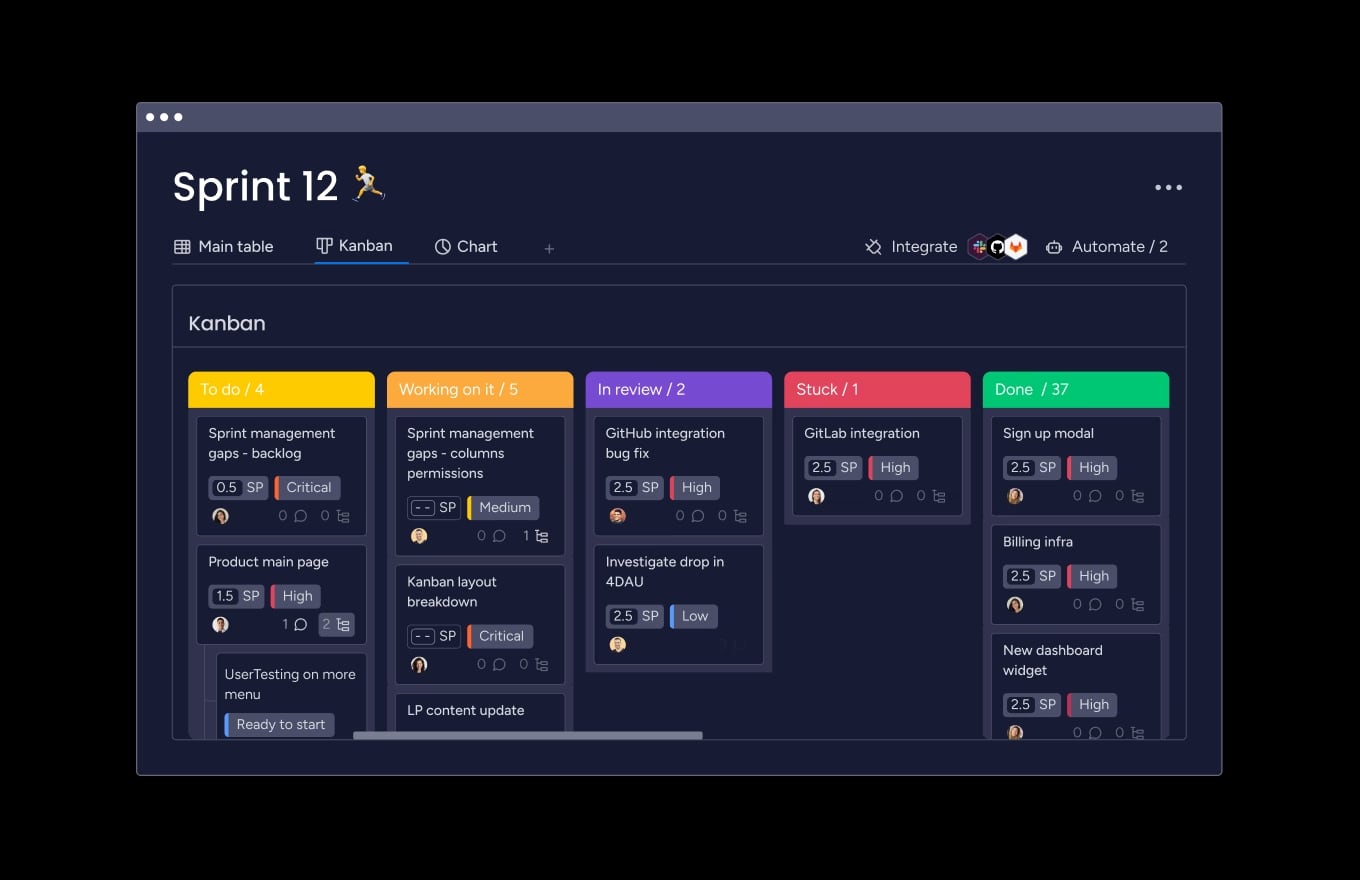
Real-time feature analytics
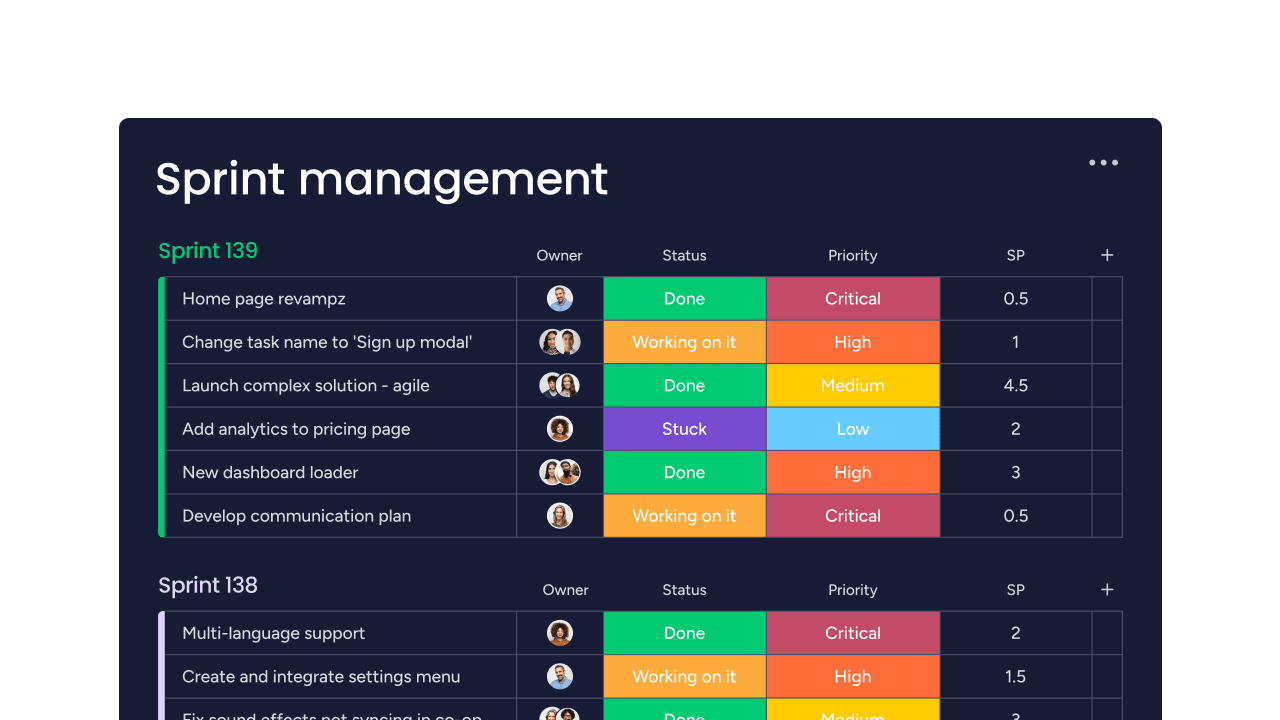
Modern dashboards show feature progress instantly. You can see which features are on track, which face obstacles, and where bottlenecks occur.
Therefore, teams spot problems early and intervene before delays cascade. Managers get the visibility they need without interrupting developers for status updates.
FDD success metrics and tracking
Implementing FDD is only half the equation. To truly understand whether your feature-driven approach is delivering results, you need clear metrics that show progress, identify bottlenecks, and demonstrate value to stakeholders. The right tracking system transforms FDD from a development methodology into a strategic advantage, giving you data-driven insights that improve with every iteration.
Key performance indicators for FDD
Track these metrics to understand your team’s performance:
- Feature completion rate: percentage of planned features delivered on time.
- Feature cycle time: average duration from design to deployment.
- Defect density: bugs per feature to measure quality.
- Team velocity: features completed per iteration.
- Stakeholder satisfaction: feedback on delivered features.
Building FDD dashboards
Create different dashboard views for different audiences. Executives need high-level summaries while developers want detailed work item lists.
Advanced platforms like monday dev provide customizable dashboards that update automatically. You can show feature status, team performance, and upcoming milestones without manual reporting.
Measuring feature value delivery
Connect technical metrics to business outcomes. Track how features impact user adoption, revenue, or operational efficiency. Calculate ROI by comparing development costs to business value. This data helps prioritize future features and demonstrates development’s impact.
Modernize your FDD process with monday dev
While FDD provides the methodology, modern platforms determine how effectively you can execute it. Solutions like monday dev designed specifically for feature-driven workflows bring FDD into the present, giving your team the flexibility, visibility, and integration capabilities needed to make FDD work in today’s development environment. monday dev delivers exactly this combination.
Flexible FDD workflows that adapt to your team
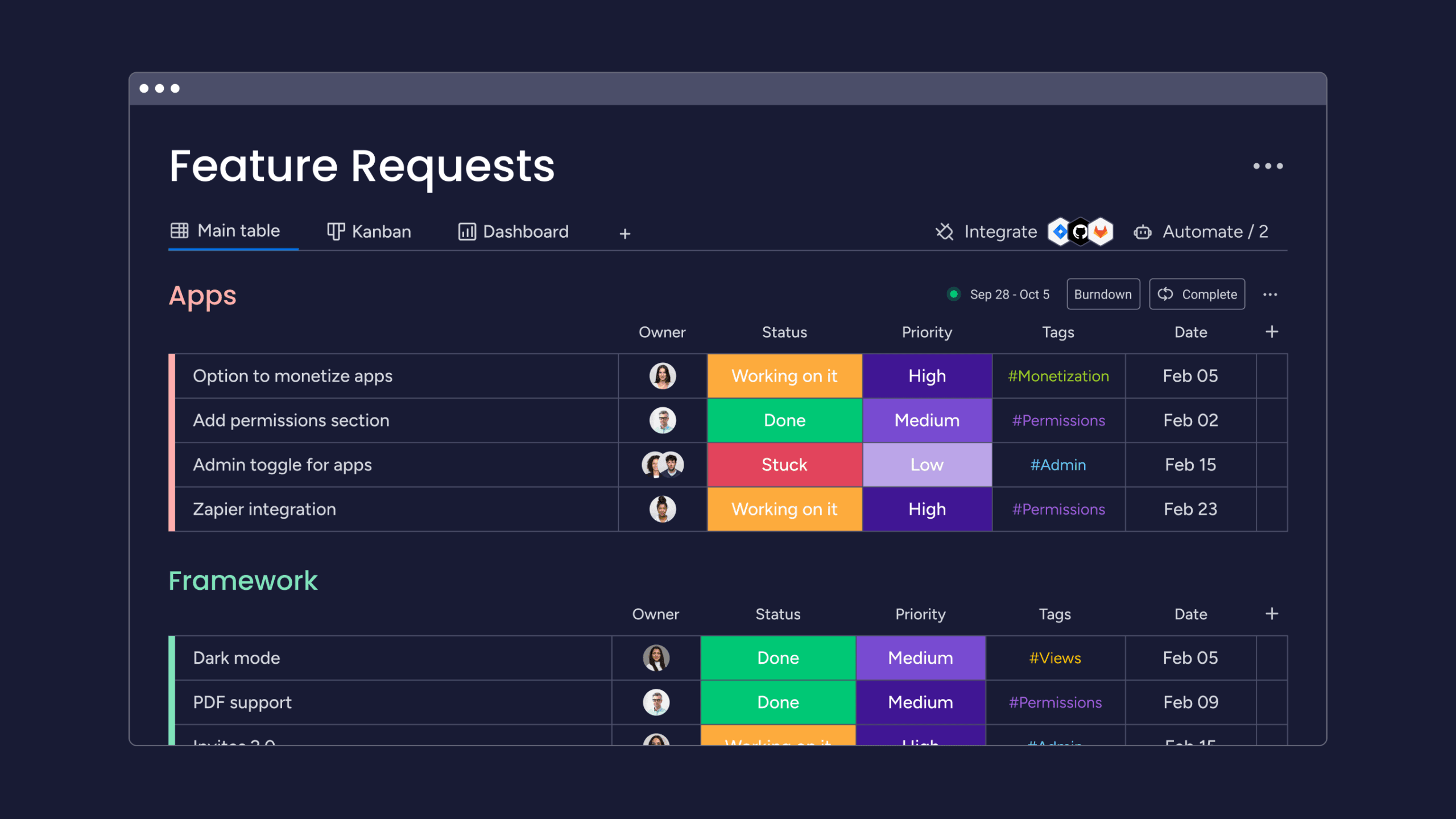
Create custom workflows for each FDD process. Define statuses that match your feature progression, automate transitions between phases, and set permissions that mirror your team structure.
The platform adapts to how you work rather than forcing you into rigid patterns. Whether you run two-week features or organize by subject areas, monday dev supports your approach.
Real-time visibility across all features
Track every feature from conception to deployment. Dashboards show completion rates, cycle times, and bottlenecks instantly.
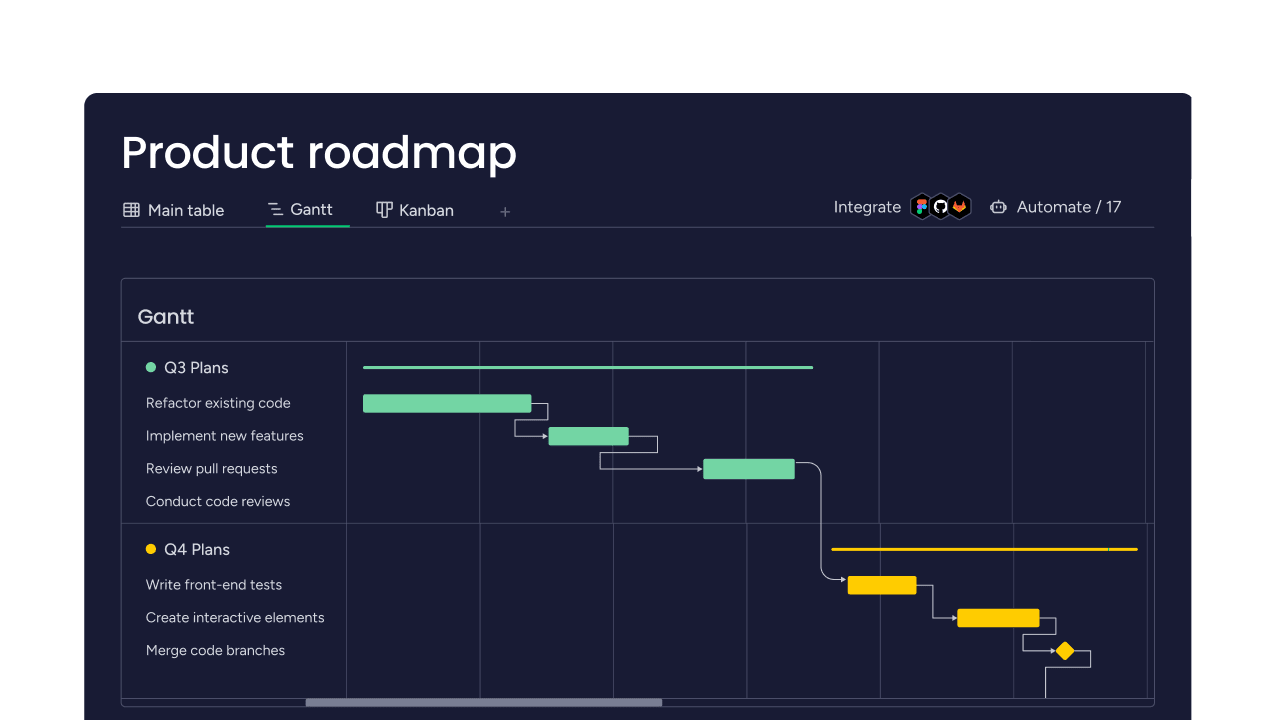
Visual timelines reveal how features progress against milestones. Kanban boards provide quick status snapshots. Automated notifications keep everyone informed without manual updates.
Seamless integration with your tech stack
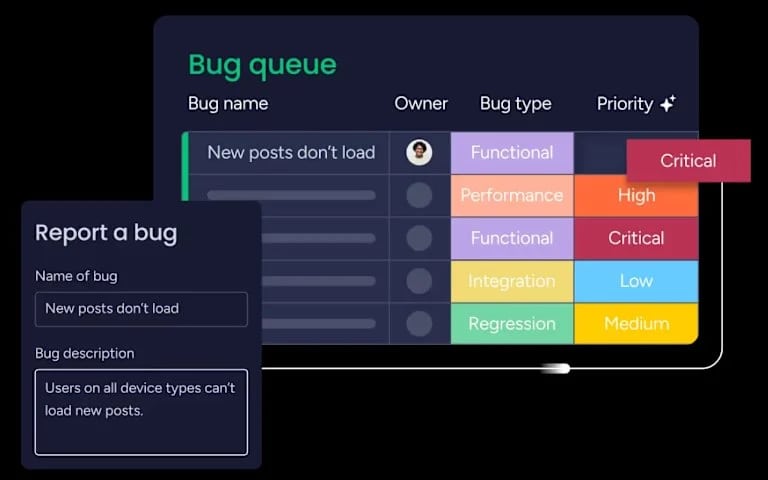
Connect monday dev to your existing tools. Link features to code repositories, trigger builds automatically, and update status based on test results.
This integration eliminates duplicate data entry and ensures your FDD board always reflects reality. Teams can implement FDD without disrupting their current platform ecosystem.
Start your FDD journey today
Feature driven development offers a proven path to predictable delivery, especially for larger teams tackling complex projects. Its structured approach brings clarity without sacrificing agility.
Modern platforms like monday dev make FDD implementation practical and powerful. You get the methodology’s benefits — clear ownership, predictable delivery, and scalability — enhanced with automation and real-time visibility.
Start small with a pilot project. Experience how FDD transforms chaotic development into smooth, predictable delivery. Your stakeholders will appreciate the visibility, your developers will value the clarity, and your customers will benefit from regular feature delivery.
Frequently asked questions
How do feature driven development FDD priorities work?
Feature driven development prioritizes features based on business value, technical dependencies, and risk factors. The development manager and chief programmer sequence features by first identifying which provide foundational capabilities, then scheduling high-value features that deliver immediate benefits while considering which features must be built before others can start.
How is FDD different from Scrum?
FDD differs from Scrum in three key ways: it organizes work around features instead of sprints, requires upfront domain modeling rather than letting design emerge, and assigns individual code ownership instead of collective ownership. FDD suits larger teams and complex projects where predictability matters, while Scrum works best for smaller teams facing rapidly changing requirements.
What are the main differences between FDD and DSDM?
Dynamic Systems Development Method (DSDM) is a comprehensive framework emphasizing business involvement and time-boxed delivery across the entire project lifecycle. FDD is more focused on the development phase specifically, with detailed processes for modeling, planning, and building features, making it particularly effective for object-oriented development.
What size teams work best with FDD?
FDD works best with teams of 15 to 50 developers where the methodology's structure enables effective coordination without excessive overhead. Smaller teams may find FDD's roles and processes unnecessary, while larger teams might need additional coordination layers beyond what FDD provides.
Can FDD work with distributed teams?
FDD can work effectively with distributed teams when supported by collaboration platforms that provide real-time visibility and clear communication channels. The methodology's emphasis on defined roles, documented processes, and transparent reporting actually helps distributed teams stay coordinated, though domain modeling sessions require extra planning for remote participation.

 Get started