


Driving strategic execution at scale is hard. Organizations are under constant pressure to deliver complex initiatives on time, optimize their resources, and adapt to shifting business conditions, all while aligning teams across multiple departments and geographies. Without the right people, technology, and project management methodologies, even the most well-intentioned projects are at risk.
This article compiles the latest project management statistics, offering a data-backed perspective on how companies manage their initiatives in 2026. From the rise of AI and hybrid project methodologies to persistent execution challenges, these insights highlight what’s working and what’s not.
Get StartedProject management software market growth
The project management software market is expected to experience significant growth in the coming years. The market was valued at $9.76 billion in 2025 and is projected to reach $11.27 billion in 2026, growing to $23.09 billion by 2030, demonstrating a compound annual growth rate (CAGR) of 15.42% during the forecast period.
This highlights the increasing adoption of project management tools as organizations prioritize team collaboration and streamlined workflows to achieve key objectives. Here are some additional project management software statistics, revealed in monday.com’s world of work report:
- 82% of companies use work and project management software to drive organizational efficiencies (monday.com)
- 57% of employees report that the number of tools they use has increased compared to the previous year (monday.com)
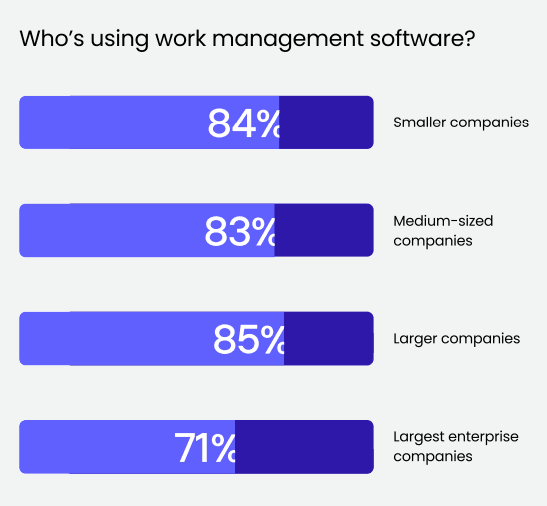
- Smaller businesses are 13% more likely to adopt project tools than enterprise companies, proving noteworthy differences in digital PM software usage according to business size. (monday.com)
Project management salaries & career outlook
With a market of this size, it’s unsurprising that there are strong project management career opportunities. Depending on the company, project manager roles are often well-paid.
- The world currently has 40 million project management professionals, but up to 30 million more will be needed by 2035 to meet global demand (PMI)
- More than 426,229 project managers are currently employed in the United States (Zippia)
- The talent demand gap is largest in China, where it’s expected to reach up to 13.6 million by 2035 (PMI)
- The current project manager salary range is $80,000 to $138,000 per year (Glassdoor)
- The technology industry is the highest-paying for project managers (Zippia)
- The median total pay for a project manager salary is $105,000 (Glassdoor)
- A project manager’s total compensation package comprises a base pay range of $65,000 to $110,000 per year and additional pay of $15,000 to $28,000 per year (Glassdoor)
- Senior project managers earned some of the highest salaries for remote workers, at $140,000 (FlexJobs)
- 17% of professionals with a PMP certification report higher median salaries than those without the certification across 21 different countries (PMI)
- 60% of PMP-certified professionals reported a compensation increase last year. (PMI)
- Three-quarters of PMP-certified professionals who received a pay rise, experienced raises of up to 10%. (PMI)
- Project manager employment is expected to increase by 7% from 2023 to 2033, more than average for all occupations (BLS)
- Over the next decade, around 77,000 job openings each year are expected to replace current workers who will switch careers or retire (BLS)
- Global demand for project management talent is projected to grow by 64% from 2025 to 2035, driven by capital investment and industry transformation across construction, manufacturing, healthcare, and IT (PMI)
Training & skill gaps in project management
Project management professionals seek ways to strengthen their soft and technical skills by achieving recognized certifications. Many turn to the Project Management Professional (PMP) certification, which is widely considered the gold standard in the field.
- 1.6 million professionals are PMP-certified across 211 countries (HQ Hire)
- The top 10 countries with the highest number of PMP holders (HQ Hire):
-
- China: 36.62%
- United States: 26.53%
- Canada: 5.83%
- India: 4.55%
- Japan: 2.88%
- Saudi Arabia: 2.61%
- Germany: 1.19%
- United Arab Emirates: 1.15%
- Brazil: 1.01%
- Singapore: 0.98%
Despite the certification paths available, many project managers don’t have access to relevant development opportunities in their roles, and some lack training in essential project management collaboration tools, too.
- Organizations continue to allocate only 25% of training hours to developing business acumen, compared to 46% for technical skills, despite business acumen now being the defining differentiator in project success. (PMI)
- Just 18% of project professionals demonstrate both high skill proficiency and strong strategic application, qualifying as high business acumen professionals; the majority (66%) sit at a moderate level. (PMI)
- 73% of practitioners expect the need for project management skills to increase in the future — signalling that the competency gap is set to widen, not narrow (Wellingtone)
- 78% of individual contributors feel comfortable using project or work management tools (monday.com)
These training gaps present a challenge and an opportunity. Companies that prioritize upskilling in their project teams — whether through certifications, internal training, or mentorship — will have a competitive advantage in delivering successful projects. Individually, too, professionals who invest in their development increase their earning potential and improve their ability to manage complex projects effectively.
Remote and hybrid project management trends
Thanks to the rise of digital project management tools and a willingness for companies to adopt remote and hybrid working strategies, many project managers now work flexibly. Yet, these project management statistics indicate how industry-specific requirements still dictate where and how projects are executed.
- Remote openings for project management roles increased 11% in the final quarter of 2025. (FlexJobs)
- 61% of project management professionals now work remotely at least some of the time. (PMI)
- 39% of project managers work in person for 5 or more days per week (PMI)
- 16% of project managers report that working in-person is an organization requirement rather than a personal preference (PMI)
- 63% of construction project managers and 51% of manufacturing project managers are most likely to work entirely in person (PMI)
- Only 3% of construction project managers and 10% of manufacturing project managers work in fully remote roles (PMI)
While McKinsey reports that 90% of companies have embraced some form of hybrid work, PMI’s statistics suggest that fewer project managers enjoy this flexibility.
Project management job title statistics
The question of “who” leads project management is complex. In some organizations, people take on project management responsibilities without holding a project manager title or having extensive project management skills. Other companies implement a formal project management office (PMO) to oversee project execution, but what it handles is up for debate.
- 86% of organizations now have at least one PMO, but nearly 50% of those PMOs are less than 4 years old (Wellingtone)
- 66% of respondents say the perceived value of their PMO is increasing (Wellingtone)
- 40% of PMOs expect their headcount to grow over the coming years, with only
- 13% anticipating a reduction (Wellingtone)
- 67% believe the scope and responsibilities of their PMO will expand in the future (Wellingtone)
Project management goals and strategic objectives
As project management responsibilities expand, organizations recognize project management’s strategic value in driving business transformation. The following examples illustrate how companies use project management to shape the future of their businesses and stay competitive in their respective markets.
- 85% of operations and supply chain leaders say they’re ahead of most competitors in digital transformation — yet 89% say their tech investments haven’t fully delivered the expected results, with integration complexity and poor data quality cited as the primary barriers (PwC)
- Only 27% of organizations have fully embedded an AI strategy across business units, despite 83% agreeing that AI and automation will accelerate the breakdown of traditional functional silos (PwC)
- 97% of project professionals managed at least one complex project in the past year, and 81% say project complexity has increased in recent years — making it the defining challenge of modern project work (PMI)
- Organizations that manage complexity effectively are 5x more likely to succeed, achieving an 88% project success rate compared to just 14% for those that manage it poorly (PMI)
- The #1 project management challenge organizations face is attempting to run too many projects simultaneously — and doing the wrong projects altogether (lack of strategic alignment) ranks among the top challenges too, underscoring how critical prioritization has become (Wellingtone)
Project management proficiency
Despite the increasing reliance on project management to drive business transformation, many organizations still struggle with project execution, governance, and maturity. These project management statistics highlight key areas where project management proficiency remains a challenge.
- 58% of organizations mostly or always apply a defined project management methodology — many are still run without any consistent approach (Wellingtone)
- Only 55% mostly or always create a scoping document as part of project planning (Wellingtone)
- Just 65% actively use a project schedule to manage projects (Wellingtone)
- A third of projects are not baselined at all — making it effectively impossible to track performance or measure progress against plan (Wellingtone)
- 60% of project managers mostly or always engage in risk management, leaving 1 in 5 projects with no regular risk oversight — a decline from 64% the previous year (Wellingtone)
- 44% of respondents are somewhat or very dissatisfied with the current level of project management maturity in their organization, while only 35% are satisfied — a figure that has remained stubbornly consistent for almost a decade (Wellingtone)
- 22% of organizations still plan projects using Microsoft Excel, and 11% have no project management solution at all (Wellingtone)
- Only 22% of respondents believe their organization has reached a project management maturity level of 4 or 5 (Wellingtone)
- The most difficult project management processes to embed are Benefits Realization, Resource Management, and Project Prioritization, yet the processes that deliver the most value when done well are Stakeholder Engagement, Risk Management, Planning, Change Control, and Project Sponsorship (Wellingtone)
- 44% of workers have experienced multiple abandoned projects without explanation — a reflection of poor planning, misaligned priorities, and ineffective leadership (Resume Now)
Project management methodologies
As organizations work to improve project delivery and execution, they choose from predictive, Agile, or hybrid project management frameworks. Looking ahead, the shift toward more flexible project management frameworks is clear:
- 58% of organizations “mostly” or “always” apply a defined project management methodology (Wellingtone)
- 43.9% of organizations still rely on predictive approaches, such as the Waterfall model, though this has declined from 58% in 2020 (Wellingtone)
- 24.6% of companies now use Agile project management practices, such as Scrum, showing gradual growth from 23% in 2020 (Wellingtone)
- 31.5% of companies use a hybrid model combining predictive and Agile practices. This approach has increased from 20% in 2020 (Wellingtone)
- 73% of organizations expect to increase their use of hybrid project management practices over the next five years (Wellingtone)
- 34% anticipate decreasing their reliance on predictive models over the same period, signaling a move away from traditional, rigid structures (Wellingtone)
| Framework | Quick definition |
|---|---|
| Agile | A flexible, iterative approach to project management that emphasizes collaboration, customer feedback, and small, incremental changes |
| Waterfall | A linear, sequential approach where each phase (e.g., planning, design, development, testing) must be completed before moving to the next. Best for projects with well-defined requirements |
| Scrum | A subset of Agile that organizes work into time-boxed iterations called sprints, with roles like Scrum Master and Product Owner ensuring continuous progress |
| Hybrid | A combination of Agile and Waterfall methodologies, allowing teams to leverage the structure of Waterfall while incorporating Agile flexibility where needed |
| Predictive | A traditional project management approach that relies on detailed upfront planning and fixed schedules, typically used in industries like construction and manufacturing |
| Kanban | A visual workflow management method that uses a board to track tasks through different stages, promoting continuous delivery and minimizing bottlenecks |
| Lean | A methodology focused on reducing waste, optimizing efficiency, and delivering maximum value with minimal resources. Often used in manufacturing and software development |
| Extreme Programming (XP) | An Agile framework emphasizing high-quality software through practices like test-driven development, pair programming, and continuous integration |
| PRINCE2 | A structured, process-driven project management methodology commonly used in government and large organizations, with a focus on predefined roles and responsibilities |
Project management statistics by industry
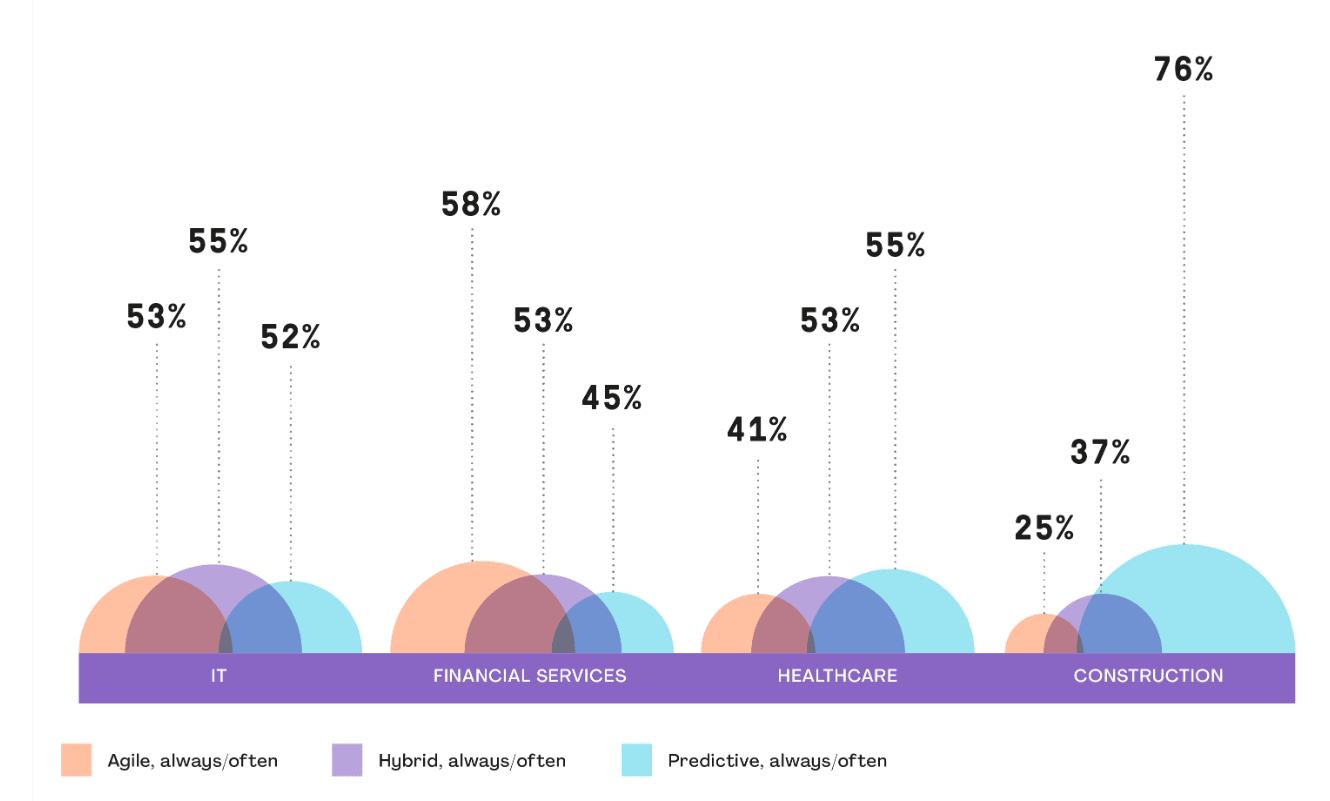
Although Agile and hybrid methods continue to gain traction, some industries remain committed to predictive models due to their need for detailed planning, compliance, and long-term project timelines.
(Image source: PMI)
Agile is dominant in financial services companies
- 58% of financial services companies report using Agile methods regularly, making them the most likely industry to adopt Agile approaches (PMI)
- Only 45% of financial services firms still use predictive methods, reflecting a clear shift toward faster, customer-driven development cycles (PMI)
- Agile adoption in this sector is driven by the need for rapid regulatory adaptation, fintech innovation, and continuous product iteration (PMI)
Predictive models are essential for construction companies
- 76% of construction companies still rely on predictive project management, the highest among all industries (PMI)
- Only 27% of construction teams use Agile approaches, as sequential planning, safety regulations, and compliance requirements make iterative work difficult (PMI)
- 37% incorporate hybrid approaches, allowing some flexibility while maintaining strict project budgets and timeline controls (PMI)
monday work management company objectives board
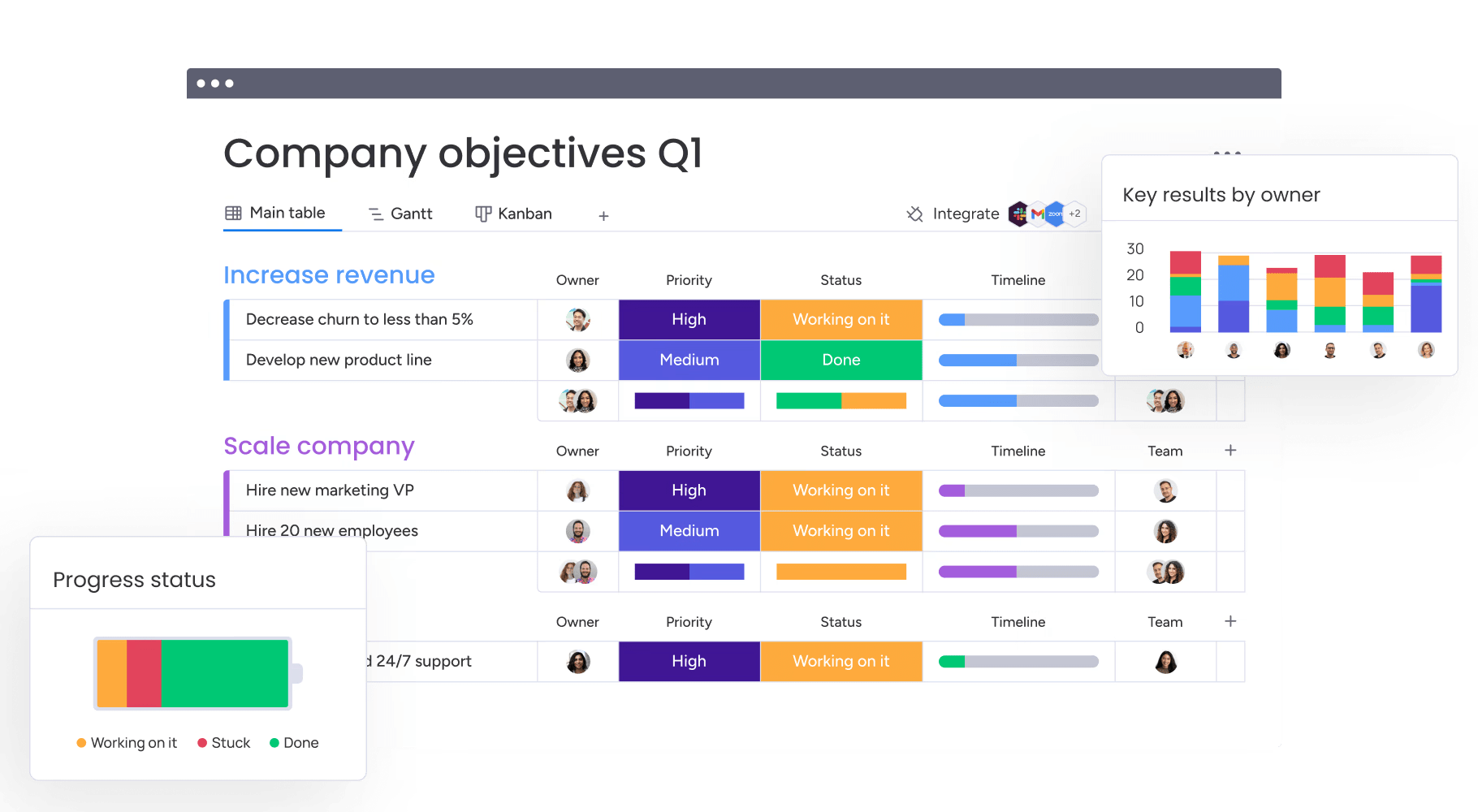
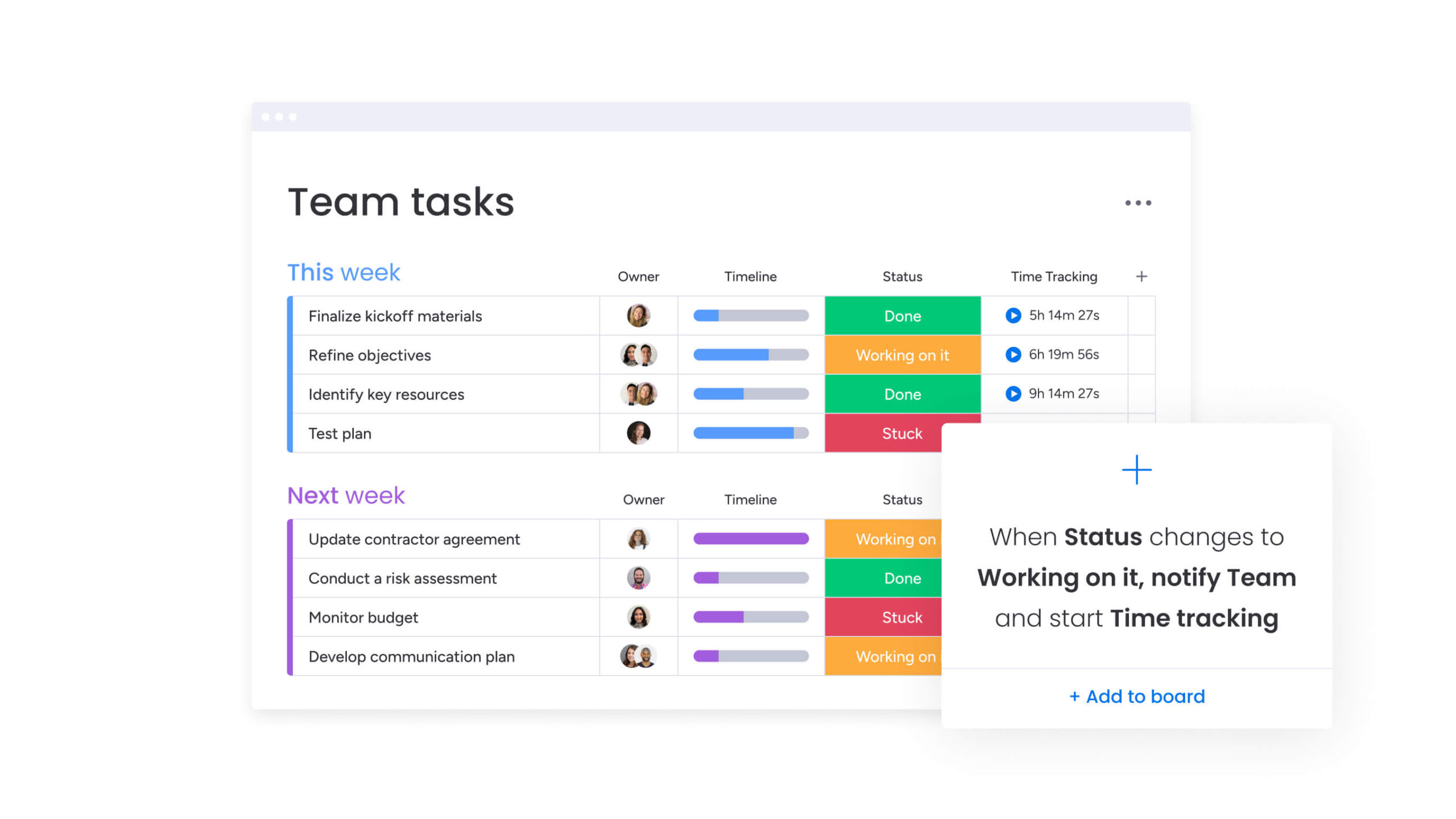
Regardless of whether teams follow a predictive, Agile, or hybrid approach, they need a flexible, scalable platform that adapts to their way of working. With customizable workflows, automation, and real-time visibility, monday.com’s AI Work Platform enables organizations to seamlessly integrate their preferred project management approach while maintaining alignment across teams, departments, and strategic goals.
Get StartedProject management success and failure statistics
For all the tools, methodologies, and expertise available, one uncomfortable truth remains: Many organizations still struggle to track project success rates and achieve positive business outcomes.
- Half of organizations do not have access to real-time centralized project KPIs — and 72% of practitioners spend half a day or more every month manually collating project reports as a result (Wellingtone)
- Only 36% of organizations mostly or always complete projects on budget (Wellingtone)
- Just 49% mostly or always deliver projects on time (Wellingtone)
- Only 42% mostly or always deliver the full benefits their projects were designed to achieve (Wellingtone)
- 52% of organizations say they have a track record of project success — but Wellingtone explicitly flags this as optimistic when measured against actual delivery performance (Wellingtone)
- Among complex projects specifically, 31% fail to achieve their originally intended benefits — more than double the 12% failure rate tracked by PMI just two years prior (PMI)
- Organizations that manage complexity effectively are five times more likely to succeed, with high-performing teams achieving an 88% project success rate compared to just 14% for those that manage it poorly (PMI)
Part of the problem is undoubtedly knowing what project success means and how to achieve it. The great news: Employees who do understand how success is measured are 2x more likely to feel motivated to achieve these results.

“monday.com has been a life-changer. It gives us transparency, accountability, and a centralized place to manage projects across the globe".
Kendra Seier | Project Manager
“monday.com is the link that holds our business together — connecting our support office and stores with the visibility to move fast, stay consistent, and understand the impact on revenue.”
Duncan McHugh | Chief Operations OfficerAI in project management software
Project management software has already become a staple for teams looking to improve collaboration, workflow automation, and real-time reporting. And now, solutions like monday.com’s AI Work Platform, that comes equipped with built-in artificial intelligence capabilities, make it easier to achieve future success.
AI in project management is expected to reach $7.4 billion with a CAGR of 19.9% by 2029.
As companies seek to reduce inefficiencies, improve real-time decision-making, and minimize the administrative burden on project teams, this has prompted a major AI boom in the project management market.
- AI use within projects has almost doubled in 2 years: 70% of project professionals say their organization currently uses AI, up from just 36% in 2023, with a further 29% planning to adopt it (APM)
- 82% of project professionals are now using AI more frequently than they anticipated 5 years ago (APM)
- Over a quarter (27%) of project professionals say AI is fully embedded into their project workflows — spanning forecasting, decision support, risk management, reporting, and resource allocation (APM)
- The top functions benefiting from AI implementation are task and schedule automation, resource allocation, and risk analysis and forecasting — each cited by 50% of project professionals already using AI (APM)
- Project professionals who use GenAI in more than half of their projects report significant performance gains: 91% in quality management, 87% in scope management, 86% in cost management, and 85% in schedule management (PMI)
- Despite high confidence — 92% say their skills are aligned with AI-enabled work — skills gaps remain real: ethical decision-making, data literacy, and AI-enabled decision-making are now ranked among the most critical future skills for project managers (APM)
- Optimism about AI has surged: 62% of project professionals believe recent AI advancements will be very positive for their industry, compared to just 15% who said the same in 2023 (APM)
Assaf Elovic, Head of AI at monday.com, believes that Gen Z’s deep familiarity with technology makes them more discerning about AI’s capabilities. Unlike earlier generations, Gen Z is less impressed by AI’s promises and may be more skeptical of its real-world benefits in project management.
Beyond adoption rates, concerns about AI’s impact on job security also vary by generation, with adoption rates of 65% for Gen Xers, 73% for millennials, and 59% for Gen Zers, according to monday.com’s world of work report.
- 30% of professionals across all age groups worry AI could threaten their jobs (monday.com)
- 42% of Gen Z is particularly concerned about AI automating the aspects of their work they enjoy most, raising questions about how AI should be integrated without diminishing employee engagement and satisfaction (monday.com)
- 80% of millennials believe AI can help them do their jobs better (monday.com)
- 49% of millennials are “very open” to AI adoption (monday.com)
Demographics in the project management space
The following statistics highlight key insights that shed light on disparities, progress, and areas for improvement in the project management profession.
- 37% of women have an academic degree in project management versus 42% of men (PMI)
- 72% of women hold a project management certification versus 76% of men (PMI)
- 57% of women have a PMP certification compared to 64% of men (PMI)
- 5% of women have a CAPM certification versus 2% of men (PMI)
- 9.8 years is the average length women have worked in project management compared to 11.4 years for men (PMI)
- Women are more likely to work full-time for an organization (+5.7%) and less likely to be a consultant/contractor (-4.6%) (PMI)
- Women are more likely to work in an organization with a departmental PMO (+1.7%) or both departmental and enterprise PMOs (+4.2%), while men are more likely to work in an enterprise PMO-only setting (-6.0%) (PMI)
- Leadership positions are held by 20% of women versus 23% of men, including roles such as PMO director, portfolio manager, or other management positions (PMI)
The future of project management and the world of work report
Project management is evolving — becoming more integrated, strategic, and technology-driven. The increase in smarter, AI-driven workflows and continuous cross-department tracking has reshaped how teams manage projects. Wellingtone’s research finds that 63% of organizations anticipate an increase in project work, while 73% expect the need for project management skills to grow significantly in the years ahead. At the same time, 97% of project professionals are already managing complex projects, and the organizations that navigate that complexity most effectively are 5x more likely to succeed.
To stay ahead, organizations must embrace the latest trends, methodologies, and technologies shaping the industry. monday.com’s AI Work Platform brings together the PM capabilities, AI agents, and real-time visibility that the data shows teams need. If your organization is ready to turn these project management statistics into action, there’s no reason to wait.
Get Started