


As a project manager, you’re responsible for meeting detailed requirements regarding scope, budget, and schedule. And if you don’t deliver in all three areas, you’ll leave your key stakeholders disappointed. Fortunately, there’s no need to panic. The Project Management Body of Knowledge (PMBOK) gives you a proven way to plan and execute projects successfully, no matter your industry or experience level.
This article explains what the PMBOK guide contains, how it’s changed across editions, and how to put it to work on real projects. We can’t remove the challenges involved in project management, but this guide will arm you with the knowledge you need to tackle any project problem with more confidence.
Key takeaways
- PMBOK stands for the Project Management Body of Knowledge, a standard reference from the Project Management Institute (PMI) that captures project management best practices.
- PMBOK is a framework and body of knowledge, not a step-by-step methodology, so it works alongside Waterfall, Agile, and hybrid approaches.
- The current 8th edition (2025) organizes project management around 6 core principles and 7 performance domains rather than the legacy model of process groups and knowledge areas.
- PMBOK is not the same as PMP: PMBOK is the reference standard, while PMP is a professional certification from PMI that draws on that standard.
- monday.com’s AI Work Platform helps you operationalize PMBOK thinking with real-time dashboards, Gantt and critical path planning, and AI risk insights that support the monitoring and risk performance domains.

What is the project management body of knowledge (PMBOK)?
PMBOK is the Project Management Body of Knowledge, a standard set of processes, guidelines, and best practices used in project management. The Project Management Institute (PMI) maintains the guide and updates it as the profession evolves. You can learn more about the standard on the official PMI PMBOK guide page.
Older editions organized the guide into five process groups, 10 knowledge areas, and 49 processes. While this was a useful learning lens, it’s no longer the structure the current guide teaches. Recent editions organize project management around principles and performance domains instead.
A shared set of best practices makes it easier for employers to identify project managers who can plan, organize, and direct projects successfully. It also gives teams a common language for scope, schedule, and cost, so a designer, an engineer, and a sponsor can all describe the same project the same way. That shared vocabulary is one of the reasons the guide has stayed so widely used.
How the PMBOK guide helps project managers
PMBOK is helpful for project management because it contains best practices that work on most projects. The Project Management Institute developed the content by conducting research and consulting experts in the field of project management, so you can be confident that the principles have been tested in a variety of settings.
The PMBOK provides a detailed overview of the project management process, along with guidelines to help project managers make wise decisions. Reading the PMBOK guide lets new project managers improve their skills in cost management, resource management, and quality management. Experienced project managers can also benefit from using the PMBOK guide to prepare for their PMP certifications, which are based on the PMBOK standards.
Managing the triple constraint: Applying the standards in the PMBOK guide makes it easier to manage projects within the triple constraints of time, scope, and cost, so a change in one area doesn’t derail the other two.
Following the PMBOK helps project managers and their teams in several ways:
- Defining the project early on keeps everyone on the same page, which helps prevent costly delays as the project progresses.
- Mapping out the activities required to complete the project makes it easier for the project manager to determine what resources the team needs and how to use those resources.
- Estimating project costs helps project managers identify when a specific activity is over budget, making it easier to budget for future costs.
- Monitoring and controlling let project managers spot small problems before they turn into big ones.
- Following the closing processes makes sure that the project manager has a record of all project-related activities. On future projects, this record can help the team do a better job overcoming project-related challenges.
- Applying the PMBOK guidelines eliminates the need to reinvent the wheel every time you begin a new project.
The guide is also portable across companies and industries. Once you’re familiar with project management best practices, you can transition to a new company or industry without having to start over from scratch. If you run into a problem with a project, you can consult the PMBOK guide to find out what the experts recommend.

The 5 PMBOK process groups
The five PMBOK process groups are initiating, planning, executing, monitoring and controlling, and closing, and together they describe how work moves from approval to completion. The 6th edition formalized these groups, and they remain a practical lens for running projects even as the guide’s formal structure has evolved. You can explore each stage in more depth in our guide to the project management process groups.
- Initiating: Initiating processes are all the processes involved in getting approval for a new project or starting a new phase of an existing project, along with defining the project’s initial scope and key stakeholders.
- Planning: Planning processes establish the full scope of the project. This process group contains 24 processes, such as creating a work breakdown structure, defining what activities are needed to complete the project, estimating how long each activity will take, and estimating project costs.
- Executing: Executing processes are the processes involved in doing the work necessary to complete the project successfully.
- Monitoring and controlling: Project managers use monitoring and controlling processes to assess how the project is going and make any necessary changes.
- Closing: Closing processes are essential for completing a project or a phase. During closing, the project manager is responsible for archiving relevant records, celebrating the project, and holding a meeting to discuss what went well and what could be improved for the future.
Here’s a compact view of what each group produces:
| Process group | What happens | Typical output |
|---|---|---|
| Initiating | Secure approval and define initial scope and stakeholders | Project charter and stakeholder register |
| Planning | Build the full scope, schedule, cost, and resource plan | Project management plan and baselines |
| Executing | Do the work and coordinate people and resources | Deliverables and progress updates |
| Monitoring and controlling | Track performance against the plan and adjust | Change requests and status reports |
| Closing | Finish the project or phase and capture lessons | Final deliverables and lessons learned |
How the PMBOK guide has evolved across editions
PMI has revised the PMBOK guide steadily since the first version arrived in 1996. Each major edition reflects how the profession was practicing at the time, and the recent editions mark a clear pivot from processes to principles. Here’s how the guide has changed at its major inflection points:
| Edition | Year | Headline change |
|---|---|---|
| First guide | 1996 | Established a shared standard for project management practice |
| 6th edition | 2017 | Formalized the 5 process groups, 10 knowledge areas, and 49 processes |
| 7th edition | 2021 | Replaced knowledge areas with 12 principles and 8 performance domains, and folded in Agile more fully |
| 8th edition | 2025 | Streamlined to 6 core principles and 7 performance domains, reintroduced process guidance, and added AI, PMO, and procurement coverage |
The 8th edition also sharpens PMI’s view that all projects are investments, so teams should focus on value delivery, not just task completion. Its added coverage of AI, project management offices, and procurement reflects how modern teams work. The current PMP exam reflects this principles-and-domains model, not the legacy knowledge areas, which is important if you’re studying for certification.
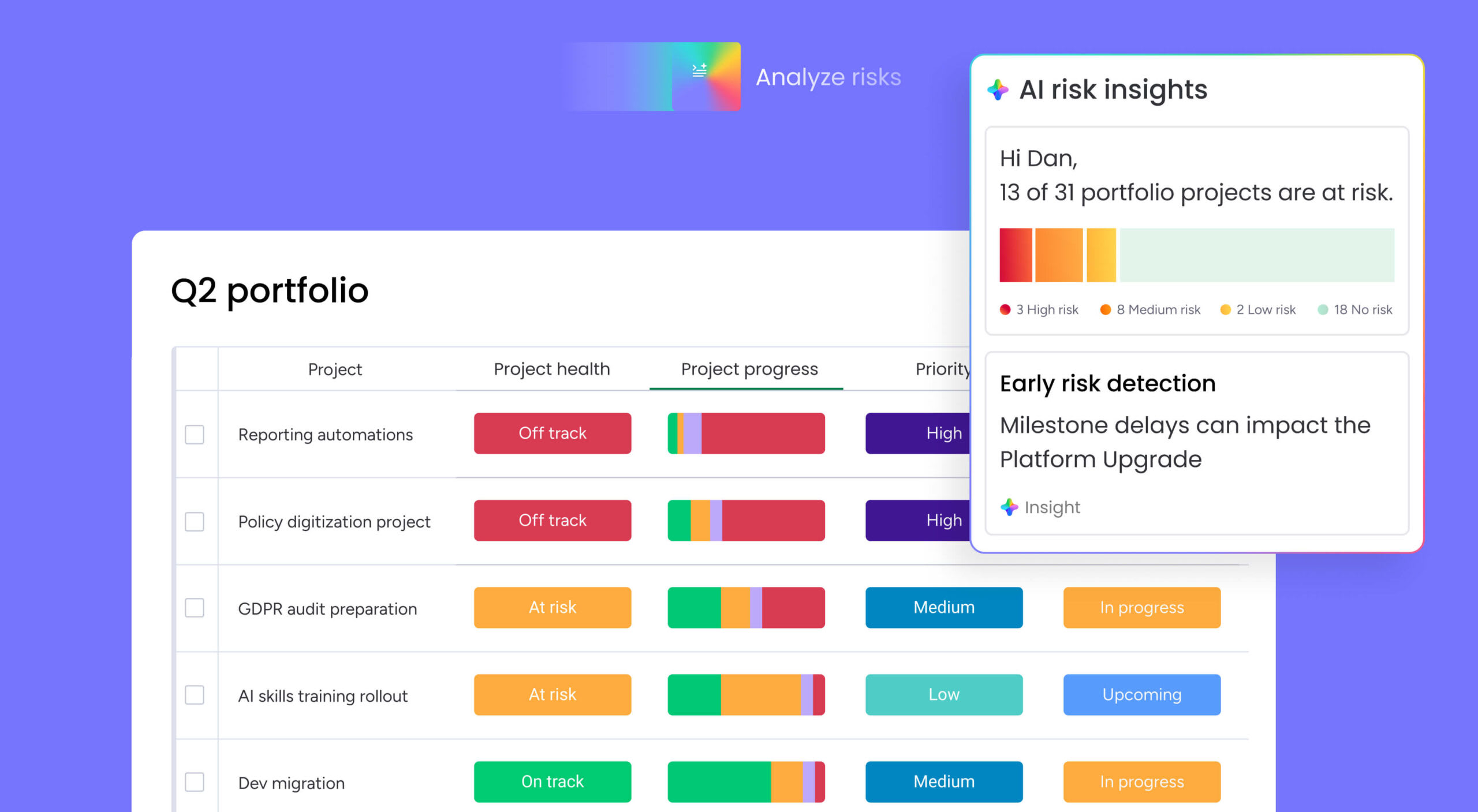
PMBOK knowledge areas and the shift to performance domains
The 6th-edition PMBOK guide contained 10 knowledge areas that helped project managers plan, execute, and close their projects.:
- Integration
- Scope
- Time
- Cost
- Quality
- Procurement
- Human resources
- Communications
- Risk management
- Stakeholder management
The knowledge areas are still worth learning because they name the disciplines every project touches. They’re no longer the guide’s current structure, though. The 7th edition replaced the 10 knowledge areas with 12 principles and 8 performance domains, and the 8th edition streamlined that further to 6 core principles and 7 performance domains: governance, scope, schedule, finance, stakeholders, resources, and risk.
Why did the shift happen? PMI moved away from prescriptive, one-size-fits-all processes toward adaptable, value-focused principles that fit modern delivery. Instead of telling you exactly which process to run, the current guide describes the outcomes you need to manage and lets you choose how to get there. That makes the framework easier to apply across Agile, Waterfall, and hybrid projects.
The table below maps each legacy knowledge area to the current performance domain it most closely relates to, so the older model still helps you navigate the new one:
| Legacy knowledge area | Related current performance domain |
|---|---|
| Scope | Scope |
| Time | Schedule |
| Cost | Finance |
| Stakeholder management | Stakeholders |
| Human resources | Resources |
| Risk management | Risk |
| Integration | Governance |
| Quality, communications, procurement | Distributed across the domains and principles |
Is PMBOK a methodology or a framework?
PMBOK is a framework and body of knowledge made up of principles, performance domains, and supporting guidance. Companies use the PMBOK framework to build standardized approaches to project management, which prevents projects from failing for avoidable reasons.
PMBOK is not a methodology. A methodology gives you a prescribed sequence of steps to follow, like Scrum or a stage-gate process. A framework describes the outcomes you need to manage and the principles that guide good decisions, then leaves the specific steps to you. PMBOK sits firmly in the framework camp, which is why it’s described as methodology-agnostic.
Because it’s methodology-agnostic, PMBOK works with Waterfall, Agile, and hybrid delivery. Say your team runs two-week Agile sprints. You can still apply PMBOK’s stakeholder domain to keep sponsors informed, its risk domain to surface blockers early, and its finance domain to track spend against value. The principles hold steady while your delivery method flexes to fit the work. That flexibility is exactly why the framework outlasts any single trend in how teams choose to deliver.

PMBOK vs PMP: what's the difference?
PMBOK isn’t the same as PMP. PMBOK stands for the Project Management Body of Knowledge, a reference standard, while PMP stands for Project Management Professional, a credential you earn. One is a set of principles and guidelines. The other is a PMP certification from the Project Management Institute that proves you can apply them.
PMI also offers the Certified Associate in Project Management (CAPM) as an entry-level credential for people earlier in their careers. Both exams now reflect the current guide’s principles and performance domains rather than the legacy knowledge areas, so studying the latest edition is the best preparation.
| Aspect | PMBOK | PMP |
|---|---|---|
| What it is | A reference standard and body of knowledge | A professional certification from PMI |
| Who it's for | Any project manager who wants a shared framework | Experienced managers proving their expertise |
| How you use it | Consult it to guide planning and delivery | Earn it by passing an exam based on the guide |
How to put PMBOK into practice
PMBOK maps cleanly onto a repeatable workflow you can reuse on every project. Here’s a practical sequence that turns the principles and performance domains into day-to-day steps, with a note on how an AI work platform supports each one. Work through it once and the framework starts to feel like second nature rather than a reference you only open when something goes wrong.
- Define scope and stakeholders: Start by clarifying what the project will deliver and who has a stake in it. A shared workspace keeps the charter, scope, and stakeholder list visible so everyone works from the same source of truth.
- Plan the schedule, cost, and resources: Break the work into activities, sequence them, and assign owners. Gantt views, dependencies, and a baseline let you build a realistic plan and see the critical path before work starts.
- Execute the work: Coordinate the team, hand off tasks, and keep momentum. No-code automations handle approvals, reminders, and task creation so people spend time on the work instead of the admin around it.
- Monitor and control against a baseline: Track progress, cost, and risk in real time and adjust when the plan drifts. Dashboards give you performance-domain visibility, and AI risk insights flag scheduling conflicts and workload imbalances early.
- Close and capture lessons: Confirm deliverables, archive records, and hold a retrospective. Storing lessons learned in one place means the next project starts smarter than the last.
Follow this loop on each project and the framework stops feeling abstract. Scope, schedule, finance, and risk become things you actively manage rather than things that surprise you late.
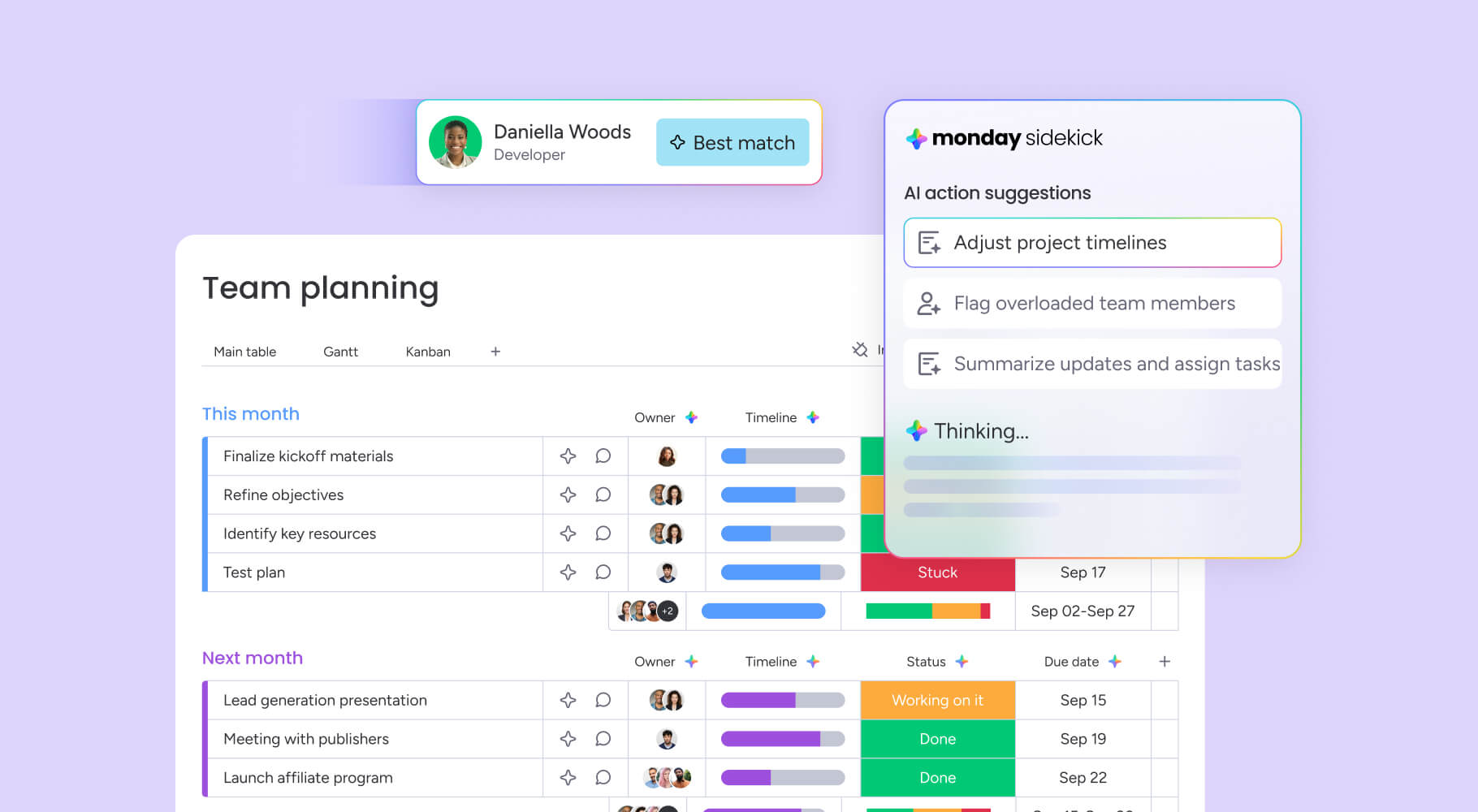
How monday.com's AI Work Platform brings PMBOK principles to life
PMBOK gives you the principles and performance domains, and a work platform gives you the place to run them. monday.com’s AI Work Platform connects planning, execution, monitoring, and reporting in one connected system, so the framework becomes daily practice instead of a binder on a shelf. Here’s how its capabilities map to the domains you manage on every project.
- Planning and scheduling: Gantt charts, task dependencies, cross-project dependencies, baselines, milestones, and critical path help you build realistic schedules and see where a slip in one task ripples through the plan.
- Monitoring and controlling: Real-time dashboards and reporting, portfolio views, and Workload for resource management give leaders performance-domain visibility across scope, schedule, finance, and resources without chasing status updates.
- Risk domain: AI-powered risk insights flag scheduling conflicts and workload imbalances before they escalate, which supports PMBOK’s emphasis on proactive portfolio risk management.
- Execution and handoffs: No-code automations run approvals, reminders, and task creation, while standardized and managed templates keep your process consistent from one project to the next.
- AI layer: AI Blocks add ready-made AI actions like categorization and summaries to any workflow, monday agents such as the Risk Analyzer and OKR Tracker act as an unlimited workforce, and monday MCP lets assistants like Claude or ChatGPT securely read and act on your project data. With monday vibe, you can build custom trackers or OKR apps from a plain-language prompt.
These capabilities connect to the AI coverage PMI added in the 8th edition, so your tooling reflects where the profession is heading. The table below contrasts a manual or spreadsheet approach with the platform approach across the domains PMBOK asks you to manage:
| PMBOK need | Manual or spreadsheet approach | monday.com's AI Work Platform approach |
|---|---|---|
| Scope and stakeholders | Static documents that go stale and scatter across inboxes | A shared workspace with a live scope and stakeholder view |
| Schedule and dependencies | Manual Gantt charts that break when dates shift | Linked dependencies, baselines, and an auto-updating critical path |
| Cost and resource management | Disconnected spreadsheets and guesswork on capacity | Workload views and reporting that show cost and capacity in real time |
| Monitoring and risk | Weekly status meetings that highlight issues too late | Real-time dashboards and AI risk insights that flag problems early |
| Closing and lessons learned | Notes that are hard to find on the next project | Centralized records and templates that carry knowledge forward |
Turning PMBOK knowledge into confident delivery
The PMBOK guide gives you a shared language and a proven set of principles for managing scope, schedule, finance, project stakeholders, resources, and risk. Now that you’re familiar with what it contains and how it has evolved, it’s time to put those ideas to work.
The current edition emphasizes value and adaptability over rigid processes, which means the framework fits however your team delivers. Pair that discipline with the AI Work Platform and PMBOK stops being theory. It becomes the way you plan, monitor, and close projects with more clarity and fewer surprises. Start with one project, apply the principles that fit, and let the results build your confidence for the next one.
Frequently asked questions
What does PMBOK stand for?
PMBOK stands for the Project Management Body of Knowledge. It's a standard reference from the Project Management Institute that captures project management principles and best practices.
What is the latest edition of the PMBOK guide?
The 8th edition is the current version, published in November 2025. It organizes project management around 6 core principles and 7 performance domains.
How do I access the PMBOK guide?
You can access the PMBOK guide through a PMI membership or by purchasing it directly from PMI. Membership often makes the digital edition more affordable.
Is PMBOK the same as PMP?
No. PMBOK is the reference standard, while PMP is a professional certification from PMI that draws on that standard.
How does monday.com's AI Work Platform support PMBOK-based project management?
The AI Work Platform supports the framework with real-time dashboards, Gantt and critical path planning, and AI risk insights that operationalize PMBOK's monitoring and risk performance domains. Automations and templates keep your process consistent across projects.
Can monday.com's AI Work Platform's AI help with PMBOK's risk domain?
Yes. AI-powered risk insights flag scheduling delays and workload imbalances early, so you can act before small issues turn into missed deadlines.

 Get started