

Regulatory pressure is intensifying as organizations head into 2026, but compliance is no longer just about avoiding fines. It has become a structural element of how projects are planned, executed, and governed. Forward-thinking teams now treat compliance as part of delivery strategy rather than an afterthought layered on at the end.
At the project level, compliance translates high-level regulations and internal policies into practical controls: checkpoints, documentation standards, approval flows, and risk monitoring. Instead of relying on periodic reviews, modern organizations embed these requirements directly into workflows, supported by automation and real-time visibility. This shift reduces last-minute remediation and strengthens accountability across departments.
This article breaks down what effective project compliance looks like today, from core components and digital frameworks to portfolio-level strategies and AI-powered monitoring. You’ll learn how to distinguish project compliance from regulatory compliance, how to scale governance across hundreds of initiatives, and how integrated platforms can transform compliance into a measurable competitive advantage.
Key takeaways
- Build compliance into daily workflows, not as separate overhead: embed requirements directly into project templates and automation so teams follow standards naturally without switching between systems or creating extra work.
- Use AI-powered monitoring to catch issues before they become problems: leverage predictive analytics and automated risk detection to identify compliance gaps early, preventing costly violations and project delays.
- Transform compliance from cost center to competitive advantage: strong compliance frameworks open new markets, accelerate sales cycles, and build stakeholder trust that directly impacts revenue growth.
- Scale portfolio compliance with integrated platforms: gain real-time visibility across hundreds of projects while automating documentation, risk detection, and reporting. Platforms like monday work management provide AI blocks and Portfolio Risk Insights that make compliance management seamless.
- Create standardized templates that adapt to specific project needs: develop repeatable workflows that maintain consistency across teams while allowing customization for different compliance requirements and project types.

What is project compliance?
Project compliance is how you make sure projects meet legal, regulatory, contractual, and internal standards from start to finish. That means every deliverable, decision, and workflow hits the mark on requirements, without cutting corners on quality or letting risks slip through.
Corporate compliance covers the whole organization, while project compliance is laser-focused on what each specific initiative needs. It transforms abstract regulations into concrete checkpoints, documentation protocols, and approval workflows that teams follow daily.
For a healthcare provider launching a patient portal, project compliance means ensuring HIPAA data privacy standards are met at every development stage. For a construction firm managing multiple sites, it involves tracking safety certifications, permit approvals, and environmental regulations across distributed teams.
With monday work management, teams see compliance status across every project in real time, so they can catch issues early instead of scrambling at the last minute.
Core components of project compliance
Strong project compliance comes down to six elements that protect against risk without slowing teams down. Get these components right, and your compliance system grows as your organization does.
| Component | Traditional approach | Digital compliance management |
|---|---|---|
| Regulatory adherence | Static checklists reviewed quarterly | Real-time tracking with automated alerts |
| Stakeholder requirements | Email chains and scattered documents | Centralized requirements with clear ownership |
| Quality standards | Manual inspections at project end | Continuous monitoring throughout execution |
| Documentation protocols | Filing cabinets and shared drives | Automated audit trails with version control |
| Risk management | Reactive issue resolution | Predictive analytics and early warning systems |
| Audit readiness | Scrambling before reviews | Always-ready documentation and reporting |
Each component serves a specific function:
- Regulatory adherence: ensures alignment with government mandates and industry laws specific to your sector and location.
- Stakeholder requirements: captures and tracks deliverables defined by clients, investors, or leadership.
- Quality standards: maintains performance benchmarks that deliverables must meet.
- Documentation protocols: creates an audit-proof history of decisions, changes, and approvals.
- Risk management: identifies and mitigates potential compliance failures before they impact timelines.
- Audit readiness: maintains preparedness for external or internal reviews without operational disruption.
Project compliance vs. regulatory compliance
These concepts are closely related but serve different purposes. Regulatory compliance defines the legal and statutory obligations an organization must meet to operate within the law. Project compliance translates those high-level obligations into actionable controls within a specific initiative.
In simple terms, regulatory compliance establishes what must be achieved, while project compliance determines how it will be executed in day-to-day work. For instance, a regulation may mandate the protection of customer data. Project compliance outlines the exact measures (such as access controls, encryption protocols, approval workflows, and audit trails) required to meet that mandate during a particular system implementation.
The scope differs significantly:
- Regulatory compliance: continuous and permanent, covering the entire organization.
- Project compliance: has defined start and end points, focusing on specific deliverables and workflows.
- Enforcement: regulatory bodies and legal courts enforce regulatory compliance, while project compliance falls under the PMO and internal governance teams.
The shift to digital compliance management
Compliance once meant filing cabinets full of paperwork and last-minute scrambles when auditors arrived. Teams relied on periodic audits and static checklists, often discovering issues only after damage had already occurred.
Today, digital platforms enable continuous compliance monitoring. Automation and real-time data flag deviations immediately, while predictive analytics identify potential breaches based on workflow patterns. AI-driven capabilities streamline evidence collection and risk assessment, reducing manual effort.
Compliance has shifted from reactive and episodic to proactive and embedded in daily operations. Teams using advanced platforms like monday work management can track requirements, automate documentation, and maintain audit readiness without the administrative burden that once slowed projects down.
Why does project compliance drive a competitive advantage?
Compliance does more than keep you out of trouble. It’s a strategic advantage that affects your market position, how efficiently you operate, and how fast you can grow. Get compliance right, and you’ll unlock new markets, close deals faster, and build the stability you need to scale aggressively.
Transform risk into business protection
Strong compliance frameworks turn vague risks into clear, manageable steps. When you standardize how risks are spotted and handled, you protect your position and avoid expensive disruptions.
In pharmaceuticals, rigorous compliance prevents product recalls that could destroy brand equity overnight. In financial services, automated compliance checks prevent transaction errors that lead to massive regulatory fines. Construction companies avoid project shutdowns by maintaining real-time permit and safety certification tracking.
Building this protection requires a structured approach to risk management. By categorizing threats and automating responses, you create a resilient framework that prevents disruptions before they happen.
- Risk categorization: classify risks by severity and likelihood to prioritize resources.
- Automated monitoring: set up triggers that flag deviations before they escalate.
- Clear escalation paths: define who handles what when issues arise.
- Preventive controls: build checks into workflows rather than relying on after-the-fact reviews.
Build stakeholder trust through transparency
When customers, investors, and partners can see your compliance processes, they trust you more. Show prospects you meet security and quality standards instantly, and you’ll close deals faster.
Compliance documentation becomes a competitive differentiator in RFP processes. Potential clients see proof of professional governance and low-risk partnership. That transparency builds relationships based on trust, not just contracts.
Trust-building happens through specific actions:
- Real-time dashboards: give stakeholders visibility into compliance status.
- Automated reporting: generate compliance reports on demand.
- Clear audit trails: show exactly how requirements are being met.
- Proactive communication: alert stakeholders to potential issues before they ask.
Enable innovation through compliance excellence
Strong compliance frameworks speed up innovation by setting clear boundaries. Teams that know the rules and have automated checks can experiment and ship faster, without second-guessing every move.
Compliance-first organizations move faster because they don’t pause for lengthy manual reviews at every stage. Safety checks are built into the development pipeline, allowing for rapid iteration and deployment. Teams know exactly what’s allowed and what isn’t, eliminating guesswork and delays.
Essential types of project compliance
Project compliance covers more than just legal requirements. Today’s organizations juggle five types of compliance, each with its own risks and rules. Know these categories, and you can build a system that covers all your compliance bases.
Regulatory and legal requirements
This category includes mandatory government laws that change based on your industry and location. GDPR governs data privacy in Europe. HIPAA protects healthcare information in the United States. SOX dictates financial reporting standards for public companies.
Miss these requirements, and you’re looking at heavy fines or even shutdowns. A single GDPR violation can cost up to 4% of global annual revenue. Beyond fines, regulatory breaches trigger investigations, legal action, and market access restrictions.
To manage regulatory requirements, you need:
- Jurisdiction mapping: track which laws apply to each project based on location and scope.
- Requirement translation: convert legal language into actionable project tasks.
- Change monitoring: stay updated as regulations evolve.
- Evidence collection: maintain documentation that proves compliance.
Industry standards and certifications
Standards like ISO 9001 and SOC 2 are not legally mandated, but enterprise clients frequently require them as prerequisites for partnership. These frameworks demonstrate organizational maturity and operational excellence, and many markets restrict entry to certified organizations.
Industry standards set a higher bar than legal minimums; they’re your roadmap to excellence. They position organizations as premium providers and open doors to larger contracts. Many enterprises won’t even consider vendors without specific certifications.
Key considerations for standards compliance:
- Certification requirements: understand what’s needed for initial certification and ongoing maintenance.
- Integration with operations: embed standard requirements into daily workflows.
- Regular assessments: conduct internal audits before official reviews.
- Continuous improvement: use standards as frameworks for operational excellence.
Data security and privacy protocols
Data protection is critical to modern project delivery. This includes technical safeguards for IP and customer data, plus processes that control who can access what.
However, obligations vary depending on the sensitivity of the data and the stakeholders involved. Healthcare initiatives managing patient records are subject to far stricter controls than marketing campaigns built on aggregated analytics. Likewise, financial information demands different safeguards than internal employee data.
Effective data compliance includes:
- Classification systems: categorize data by sensitivity level.
- Access controls: define who can view and modify different data types.
- Encryption standards: protect data in transit and at rest.
- Retention policies: know how long to keep data and when to delete it.
Environmental and ESG mandates
ESG criteria now decide whether projects move forward or get shelved. This includes regulatory requirements for carbon footprints and labor practices, plus voluntary commitments made to investors and stakeholders.
ESG compliance impacts every project phase:
- Vendor selection: must consider supplier sustainability.
- Resource planning: must account for environmental impact.
- Supply chain management: must ensure ethical sourcing.
- Performance tracking: projects now track environmental metrics as strictly as financial budgets.
AI and technology governance
AI brings a whole new set of compliance challenges, around ethics and safety. This includes ensuring algorithmic transparency, overseeing automated decision-making, and managing technology risks.
As teams adopt AI, they need governance systems to check for bias and accuracy. AI compliance requires oversight of the technology itself, plus the processes and decisions it influences. Teams need protocols for explainability, fairness testing, and human oversight of automated decisions.

Building a scalable compliance framework
A strong compliance framework isn’t something you set up once and forget. It’s infrastructure that grows as your organization does. Building this foundation means finding the right balance between control and speed.
Step 1: map your compliance landscape
Start by mapping out every regulation, standard, and internal requirement that applies to your work. Don’t just list requirements. Figure out how they connect and affect your projects.
Categorize requirements by criticality, complexity, and review frequency. Identify which requirements are deal-breakers versus nice-to-haves. Map requirements to specific project types and phases. Most importantly, assign clear ownership for each compliance area.
Stakeholder mapping ensures no requirement lacks an owner:
- Define monitoring responsibilities: who tracks regulatory changes.
- Assign translation duties: who converts requirements into workflows.
- Establish validation roles: who confirms compliance.
- Prevent ownership gaps: avoid the common problem of everyone assuming someone else is handling critical requirements.
Step 2: design standardized workflows
If you want to scale, make your processes repeatable. Build workflow templates with compliance steps baked right in. These templates ensure every project follows the same validation and approval steps, regardless of who manages it.
Standardized workflows should be flexible enough for customization while maintaining core compliance checkpoints. A software development template might include code review requirements, security testing gates, and documentation standards. A marketing campaign template might include brand compliance checks, legal reviews, and data privacy validations.
Organizations using solutions like monday work management can create managed templates that update across hundreds of projects simultaneously. When regulations change, update the template once and changes cascade across all active projects.
Step 3: create cross-functional alignment
Effective compliance requires coordination across legal, IT, operations, and project teams rather than residing in a single department. This step establishes clear roles, responsibilities, and escalation paths to ensure seamless cross-functional collaboration.
When teams work together on compliance, it stops being a bottleneck:
- Legal: provides regulatory interpretation.
- IT: ensures technical controls.
- Operations: implements processes.
- Project teams: execute with confidence knowing requirements are covered.
Executive sponsorship proves critical here. Leadership must enforce alignment and provide resources. Without C-suite support, compliance efforts fragment and fail to scale effectively.
Step 4: implement automated tracking
You can’t scale compliance with spreadsheets and manual tracking. Replace spreadsheets and email chains with technology that keeps things accurate and cuts down on busywork. Automation handles routine verification work, freeing human experts for complex exceptions and strategy.
Set up automated notifications for approaching deadlines. Create real-time dashboards for status monitoring. Use AI to detect anomalies in compliance patterns. Build approval workflows that route documents automatically based on predefined rules.
Make compliance seamless for project teams, but keep it fully visible for governance. Work flows naturally through required checkpoints without manual intervention.
Step 5: establish continuous monitoring
Compliance frameworks require ongoing maintenance rather than one-time implementation. Establish regular cadences for performance reviews, internal audits, and process updates. Use metrics to identify improvement areas and ensure the framework adapts to regulatory changes and business evolution.
Schedule regular compliance reviews at project milestones. Conduct quarterly assessments of the overall framework. Hold annual strategic reviews to align compliance with business objectives. Most importantly, create feedback loops so lessons learned improve future projects.
Common compliance challenges and solutions
Most organizations hit the same roadblocks when scaling compliance. Know these challenges and how to solve them, and you’ll build compliance programs that can handle anything.
Documentation gaps become digital excellence
When documentation is incomplete or all over the place, audits become a nightmare. Teams waste hours searching for documents. Version control becomes impossible. Auditors find gaps that trigger findings and penalties.
Fix it with centralized digital documentation: everything tagged, searchable, and version-controlled without lifting a finger. Digital platforms turn documentation from a chore into something actually useful. Teams using platforms like monday work management maintain audit-ready documentation without the manual filing and retrieval that traditionally consumed hours weekly.
Resource constraints become efficiency gains
Small compliance teams become bottlenecks fast. Small teams struggle to review everything manually. Subject matter experts become overwhelmed. Projects stall waiting for compliance approval.
Automation handles the routine stuff like data collection or status checks, so your team can do more with less. By automating repetitive compliance tasks, small teams can manage large portfolios effectively. AI-powered tools can pre-screen documents, flag potential issues, and even suggest remediation steps.
Complex requirements become actionable processes
When multiple regulations overlap, teams freeze, unsure which rules to follow first. When projects must comply with multiple frameworks simultaneously, requirements conflict and confusion reigns.
The fix? Break down complex requirements into simple, step-by-step processes:
- Break down dense regulations: convert into actionable checklists.
- Create decision trees: guide teams through requirement conflicts.
- Build standardized workflows: incorporate all applicable requirements without requiring every team member to be a regulatory expert.
Audit findings become improvement catalysts
Too many organizations see audit findings as failures instead of chances to improve. This defensive posture prevents systematic improvement.
Smart teams use audit results as improvement guides:
- Analyze findings: identify root causes.
- Update processes: prevent recurrence.
- Share lessons learned: distribute insights across teams.
- Track improvement metrics: demonstrate progress.
Organizations that embrace this mindset see audit scores improve consistently over time.
Technology gaps become integration opportunities
When systems don’t talk to each other, you lose visibility and data gets trapped. Compliance data, project data, and financial data reside in separate systems. This fragmentation makes holistic compliance management impossible.
Connect your systems so compliance data moves between them without friction. Modern platforms connect through APIs and native integrations, ensuring decision-makers have complete risk visibility regardless of where data originates. This integration enables real-time compliance monitoring across the entire project portfolio.
Strategies for portfolio-wide compliance success
Managing compliance for a single project presents significant challenges. Scaling that effort across dozens or hundreds of projects requires a fundamentally different approach. These strategies maintain consistent standards as your organization grows.
Portfolio compliance begins with standardized templates that ensure every project launches with the proper structure. However, templates represent only the foundation. Organizations also need comprehensive strategies for visibility, automation, and continuous improvement.
Key strategies for portfolio-wide success include:
- Deploy standardized compliance templates: create centralized templates that maintain consistency while allowing customization for specific project needs.
- Build real-time visibility dashboards: provide executives with instant insight into compliance health across the entire portfolio.
- Automate documentation and reporting: let systems collect data and generate reports without human intervention.
- Create cross-functional compliance teams: bring together expertise from legal, technical, and operational backgrounds.
- Embed compliance in project planning: integrate requirements during initiation to prevent costly rework.
- Leverage AI for predictive risk management: analyze historical data to predict and prevent compliance breaches.
- Develop continuous training programs: keep teams current with evolving regulations and best practices.
- Schedule strategic compliance reviews: ensure the framework evolves with business and regulatory changes.
These strategies work together to create a robust compliance system. Templates provide consistency, dashboards reveal patterns, and automation reduces errors, while cross-functional teams contribute diverse expertise. Combined, these elements ensure a compliance framework that scales effectively without losing precision or control.
The future of compliance management
Compliance management is becoming smarter and more autonomous as new technologies transform how teams handle regulatory requirements.
AI-powered compliance transformation
AI enables teams to predict compliance issues rather than merely reacting to them. It detects patterns that indicate potential problems before they occur. Machine learning models identify risk indicators that humans might miss, while natural language processing converts complex regulations into actionable requirements automatically.
Organizations leveraging AI capabilities in platforms like monday work management can categorize risks at scale, instantly summarize compliance documentation, and extract actionable insights from audit reports. AI blocks handle routine analysis, while Digital Workers continuously monitor projects for compliance deviations.
Emerging compliance frameworks
Regulators are creating new frameworks for AI ethics and algorithmic decisions. These frameworks require rigorous auditing of AI models and transparent documentation of automated decisions. Project planning must now account for algorithmic impact assessments and bias testing.
ESG compliance is becoming mandatory across industries:
- Environmental impact assessments: required for project approval.
- Social responsibility metrics: influence vendor selection.
- Governance transparency: affects investor relations.
These new requirements make things more complex, but they also create opportunities for fast movers.
Continuous compliance monitoring
Compliance is shifting from periodic checks to continuous monitoring. Real-time monitoring replaces quarterly reviews. Automated systems track compliance 24/7. Dashboards provide instant visibility. Alerts flag issues immediately.
However, that shift demands strong technology infrastructure. Systems must integrate seamlessly. Data must flow freely between platforms. Analytics must process information instantly. Organizations that invest in these capabilities gain significant competitive advantage through faster response times and reduced compliance costs.

Measuring compliance performance
If you can’t measure compliance, you can’t prove its value or improve it. Your metrics should show how compliance affects the bottom line.
Essential metrics and KPIs
Track both how efficiently you’re doing compliance and how well it’s working. Leading indicators show where you’re headed. Lagging indicators confirm you got there. Track both for complete visibility.
| Metric category | Definition | Business value |
|---|---|---|
| Audit pass rate | Percentage of audits passed without major findings | Indicates framework robustness |
| Time to resolution | Average time to fix identified issues | Measures agility and responsiveness |
| Compliance cost percentage | Compliance cost as percentage of project budget | Tracks process efficiency |
| Risk exposure value | Quantified value of open compliance risks | Provides leading indicator of potential loss |
| First-time approval rate | Percentage of deliverables meeting compliance on first review | Shows process effectiveness |
| Training completion rate | Percentage of team members completing compliance training | Indicates organizational readiness |
Building executive dashboards
Executive scorecards turn complex data into clear next steps. Good dashboards show trends and big risks and not every tiny detail. They use visualizations to communicate health instantly.
Portfolio dashboards should aggregate data from hundreds of projects while maintaining drill-down capability. Show compliance status by department, project type, and risk level. Highlight emerging patterns and exception areas. Most importantly, connect compliance metrics to strategic objectives.
Data-driven improvement
Use compliance data to spot what’s working and what needs fixing. Analyze trends to identify systemic issues. Track improvement initiatives to verify effectiveness. Compare performance across teams to identify best practices.
Organizations using monday work management can leverage built-in analytics to identify patterns, track improvements, and demonstrate ROI. Automated reporting saves hours while providing deeper insights than manual analysis could achieve.
Scale compliance with monday work management
Enterprise compliance takes more than good intentions. Therefore, you need systems that connect risk detection, automation, and visibility across your whole portfolio. These complexities are addressed by monday work management, which embeds compliance into daily workflows.
The platform transforms compliance from a separate activity into an integrated part of work execution. Teams don’t switch between compliance tools and project management systems. Everything happens in one place, with complete visibility and control.
AI-powered risk detection
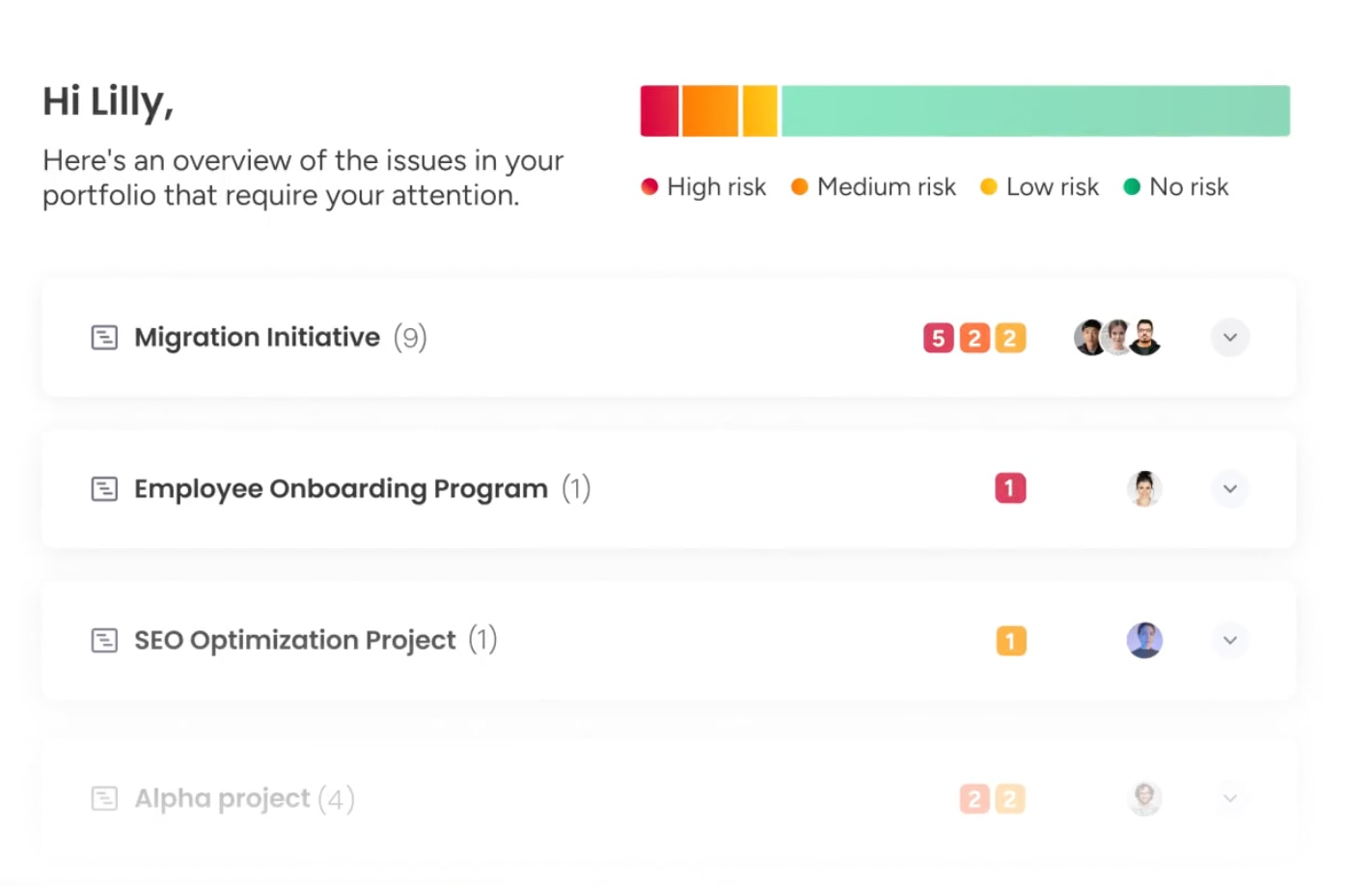
Portfolio Risk Insights proactively identifies compliance vulnerabilities across your entire portfolio. This feature scans projects continuously, analyzing timelines, dependencies, and data patterns to flag potential risks before they escalate.
The system examines both structured data and unstructured updates:
- Pattern identification: spots concerning trends in project communications.
- Timeline monitoring: flags delays that might impact compliance deadlines.
- Resource tracking: alerts teams to constraints that could compromise quality standards.
This predictive capability helps organizations address issues while they’re still manageable.
Automated compliance workflows
Automation eliminates the manual work that makes compliance burdensome. For example, teams use AI blocks to analyze documents, categorize risks, and generate reports automatically. Approval workflows ensure no critical step is skipped. Automated notifications keep stakeholders informed without manual follow-up.
These automations adapt to your specific requirements:
- Custom triggers: set up alerts based on your compliance framework.
- Conditional logic: route work based on risk levels.
- Escalation paths: activate when issues arise.
The result is compliance that happens automatically while maintaining complete audit trails.
Enterprise visibility and control
For large organizations, unified visibility across the entire portfolio is provided by monday work management. Executive dashboards aggregate compliance data from hundreds of projects. Moreover, real-time insights reveal risk exposure and compliance trends. Drill-down capabilities let leaders investigate specific issues without losing the big picture.
This visibility enables proactive management. Spot patterns before they become problems. Allocate resources where they’re needed most. Make informed decisions about risk acceptance. Most importantly, demonstrate compliance posture to stakeholders with confidence.
Change compliance from a burden into a competitive edge
Project compliance has evolved from a necessary burden to a strategic differentiator. Organizations that embrace this shift gain significant advantages in market access, operational efficiency, and stakeholder trust. The key is moving beyond reactive compliance to proactive frameworks that enable rather than constrain business growth.
Modern compliance management requires integrated technology that embeds requirements into daily workflows. Teams using monday work management experience compliance as a natural part of project execution rather than a separate overhead activity. This integration transforms compliance from a quarterly scramble into continuous protection that scales with organizational growth.
The future belongs to organizations that view compliance as infrastructure for innovation. By building robust frameworks today, you create the foundation for aggressive expansion tomorrow. Start with standardized templates, add automated monitoring, and scale with a platform that turns regulatory requirements into a competitive advantage.
Frequently asked questions
What's the difference between project compliance and program compliance?
Project compliance ensures individual initiatives meet specific requirements and deliverables. Program compliance manages broader regulations and standards that apply across groups of related projects, focusing on overarching governance rather than individual project details.
How does AI compliance differ from traditional project compliance?
AI compliance introduces unique requirements for algorithmic transparency, bias detection, and ethical oversight. These requirements don't exist in traditional frameworks and demand specialized auditing, explain ability protocols, and continuous monitoring of automated decisions.
Which compliance frameworks are essential for enterprise projects?
Essential frameworks typically include industry-specific mandates like GDPR for data privacy or HIPAA for healthcare, international standards such as ISO 27001 for security and SOC 2 for service organizations, plus emerging AI governance protocols depending on project scope.
How can distributed teams maintain consistent compliance standards?
Distributed teams achieve consistency through centralized platforms that enforce standardized workflows, provide real-time monitoring across locations, and automate documentation regardless of geography. Cloud-based systems ensure everyone works from the same requirements and processes.
What role does ESG compliance play in project portfolios?
ESG compliance directly influences project approval, vendor selection, and resource allocation. It determines which projects receive funding, which suppliers can be used, and how success is measured beyond financial metrics.
How do agile methodologies integrate with compliance requirements?
Agile teams integrate compliance by embedding checkpoints directly into sprints, using definition-of-done criteria that include compliance validation, and utilizing continuous monitoring to ensure documentation and validation occur iteratively without slowing development cycles.

 Get started