



A single Scrum team can be a powerhouse of focus and speed. But when a second, third, or fourth team joins the same product, that momentum often stalls. Communication becomes complex, priorities get misaligned, and the simple process that once worked so well starts to feel slow and heavy. The real challenge isn’t just growing teams, but scaling the agility that made them successful in the first place.
Large Scale Scrum (LeSS) provides a clear path forward. Instead of adding layers of new rules and roles, LeSS extends the core principles of Scrum to multiple teams. It’s designed to help organizations scale development while maintaining a sharp focus on customer value, product coherence, and organizational simplicity. This approach keeps teams aligned and empowers them to deliver a single, integrated product together.
What follows is a comprehensive exploration of how to implement LeSS successfully: from its core principles and framework sizes to practical adoption steps. Learn how to navigate common challenges and discover how flexible platforms support the visibility and coordination needed to make scaling work.
Key takeaways
- LeSS keeps Scrum simple while scaling to multiple teams: use one product owner and shared backlog for two to eight teams (basic LeSS) or add requirement areas for larger organizations (LeSS Huge).
- Feature teams deliver faster than component teams: build cross-functional teams that can complete entire customer features without handoffs between specialized groups.
- Flexible platforms provide the visibility LeSS needs: solutions like monday dev deliver unified backlog management, cross-team visibility, and real-time coordination with the freedom to adapt your process as you grow.
- Organizational change matters more than following rules perfectly: focus on forming feature teams, getting leadership support, and building technical excellence rather than implementing every LeSS practice exactly as written.
- Start small and adapt LeSS to your context: begin with willing teams, show quick wins, and customize practices while maintaining core principles like single product ownership and shared backlogs.
What is Large Scale Scrum?
Large Scale Scrum (LeSS) is a framework for scaling Scrum to multiple teams working on a single product. It extends Scrum to support two to eight teams (basic LeSS) or more than eight teams (LeSS Huge) while preserving the simplicity that makes Scrum effective.
LeSS maintains the core structure of Scrum including sprints, a single product owner, and one product backlog, while enabling multiple teams to work from the same priorities. This unified approach ensures all teams remain aligned on the primary objective: delivering value to customers.
Core principles of Large Scale Scrum
LeSS operates on ten principles that guide every decision when scaling Scrum. These principles help you maintain agility even as your organization grows.
The foundation starts with “Large Scale Scrum is Scrum” — meaning organizations maintain what works when adding teams. This includes preserving the same roles, events, and focus on empirical process control. The “more with less” principle encourages teams to evaluate every addition to their process, questioning whether additional meetings or new roles are truly necessary.
What drives successful LeSS implementations is:
- Whole-product focus: all teams work on one product with a unified vision.
- Customer-centric organization: structure teams around customer value, not technical components.
- Continuous improvement: regular reflection and adaptation at all levels.
- Systems thinking: consider how changes affect the entire organization.
- Lean thinking: eliminate waste and optimize value flow.

The 2 LeSS framework sizes
LeSS comes in two sizes depending on your team count. Choosing the right size prevents unnecessary complexity while ensuring adequate coordination.
Basic LeSS for 2 to 8 teams
Basic LeSS keeps things simple. You have one product owner managing priorities for all teams. Each team has its own Scrum Master who also helps with cross-team coordination. Teams organize as feature teams that can deliver complete customer features without dependencies.
The structure adds minimal overhead to standard Scrum. Sprint planning happens together, reviews involve all teams, and you add overall retrospectives to address system-wide issues. This simplicity makes basic LeSS accessible when scaling up from single-team Scrum.
LeSS Huge for more than 8 teams
LeSS Huge adds requirement areas to manage increased complexity. These areas represent customer-focused parts of your product like “user onboarding” or “payment processing”.
Each requirement area gets an area product owner who works with the main product owner. Teams within an area coordinate closely while the overall product owner ensures areas align with product strategy. You still maintain one product backlog, though teams may refine area-specific portions separately.
Roles in Large Scale Scrum
LeSS adapts Scrum roles for multiple teams without creating new management layers. This approach maintains clarity while enabling coordination at scale.
The single product owner role
One product owner serves all teams, regardless of team count. This centralized decision-making ensures consistent prioritization and prevents teams from working at cross-purposes. The product owner faces challenges managing input from many teams, but unified direction outweighs these difficulties.
In LeSS Huge, area product owners help manage specific requirement areas but don’t replace the single product owner. They translate overall priorities into area-specific work while maintaining alignment with product strategy.
Scrum Masters as organizational coaches
Scrum Masters expand beyond serving individual teams. They coordinate with other Scrum Masters to resolve dependencies and spread good practices and their focus shifts to removing organizational impediments that affect multiple teams.
These broader responsibilities include:
- Cross-team facilitation: helping teams coordinate and learn from each other.
- Organizational improvement: addressing systemic issues no single team can solve.
- Product owner support: helping manage the larger backlog and stakeholder communication.
Feature teams over component teams
Feature teams can deliver complete customer features from start to finish. They include all skills needed: frontend, backend, testing, and deployment. Component teams that specialize in technical layers create handoffs and delays.
This structure matters because when a team can deliver a complete feature, customers see value faster. There’s no waiting for the “backend team” or “UI team” to complete their part. Teams receive direct feedback on their work and can adapt quickly based on customer needs.
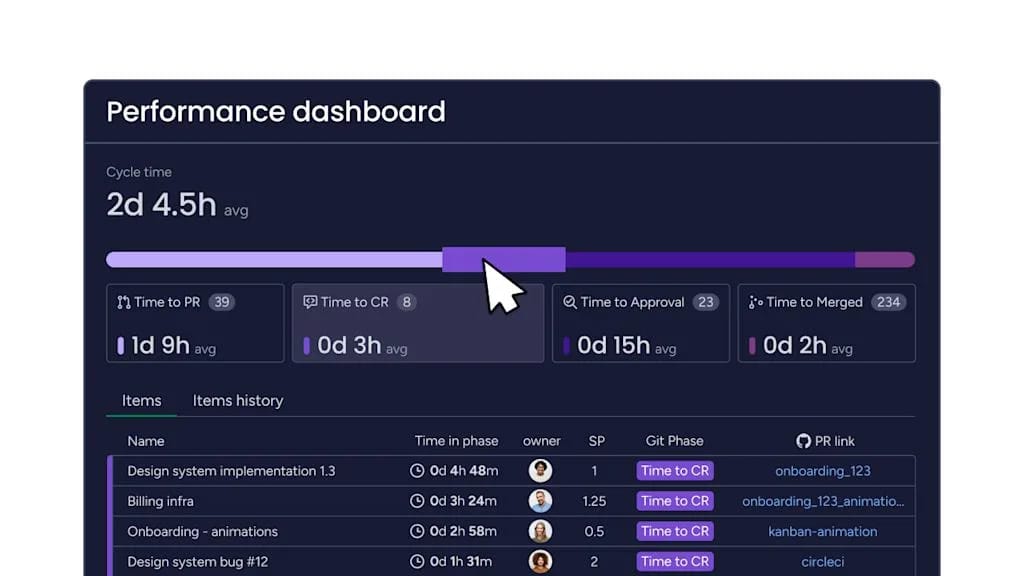
LeSS events and artifacts that scale
LeSS adapts Scrum events for multiple teams while keeping their purpose and timebox. The additions focus on coordination without creating meeting overload.
Multi-team sprint planning
Sprint planning happens in two parts. Part one brings all teams together with the product owner to review priorities and identify dependencies. Teams see what others plan to work on and can coordinate before committing.
Part two lets teams do detailed planning while staying available for coordination. If two teams discover they’re both planning to modify the same code, they can adjust their plans immediately.
Advanced platforms like monday dev support this coordination by providing real-time visibility into all teams’ plans and dependencies.
Overall retrospectives for system improvement
Teams still hold their own retrospectives, but LeSS adds overall retrospectives for system-wide issues. These sessions bring representatives from all teams together to address problems no single team can solve.
What kinds of issues surface here? Things like deployment bottlenecks affecting everyone, unclear product direction, or organizational policies that slow delivery. By addressing these together, teams can improve the entire system rather than just their local environment.
Scaled sprint reviews
All teams demonstrate their work in a joint sprint review. Stakeholders see the complete product increment and provide unified feedback. This coordination prevents conflicting direction and helps stakeholders understand how different features work together.
Managing large groups requires focus. Keep demonstrations time-boxed and ensure quieter voices get heard. The goal is meaningful feedback on working software, not status reports.
Implementing Large Scale Scrum successfully
Successful LeSS adoption requires organizational change beyond just following new practices. Learn how to approach implementation thoughtfully.
Step 1: assess your organizational readiness
Start by evaluating four key areas:
- Leadership commitment: leaders must actively support restructuring and new ways of working.
- Scrum Maturity: teams need solid Scrum fundamentals before scaling.
- Flexibility to restructure: you’ll need to form feature teams even if it disrupts the current organization.
- Cultural openness: transparency and collaboration must be valued over information hoarding.
Without these foundations, LeSS implementation will struggle. Address gaps before proceeding rather than hoping they’ll resolve themselves.
Step 2: form cross-functional feature teams
Building feature teams means assembling groups with all skills needed to deliver customer value. Common challenges include skill gaps, resistance to leaving specialized teams, and coordinating distributed members.
Effective feature teams typically have five to nine members with complementary skills. They need strong collaboration practices, especially if not co-located. Initial productivity often dips as teams learn to work together, but long-term benefits justify this investment.
Step 3: define requirement areas
For LeSS Huge only, define requirement areas based on how customers experience your product. Good areas might be “mobile experience” or “merchant tools” — bad ones would be “backend services” or “data layer.”
Customer-centric areas naturally align teams with delivering value. Technical areas create silos and handoffs. When teams organize around customer journeys, they focus on outcomes rather than technical elegance.
Step 4: establish cross-team coordination
Coordination happens through both formal and informal mechanisms:
- Communities of practice: people with similar skills share knowledge across teams.
- Working agreements: teams define how they’ll handle dependencies and communicate.
- Visual management: boards showing cross-team work and dependencies.
Solutions like monday dev enable this coordination by connecting team boards and providing visibility into dependencies. Teams can see how their work affects others and adjust accordingly without lengthy status meetings.
Step 5: Build engineering excellence
Technical practices become critical at scale as without them, integration problems and quality issues multiply across teams.
Essential practices include:
- Continuous integration: frequent code integration catches problems early.
- Test automation: fast feedback on changes prevents regression.
- Shared standards: consistent conventions ease collaboration.
- Collective ownership: any team can work on any code.
These practices directly enable LeSS success. When teams can integrate smoothly and maintain quality, coordination becomes about delivering value rather than fixing problems.
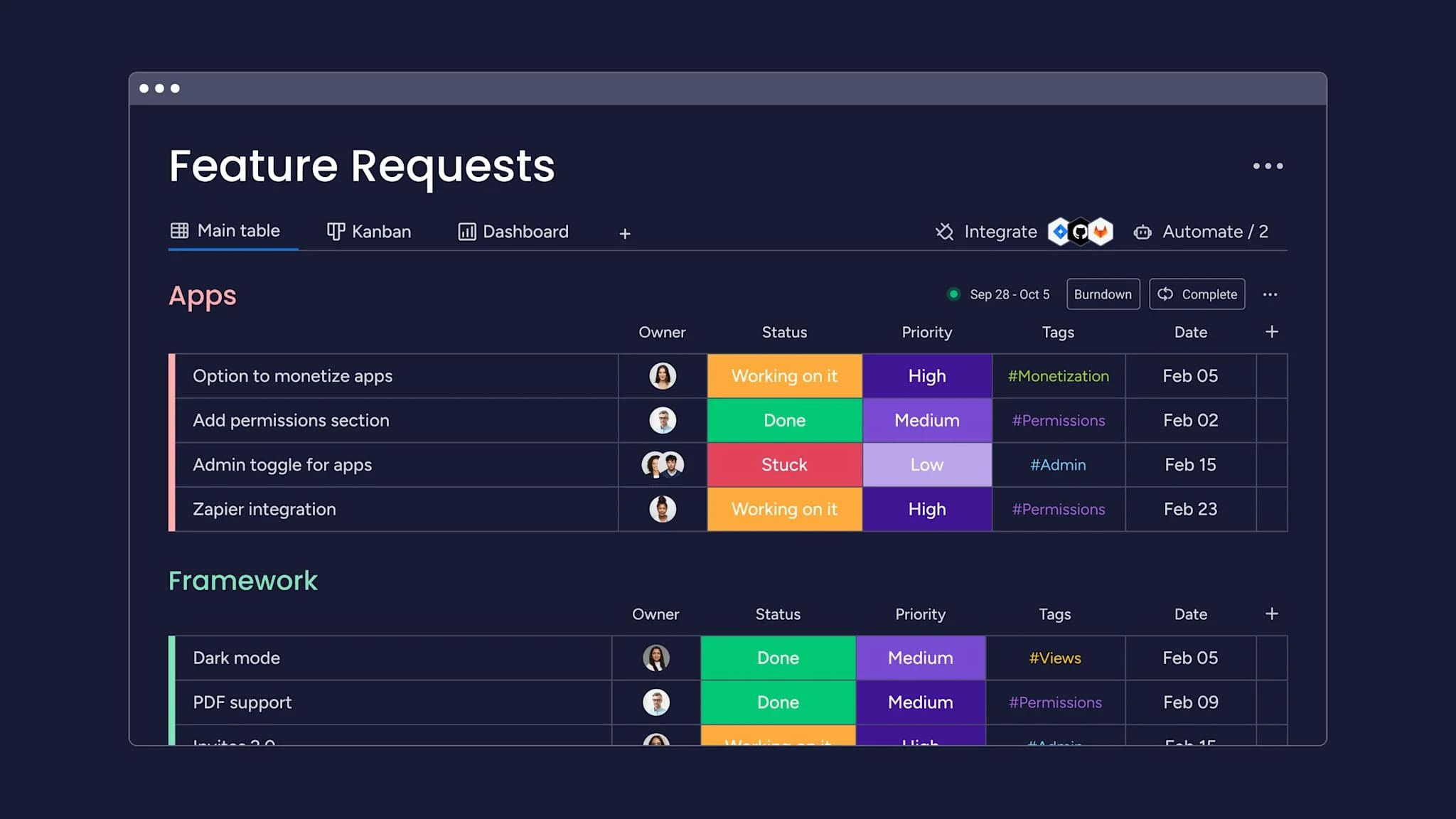
5 key benefits of Large Scale Scrum
LeSS delivers measurable improvements when implemented well:
- Faster delivery: feature teams eliminate handoffs that slow traditional development, with agile transformations reducing time-to-market by at least 40%, according to McKinsey.
- Product coherence: single product owner ensures all teams build toward unified vision.
- Organizational learning: shared events spread knowledge and practices rapidly.
- Reduced overhead: minimal roles and ceremonies compared to heavier frameworks.
- Sustained agility: short feedback loops and empirical process scale with the organization.
These benefits compound over time. As teams improve at coordination and technical practices, delivery accelerates further, with highly successful agile transformations reporting around 30% improvement in efficiency, customer satisfaction, employee engagement, and operational performance.
4 common implementation challenges
Real challenges arise during LeSS adoption:
- Organizational resistance: people comfortable with current structures may resist feature teams.
- Skill gaps: existing specialization makes forming cross-functional teams difficult.
- Coordination complexity: more teams mean more potential dependencies to manage.
- Temporary productivity loss: teams need time to gel and learn new practices.
How long do these challenges last? Most organizations see productivity return to previous levels within two to three sprints, then improve beyond that as teams mature.
Strategies to overcome resistance
Successful change requires thoughtful approaches:
- Start with volunteers: early adopters demonstrate success and build momentum
- Show quick wins: visible improvements in delivery or quality convince skeptics
- Invest in coaching: experienced guides help navigate difficult transitions
- Communicate transparently: share both challenges and benefits openly
Solutions like monday dev support change by making progress visible. When teams see improved flow and faster delivery, resistance naturally decreases.

LeSS compared to other scaling frameworks
How does Large-Scale Scrum (LeSS) stack up against other popular approaches? Unlike frameworks that introduce extensive new roles and ceremonies, LeSS is designed to “descale” organizational complexity through simplification. Each framework makes different trade-offs between prescriptive guidance and team autonomy.
By comparing LeSS with alternatives like SAFe and Nexus, leadership can determine which model best fits their specific culture, technical requirements, and strategic goals.
LeSS vs SAFe for enterprise scaling
LeSS and SAFe take opposite approaches. LeSS stays lightweight with minimal roles and ceremonies, while SAFe adds extensive structure including Release Train Engineers, program increment planning, and multiple coordination layers.
Which works better? It depends on your organization. LeSS maintains agility but requires you to figure out some coordination yourself. SAFe provides detailed guidance but adds significant overhead. If you value flexibility and trust teams to self-organize, LeSS is a more suitable fit. If you want prescribed processes for everything, consider SAFe.
LeSS vs Nexus framework
Nexus adds a Nexus Integration Team to handle technical integration between teams. LeSS relies on feature teams and shared ownership to avoid integration problems in the first place.
The choice often comes down to your main challenge. If technical integration is your biggest problem, Nexus provides direct support. If organizational silos slow you down, LeSS’s feature team approach addresses the root cause.
Choosing the right framework for your context
Consider these factors when selecting a scaling framework:
- Organization size: larger groups may need more structure.
- Change tolerance: how much disruption can you handle?
- Current maturity: strong Scrum teams adapt to LeSS more easily.
- Leadership support: more ambitious frameworks need stronger backing.
Remember: the “best” framework is the one that fits your context. LeSS works well for organizations willing to restructure around customer value and maintain minimal process.
Flexible LeSS implementation strategies
Real organizations rarely implement LeSS exactly as prescribed. Success comes from adapting while maintaining core principles.
Adapting LeSS to your current practices
Common adaptations include:
- Distributed teams: use collaboration platforms and overlap working hours.
- Legacy systems: gradually expand team capabilities rather than immediate full-stack teams.
- Regulatory requirements: add necessary documentation without abandoning transparency.
The key is evaluating each adaptation. Does it support or undermine LeSS principles? Adjusting meeting times for time zones supports collaboration. Adding approval layers undermines team ownership.
Customizing without breaking core principles
Some elements can’t be compromised without breaking LeSS:
- Single product owner: multiple owners create conflicting priorities.
- Feature teams: component teams reintroduce the problems LeSS solves.
- Shared backlog: separate backlogs fragment the product.
Within these constraints, you have flexibility. Adjust sprint length, customize your definition of done, or create team-specific practices. Just maintain the core structure that makes LeSS work.
AI integration in Large Scale Scrum
Integrating artificial intelligence into a Large-Scale Scrum (LeSS) environment provides a powerful way to scale transparency and coordination without adding the overhead of new management layers.
Rather than replacing the human judgment essential to the Agile process, AI serves as an objective analytical layer that helps teams identify hidden patterns, anticipate risks, and streamline communication in real time.
AI platforms for team coordination
AI helps teams coordinate by analyzing patterns and surfacing insights. It might notice that certain types of work always create dependencies between specific teams. Or identify optimal meeting times based on team calendars and time zones.
Advanced platforms like monday dev incorporate AI to help teams spot bottlenecks and suggest improvements. Rather than replacing human coordination, it augments it with data-driven insights.
Automating dependency tracking
Dependencies between teams can derail sprints if discovered late. AI can analyze planned work and highlight potential conflicts before they become problems. It might notice two teams planning to modify the same service or flag when a feature depends on work not yet scheduled.
This early warning system helps teams adjust plans during sprint planning rather than discovering conflicts mid-sprint. It results in smoother delivery and fewer emergency coordination meetings.
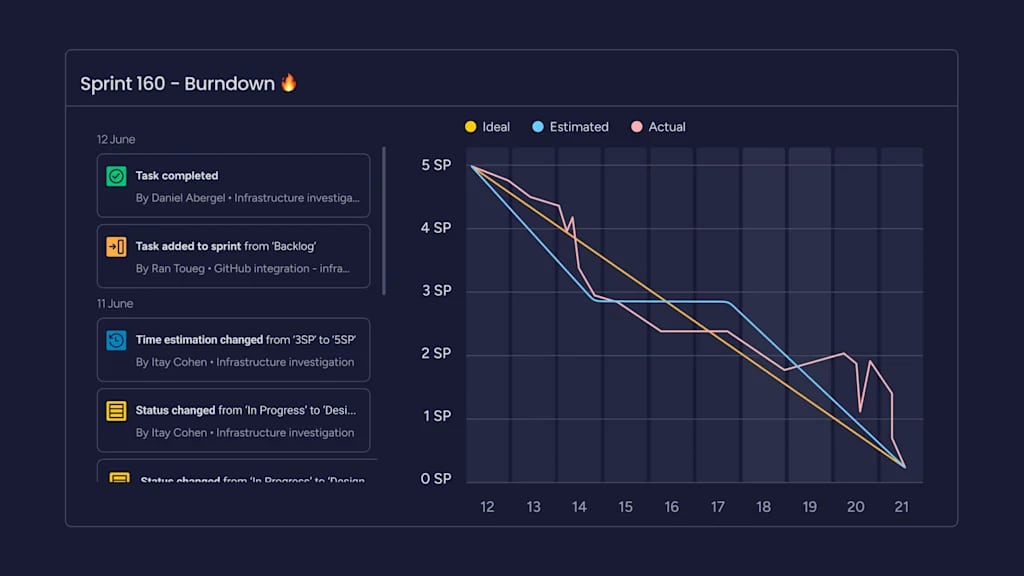
Tools that enable flexible LeSS implementation
The right platform can make or break your LeSS implementation. Rigid systems force you into component team thinking and create artificial barriers between teams.
Breaking free from rigid tool constraints
Traditional project management platforms often assume component teams and phase-gate processes. They create separate projects, limit visibility, and make cross-team coordination harder than necessary.
What should you look for instead?
- Unified backlog management: all teams access and prioritize together.
- Cross-team visibility: real-time view of everyone’s work and progress.
- Flexible workflows: adapt to your process, not the other way around.
- Collaboration features: built-in communication without leaving the platform.
Achieving visibility without overhead
Platforms like monday dev provide the flexibility LeSS requires. Teams can structure boards to match their workflow while maintaining visibility across the organization. Whether you’re running basic LeSS or LeSS Huge, the platform adapts to your needs.
Real-time dashboards show progress without manual reporting. While automation handles routine updates, teams spend time delivering value rather than updating status. This combination of flexibility and visibility makes LeSS practices sustainable at scale.
Scale your Scrum practice with monday dev
The implementation of LeSS is enabled by monday dev through flexible workflows and real-time visibility. Teams can organize in whatever way makes sense for their specific needs while maintaining the transparency required for effective coordination.
Both basic LeSS and LeSS Huge configurations are supported by the platform. It allows users to create unified backlogs, track dependencies, and coordinate sprints without forcing teams into rigid processes. Furthermore, technical work remains connected to customer value through seamless integration with leading development platforms.
Most importantly, monday dev grows alongside your organization. You can start with basic LeSS and expand to LeSS Huge whenever the need arises. As teams mature, you can add automation and connect new systems as your tech stack evolves. The platform is designed to adapt to your requirements rather than constraining your organizational growth.
Frequently asked questions
What is the difference between SAFe and Large Scale Scrum?
The difference between SAFe and Large Scale Scrum is that LeSS maintains Scrum's simplicity with minimal additional roles and ceremonies, while SAFe introduces extensive roles, layers, and prescribed processes for enterprise scaling. LeSS focuses on organizational design and feature teams, whereas SAFe provides detailed frameworks with Release Train Engineers and program increment planning.
What is a large scale Agile?
Large scale Agile refers to applying agile principles across multiple teams or entire organizations working together on complex products or programs. It involves frameworks and practices that coordinate agile teams while maintaining flexibility and customer focus at scale.
What is the 3:5:3 rule in Scrum?
The 3:5:3 rule in Scrum means there are three roles (product owner, scrum master, development team), five events (sprint, sprint planning, daily scrum, sprint review, sprint retrospective), and three artifacts (product backlog, sprint backlog, increment). This structure provides the essential elements needed for Scrum to function effectively.
How many teams can effectively use basic LeSS?
Basic LeSS is designed for 2–8 teams working on a single product. Organizations with more than 8 teams should consider LeSS Huge, which adds requirement areas and area product owners for better coordination at larger scale.
Can you combine LeSS with other Agile methodologies?
You can incorporate practices from other Agile methodologies like Kanban or XP into LeSS, as long as they don't conflict with core LeSS principles and Scrum fundamentals remain intact. Many teams use Kanban boards for visualization or XP engineering practices while following the LeSS framework.
How long does a typical LeSS transformation take?
A typical LeSS transformation takes 6–18 months depending on organizational size and readiness for change. The process is gradual, with teams learning and adapting LeSS practices over multiple sprints while maintaining delivery momentum.

 Get started