


Marketing teams today juggle an overwhelming number of platforms, typically 12 different ones, just to keep campaigns running, creative flowing, and results tracked. Email automation handles nurture sequences. Project management platforms coordinate timelines. Analytics dashboards measure results. But for leaders managing 50-100+ people across content, creative, acquisition, and operations teams, the real challenge isn’t finding another marketing automation platform. The real challenge is finding one that orchestrates how entire marketing organizations work together.
Traditional automation handles customer-facing needs like email sequences and lead scoring. Enterprise marketing requires much more: direct visibility into who does what, where campaigns get stuck, and how teams actually work together. Leaders need platforms that connect strategic planning to daily execution while automating the coordination overhead that consumes hours of productive time. The most effective solutions address both workflow automation and work orchestration, giving teams the structure to deliver consistent results at scale.
This guide examines marketing automation differently, focusing on what actually matters when managing enterprise-level marketing operations. It further explores how comprehensive work management solutions transform marketing execution.
Key takeaways
To be direct: marketing automation isn’t just about scheduling emails anymore. If you’re leading a modern marketing department, you need systems that coordinate everything from creative development to campaign launches to team bandwidth management. The platforms that truly transform marketing operations nail five critical areas:
- Move beyond channel automation to work orchestration: focus on platforms that coordinate how marketing teams collaborate, not just how messages get delivered to customers.
- Unify campaign visibility across all functions: connect creative production, resource planning, and performance tracking in one workspace so teams stay aligned on priorities and deadlines.
- Transform resource management from reactive to proactive: use real-time workload views to prevent bottlenecks, balance team capacity, and assign work based on skills and availability.
- Connect daily marketing work to business outcomes: link every campaign and initiative to company OKRs so teams understand how their efforts drive measurable business growth.
- Orchestrate collaboration while automating coordination: platforms like monday.com combine team orchestration with workflow automation through customizable processes and integrated dashboards.
What makes heads of marketing choose monday.com for marketing operations?
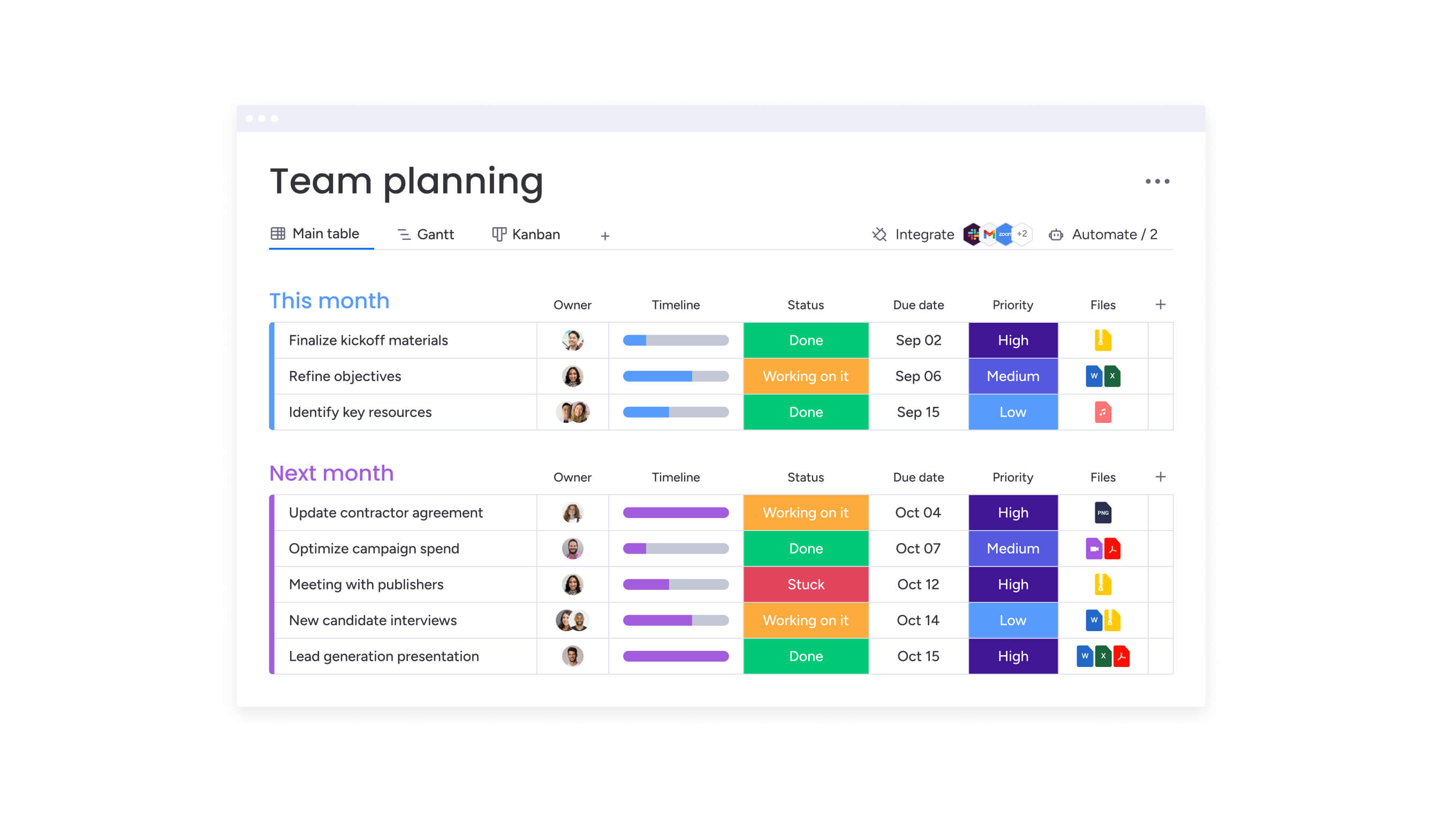
If you’re heading marketing at a services company, you’ve got a problem that your current automation tools simply weren’t built to fix. You manage 50-100+ people across content, creative, acquisition, events, and operations teams, each using different tools while executives demand clear ROI reporting and predictable delivery.
Some teams also integrate sales automation to unify marketing and sales processes.
- The operational complexity gap: traditional marketing automation platforms focus on customer-facing activities — email sequences, lead scoring, and nurture campaigns. But they miss the operational complexity behind those campaigns: Who’s working on what? Is the creative team overloaded?Will the campaign launch on time?
- The dual capability solution: monday.com addresses both sides of marketing automation. It orchestrates how teams collaborate, plan resources, and track performance while enabling the workflow automation that reduces manual overhead.
Marketing leaders gain visibility into campaign ROI alongside team productivity metrics, resource utilization rates, and time-to-launch data, all from one platform. For services industry marketing teams managing multi-channel strategies across diverse client portfolios, this dual capability transforms execution through strategic resource allocation, automated repetitive coordination, and real-time dashboards that connect daily work to business outcomes.
monday.com top features for marketing operations
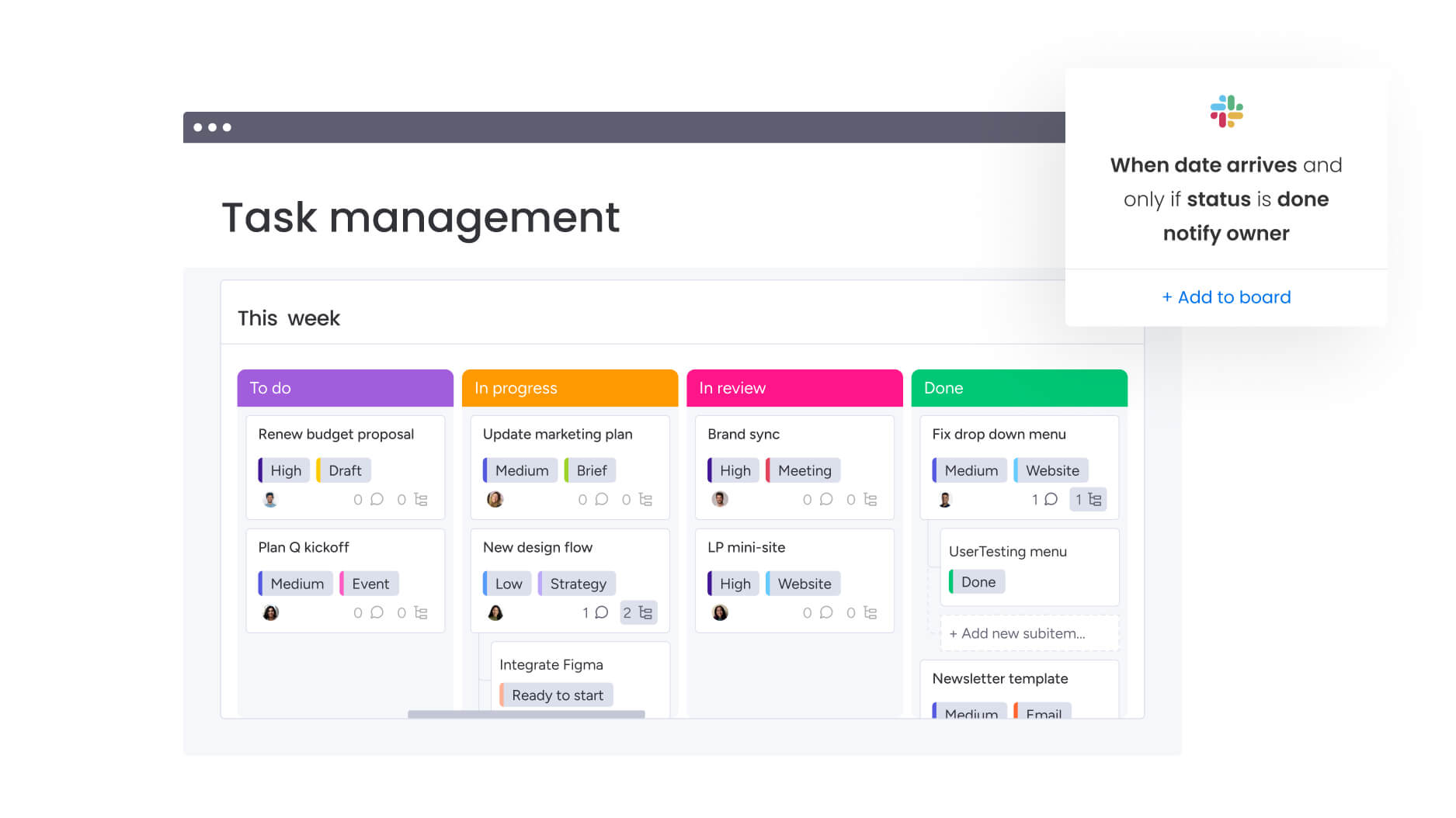
Seven powerful features make all the difference for marketing teams drowning in complexity. Each one tackles a specific pain point you’re likely facing when trying to wrangle campaigns across multiple teams and channels.
Campaign management
Marketing teams frequently encounter campaign challenges including outdated spreadsheets, lost email communications, and disconnected platforms. With monday.com, these issues are addressed by consolidating everything into a single workspace where teams gain complete visibility into campaign status, dependencies, and task assignments.
Key benefits for marketing leaders:
- Immediate visibility: see campaign health across teams and regions in real time.
- Proactive bottleneck identification: spot delays before they impact launch dates.
- Resource reallocation: shift priorities when business needs change.
- OKR connection: link campaign performance directly to business objectives.
The platform’s visual timelines and calendars ensure nothing falls through the cracks. Automated status updates eliminate endless check-in meetings.
Genpact’s marketing team manages 24 large-scale campaigns simultaneously using campaign workflows that track both target and actual timelines. Their workflow app outlines the entire end-to-end activation process for each channel, allowing them to see trends and identify bottlenecks causing delays. This visibility enables the team to proactively address issues before they impact campaign launches.
Resource management
With monday.com, resource management provides real-time visibility into team bandwidth, skills, and workload distribution. Marketing leaders can see who’s available, who’s overloaded, and where capacity exists to take on new work. All from dynamic workload views that update automatically.
How this transforms services marketing operations:
- Proactive workload balancing: prevent resource conflicts before deadlines slip.
- Skills-based matching: assign team members to work based on expertise and availability.
- Instant capacity assessment: know immediately who can handle urgent requests.
- Burnout prevention: maintain balanced workloads across all team members.
ThoughtWorks achieved remarkable efficiency gains after implementing resource management capabilities. The team now budgets time and efforts much more scientifically, with measurable results that speak volumes. Email communication dropped by 55% while assets and approvals improved by 62%.
Dashboards and reporting
Marketing leaders need instant access to performance data without manually compiling reports from multiple systems. With monday.com’s dashboards, data from all your projects connects to provide real-time insights through customizable widgets that track what matters most to your organization.
Dynamic reporting capabilities:
- Flexible filtering: view data by campaign, team, or time period.
- Drill-down analysis: move from portfolio-level metrics to individual project details.
- Executive-ready views: share stakeholder dashboards without operational access.
- Visual decision-making: spot issues, celebrate wins, and optimize resource allocation.
FARFETCH uses these capabilities to coordinate 400 people across 40 teams, achieving $118K monthly savings and 6x ROI. The platform has become the global centralizing hub for their growing organization, demonstrating how unified visibility drives both efficiency and growth.
Workflow automation
Manual coordination drains marketing teams of strategic focus. Status updates, approval requests, and deadline reminders consume hours that could focus on strategy and creativity. With monday.com’s automation capabilities, this overhead is eliminated through customizable recipes that move work forward automatically.
Automation examples that drive efficiency:
- Creative brief notifications: automatic alerts when briefs need review.
- Stage-based task assignment: trigger assignments when campaign phases complete.
- Status report generation: compile updates without manual effort.
- Cross-regional consistency: ensure standardized processes across global teams.
The no-code interface means marketing teams can build and modify automations without IT involvement.
McDonald’s Australia transformed their marketing operations through workflow automation, eliminating manual tracking and reducing email volume. The impact was substantial: 25% faster project management timelines, 1,224 hours saved monthly, and 20,000 fewer emails.
Creative requests and approvals
Creative production often becomes a bottleneck when requests flow through email and stakeholders can’t see queue status. With monday.com, this process is streamlined through automated intake forms, visual approval workflows, and transparent queue management that keeps everyone informed.
Streamlined creative workflow benefits:
- Standardized intake: campaign managers submit requests through forms that capture all necessary details.
- Prioritized queues: creative teams see incoming work organized by deadline and importance.
- Transparent tracking: stakeholders monitor request status without follow-up emails.
- Automated routing: requests reach the right reviewers with notification-driven approvals.
This transparency reduces friction, accelerates production, and helps marketing leaders identify when creative capacity needs adjustment.
Genpact formalized their creative brief process using these capabilities. Campaign managers previously lacked visibility into where their requests stood in the queue or how many other requests were ahead of theirs. Now, automated workflows provide complete visibility into status and turnaround times for every request.
Goals and OKRs
Strategic alignment often breaks down between planning and execution. With monday.com, marketing initiatives connect directly to company objectives, ensuring every campaign and project contributes to measurable business goals.
Strategic alignment features:
- OKR cascading: set company-level objectives and cascade to team-specific goals.
- Initiative linking: connect campaigns and projects to strategic outcomes.
- Real-time progress tracking: visual indicators show which initiatives are on track.
- Impact demonstration: prove marketing’s contribution to business growth.
This connection between daily work and strategic objectives keeps teams focused on outcomes that matter. It makes it easier to demonstrate marketing’s contribution to business growth.
Integration capabilities
Marketing teams typically use 10-15 specialized platforms across different functions. With monday.com’s 200+ integrations, these platforms connect into a unified workspace, eliminating the need to switch between platforms or manually sync data. For example, integrating a CRM with marketing automation ensures that lead and customer data is always up to date.
Integration ecosystem benefits:
- CRM connectivity: pull lead data directly into campaign workflows.
- Analytics platform linking: connect performance metrics to project tracking.
- Creative tool integration: manage assets alongside campaign timelines.
- Communication system sync: centralize team collaboration across tools.
- Custom API access: build unique integrations for specialized workflows.
This connectivity means campaign data, team communications, and creative assets flow seamlessly between systems, creating a true marketing operations hub that adapts to your existing technology investments.
Try monday.comHow heads of marketing in services benefit from monday.com
Marketing leaders in the services industry who implement comprehensive work management alongside their automation stack achieve measurable improvements across six key areas:
Operational efficiency gains:
- Time savings: eliminate thousands of hours monthly spent on manual coordination, status meetings, and information hunting. Teams report saving 60+ hours per employee yearly through automated workflows and centralized visibility.
- Cost efficiency: achieve 6x ROI through improved operational efficiency and resource optimization. Organizations save $100K+ monthly by eliminating duplicative processes and maximizing team productivity.
- Compliance and accuracy: replace scattered spreadsheets with a single source of truth for campaign data, timelines, and performance metrics. Standardized workflows ensure consistency while maintaining governance across global teams.
Performance and quality improvements:
- Productivity improvements: increase cross-team collaboration by 40% and improve asset delivery by 62% through streamlined workflows and clear ownership. Teams deliver campaigns 25% faster with 2x improvement in delivery speeds.
- Output quality improvements: triple creative output and increase weekly campaigns by 142% through efficient resource allocation and automated workflows. Reduce time-to-launch while maintaining brand consistency.
- Visibility and tracking improvements: gain real-time insights into team priorities, campaign performance, and progress toward OKRs. Track ROI, budget adherence, and stakeholder satisfaction from unified dashboards.
How to solve marketing operations challenges with monday.com
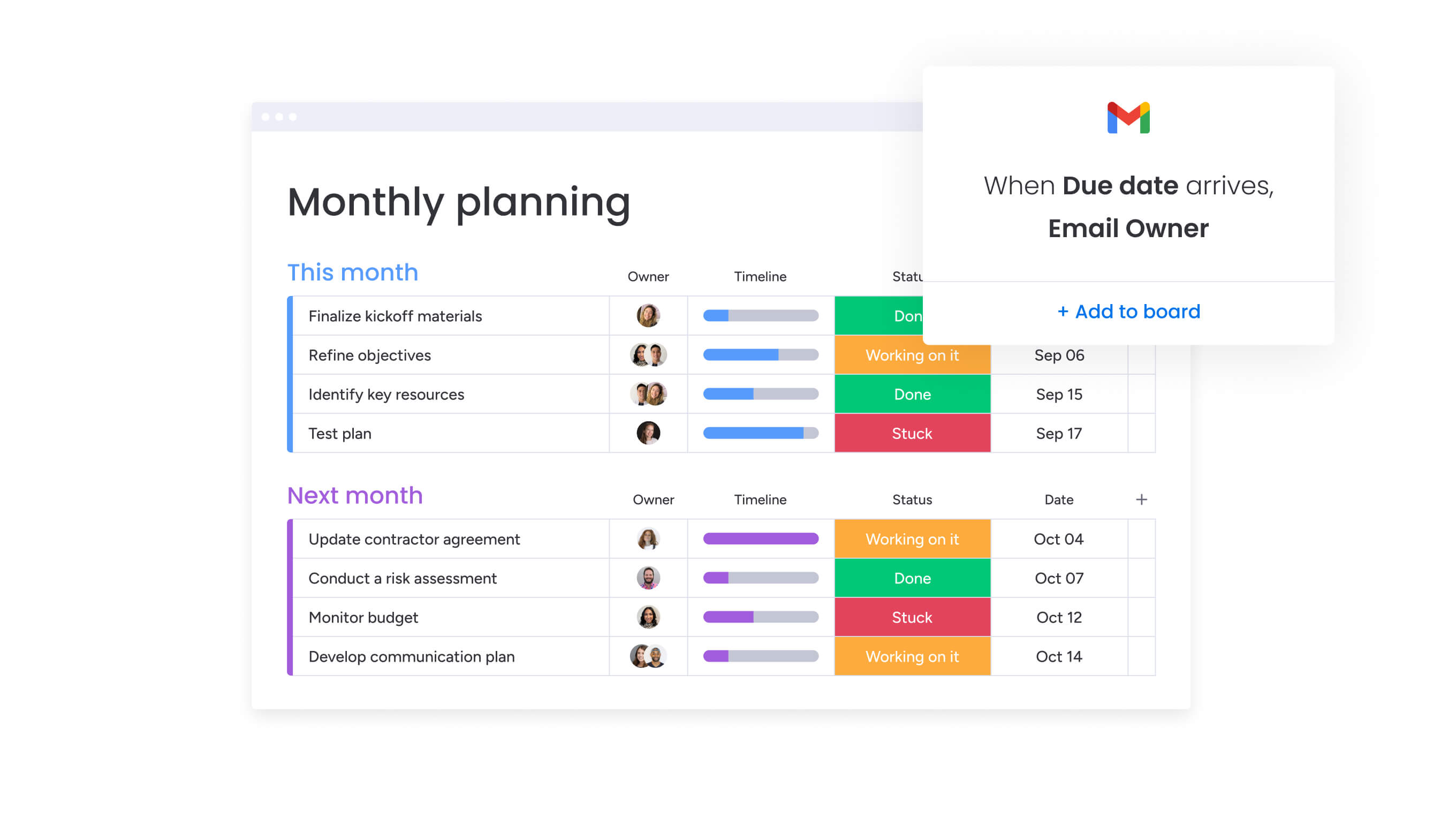
Organizing your marketing operations requires a structured approach. This six-step roadmap provides a framework for building efficient, scalable marketing operations:
Step 1: centralize campaign planning and execution
Start by creating a unified marketing calendar that houses all campaigns, milestones, and dependencies. Replace scattered spreadsheets with customizable boards that track campaign status, owners, and deadlines in one workspace.
Implementation actions:
- Build campaign boards: create status tracking, owner assignment, and deadline management.
- Create visual timelines: show dependencies between campaign elements.
- Establish naming conventions: implement tagging systems for easy filtering and reporting.
- Import existing campaign data: establish historical baselines.
This centralization immediately improves visibility and reduces the confusion that comes from disconnected planning tools.
Step 2: standardize creative workflows and approvals
Build automated request forms that capture all necessary information upfront. Set up approval workflows with clear stages and automatic notifications.
Workflow standardization steps:
- Design intake forms: collect brief requirements, deadlines, and stakeholder information.
- Create approval stages: designate reviewers and automatic routing.
- Set up notification triggers: automate alerts for status changes and deadline approaches.
- Establish turnaround time tracking: identify and address bottlenecks.
This standardization ensures consistent quality while reducing the back-and-forth that delays creative production.
Step 3: establish resource capacity planning
Configure workload views to visualize team bandwidth across all initiatives. See who’s available, who’s overloaded, and where you have capacity for new work.
Capacity planning configuration:
- Set up workload views: show individual and team bandwidth.
- Define capacity limits: create automated alerts for overallocation.
- Create skills-based assignment rules: enable optimal resource matching.
- Implement time tracking: validate capacity assumptions and improve planning.
Assign resources based on skills and availability to prevent burnout while ensuring balanced workloads.
Step 4: connect marketing work to business OKRs
Link every campaign and initiative to specific company objectives. This connection ensures teams understand how their work drives business outcomes.
OKR integration process:
- Define company-level OKRs: cascade to marketing-specific objectives.
- Create linking mechanisms: connect campaigns and strategic goals.
- Build executive dashboards: show marketing’s contribution to business outcomes.
- Establish regular review cycles: assess progress and adjust priorities.
Create executive dashboards that demonstrate marketing’s contribution to strategic goals, making it easier to justify budgets and prove value to leadership.
Step 5: automate routine coordination tasks
Identify repetitive workflows like status updates, deadline reminders, and stakeholder notifications. Build automation recipes that handle these tasks automatically.
Automation implementation priorities:
- Map current manual processes: identify automation opportunities.
- Create notification rules: automate alerts for status changes, deadline approaches, and approval needs.
- Set up automatic task assignment: trigger assignments based on workflow stage completion.
- Build recurring report generation: eliminate manual compilation.
This automation frees your team from administrative overhead, allowing more time for strategic and creative work that drives results.
Step 6: integrate your marketing technology stack
Connect monday.com with your existing tools including CRM, analytics platforms, creative software, and communication systems.
Integration strategy:
- Audit current tool usage: identify integration priorities.
- Connect high-impact systems first: prioritize CRM, analytics, and creative tools.
- Set up data synchronization rules: maintain accuracy across platforms.
- Train teams on unified workflows: ensure adoption across integrated systems.
This integration creates seamless data flow across your martech ecosystem, eliminating manual data entry and ensuring everyone works from current information.
Try monday.comComparison: monday.com vs. competing platforms for marketing operations
If you’re debating which platforms are best for marketing operations, understanding how different solutions compare across key capabilities is essential. The following comparison examines monday.com alongside other leading solutions:
| Feature | monday work management | HubSpot Marketing Hub | Salesforce Marketing Cloud |
|---|---|---|---|
| Work management + automation | ✓ Native integration | Limited project features | Requires separate tools |
| Resource capacity planning | ✓ Built-in workload views | Add-on required | Limited visibility |
| Cross-functional collaboration | ✓ Unified workspace | Marketing-focused | Complex setup |
| Visual workflow builder | ✓ Drag-and-drop | ✓ Available | Steep learning curve |
| Real-time dashboards | ✓ Customizable | ✓ Available | ✓ Available |
| Template library | 200+ examples | Marketing templates | Limited templates |
| Implementation time | Two to four weeks | Two to three months | Three to six months |
| Price per user/month | Starting at $10 | Starting at $890 | Custom pricing |
| G2 rating | 4.7/5 | 4.4/5 | 4.0/5 |
| Best for | Enterprise marketing teams 50-100+ | Inbound marketing focus | Enterprise with Salesforce CRM |
How Genpact transformed their global marketing operations
Want to see what this looks like in action? Here’s how Genpact, a global services powerhouse, transformed its marketing operations to achieve measurable wins in team collaboration, efficiency, and visibility.
The challenge
Genpact’s globally distributed marketing team juggled 24 large-scale campaigns across multiple regions simultaneously. Teams relied on spreadsheets saved across desktops, emails, and SharePoint folders. With multiple stakeholders entering information at different times, nobody knew who had the latest version.
Specific operational pain points:
- No single source of truth: campaign information scattered across multiple systems and file versions.
- Version control chaos: global teams working from outdated information without knowing it.
- Limited campaign visibility: no way to spot progress issues or bottlenecks before they caused delays.
- Manual coordination overhead: significant time and resources consumed by administrative tasks.
The solution
Genpact implemented monday.com to standardize campaign planning and execution across their global organization. The implementation focused on creating systematic workflows that could scale across regions and campaign types.
Implementation components:
- Channel-specific workflow apps: dedicated activation processes for each marketing channel.
- Dual timeline tracking: target and actual timelines for all campaigns to identify variances.
- Executive GTM calendar: high-level visibility into all marketing programs for leadership.
- Automated brief management: streamlined campaign brief submission and queue tracking.
- Standardized processes: consistent forms and approval workflows across all teams.
They created workflow apps for each channel’s activation process, tracking both target and actual timelines. A high-level GTM calendar provided leadership with visibility into all marketing programs.
The results
The results hit fast and were impossible to ignore:
- 40% improvement: in cross-team collaboration for campaign planning and execution.
- 100% removal: of spreadsheets from marketing workflows.
- 25% decrease: in email exchanges across the department.
Ready to transform your marketing operations function?
Ultimately, marketing automation needs to do more than send emails. You need a platform that gets your entire team in sync while eliminating the busywork that slows everyone down.
Through comprehensive work orchestration that addresses the operational complexity behind successful campaigns, monday.com delivers this dual capability. From campaign planning to resource optimization to performance tracking, it provides the visibility and automation that enterprise marketing teams need to operate efficiently at scale.
The results speak for themselves: marketing teams achieve 40% better collaboration, 6x ROI, and thousands of hours saved monthly through unified operations that connect daily work to business outcomes.
Join the marketing teams at Genpact, ThoughtWorks, and FARFETCH who’ve transformed their operations with measurable results. Experience how comprehensive work management elevates marketing from campaign execution to strategic business impact.
The content in this article is provided for informational purposes only and, to the best of monday.com’s knowledge, the information provided in this article is accurate and up-to-date at the time of publication. That said, monday.com encourages readers to verify all information directly.
Frequently asked questions
How do I choose the right marketing automation software?
Choosing the right marketing automation software depends on your organization's specific needs and complexity. For enterprise marketing teams managing 50-100+ people across multiple functions, platforms that combine work management with automation capabilities deliver the most value. These solutions orchestrate how teams collaborate while automating repetitive tasks.
What software do marketing managers use?
Marketing managers typically use 10-15 different tools across campaign management, creative production, analytics, and collaboration functions. Common categories include project management platforms, creative suites, analytics dashboards, CRM systems, and communication tools. The challenge isn't finding tools, but connecting them effectively. Unified work management platforms help consolidate these functions, reducing tool sprawl while improving visibility and coordination across teams.
What is the difference between CDP and marketing automation?
A Customer Data Platform (CDP) collects and unifies customer data from multiple sources to create comprehensive customer profiles. Marketing automation uses that data to execute campaigns, nurture leads, and personalize communications. Work management platforms like monday.com serve as the orchestration layer, connecting data systems to execution teams. While CDPs organize customer information and marketing automation delivers messages, work management ensures the teams behind those campaigns operate efficiently.
What is the most used automation tool?
Market leaders vary by category and use case. Email automation platforms like HubSpot and Mailchimp dominate small business segments. Enterprise marketing clouds from Salesforce and Adobe serve large organizations with complex needs. However, adoption doesn't equal fit — the most-used tool in one organization might not suit another's workflow complexity or team structure. Focus on evaluation criteria that match your specific requirements rather than following market share alone.
How can marketing automation software improve cross-functional collaboration?
Marketing automation software improves cross-functional collaboration by creating shared workspaces where creative, content, campaigns, and analytics teams work from the same information. Real-time visibility into project status, automated handoffs between teams, and centralized communication eliminate the silos that slow execution.
Which marketing automation platforms offer AI-powered features?
Many platforms now incorporate AI capabilities, but their applications vary widely. Some focus on predictive lead scoring and content personalization. Others, like monday.com, use AI for operational optimization: automatically categorizing requests, balancing workloads, and surfacing risks across campaigns. Look for AI features that address your specific challenges, whether that's resource allocation, campaign optimization, or workflow automation.

 Get started