


Marketing teams are drowning in tech, using twelve different platforms on average just to get campaigns out the door, manage assets, and track what’s working. While email automation and lead scoring grab attention, the real challenge for enterprise marketing leaders lies in orchestrating complex workflows across distributed teams, managing resource capacity, and maintaining visibility from strategy through execution.
Effective marketing automation software for large organizations goes beyond traditional campaign management. It connects marketing execution with creative production, legal approvals, budget tracking, and cross-functional collaboration. Coordinating campaigns across multiple stakeholders, time zones, and approval chains requires platforms that unify work management with marketing automation rather than adding another disconnected system to the tech stack.
This guide cuts through the marketing automation noise to focus on what actually matters: how well these platforms streamline complex enterprise workflows. It explores key capabilities that matter for teams managing complex campaigns, compares leading solutions across critical dimensions, and shows how unified work management transforms marketing operations from fragmented processes into cohesive, measurable systems.
Key takeaways
Before diving into the details, here’s what you need to know about choosing marketing automation software that actually solves enterprise-level challenges:
- Unify marketing operations beyond campaign automation: connect strategy, creative production, resource planning, and performance tracking in one platform instead of juggling fragmented tools across teams.
- Focus on cross-functional collaboration over marketing-only features: break down silos between marketing, creative, legal, and finance teams to accelerate campaign delivery and reduce miscommunication.
- Prioritize real-time visibility into team capacity and project health: prevent burnout and missed deadlines by tracking workloads, identifying bottlenecks, and making proactive resource adjustments.
- Transform marketing workflows with unified work management: monday work management orchestrates entire campaign lifecycles from brief to optimization while maintaining oversight without replacing specialized marketing tools.
- Measure operational efficiency alongside campaign performance: track metrics like project velocity, approval cycle times, and resource utilization to continuously optimize team productivity and demonstrate marketing’s business impact.
How to choose the right marketing automation platform
There’s no universal “best” marketing automation solution — the right choice depends on whether you’re optimizing email campaigns, managing cross-functional workflows, or running marketing as a strategic business operation. Understanding this spectrum helps you evaluate platforms based on your actual needs rather than feature lists.
For enterprise marketing teams, the evaluation shifts from comparing individual capabilities to assessing how well a platform addresses three critical dimensions. These considerations determine whether a platform can truly support marketing at scale or simply handle basic campaign automation.
Key evaluation criteria include:
- Unified work management vs. marketing-only tools: can the platform connect marketing execution with creative production, approvals, and resource planning?
- AI capabilities that teams can actually use: does it offer embedded, no-code AI for categorization and summarization, or does it require data science expertise?
- Enterprise scalability with flexibility: can you standardize processes while still adapting to changing campaign types and regional differences?
If you want to unify your marketing operations, look beyond basic automation tools. You need a system where strategy directly connects to daily execution, teams actually collaborate (not just talk about it), and you can see both campaign results and team bandwidth in real time.
What makes heads of marketing choose monday work management for marketing operations?
Traditional automation platforms fall flat for media marketing leaders dealing with the real-world chaos of content calendars, creative approvals, and cross-channel campaigns. Managing distributed teams across content creation, creative production, paid media, events, and operations requires more than campaign automation; it demands a unified workspace where strategy connects to execution.
The complexity multiplies when you’re coordinating between in-house teams, agencies, and cross-functional stakeholders. Without proper visibility, marketing struggles to track campaign performance, manage team capacity, and demonstrate ROI to executive leadership. When planning and execution are disconnected, challenges often arise: deadlines are missed, budgets are exceeded, and teams inadvertently create conflicting workstreams.
These challenges are addressed by monday work management, which provides a single platform that connects every aspect of marketing operations. Unlike traditional marketing automation platforms that focus solely on customer-facing campaigns, the platform orchestrates the entire marketing workflow, from strategic planning through creative production to performance analysis.
This comprehensive approach enables marketing leaders to maintain control while giving teams the flexibility they need to execute creatively.
Top features for marketing operations
The following capabilities demonstrate how monday work management transforms marketing operations from fragmented processes into unified, efficient workflows. Each feature addresses specific pain points that enterprise marketing teams face when managing complex campaigns across multiple stakeholders.
Campaign management and orchestration
Campaign orchestration in monday work management goes beyond basic project tracking to provide complete visibility across multi-channel initiatives. Marketing teams map entire campaign lifecycles, from initial brief through launch and optimization, with automated workflows that connect every stakeholder.
With campaign management capabilities within the platform, you can move beyond simple tracking to true orchestration. This allows your team to connect every moving part of a campaign, providing the visibility needed to anticipate issues and maintain momentum.
- Visualize dependencies: see connections between creative assets, media buys, and launch dates.
- Flag bottlenecks automatically: identify potential delays before they impact deadlines.
- Create unified views: maintain oversight without replacing specialized marketing tools.
This orchestration layer sits above your existing marketing tools, creating a unified view without replacing specialized platforms.
Creative production workflows
Standardize your creative workflows in monday work management and watch the chaos transform into a predictable, scalable production machine. The platform transforms chaotic creative processes into structured pipelines where briefs flow seamlessly to designers, feedback loops are automated, and approval chains are transparent.
Marketing leaders gain real-time visibility into creative capacity, enabling them to balance workloads across internal teams and external agencies while maintaining quality standards. Managed templates ensure consistency across campaigns while still allowing flexibility for unique creative needs.
Resource planning and workload management
Marketing leaders face a critical challenge: ensuring balanced workload distribution across their teams to prevent burnout while maximizing productivity. The platform’s resource management capabilities provide instant visibility into team capacity across all marketing functions.
Core resource management tools:
- Resource directory: centralized view of team members’ skills, roles, and availability.
- Capacity manager: real-time workload tracking across projects and portfolios.
- Resource planner: project-level planning with smart assignment capabilities.
These tools reveal who’s overallocated, which projects need additional resources, and where bottlenecks are forming — enabling proactive adjustments before burnout occurs.
Real-time analytics and reporting dashboards
To make data-driven decisions, you need insights in real time, not from weekly spreadsheet reports. Customizable dashboards aggregate performance metrics from across your marketing ecosystem in real-time. Marketing leaders track campaign ROI, content performance, and team productivity metrics in unified views that update automatically.
The platform’s AI-powered portfolio reports instantly generate executive-level summaries with trends, risks, and actionable insights. Out-of-the-box portfolio dashboards scale to handle hundreds of projects simultaneously, eliminating hours of manual reporting while providing instant insights for strategic decisions.
Cross-functional collaboration tools
Breaking down silos between marketing, creative, legal, and finance teams accelerates campaign delivery and reduces miscommunication. The platform’s collaboration features ensure that feedback, approvals, and updates flow seamlessly between departments.
Collaboration benefits include:
- Contextual feedback: stakeholders provide input directly within campaign workflows.
- Streamlined approvals: legal teams review assets in context without platform switching.
- Budget visibility: finance tracks spending alongside campaign progress.
- Dependency mapping: visualize how campaigns connect to identify conflicts early.
Cross-project dependencies visualize how campaigns connect, helping teams identify and resolve conflicts before they impact delivery.
Marketing automation and integrations
With over 200 marketing platform integrations, monday work management creates a unified ecosystem where data flows seamlessly between systems. Native integrations with creative tools, social media platforms, analytics systems, and communication channels mean teams can automate repetitive processes while maintaining their preferred tech stack.
This connectivity eliminates manual data entry and ensures that insights from every channel inform strategic decisions. The platform acts as an orchestration layer, coordinating work across your existing tools rather than replacing them.
Goals and OKR tracking
Strategic alignment becomes tangible when marketing objectives connect directly to daily execution. The platform enables marketing leaders to cascade organizational goals into team-level OKRs and individual projects, creating transparent accountability at every level.
Progress updates flow automatically from project execution to strategic dashboards, giving leadership confidence that marketing investments align with business priorities. This connection between strategy and execution helps teams understand how their work contributes to broader business outcomes.
AI-powered risk identification
Proactive risk management transforms how marketing teams handle potential campaign delays or budget overruns. AI capabilities analyze patterns across hundreds of projects to identify risks before they materialize.
The system’s AI-powered risk insights scan project updates to surface issues with urgency levels, owners, and mitigation options. These insights flag resource conflicts, deadline pressures, and scope creep automatically, enabling marketing leaders to course-correct while there’s still time to maintain campaign momentum.
Try monday work managementHow heads of marketing in media benefit from monday work management
Marketing leaders who implement monday work management experience transformative improvements across multiple dimensions of their operations. The benefits snowball as your team gets comfortable with standardized workflows and you build a treasure trove of data that actually drives better decisions.
The platform delivers measurable impact through several key areas that directly address the challenges of running marketing at scale. Each benefit translates into tangible improvements that marketing leaders can track and report to executive leadership.
Key operational improvements:
- Time savings through automated workflows: marketing teams reclaim hours weekly by automating repetitive tasks like status updates, approval routing, and report generation.
- Cost efficiency with strategic resource allocation: real-time capacity planning prevents costly contractor overspend while ensuring internal resources are optimally utilized.
- Compliance and accuracy through centralized data: standardized templates and automated data aggregation ensure consistent, accurate reporting that meets governance requirements.
- Productivity improvements with enhanced collaboration: teams spend less time in meetings and email chains when project context, feedback, and approvals live in unified workspaces.
- Output quality through streamlined processes: structured creative workflows and transparent feedback loops accelerate production while maintaining brand standards.
- Visibility improvements with real-time metrics: leadership gains instant access to performance data that previously required days of manual compilation.
How to implement monday work management for marketing operations
Successfully transforming your marketing operations requires a structured approach that balances quick wins with long-term strategic improvements. The following six-step framework guides marketing leaders through implementation, from initial assessment through ongoing optimization.
Step 1: assess your current marketing operations
Start by auditing your current state of operations. Map out your current workflows, find the bottlenecks, and spot where information keeps getting lost or duplicated. Survey team members about their biggest time wasters and catalog the various platforms currently in use.
This assessment reveals optimization opportunities and helps prioritize which processes to standardize first. Focus on workflows that span multiple teams or create the most friction in daily operations.
Step 2: define objectives and success metrics
Get crystal clear about what success looks like for your marketing operations overhaul. Whether targeting faster campaign delivery, reduction in revision cycles, or less time spent on reporting, having defined metrics guides implementation priorities.
Tie these operational fixes directly to what the business cares about: more campaigns, better ROI, and happier teams that don’t quit on you. This connection helps secure buy-in from leadership and demonstrates the value of operational excellence.
Step 3: implement standardized campaign workflows
Start with one high-impact workflow — typically campaign planning or creative production — and build a standardized template in monday work management. Include all stages, stakeholders, and handoffs while incorporating automation for routine tasks.
Once this pilot workflow demonstrates value, expand standardization to other marketing processes. Managed templates ensure consistency across teams while allowing flexibility for unique campaign requirements.
Step 4: connect your marketing technology stack
Integration transforms monday work management from a project management platform into your marketing command center. Connect creative tools, analytics platforms, and communication channels to create seamless data flow.
Prioritize integrations that eliminate manual data entry or provide critical performance insights. Build toward a fully connected marketing ecosystem where insights from every tool inform strategic decisions.
Step 5: enable cross-functional collaboration
Break down departmental silos by inviting stakeholders from creative, legal, finance, and other teams into relevant workspaces. Establish roles, permissions, and communication protocols that balance transparency with focus.
Create dedicated collaboration spaces for major campaigns where all stakeholders access context, provide input, and track progress without overwhelming email threads. This unified approach reduces miscommunication and accelerates approval cycles.
Step 6: measure and optimize team performance
Leverage analytics capabilities to track both campaign performance and operational efficiency. Monitor metrics like project velocity, resource utilization, and approval cycle times to identify optimization opportunities.
Regular performance reviews using platform data help teams continuously improve while demonstrating marketing’s impact on executive leadership. AI-powered insights surface trends and risks that might otherwise go unnoticed.
Comparison: monday work management vs competing platforms for marketing operations
Before you decide to jump right into a platform, it’s essential to compare capabilities across the dimensions that matter most for enterprise marketing teams. This comparison highlights how different platforms address the core needs of marketing operations at scale.
| Capability | monday work management | Traditional marketing automation | Enterprise project management | Point solutions |
|---|---|---|---|---|
| Cross-functional collaboration | Native workspace design connects marketing, creative, legal, finance | Limited to marketing teams | Project-focused, lacks marketing context | Requires multiple platforms |
| Creative production management | Integrated creative workflows with approval automation | Minimal creative capabilities | Generic project tracking | Separate creative platforms needed |
| Resource optimization | Real-time capacity planning across all marketing functions | Basic user management | Resource tracking without marketing context | Manual coordination required |
| AI-powered insights | Proactive risk identification across portfolio | Rule-based automation only | Limited predictive capabilities | No integrated AI |
| Scalability | Handles 1,000+ concurrent projects | Campaign volume limitations | Project limits vary | Performance degrades at scale |
| Time to value | Two to four weeks with high adoption | Three to six months implementation | Six to twelve months rollout | Varies by platform |
| Customization flexibility | No-code customization with governance | Rigid workflows | IT-dependent changes | Limited adaptability |
How SPH Media transformed their marketing operations
This real-world example demonstrates how monday work management addresses the operational challenges that marketing teams face when scaling their operations. SPH Media’s transformation illustrates the tangible benefits that result from unifying marketing workflows on a single platform.
The challenge
SPH Media’s creative team faced mounting pressure as campaign volumes increased while resources remained constant. Their fragmented workflow across email, spreadsheets, and various project management platforms created visibility gaps that led to missed deadlines and team burnout.
Creative directors lacked real-time insight into team capacity, making resource allocation reactive rather than strategic. The absence of standardized processes meant every campaign reinvented workflows, wasting valuable time and creating inconsistent outputs.
The solution
SPH Media implemented monday work management to unify their marketing operations on a single platform. They began by standardizing their creative production workflow, creating templates that automated brief intake, review cycles, and approval chains.
The team connected their existing creative tools through integrations, eliminating manual handoffs while preserving their preferred design applications. Custom dashboards provided creative leadership with instant visibility into project status, team workload, and campaign timelines.
The results
Within three months, SPH Media achieved transformative operational improvements. Creative output increased 3x as standardized workflows eliminated process friction. The centralized project board enabled precise workload tracking, preventing team burnout while ensuring optimal resource utilization.
Campaign delivery times decreased by 40% as automated workflows replaced manual coordination. Most significantly, creative directors gained macro-level visibility into team performance, enabling data-driven decisions about resource allocation and campaign prioritization.
What software do marketing managers use?
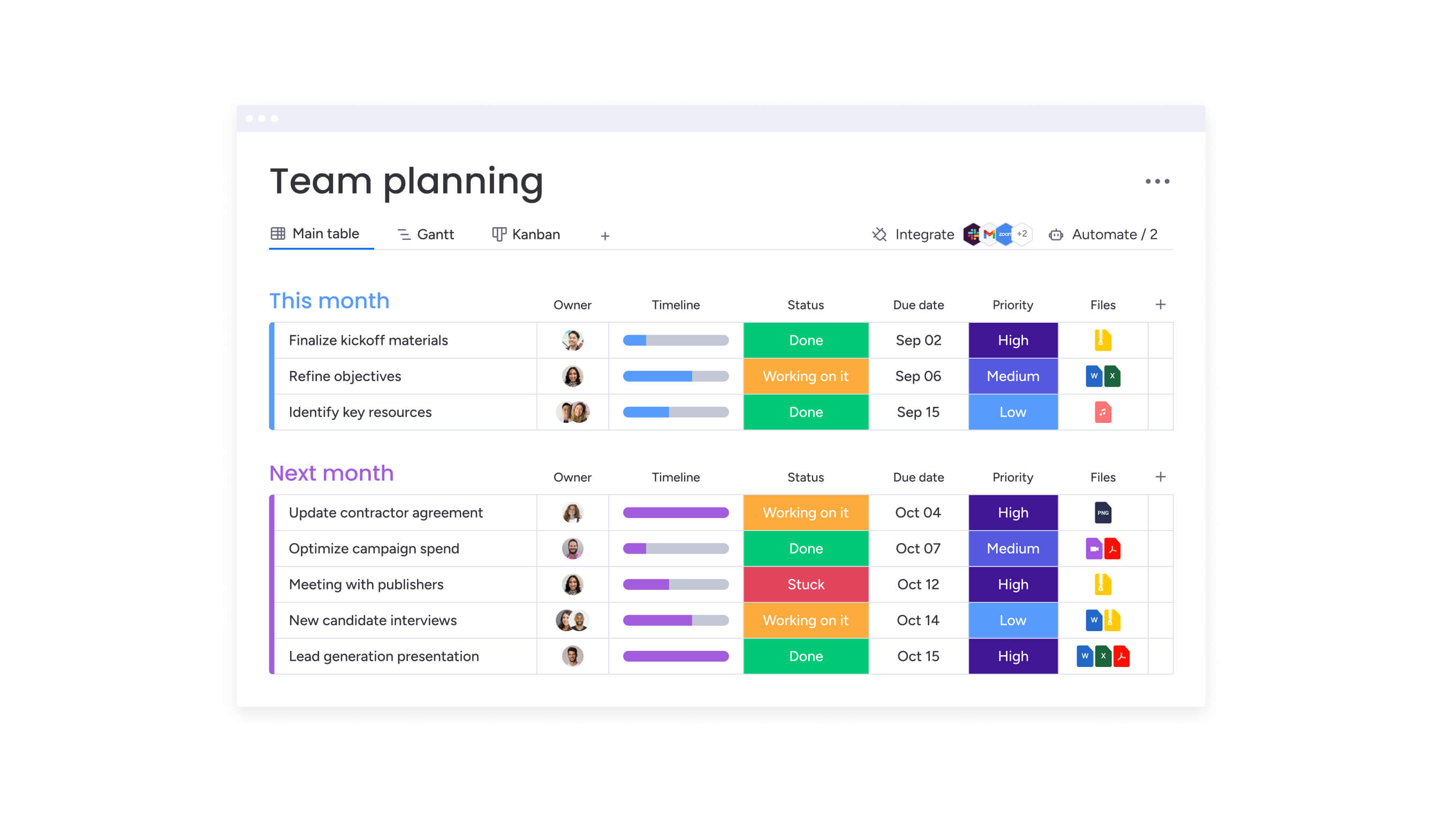
Marketing managers typically juggle a complex tech stack that includes automation platforms, analytics tools, CRM systems, project management software, and creative applications. This fragmentation creates significant challenges: disconnected data, version control issues, and constant context switching between platforms.
The problem compounds when teams use different tools for similar functions. Marketing might track campaigns in one system while creative uses another for production management. Finance tracks budgets separately, and leadership relies on manual reports that quickly become outdated.
Unified platforms reduce this complexity by connecting automation with planning, execution, and reporting. Marketing managers benefit when one platform can replace multiple disconnected tools while offering deeper functionality.
As this connective tissue, monday work management orchestrates work across your existing marketing stack while providing the visibility and control that fragmented platforms can’t deliver.
What are the most effective AI capabilities for marketing?
The best AI software for marketing depends on whether you need content generation or workflow optimization. While many platforms offer AI for creating copy or images, the real value for enterprise marketing teams comes from AI that optimizes operations and surfaces insights.
Embedded AI capabilities make the difference between theoretical potential and practical value. Marketing teams need AI they can use immediately without technical expertise.
Practical AI capabilities for marketing teams:
- AI Blocks for instant analysis: categorize campaign data at scale, analyze sentiment in customer feedback, and summarize complex reports into actionable insights.
- Workflow optimization: automatically assign tasks based on capacity and skills, flag at-risk campaigns, and suggest resource reallocations.
- No-code implementation: deploy AI capabilities directly into existing workflows without waiting for IT or hiring data scientists.
AI Blocks and Digital Workforce from monday work management provide ready-to-use capabilities that marketing teams implement immediately. These tools don’t require technical setup or data science expertise — they work within your existing workflows to reduce manual effort and surface insights that drive better decisions.
Try monday work managementHow to evaluate automation software for your organization
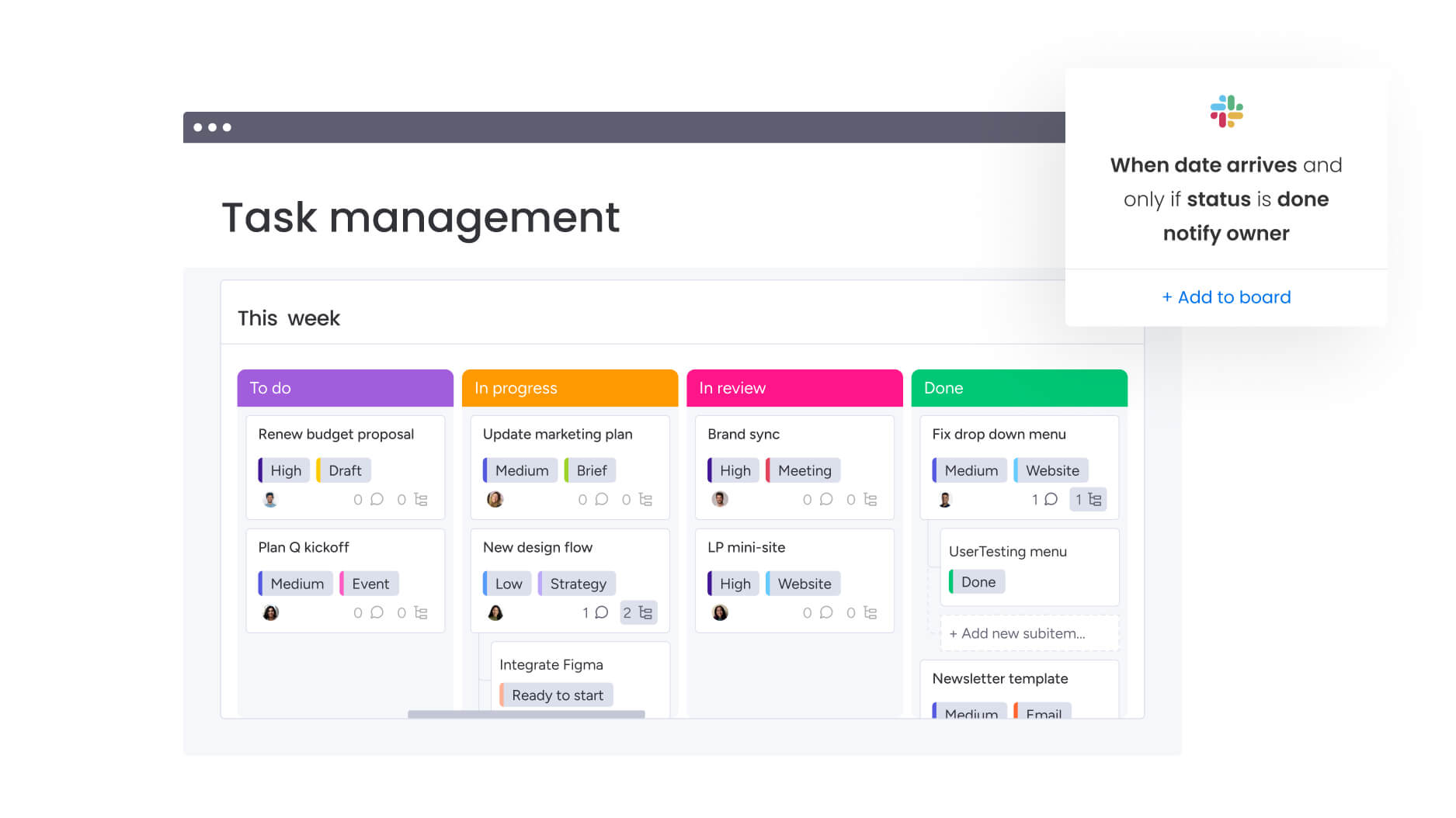
The best automation software depends on your organization’s specific needs and maturity level. Email automation suits teams focused on nurture campaigns. Workflow automation benefits organizations managing complex, multi-team processes. Unified work management serves enterprises that need both capabilities plus cross-functional coordination.
Consider your organizational context when evaluating automation platforms:
Automation needs by organization type:
- Earlystage organizations: focus on ease of use and quick wins with email automation.
- Growthstage companies: prioritize integrations and scalability as marketing complexity increases.
- Enterprise organizations: require unified work management, governance, and cross-functional collaboration.
For organizations prioritizing cross-functional workflow automation and unified visibility, monday work management provides the comprehensive capabilities needed. The intuitive platform combines marketing automation with work management, enabling teams to automate everything from campaign workflows to resource allocation while maintaining governance and control.
Ready to transform your marketing operations?
Marketing leaders who embrace operational excellence gain competitive advantage through faster execution, improved ROI, and empowered teams. The foundation for this transformation comes from monday work management, which connects strategy to execution while giving teams the flexibility to innovate.
The platform’s combination of powerful automation, AI-driven insights, and intuitive collaboration tools enables marketing organizations to achieve more with existing resources while preparing for future growth. By unifying marketing automation with cross-functional work management, teams eliminate silos, gain real-time visibility, and deliver measurable results at scale.
Revolutionize your marketing operations from fragmented processes into unified, efficient workflows that drive measurable business impact. Start building the foundation for operational excellence that scales with your organization’s growth and adapts to changing market demands.
The content in this article is provided for informational purposes only and, to the best of monday.com’s knowledge, the information provided in this article is accurate and up-to-date at the time of publication. That said, monday.com encourages readers to verify all information directly.
Frequently asked questions
How does marketing work management differ from traditional marketing automation platforms?
The primary difference between marketing work management and traditional marketing automation is scope. Marketing work management focuses on orchestrating the entire marketing operation, from planning through execution, while traditional marketing automation primarily handles customer-facing campaign delivery.
What is the typical ROI timeline for marketing teams implementing monday work management?
Marketing teams typically see measurable improvements within four to eight weeks of implementation, with full ROI realized within three to four months. Quick wins include reduced meeting time and faster approval cycles, while longer-term benefits like improved campaign velocity and resource optimization compound over time.
Can monday work management integrate with existing creative production workflows?
Yes, integrations with Adobe Creative Cloud, Figma, Canva, and other creative platforms are available through monday work management while preserving existing workflows. The platform acts as an orchestration layer that connects creative tools with project management, rather than replacing specialized design applications.
How do you measure team productivity and resource utilization with monday work management?
The platform provides real-time workload views, capacity planning tools, and productivity dashboards that track metrics like project completion rates, cycle times, and resource allocation. Marketing leaders monitor individual and team performance while identifying optimization opportunities through automated reporting.
What security features does monday work management offer for media companies?
Enterprise-grade security including SOC 2 Type II certification, GDPR compliance, SSO integration, and granular permission controls are provided by monday work management. Media companies maintain strict access controls for sensitive campaigns while enabling secure collaboration with external agencies and partners.
Does monday work management support multi-channel campaign management?
Yes, the platform enables comprehensive multi-channel campaign orchestration through customizable workflows, integrated calendars, and channel-specific tracking. Marketing teams manage social, digital, print, and event campaigns from unified workspaces while maintaining channel-specific requirements.

 Get started