


Marketing teams running ten-50+ events annually face a coordination challenge that extends beyond logistics. When events span multiple departments and connect to broader campaign goals, a unified approach is essential. Without it, teams often experience disconnected workflows and have difficulty proving ROI to leadership.
The best event management software solves this by unifying event coordination with your entire marketing operation. Instead of managing events in isolation, leading platforms integrate event planning with campaign execution, resource allocation, and performance tracking. This approach eliminates the fragmented workflows that slow down enterprise marketing teams while providing the real-time visibility leaders need to make strategic decisions.
Throughout this guide, you’ll discover the essential capabilities that make event management software truly work for enterprise marketing teams — from seamless cross-functional coordination to powerful automation and analytics that connect directly to your bottom line. Aditionally, we’ll examine how platforms that connect events to broader marketing operations deliver measurable improvements in team collaboration, resource utilization, and campaign impact.
Key takeaways
Running ten-50+ events annually across multiple departments? Your choice of management software isn’t just important — it’s the difference between chaotic execution and strategic impact. Here’s what matters most for enterprise marketing teams:
- Unify events with your entire marketing operation: connect event planning, campaign execution, and performance tracking in one platform so teams stop working in silos and start driving measurable impact.
- Gain real-time visibility across all marketing initiatives: track event progress, team capacity, and ROI through customizable dashboards that show how events contribute to your broader marketing goals.
- Automate approval workflows to eliminate bottlenecks: set up conditional logic that routes event deliverables through legal, finance, and creative teams without manual follow-up or missed deadlines.
- Manage resources strategically across concurrent events: use workload views to prevent team burnout, redistribute work based on skills and availability, and forecast resource needs for upcoming activations.
- Scale event management with monday work management’s enterprise capabilities: leverage 200+ integrations, customizable templates, and AI-powered automation to coordinate ten-50+ annual events across distributed marketing teams.
What makes heads of marketing choose monday work management for event management?
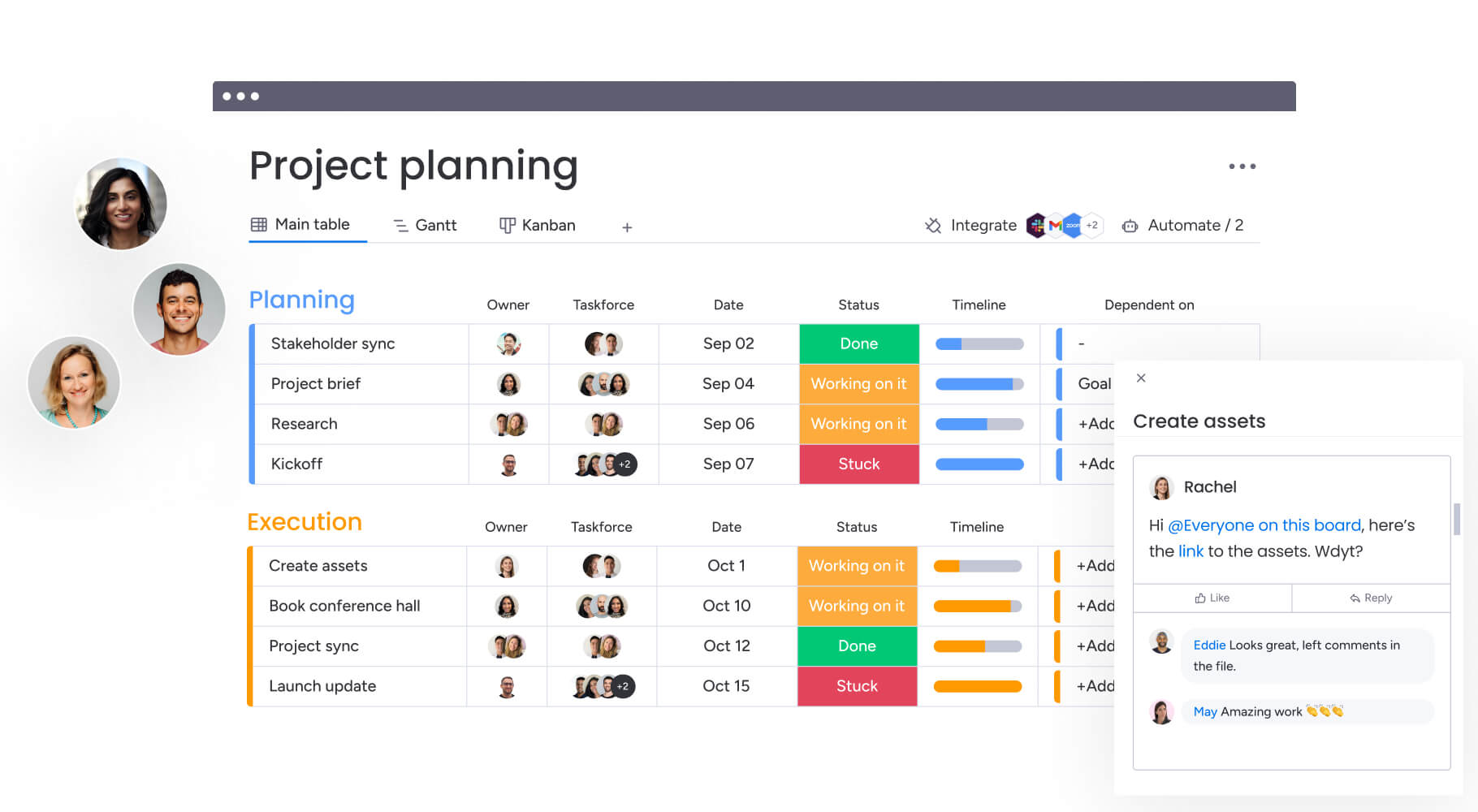
Heads of marketing in media companies face a unique challenge, similar to what an event planner encounters when coordinating complex, multi-channel events and connecting performance to broader marketing goals. Traditional event management tools create yet another data silo, disconnecting your event coordination from campaign execution, creative production, and performance reporting.
Modern solutions like monday work management solve this issue by unifying event coordination with your entire marketing operation. Your event launches, campaign activations, and brand experiences flow seamlessly alongside content production, creative approvals, and performance reporting.
Everything happens in one platform that your 100+ person team actually wants to use.
For marketing leaders managing teams across tech, media, retail, and finance sectors, this integration transforms how work gets done. You can track how events contribute to campaign ROI, allocate resources strategically across concurrent activations, and report impact to executive leadership without manually consolidating data from disconnected systems.
monday work management top features for event management
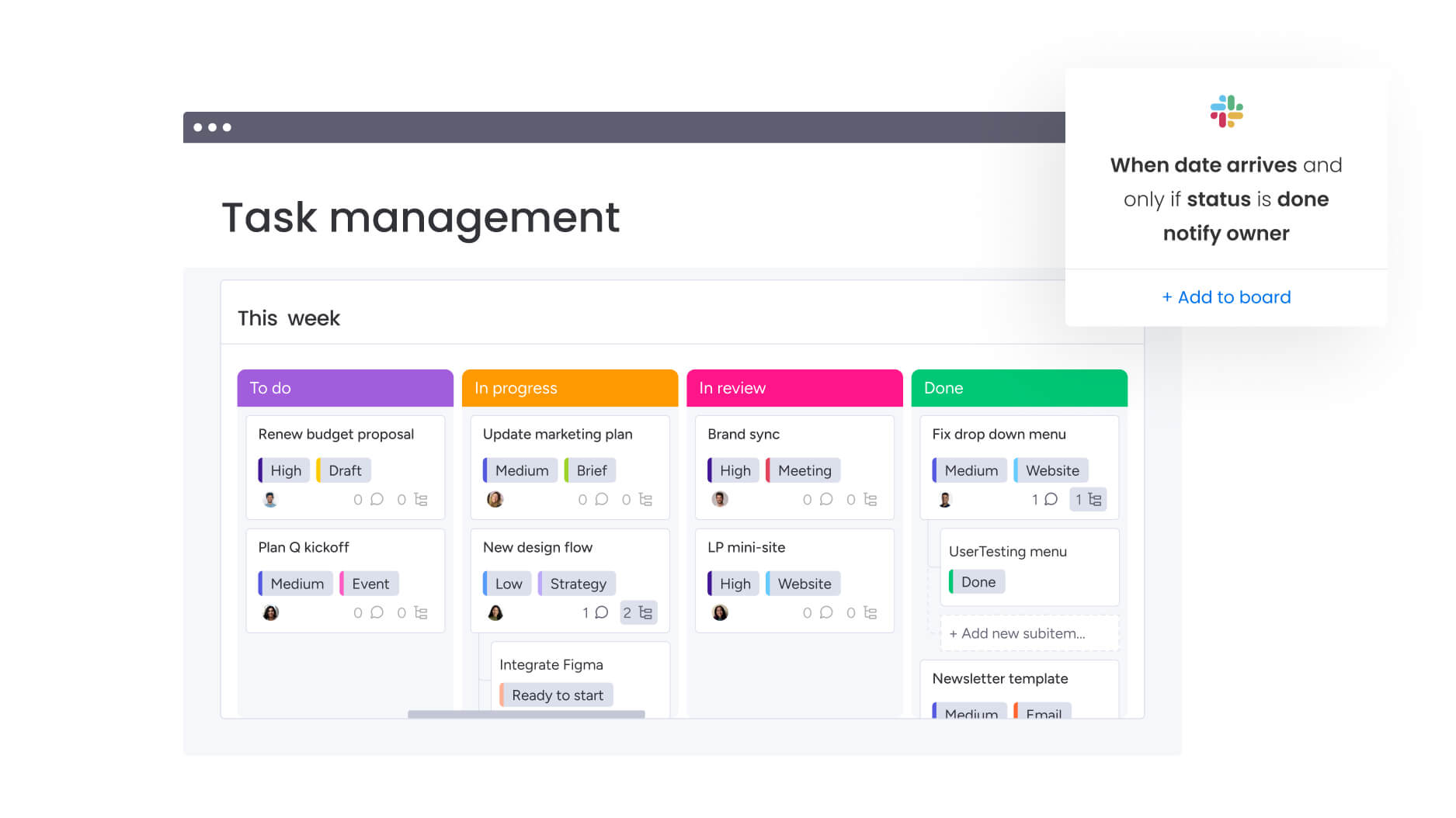
The following features demonstrate how monday work management addresses the specific challenges enterprise marketing teams face when coordinating events at scale. Each capability integrates seamlessly with your broader marketing operations, eliminating the silos that slow down execution and reduce visibility.
Event management workflows
The easy-to-use monday work management platform provides dedicated event management capabilities that allow you to plan, track, and execute both in-person and virtual events from a single collaborative workspace. The platform includes:
- Customizable event boards with timeline views and calendar integration.
- Automated status tracking that keeps every stakeholder aligned on event progress.
- Dependency tracking that automatically updates timelines when delays occur.
For heads of marketing managing multiple concurrent events across distributed teams, this eliminates the disconnected execution that plagues siloed organizations. You can standardize event workflows with reusable templates while customizing each activation to match specific campaign requirements.
Real-time dashboards and analytics
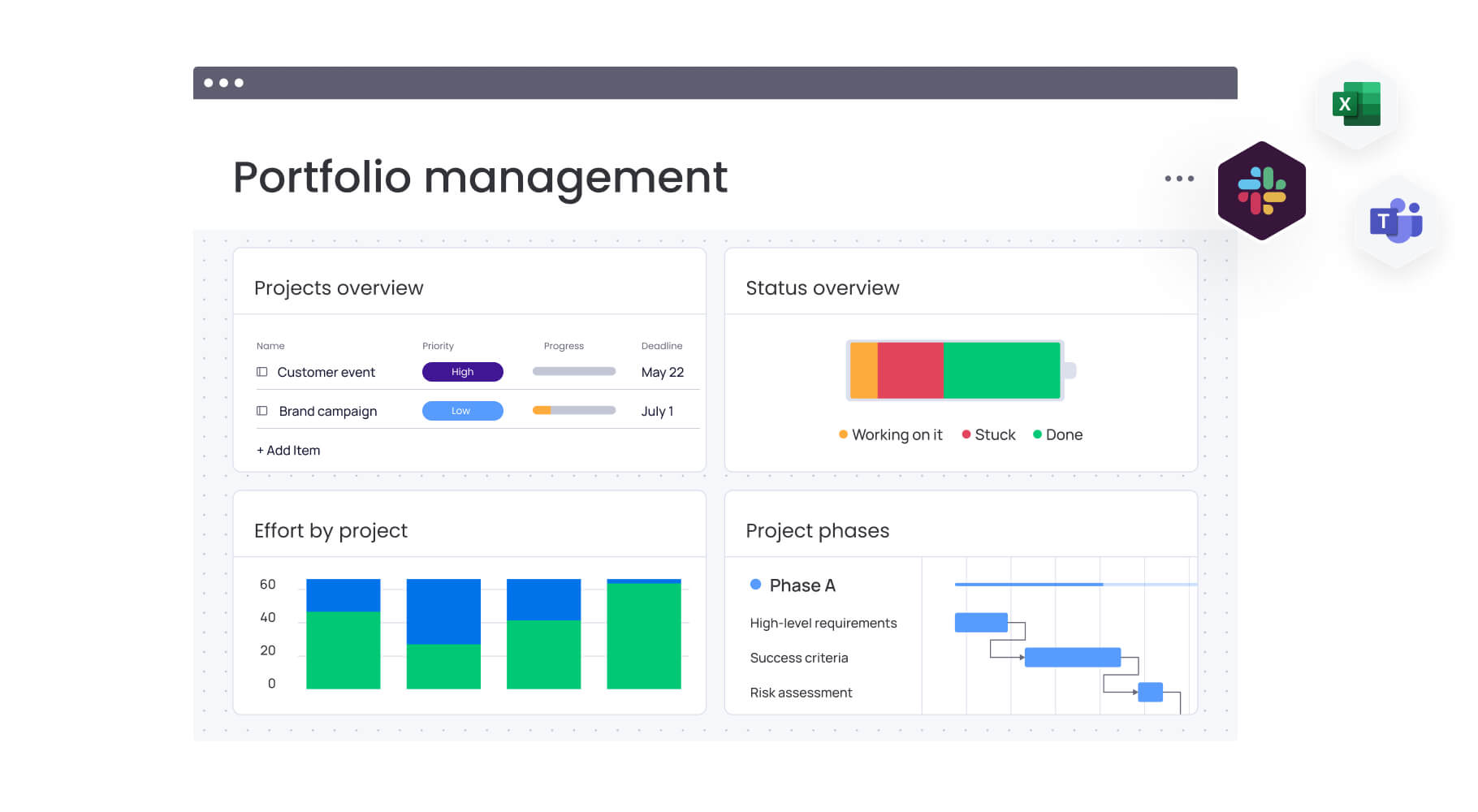
The platform’s dashboard capabilities provide instant visibility into event performance, team capacity, and budget adherence through customizable widgets that pull data directly from your event workflows. You can create:
- Executive-level dashboards showing event ROI metrics.
- Team-level views tracking task completion rates and resource utilization.
- Real-time monitoring of registration trends and budget burn rates.
This addresses the lack of real-time visibility that prevents marketing leaders from making data-driven decisions about resource allocation and event prioritization. Instead of waiting for post-event reports compiled from multiple systems, you can monitor performance as it happens.
Resource and workload management
monday work management includes built-in resource management capabilities that provide visibility into team capacity across all marketing initiatives, including events. Key features include:
- Workload views showing individual and team bandwidth.
- Overallocation alerts to prevent burnout before it happens.
- Time tracking features for accurate resource forecasting.
- Skills-based redistribution tools for optimal resource allocation.
For marketing leaders managing 50-100+ person teams across content, creative, acquisition, events, and operations, this solves the poor resource utilization that causes misalignment and missed deadlines.
Cross-functional approval workflows
Streamline your approval process. The platform’s automation routes deliverables through legal, finance, and creative teams automatically, enabling proactive communication and timely sign-offs. Features include:
- Conditional logic that triggers specific approval paths based on event type, budget threshold, or content category.
- Automated notifications when stakeholder review is needed.
- In-context feedback capabilities for streamlined collaboration.
- Single-click workflow progression to eliminate bottlenecks.
This eliminates the typical bottlenecks where marketing plans get stuck waiting for legal approval or finance sign-off — the exact pain points that repeatedly delay your event launches.
Marketing automation integration
monday work management integrates natively with major marketing automation platforms, CRM systems, and analytics tools through 200+ pre-built integrations and an open API. This enables:
- Automatic data flow into your broader marketing technology stack.
- Event registration to lead scoring connections.
- Attendance to customer journey tracking integration.
- Seamless attribution across all marketing touchpoints.
How can you connect event performance directly to business results? These integrations unify your data, revealing the true ROI of your events and connecting their success to your overarching marketing goals. Event metrics automatically populate your marketing dashboards alongside campaign performance and content engagement.
Customizable templates and standardization
The platform provides extensive template libraries for recurring event types while allowing complete customization to match your specific workflows and branding requirements. You can:
- Create master event templates with all standard tasks, approval gates, and deliverables.
- Customize each instance based on event scale and format.
- Maintain consistent processes across your organization.
- Focus on creative differentiation rather than operational setup.
This solves the inefficient processes that force teams to reinvent workflows for each event activation. By standardizing the repeatable elements of event execution, you free your teams to focus on the creative and strategic elements that differentiate each activation.
How a head of marketing in media benefits from monday work management
monday work management doesn’t just help you run events — it transforms how your entire marketing operation functions. Marketing teams using the platform report measurable improvements across multiple dimensions that directly impact business outcomes and team effectiveness.
Operational efficiency gains
- Time savings: marketing teams save thousands of hours monthly through automated workflows and standardized processes.
- Cost efficiency: organizations achieve significant ROI by consolidating multiple event tools into one platform.
- Compliance and accuracy: automated approval workflows and centralized documentation ensure legal and financial compliance.
Team performance improvements
- Productivity improvements: teams report substantial improvement in cross-team collaboration and reduction in email exchanges.
- Output quality improvements: creative teams produce more output with streamlined approval processes.
- Visibility and tracking improvements: real-time dashboards provide instant visibility into event progress and team capacity.
How to manage enterprise events with monday work management
Ready to get started? Here’s your roadmap for building an event management system that actually connects to the rest of your marketing machine. Each step builds on the previous one to create a unified system that scales with your organization’s needs.
Step 1: centralize event planning in unified workspaces
Create dedicated event boards that bring together all stakeholders, timelines, budgets, and deliverables in one collaborative space. Use the platform’s customizable columns to track event-specific data like:
- Venue details and logistics coordination.
- Speaker confirmations and content requirements.
- Sponsor commitments and partnership deliverables.
- Registration milestones and attendance tracking.
Step 2: standardize workflows with reusable templates
Build master event templates that include all standard tasks, approval gates, and deliverables for your recurring event types. This approach allows you to:
- Maintain consistency across all event activations.
- Reduce setup time for new events.
- Ensure compliance with organizational requirements.
- Customize instances based on event scale and format.
Step 3: automate approval and notification workflows
Set up automated workflows that route event deliverables through legal, finance, and creative stakeholders based on conditional logic. Configure:
- Automatic routing based on event type and budget thresholds.
- Notification triggers when team member input is needed.
- Deadline alerts to prevent last-minute rushes.
- Escalation paths for overdue approvals.
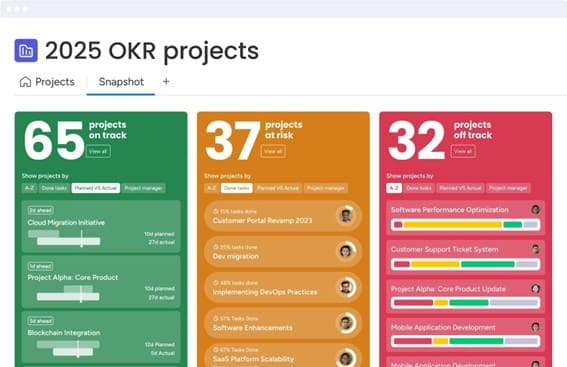
Step 4: connect events to marketing OKRs and campaigns
Link event boards to your broader marketing strategy boards, campaign calendars, and OKR tracking systems. Use the platform’s mirroring and dependency features to:
- Show event contribution to higher-level marketing objectives.
- Track ROI impact across all marketing initiatives.
- Align resource allocation with strategic priorities.
- Report unified performance to executive leadership.
Step 5: monitor capacity and allocate resources strategically
Use Workload views to visualize team capacity across all marketing initiatives, including events. This enables you to:
- Identify overallocation before it leads to burnout.
- Redistribute work based on skills, availability, and strategic priorities.
- Forecast resource needs for upcoming events.
- Balance workloads across concurrent activations.
Step 6: track performance and optimize continuously
Build dashboards that monitor event KPIs in real time. Use these insights to:
- Identify bottlenecks in your event execution process.
- Optimize resource allocation for future events.
- Improve workflows based on actual performance data.
- Demonstrate ROI to stakeholders and leadership.
Comparison table: monday work management vs competing platforms
Not all event management platforms are built for enterprise marketing teams. Many tools excel at running individual events, but fall short when events need to connect to campaigns, resources, approvals, and executive reporting across the wider marketing organization.
The comparison below highlights an important difference: event-only platforms vs platforms that manage events as part of your full marketing operation. While tools like Cvent, Eventbrite, and Bizzabo focus on registration and attendee experience, monday work management is designed to support portfolio-level visibility, cross-functional execution, and strategic alignment across all marketing work — including events.
| Feature | monday work management | Cvent | Eventbrite | Bizzabo |
|---|---|---|---|---|
| Unified marketing operations | ✓ Full integration with campaigns, creative, and strategy | ✗ Event-only platform | ✗ Event-only platform | ✗ Event-only platform |
| Resource management | ✓ Built-in workload views and capacity planning | ✗ Limited resource features | ✗ No resource management | ✗ Basic resource tracking |
| Custom workflow automation | ✓ No-code automation builder | ○ Limited automation options | ✗ Minimal automation | ○ Pre-set automations only |
| Cross-functional approvals | ✓ Customizable approval workflows | ○ Basic approval routing | ✗ No approval workflows | ○ Limited approval features |
| Marketing tech integration | ✓ 200+ native integrations + open API | ○ Select integrations | ○ Limited integrations | ○ Select integrations |
| OKR and goal tracking | ✓ Native goals and OKRs features | ✗ No goal tracking | ✗ No goal tracking | ✗ No goal tracking |
| Pricing model | Unlimited events, per-user pricing | Annual license + per-registrant fees | Per-event or subscription | Starts at $499/user/month (3-user minimum) |
| Implementation time | Days to weeks with templates | Weeks to months | Days | Weeks |
How SPH Media transformed their marketing operations
Here’s the story of how SPH Media transformed their marketing chaos into streamlined execution — with results you can actually measure.
The challenge
SPH Media, a leading media group in Singapore with over 40 media brands, faced a critical operational challenge. Managing media campaigns across multiple channels required timely communication between creative, content, sales, and ad operations teams. Their existing process relied heavily on manual work, and as the business expanded, managing campaigns became increasingly unsustainable.
The solution
SPH Media implemented monday work management to create a centralized platform for managing hundreds of campaigns across 130+ team members. They developed a customized solution offering both high-level and granular views of every project. The platform’s customizable API enabled automatic synchronization between advertiser bookings and creative production processes.
The results
The results speak for themselves:
- Hundreds of campaigns tracked in one unified platform.
- 130+ people managing work collaboratively with full visibility.
- 40 brands reaching audiences across Asia with streamlined operations.
- Automated workflows eliminated information silos and reduced missed deadlines.
- Real-time visibility enabled stakeholders to drill into specific tasks or zoom out to track overall campaign delivery.
Power your event marketing operations with unified work management
In 2026 the realist is that your team has outgrown basic event tools. You now need something that connects your events directly to your marketing strategy, budget, and goals.
monday work management delivers this integration while providing the scalability, automation, and visibility that modern marketing organizations require.
The platform’s comprehensive approach unifies operations, which accelerates execution and enhances visibility across all initiatives. By connecting event management to campaign execution, resource planning, and strategic goal tracking, marketing leaders can demonstrate clear ROI while empowering their teams to execute memorable brand experiences at scale.
Teams using monday work management collaborate more effectively, launching campaigns faster, maximizing their resources, and hitting their targets with improved foresight and planning. The platform’s template library and automation capabilities enable rapid implementation while maintaining the flexibility to adapt to your specific workflows and requirements.
The content in this article is provided for informational purposes only and, to the best of monday.com‘s knowledge, the information provided in this article is accurate and up-to-date at the time of publication. That said, monday.com encourages readers to verify all information directly.
Frequently asked questions
How does monday work management integrate with existing marketing technology stacks?
monday work management offers 200+ native integrations with major marketing platforms including Salesforce, HubSpot, Marketo, Google Analytics, Slack, Microsoft Teams, and Zoom. The platform also provides an open API that enables custom integrations with proprietary systems. Event data flows automatically into your CRM for lead tracking and marketing automation platforms for nurture campaigns.
What's the typical ROI timeline for event management platforms?
Organizations using monday work management typically see measurable ROI within four months. Marketing teams report immediate time savings from workflow automation and improved cross-team collaboration within the first quarter.
Can event management software handle both B2B and B2C events?
Yes, monday work management supports all event types and formats. The platform's customization capabilities allow you to create distinct workflows for different event types while maintaining standardized processes for recurring elements like approvals, vendor management, and budget tracking.
How do you measure event success beyond attendance numbers?
monday work management enables comprehensive event measurement by connecting event data to broader marketing metrics. Track registration conversion rates, attendee engagement scores, lead quality from event captures, and post-event pipeline contribution within customizable dashboards. The platform's integration with marketing automation and CRM systems allows you to measure long-term event impact on customer journey progression.
How do you structure an event management process?
Event management platforms focus exclusively on event logistics like registration, ticketing, and attendee engagement. Work management platforms like monday work management provide these event capabilities within a broader operational framework that includes campaign management, resource planning, creative production, and strategic goal tracking.
How long does implementation take for enterprise marketing teams?
Implementation timelines vary based on organizational complexity, but marketing teams typically achieve initial value within days to weeks using monday work management's template library. For enterprise-wide rollouts across 100+ person marketing organizations, structured implementations with dedicated onboarding support typically reach full adoption within two to four months.

 Get started