


Your organization runs on dozens of moving parts. Teams coordinate across departments, projects span multiple systems, and leadership needs visibility into what’s actually happening versus what was planned. When work is scattered across disconnected platforms, even well-intentioned teams struggle to maintain momentum, meet deadlines, and deliver consistent results.
Teams are moving beyond simple task lists to platforms that actually connect their entire operation — a game-changer in how companies get work done. Rather than managing individual tasks in isolation, organizations now orchestrate entire workflows with platforms that connect strategy to execution. This approach provides real-time visibility, automates routine coordination, and ensures every team member understands how their work contributes to broader objectives.
Let’s cut through the noise and show you what actually matters when choosing operations software — from AI that works for you, to customization you can handle yourself, to systems that grow with your business.
Explore our guide below and discover how to evaluate platforms based on your organization’s specific needs, understand realistic implementation timelines, and see how unified operations transform scattered work into strategic execution.
Key takeaways
- Replace scattered tools with unified operations: consolidate five to ten disconnected platforms into one system where all teams collaborate, eliminating data silos and manual coordination that waste hours daily.
- Gain real-time visibility across your entire organization: see project progress, resource allocation, and risks instantly through AI-powered dashboards that surface issues before they become crises.
- Accelerate implementation with weeks-to-value platforms: modern business operations software delivers measurable ROI within 30-60 days, not the six to twelve months traditional enterprise tools require.
- Scale workflows without coding dependencies: enable each department to build custom processes while maintaining enterprise governance and standardized reporting across all teams.
- Transform operations with monday work management’s AI-driven automation: leverage Digital Workers that monitor projects continuously, AI Blocks that categorize data at scale, and portfolio dashboards that track 1,000+ projects in real-time.
Understanding business operations software
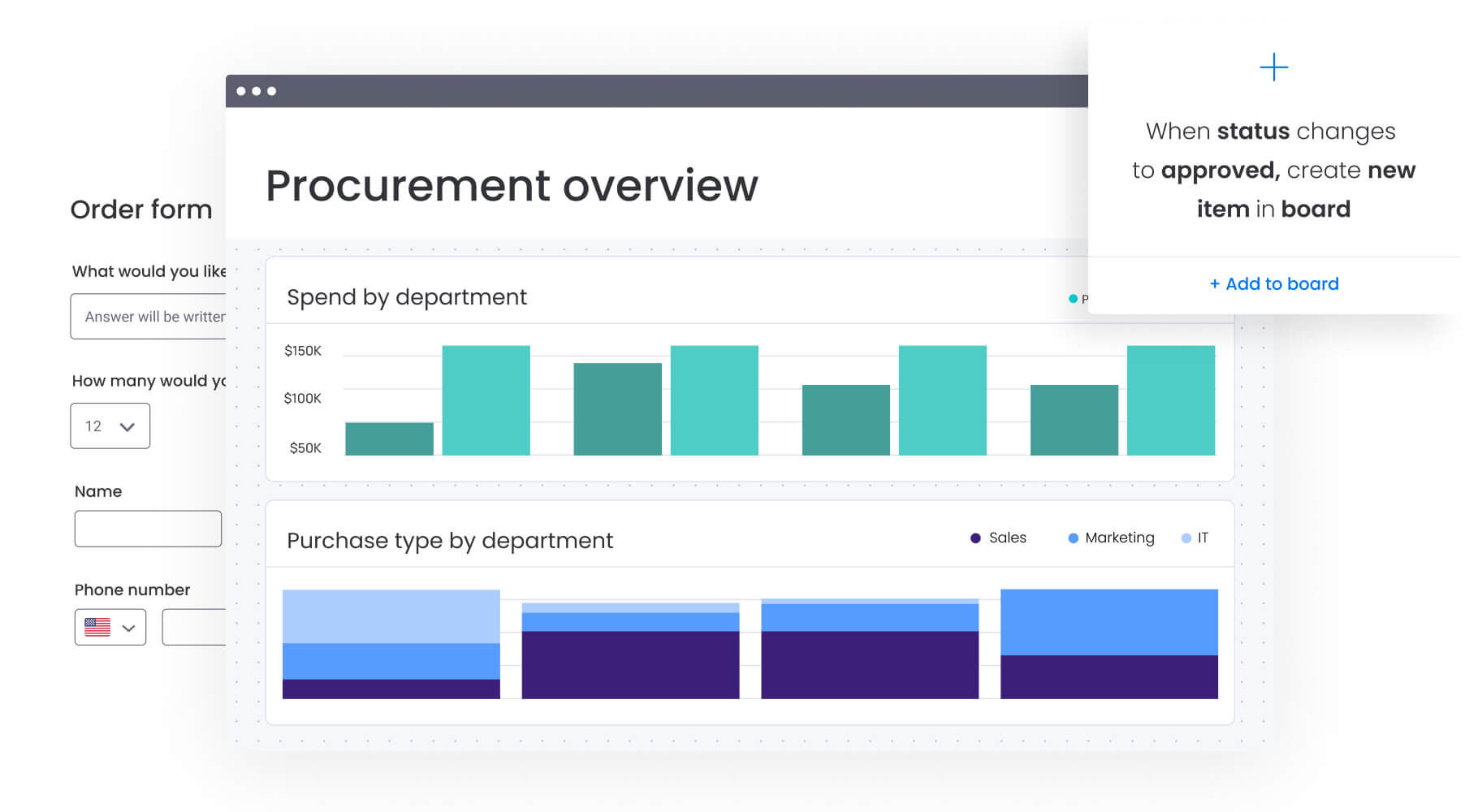 Business operations software helps organizations coordinate work across teams, systems, and priorities from a single operational layer. Instead of managing projects, resources, and reporting in isolation, teams use one connected platform to plan, execute, and track work as it moves across the organization.
Unlike basic project or task tools, modern business management software solutions focus on how work flows end to end. They connect people, processes, and data so project managers can see dependencies, allocate resources effectively, and keep execution aligned with business goals in real time.
For media organizations especially, this matters because work rarely stays within one team. Campaigns move between creative, production, sales, operations, and leadership. Business operations software provides the structure to manage that complexity without forcing teams to abandon the tools or workflows they already rely on.
Why organizations need business operations software in 2026
The gap between strategy and execution has never been wider. In many B2B software scenarios, organizations using five to ten disconnected tools lose visibility into work, create data silos, and waste resources on manual coordination. Meanwhile, priorities shift faster than ever, teams span time zones and systems, and leadership needs real-time insights to make confident decisions.
Business operations software addresses these fundamental challenges by providing four key capabilities that transform how work gets done, similar to business process management software in many large-scale organizations:
- Unified workflows: consolidate fragmented work into one platform where all teams operate.
- Real-time visibility: see progress, risks, and resource allocation across departments instantly.
- Automated processes: eliminate repetitive tasks and manual handoffs that slow execution.
- Strategic alignment: connect daily work to business objectives with measurable accountability.
We’re seeing a real mindset change. Smart companies don’t just track projects anymore — they’re building connected workflows across departments while letting AI handle the repetitive stuff so their people can focus on what actually moves the needle.
How to evaluate business operations software for enterprise scale
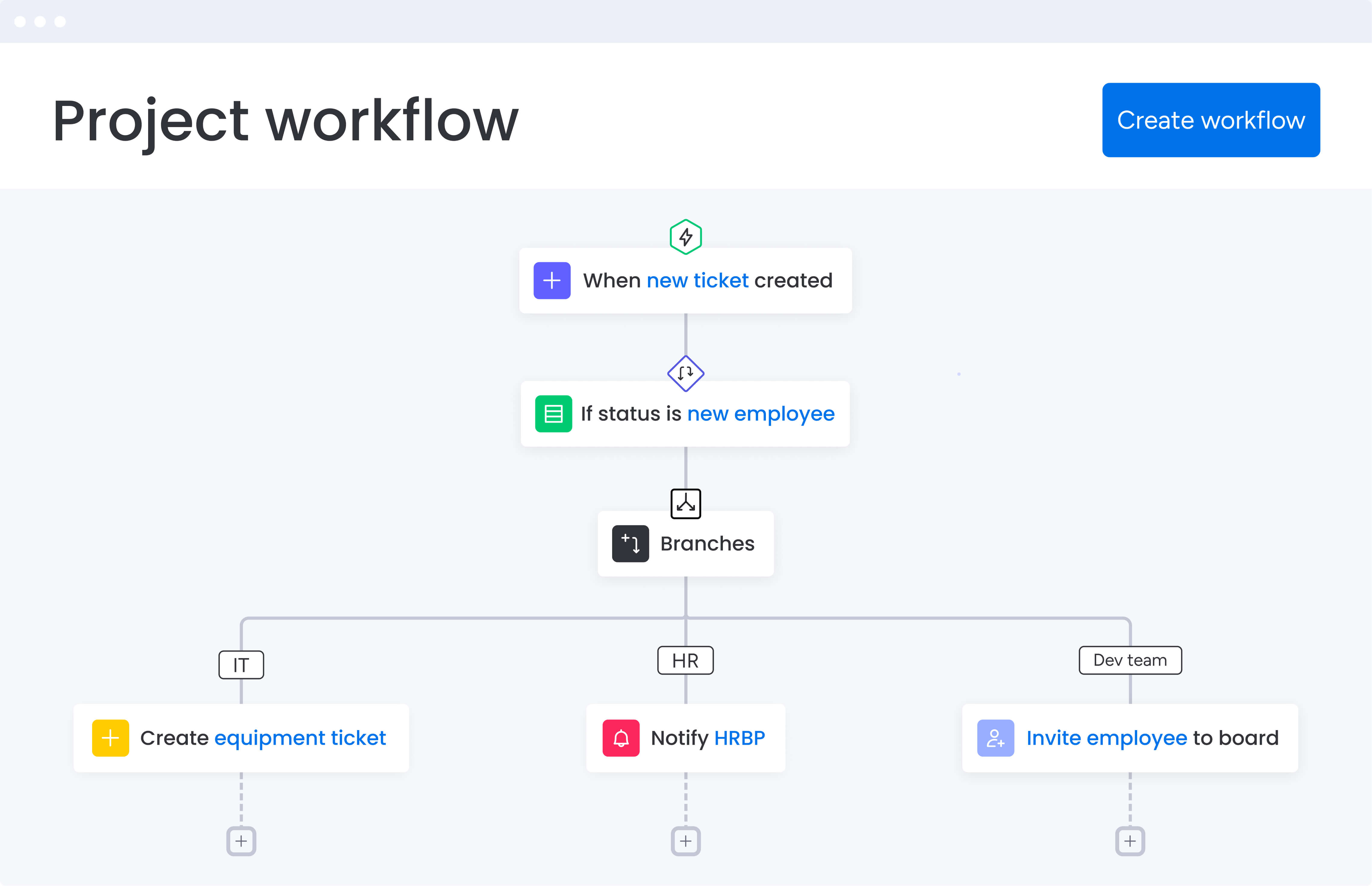
Selecting the right platform starts with understanding which capabilities truly matter for scale and complexity. Enterprise organizations need more than feature lists — they need systems that balance flexibility with governance, which is why enterprise management software can be transformative.
Step 1: evaluate AI and automation capabilities
The best platforms have AI built into their DNA — not just slapped on as a marketing feature. Here’s what real AI capabilities should do for you:
- Proactive risk identification: AI that analyzes patterns across projects to flag delays before they happen.
- Intelligent resource allocation: automated matching of tasks to people based on skills, availability, and capacity.
- Predictive insights: analytics that help optimize workflows and prevent bottlenecks.
- Digital workers: AI agents that continuously monitor, adjust, and optimize processes.
For example, some platforms exemplify this approach with AI blocks that categorize data at scale, product power-ups that identify risks across portfolios, and digital workers that proactively monitor projects and suggest optimizations.
Step 2: assess customization without coding requirements
Enterprise teams need to adapt quickly without IT bottlenecks. No-code customization enables organizations to balance flexibility with control through:
- Team-level flexibility: each department builds workflows matching their unique processes.
- Enterprise governance: leadership maintains visibility and standardized reporting across all teams.
- Rapid iteration: adjust workflows as priorities shift without development resources.
- Template standardization: scale best practices while allowing local adaptation.
This balance between flexibility and control is critical. Marketing needs different workflows than finance, yet leadership requires unified reporting across both departments, often supported by accounting practice management software and real-time dashboards.
Step 3: review integration ecosystem capabilities
Standalone platforms create silos that undermine operational efficiency. Your business operations software must connect seamlessly with existing systems through comprehensive integration options:
- Native integrations: pre-built connections to tools like Slack, Microsoft Teams, Salesforce, and Adobe Creative Cloud.
- Open APIs: flexibility to build custom integrations for specialized systems.
- Bi-directional sync: data flows both ways, maintaining accuracy across platforms.
- Automated workflows: trigger actions across systems without manual intervention.
When a deal closes in Salesforce, your operations platform should automatically trigger onboarding workflows. When a campaign launches in your marketing tools, resource allocation should update instantly.
Step 4: examine real-time reporting and dashboard features
Visibility drives decision-making at every organizational level. Enterprise platforms must provide comprehensive reporting capabilities that scale with your operations:
- Portfolio-level views: monitor hundreds of projects simultaneously.
- Drill-down capabilities: move from high-level metrics to task-level details instantly.
- Custom metrics: track KPIs specific to your business and industry.
- Automated reporting: generate and distribute insights without manual compilation.
monday work management’s portfolio dashboards scale to 1,000+ projects while maintaining real-time accuracy, giving leaders instant visibility into progress and risks across the entire organization.
How business operations software transforms visibility and accountability
.jpg)
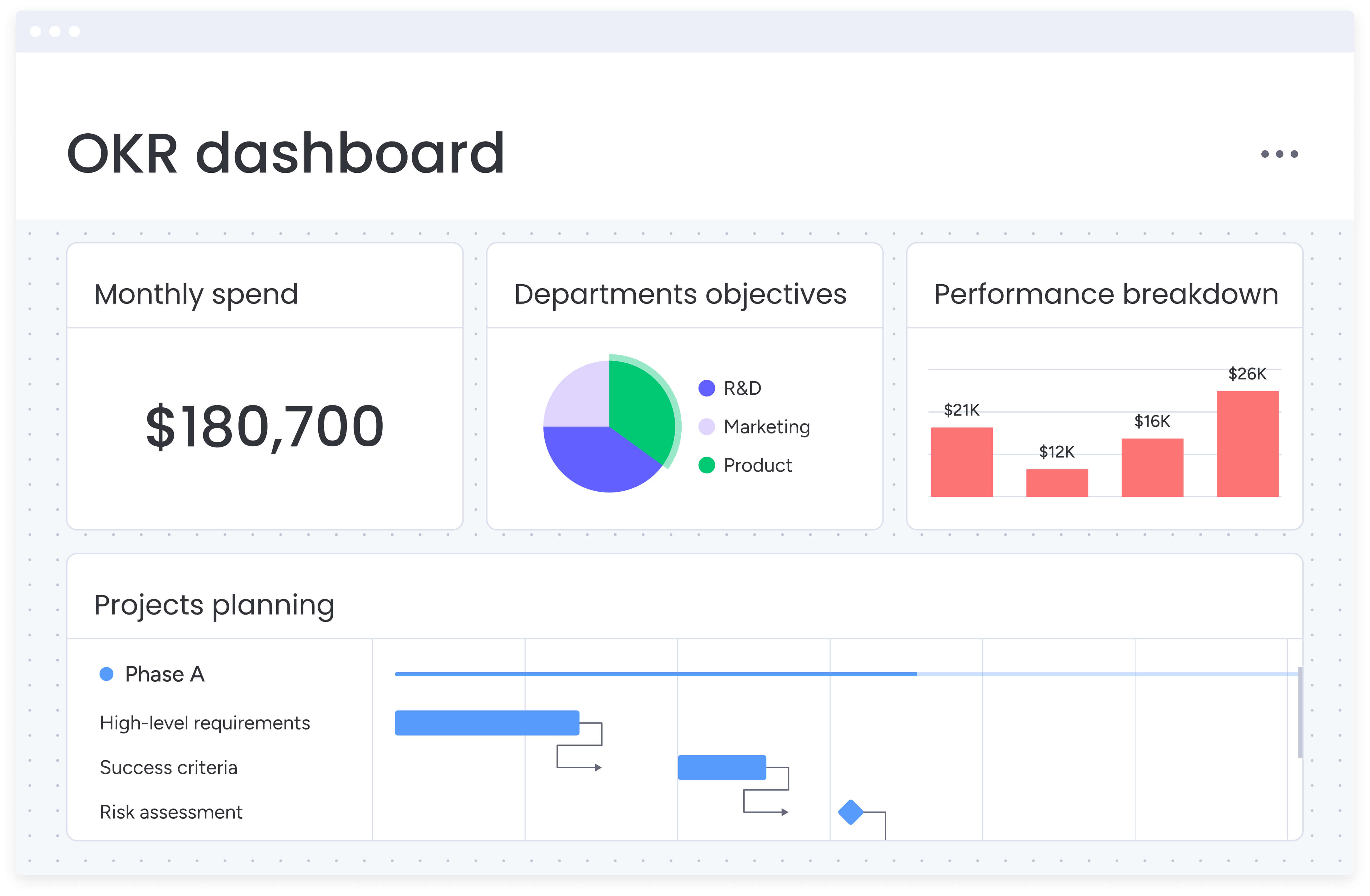
The transformation from scattered work to unified operations fundamentally changes how organizations function. This shift creates measurable improvements in transparency, ownership, and decision-making quality across all departments and levels.
Before implementing business operations software, teams often operate in isolation. Sales doesn’t know what marketing is planning, operations can’t see IT’s capacity, and leadership lacks real-time visibility into execution.
After implementation, the entire organization gains four critical advantages:
- Complete transparency: every stakeholder sees project status, ownership, and dependencies.
- Clear accountability: tasks have defined owners with automated status tracking.
- Proactive management: issues surface before they become crises.
- Data-driven decisions: live insights replace outdated reports and assumptions.
We’re talking about more than basic status updates here. Picture this: AI constantly scanning your entire project portfolio, flagging potential problems before they blow up, and showing exactly where your team’s attention is needed — all in one view that doesn’t require three different logins.
Speed to value: what to expect from modern business operations platforms
Forget the year-long implementation nightmares of the past. Leading platforms start delivering real results in weeks, not quarters — and your teams will actually thank you for it.
Understanding realistic timelines helps set proper expectations and ensures successful adoption across your organization:
- Week one to two: initial setup and team onboarding.
- Week three to four: first automated workflows live.
- Month 2: department-wide adoption and initial ROI.
- Month 3: cross-functional workflows and advanced automation.
- Month 4: full portfolio visibility and optimization.
The key differentiator is adoption rate. Platforms with intuitive interfaces achieve 90%+ adoption because teams actually want to use them. This high engagement ensures data accuracy, process compliance, and compounding value over time.
monday work management accelerates this timeline through managed templates that standardize entire workspaces at scale, allowing organizations to replicate successful workflows across hundreds of projects instantly.
Comparing leading business operations platforms
When weighing up solutions, focus on how each platform addresses your specific operational challenges. The following comparison highlights key differentiators between unified work management platforms and traditional enterprise software:
| Capability | monday work management | Traditional platforms |
|---|---|---|
| Implementation time | Weeks to value | 6-12 months typical |
| Adoption rate | 90%+ user adoption | Variable, often low |
| AI integration | Native AI throughout | Often bolted on |
| Customization | No-code flexibility | Requires IT resources |
| Scalability | 1,000+ projects | Performance degrades |
| Resource management | Built-in directory and planner | Separate tools needed |
| Cross-project dependencies | Native visualization | Limited or manual |
The difference becomes obvious when you see the key features of these platforms side-by-side.
Legacy platforms might help you track projects, but a Work OS like monday work management connects your entire operation while giving you both the flexibility teams need and the visibility leadership demands.
Building your business operations software evaluation framework
Choosing business operations software is a strategic decision, not a tools comparison. The right platform will shape how teams collaborate, how leaders make decisions, and how work scales as complexity increases.
This evaluation framework helps you assess platforms based on real operational readiness — not demos or feature lists. It focuses on the factors that determine long-term success: technical fit, organizational alignment, and process maturity. Use it to identify risks early, set realistic expectations, and select software that your teams will actually adopt and grow with.
Step 1: assess technical readiness
Evaluate your organization’s technical foundation to ensure smooth integration and data flow:
- Data quality: is your data clean, accessible, and API-ready?
- Workflow prototyping: can you prototype workflows without IT dependency?
- Integration mapping: do you have integration requirements mapped?
Step 2: evaluate organizational alignment
Strong leadership support and team buy-in are critical for successful transformation:
- Leadership commitment: does leadership support operational transformation?
- Process standardization: are teams ready to standardize core processes?
- Change management: is there budget allocated for change management?
Step 3: review process maturity
Understanding your current process state helps determine implementation complexity:
- Documentation: are workflows documented and repeatable?
- Ownership clarity: do you have clear ownership for key processes?
- Efficiency measurement: can you measure current operational efficiency?
Use this framework to identify gaps before selection. Organizations with strong alignment across all three dimensions see faster implementation and higher ROI.
How monday work management unifies business operations at scale
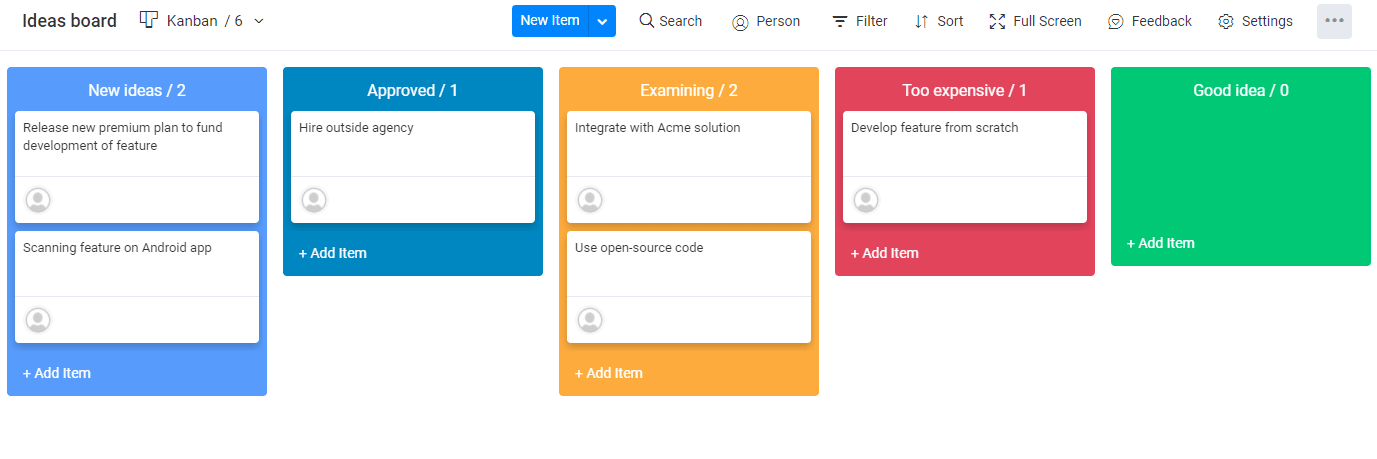
Intuitive solutions like monday work management bring together the capabilities enterprises need to transform operations. The platform provides three core pillars that address enterprise complexity while maintaining the flexibility teams need to work effectively.
- Leadership visibility surfaces what matters most through intelligent automation and real-time insights. AI-powered portfolio reports generate executive summaries instantly, while risk insights proactively flag issues across hundreds of projects. Leaders gain the confidence to make decisions based on real-time data, not outdated reports.
- Standardization and alignment ensure consistency without rigidity across all departments and teams. Managed templates standardize workflows across the organization while allowing team-level customization. Cross-project dependencies visualize connections between initiatives, preventing conflicts and ensuring smooth execution.
- Resource optimization maximizes your talent’s impact through intelligent allocation and capacity planning. The resource directory centralizes people and skills data, while the capacity manager provides live visibility into workload distribution. Teams can plan resources at the project level while leadership maintains portfolio-wide oversight.
These capabilities work together seamlessly. When marketing plans a campaign, the platform automatically checks resource availability, flags dependencies with other departments, and surfaces any risks to leadership — all without manual coordination.
Making your business case for operations software investment
Quantifying the value of business operations software requires looking beyond simple ROI calculations, much like business planning software frameworks do for forecasting. Consider the total cost of your current state across five key areas that impact every organization:
- Tool proliferation costs: licensing for five to ten disconnected platforms.
- Context-switching waste: two to three hours per person daily jumping between tools.
- Coordination overhead: time spent in status meetings and email chains.
- Opportunity costs: delayed decisions due to poor visibility.
- Quality issues: rework caused by miscommunication and missed handoffs.
Against these costs, unified platforms deliver measurable value through faster execution, reduced manual work, improved resource utilization, and stronger strategic alignment. Organizations using monday work management report saving thousands of hours annually through automation alone, while improved visibility enables faster, more confident decision-making at every level.
Transform your operations with unified work management today
Business operations software represents a fundamental shift from managing individual projects to orchestrating work across your entire enterprise. The organizations that embrace this transformation gain competitive advantages through improved visibility, faster execution, and better resource utilization.
Platforms like monday work management provide the AI-driven automation, no-code customization, and enterprise-grade scalability needed to unify operations without sacrificing team flexibility. With implementation timelines measured in weeks rather than months, the opportunity cost of maintaining fragmented operations continues to grow.
Your teams are wasting too much time jumping between tools and meetings. The real question is: how quickly can you give them a system that actually helps them do their best work?
The content in this article is provided for informational purposes only and, to the best of monday.com’s knowledge, the information provided in this article is accurate and up-to-date at the time of publication. That said, monday.com encourages readers to verify all information directly.
Frequently asked questions
What type of business operations software is most effective for unifying workflows across departments?
The best business operations software for unifying workflows provides customizable boards that serve different departments while maintaining portfolio-level reporting. Platforms like monday work management excel here by offering no-code customization that lets each team work their way, while enterprise features like managed templates and cross-project dependencies ensure consistency and visibility across the organization.
How can business operations software improve visibility and resource allocation?
Business operations software improves visibility through real-time dashboards that show portfolio progress, resource capacity, and project health instantly. Automated status updates and AI-powered insights eliminate blind spots, while features like workload views and resource planners help optimize allocation based on skills, availability, and priorities.
Which business operations platforms offer AI-powered automation?
Leading platforms like monday work management embed AI throughout operations with capabilities like AI Blocks for data categorization and summarization, Product Power-ups for risk identification, and Digital Workers that monitor projects continuously. These go beyond basic automation to provide proactive optimization and intelligent resource allocation.
How quickly can teams adopt business operations software?
Modern business operations platforms achieve 90%+ adoption rates within two to four weeks due to intuitive interfaces and minimal training requirements. Organizations typically see first automated workflows live within weeks and measurable ROI within 30-60 days, compared to traditional six to twelve month implementations.
What's the difference between business operations software and project management tools?
Business operations software orchestrates work across entire organizations with capabilities for portfolio management, resource optimization, and strategic alignment. Project management tools focus on individual projects with task tracking and basic collaboration. Operations software provides the infrastructure to run your business, not just manage projects.
How much does business operations software typically cost?
Business operations software pricing varies by organization size and features needed. Entry-level platforms start around $10 per user monthly, while enterprise solutions with advanced AI, governance, and scalability features require custom pricing. Consider total cost of ownership including implementation, training, and integration when evaluating options.

 Get started