


Performance review season has a way of exposing just how much managers rely on memory. When you’re reviewing 10 or 15 people at once, you’re trying to reconstruct months of projects, goals, feedback, 1:1s, and everyday contributions — often from information scattered across different places. AI can reduce some of the preparation involved by organizing review inputs, summarizing documented feedback, and surfacing patterns for the manager to examine.
An employee review template can standardize the questions, criteria, and evidence managers use across reviews. Employee self-evaluations provide another source of context by giving employees space to document achievements, challenges, and development priorities in their own words.
AI HR agents can help managers pull together performance evidence, summarize feedback, identify patterns, and turn raw information into a structured first draft. What it shouldn’t do is decide whether someone performed well. Ratings, promotions, compensation decisions, and the review conversation itself still require human judgment.
That distinction matters. The International Labour Organization (ILO) has highlighted risks associated with using AI in HR functions such as performance management, including biased or incomplete data, poorly defined objectives, and limited transparency.
In this guide, we’ll look at how to use AI for performance reviews, what information produces better results, how to write useful AI performance review prompts, and how monday AI Workspace can connect the process to the work employees actually did.
Key takeaways
- AI is best used for drafting and synthesis, not decision-making. Let it organize evidence and create a starting point while managers retain responsibility for the evaluation
- Good reviews start with good evidence. Project outcomes, goals, feedback, and check-in notes give AI something concrete to work with
- AI doesn’t automatically eliminate bias. Human oversight is still essential, and AI-generated language should be checked for consistency and fairness
- Connected work data makes AI more useful. When projects, goals, and feedback already live together, managers spend less time reconstructing performance at review time
- People still own the consequential parts. Ratings, promotions, compensation, development conversations, and final decisions remain human responsibilities
What is an AI performance review?
An AI performance review is an employee performance evaluation where artificial intelligence assists with parts of the review process.
In practice, that usually means helping a manager turn a large amount of information into something useful. AI might summarize 360-degree feedback, organize achievements around specific goals, identify recurring themes in check-in notes, improve vague feedback, or draft a first version of the written evaluation.
The important word is assists.
There’s a significant difference between using AI to summarize evidence and using an algorithm to evaluate an employee. The ILO describes the broader use of automated systems to organize, monitor, supervise, and evaluate work as algorithmic management and has highlighted the risks that come with delegating managerial decisions to technology.
For performance reviews, a more useful division of responsibility looks like this:
| Review task | AI can support | Manager remains responsible for |
|---|---|---|
| Gathering evidence | Consolidating goals, updates, feedback, and documented outcomes | Deciding which evidence is relevant and representative |
| Summarizing information | Condensing written feedback and identifying recurring themes | Checking summaries against the original evidence and adding context |
| Preparing review drafts | Organizing evidence into a consistent review structure | Evaluating performance and deciding what feedback to give |
| Identifying patterns | Surfacing recurring topics or changes across documented work | Determining what those patterns mean for the individual employee |
| Development planning | Organizing goals, skills, and possible follow-up actions | Agreeing on development priorities with the employee |
| Final decisions | Providing information that can support a decision | Making and owning decisions about ratings, promotion, compensation, or employment |
This approach also reflects NIST’s AI Risk Management Framework, which emphasizes clear human roles, accountability, transparency, and oversight when AI contributes to decisions.
Why use AI for performance reviews?
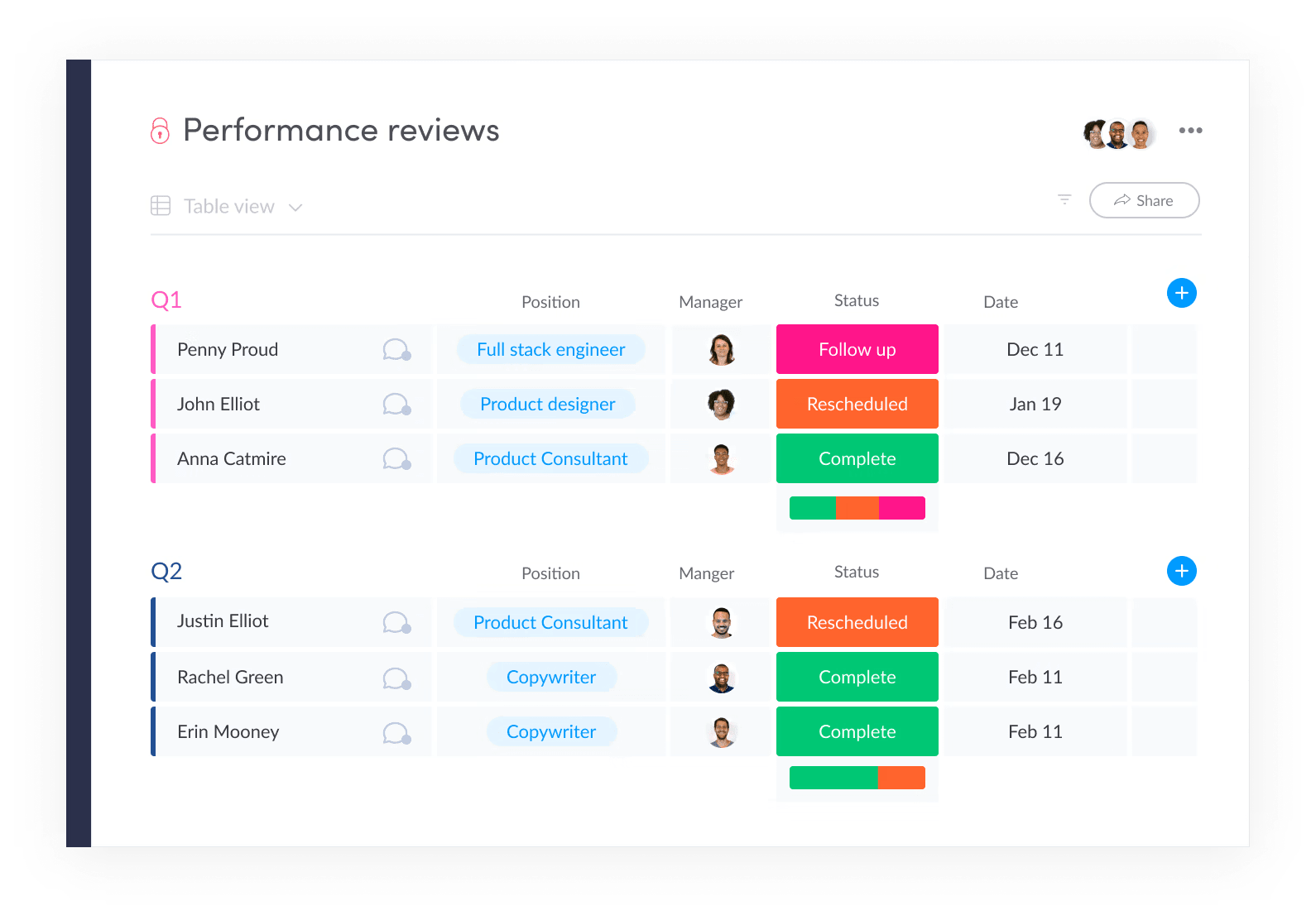
Writing is only one part of a performance review. A lot of the work happens before anyone writes a sentence.
Managers need to remember what happened, find supporting evidence, read feedback, compare results against goals, and work out which events are actually representative of an employee’s performance across the review period.
AI can reduce that administrative load.
Instead of manually rereading a year’s worth of project updates, for example, a manager can use AI to summarize the employee’s major deliverables, missed or exceeded goals, recurring feedback themes, and documented development areas. The manager then verifies those findings and decides what matters.
That can also help counter one of the weaknesses of memory-based reviews: recency bias. A project completed last month is naturally easier to remember than something delivered nine months ago. Giving AI structured evidence covering the whole review period can help bring older work back into view.
It’s important not to overstate this benefit, though. AI doesn’t automatically make an evaluation objective. NIST notes that bias can enter AI systems through human assumptions, underlying data, and system design. AI can help managers examine more evidence, but people still need to judge that evidence fairly.
What information should you give AI for a performance review?
The biggest mistake you can make is starting with the prompt. Begin by gathering the evidence that will inform the review, including agreed goals, documented outcomes, project updates, feedback, and relevant performance data.
An AI system asked to “write a great performance review for Sarah” has almost nothing useful to work with. It can produce polished performance-review language, but polished language isn’t the same thing as an accurate evaluation.
A better input combines the employee’s goals and OKRs, project outcomes, manager observations, 1:1 notes, peer or 360-degree feedback, documented recognition, and relevant development goals from the previous review.
Specificity matters here. Reviews are more useful when employees are evaluated against goals that were clearly defined in advance. A consistent goal-setting process gives managers and employees a shared reference point for evaluating progress.
“Improved customer retention” gives AI very little context. “Goal: increase renewal rate from 82% to 86% by Q4. Final result: 87.3%” gives it an outcome it can accurately reference.
Project information should work the same way. Rather than simply recording that someone “led the website project,” capture what they owned, who they worked with, the intended deadline, what happened, and what impact the project had.
The ILO has identified data quality as one of the central limitations organizations need to consider when using AI in HR. In performance reviews, that principle is fairly simple: vague evidence produces vague reviews.
How to use AI for performance reviews in seven steps
1. Gather evidence from the entire review period
Before opening an AI tool, gather the information you would need to defend the review yourself.
Look across goals and OKRs, completed projects, check-in notes, peer feedback, previous development goals, recognition, and any relevant performance documentation. Whenever possible, include dates, outcomes, and measurable results.
The aim isn’t to feed AI everything anyone has ever said about an employee. It’s to create a representative record of their performance across the full period.
2. Decide what AI is allowed to do
Set the boundary before you start.
You might decide AI can summarize feedback, organize achievements, draft sections of the review, suggest coaching questions, and help make language more specific. Final ratings, compensation, promotions, disciplinary decisions, and performance improvement plans stay with people.
This isn’t just good workflow design. The NIST AI Risk Management Framework emphasizes managing AI risks throughout the design, development, deployment, and use of AI systems.
3. Write an evidence-rich prompt
A useful AI performance review prompt explains the task, supplies the evidence, and tells the system what it must not infer.
For example:
Draft the achievements section of an annual performance review for a senior project manager. Use only the evidence provided below. Organize the review around business outcomes, collaboration, and delivery. Include specific examples where available. Do not invent achievements, motivations, or results. Flag anything that cannot be supported by the evidence.
Then provide the relevant information.
This gives AI a much narrower job than “write a performance review,” which makes the output easier to verify.
4. Treat the output as a first draft
AI-generated text can sound authoritative even when it is wrong, so the first draft needs active review.
Check whether every project, result, and claim is accurate. Look for achievements AI has exaggerated, team outcomes attributed to one person, missing context, or conclusions the evidence doesn’t support.
If the draft repeatedly gets something wrong, go back to the source information or prompt rather than simply polishing the sentence.
5. Make every important claim specific
One of AI’s most useful roles is helping managers move away from vague performance language.
“Alex demonstrated strong leadership this year” tells the employee very little.
“Alex led the Q3 website migration across design, engineering, and content, coordinating six contributors and delivering the project two weeks ahead of the revised deadline” explains what the manager actually means by leadership.
Not every sentence needs a metric, but consequential feedback should be grounded in something observable.
6. Check for bias and inconsistent language
AI can help identify inconsistent language, but it cannot certify that a review is unbiased.
Compare reviews across employees. Are similar accomplishments described with similar strength? Is one person described using personality labels while another is evaluated on outcomes? Does one employee receive detailed evidence while another gets vague judgments? Is a recent mistake overshadowing the rest of the year?
The ILO has specifically warned against assuming AI automatically makes HR decisions fairer. Biased inputs, poorly chosen objectives, and opaque systems can all affect the result.
That makes the human review stage essential.
7. Finalize the review and document the process
The manager should ultimately be able to stand behind every sentence in the final review.
Verify the evidence, add context AI couldn’t know, remove unsupported conclusions, make the final performance assessment yourself, and prepare for the employee’s questions.
Your organization should also retain appropriate documentation of the review process in line with its HR, privacy, and AI governance policies. NIST’s AI RMF treats governance and documentation as ongoing parts of responsible AI use rather than a final compliance check.
AI performance review prompt examples
A few reusable prompts make this section much more useful for people arriving from search.
To draft a review:
Using only the evidence provided below, draft an employee performance review covering achievements, areas for development, and progress against goals. Include specific examples where evidence is available. Do not invent results, motivations, or behaviors. Flag anything that isn’t sufficiently supported.
To summarize 360-degree feedback:
Summarize the feedback below into recurring themes. Separate strengths, development opportunities, and contradictory feedback. Indicate how many responses support each theme, and don’t treat a single comment as a pattern.
To improve vague manager feedback:
Rewrite the feedback below so it focuses on specific, observable behavior and outcomes. Preserve the manager’s intended meaning and don’t introduce facts or examples that aren’t provided.
To check reviews for consistency:
Compare these reviews for differences in tone, specificity, evidence, and performance standards. Flag places where similar performance appears to be described differently. Do not change ratings or make performance decisions.
Common mistakes when using AI for performance reviews
Asking AI to write a review without evidence
This is how you end up with an extremely professional paragraph saying essentially nothing.
AI needs something concrete to summarize. Without documented work, goals, and feedback, it is mostly generating plausible performance-review language.
Assuming AI-generated feedback is objective
AI output isn’t inherently neutral.
The model, prompt, underlying information, and decisions made by the people using it can all influence the result. NIST’s framework specifically treats fairness, transparency, privacy, validity, and accountability as risks that need to be actively managed.
Putting sensitive employee information into an unapproved AI tool
Performance information can include confidential employee data. Before entering it into any AI system, check what your organization’s policies allow and how the provider handles access, retention, security, and model training.
Letting AI make the final performance decision
There’s a meaningful difference between asking AI to summarize evidence and asking it to decide whether someone deserves a promotion.
AI can make the first task easier. The second requires organizational accountability, context, and human judgment.
How monday AI Workspace supports AI-assisted performance reviews

The challenge with a standalone AI tool is that it doesn’t automatically know what happened at work.
Managers still need to find project information, collect feedback, copy in goals, explain context, and work out where every claim came from. That limits how much time AI can actually save.
monday AI Workspace brings the AI closer to the work itself. Projects, goals, workflows, feedback, and AI capabilities can operate in the same environment, making it easier to build reviews around documented performance rather than memory.
For example, monday Workforms can collect self-evaluations, manager observations, and peer feedback in a consistent format. Automations can handle review reminders and handoffs instead of HR manually chasing every participant.
AI blocks can help summarize written feedback and categorize recurring themes, while managers retain access to the original information for verification. Goals and OKRs can connect review discussions to the objectives employees were actually working toward.
For HR teams managing a review cycle across multiple departments, dashboards also provide a live view of which reviews are started, awaiting input, overdue, or complete. AI performance reviews work best as part of an ongoing performance management process rather than as a replacement for regular conversations between managers and employees.
The result isn’t an automated performance decision. It’s a more connected review process where the evidence, workflow, and AI assistance aren’t scattered across separate systems.
Building a better performance review process with AI
The strongest case for AI in performance reviews isn’t that a machine can write nicer feedback.
It’s that managers have more information to process than they can reliably hold in their heads. That’s precisely the gap a connected AI performance management platform is built to close, bringing goals, feedback, and review evidence into one place instead of leaving managers to reconstruct a year from memory.
Used well, AI can turn a year of goals, projects, notes, and feedback into a more manageable body of evidence. It can summarize information, structure a draft, highlight patterns, and help managers interrogate vague language.
But the final evaluation still belongs to people.
That’s especially important as AI becomes more deeply embedded in HR and performance management. Both the ILO’s research into AI in the workplace and NIST’s AI governance guidance emphasize the risks of treating automated outputs as inherently objective or removing meaningful human oversight.
With monday AI Workspace, teams can connect AI assistance directly to the projects, goals, feedback, and workflows where performance happens — helping managers spend less time reconstructing the year and more time having a useful conversation about it.
Frequently asked questions
Can you use AI to write performance reviews?
Yes. AI can summarize performance information, organize feedback, and create a first draft of an employee review. Managers should verify every important claim against documented evidence and retain responsibility for the final evaluation.
What is the best AI prompt for a performance review?
The best prompts provide role context, the review period, goals, documented achievements, development areas, and relevant feedback. They should also explicitly instruct the AI not to invent missing information or infer unsupported conclusions.
Can AI remove bias from performance reviews?
No. AI can help identify inconsistent or subjective language, but it can't guarantee an unbiased review. AI systems can also reproduce or amplify bias present in their data, objectives, or design, which is why human review remains necessary.
What should AI not do in a performance review?
AI shouldn't independently determine performance ratings, promotions, compensation, disciplinary action, or other consequential employment decisions. People should retain accountability for those decisions.
What data should you give AI for a performance review?
Useful inputs include goals and OKRs, project outcomes, measurable results, manager and 1:1 notes, peer and 360-degree feedback, recognition, and previous development goals. Ideally, the information should cover the entire review period rather than just recent work.
Is it safe to put employee performance information into AI?
That depends on the system and your organization's policies. Before using AI with employee data, evaluate access controls, security, privacy, retention policies, and whether submitted information is used for model training.
 Get started