


Staying focused at work feels harder than it used to. Between notifications, emails, and the constant pull of your phone, deep concentration has become a rare commodity. What if a simple kitchen timer could reclaim your focus?
The Pomodoro technique is a deceptively simple time management method that’s been around since the late 1980s. It breaks your work into short sprints separated by short breaks, creating a rhythm that helps you sustain attention throughout the day. This guide covers the science behind the Pomodoro technique, and shows you how to customize it for the way you work. Whether you’re battling procrastination or looking to improve your productivity, this guide helps you get started.
Get startedKey features
- The Pomodoro technique breaks work into 25-minute focused sessions separated by short breaks, creating a rhythm of sustained concentration and recovery.
- Neuroscience shows attention naturally declines after roughly 25 minutes, and regular resets sustain peak focus throughout the day.
- Those struggling with distractions, procrastination, or inaccurate time estimation may benefit from this time management technique.
- You can customize session lengths and combine the Pomodoro method with other productivity systems to match your workflow.
- Platforms like monday.com’s AI Work Platform let you track pomodoros, automate session reminders, and visualize productivity trends over time.
What is the Pomodoro technique?
The Pomodoro technique is a time management method that breaks work into focused intervals, traditionally 25 minutes long, separated by short breaks. Each interval is called a “pomodoro” — Italian for tomato — named after the tomato-shaped kitchen timer that its creator used as a university student.
Francesco Cirillo developed the Pomodoro method in the late 1980s while studying at the Luiss Business School in Rome. Struggling to concentrate on his coursework, he grabbed a small tomato-shaped kitchen timer and challenged himself to focus for just 10 minutes. That modest experiment grew into a structured productivity system that millions of people now use daily. Cirillo eventually published his method formally, and it spread through productivity communities long before the modern focus crisis made it essential.
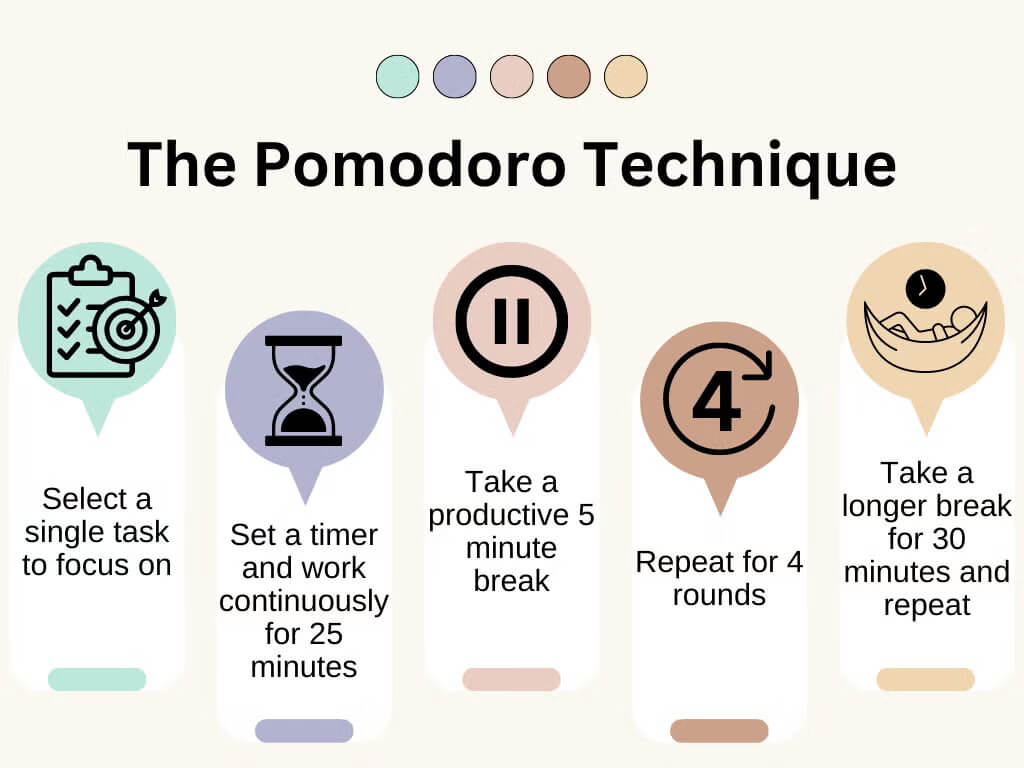
The core concept is straightforward. You work for 25 minutes with full focus on a single task. When the timer rings, you take a 5-minute break. After completing 4 pomodoros, you take a longer break of 15 to 30 minutes. That’s the full cycle, and it’s designed to work with your brain’s natural attention rhythms rather than against them.
What separates the Pomodoro technique from generic “take breaks” advice are 3 specific rules that give the method its structure:
- Break down complex projects: If a task will take more than 4 pomodoros, divide it into smaller, actionable steps before you start. This prevents overwhelm and gives you a realistic sense of scope.
- Batch small tasks together: If a task takes less than one pomodoro, group it with other short tasks to fill the full 25-minute interval. Email replies, quick updates, and admin tasks fit naturally into a single session.
- A pomodoro is indivisible: Once you start a pomodoro, it runs for the full 25 minutes. If you’re interrupted, you either end the pomodoro and restart later or postpone the distraction until your break.
Since its inception in the 1980s, people have experimented with variations of the Pomodoro technique, using different interval lengths, digital timers, and integrated platforms. But the core principle remains unchanged. Structured focus paired with intentional breaks could sustain your concentration for longer than your usual powering through habit.
How to use the Pomodoro technique in 5 steps
Getting started with the Pomodoro technique takes less than 2 minutes. All you need is a timer and a single task. Here’s how to run your first pomodoro session from start to finish.
- Choose your task: Prioritize a single task to work on — not a vague goal like “catch up on work,” but a concrete deliverable like “draft the project proposal introduction” or “review the Q3 budget spreadsheet.” The specificity tells your brain exactly where to direct attention. If you’re unsure what to pick, start with whatever you’ve been putting off the longest.
- Set your timer for 25 minutes: Use a physical kitchen timer, your phone’s built-in clock, a browser-based pomodoro timer, or a time tracking feature on your project management platform. The format is less important than keeping the countdown is visible and making sure you commit to the full interval.
- Work with full focus until the timer rings: This is the hardest step and the most important one. No email, no Slack, no “quick checks” of your phone. Close unnecessary browser tabs. Put your phone face-down or in a drawer. If a thought unrelated to the task pops into your head, write it on a notepad and come back to it later. The 25 minutes belong entirely to the task you chose.
- Take a 5-minute break: When the timer rings, stop immediately, even if you’re in the middle of a sentence. Stand up, stretch, get water, look out a window. The key is to get away from your screen. Scrolling through social media doesn’t count as a break because it keeps your brain in consumption mode. Your break should feel physically different from your work session.
- After 4 pomodoros, take a longer break: Once you’ve completed 4 pomodoros (roughly 2 hours of focused work), take a 15 to 30-minute break to fully recharge. Go for a walk, eat a meal, or do something completely unrelated to work. This extended recovery period prevents the cumulative mental fatigue that builds across long work stretches.
How to handle interruptions during a pomodoro
Ever notice how a “quick check” of your inbox turns into 20 minutes of distraction? Interruptions are the biggest threat to a productive pomodoro, and they come in 2 forms.
Internal interruptions are the thoughts that pop into your head mid-session: “I should reply to that email,” “I need to schedule that appointment,” “I wonder what happened with that Slack thread.” The fix is simple. Keep a notepad next to you and write down each thought as soon as it comes up. Don’t evaluate or act on it — just capture it and return to your task. You’ll address the list during your break.
External interruptions are the ones other people bring: a colleague stops by your desk, your phone buzzes, someone pings you on chat. Research shows that concentration starts to decline after 10 to 15 minutes, so every interruption that pulls you out of a focused state costs more than just the interruption itself — it costs the ramp-up time to get back. When someone interrupts, politely defer: “I’m in a focus session — I’ll get back to you in 15 minutes.” If the interruption is truly urgent, end the pomodoro and restart it once you’ve handled the situation.

Why the Pomodoro technique works: the science behind it
So why does something as simple as a timer beat willpower alone? The answer lies in how your brain handles sustained attention, and the research paints a consistent picture.
Vigilance decrement is the term neuroscientists use for the measurable decline in attention that happens during prolonged tasks. Researchers have documented consistent drops in focus after roughly 20 to 25 minutes of sustained concentration on a single activity. The Pomodoro technique’s 25-minute interval isn’t arbitrary — it’s designed to reset your attention before the worst of that decline sets in, keeping you in your most productive zone throughout the day.
Attention reset theory explains why the breaks themselves matter. Alejandro Lleras, a psychology professor at the University of Illinois, conducted research demonstrating that brief diversions during sustained tasks actually improve focus rather than harm it. His explanation: the brain habituates to constant stimulation, and a short break “deactivates and reactivates your goals,” refreshing your cognitive engagement with the task. This is why you often return from a 5-minute break with renewed energy and a fresh perspective on a problem you were stuck on.
The most compelling evidence comes from recent studies. A 2025 scoping review analyzing multiple Pomodoro-based interventions found that time-structured intervals consistently outperformed self-paced breaks for maintaining focus and reducing mental fatigue. Participants who used Pomodoro-style intervals sustained their task performance significantly longer than those who took breaks whenever they felt like it.
The evidence extends to clinical populations as well. A study evaluating productivity interventions found measurable benefits from structured interval work, and a 2024 clinical trial using Pomodoro-integrated wearables reported a roughly 17% improvement in focus scores among users with ADHD — expanding the technique’s evidence base well beyond general productivity. Other research has confirmed similar patterns across diverse work environments and task types.
The takeaway is straightforward: your brain isn’t built for marathon focus sessions. It’s built for sprints. The Pomodoro technique works because it aligns with your neurology instead of fighting it.
How the Pomodoro technique beats procrastination
How many times have you put off a task for days, only to finish it in under an hour once you finally started? The difference between avoidance and action is what procrastination researchers call the “intention-action gap,” and it’s where the Pomodoro technique delivers some of its most powerful results.
Procrastination isn’t laziness — it’s emotional avoidance. Psychologist Tim Pychyl’s research at Carleton University has shown that we procrastinate to dodge the negative emotions associated with a task: boredom, frustration, anxiety, self-doubt. The task itself isn’t the problem. The feelings we associate with starting it are. That’s why you can procrastinate on something for 3 days and then knock it out in 40 minutes once you begin.
The Pomodoro technique reframes the psychological challenge. Instead of “write the entire quarterly report,” it becomes “focus for just 25 minutes.” This lowers what psychologists call the activation energy — the mental barrier to starting. You’re not committing to finishing the task. You’re committing to 25 minutes of effort. That distinction matters because the emotional weight of “just get started” is dramatically lighter than “get it all done.”
Once you start a pomodoro, 2 things happen. First, the running timer creates external accountability — it’s harder to drift into distraction when a clock is counting down. Second, your progress creates momentum. Most people find that starting was the hard part, and once they’re 10 minutes into a pomodoro, they don’t want to stop. The timer gave them permission to begin, and the work itself carries them forward.
There’s also a gamification angle that makes the technique sticky. Treat each completed pomodoro as a unit of effort. At the end of the day, you can look back and say “I completed 8 pomodoros” — and that visible evidence of productivity reinforces the habit. Over time, the psychological barrier to starting shrinks because your brain associates pomodoros with accomplishment rather than dread.

Benefits of the Pomodoro technique
The Pomodoro technique delivers a range of benefits that compound over time. While the immediate payoff is better focus during each session, the long-term advantages touch nearly every aspect of how you plan, execute, and recover from work. Here are 6 benefits you’ll notice once the technique becomes part of your routine:
- Stronger focus and concentration: Structured intervals train your brain to sustain attention for defined periods. Over weeks, you’ll notice that 25 minutes of deep work becomes easier to achieve — and you can increase focus and concentration even further by extending your sessions as your stamina builds.
- More accurate time estimation: After tracking pomodoros for a few weeks, you’ll develop a realistic sense of how long tasks actually take. That report you assumed would take “a couple of hours” might consistently require 6 pomodoros, giving you data to plan more honestly and set achievable goals and objectives.
- Reduced mental fatigue: Regular breaks prevent the cognitive drain that comes from marathon work sessions. Instead of hitting a wall at 3:00 p.m., you’ll maintain a steadier energy level throughout the day because you’ve been recovering in small increments all along.
- Less burnout: The technique forces rest, even when you don’t think you need it. That built-in recovery makes the Pomodoro method sustainable over weeks and months, unlike brute-force focus strategies that lead to exhaustion.
- Greater accountability: Completed pomodoros create a visible record of your effort. You can see exactly how many focused sessions you completed each day, which projects consumed your attention, and where your time actually went.
- Improved work-life balance: When you know you’re working effectively during your pomodoros, you can stop at the end of the day without guilt. The data shows you were productive, which makes it easier to disconnect and recharge.
How to customize your Pomodoro sessions
The 25-minute default isn’t sacred. Francesco Cirillo chose it because it worked for him as a student, but your optimal session length depends on the type of work you do, your natural attention span, and your energy levels throughout the day. Here are the most common interval variations and when each one works well:
- 15/3 (15-minute work, 3-minute break): A good starting point if you’re building the habit or tackling tasks you find particularly aversive. The shorter commitment lowers the barrier to starting and helps you build confidence before graduating to longer sessions.
- 30/5 (30-minute work, 5-minute break): A slight extension that works for tasks requiring a bit more ramp-up time. If you regularly feel like you’re just hitting your stride when the 25-minute timer rings, this variation gives you a few extra minutes in the flow zone.
- 50/10 (50-minute work, 10-minute break): Popular among writers, developers, and analysts doing deep creative or analytical work where 25 minutes feels too short. The longer break compensates for the added cognitive load.
- 90/20 (90-minute work, 20-minute break): Aligned with ultradian rhythms — the body’s natural 90-minute energy cycles. This is well-suited for complex, immersive work but demands a higher baseline of focus stamina.
Match your intervals to your task type. Shallow work like email triage, scheduling, and administrative updates fits naturally into shorter sessions. Deep work like writing, strategic planning, or data analysis benefits from longer, uninterrupted stretches. You don’t have to use the same interval length all day — mix and match based on what’s on your schedule.
Plan your pomodoros in advance. At the start of each day, look at your task list and estimate how many pomodoros each item will require. Allocate them across your available hours. This turns the Pomodoro technique from a reactive focus method into a proactive planning system. You’ll know before the day starts whether your workload is realistic — and if it isn’t, you can reprioritize before falling behind.
You can also combine the Pomodoro method with other time management strategies for a hybrid productivity system. Pair it with time blocking by assigning pomodoro blocks to specific hours on your calendar. Or use the “Eat the Frog” approach by directing your first pomodoros of the day to the hardest, most important task on your list. These combinations let you keep the focus benefits of Pomodoro while layering in the strategic structure of complementary methods.

How to use the Pomodoro technique on monday.com's AI Work Platform
The Pomodoro technique gives you the focus method, but a work management platform gives you the system around it. With monday.com’s AI Work Platform, you can build a complete Pomodoro workflow that tracks your sessions, automates reminders, and turns individual focus sprints into long-term productivity data.
Here’s how to set it up.
- Log pomodoros with the time tracking column. The AI Work Platform includes a built-in time tracking column you can add to any board. Use it to log each pomodoro as you complete it — start the timer when you begin a session and stop it when the 25 minutes are up. Over time, you’ll build a dataset showing how many pomodoros different types of work actually require, making your future time estimates significantly more accurate.
- Automate session management with built-in automations. Set up automations to support your Pomodoro rhythm without manual effort. For example, you can create a recipe that sends a notification when a task has been in progress for 25 minutes — serving as your pomodoro timer. You can also configure automations that move a task to “In Review” after a certain number of tracked pomodoros, or that notify your team lead when a project’s pomodoro count exceeds its original estimate.
- Visualize productivity trends with dashboards. Create a dedicated Pomodoro dashboard on the AI Work Platform that shows total pomodoros completed per day or week, which projects consumed the most focus time, and how your estimates compared to effort. These insights help you identify patterns — maybe your deep work is most productive before noon, or maybe certain project types consistently take more pomodoros than expected. The data helps you plan smarter, not just work harder.
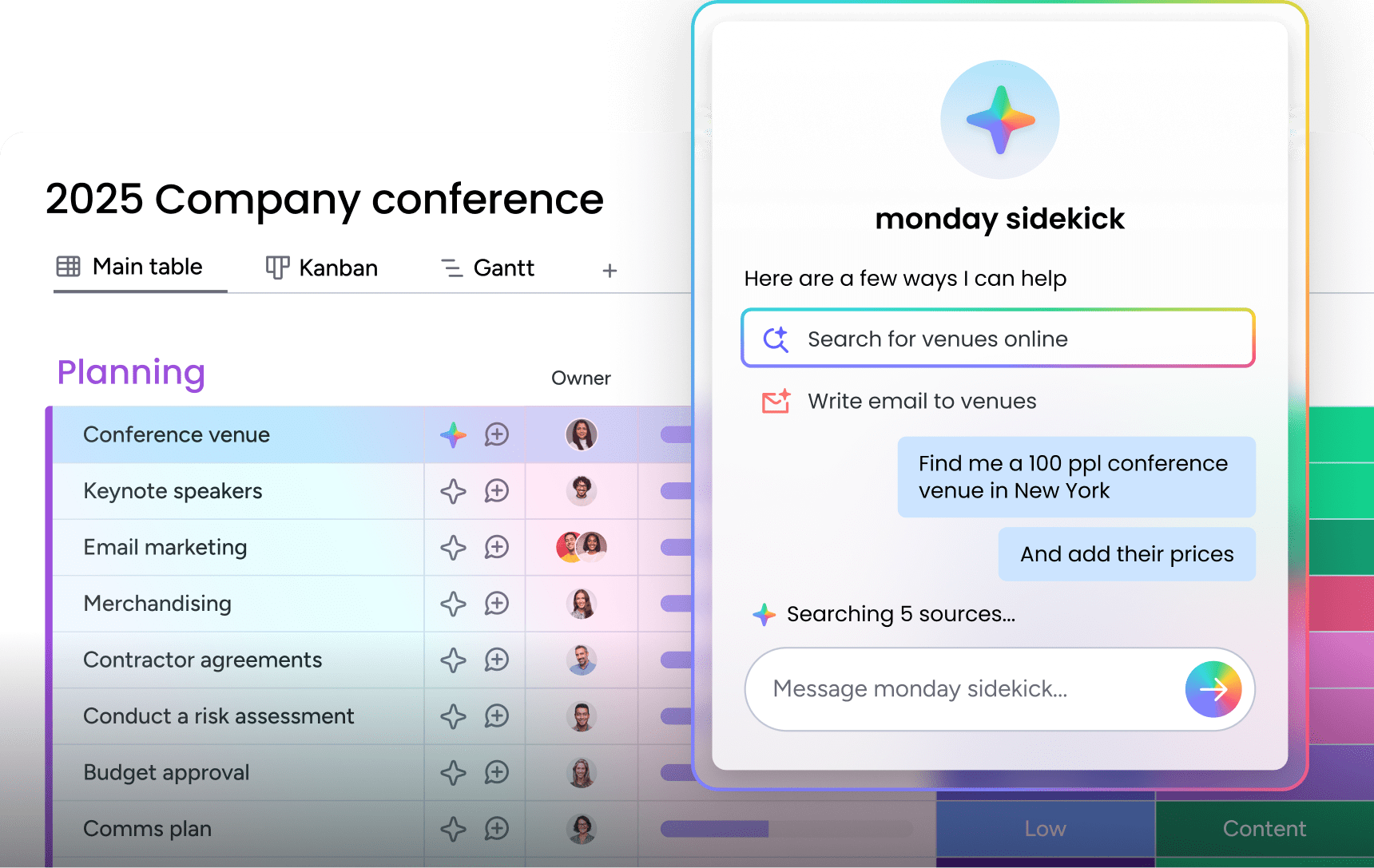
- Plan your daily allocation with monday sidekick. monday.com’s AI Work Platform’s AI assistant can help you plan your daily pomodoro allocation. It analyzes your task list, considers deadlines and priorities, and suggests how to distribute your focus sessions across the day. This takes the guesswork out of the planning step and helps you start each morning with a realistic, structured plan.
- Use multiple views to manage your workflow. The AI Work Platform lets you switch between views to match your needs. Use the Kanban view to see your pomodoro queue — tasks lined up and ready to work. Use the Calendar view to block focus time on your schedule. Use the Gantt view for longer-term project planning that maps pomodoro estimates to deadlines. Each view gives you a different lens on the same data, so you always know where to focus next.
- Connect with dedicated timer apps. If you prefer a specialized Pomodoro timer app, the AI Work Platform integrates with platforms like Toggl 2.0 and Harvest to sync tracked time directly into your boards. You get the dedicated timer experience while keeping all your productivity data in one central workspace.
Staying focused one Pomodoro at a time
The Pomodoro technique works because it respects that the brain is built for focused sprints, not marathons. You don’t need to overhaul your entire workflow to see results. Start with one pomodoro today — 25 minutes of focused, undistracted work on a single task — and see how it feels.
If you want to build a system around the technique, turn to monday AI Workspace. It gives you the time tracking, automations, and dashboards to turn individual focus sessions into lasting habits. The first 25 minutes are the hardest. Everything after that is momentum.
Get startedFrequently asked questions
What is the 25-5 Pomodoro rule?
The 25-5 Pomodoro rule means you work for 25 minutes with full focus on a single task, then take a 5-minute break. After completing 4 of these cycles (called pomodoros), you take a longer break of 15 to 30 minutes to fully recharge before starting the next set.
Is the Pomodoro technique good for ADHD?
Yes, the Pomodoro technique can be effective for ADHD. A 2024 clinical trial using Pomodoro-integrated wearables reported a roughly 17% improvement in focus scores among ADHD users. The technique provides external structure — a visible timer and defined intervals — that compensates for the self-regulation challenges associated with ADHD.
What is the best Pomodoro interval?
The standard 25-minute work and 5-minute break interval works well for most people, but the best interval depends on your task type and personal attention span. Experiment with 15/3 for aversive tasks, 50/10 for deep creative work, or 90/20 if you want to align with your body's natural 90-minute energy cycles.
Can you use the Pomodoro technique for studying?
The Pomodoro technique is especially effective for studying because it prevents cramming fatigue and improves retention through spaced focus sessions. Breaking study material into 25-minute blocks forces you to prioritize what matters most, and the regular breaks help your brain consolidate information between sessions.
What are the disadvantages of the Pomodoro technique?
The Pomodoro technique can interrupt flow states during deep creative work if the timer rings when you're fully immersed. Rigid intervals may not suit collaborative or meeting-heavy roles where interruptions are constant, and the method requires discipline to actually take breaks rather than powering through.
How many pomodoros should you do in a day?
Most people find 8 to 12 pomodoros — roughly 3.5 to 5 hours of focused work — to be a sustainable daily target. The remaining hours of a typical workday go to meetings, communication, administrative tasks, and the breaks between sessions. Tracking your daily count helps you find the range that works for your role and energy levels.
 Get started