


Strong strategy means little without connected execution. When departments move in parallel without alignment, momentum slows. Work overlaps, priorities compete, and customer experiences feel fragmented. As organizations grow, coordination becomes more complex across specialized teams, tools, and timelines.
Cross-team collaboration brings structure to how work moves between teams. Shared visibility into priorities and progress helps teams anticipate dependencies earlier, reduce rework, and maintain momentum across initiatives. Instead of reacting to misalignment, organizations create systems that support consistent coordination.
Below, explore how cross-team collaboration works, why it drives performance, and the steps required to build a framework that truly scales in 2026.
Key takeaways
- Break down silos with unified work management: Connect marketing, finance, IT, and other teams on one platform. Everyone sees the same data. This creates a single source of truth, unifying communication and reducing the need for excessive meetings.
- Focus on shared business outcomes, not departmental goals: Align every team around the same goals so sales speed and legal risk management support each other instead of clashing.
- Transform workflows with monday.com’s AI automation: Let the platform handle handoffs, trigger approvals automatically, and show teams what they need — so they can focus on real work instead of coordination.
- Measure collaboration success through cycle time reduction: Track how quickly ideas move from concept to launch and see how your resources are being used. That’s how you prove collaboration is working.
- Start with pilot programs before scaling organization-wide: Test your framework on one important project first. Learn what works for your team. Then roll it out everywhere else.
What is cross-team collaboration?
Cross-team collaboration is when different departments coordinate to hit the same business goals. It’s more than teamwork within one department. It’s about setting up systems so marketing, finance, legal, IT, and other teams can execute together without things falling apart.
This changes how information, resources, and decisions move through your company. When teams collaborate well, they avoid the bottlenecks that happen when work moves between departments.
The goal is simple: get people the information they need, when they need it, no matter which department they’re in.
How cross-functional collaboration works
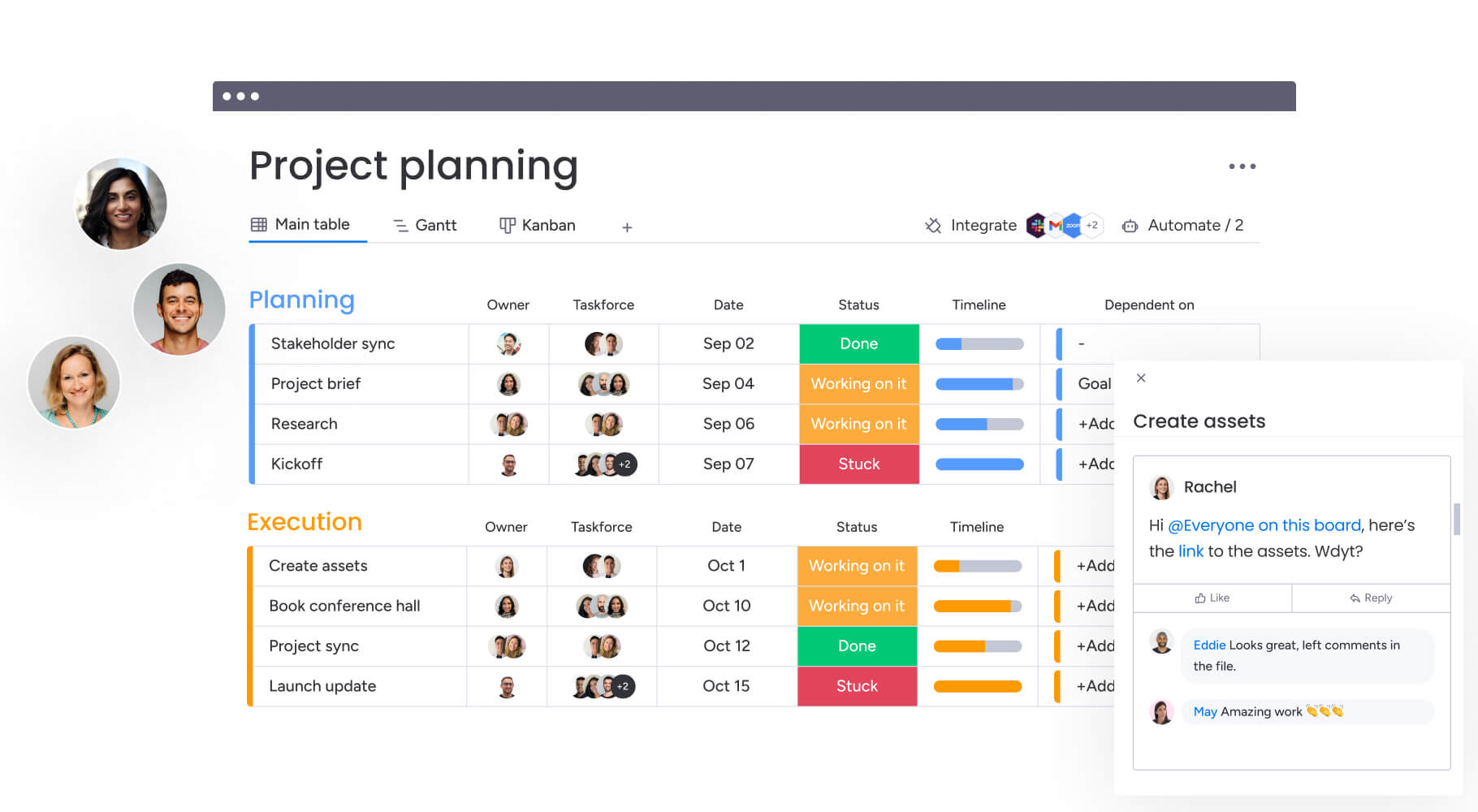
Cross-functional collaboration works when everyone has access to the same data and context, no matter which department they’re in. In a typical product launch scenario, marketing, engineering, and operations teams work simultaneously rather than sequentially.
Information flows through a centralized digital workspace rather than fragmented email chains. Teams can make decisions without waiting for approval from the top. For example, a marketing lead can adjust campaign timing based on real-time engineering updates without waiting for a weekly status meeting. This real-time coordination helps teams spot dependencies early and adjust their workflows before problems hit.
Key components of effective cross-team collaboration
To make this work as you grow, you need a few key pieces in place. With these components, you can create a clear and efficient collaborative environment:
- Shared strategic objectives: Every team needs to align on the same goal. When sales and legal align on a shared goal, they can manage both speed and risk effectively. A shared goal gets everyone on the same page.
- Unified information architecture: All your data needs to live in one place. When teams work in separate systems that don’t connect, they can’t see what’s happening — and collaboration falls apart.
- Defined accountability structures: Collaboration doesn’t mean everyone agrees on every decision. A RACI framework defines who owns the outcome, even when lots of people contribute.
- Agile governance protocols: Teams need clear rules: how often to communicate, when to meet, and how to resolve conflicts. These rules replace rigid bureaucracy with flexible workflows everyone agrees on upfront.
Cross-team vs cross-departmental collaboration
These two collaboration models sound similar but apply to different types of work.
Cross-team collaboration usually happens when multiple functions come together to deliver a specific outcome. Think product launches, transformation initiatives, or major campaigns. The team forms around the objective and works closely until the initiative is complete, allowing faster adjustments as priorities shift.
Cross-departmental collaboration reflects how entire departments stay aligned over time. It focuses on consistent coordination between functions such as marketing, finance, legal, and IT, ensuring processes connect smoothly across the organization.
The comparison below shows how each approach differs in structure, timeline, and flexibility.
| Aspect | Cross-team collaboration | Cross-departmental collaboration |
|---|---|---|
| Primary focus | Project or initiative-based | Structural or process-based |
| Duration | Temporary or cyclic | Ongoing and permanent |
| Structure | Dynamic, agile squads | Rigid, hierarchical handoffs |
| Leadership | Project lead or product manager | Department heads or VPs |
| Agility | High; teams pivot quickly | Low; changes require re-engineering |
Cross-functional collaboration works when everyone has access to the same data and context, no matter which department they’re in.
Why cross-team collaboration drives enterprise success
For mid-to-large companies, cross-team collaboration is what sets you apart from competitors. As companies grow, things get exponentially more complex. How well you handle that complexity determines whether you lead the market.
Companies that excel at cross-team collaboration deliver higher-quality products and services because everyone’s aligned. This alignment hits your bottom line: less waste, faster revenue, and customers who stick around.
Strategic value for growing organizations
Once you hit 100 employees, you naturally lose that startup speed. More managers and specialized roles create distance between strategy and execution. Cross-team collaboration keeps you agile as you grow.
It lets a 500-person company pivot as fast as a 50-person team because strategic changes get communicated and executed instantly across all departments. This means faster market response, stronger innovation, and the ability to launch complex solutions that need input from legal, security, and product — all at once.
The real cost of organizational silos
Silos aren’t just annoying. They cost you money. When teams don’t collaborate effectively, the business pays in duplicated efforts and delayed decision-making.
The hidden costs:
- Shadow work: Employees spend hours reconciling data between incompatible systems.
- Missed revenue opportunities: Slow handoffs delay time-to-market.
- Fragmented customer view: Support doesn’t communicate with product, and product doesn’t sync with sales.
Marketing creates assets that sales can’t use. Engineering builds features that product never requested. When support doesn’t communicate with product, and product doesn’t sync with sales, customers experience a disjointed journey, leading to churn and brand erosion.
Building competitive advantage through collaboration
When competitors have the same tech and talent, the company that coordinates best wins. Better cross-team collaboration lets you deliver solutions competitors can’t match.
Companies that connect customer feedback with feature development and marketing will consistently beat competitors where these teams work in silos. This becomes your competitive advantage. Copying a culture of strong collaboration is way harder than copying features.
Try monday.comCritical benefits of cross-functional collaboration
Investing in collaboration pays off in ways you can measure. These benefits show up in the metrics leadership tracks — not just soft improvements, but real business results.
1. Achieve greater operational efficiency
Cross-team collaboration eliminates the friction in your processes. Cut the wait time between handoffs and reduce status meetings, and you’ll see real efficiency gains.
Workflows that used to take weeks? You can streamline and automate them. Contract processing from sales to legal to finance happens faster. Less admin work means your team can focus on real work instead of managing processes.
2. Accelerate innovation and problem-solving
Innovation rarely happens in isolation. It occurs at the intersection of different disciplines. When engineers hear customer pain points directly from success teams, and marketers understand technical constraints from developers, you get breakthrough solutions.
Cross-functional teams bring different perspectives to complex problems and spot solutions single-function teams miss. This leads to more creative products and faster fixes for big business problems.
3. Improve customer experience and outcomes
Customers see your brand as one company, not a bunch of separate departments. Cross-team collaboration keeps the customer experience consistent from the first marketing interaction to the last support ticket.
When your teams align, customers get:
- Accurate expectations during sales.
- Seamless onboarding from success teams.
- Reliable product performance.
This internal alignment leads to higher Net Promoter Scores and customers who stick around longer.
4. Enhance organizational agility
Markets change fast. Your survival depends on how quickly you can sense and respond. Strong cross-team collaboration acts like a nervous system for your company, helping you spot market shifts and pivot fast.
Instead of waiting for quarterly planning to realign, connected teams adjust priorities in real time. This agility lets you jump on opportunities and handle risks faster than competitors stuck in silos.
5. Strengthen employee engagement and retention
Top talent wants meaningful work and room to grow. Cross-team collaboration exposes people to different parts of the business, helping them build new skills and understand company strategy.
This visibility cuts the frustration of throwing work over the wall and builds a sense of shared purpose. Employees who feel connected to the mission and see how their work matters are way more likely to stay — cutting turnover costs and keeping institutional knowledge.
4 major opportunities in cross-team collaboration
If you want to modernize operations, focus on these four areas for the biggest ROI. These aren’t just problems to fix — they’re chances to upgrade how your business runs.
1. Unifying fragmented systems and information
The average enterprise uses dozens of disconnected SaaS apps. This sprawl creates pockets of isolated data. The opportunity? Set up one work management layer that sits above all these specialized systems.
Integrate workflows into one central platform, and you get one view for decision-making. You don’t need to replace every system — just connect them so status changes in developer platforms show up instantly on marketing roadmaps. Teams using powerful platforms like monday.com connect all their existing systems — Microsoft Teams, Gmail, Slack, Jira, Salesforce — and run projects without switching tabs.
2. Aligning goals across departments
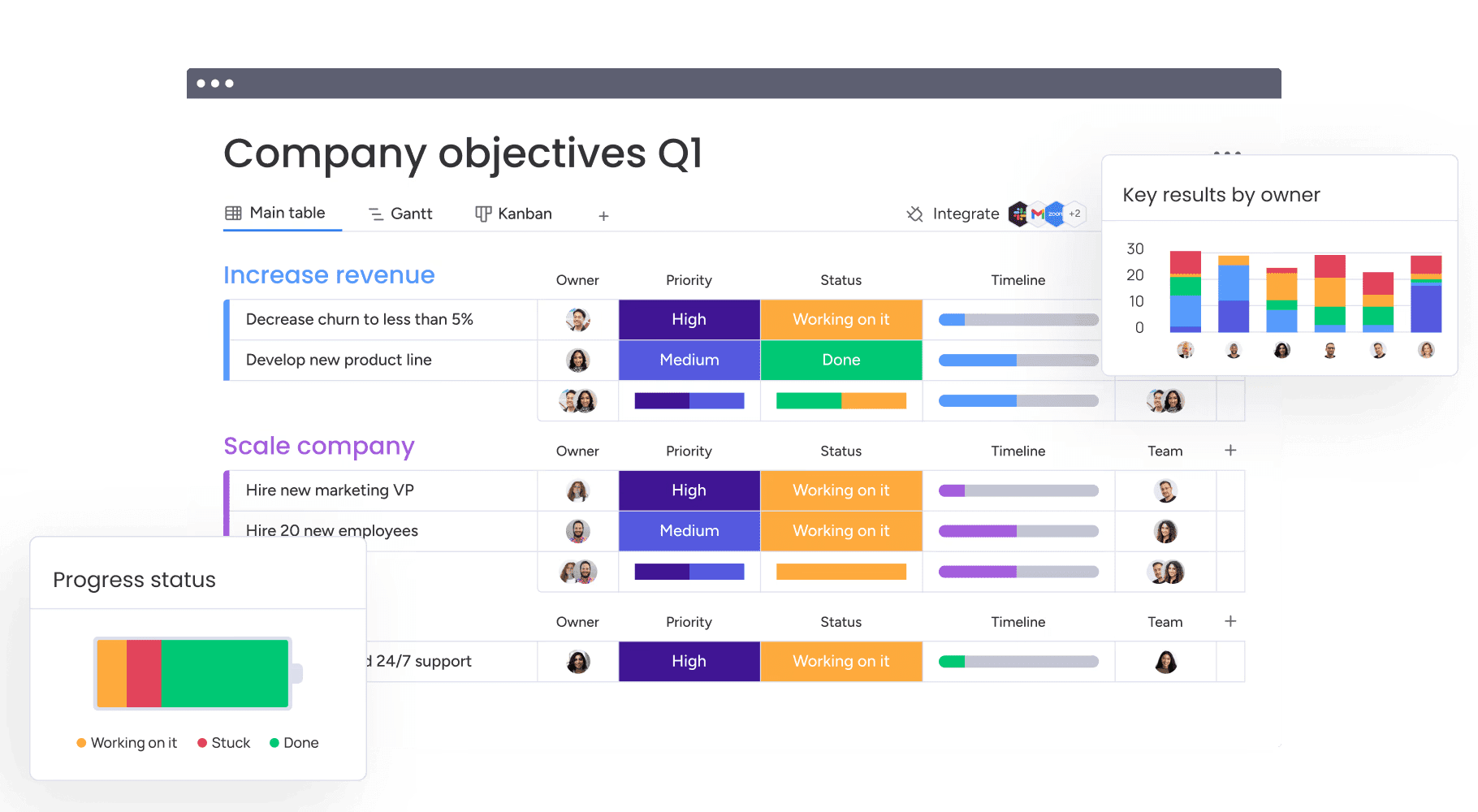
Most companies struggle to connect high-level strategy with daily execution. Cross-team collaboration lets you set goals that cascade down and stay visible to everyone.
When developers see how their sprint initiatives tie to revenue goals, they’re more aligned. This transparency helps teams focus on work that matters instead of busywork. How visible are your company goals to the people doing the work?
3. Bridging communication gaps between teams
Communication breaks down because different departments speak different languages. The opportunity? Design communication rules that translate between these languages.
This involves moving away from unstructured email and chat toward contextual communication within the work itself. When discussions happen directly on the project, context stays intact and anyone joining later can see why decisions were made.
Learn more: Team communication
4. Accelerating adoption of collaborative practices
Technology alone doesn’t solve collaboration. Culture does. The opportunity here is to systematically build collaborative muscle through deliberate change management.
This involves:
- Training leaders to facilitate rather than dictate.
- Rewarding teams for collective outcomes rather than individual performance.
- Treating collaboration as a skill to be developed.
Organizations that treat collaboration as a skill to be developed accelerate their transformation and realize value from their platforms much faster.
7 steps to implement cross-team collaboration
Strong collaboration doesn’t happen by accident. It requires clear structure, shared expectations, and intentional rollout across teams. A step-by-step approach helps organizations introduce new ways of working without creating confusion or disrupting delivery.
The following steps provide a practical path for building cross-team collaboration that teams adopt quickly and that continues to perform as the organization grows.
Step 1: establish shared business objectives
The foundation of collaboration is a shared definition of success. Leadership must articulate measurable objectives that require contribution from multiple teams.
Frame these objectives as business outcomes rather than functional activities. This prevents turf wars and focuses energy on the collective goal.
Step 2: define roles and accountability
Ambiguity breeds conflict. Before work begins, define who decides, who executes, and who needs to be informed.
Using a RACI framework clarifies these relationships across team boundaries. Explicitly state that accountability doesn’t mean doing all the work but ensuring the work gets done.
Step 3: select your unified collaboration platform
The digital environment dictates behavior. Organizations need a platform supporting various workflow styles while feeding into a shared view.
Selection criteria must prioritize:
- Integration capabilities.
- Scalability for enterprise data volumes.
- Intuitive interface that drives adoption across non-technical teams.
Step 4: form cross-functional teams
Structure follows strategy. Create tiger teams composed of members from necessary functions.
These teams should be small enough to remain agile but diverse enough to handle end-to-end execution. Define the leadership structure for these teams, often a lead who facilitates the process regardless of functional seniority.
Step 5: create communication protocols
Decide how the team will communicate before they start talking. Establish standards for synchronous versus asynchronous communication.
Status updates should happen asynchronously within the platform, while meetings are reserved for decision-making and brainstorming. Define response time expectations and escalation paths to ensure communication blocks are removed quickly.
Step 6: launch targeted pilot programs
Don’t boil the ocean. Select one high-impact, cross-functional initiative to pilot the new framework.
This could be a specific product launch or customer journey revamp. Use this pilot to test the technology, roles, and communication protocols. Learn what works for your specific organizational culture and refine the process before wider rollout.
Step 7: Scale success across the organization
Finally, and once the pilot proves value, codify the insights into a playbook. Identify champions from the pilot team to advocate for the new way of working in their respective departments.
Roll out the methodology incrementally, focusing on one value stream at a time. Invest in ongoing training and celebrate early wins to build momentum and overcome resistance to change.
Try monday.comThe foundation of collaboration is a shared definition of success. Leadership must articulate measurable objectives that require contribution from multiple teams.
Essential leadership skills for cross-functional teams
Leading across functions requires a different approach than managing a single team. Priorities compete, perspectives vary, and authority is often shared rather than direct.
Strong leaders create alignment without control. They bring clarity to decisions, keep teams focused on shared outcomes, and ensure collaboration continues even when challenges arise.
Strategic communication and active listening
Leaders must act as translators. They need the ability to explain technical constraints to marketing teams and business requirements to engineering teams in language that resonates.
This requires active listening, hearing what isn’t being said, and synthesizing diverse viewpoints into a coherent narrative that keeps everyone aligned.
Vision alignment and goal setting
A cross-functional leader’s primary job is keeping the why front and center. They must continuously connect daily activities back to the shared strategic objective.
This involves setting achievable interim goals that create momentum and ensuring every team member understands how their contribution impacts the final outcome.
Constructive conflict resolution
Friction is inevitable when diverse perspectives collide. Effective leaders don’t suppress conflict; they mine it for value.
They view functional tension as a necessary part of the process and use frameworks to resolve conflicts based on data and strategic alignment rather than politics or volume.
Change leadership and enablement
Cross-team collaboration is a departure from the status quo. Leaders must be change agents who manage the emotional side of this transition.
This involves:
- Empathy for the discomfort of new processes.
- Patience to coach team members through the learning curve.
- Persistence to reinforce new behaviors until they become habits.
How AI transforms cross-team workflows
Artificial intelligence moves beyond simple content generation to become the orchestration layer for the enterprise. AI acts as an intelligent agent that actively facilitates connection, ensuring the right information reaches the right people at the right time without manual intervention.
AI-augmented decision making across teams
AI analyzes vast datasets from across the organization to provide cross-functional insights that human teams might miss. An AI model can correlate support ticket spikes with recent code deployments and sales discount trends, presenting a holistic view of product health.
This allows cross-functional teams to make decisions based on synthesized reality rather than fragmented reports.
Automated knowledge discovery and sharing
The era of searching for files is ending. AI-powered knowledge bases automatically tag, categorize, and surface relevant documentation based on work context.
When a marketing team works on a feature campaign, the system proactively surfaces relevant technical specs and product roadmap items, breaking down information silos without manual curation.
Predictive resource allocation
AI models predict resource bottlenecks before they stall projects. By analyzing historical velocity and current workload across departments, the system recommends optimal team composition and highlights potential delays.
Organizations using monday.com leverage AI to assign the right people to the right projects, taking into account effort, level, availability, and skills.
Digital workers for seamless coordination
Digital workers handle the administrative glue between teams. These agents:
- Schedule meetings.
- Chase down status updates.
- Route approvals.
- Summarize meeting notes into action items.
By offloading this coordination tax, human teams focus on high-value creative and strategic collaboration.
AI analyzes vast datasets from across the organization to provide cross-functional insights that human teams might miss. An AI model can correlate support ticket spikes with recent code deployments and sales discount trends, presenting a holistic view of product health.
3 ways to measure cross-team collaboration success
Collaboration improves when progress is visible. Measuring the right indicators helps teams understand whether coordination is actually improving speed, alignment, and outcomes across departments.
The following metrics highlight how effectively work moves between teams and whether collaboration efforts are delivering measurable business value.
1. Track efficiency and productivity gains
Measure the reduction in cycle time for key cross-functional processes. Track the time from idea to launch or lead to cash.
Monitor resource utilization rates to see if teams spend less time on administrative activities. A decrease in status meetings and email volume can also serve as a proxy for improved workflow efficiency.
2. Monitor innovation velocity
Innovation can be quantified by tracking:
- Rate of new product or feature releases.
- Time to validate new hypotheses.
- Percentage of revenue from products launched in the last 24 months.
Higher velocity indicates that friction between product, engineering, and go-to-market teams has been reduced.
3. Assess team and stakeholder alignment
Finally, use quantitative surveys and qualitative feedback to measure alignment. High Employee Net Promoter Scores within cross-functional teams suggest healthy collaboration.
Track the frequency of rework caused by miscommunication. A downward trend indicates teams are aligned and getting it right the first time.

Improve cross-team collaboration with monday.com
ross-team collaboration becomes easier when everyone works from the same source of truth. monday.com connects strategy, execution, and communication in one shared workspace, giving every team visibility into priorities, progress, and dependencies.
Instead of chasing updates across disconnected tools, teams coordinate directly where work happens. Everyone understands what is moving forward, what is blocked, and where support is needed.
Visual workflows that keep teams aligned
Different teams prefer different ways of working. monday.com supports multiple views of the same data, allowing each function to work in the format that suits them best while staying aligned across initiatives.
Teams can collaborate using:
- Timeline and Gantt views: Map dependencies and long-term initiatives.
- Kanban boards: Manage Agile delivery and shifting priorities.
- Calendar views: Coordinate launches, campaigns, and deadlines.
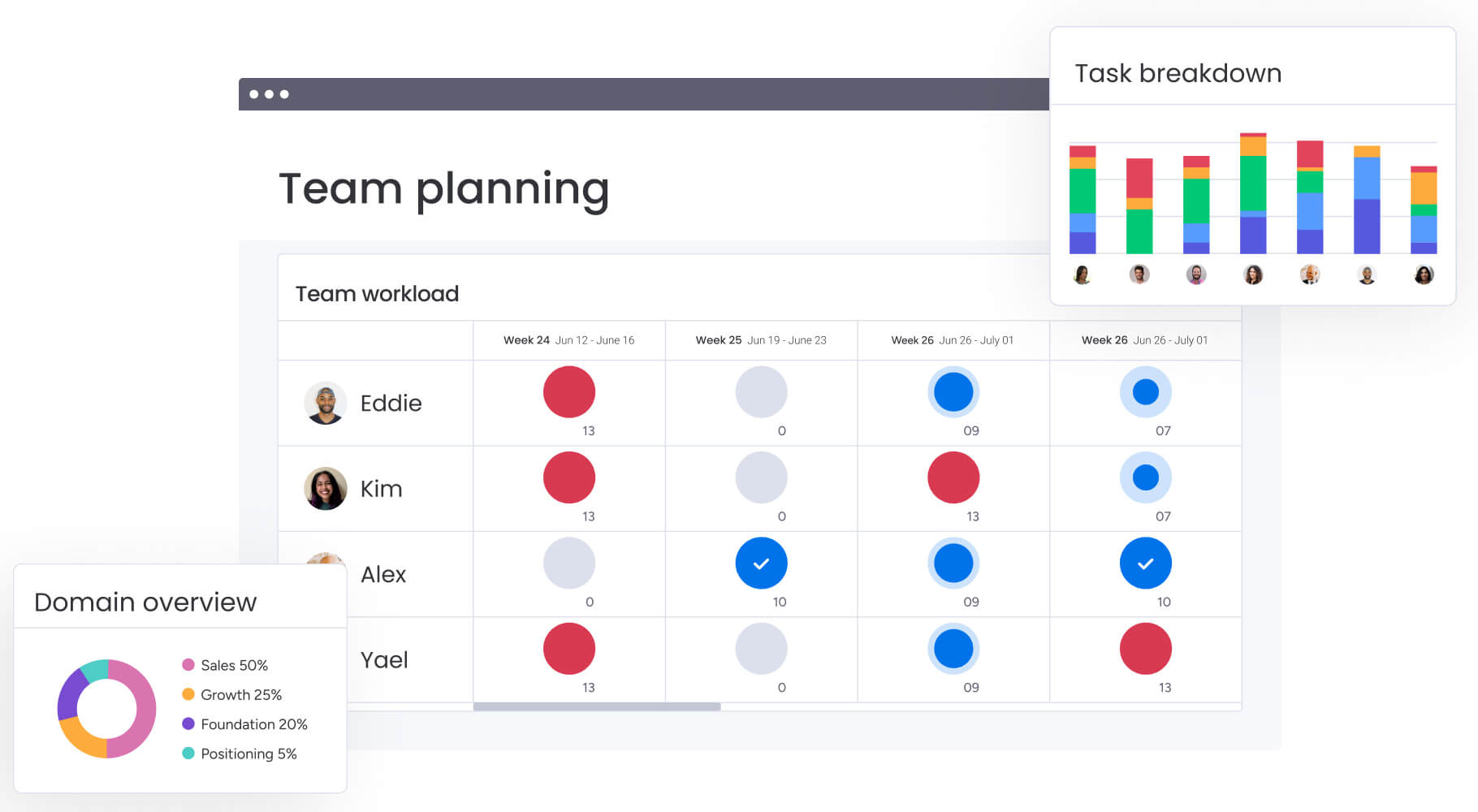
- Workload views: Balance capacity across teams to prevent bottlenecks.
When one team updates a timeline, everyone sees the impact immediately. Shared visibility helps teams adjust earlier and avoid last-minute surprises.
AI-powered automation that connects teams
Manual handoffs slow collaboration. monday.com automates routine coordination so work continues moving without constant follow-up.
AI-powered capabilities help teams:
- Automate approvals: Trigger legal, finance, or leadership reviews automatically.
- Identify risks early: Portfolio Risk Insights highlights potential delays across projects.
- Summarize updates: AI-generated summaries keep stakeholders aligned without long meetings.
- Connect workflows: Actions in one team automatically update related work elsewhere.
Reducing manual coordination helps teams focus on execution rather than process management.
Real-time dashboards for shared visibility
Leaders need a clear view across multiple functions at once. monday.com dashboards combine data from different teams into a single live view, helping organizations track progress and make faster decisions.
Dashboards allow teams to:
- Track KPIs: Monitor performance across marketing, product, and operations.
- Monitor progress: View multiple initiatives in one place.
- Identify capacity gaps: Spot constraints before they impact delivery.
- Make faster decisions: Use real-time data instead of static reports.
Customizable widgets allow each stakeholder to focus on the metrics most relevant to their role.
Fast setup that scales with your organization
Traditional enterprise systems often require long implementation cycles. monday.com allows teams to launch cross-functional workflows quickly and refine them as needs evolve.
The comparison below highlights how modern work management platforms differ from traditional systems.
| Feature | monday work management | Traditional systems |
|---|---|---|
| Implementation speed | Days to weeks | Months to years |
| User experience | Intuitive, visual, consumer-grade | Complex, requires training |
| Flexibility | Highly customizable workflows | Rigid, process-forced workflows |
| Visibility | Real-time, cross-departmental dashboards | Siloed reporting, stale data |
| Automation | No-code, AI-powered automations | Requires IT support |

“monday.com has been a life-changer. It gives us transparency, accountability, and a centralized place to manage projects across the globe".
Kendra Seier | Project Manager
“monday.com is the link that holds our business together — connecting our support office and stores with the visibility to move fast, stay consistent, and understand the impact on revenue.”
Duncan McHugh | Chief Operations OfficerBuild your collaborative operating system today
Organizations that collaborate well execute faster, adapt sooner, and deliver more consistent customer experiences. As complexity grows, the ability to coordinate across teams becomes a defining advantage — not just an operational improvement.
Strong collaboration connects strategy to execution. Teams share context, align priorities earlier, and solve problems together instead of passing them between departments. The result is less friction, clearer accountability, and better outcomes across every initiative.
Creating this environment requires more than good intentions. It takes shared visibility, structured workflows, and tools that support real coordination at scale. monday.com provides the foundation for this way of working, helping teams stay aligned while moving quickly.
Start building a more connected, responsive organization today with monday.com.
Try monday.comFrequently asked questions
How do you facilitate cross-team collaboration?
To facilitate cross-team collaboration, establish shared strategic goals that align incentives across departments and implement a unified work management platform to centralize information. Support this with defined communication protocols and accountability structures like RACI to ensure smooth execution.
What is the difference between cross-functional and cross-team collaboration?
Cross-functional collaboration typically refers to structural, ongoing cooperation between departments like marketing and sales. Cross-team collaboration is often more dynamic, involving project-based squads formed to achieve specific, time-bound objectives.
How do you manage cross-functional teams effectively?
Effective management requires leading through influence rather than authority, focusing on vision alignment, and acting as a translator between different functional languages. Leaders must establish governance for decision-making and conflict resolution to keep the team moving forward.
What platforms are Use case cross-departmental collaboration?
The best platforms are unified work management systems offering integration with existing tech stacks, real-time visibility through dashboards, and flexible views that accommodate different departmental working styles within a single environment.
How long does it take to implement cross-team collaboration?
Initial implementation of a pilot program typically takes four to eight weeks. Scaling cultural change and full organizational adoption is an ongoing journey that typically matures over six to twelve months depending on organization size and complexity.
What are the key metrics for measuring collaboration success?
Key metrics include operational efficiency gains like reduced cycle times, innovation velocity measured by time-to-market, employee engagement scores, and the reduction of rework or duplicate efforts across teams.

 Get started