


Most of us think we’re managing our time well simply by planning our work in advance. But that all changes when something unexpected happens and we miss a key deadline that causes our plans to unravel fast.
This guide explores how to manage deadlines well, starting with how we use time around certain due dates. We’ll also show you how a shared, AI-ready workspace like monday.com’s AI Work Platform gives teams the visibility to see problems coming so you can hit every milestone on time.
Key takeaways
- Deadline management is a system, not a to-do list: it’s the ongoing process of setting, tracking, and meeting due dates across every task and deliverable.
- Most teams manage tasks, not time: setting the deadline first and fitting work into it is more reliable than estimating tasks and hoping they add up.
- Missed deadlines trace back to a few recurring causes: unrealistic estimates, unclear communication, scope creep, and no shared view of progress.
- Best practices compound: realistic dates, milestones, prioritization, buffer time, critical-path mapping, regular check-ins, and clear ownership keep work moving.
- monday.com’s AI Work Platform helps you predict slippage: Gantt charts, automated reminders, and AI risk alerts flag at-risk work before a due date is at stake.
What is deadline management?
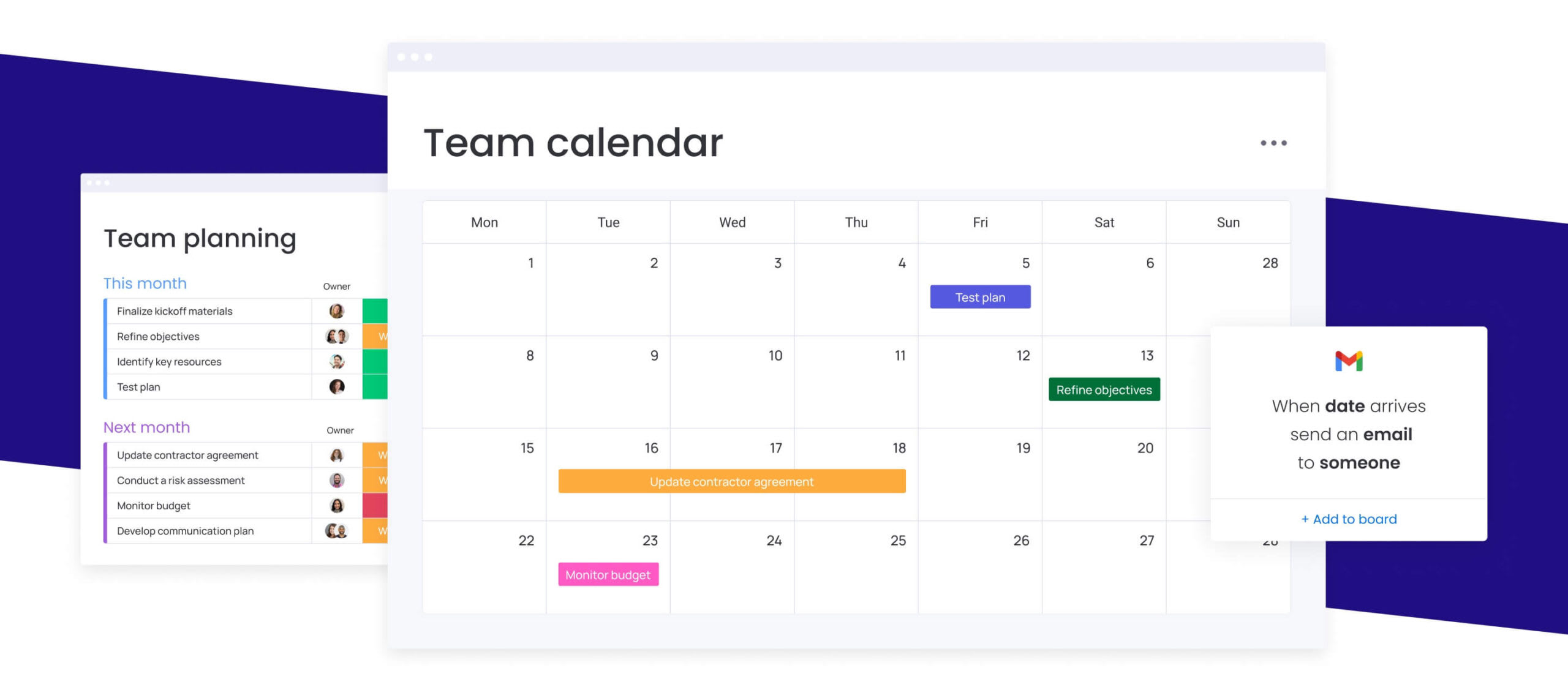
Deadline management is the systematic process of setting, tracking, and meeting due dates across every task and deliverable. It covers how you estimate work, sequence it, monitor progress, and adjust based on what’s really happening. Think of it as the operating layer that turns your plan into on-time delivery.
It’s a broader practice than simply writing dates on a calendar. Good deadline management connects the date to:
- the work that has to fit inside it
- the people who own each piece
- the checkpoints that tell you early whether you’re on track.
When those elements work together, a due date becomes a prediction you can trust rather than a hope you cross your fingers over.
3 types of deadlines to manage
Not every deadline carries the same weight, and treating them all the same is a fast way to misallocate effort. Understanding the type of deadline you’re working against tells you how much buffer to build and how firmly to hold the line:
- Hard deadlines: fixed dates with real consequences if you miss them, like a product launch, a contractual delivery, or a compliance filing. These leave no room to negotiate the date, so the work has to flex instead.
- Soft deadlines: internal targets guide pace but can move without breaking a commitment, like a first-draft date. They keep momentum without triggering a crisis when the unexpected happens.
- Rolling deadlines: recurring or staggered due dates on ongoing work, like a weekly report or a content calendar. They demand a steady cadence rather than a single sprint to the finish.
The surprising reason most teams fail to manage time
Many of us think we’re managing time. But, we’re usually managing people or tasks (or both), which are far from the same thing.
Managers are some of the top culprits. They make a list of tasks and ask employees to assess how long each will take them. Then, they set the due dates based on those evaluations.
This approach seems to make perfect sense in theory. But the reality is those assessments are inaccurate at best. When people try to estimate how long a task will take them, they forget to take into account all the things that can (and often will) go wrong. That’s not necessarily anyone’s fault; it’s pretty darn hard to predict all the things that could potentially go downhill, from servers collapsing to people catching the flu.
But when you run things this way:
- It makes entire teams miss their deadlines
- You usually find out that you won’t be meeting the deadline only after the fact, or just shortly before it

5 steps to manage time and never miss a deadline
Instead of listing tasks and hoping they fit, flip the usual planning order by starting with the deadline and working backward.
1. Ask when, not what
Don’t say “this is what we want to achieve, now let’s put a time-tag on it.” Instead, say “this is when we want to achieve something, now let’s see what can fit into this time frame.”
This is exactly how you set a realistic deadline: fix the date first, then scope the work to fit. It answers the question every team wrestles with, because a date you commit to on purpose beats a date you back into by adding up shaky estimates.
Example: A marketing team has eight weeks until a conference. Rather than list every asset they’d love to produce, they lock the eight weeks, then decide that a landing page, three emails, and one demo video fit that window. The wish list of extra blog posts waits for the next cycle.
2. Break it down into smaller time units
Instead of taking big project and breaking it down into medium tasks, then smaller tasks etc., take the time frame you decided on and break it down into smaller time units. This suits the practical side of creating milestones and a work breakdown structure. Each unit becomes a checkpoint with its own mini-deadline, so progress is visible long before the final date arrives. Small time blocks also make it obvious when one piece of work is eating away at your schedule.
Example: A two-month app build splits into eight weekly units. Week one targets a working login flow, week two the core dashboard, and so on. If week one’s login isn’t done by Friday, the team knows immediately, instead of discovering it in week seven.
3. Check where you stand at the end of the first day
Use each smaller time unit as a meaningful inspection point. Instead of telling someone, “work for 15 days, then show me what you’ve got,” ask them to show you what they’ve got after the first day.
Early inspection points are the foundation of progress monitoring. The sooner you catch a slip, the cheaper it is to correct, because you’re adjusting hours rather than rescuing weeks. This is where a shared, real-time view of status pays off, since nobody has to wait for a status meeting to learn the truth.
Example: An engineering lead reviews a short demo at the end of day one of a sprint. The feature is half as far along as expected, so they pair two developers on it the next morning. That one-day correction keeps the two-week milestone intact.
4. Never move the deadline
There will probably come a point where you’re tempted to move a deadline. But if you give in and shift the goal posts every time there’s a setback, your deadline becomes later and further away.
Holding the date steady forces a healthier trade-off between adjusting project scope rather than time. When the finish line is fixed, the conversation shifts to what you can safely cut or defer, which protects the commitment everyone else is planning around.
Example: With three days left and one feature at risk, a product team ships the release on schedule without the “nice to have” export option and adds it to the next sprint. The launch date holds, and customers still get the core value on time.
5. Use time-oriented focus
If, after focusing and pushing harder, you still can’t make the deadline, then prioritize by removing less important tasks.
Focus is really prioritization in action. Naming the few tasks that directly move the deadline, and setting everything else aside, is what keeps a team from spreading effort thin. A clear ranking of what matters most turns “work harder” into a concrete plan for where that harder work should go.
Example: A support team facing a compliance deadline pauses its backlog of low-priority tickets for a week and routes everyone to the audit-critical work. Once the deadline is met, the paused work resumes with no lasting harm.

Why deadlines slip: common deadline management challenges
Missed deadlines usually trace back to several recurring causes rather than a single dramatic failure. Each is predictable and also preventable once you know where to look.
- Unrealistic estimates: when dates are set by adding up optimistic task guesses, they ignore the setbacks that always happen. The plan looks fine on paper and breaks the moment reality intrudes.
- Poor communication and unclear expectations: if people don’t share the same understanding of what “done” means or who owns what, work stalls in the gaps between them. Ambiguity is expensive.
- Scope creep: small additions feel harmless in the moment, but each one borrows time from the original deadline. Without a check, the finish line drifts.
- No shared visibility: when progress lives in someone’s head or a private spreadsheet, nobody sees a problem until it’s too late to fix cheaply. You can’t manage what you can’t see.
- Cross-team coordination breakdowns: handoffs between teams are where deadlines go to die. A deliverable waiting on another group can sit idle for days if the dependency isn’t tracked.
7 deadline management best practices and strategies
Strong deadline management boils down to a set of habits you can apply to any project, from a two-week sprint to a multi-quarter program. None of them is complicated on its own. But together, they turn deadlines from a source of stress into a reliable outcome. Work through the following best practices in order when you kick off a project, and revisit them whenever a plan starts to wobble.
- Set realistic, clearly defined deadlines: fix the date deliberately and scope the work to fit, rather than backing into a date from optimistic estimates. Make sure everyone knows exactly what the deadline covers.
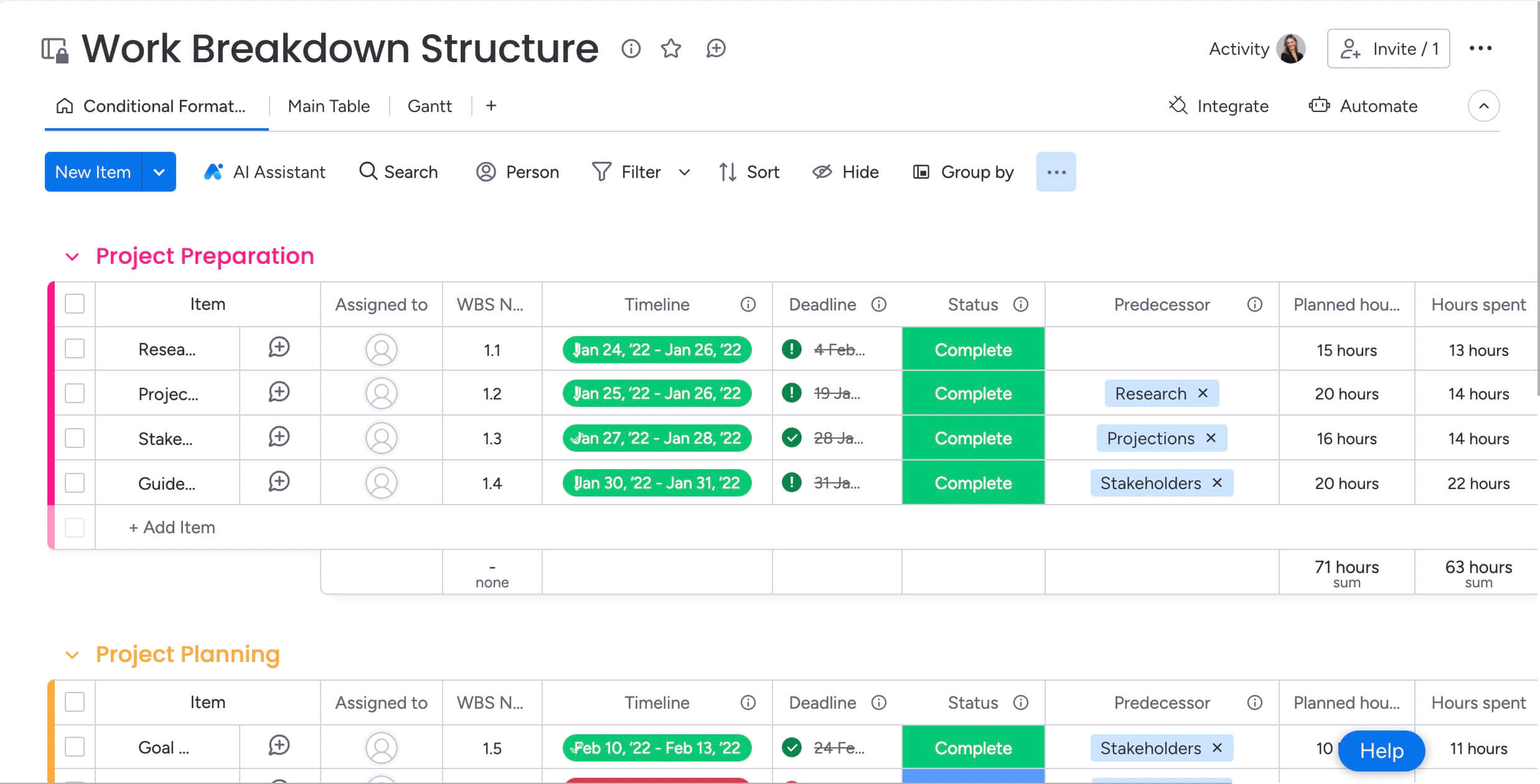
- Break work down: divide the project into smaller deliverables with their own due dates using a work breakdown structure. Milestones create early signals and make a big timeline feel manageable.
- Prioritize with MoSCoW and the Eisenhower matrix: use MoSCoW to sort work into must-have, should-have, could-have, and won’t-have. Use the Eisenhower matrix to separate the urgent from the important so effort lands where it counts.
- Build in buffer time: add contingency to the schedule for the setbacks you can’t predict. A protected buffer absorbs surprises without forcing you to move the deadline.
- Map the critical path and dependencies: identify the sequence of tasks that controls the finish date with the critical path method, and track what each task waits on. Delays on the critical path move the whole deadline, so watch it closely.
- Monitor progress with regular check-ins: use frequent, lightweight inspection points and project schedule management to catch issues while they’re still small. A shared dashboard makes this visible without adding meetings.
- Assign clear accountability: give every task and milestone a single owner so nothing falls through the cracks. When ownership is explicit, follow-up is faster and cleaner.
Several of these practices get easier when the work lives in one place. On monday.com’s AI Work Platform, teams keep milestones, dependencies, and progress in a shared view, so priorities and ownership stay clear without extra status chasing.
Which teams benefit from strong deadline management
Deadline management isn’t just a project-manager concern. Any team that commits to delivering work by a date relies on it, even if they don’t use the term. The scenarios below show how the practice looks across different functions.
- Marketing: campaigns hinge on fixed launch dates, event timelines, and content calendars where a late asset can derail a whole go-to-market push. Rolling deadlines on recurring content demand a steady cadence.
- PMO and operations: these teams juggle portfolios of projects at once, so they need shared visibility to spot which timelines are at risk before they cascade across the organization.
- Product and engineering: sprints, releases, and roadmaps live or die by dependencies and the critical path. Clear inspection points keep features from carrying over into the next cycle.
- IT and service: ticket resolution targets and rollout schedules carry hard deadlines with real consequences, from service level agreements (SLAs) to compliance windows that can’t move.
- Cross-functional teams: when work spans several groups, handoffs become the biggest deadline risk. A shared view of who owns what and when keeps coordination from breaking down.

How monday.com's AI Work Platform helps you manage deadlines
Even the best method needs a place to live. When deadlines, dependencies, and progress sit in scattered spreadsheets and inboxes, slips stay hidden until it’s too late to react. monday.com’s AI Work Platform brings the whole picture into one connected view, with built-in AI that watches the schedule for you.
- See the full timeline and what controls it. Gantt charts lay out the full timeline, task dependencies show what waits on what, and a baseline view compares your planned schedule against your actual progress. A critical-path overlay highlights the tasks that control the finish date, while milestones and built-in time tracking keep every checkpoint honest.
- Automate routine follow-ups. With no-code recipes, teams set date reminders that fire before a due date, auto-assign tasks when work moves forward, and trigger status-change notifications so handovers between stages don’t stall. Fewer things are missed because someone forgot to check.
- Get a real-time read on where things stand. Dashboards turn all that activity into a live view. Progress and battery views show how close each workstream is to done, portfolio views roll multiple projects into one screen, and AI risk alerts spots timelines that are trending late. AI-generated summaries give leaders the status in seconds without a meeting.
- Let AI watch for trouble around the clock. A monday agent works as a Risk Analyzer that monitors projects continuously, flags bottlenecks, and suggests schedule adjustments before a deadline is at stake. monday sidekick answers plain-language questions about project status, and monday MCP lets teams connect Claude, ChatGPT, or Copilot to securely read and act on their monday.com data. With monday vibe, a team can build a custom tracker, like a time-tracking or OKR-monitoring board, from a plain-language prompt.
Turning deadlines into dependable delivery
Deadline management isn’t about working faster or squeezing more hours out of a week. It’s about setting dates you can defend, catching problems while they’re small, and holding the line by adjusting scope instead of the calendar. Do that consistently, and on-time delivery stops feeling like luck.
The teams that deliver dependably pair a sound method with a shared, real-time view of their work. When progress, dependencies, and risk all live in one place, and AI helps watch for trouble, meeting deadlines becomes a predictable outcome rather than a recurring scramble. That’s the shift the monday.com’s AI Work Platform is built to support.
Deadline management FAQs
What is the difference between deadline management and time management?
Deadline management is the process of setting, tracking, and meeting specific due dates for tasks and projects. Time management is the broader personal practice of how you allocate your hours across all your work, whether or not a deadline is attached.
What is the best tool for deadline management?
The best tool for deadline management gives you a shared timeline, dependency and critical-path tracking, automated reminders, and progress visibility in one place. monday.com's AI Work Platform combines those with AI risk detection so at-risk deadlines emerge early.
How does monday.com's AI Work Platform help teams meet deadlines?
The AI Work Platform centralizes timelines, dependencies, and progress into shared Gantt charts and dashboards, then automates reminders and handovers. AI risk alerts and a monday agent flag bottlenecks and suggest schedule adjustments before a due date is at stake.
Can AI help manage project deadlines?
Yes. AI can monitor projects continuously, predict which tasks are trending late, flag bottlenecks on the critical path, and recommend schedule adjustments. Adoption is rising fast, with McKinsey's 2025 State of AI reporting that about 23% of businesses are already scaling agentic AI.

 Get started