


Marketing teams face ambitious 2026 agendas: product launches, brand campaigns, lead generation pushes, content series. Mapping these initiatives reveals a harsh reality: overlapping deadlines, resource conflicts, and campaigns disconnected from actual business goals. Strategic thinking devolves into a juggling act, making it difficult to keep initiatives on track and visible.
A marketing roadmap template solves this coordination challenge by providing a structured framework that connects marketing activities to measurable outcomes. Unlike basic calendars that track individual tasks, roadmaps show how campaigns, content, and initiatives connect over time to hit real business targets. Teams see the bigger picture while ensuring every detail is accounted for.
This guide explains how to build a marketing roadmap template for 2026 that actually works. It covers what every roadmap needs, which type fits different teams, and how to build one people will actually use. The right work management platform can turn static plans into living roadmaps that shift with changing priorities.
Key takeaways
- Connect every campaign to business goals: build roadmaps that tie marketing activities directly to revenue targets and company objectives, preventing wasted effort on random acts of marketing.
- Use visual timelines to prevent resource conflicts: map campaigns across quarters to spot bottlenecks early and allocate team bandwidth before burnout occurs.
- Coordinate marketing with unified roadmaps: visualize strategy through Gantt charts and Kanban boards while automating approvals and stakeholder notifications in one workspace on monday.com.
- Plan across three time horizons simultaneously: balance immediate execution with strategic development and long-term innovation to deliver short-term results while securing future growth.
- Embed measurement frameworks from day one: define both leading and lagging indicators before launch to capture accurate data and identify off-track campaigns immediately.

What is a marketing roadmap and why does every team need one?
A marketing roadmap is a visual timeline that maps out campaigns and initiatives across weeks, months, or quarters. While calendars track daily tasks, roadmaps demonstrate how those tasks connect to broader business objectives. This framework bridges high-level strategy and ground-level execution, providing visibility into the timing and rationale behind every campaign.
For mid-to-large teams managing multiple departments, operating without a roadmap results in scattered work, missed deadlines, and budget overruns: a significant challenge given that only 3% of CMOs can demonstrate marketing ROI for more than half of their spend. Effective teams address this by building roadmaps that update in real time as priorities evolve.
Roadmaps provide essential value by making team work easier to track and communicate. The benefits extend beyond organization; they directly impact overall business performance:
- Strategic alignment: every campaign, content piece, and event connects to a specific goal. No more random marketing—just focused work on what moves the needle.
- Resource optimization: when you map campaigns over time, you spot bottlenecks and overloaded schedules early—so you can shift resources before your team burns out.
- Stakeholder communication: roadmaps give execs and other teams instant visibility into what marketing’s working on (which builds trust and which builds trust and leads to more focused status meetings) especially critical as integration with sales ranked #7 among marketing leaders’ operational priorities.
Marketing roadmap vs marketing plan
It’s common to confuse them, but marketing roadmaps and marketing plans serve different functions. A marketing plan is a detailed, text-heavy doc covering market analysis, buyer personas, pricing, and positioning. A marketing roadmap is a visual, timeline-focused framework that communicates the “when” and “how,” translating the static strategy of the plan into a dynamic execution sequence.
The table below highlights the fundamental differences between these two essential documents:
| Feature | Marketing plan | Marketing roadmap |
|---|---|---|
| Primary purpose | Defines strategy, market positioning, and detailed tactics | Visualizes the timeline and sequence of execution |
| Time frame | Usually static, covering 1–3 years | Dynamic, covering quarters or specific campaign cycles |
| Level of detail | High; includes research, pricing, and competitive analysis | High-level; focuses on milestones, deliverables, and dates |
| Primary audience | Marketing leadership and investors | The entire marketing team, stakeholders, and other departments |
| Update frequency | Reviewed annually or bi-annually | Updated weekly or in real time as projects evolve |
For your marketing to be successful, you need both working together. The plan lays out the strategy and research, while the roadmap turns that into timelines and milestones you can actually execute.
5 essential components every marketing roadmap template must include
The best marketing roadmaps all share a few core elements that make them easy to use and track. These five components turn a basic to-do list into a roadmap that delivers real results.
1. Strategic timeline and milestones
The timeline forms the backbone of the roadmap, visualizing campaign durations, launch dates, and critical hand-offs. This is typically structured by weeks, months, or quarters depending on the planning horizon.
Good timelines build in buffer time for delays and flag dependencies, like making sure your landing page is live before you launch paid ads.
2. Goals and business objectives
Each element on your roadmap should connect to a measurable outcome. Distinguish between marketing goals (brand awareness, MQLs) and business objectives (revenue, market share), as this distinction is critical for strategic alignment.
Apply SMART criteria to enable objective progress tracking and performance evaluation.
3. Campaign themes and initiatives
Group activities into themes to keep messaging consistent and resources focused. Theme-based grouping makes sure all your touchpoints work together instead of operating in silos.
This keeps teams aligned around one story instead of pulling in different directions.
4. Resource allocation and budget planning
A solid roadmap shows exactly what resources you need to execute. This includes:
- Team assignments: assigning specific team members or squads to initiatives.
- Budget allocation: setting budget caps for campaigns and identifying spending priorities.
- External resources: identifying where external vendors or agencies are needed.
You’ll see who’s overloaded and who has capacity, so your roadmap matches what your team can actually handle.
5. Success metrics and performance KPIs
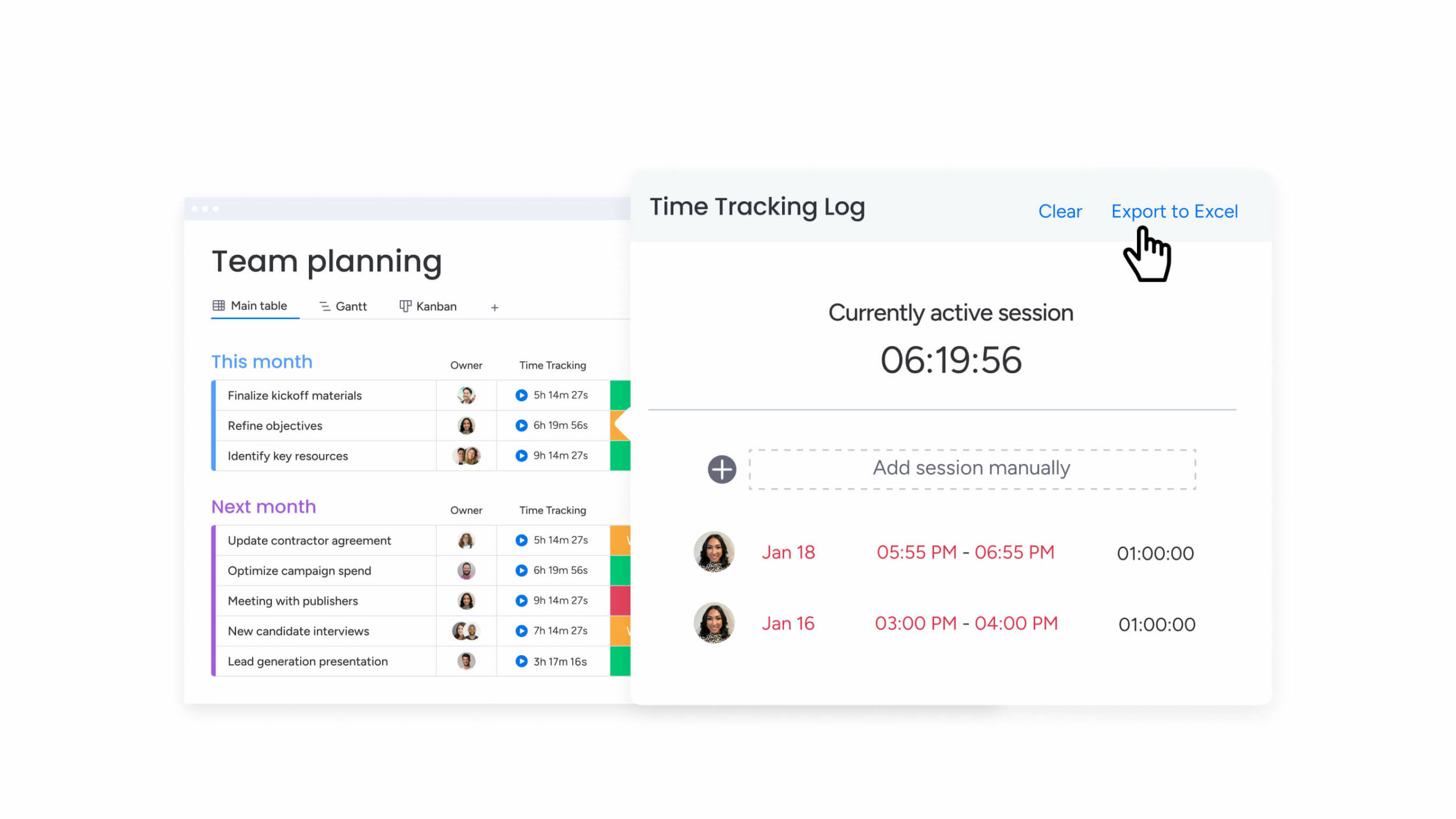
Integrate measurement frameworks into your roadmap from the outset: a priority reinforced by research showing measuring marketing ROI ranked #6 among marketing leaders’ top operational priorities. Define both leading indicators (traffic, CTR) and lagging indicators (revenue, LTV).
Establish tracking mechanisms before launch to ensure accurate data capture from day one.
4 types of marketing roadmaps that deliver real results
Different teams need different roadmap formats. Pick the right format and your roadmap will actually serve your team’s needs and deliver the results that matter.
1. Theme-based marketing roadmaps
Theme-based roadmaps organize activities around high-level strategic focuses, such as “Market Expansion,” “Brand Awareness,” or “Customer Retention.” This works well if you have multiple product lines or market segments.
Different teams can align their tactics under one shared strategy.
2. Goal-oriented marketing roadmaps
Goal-oriented roadmaps structure activities around specific business objectives, such as “Increase ARR by 20%” or “Acquire 1,000 New Users.” Perfect for performance marketing teams tracking specific targets.
Every activity on the list connects directly to your main goal.
3. Timeline-driven marketing roadmaps
Timeline-driven roadmaps focus on dates. It’s essential when managing fixed deadlines, events, or seasonal peaks. This format displays the sequence of events and identifies critical paths and hard deadlines.
Teams leverage Gantt charts to manage complex dependencies while balancing strict time constraints with the flexibility needed to adapt to market changes.
4. Resource-focused marketing roadmaps
Resource-focused roadmaps organize activities based on available bandwidth and team capacity. This approach is particularly effective for small teams or organizations operating with constrained budgets.
Managers gain visibility into team allocation and workload distribution, preventing individual specialists from becoming bottlenecks across multiple concurrent campaigns.
How to create a marketing roadmap in 7 strategic steps?
Building a roadmap that works starts with analysis and moves into structured planning. Follow these steps and you’ll build a roadmap that’s both strategic and doable, giving your team a clear path to results.
Step 1: analyze past campaign performance
Before planning ahead, look back at what worked and what didn’t. Review metrics like ROI, engagement rates, and conversion costs to spot patterns.
These insights help you These insights help you learn from past performance and double down on successful strategies.
Step 2: define strategic business objectives
High-level company goals must be translated into specific marketing objectives. This step ensures alignment with sales targets, product release schedules, and overall company growth plans.
If the company goal is to move upmarket, the marketing objective might shift from volume lead generation to account-based marketing for enterprise targets.
Step 3: map campaign themes to goals
Once objectives are set, marketing activities are organized into coherent themes that support them. This process involves identifying priority themes and ensuring a balanced distribution of effort.
A “Thought Leadership” theme might aggregate blog posts, whitepapers, and speaking engagements under one strategic bucket.
Step 4: allocate team resources effectively
Capacity planning is critical to execution. This step involves assessing current team skills, availability, and workload distribution.
Teams use the Workload View in monday.com to see over/under-utilized resources at a glance, ensuring the resource allocation is realistic rather than aspirational.
Step 5: prioritize high-impact initiatives
Not all good ideas can be executed at once. Frameworks like ICE (Impact, Confidence, Ease) or RICE (Reach, Impact, Confidence, Effort) help rank initiatives.
Prioritization ensures that resources flow to the activities with the highest potential return on investment, while lower-impact activities are deprioritized or backlogged.
Step 6: set timelines and dependencies
Realistic timelines account for approval processes, creative iterations, and potential delays. This step involves mapping out the sequence of execution and identifying dependencies.
Building flexibility into the schedule prevents a domino effect of missed deadlines if one element slips.
Step 7: establish tracking systems and KPIs
The final step is implementing measurement frameworks that provide ongoing visibility. Dashboards allow teams to automatically display live high-level project data for insights on budget, goals, schedules, and resources.
This ensures that if a campaign goes off track, it is identified immediately rather than at the end of the quarter.
Marketing roadmap examples that drive business growth
Real-world examples help illustrate how different roadmap types support specific business objectives. These scenarios demonstrate practical applications across various marketing contexts, showing how strategic planning translates into measurable outcomes.
Product launch marketing roadmap
A product launch roadmap typically spans six months, covering distinct phases that ensure all teams are synchronized for the big day:
| Phase | Timeline | Key activities | Success metrics |
|---|---|---|---|
| Research | Months 1–2 | Competitor analysis, beta user feedback | Market fit validation |
| Awareness | Months 3–4 | Teaser content, influencer outreach | Social engagement, waitlist signups |
| Launch | Month 5 | Press release, email blast, paid ads live | Day 1 active users, traffic spikes |
| Optimization | Month 6 | User onboarding flows, retention campaigns | Activation rate, churn rate |
Brand awareness campaign roadmap
This 12-month roadmap focuses on establishing presence in a new market. It emphasizes long-term consistency over short-term bursts.
Key components include:
- Content creation: a steady drumbeat of valuable, educational content.
- Strategic partnerships: influencer collaborations and industry relationships.
- PR initiatives: sustained media outreach and thought leadership positioning.
The goal is to build share of voice, measured by organic search volume and brand sentiment analysis.
Lead generation marketing roadmap
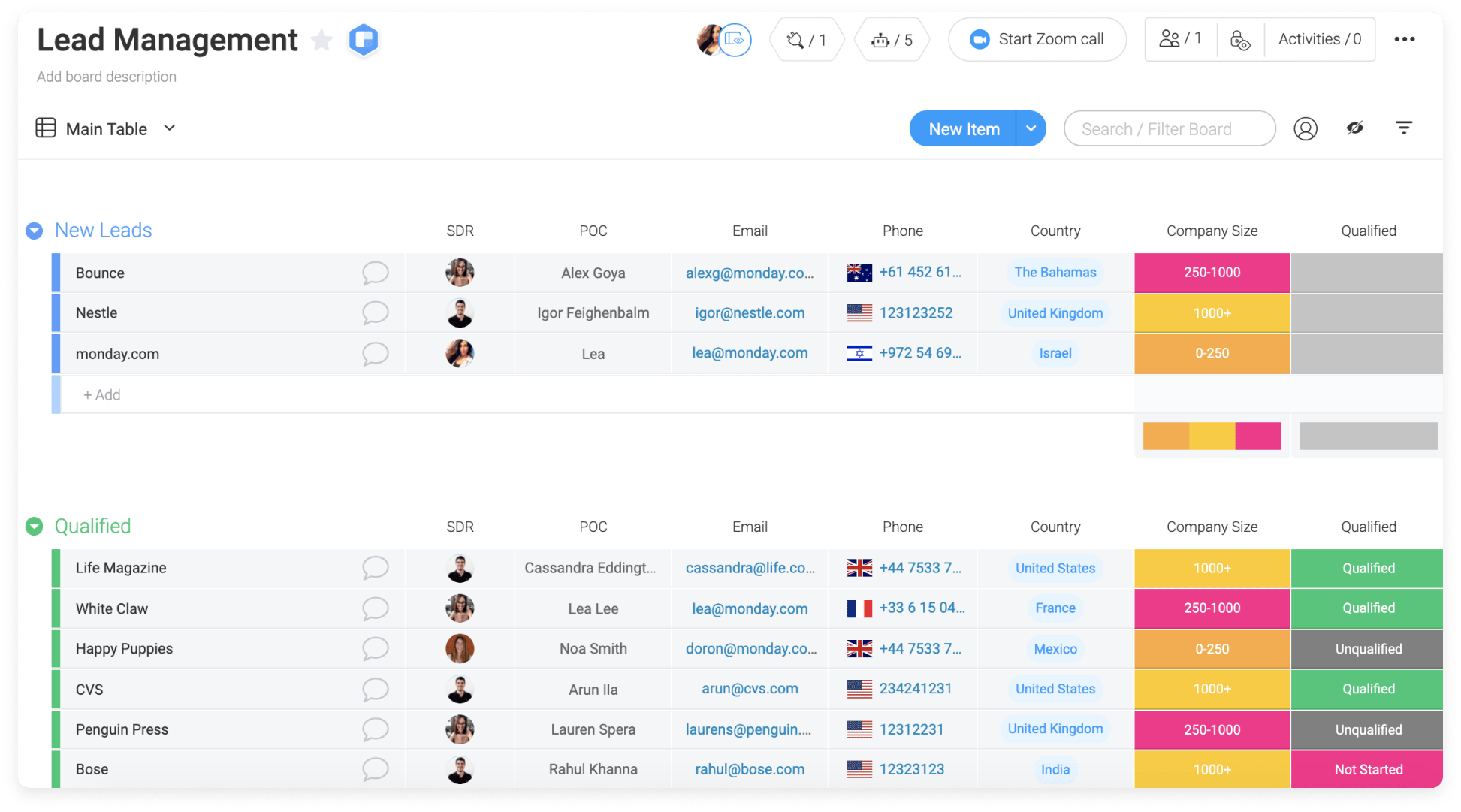
Designed for high-velocity growth, this quarterly roadmap aims to increase qualified leads by 40%. It integrates content marketing, a webinar series, targeted email campaigns, and conversion rate optimization on landing pages.
Success is measured strictly by MQLs and SQLs, with weekly sprints adjusting tactics based on performance data.

Advanced marketing roadmap strategies for 2026
Mature marketing organizations require sophisticated planning approaches to navigate complexity and volatility. These advanced strategies move beyond basic scheduling to integrated portfolio management, enabling teams to coordinate hundreds of initiatives while maintaining strategic focus.
Three-horizon planning for long-term success
This strategic planning approach structures roadmaps across three simultaneous time horizons:
- Horizon 1: immediate execution (0–6 months).
- Horizon 2: strategic development and emerging channels (6–18 months).
- Horizon 3: innovation exploration (18+ months).
This ensures the organization delivers short-term results while securing long-term growth.
Portfolio risk management across campaigns
Advanced roadmaps proactively identify and mitigate risks across the entire portfolio of initiatives. This includes monitoring for resource conflicts, market saturation, and competitive responses.
AI-Powered Risk Insights in monday.com scans all project boards, flagging potential risks by severity so leaders can pivot strategies and optimize resource use.
Cross-department workflow integration
Marketing does not exist in a vacuum. Advanced roadmaps integrate directly with sales, product, and customer success workflows.
This creates shared visibility, ensuring that a marketing push for a new feature aligns perfectly with the product release and sales enablement training.
3 ways AI transforms your marketing roadmap planning
Artificial intelligence is shifting roadmap planning from a static administrative activity to a dynamic, data-driven advantage. These AI capabilities help marketing teams make smarter decisions, optimize resources, and anticipate challenges before they impact execution.
1. AI-powered resource optimization
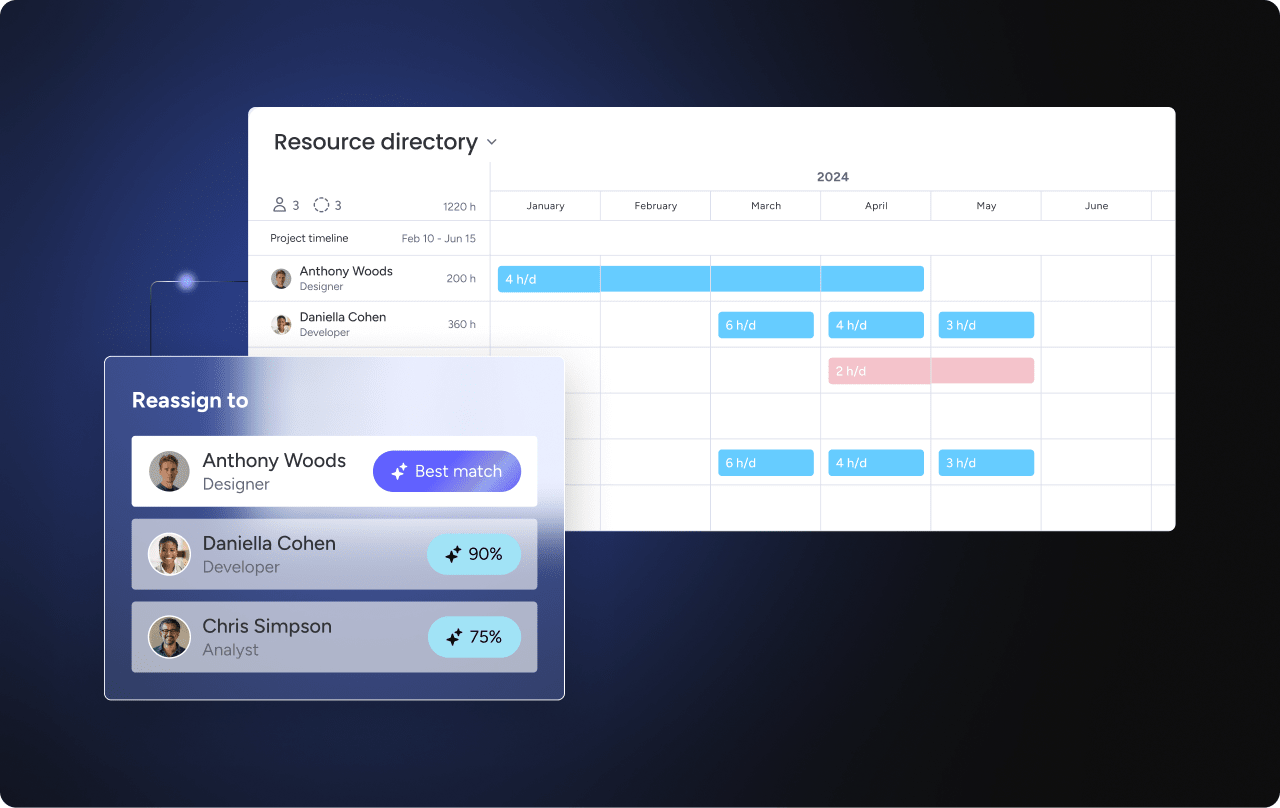
AI analyzes team capacity, individual skill sets, and historical performance data to recommend the optimal allocation of resources. This reduces the time managers spend playing calendar tetris and improves execution quality by assigning the right people to the right activities.
AI capabilities within solutions like monday.com suggest resource assignments based on project requirements and real-time availability.
2. Predictive campaign performance analysis
Instead of relying on gut feeling, AI analyzes historical data, market trends, and competitive intelligence to predict likely campaign outcomes. This allows teams to simulate different roadmap scenarios and allocate budgets to the initiatives with the highest probability of success.
This significantly increases planning accuracy and reduces wasted spend on underperforming initiatives.
3. Automated risk detection and mitigation
AI continuously monitors roadmap progress, identifying potential issues such as scope creep or dependency conflicts before they impact delivery. Automated alerts and recommendations help teams stay on track.
This enables proactive problem-solving rather than reactive firefighting.
Turn your marketing strategy into action with monday.com
A centralized platform specifically designed to handle the complexity of marketing roadmaps, monday.com helps marketing teams move beyond static spreadsheets to visualize, execute, and measure strategy in a single, unified workspace.
The platform offers dynamic visual boards and timeline views that make roadmaps intuitive and accessible. Teams can toggle between:
- Gantt charts: for dependency management and critical path visualization.
- Kanban boards: for workflow stages and campaign progression.
- Calendar views: for publication schedules and deadline tracking.
Custom columns track campaign status, budget spend, and performance metrics in real time, giving you an instant pulse check on your entire marketing strategy without digging through reports.
Collaboration happens naturally because it’s built into the platform’s foundation. Marketing connects directly with sales, product, and executive teams through @mentions, contextual update threads, and shared dashboards, so every conversation stays anchored to the actual work instead of getting lost in email chains.
External partners, freelancers, and agencies can jump right into roadmap execution through guest access capabilities, contributing where they’re needed without creating security vulnerabilities.
Automation handles the repetitive tasks that typically bog down execution. Marketing teams set up automation recipes to:
- Streamline approvals: instantly move campaigns through approval stages.
- Enhance communication: notify stakeholders of status changes automatically.
- Prevent delays: alert team members when deadlines approach.
This removes manual friction and ensures process adherence across all initiatives.
AI blocks categorize incoming campaign requests, extract actionable insights from performance data, and suggest next steps based on roadmap progress. The Digital Workforce capabilities provide proactive analysis, helping teams optimize resources and anticipate challenges.

“monday.com has been a life-changer. It gives us transparency, accountability, and a centralized place to manage projects across the globe".
Kendra Seier | Project Manager
“monday.com is the link that holds our business together — connecting our support office and stores with the visibility to move fast, stay consistent, and understand the impact on revenue.”
Duncan McHugh | Chief Operations OfficerBuild marketing roadmaps that drive measurable growth
Marketing roadmaps transform scattered activities into strategic execution engines that deliver measurable business impact. The most successful organizations use roadmaps not just to organize campaigns, but to align cross-functional teams around shared objectives and create accountability for results.
When built with the right components and supported by dynamic platforms, roadmaps become living documents that evolve with your business needs. They provide the visibility leaders need to make informed decisions and the structure teams need to execute with confidence.
Organizations that coordinate marketing strategy through unified roadmaps on monday.com experience faster execution, more effective resource allocation, and stronger alignment between marketing initiatives and business outcomes.
Frequently asked questions
How often should I update my marketing roadmap?
Marketing roadmaps should be reviewed monthly to ensure alignment with current goals, with updates made immediately whenever there are significant shifts in business priorities, market conditions, or resource availability.
What's the ideal time frame for a marketing roadmap?
Most effective marketing roadmaps cover a six to twelve month period. Fast-moving startups often prefer quarterly roadmaps for agility, while enterprise organizations utilize annual roadmaps for stable, long-term strategic planning.
Can I use one roadmap template for multiple marketing teams?
A master template can be effectively customized for different functions, such as content, performance, and product marketing, allowing for specific team needs while maintaining a consistent structure and reporting format across the organization.
How do I get stakeholder buy-in for my marketing roadmap?
Securing buy-in requires involving key stakeholders early in the planning process and explicitly demonstrating how specific roadmap initiatives directly contribute to the business objectives and KPIs they value most.
What's the difference between a marketing roadmap and a content calendar?
A marketing roadmap visualizes high-level strategic initiatives and campaigns over a longer horizon, whereas a content calendar details the specific assets, publication dates, and channels for execution within those campaigns.
How does monday.com help with marketing roadmap collaboration?
The platform facilitates collaboration through real-time updates, automated notifications, and shared dashboards, ensuring that all team members and stakeholders have immediate access to the single source of truth regarding progress.

 Get started