


Sales teams are drowning in manual work. Reps spend Monday mornings updating CRM records instead of calling prospects, and qualified leads sit unassigned for hours. Meanwhile, follow-up emails get forgotten, meetings take weeks to schedule, and promising deals stall because nobody tracked the next step.
Virtual inside AI sales agents fix this by automating the repetitive work that kills momentum. These AI systems handle lead qualification, personalized outreach, CRM updates, and meeting coordination, all on their own. Basic automation follows rigid scripts. AI agents adapt in real time, shifting tactics when prospects change how they engage.
This guide shows how to build a virtual inside AI sales team, from strategy to deployment. It covers the five types of AI agents that transform revenue operations and explains how to design workflows that get the most from automation. With an intuitive Work OS, sales leaders can build AI systems that speed up results, scaling success without hiring more reps or cutting into team morale.
Key takeaways
- Cut manual sales work by 70% with AI automation: virtual AI agents handle lead scoring, email follow-ups, and CRM updates so your reps focus on closing deals instead of data entry.
- Scale personalized outreach without hiring more reps: AI agents manage hundreds of customized conversations simultaneously, referencing company news and industry challenges for each prospect.
- Start with high-impact activities first: automate lead qualification and email personalization before expanding to complex workflows. Quick wins build momentum and prove ROI.
- Deploy AI that works within your existing process: native AI features like sentiment detection and smart lead routing in platforms like monday CRM integrate seamlessly without forcing workflow changes or technical complexity.
- Create human-AI partnerships that amplify results: AI handles repetitive tasks while humans focus on relationship building and strategic selling. Collaboration beats replacement every time.
What is a virtual inside AI sales agent?
A virtual inside AI sales agent is software that automates repetitive sales tasks with a fully digital footprint and an intuitive setup. These systems handle lead qualification, outreach, follow-up, CRM updates, and scheduling: the manual work that eats up hours every day.
Virtual AI agents function as digital team members that operate continuously alongside your human representatives. These agents execute complete sales workflows autonomously: from scoring inbound leads to delivering personalized follow-ups.
While basic automation adheres to predetermined scripts, AI agents make real-time decisions based on prospect behavior adapting their approach as engagement patterns evolve.
The technology breaks into three categories, each solving different automation problems:
| Agent type | Primary function | Level of autonomy | Best for |
|---|---|---|---|
| Virtual sales assistants | Support reps with repetitive tasks | Low to medium | Teams drowning in admin work |
| Autonomous AI agents | Execute complete workflows independently | High | Organizations scaling without headcount |
| CRM-integrated AI systems | Embed automation within existing platforms | Medium to high | Teams wanting seamless data flow |
- Virtual sales assistants: automate time-consuming activities that drain productivity like data entry across CRM systems, prospect company research, and initial outreach sequences. A virtual assistant logs email interactions, updates contact records with LinkedIn data, and queues follow-up activities based on responses.
- Autonomous AI agents: operate with significant independence, executing workflows from start to finish. These agents qualify leads with discovery questions, analyze responses to see if there’s a fit, and schedule meetings with qualified prospects. They decide based on prospect behavior, adjusting messaging when engagement spikes, escalating to human reps when questions get complex.
- CRM-integrated AI systems: embed directly within your existing platform, creating automation without separate software or manual transfers. When a lead submits a form, the system scores it instantly, enriches the contact record, assigns it by territory, and sends personalized outreach — all inside your CRM.
Why does your sales team need AI agent transformation now?
Sales teams are under pressure: faster competitors, prospects expecting instant responses, and manual processes that stretch teams thin. According to the U.S. Bureau of Labor Statistics, there were 7.7 million job openings but only 5.1 million hires in October 2023, making automation leverage urgent for scaling workflows without expanding headcount.
Organizations still reliant on fragmented spreadsheets or manual data entry concede winnable deals to agile competitors every day. Revenue leaders who move beyond these legacy systems gain a decisive advantage by identifying exactly where AI agents can alleviate operational friction and accelerate growth.
Four reasons AI agent transformation isn’t optional anymore:
- Cut manual sales activities by 70%: sales reps spend most of their time on non-selling activities. According to McKinsey data on GenAI’s ROI, organizations implementing AI in marketing and sales report 66% experienced revenue increases over twelve months, with 8% seeing gains above 10%. AI agents fix this by logging interactions, researching prospects, sending follow-ups, and keeping CRM data current.
- Scale personalized engagement without hiring: AI agents let teams handle 3-5x more prospects without adding headcount. These agents customize every message with prospect-specific data like company news, industry challenges,and tone adjusted for seniority.
- Generate revenue around the clock: prospects research solutions outside business hours, but most teams shut down at 5 PM. AI agents work 24/7, responding instantly regardless of time zone, qualifying leads while reps sleep,and nurturing prospects through automated sequences.
- Accelerate your sales velocity: AI agents shorten sales cycles by qualifying leads instantly, scheduling meetings in hours instead of weeks, and answering prospect questions immediately.
5 types of AI sales agents that transform revenue teams
Different AI agents specialize in different sales stages, covering everything from first touch through customer expansion. Most organizations use multiple types to fix the bottlenecks slowing down revenue growth. Understanding each agent type helps you figure out which automation will make the biggest difference for your team.
Type 1: lead qualification AI agents
These agents evaluate every inbound lead against set criteria, separating high-potential prospects from poor fits before reps spend time on them. Qualification happens instantly and when a lead enters your system, the AI agent:
- Analyzes firmographic data: company size, industry, and technology stack.
- Evaluates behavioral signals: content downloads, page visits, email engagement.
- Asks discovery questions: via email or chat to uncover buying signals.
- Assigns qualification scores: based on ideal customer profile alignment.
- Routes intelligently: matching leads to reps with relevant expertise.
Type 2: outreach and follow-up agents
These agents run multi-touch campaigns across email, LinkedIn, and phone, keeping engagement consistent without manual work. When a prospect opens three emails without responding, they switch to a different value prop. The agent:
- Creates personalized sequences: referencing prospect pain points and challenges.
- Tracks engagement patterns: open rates, click-throughs, response timing.
- Measures message effectiveness: which templates generate responses.
- Adjusts messaging dynamically: based on prospect engagement behavior.
- Optimizes send times: when prospects are most likely to engage.
- Triggers escalation: when to involve human reps.
Type 3: sales intelligence systems
Sales intelligence systems research prospects before conversations, gathering company info, competitive intelligence, and decision-maker insights. They identify key stakeholders, pull together recent company initiatives, and find relevant case studies. Before a discovery call, the intelligence system gives you context that steers the conversation toward real challenges.
Type 4: deal acceleration agents
These agents watch pipeline opportunities, spot stalling risks, and automate actions to keep deals moving. They catch when deals haven’t moved in 7+ days, suggest next steps based on similar wins, automate proposals, and trigger follow-up reminders.
Type 5: customer success AI agents
These agents go beyond acquisition, driving expansion revenue through automated onboarding, usage monitoring, and renewal management. They walk customers through implementation milestones, watch product usage for at-risk accounts, and start renewal conversations 90 days before contracts end.

7 high-impact activities to automate with AI sales reps
Seven activities offer the biggest automation wins: they save time and speed up revenue when you shift them from human reps to AI agents. Prioritizing these activities gets you immediate, visible results that prove the investment is worth it.
Activity 1: instant lead scoring and routing
Manual lead triaging often introduces subjectivity and delays that can jeopardize early-stage opportunities. AI agents standardize this process by evaluating every prospect in real-time against consistent data points, ensuring that high-value leads are identified and distributed without friction.
AI agents score every lead in seconds using consistent criteria:
- Company size: revenue, employee count, market segment.
- Industry fit: alignment with ideal customer profile.
- Technology stack: current tools and integration potential.
- Budget indicators: pricing page visits, plan comparisons.
- Behavioral signals: content engagement, demo requests.
The agent assigns leads automatically based on territory rules, product expertise, and current workload.
Activity 2: hyper-personalized email campaigns
Generic outreach yields diminishing returns as prospects become adept at filtering automated “blasts.” AI agents solve this by synthesizing disparate data points to draft tailored communications that maintain a human tone while operating at a volume impossible for manual effort.
AI agents write personalized emails that reference:
- Company news: recent funding, acquisitions, leadership changes.
- Industry challenges: regulatory changes, market trends.
- Recent job changes: new roles, promotions, team expansions.
- Competitive intelligence: current vendor relationships, pain points.
Each message feels custom-written but keeps your brand voice consistent.
Activity 3: intelligent meeting coordination
The administrative friction of scheduling often extends the sales cycle by several days. AI agents function as executive assistants, managing the logistics of calendar alignment and rescheduling to ensure the transition from interest to interaction is seamless.
AI agents fix this by:
- Accessing participant calendars: finding mutual availability.
- Proposing optimal times: based on time zones and preferences.
- Sending invitations: with meeting details and preparation materials.
- Managing rescheduling: automatically when conflicts arise.
Activity 4: automated CRM updates
Administrative overhead remains a primary cause of representative burnout and data decay. AI agents eliminate manual entry by capturing every prospect touchpoint and updating the CRM in real-time, ensuring that the “single source of truth” remains accurate without requiring human intervention.
This ensures your CRM data is always current and reps can focus on selling.
- Logging emails: inbound and outbound communications.
- Transcribing recordings: converting calls to searchable text.
- Updating contact records: with new information and insights.
- Setting follow-up tasks: based on conversation outcomes.
Activity 5: real-time sales forecasting
Traditional forecasting is often hampered by “stale” data and subjective rep estimates. AI agents provide continuous pipeline analysis, moving beyond manual probability updates to offer a data-driven view of future revenue.
AI agents analyze pipeline data nonstop:
- Deal progression patterns: comparing current deals to historical data.
- Historical close rates: by rep, product, and deal size.
- Rep-specific conversion trends: individual performance patterns.
- Market conditions: external factors affecting close probability.
Activity 6: proposal creation
The time required to assemble customized proposals often creates a “dead zone” in the sales process where prospect interest can cool. AI agents reduce this window from hours to minutes by dynamically populating templates with accurate, approved data.
AI agents create proposals in minutes:
- Pulling approved templates: based on prospect requirements.
- Inserting accurate pricing: from current rate cards and discounts.
- Customizing solution descriptions: matching prospect needs.
- Adding relevant case studies: similar company success stories.
Activity 7: revenue expansion opportunities
Account managers often struggle to identify upselling opportunities within large, complex customer bases. AI agents serve as a monitoring layer, identifying expansion signals that would otherwise go unnoticed until the renewal period.
AI agents watch:
- Usage data: comparing actual usage against plan limits.
- Buying signals: new user additions, increased activity.
- Contract timing: renewal dates and expansion windows.
- Support interactions: feature requests indicating growth needs.
Design your AI-first sales workflow
Successful AI implementation requires redesigning workflows rather than simply adding AI to existing processes. Organizations that integrate AI into unchanged workflows often see minimal impact because the underlying process was not designed for automation.
This section demonstrates how to create workflows that maximize AI effectiveness while maintaining appropriate human oversight.
Step 1: map your current sales process
Map out your current workflow: from lead generation through deal closure and customer handoff. This mapping shows each step, who’s responsible, how long things take, and where deals stall.
Key questions to answer during mapping:
- Entry points: where do leads enter the system?
- Process flow: what happens to leads at each stage?
- Ownership: who touches each lead and when?
- Bottlenecks: where do delays typically occur?
Step 2: identify automation sweet spots
Remember that not every activity needs automation. The biggest wins share four traits:
- Repetitive activities: follow consistent patterns AI can learn.
- Time-consuming activities: drain productivity without adding strategic value.
- Error-prone processes: where human mistakes create problems.
- Bottlenecks: where deals slow down or stall.
Step 3: build human-AI collaboration points
Effective workflows set clear handoff points between AI agents and humans. AI’s great at data processing, pattern recognition, and running predefined rules. Human judgment is still essential: complex negotiations, relationship building, strategic decisions.
Design collaboration points that play to each side’s strengths:
- AI handles: initial qualification, data entry, routine follow-up.
- Humans handle: discovery calls, objection handling, contract negotiation.
- Shared responsibility: account strategy, deal progression, customer success.
Step 4: create continuous feedback systems
AI agents get better through consistent monitoring and optimization. Feedback systems track how well agents work, collect rep input, spot escalation patterns, and refine automation rules based on what you learn.
Build your human-AI sales partnership model
The most effective AI implementations don’t replace humans; they create powerful partnerships. AI agents take over routine, repetitive work while your sales reps focus on what they do best, building relationships and closing strategic deals.
This partnership model addresses concerns about AI displacement head-on by clearly defining complementary roles that amplify your team’s overall performance rather than diminishing it.
Step 1: define AI agent and human roles
AI agents excel at managing the repetitive, data-intensive tasks that consume hours of your sales team’s day:
- Data entry: contact information, interaction logs.
- Initial qualification: scoring and routing leads.
- Routine follow-up: scheduled touchpoints and nurture sequences.
- Meeting scheduling: calendar coordination and confirmations.
- Performance tracking: activity metrics and conversion rates.
Human sales representatives excel at relationship-intensive activities that require emotional intelligence, strategic thinking, and nuanced judgment:
- Complex discovery: understanding nuanced business challenges.
- Trust development: building rapport and credibility.
- Solution design: customizing offerings to specific needs.
- Negotiation: handling objections and contract terms.
- Executive engagement: C-level relationship management.
This division allows each party to focus on their strengths. AI never tires of repetitive tasks, while humans bring creativity and empathy to customer interactions.
Step 2: establish smart escalation rules
AI agents must recognize situations requiring human intervention and transfer prospects smoothly. Escalation triggers include:
- High-value opportunities: exceeding defined thresholds.
- Complex questions: beyond AI knowledge base.
- Negative sentiment: detection in prospect communications.
- Explicit requests: for human contact.
Step 3: train your team for AI collaboration
Sales reps need new skills to work effectively with AI agents. Training covers:
- Interpreting AI-generated insights: understanding scoring and recommendations.
- Managing AI-qualified leads: prioritizing and engaging prospects.
- Leveraging AI research: using intelligence for conversations.
- Providing feedback: improving AI performance over time.
Address common concerns directly. AI enhances rather than replaces human reps. AI handles activities reps dislike, enabling focus on high-value work.
Step 4: track partnership performance
Measuring collaboration effectiveness requires tracking both individual rep performance and overall team outcomes to understand how well your human-AI partnership is working:
Individual indicators:
- Rep productivity improvements: time saved on administrative tasks.
- Deal velocity acceleration: faster progression through pipeline stages.
- Quota attainment rates: percentage of reps hitting targets.
Team metrics:
- Conversion rate improvements: lead-to-opportunity and opportunity-to-close ratios.
- Pipeline coverage expansion: total pipeline value relative to quota.
- Forecast accuracy enhancement: predicted versus actual revenue.
- Average deal size growth: revenue per closed opportunity.
8 must-have features in AI sales agent software
Eight critical capabilities separate basic automation from sophisticated AI platforms that drive meaningful business impact. Knowing them helps you evaluate solutions and avoid platforms that promise AI capabilities but deliver only simple automation.
| Feature | Basic automation | Comprehensive AI platform |
|---|---|---|
| Natural language | Keyword matching | Context understanding |
| CRM integration | Third-party connector | Native, real-time |
| Channel support | Email only | Email, phone, social, chat |
| Analytics | Weekly reports | Real-time dashboards |
| Workflow design | Pre-built templates | Visual builder |
| Security | Standard encryption | Enterprise compliance |
| Monitoring | Basic activity logs | Full funnel tracking |
| Learning | Static rules | Self-improving models |
Feature 1: advanced natural language processing
Sophisticated NLP enables AI agents to understand context, sentiment, and intent rather than just matching keywords. This capability allows agents to interpret nuanced prospect communications and respond appropriately.
Feature 2: native CRM integration
Seamless integration with existing CRM systems ensures data consistency and workflow continuity. Native integration means AI capabilities work within your platform, reading and writing data in real-time without manual transfers.
Feature 3: omnichannel engagement
Prospects interact across email, phone, social media, and chat. AI agents must manage all channels from a unified interface to prevent communication gaps and duplicate outreach.
Feature 4: real-time analytics dashboard
Immediate visibility into agent performance, prospect engagement, and pipeline health enables quick optimization. Dashboards should provide actionable insights without requiring technical expertise.
Feature 5: drag-and-drop workflow builder
Visual workflow builders enable non-technical users to create and modify AI agent behaviors without coding. Sales managers can build workflows that qualify leads, send outreach, and trigger follow-up using visual building blocks.
Feature 6: enterprise security standards
Handling sensitive prospect data requires robust security measures meeting enterprise compliance requirements, including:
- Data encryption: at rest and in transit.
- Role-based access controls: limiting user permissions.
- Audit logs: tracking all system activities.
- Compliance certifications: SOC 2, GDPR, HIPAA.
Feature 7: performance monitoring
Built-in capabilities for tracking AI agent effectiveness enable continuous improvement, including:
- A/B testing capabilities: comparing message variations.
- Conversion tracking: through the full funnel.
- Response rate analysis: by channel and message type.
- ROI measurement: time saved and revenue generated.
Feature 8: self-improving AI models
Machine learning capabilities enable agents to improve performance based on interaction data:
- Message optimization: analyzing which content generates highest response rates.
- Qualification refinement: improving criteria based on conversion data.
- Timing optimization: learning optimal send times for each prospect.
- Personalization enhancement: identifying effective customization patterns.
How does monday CRM power your AI sales transformation?
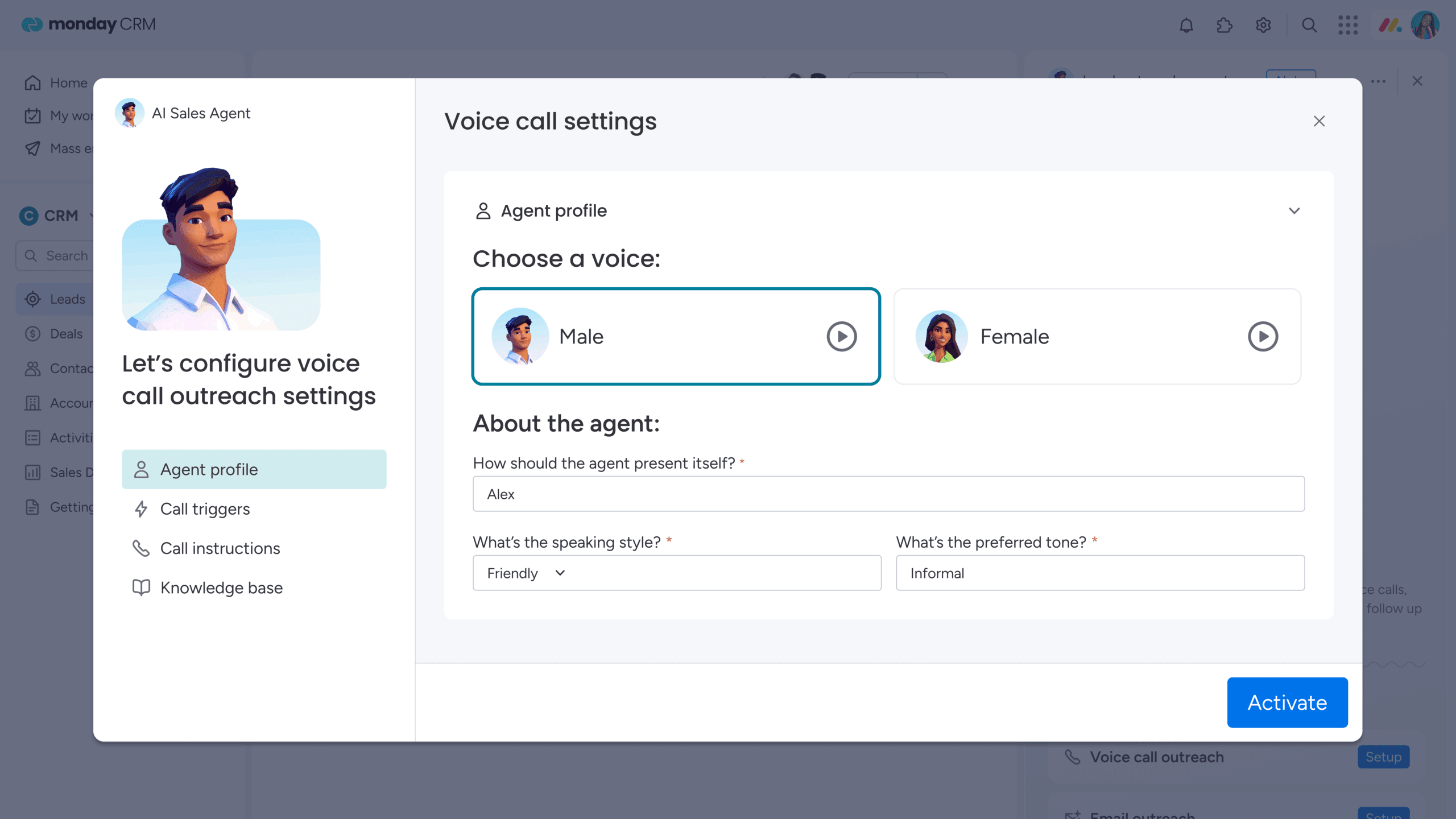
Revenue teams discover that monday CRM provides the foundation for building virtual inside AI sales teams without technical complexity. The platform’s intuitive interface combined with native AI capabilities enables sales leaders to deploy automation that adapts to their unique sales process.
AI-powered automation without the complexity
The AI features in monday CRM work directly within the platform where your team already operates. The Autofill with AI capability applies intelligent automation to any column on your boards. Teams can deploy AI actions including:
- Sentiment detection: analyzing prospect communications for buying signals.
- Information extraction: pulling key data from documents and emails.
- Text improvement: improving message composition and tone.
- Smart assignment: routing leads based on expertise and workload.
All configured through simple dropdown menus rather than complex programming.
The Writing assistant feature enables reps to generate personalized emails with simple prompts. Specify tone and length, preview the output, and send perfectly crafted messages that maintain your brand voice while saving hours of drafting time.
Intelligent lead management at scale
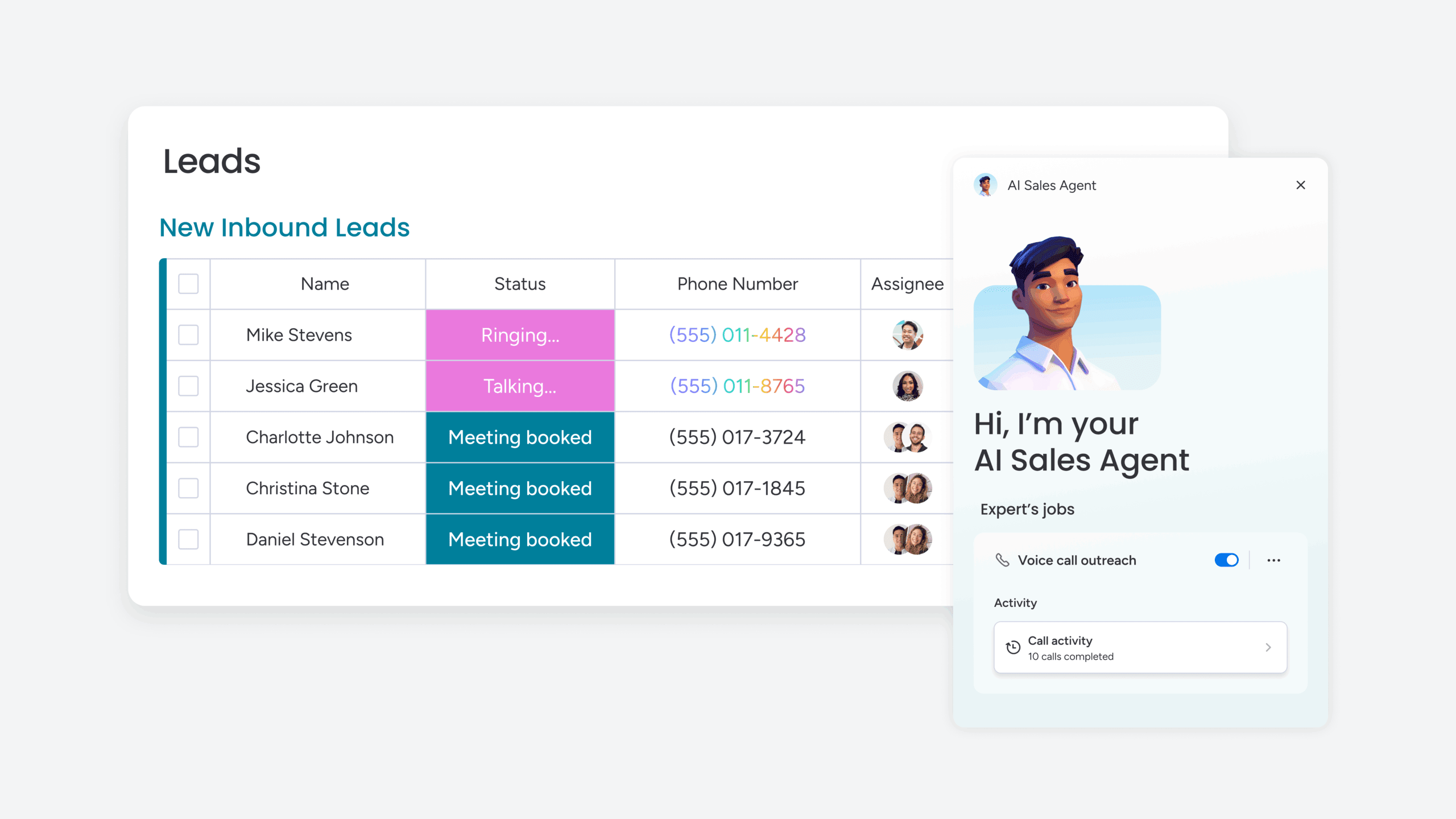
When leads enter the system, AI agents in monday CRM immediately spring into action. The Assign person action analyzes lead characteristics and automatically routes them to the most qualified rep based on:
- Expertise alignment: matching industry or product knowledge.
- Territory rules: geographic or account-based assignments.
- Workload balancing: distributing leads evenly across the team.
- Performance metrics: routing to highest-converting reps.
The Extract information feature pulls key data from documents, contracts, or communications, eliminating manual data entry and ensuring complete prospect profiles.
Teams using the platform report dramatic improvements in lead response time. Instead of leads sitting unassigned for hours, AI agents ensure immediate routing and initial engagement, keeping prospects warm while human reps prepare for meaningful conversations.
Complete visibility and control
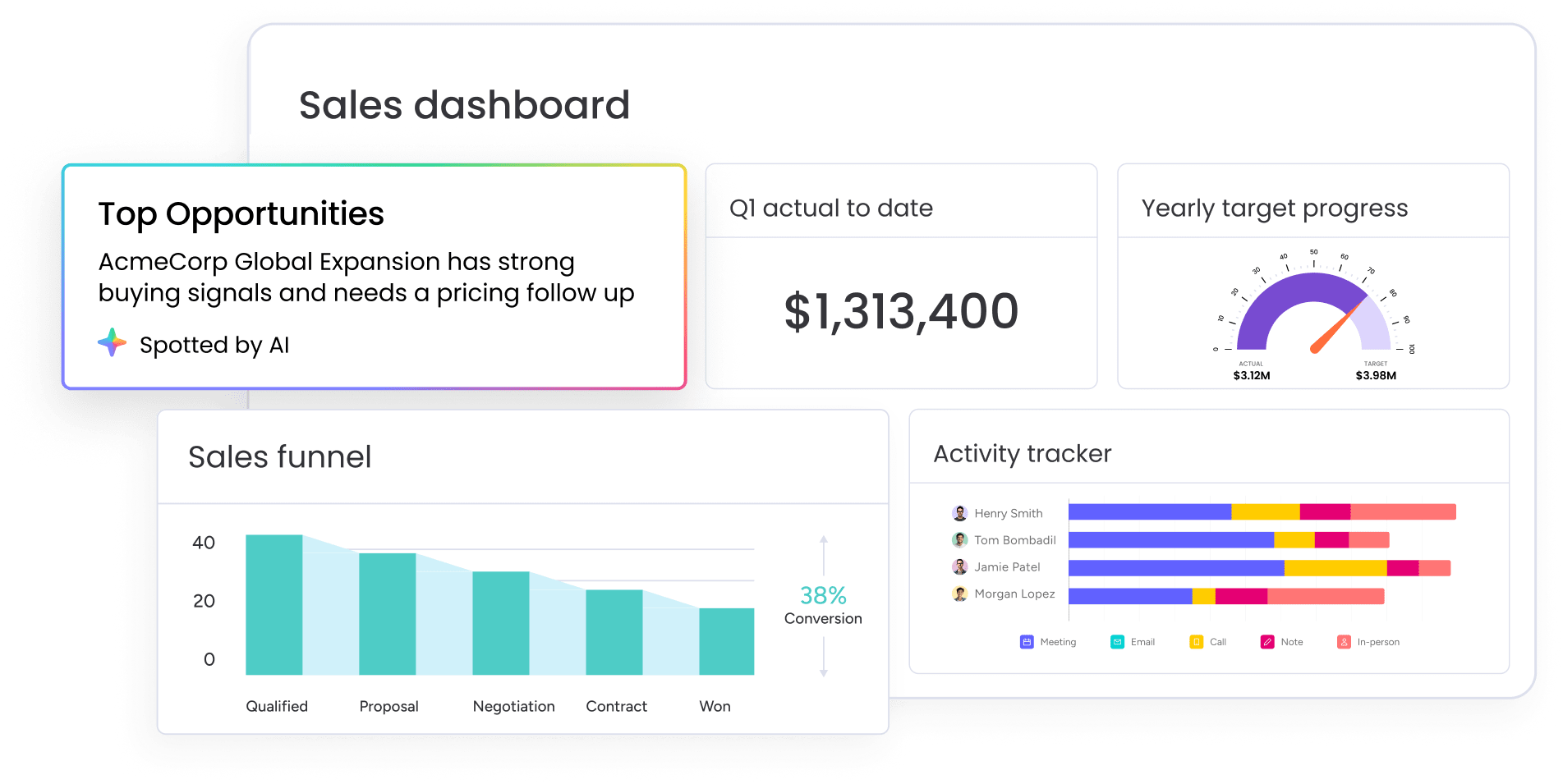
All customer information, communication history, and automation activity centralize in one platform with monday CRM. Custom dashboards provide real-time insights into:
- Pipeline health: deal progression and stalling risks.
- Team performance: individual and group metrics.
- AI agent effectiveness: automation success rates and ROI.
- Revenue forecasting: predictive analytics and trend analysis.
Revenue leaders gain the visibility needed to make confident decisions about resource allocation and strategy.
The platform’s Run history feature provides transparency into AI decision-making. Review exactly how AI agents processed information and made assignments, ensuring accountability and enabling continuous optimization.
Seamless collaboration across teams
AI agents in monday CRM facilitate smooth handoffs between sales, account management, legal, and finance teams. Automated notifications, task assignments, and status updates keep everyone aligned without manual coordination. When a deal requires legal review, AI agents automatically notify the right stakeholders and track progress.
Create an unstoppable human-AI sales partnership
Manual sales processes create significant operational bottlenecks. Time allocated to data entry, delayed follow-up communications, and unattended leads directly impact revenue generation. Virtual inside AI sales agents address these challenges by automating repetitive tasks that reduce team efficiency.
Organizations should begin with targeted, high-impact automations. Implementing lead scoring capabilities first, followed by email personalization, allows teams to evaluate results and gather actionable feedback before scaling. Leading organizations are deploying solutions now, refining their approach through continuous implementation and iteration.
Successful AI agent deployment depends on selecting platforms that integrate with existing processes rather than requiring workflow restructuring. Prioritize solutions that provide visual workflow builders, transparent AI decision-making logic, and native CRM integration. Focus on measurable outcomes: time savings per representative, lead response time reduction, and deal velocity acceleration.
AI agents augment rather than replace human sales teams. By managing administrative tasks, these systems enable sales professionals to concentrate on relationship development, complex problem-solving, and deal closure. The combination of human expertise and AI-driven efficiency creates a competitive advantage in revenue operations.
Frequently asked questions
How much do virtual inside AI sales agents cost?
Virtual inside AI sales agents typically cost between $50-500 per user per month depending on platform sophistication and capabilities. Most organizations achieve positive ROI within three to six months through time savings and increased conversion rates.
What is an example of AI in sales?
Most AI sales agent platforms offer CRM integrations, though integration depth varies significantly. Native integrations provide real-time data synchronization while third-party connectors may introduce delays.
How quickly can I implement AI sales agents?
AI sales agent implementation typically requires 30-90 days depending on complexity. Simple automation deploys in one to two weeks while sophisticated multi-agent systems require two to three months.
Do AI agents replace human sales teams?
AI sales agents complement rather than replace human teams by automating routine activities. Human reps focus on relationship building, negotiations, and strategic account management.
What's the difference between AI sales agents and chatbots?
AI sales agents proactively execute complete workflows and make autonomous decisions across multiple channels. Chatbots primarily respond to direct inquiries through predetermined scripts.
How do I measure the success of AI sales agents?
Measure AI agent success through lead qualification accuracy, response time reduction, conversion rate improvements, and sales velocity acceleration. Track both efficiency gains and revenue impact.

 Get started