
As it happens often, even though SDR teams hit their monthly lead response targets, half those leads go cold before anyone qualifies them. Companies generate more inbound interest than ever, but teams can’t keep up with the volume. Prospects expect instant responses, yet SDRs spend most of their day researching companies and updating CRM records instead of having actual sales conversations.
In contrast, AI SDRs respond to leads instantly, day or night, and handle the repetitive qualification work that bogs down teams. These intelligent systems engage prospects immediately, ask the right discovery questions, and route qualified leads to human SDRs who can focus on relationship building and closing deals.
So how to scale inbound pipelines with AI SDRs in 2026? The following sections cover a 5-step roadmap, the platform features that matter most, and how to make AI and human SDRs work together to close more deals. They also demonstrate how platforms with native AI cut setup time from weeks to days.
Key takeaways
- Respond to leads within five minutes or lose them to competitors: the first company to respond wins 35-50% of deals, regardless of product quality as speed beats features every time.
- AI SDRs handle routine qualification while humans focus on relationship building: this hybrid approach handles 5-10x more leads than human-only teams without sacrificing conversion rates.
- Manual qualification creates hard capacity limits that block pipeline growth: each SDR can only qualify 15-20 leads daily, meaning a 5-person team hits a ceiling at 100 daily qualifications regardless of inbound volume.
- Scale inbound pipeline with native AI capabilities: advanced solutions monday CRM automatically categorizes leads, extracts qualification data, and detects prospect sentiment without complex integrations, deploy in hours instead of weeks.
- Measure what matters with response time, conversion rates, and pipeline velocity: track these three metrics to prove AI SDR impact and identify where your revenue operations need the most improvement.
What prevents teams from scaling inbound pipelines?
Your team hits a wall when leads pour in faster than you can respond. Marketing generates more leads, but your SDR team can’t keep up with qualification and follow-up. It results in missed opportunities, frustrated prospects, and SDRs burning out from repetitive tasks.
Mid-market teams feel this the most. You need enterprise-level responsiveness but lack the resources to triple your SDR headcount. Meanwhile, buyers expect immediate engagement regardless of when they submit a form or start a chat.
These bottlenecks get worse over time, and the gap between lead volume and what you can actually convert keeps growing:
- Response time failures: leads who don’t hear back within five minutes are far less likely to convert, yet most SDR teams take 24-48 hours to respond, even during business hours.
- Manual qualification overhead: SDRs spend 70% of their time on research and administrative tasks rather than actual selling conversations.
- MQL quality issues: marketing-generated leads require extensive filtering before they’re sales-ready, forcing SDRs to act as gatekeepers.
- Visibility gaps: revenue leaders can’t see where leads get stuck in real time, so they only spot problems after deals are already lost.
- Coverage limitations: global buyers expect 24/7 engagement, but traditional SDR teams can’t cover nights and weekends without blowing up costs.
Missing leads due to slow response times
How fast you respond decides whether you win or lose the deal. The first company to respond wins the deal 35-50% of the time, regardless of product superiority. Every hour of delay reduces conversion probability.
The problem gets worse across time zones and after hours. A lead submitting a form at 7 PM receives no response until the next morning. By then, they’ve already talked to three competitors who responded right away. Weekend inquiries sit untouched until Monday, giving competitors a 48-72 hour head start.
Manual qualification creating pipeline bottlenecks
Manual lead qualification creates hard capacity constraints. Each SDR can realistically qualify 15-20 leads per day when accounting for research time, email composition, follow-up sequences, and CRM updates. A 5-person SDR team maxes out at 75-100 qualifications per day, no matter how many leads come in.
Qualification eats up way too much time:
- Research phase: 20 minutes researching the company and contact.
- Outreach creation: 15 minutes crafting personalized messaging.
- Administrative tasks: ten minutes logging activities and updating records.
That’s 45 minutes per lead. This time sink means SDRs spend their entire day qualifying prospects instead of having the high-value sales conversations that drive revenue.
SDRs drowning in low-quality MQLs
Marketing automation brings in volume, but not every lead is ready to buy. SDRs typically find that 60-70% of marketing-qualified leads fail basic qualification criteria. Wrong company size, no budget authority, researching for future needs, or simply downloading content without purchase intent.
That quality gap frustrates your team and kills efficiency. SDRs waste hours filtering out unqualified leads, leaving less time for high-value prospects ready to buy. The filtering burden also obscures true pipeline metrics, making it difficult for revenue leaders to accurately forecast or optimize marketing spend.

How do AI SDRs transform inbound pipeline scaling?
AI SDRs are software that talks to leads, qualifies them, and routes them to the right rep — using natural language processing and machine learning. Unlike simple chatbots, AI SDRs conduct genuine discovery conversations, assess fit against qualification criteria, and determine appropriate next steps based on prospect responses.
The improvement occurs through augmentation rather than replacement of traditional SDRs. AI SDRs handle routine qualification tasks and initial engagement, freeing human SDRs to focus on complex relationship-building and strategic selling conversations.
This hybrid model gives you scale and quality. AI covers nights and weekends with instant responses, while humans bring judgment and build relationships where it counts.
Achieve instant lead response and qualification
AI SDRs respond within seconds of a form submit or chat message. You catch prospects when they’re most interested and stop them from checking out competitors while they wait.
Qualification happens through a natural conversation. AI SDRs ask contextual discovery questions based on initial information provided, adapting the conversation flow based on prospect responses. Enterprise prospects get different questions than small business leads.
Enable intelligent lead prioritization
AI SDRs analyze multiple data points simultaneously to score and prioritize leads in real-time. The scoring considers:
- Explicit information: data from prospect conversations.
- Behavioral signals: engagement patterns and website activity.
- Firmographic data: company size, industry, and growth indicators from third-party sources.
- Historical patterns: conversion data from similar prospects.
High-value prospects get routed to human SDRs immediately. Medium-priority leads enter nurture sequences with periodic AI check-ins. Low-priority leads receive self-service resources and automated follow-up until they demonstrate increased intent.
Deliver personalization without added headcount
AI SDRs tailor messaging based on prospect profile, behavioral patterns, and conversation history. This personalization extends beyond basic name insertion to include industry-specific language, role-appropriate messaging, and targeted pain point addressing that resonates with each prospect’s unique context.
For example, a prospect from healthcare receives different messaging than one from financial services. The AI references relevant examples, addresses industry-specific concerns, and uses familiar terminology.
5-step roadmap to scale inbound pipeline with AI SDRs
A successful AI SDR rollout follows a clear plan that adds capabilities step by step without disrupting your team. The five stages usually take eight to twelve weeks from audit to full launch. Each stage builds on the last, so you integrate smoothly without breaking what already works.
This roadmap gives you a proven framework for implementing AI SDRs that complement your existing sales process. Follow these steps to transform your inbound pipeline from a bottleneck into a competitive advantage.
Step 1: audit your current inbound coverage gaps
Start with the audit that sets your baseline and shows where AI SDRs will help most. Revenue leaders need hard numbers on current performance before tracking improvements.
| Metric | What to measure | Why it matters |
|---|---|---|
| Response time distribution | Time from lead submission to first contact | Identifies coverage gaps |
| Qualification capacity | Leads processed per SDR per day | Reveals scaling constraints |
| Conversion rates by stage | MQL-to-SQL rates by response time | Connects speed to revenue |
| SDR capacity utilization | Time on manual tasks vs. selling | Shows automation value |
Step 2: map AI SDR workflows to your sales process
Workflow design decides what AI does on its own and when it is handed off to your team. Therefore, map workflows to fit your current sales process, but don’t force changes that disrupt your team.
Document your current qualification workflow in detail:
- Discovery questions: what questions do SDRs ask?
- Information gathering: what data do they collect?
- Qualification criteria: what determines if a lead moves forward?
- Handoff triggers: when do leads transfer to account executives?
This documentation guides your AI workflow design.
Step 3: connect AI SDRs to your tech stack
You’ll need to connect AI SDRs to your CRM, marketing automation, and communication platforms. Core requirements include:
- Bidirectional CRM sync: real-time data flow between AI and CRM systems.
- Marketing automation integration: lead tracking and campaign attribution.
- Communication platform connectivity: email, chat, and phone channel access.
Organizations using solutions like monday CRM benefit from pre-built integrations and AI capabilities that reduce implementation time from weeks to days. Native AI features eliminate the need for complex third-party integrations while maintaining complete workflow flexibility.
Step 4: launch your hybrid human-AI model
Launch AI SDRs alongside your current team. Communicate to your team that AI is there to free them up to focus on work that matters more.
Start with a pilot covering 20-30% of inbound volume. Pick a lead segment where AI helps right away — usually high-volume routine inquiries. Track the numbers and listen to feedback from SDRs and prospects.
Key launch considerations include:
- Team communication: explain how AI enhances rather than replaces human roles.
- Training requirements: ensure SDRs understand handoff protocols.
- Performance monitoring: track both AI and human metrics during transition.
Step 5: scale based on performance data
Scale based on performance data that clearly shows where AI SDRs drive measurable impact. Focus on metrics that directly influence revenue:
- Conversion comparisons: AI-qualified vs. human-qualified lead performance.
- Response time impact: how speed affects conversion rates.
- Cost efficiency: cost per qualified lead across different approaches.
- Quality indicators: lead scoring accuracy and progression rates.
7 must-have capabilities for AI SDR platforms
When evaluating AI SDR platforms, assess these seven capabilities that predict long-term success. These features distinguish advanced AI solutions from basic automation and determine the return on your investment.
1. Real-time multi-channel engagement
AI SDRs need to work across email, chat, social media, and phone. Because single-channel tools frustrate prospects by forcing them to use one communication method, channels should work together smoothly and keep conversation context when prospects switch between them.
2. Natural language understanding
Natural language processing enables AI SDRs to understand context, intent, and nuance rather than simply matching keywords. Advanced NLP allows AI to:
- Interpret variations: understand questions phrased multiple ways.
- Process industry jargon: recognize sector-specific terminology.
- Detect sentiment: adjust tone based on prospect emotions.
- Maintain context: remember previous conversation points.
3. Continuous lead scoring
AI SDRs update lead scores in real time as prospects interact with your business. Each action including website visits, email replies, content downloads, or chat responses,triggers an instant score update.This means high-intent leads automatically rise to the top when they show buying signals like viewing pricing pages, involving multiple stakeholders, or discussing timelines.
Your team focuses on the hottest opportunities right now, not yesterday’s priorities, so ready-to-buy prospects get immediate attention.
4. No-code workflow customization
Business users need to adjust AI SDR workflows without needing technical skills. Visual workflow builders let you iterate fast based on what’s working. Teams using advanced platforms like monday CRM can mix AI features with automations and conditional logic using drag-and-drop without technical help needed.
5. Native CRM integration
Seamless CRM integration ensures:
- Data consistency: single source of truth across systems.
- Workflow continuity: smooth handoffs between AI and human touchpoints.
- Reliable performance: superior stability compared to third-party connectors.
6. Transparent performance analytics
AI SDR platforms need reporting that connects operational metrics to actual business results. Revenue leaders need to see what’s working, what’s not, and how AI stacks up against human performance.
Look for dashboards that show response times, qualification accuracy, conversion rates by lead source, and cost per qualified lead — all in real time so you can spot problems and opportunities before they impact revenue.
Learn more: The best AI SDR tools
7. Continuous learning systems
Machine learning allows AI SDRs to improve their performance by analyzing successful interactions and outcomes. The system keeps improving and gets more valuable over time.
The best platforms learn from every conversation, automatically adjusting their approach based on which questions, messaging, and qualification criteria actually lead to closed deals.
Building an AI-human SDR partnership that works
The best setups combine AI speed with human relationship skills. You need smart integration that plays to each side’s strengths and keeps prospects happy through the whole sales process.
Define handoff protocols
Clear handoff rules prevent confusion and keep prospects happy. The protocol should spell out when handoffs happen, what info gets transferred, and who follows up.
Human SDRs need comprehensive information during handoffs:
- Complete conversation transcripts: full context of AI interactions.
- Qualification data: scoring rationale and identified requirements.
- Pain points: specific challenges the prospect mentioned.
- Recommended next steps: suggested actions based on conversation.
Upskill SDRs as AI orchestrators
Human SDRs shift from doing everything themselves to managing AI workflows and handling complex situations. This shift opens up career growth instead of eliminating jobs.
New skills for SDR development include:
- AI workflow optimization: understanding how to improve AI performance.
- Complex relationship management: handling high-touch prospect interactions.
- Strategic account planning: developing long-term engagement strategies.
- Data analysis: identifying improvement opportunities from performance metrics.
Create continuous feedback loops
Human SDRs provide feedback that refines the AI’s performance. They spot edge cases, suggest more effective responses, and flag conversations where AI falls short. Make feedback simple and build it into daily work.
Teams using AI provided by solutions like monday CRM can customize actions based on qualification criteria and adjust them based on results, creating a feedback loop that keeps improving.
Measuring your AI SDR pipeline impact
Good measurement ties AI SDR improvements to real business results. Track forward-looking metrics and backward-looking results to see the full impact of your AI rollout.
Track response time improvements
Response time measures the speed at which prospects receive initial contact from your team. Analyze this metric by time of day, lead source, and priority level to identify areas requiring optimization. Organizations implementing AI SDRs typically observe response times decrease from several hours to under 60 seconds.
Monitor conversion rate gains
Evaluate how AI SDRs influence lead progression through each stage of your pipeline. Segment this analysis by lead source and qualification criteria to determine where AI delivers the greatest impact. Most organizations observe MQL-to-SQL conversion rates increase by 10-25% following AI SDR implementation.
Calculate pipeline velocity changes
Pipeline velocity measures the time required for leads to progress from initial contact to closed deal. Increased velocity translates to faster deal closure and accelerated revenue realization. AI SDRs influence velocity through:
- Faster qualification: immediate response and assessment.
- Improved accuracy: reduced time spent on poor-fit prospects.
- Automated follow-up: consistent engagement preventing stalls.

Scale smarter with monday CRM's AI-powered pipeline capabilities
Revenue teams get three key advantages for scaling inbound pipeline with AI from monday CRM. The platform combines AI that automates qualification, no-code workflow builders for fast customization, and real-time dashboards for full pipeline visibility.
| Capability | monday CRM approach | Traditional CRM + AI |
|---|---|---|
| Implementation time | Hours to days with native features | Weeks to months for integration |
| Data consistency | Perfect sync within unified platform | Sync delays and conflicts |
| Workflow flexibility | No-code customization by business users | Often requires IT consultants |
| User experience | Seamless AI-human handoffs | Context switching between systems |
Automate lead qualification with AI capabilities
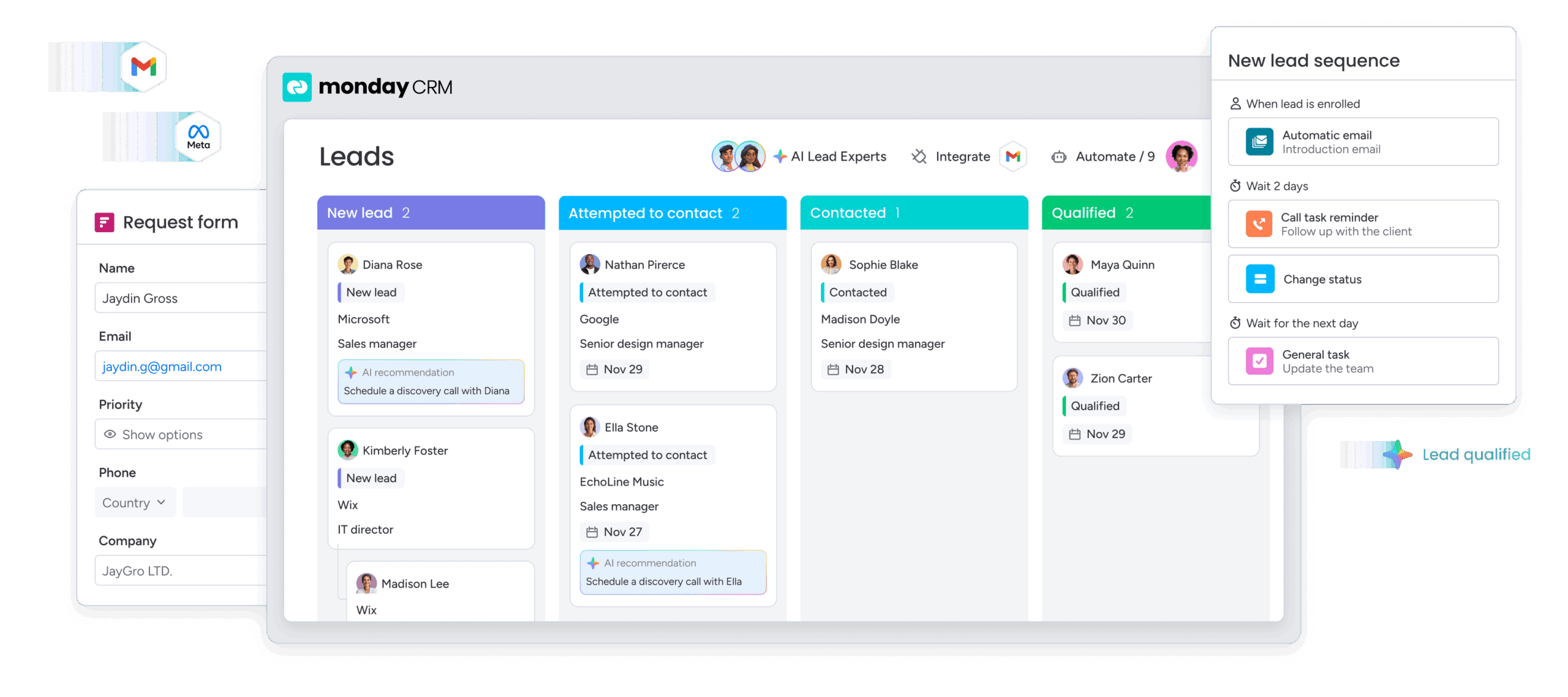
The platform’s AI handles these qualification tasks on its own:
- Categorize capability: scores and segments leads automatically based on company size, industry, and engagement, with no manual review needed.
- Extract info capability: captures structured data from unstructured sources, automatically extracting company details, requirements, and timeline information when prospects submit detailed inquiries.
- Detect sentiment capability: analyzes prospect communications to understand intent and urgency, helping SDRs prioritize follow-up and tailor their approach.
Build custom AI workflows without code
Visual workflow builders enable revenue teams to create sophisticated AI-powered processes. The drag-and-drop interface allows users to combine AI capabilities with automations and conditional logic, designing end-to-end lead management workflows.
Teams can test new qualification criteria, adjust prioritization rules, and refine messaging without waiting for technical resources, enabling rapid iteration based on performance data.
Gain real-time pipeline visibility
Dashboard capabilities provide revenue leaders with real-time visibility into inbound pipeline health and AI performance. Dashboards combine data from AI interactions and human activities, delivering insights that drive decision-making.
Key dashboard views include:
- Lead flow metrics: inbound volume and response times.
- AI performance tracking: qualification accuracy comparisons.
- Pipeline health indicators: current value and velocity trends.

“With monday CRM, we’re finally able to adapt the platform to our needs — not the other way around. It gives us the flexibility to work smarter, cut costs, save time, and scale with confidence.”
Samuel Lobao | Contract Administrator & Special Projects, Strategix
“Now we have a lot less data, but it’s quality data. That change allows us to use AI confidently, without second-guessing the outputs.”
Elizabeth Gerbel | CEO
“Without monday CRM, we’d be chasing updates and fixing errors. Now we’re focused on growing the program — not just keeping up with it."
Quentin Williams | Head of Dropship, Freedom Furniture
“There’s probably about a 70% increase in efficiency in regards to the admin tasks that were removed and automated, which is a huge win for us.“
Kyle Dorman | Department Manager - Operations, Ray White
"monday CRM helps us make sure the right people have immediate visibility into the information they need so we're not wasting time."
Luca Pope | Global Client Solutions Manager at Black Mountain
“In a couple of weeks, all of the team members were using monday CRM fully. The automations and the many integrations, make monday CRM the best CRM in the market right now.”
Nuno Godinho | CIO at Velv
“monday.com provides developmental flexibility, operational efficiency, and data transparency — all in one place. We became a company that moved from chasing data to leading with it.”
Hyunghan Lee | Team Lead, Sandbox Network
"monday.com brought every part of our business into one connected space. The harmony between work management and CRM has become our operating system — giving us the clarity and confidence to scale.”
Jennifer Chinburg | Executive Vice President of Corporate Development & Brand, Chinburg Properties
“We just weren’t getting value from our old CRM. With monday.com, it's a thousand times better. Our sales teams are more informed, more consistent, and far more connected."
James Arnold | Chief Operating Officer, CenversaBuild a high-performance inbound pipeline with AI SDRs
AI SDRs represent a fundamental shift in how revenue teams scale inbound pipeline. The technology has matured into production-ready solutions delivering measurable impact across response times, conversion rates, and pipeline velocity.
Organizations implementing AI SDRs gain competitive advantages that compound over time. Early adopters capture more opportunities, build efficient revenue operations, and develop AI expertise that becomes increasingly valuable.
The implementation path is straightforward: audit current performance, design workflows that align with your sales process, and launch a hybrid model that combines AI and human capabilities. Teams ready to transform their inbound pipeline can start building AI-powered workflows and scaling smarter.
Frequently asked questions
How much does AI SDR implementation typically cost for mid-market companies?
AI SDR implementation for mid-market companies typically ranges from $2,000-$5,000 monthly for platform fees plus one-time setup costs of $10,000-$25,000, compared to $60,000-$80,000 annually per additional human SDR.
What data quality standards do AI SDRs require for effective lead qualification?
AI SDRs require clean contact information and basic firmographic data with CRM accuracy above 90% to function effectively for lead qualification.
How quickly can teams deploy AI SDRs for inbound pipeline management?
Deployment timelines range from two to four weeks for platforms with native CRM integration to eight to twelve weeks for standalone solutions requiring complex integrations.
Can AI SDRs handle complex enterprise sales cycles effectively?
AI SDRs excel at initial qualification and routine interactions but require human involvement for complex relationship building and strategic account planning in enterprise cycles.
What happens when AI SDRs encounter scenarios beyond their capabilities?
AI SDR platforms include escalation protocols that transfer prospects to human team members when conversations exceed AI capabilities, providing complete context and conversation history for seamless handoffs.
How do AI SDR conversion rates compare to human SDR performance?
AI SDRs typically match or exceed human SDR conversion rates for routine qualification while processing 5-10x more leads, with hybrid models delivering 30-40% higher overall conversion than human-only approaches.