



Key takeaways
- Start with pilot programs that show quick wins: launch AI in one high-impact area like lead scoring or data entry to prove value before expanding across your entire sales process.
- Define who does what to avoid confusion: AI handles data analysis and pattern recognition while humans focus on relationship building, negotiations, and strategic decisions that require emotional intelligence.
- Use no-code AI to get started immediately: add AI capabilities like sentiment detection, information extraction, and lead assignment to your workflows with solutions like monday CRM without technical expertise or IT support.
- Measure both revenue impact and team adoption: track metrics like revenue per rep and deal velocity alongside user satisfaction scores to ensure AI improves both performance and team experience.
- Address team concerns upfront with transparency: show how the AI makes its decisions and let team members override recommendations to build trust and demonstrate that AI augments rather than replaces human expertise.
What is human-AI collaboration in sales?
Human-AI collaboration in sales is a strategic partnership where AI manages data-intensive tasks while sales professionals concentrate on relationship development and strategic decision-making.
This partnership succeeds because it combines the scale of machine learning with the nuance of human judgment. While AI processes thousands of interactions to identify trends, humans interpret emotional cues and establish the trust necessary to close complex deals.
Understand the shift from automation to AI partnership
Traditional automation operates according to predetermined rules: sending follow-up emails, updating records, and executing workflows. AI partnership extends beyond these capabilities by analyzing context, learning from outcomes, and continuously improving its performance over time.
As a result, teams work in different ways. AI might detect that a prospect responds best on Tuesday mornings and wants technical details, not high-level pitches. The sales rep uses this to time their outreach and customize their message.
The platform detects sentiment, pulls information from documents, and summarizes email threads. Sales reps get the intel they need without spending hours on research.
Leverage digital workers as virtual team members
Digital workers are specialized AI team members. They work 24/7, learn from interactions, and handle specific tasks. Unlike software that waits for commands, digital workers monitor activities, spot opportunities, and take action.
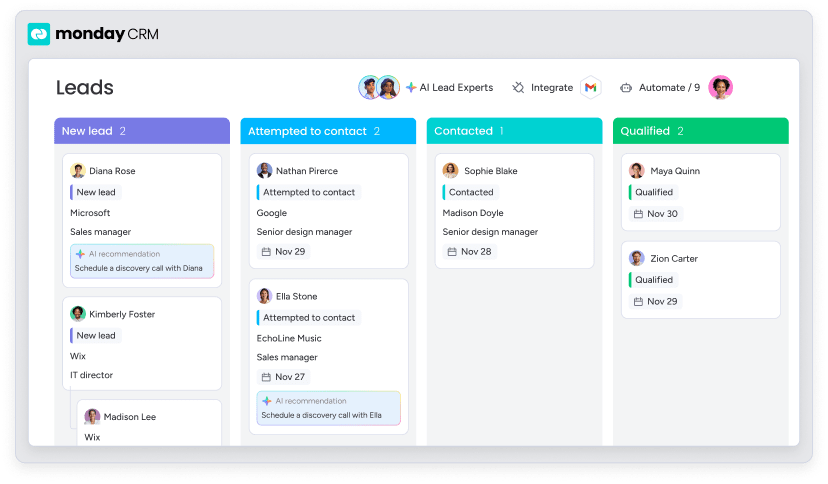
Sales teams see this when AI automatically categorizes leads, pulls contact info, and assigns labels based on your criteria. Managers get performance insights for targeted, effective coaching and reps get personalized recommendations for prioritizing their day.
Recognize current adoption rates and trends
Sales organizations are integrating AI into workflows rapidly, with highest adoption in AI in sales enablement areas like lead scoring, customer analysis, and pipeline forecasting. Early adopters say their reps now spend way more time with customers and on strategic selling.
Successful teams approach AI adoption strategically, focusing on specific, high-impact areas to demonstrate value quickly. This phased approach secures early wins and builds momentum for broader implementation. Teams typically start with:
- AI-powered lead prioritization: focusing on high-probability prospects based on conversion patterns.
- Automated data entry: eliminating manual information capture and record updates.
- Predictive analytics: forecasting deal outcomes with greater accuracy.
- Personalized content generation: creating tailored messaging that resonates with individual prospects.
Why does human-AI balance drive sales success?
The right balance between human expertise and AI creates results neither can hit alone. Organizations using human-AI collaboration see measurable revenue growth, stronger relationships, and distinct competitive advantages.
In fact, 66% report revenue increases when using generative AI regularly in marketing and sales functions. Mastering these specific advantages allows sales leaders to decide exactly where to invest for the highest impact.
Proven revenue growth through collaboration
Human-AI collaboration drives revenue two ways: more selling time and better decisions. First, when AI handles analysis, pattern recognition, and admin work, sales reps gain five to ten hours a week for customers. Organizations with mature AI implementations have already realized 22% efficiency gains and expect 28% within two years. That means more conversations, more proposals, more closed deals.
Furthermore, decisions improve because AI analyzes historical data to identify:
- High-probability prospects: based on conversion patterns and engagement signals.
- Optimal product matches: using customer characteristics and past success data.
- Winning pricing strategies: through analysis of competitive positioning and deal history.
Sales reps use these insights to focus on the best opportunities and customize their approach for each prospect.
Maintaining authentic relationships at scale
Additionally, the right balance strengthens relationships instead of weakening them. AI often spots opportunities humans might miss within large customer bases, such as usage patterns indicating a lead is ready to buy or engagement drops that signal risk.
Because AI handles the tracking and analysis, sales pros can spend less time on admin and more time reading people—focusing on the authentic connections that build long-term loyalty.,
Competitive edge through hybrid teams
Moreover, organizations using human-AI collaboration respond faster to market changes, forecast more accurately, and handle complex scenarios better than competitors still doing things the old way. That creates advantages competitors can’t copy fast.
The speed comes from AI processing information and spotting patterns in real time. When competitors launch products or trends shift, AI-enhanced teams spot it immediately and adjust.
5 core principles for human-AI sales balance
Successful human-AI collaboration rests on core principles that guide how you implement and sustain it. These principles help sales leaders avoid pitfalls and build models that help teams instead of disrupting them. Each principle addresses specific collaboration aspects, from role definition to continuous improvement:
- Augment capabilities, never replace: AI enhances what humans do best rather than eliminating roles. AI analyzes behavior patterns, scores leads on conversion probability, and tracks engagement across channels. Humans focus on relationship building, complex problem-solving, and strategic thinking requiring contextual understanding.
- Redesign complete workflows: effective collaboration requires rethinking entire processes, not adding AI to existing workflows. Map current processes to identify where AI eliminates friction, where humans add unique value, and where handoffs should occur.
- Focus on high-impact applications: prioritize AI implementation where returns are highest. Lead scoring, customer analysis, and pipeline forecasting typically deliver immediate value because they require processing large data amounts.
- Build cross-functional teams: success requires involvement from sales, marketing, IT, and operations. Sales provides frontline insights, marketing contributes customer data, IT ensures integration and security.
- Create continuous learning systems: both humans and AI improve through ongoing feedback. Establish regular reviews examining AI accuracy and human adoption.

“With monday CRM, we’re finally able to adapt the platform to our needs — not the other way around. It gives us the flexibility to work smarter, cut costs, save time, and scale with confidence.”
Samuel Lobao | Contract Administrator & Special Projects, Strategix
“Now we have a lot less data, but it’s quality data. That change allows us to use AI confidently, without second-guessing the outputs.”
Elizabeth Gerbel | CEO
“Without monday CRM, we’d be chasing updates and fixing errors. Now we’re focused on growing the program — not just keeping up with it."
Quentin Williams | Head of Dropship, Freedom Furniture
“There’s probably about a 70% increase in efficiency in regards to the admin tasks that were removed and automated, which is a huge win for us.“
Kyle Dorman | Department Manager - Operations, Ray White
"monday CRM helps us make sure the right people have immediate visibility into the information they need so we're not wasting time."
Luca Pope | Global Client Solutions Manager at Black Mountain
“In a couple of weeks, all of the team members were using monday CRM fully. The automations and the many integrations, make monday CRM the best CRM in the market right now.”
Nuno Godinho | CIO at Velv
“monday.com provides developmental flexibility, operational efficiency, and data transparency — all in one place. We became a company that moved from chasing data to leading with it.”
Hyunghan Lee | Team Lead, Sandbox Network
"monday.com brought every part of our business into one connected space. The harmony between work management and CRM has become our operating system — giving us the clarity and confidence to scale.”
Jennifer Chinburg | Executive Vice President of Corporate Development & Brand, Chinburg Properties
“We just weren’t getting value from our old CRM. With monday.com, it's a thousand times better. Our sales teams are more informed, more consistent, and far more connected."
James Arnold | Chief Operating Officer, CenversaDefining roles: AI activities vs. human expertise
Effective collaboration requires explicit role definition to create alignment and ensure accountability. Successful implementations create frameworks specifying which activities AI handles, where humans add irreplaceable value, and how work transitions between them. This clarity ensures teams maximize both AI capabilities and human strengths while maintaining smooth operations.
Identify activities AI handles best
Understanding which activities AI handles most effectively helps sales leaders make informed deployment decisions. This framework shows where AI capabilities deliver maximum impact:
| Activity type | AI capability | Business impact |
|---|---|---|
| Data analysis | Pattern recognition across thousands of interactions | Insights uncovered in minutes instead of days |
| Lead scoring | Evaluation against dozens of criteria simultaneously | Prioritized lists focusing attention on high-probability opportunities |
| Sentiment detection | Real-time analysis of communication tone | Early warning signals for at-risk relationships |
| Content personalization | Tailored messaging based on prospect characteristics | Relevant outreach resonating with individual preferences |
| Performance tracking | Continuous monitoring of sales metrics | Automatic reports and trend identification |
The platform’s AI aligns with these activities through features like autofill columns that detect sentiment, extract document information, and assign labels automatically. AI can summarize lengthy email threads, translate content, and execute custom actions based on specific instructions.
Recognize where humans add irreplaceable value
Human sales professionals excel at activities requiring emotional intelligence, strategic thinking, and creative problem-solving. These capabilities remain essential regardless of AI sophistication:
- Complex relationship building: humans navigate subtle dynamics of trust-building, understand unstated needs, and create genuine connections with prospects and customers.
- Emotional intelligence and empathy: sales representatives recognize when prospects feel frustrated, excited, or uncertain, adjusting communication accordingly.
- Strategic negotiation: humans handle complex deal negotiations, understanding when to hold firm and when to offer concessions.
- Creative problem-solving: when customers present unique challenges, humans develop innovative solutions combining capabilities in novel ways.
- Ethical decision-making: humans make judgment calls about customer best interests, even when it might not maximize immediate revenue.
Design seamless handoff protocols
Effective handoffs ensure smooth transitions between AI and human work without losing context or momentum. Define triggers for AI escalation to humans: questions outside AI’s knowledge, detected frustration, or deals reaching negotiation stages.
Because context preservation during handoffs proves critical, when AI escalates conversations, it provides complete history including:
- Gathered information: all data collected during AI interactions.
- Answered questions: previous inquiries and responses provided.
- Raised concerns: issues or objections identified during conversations.
- Recommended next steps: AI suggestions for moving forward.
Overcoming trust gaps in AI adoption
Many sales professionals express concerns about AI reliability, job security, or implementation complexity. Addressing these factors requires understanding specific resistance and implementing strategies building confidence through transparency and demonstrated value.
Success depends on acknowledging concerns while providing evidence of AI’s supportive role rather than replacement function.
Understand team resistance factors
Job security concerns top the list of resistance factors. Sales professionals worry that AI will eventually replace their roles, creating hesitation to embrace capabilities that could automate certain responsibilities. This fear persists even when leadership clearly communicates augmentation intent rather than replacement strategy.
Moreover, another barrier is created by complexity fears. Many have experienced frustrating technology implementations promising efficiency but delivering complicated interfaces and additional administrative burden.
Make millennials your AI champions
Millennial team members typically demonstrate higher AI comfort and can serve as internal advocates helping train and support others on how to use AI in sales. These champions bridge gaps between early adopters and skeptics by demonstrating value in practical, relatable terms.
Peer learning through millennial champions proves more effective than top-down mandates. When respected colleagues show how AI helped close difficult deals or saved hours on administrative work, skeptical members pay attention.
Build transparency into every process
Transparent AI processes showing how decisions are made, what data is used, and how humans can verify or override recommendations build trust more effectively than reassurance about reliability.
Modern platforms support transparency by providing visibility into AI actions and decision logic. Users can review how recommendations were generated, what data was used, and which rules or patterns influenced the outcome. This clarity builds trust, enables informed oversight, and helps teams refine inputs to improve future results.
7 strategies to implement human-AI collaboration
Successful implementation follows structured approaches building capability systematically while maintaining team confidence and business continuity. These strategies provide a roadmap for organizations ready to integrate AI into their sales processes while ensuring smooth adoption and measurable results.
Strategy 1: launch strategic pilot programs
Launch strategic pilots to demonstrate value without risking business continuity. Focus on high-impact areas like lead scoring or automated data entry with a small team of early adopters. By defining success metrics (such as time saved or conversion improvement) before launch, you can prove the pilot’s ROI and build momentum for a wider rollout.
Select pilots delivering measurable results quickly:
- Lead scoring: prioritize prospects based on conversion probability.
- Automated data entry: eliminate manual information capture.
- Pipeline forecasting: predict deal outcomes with greater accuracy.
- Revenue impact tracking: measure time saved, conversion improvement, and forecast accuracy.
Define success metrics before launch including time saved, conversion improvement, forecast accuracy, or revenue impact.
Strategy 2: develop AI fluency across teams
AI fluency means understanding capabilities and limitations, working effectively with AI features, and knowing when to trust recommendations versus applying judgment. This develops through hands-on training rather than theoretical education.
Focus training on practical skills:
- Interpreting lead scores: understanding probability indicators and confidence levels.
- Following versus overriding recommendations: knowing when human judgment should prevail.
- Providing feedback: teaching AI to improve through user input and corrections.
Strategy 3: define specific role boundaries
Create a responsibility matrix mapping every sales activity to AI, human, or collaborative execution. For example, lead research can be AI-only, while complex relationship building remains human-only. Proposal development serves as a hybrid space where AI generates initial drafts and humans provide the final customization.
Strategy 4: design human-first AI experiences
AI implementation should feel natural and supportive rather than complex or intrusive. Human-first design prioritizes user experience, making AI feel like helpful team members rather than complicated systems.
The platform exemplifies human-first design through no-code approaches allowing teams to add AI capabilities without technical expertise. Representatives autofill columns with AI by selecting from available actions like detect sentiment, extract information, or summarize.
Strategy 5: establish success metrics
Meaningful measurement requires quantitative metrics demonstrating business impact and qualitative measures capturing team experience and customer satisfaction:
- Revenue and efficiency metrics: revenue per representative, deal velocity, conversion rates, win rates, administrative versus selling time.
- Adoption and engagement metrics: feature utilization rates, user satisfaction scores, training completion, support ticket volume.
- Customer experience metrics: response time to inquiries, satisfaction scores, retention rates, expansion revenue.
Strategy 6: build continuous feedback loops
Continuous improvement requires systematic feedback from users and performance data. Therefore, gather feedback through surveys, focus groups, and usage analytics.
Monitor AI performance continuously:
- Track prediction accuracy: measure how often AI recommendations prove correct.
- Measure override frequency: understand when humans choose different approaches.
- Analyze error patterns: identify limitations requiring human intervention.
Strategy 7: scale through standardization
Systematically create and deploy AI capabilities across organizations, standardizing processes and creating reusable templates accelerating deployment without sacrificing quality.
Develop standardized deployment documenting every implementation step. Create reusable templates quickly adapted for different functions.
Measuring human-AI team performance
Comprehensive measurement requires tracking metrics across multiple dimensions. This approach provides complete collaboration success pictures and identifies areas needing attention. Effective measurement combines quantitative business metrics with qualitative adoption indicators to ensure both performance improvement and team satisfaction.
Performance measurement framework
Track these key indicators to understand human-AI collaboration effectiveness:
| Metric category | Key indicators | Target improvement | Measurement frequency |
|---|---|---|---|
| Revenue impact | Revenue per rep, win rates, deal size | 7-12% increase | Monthly |
| Efficiency gains | Selling vs. admin time, deal velocity | 30-40% more selling time | Weekly |
| Team adoption | Feature utilization, user satisfaction | 80%+ active usage | Monthly |
| Customer experience | Response time, satisfaction, retention | Maintain or improve | Quarterly |
| AI performance | Prediction accuracy, override rates | 85%+ accuracy | Continuous |
Revenue and productivity benchmarks
Revenue metrics demonstrate human-AI collaboration business value. Track revenue per representative as primary productivity indicators, capturing efficiency gains from AI handling administrative work and effectiveness gains from informed decisions.
Deal velocity measures how quickly opportunities move through pipelines. AI-enhanced teams typically close deals faster because they:
- Identify obstacles earlier: spot potential roadblocks before they become deal-killers.
- Prioritize high-probability opportunities: focus time on winnable deals.
- Spend less time on administrative activities: automate routine tasks and data entry.
Adoption and engagement tracking
Adoption metrics predict long-term success. High feature utilization indicates teams find AI capabilities valuable enough for daily workflow incorporation. Target 80% or more users actively engaging core AI features within 90 days.
User satisfaction scores from regular surveys capture how teams feel about AI capabilities and identify friction points before they become major adoption barriers.
How does monday CRM power human-AI sales success?
The platform’s AI approach differs fundamentally from traditional sales platforms by making capabilities accessible to any team member, regardless of technical expertise. The platform focuses on augmenting human capabilities through intuitive AI features integrating seamlessly into existing workflows.
This democratized approach ensures every team member can leverage AI without requiring specialized training or technical support.
AI capabilities that work instantly
Ready-made AI capabilities help sales teams implement immediately without technical expertise or IT support. These handle common activities traditionally requiring manual effort:
- Detecting sentiment: automatically determines whether customer communication is positive, negative, or neutral, helping teams identify at-risk relationships early.
- Extract information: pulls key details from customer communications and documents, eliminating manual data entry consuming hours weekly.
- Summarize: creates concise summaries of lengthy interactions, meeting notes, or email threads, helping managers quickly understand deal status.
- Assign label: automatically categorizes leads by priority, source, or potential based on AI analysis.
- Assign person: matches the right team member to each opportunity based on defined roles and skills.
No-code integration for any team
Sales teams implement AI without technical skills or IT support. The drag-and-drop interface allows members to add AI capabilities to workflows in minutes, democratizing AI access across entire organizations.
This no-code approach eliminates traditional adoption barriers:
- Long implementation timelines: deploy AI features in minutes, not months.
- Expensive technical resources: no specialized developers or consultants required.
- Complex configuration processes: visual builders replace coding requirements.
Sales operations managers design AI-enhanced workflows using visual builders, testing and refining without writing code.
Real-time insights without complexity
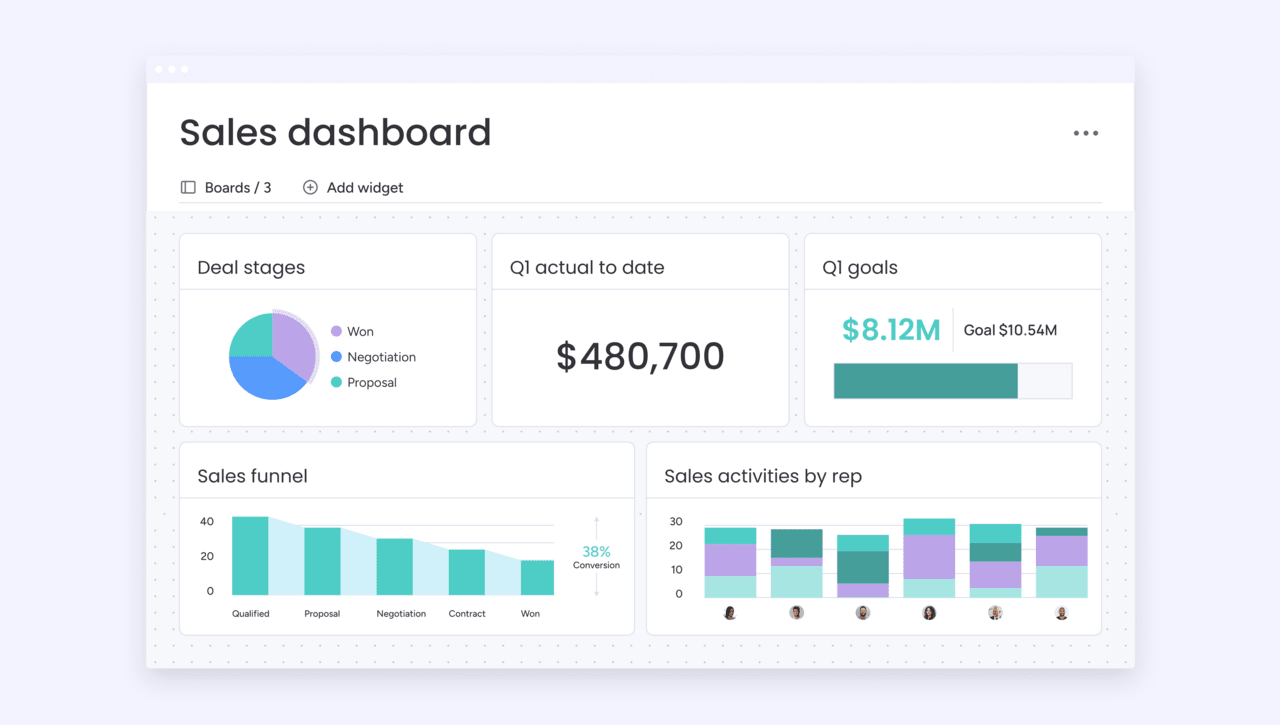
AI-powered insights help teams immediately understand and act upon information, presenting complex analysis in simple, visual formats supporting quick decision-making. Dashboards surface critical information without requiring reports or interpreting analytics.
With monday CRM, the insights approach prioritizes actionability over comprehensiveness. Rather than overwhelming users with every possible metric, AI identifies important information for each role and presents it in context.
With monday CRM, the insights approach prioritizes actionability over comprehensiveness. Rather than overwhelming users with every possible metric, AI identifies important information for each role and presents it in context.
Transform your sales team with human-AI collaboration
Human-AI collaboration represents sales’ future, but success requires more than adopting AI capabilities. Organizations thriving combine thoughtful planning, explicit role definition, continuous improvement, and platforms making AI accessible to every member.
The goal isn’t replacing human sales professionals but amplifying capabilities and creating more effective teams. AI handles data-intensive activities consuming time and energy, while humans focus on relationship building, strategic thinking, and creative problem-solving driving revenue.
Early adopters gain competitive advantages compounding over time. They respond faster to market changes, provide personalized customer experiences, and make informed decisions than competitors using traditional approaches.
This transformation is accessible to any team, regardless of technical expertise, through platforms that make sophisticated AI capabilities available through intuitive, no-code interfaces teams implement immediately and customize to specific needs.
Frequently asked questions
How long does implementing human-AI collaboration in sales typically take?
Implementing human-AI collaboration in sales typically takes two to four weeks for basic AI integration, with full team adoption occurring over two to three months depending on team size and existing process complexity.
What budget should sales teams allocate for AI integration?
Sales teams should budget 10-15% of their annual technology spend for AI integration, though platforms like monday CRM offer AI capabilities within existing CRM pricing structures.
Can small sales teams benefit from human-AI collaboration?
Small sales teams often see the greatest immediate impact from AI collaboration because they can implement changes quickly and AI helps them compete with larger teams by automating time-consuming activities.
How do sales teams maintain data security with AI integration?
Sales teams maintain data security by choosing AI platforms offering enterprise-grade security, maintaining data encryption, and providing governance controls ensuring customer information remains protected throughout AI processing.
What happens to existing sales roles when AI is adopted?
Sales roles evolve rather than disappear. Team members shift their focus toward high-value activities like relationship building, strategic thinking, and complex problem-solving, while AI assumes the burden of data-intensive analysis and routine administrative tasks.
Which metrics best measure human-AI collaboration success in sales?
The best metrics for measuring human-AI collaboration success include revenue per representative, deal velocity, lead conversion rates, and team satisfaction scores to measure both business impact and adoption success.

 Get started