


Sales reps juggle hundreds of emails each week, log countless calls, update records, and chase follow-ups across a maze of tabs. Despite all that effort, deals that seem certain often slip through the cracks. The challenge isn’t the workload — it’s that outreach still relies on manual processes and disconnected systems.
Enterprise outreach platforms with AI automation change the game. By automating repetitive tasks like sequencing emails, scoring leads, and identifying the ideal moment to reach out, these tools free reps to focus on meaningful conversations. The result is more efficient selling and fewer opportunities lost to administrative overhead.
This guide explores the 15 platforms enterprise revenue teams actually use to power AI-driven outreach. It highlights which features deliver real value, how to distinguish automation that works from marketing hype, and how to choose a platform that fits a sales process. Whether consolidating multiple tools or building a system from scratch, the insights here provide a clear path to a more streamlined and productive workflow.
Key takeaways:
- AI automation transforms outreach: enterprise platforms automate repetitive tasks like follow-ups, lead scoring, and data enrichment, allowing sales teams to focus on conversations that drive revenue.
- Personalization at scale matters: successful outreach requires AI-driven messaging that references prospect-specific context, behavior, and challenges rather than generic templates.
- Data quality drives AI effectiveness: accurate, enriched, and unified CRM data ensures AI tools provide relevant insights and avoid wasted outreach.
- Integration and consolidation improve efficiency: using a single platform for CRM, outreach, and analytics reduces tool sprawl, prevents data silos, and speeds up workflow.
- monday CRM offers end-to-end revenue management: it combines AI-assisted outreach, deal tracking, and reporting in one platform, helping teams maintain context and accelerate results.
7 must-have features in enterprise outreach platforms
Basic email blasts do not cut it at enterprise scale. Real revenue comes from platforms that automate repetitive work such as lead scoring, personalization, and follow-ups. Teams with these seven features close more deals faster. Teams without them spend valuable hours on administrative tasks instead of selling.
Feature 1: prioritize leads with intelligent scoring
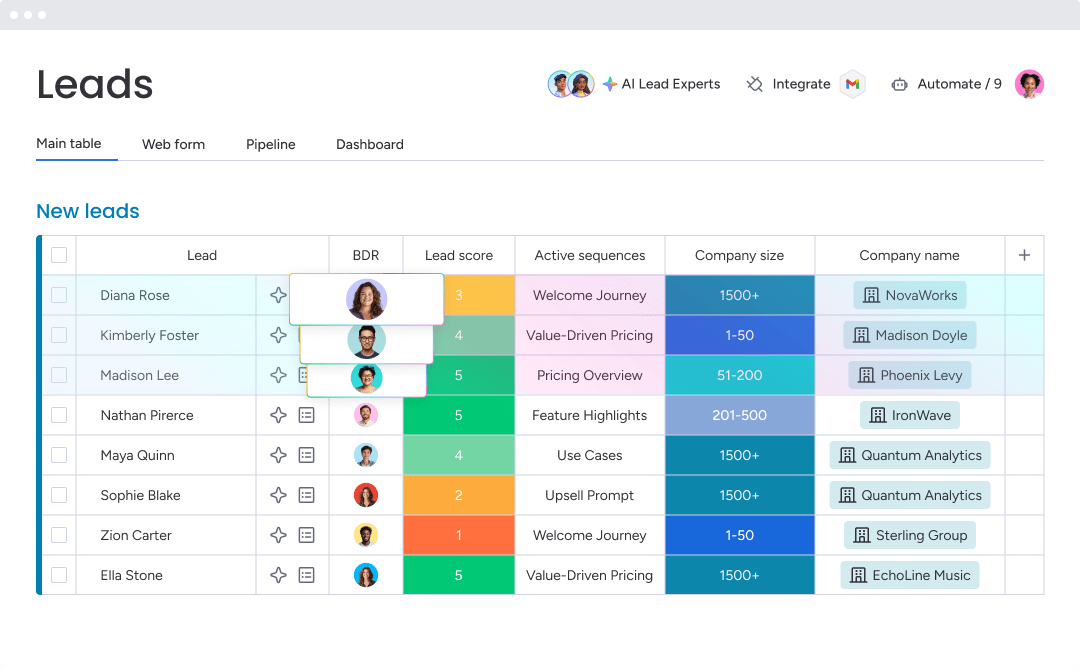
Demographics alone cannot reveal which prospects are ready to buy. AI lead scoring identifies prospects with the highest likelihood to convert by analyzing behavior, not just firmographic data. The system flags buying signals from website visits, content downloads, and social engagement, focusing your team’s efforts on hot leads rather than cold lists.
- Real-time connection: reps engage prospects while they are actively researching, not weeks after interest has faded.
- Strategic timing: strong intent signals allow outreach at the ideal moment. A welcome call beats a shot in the dark every time.
Feature 2: coordinate workflows with smart AI
Simple automation follows rigid rules, but a multi-agent AI system acts like a specialized team. Different AIs manage complex workflows to ensure outreach is timely, relevant, and personalized.
- Contextual decisions: for example, if a prospect opens an email but does not respond, basic automation sends a generic follow-up. Coordinated AI evaluates behavior and engagement, then decides whether to switch channels, adjust the message, or pause.
- Collaborative agents: agents work together to fill data gaps, draft personalized emails, and recommend the optimal next steps.
Feature 3: scale personalization that feels human
Adding a {{first_name}} to a template is not personalization. True AI-driven personalization addresses a prospect’s challenges, company news, and role-specific pain points. Data from CRM records, news feeds, and social profiles enables messages that read as thoughtful and informed.
- Automated detail: tasks that were impossible at scale are handled automatically by AI.
- Measurable impact: while generic outreach often sees low response rates, AI-personalized messages can achieve response rates of 8–12% or higher. Thoughtful communication drives engagement versus mass email blasts.
Feature 4: sync your CRM data instantly
Data silos slow deals and frustrate reps. Platforms with native CRM synchronization update every interaction, note, and status in real time. This ensures full context for your team without switching between tools.
- Data enrichment: the system automatically fills missing job titles, company details, and contact information.
- Unified platform: combining CRM and outreach within one platform ensures consistency, reliability, and smooth workflows.
Feature 5: improve continuously with conversation intelligence
Calls and emails contain valuable insights, but they are often underutilized. Conversation intelligence analyzes interactions to determine what drives results — from subject lines that get opened to objections that are successfully handled.
- Actionable feedback: knowledge from top performers becomes a playbook that every rep can use.
- Faster ramp-up: coaching insights accelerate onboarding, reducing the time new reps need to reach full productivity.
Feature 6: automate compliance to reduce risk
GDPR and CAN-SPAM violations lead to fines and brand damage. Platforms with compliance built into workflows manage opt-outs, enforce secure data retention, and control access permissions automatically.
- Built-in safety: compliance is integrated, allowing teams to stay productive without creating risk.
- Secure access: audit trails and role-based permissions protect sensitive data while providing necessary functionality.
Feature 7: launch in weeks, not quarters
Long implementations kill momentum. Modern platforms let teams become productive in under thirty days with pre-built templates, automated data migration, and guided workflows for your sales lead generation process.
- Rapid adoption: no-code setups and ready templates allow teams to skip configuration and start selling immediately.
- Proven results: organizations see impact quickly, spending less time on admin tasks and more time closing deals.
Modern platforms like monday CRM deliver exactly this. Teams can integrate CRM data, automate workflows, personalize at scale, and start generating results in weeks instead of months. With these capabilities, teams focus on revenue rather than administrative work.
15 best AI outreach tools for enterprise revenue teams
Generic outreach often gets ignored. Manual follow-ups exhaust top sales representatives, and disconnected tools increase administrative work. The right AI does more than send emails—it enables revenue teams to have conversations that convert.
We analyzed platforms enterprise teams rely on to close more deals. This review focuses on practical use cases, actual AI capabilities, and transparent pricing. You will find specialized tools for specific functions alongside unified platforms like monday CRM that manage the entire revenue lifecycle.
| Platform | Use case | Key AI features | Starting price | Enterprise focus |
|---|---|---|---|---|
| monday CRM | Run the entire revenue lifecycle in one place | AI agents for tasks, call analysis, and forecasting | $9/user/month | High - Full revenue lifecycle |
| Outreach | Automate sales plays and outreach sequences | AI-driven sequences and sentiment analysis | Custom pricing | High - Enterprise sales teams |
| Apollo.io | Find prospects and automate engagement | AI lead scoring and email copy suggestions | $49/user/month | Medium - Growing sales teams |
| Reply.io | Automate multi-channel outreach | AI personalization and send-time optimization | $60/user/month | Medium - SMB to mid-market |
| Lemlist | Create personalized cold email campaigns | AI image personalization and dynamic content | $32/user/month | Low - Individual contributors |
| Lindy | Automate sales tasks with an AI assistant | Conversational AI for scheduling and follow-ups | $99/user/month | Medium - AI-first teams |
| Clay | Automate research and data enrichment | AI web scraping and data validation | $149/user/month | High - Data-driven teams |
| Gong.io | Analyze sales calls and team performance | AI call transcription, analysis, and deal insights | Custom pricing | High - Enterprise sales orgs |
| Lavender | Get real-time email writing help | AI email scoring and coaching | $25/user/month | Low - Individual email optimization |
| Clearout | Verify emails and improve deliverability | AI-powered email list cleaning | $0.008/email | Low - Email hygiene focus |
| Smartlead.ai | Scale cold email with improved deliverability | AI inbox warm-up and rotation | $39/user/month | Medium - Email-focused teams |
| Seamless.ai | Find verified contact and company data | AI-powered contact search engine | $65/user/month | Medium - Prospecting teams |
| HubSpot Sales Hub | Manage sales in an all-in-one CRM | AI-powered insights and predictive lead scoring | $20/user/month | High - All-in-one solution |
| ZoomInfo | Access a B2B database with intent signals | AI intent data and contact recommendations | Custom pricing | High - Enterprise prospecting |
| Conversica | Qualify and nurture leads with an AI assistant | Conversational AI for lead engagement | Custom pricing | High - Lead qualification focus |
Juggling a dozen separate tools does not accelerate results. It increases administrative burden. The true advantage comes from AI that works within the workflows your team already uses, delivering actionable insights and closed deals without requiring extra software.
1. monday CRM
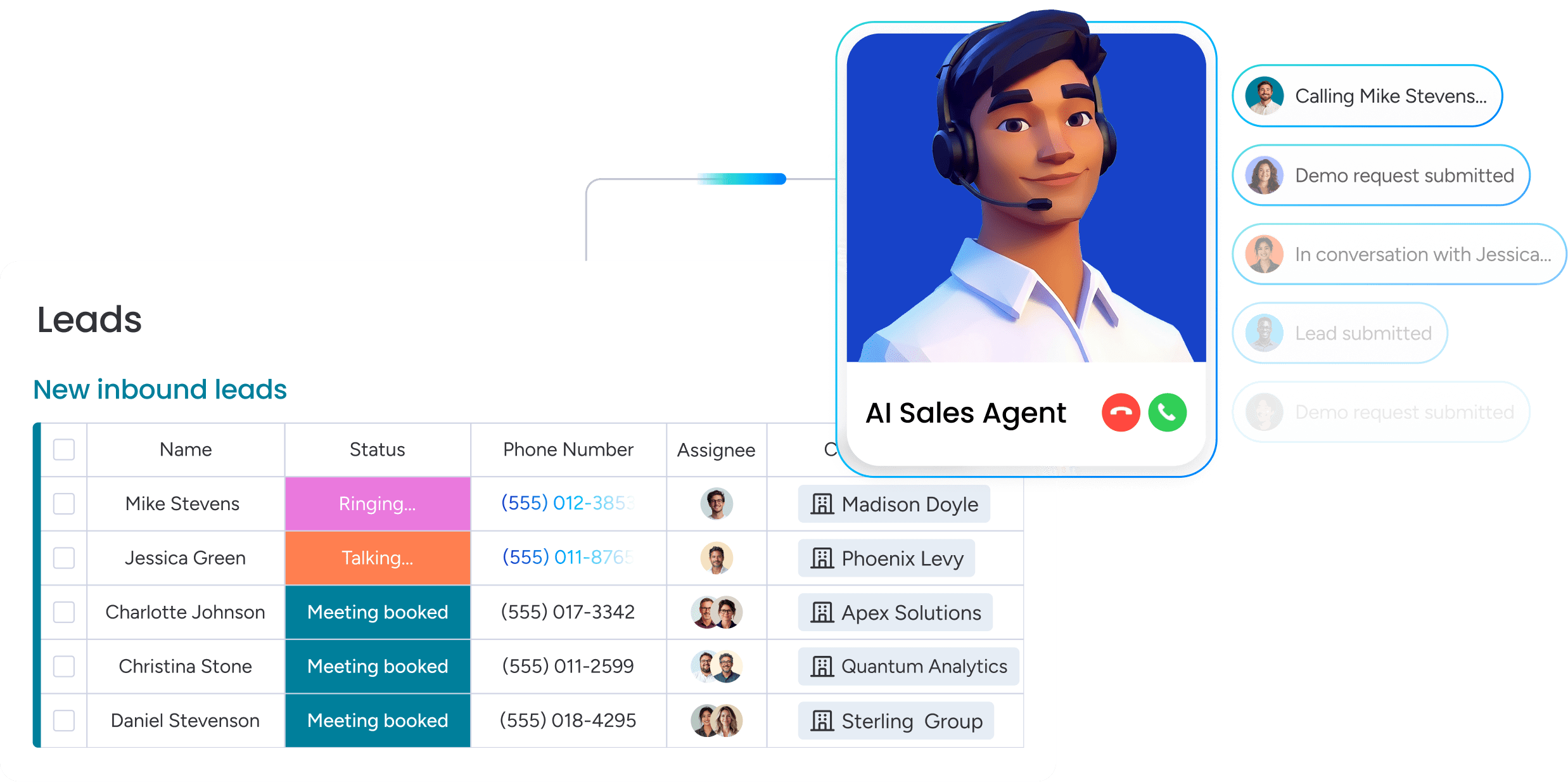
Modern platforms like monday CRM consolidate lead management, deal tracking, and customer communication into one environment. Teams avoid context-switching while tailoring boards, items, views, and dashboards to their sales process. AI integrates seamlessly where it adds value.

Use case:
Revenue teams manage outreach and deals in a single system, keeping records consistent as prospects move from initial contact through post-sale activity.
An outbound team can capture inbound leads from website forms or social campaigns, enrich and assign leads automatically, run mass email campaigns, and log every email, meeting, and note on the Emails & Activities timeline. Post-sale, account teams continue working in the same customer record to manage onboarding, renewals, and collections.
Key features:
- Emails & Activities with AI support: team members compose messages directly in Emails & Activities using AI assistance, ensuring follow-ups do not stall.
- Mass email and tracking: send individual and mass emails with dynamic fields and templates, then monitor open rates and link clicks.
- Visual pipeline for deal management: track deals in a visual pipeline, customize stages with drag and drop, and maintain momentum without complex setup.
- Lead capture and enrichment options: collect leads from website forms and social campaigns, then enrich data using Crunchbase.
Pricing:
- Basic: $12/user/month (billed annually)
- Standard: $17/user/month (includes two-way email sync)
- Pro: $28/user/month (includes sequences and mass email)
- Enterprise: custom pricing (quote-based, also known as the Ultimate plan)
Annual billing saves 33% compared to monthly plans. Minimum three seats required.
Why it stands out:
- Customizable without heavy lift: teams adapt boards, fields, deal stages, and automations to their sales cycle without deep technical work.
- Customer context stays together: emails, meetings, calls, and notes remain organized in one timeline, preventing handoffs from becoming guessing games.
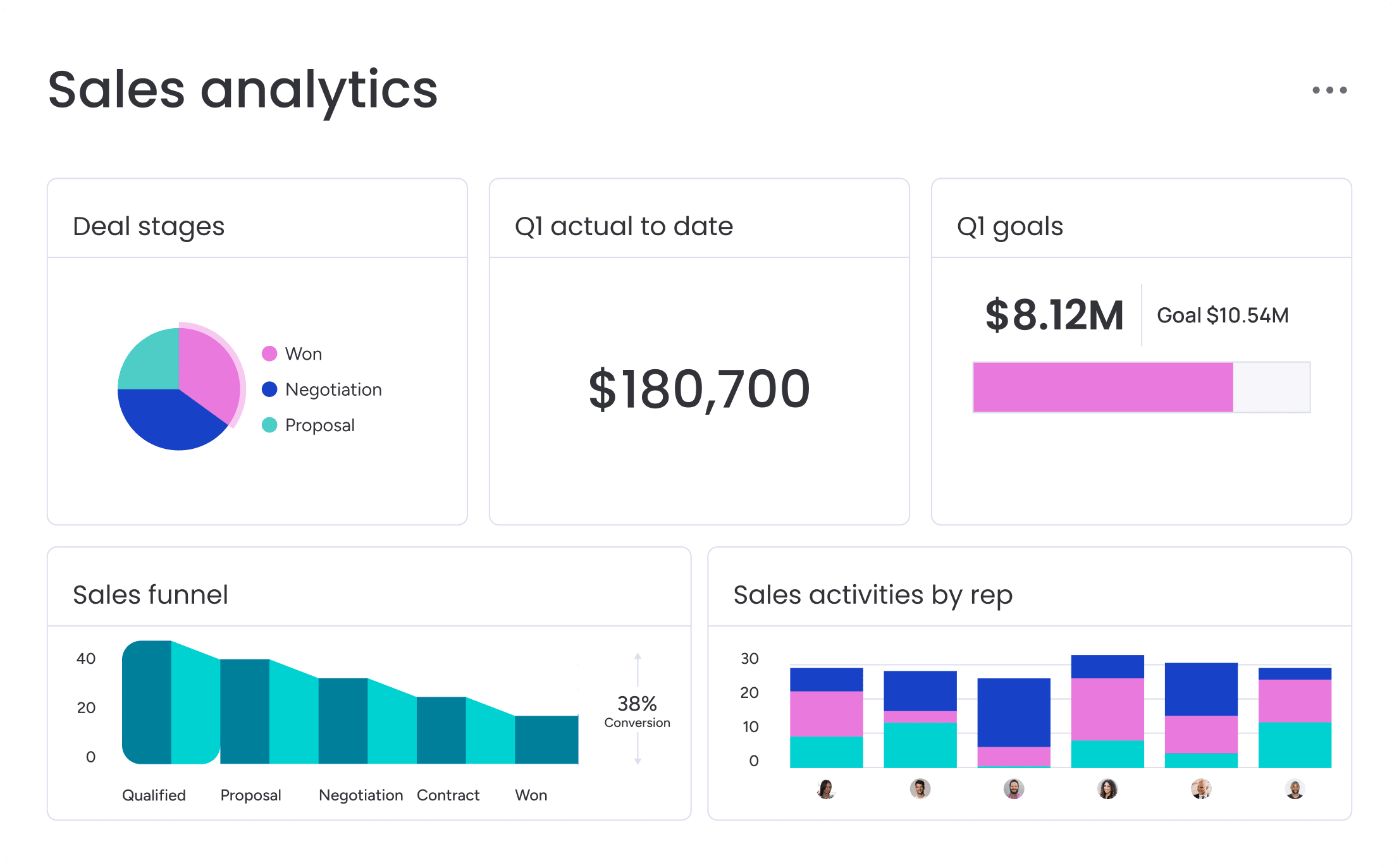
- Reporting leaders actually use: code-free dashboards and sales-focused widgets like leaderboard and funnel help managers track pipeline health without manual report creation.
Advanced AI features:
- Timeline summary: AI Timeline Summary creates concise summaries of all communications in Emails & Activities, allowing teams to get up to speed quickly.
- Sentiment detection: Detect sentiment AI categorizes text as positive, negative, or neutral, capturing the signal in a Text column.
- Autofill columns with AI actions: auto-fill Text, Date, Numbers, Dropdown, People, and Status columns with actions such as extract information, summarize, improve text, translate, writing assistant, custom action, assign label, and assign person.
- Extract information from documents: Extract Info with AI pulls structured details from files like invoices, resumes, and contracts into board columns.
Automations:
- Automated email follow-ups: configure AI-driven lead follow-up so outreach does not depend on memory.
- Condition-based workflow actions: automate updates based on custom conditions to keep deals and lead statuses current.
- AI-powered column updates at scale: apply Autofill with AI across existing and new items, then review results using Run history for auditing.
Integrations:
- Connect your stack to your workflow: monday CRM supports integrations that centralize customer data while connecting systems your team already uses.
- One platform beyond sales: organizations can run connected processes beyond sales as business needs expand.
Built for scale:
- Full customer journey coverage: teams use monday CRM for lead management, account and contact management, deal management, and post-sale work such as onboarding and renewals.
- Cross-functional collaboration: stakeholders like legal and finance collaborate in the same workflow, with the latest status visible to all involved.
- Operational reporting for leadership: dashboards and widgets track pipeline status, forecasting, and team performance, providing the data needed for confident decisions.
3. Apollo.io
Apollo.io combines access to a B2B contact database with engagement capabilities, offering a middle-ground solution for growing teams that need both prospecting and outreach functionality. The platform unifies proprietary sales data with AI-powered workflows, helping teams reduce tool sprawl while building their sales stack. With over 270 million contacts and built-in deliverability controls, Apollo positions itself as a comprehensive sales execution platform.

Use case:
Apollo.io supports teams consolidating prospecting, engagement, and basic analytics into a single environment rather than managing separate database and outreach tools.
Key features:
- Integrated contact database: access millions of B2B contacts with email verification and AI-powered lead scoring that prioritizes prospects based on fit and engagement signals.
- Multi-channel sequences: email, phone, and LinkedIn outreach with built-in dialer, Chrome extension integration, and automated follow-up workflows.
- Visual workflow engine: multi-branch automation with conditional logic, pre-enrollment approvals, and template library for complex outreach campaigns.
Pricing:
- Free plan: basic access with limited credits and features.
- Professional plan: $49/user/month with full database access and engagement features.
- Custom/organization tiers: enterprise pricing available through the sales team.
- Credit-based usage model: applies to data reveals, dialer minutes, and additional phone numbers.
Considerations:
- Teams still require a separate CRM for complete deal management and advanced sales operations beyond basic engagement tracking.
- Credit model complexity can generate unexpected costs, as data reveals, dialer minutes, and additional features consume credits that expire at the end of each billing cycle.
4. Reply.io
Reply.io provides multichannel outreach automation, coordinating email, LinkedIn, and phone touchpoints in unified sequences. The platform serves SDR teams and agencies running complex campaigns without juggling separate tools for each communication channel.

Use case:
Reply.io excels at creating conditional multichannel sequences that adapt based on prospect data and engagement, supporting teams managing sophisticated campaigns across multiple touchpoints.
Key features:
- Multichannel conditional sequences: automatically adjust steps based on contact data or engagement behaviors, including opens, clicks, and replies.
- AI-powered personalization: the Jason AI SDR agent handles prospect research, message writing, reply categorization, and meeting booking.
- Built-in contact database: access 1 billion verified contacts with intent filters, reducing reliance on external data providers.
Pricing:
- Email volume plans: start at $59/user/month (billed annually) for basic email outreach.
- Multichannel all-inclusive: start at $99/user/month (billed annually) with full channel access.
- LinkedIn automation add-on: $69/account/month for LinkedIn connection and messaging features.
- Calls & SMS add-on: $29/account/month for phone and text capabilities.
- AI SDR (Jason): starting at $500/month for automated prospect research and engagement.
- Trial: 14-day free trial available for all plans.
Considerations:
- LinkedIn automation carries platform policy risks, as automated connection requests and messaging may result in account restrictions.
- Built-in CRM functionality is basic, often requiring integration with a separate CRM for complex sales processes.
5. Lemlist
Lemlist delivers personalized multichannel outreach sales automation beyond standard email sequences. The platform combines prospect data, AI-powered personalization, and native LinkedIn automation, enabling sales teams to run sophisticated campaigns from one workspace.

Use case:
Lemlist is ideal for teams automating outreach across email, LinkedIn, and WhatsApp while maintaining deliverability and sender reputation.
Key features:
- AI sequence generator: builds complete multichannel campaigns with prospect lists and personalized copy in minutes.
- Native LinkedIn automation: handles profile visits, connection requests, messages, and AI voice notes within sequences.
- Unified inbox: centralizes replies across all channels so representatives respond from one thread.
Pricing:
- Email Pro: $69/user/month.
- Multichannel Expert: $99/user/month.
- Enterprise: custom pricing with annual billing and five-seat minimum.
- Add-on costs: $9/month per extra sending address, $20/month per seat for WhatsApp.
- Billing discounts: quarterly billing offers 10% discount, annual billing provides 20% discount.
Considerations:
- Costs increase quickly with add-ons like extra sending addresses, WhatsApp, and credit consumption for enrichment and calling.
- LinkedIn and WhatsApp automation requires careful adherence to platform limits to avoid account restrictions.
6. Lindy
Lindy uses an AI-first approach, functioning as a virtual sales assistant rather than traditional outreach software. The platform manages research, follow-up scheduling, and basic qualification tasks through conversational AI, appealing to teams looking to automate routine sales activities.

Use case:
Teams use Lindy to automate multi-touch email sequences, scale personalized outreach, and handle administrative tasks through AI agents capable of executing complex workflows.
Key features:
- Conversational AI capabilities: enable natural language interaction for workflow management across email, phone, and chat channels.
- End-to-end outreach orchestration: handles lead research, enrichment, personalized drafting, sequencing, and CRM synchronization in unified workflows.
- Agent swarms: coordinate multiple AI assistants on complex sales processes, with enterprise-grade security and governance.
Pricing:
- Free tier: 400 free credits and 400 free tasks to get started.
- Paid plans: pricing details available through sales contact or in-app signup.
- Voice add-ons: phone numbers approximately $10/month each, with per-minute credit costs varying by country.
- Premium data actions: higher credit costs for enrichment services like People Data Labs (approximately 40 credits per lead).
Considerations:
- AI-first approach requires setup and training to align with specific sales processes.
- Teams still need traditional CRM and outreach platforms for full sales operations, as Lindy mainly serves as an automation layer.
7. Clay
Clay turns data enrichment into a competitive advantage for revenue teams. The platform combines AI-powered research with waterfall enrichment across more than 150 data sources, supporting teams that need deep prospect intelligence before launching outreach campaigns.

Use case:
Clay automates research processes and gathers detailed prospect data, enabling highly personalized campaigns with higher response rates.
Key features:
- Claygent AI research agent: automatically visits websites and extracts structured data to fuel personalization at scale.
- Waterfall enrichment: sequences multiple data providers to maximize contact coverage while reducing costs.
- Native sequencer with deliverability controls: sends AI-generated emails with built-in warming, domain rotation, and reply management.
Pricing:
- Free: 1,200 credits annually (100/month), unlimited users.
- Starter: from $134/month with 2,000–3,000 credits monthly.
- Explorer: from $314/month with 10,000–20,000 credits monthly.
- Pro: from $720/month with 50,000–150,000 credits monthly.
- Enterprise: custom credits with advanced security features.
- Annual prepay: 10% discount with upfront credit allocation.
- Sequencer costs: 0.03 credits per email sent.
Considerations:
- Credit-based pricing can become expensive for high-volume data enrichment and AI usage.
- Email-focused sequencing requires integration with other platforms for multichannel outreach campaigns.
8. Gong.io
Gong.io converts sales conversations into revenue intelligence by using AI to analyze calls, emails, and meetings for actionable insights. The platform focuses on conversation intelligence and revenue analytics, supporting enterprise teams that want to turn sales interactions into competitive advantages. It is designed for revenue organizations seeking deep visibility into what drives deals forward.

Use case:
Gong.io captures and analyzes sales conversations to uncover winning patterns, coach representatives on effective approaches, and predict deal outcomes using real interaction data.
Key features:
- Call recording and analysis: automatically captures sales conversations and identifies successful patterns, coaching opportunities, and competitive intelligence.
- AI-powered forecasting: predicts deal outcomes based on engagement signals and interaction quality rather than relying solely on pipeline data.
- Deal insights: surface risks and opportunities by analyzing communication patterns, helping teams prioritize deals most likely to close.
Pricing:
- Enterprise custom pricing: quote-based per-user licensing plus platform fee.
- Professional services: add-on packages provide implementation, training, and data migration.
- Budget considerations: pricing reflects enterprise positioning, requiring significant investment and longer sales cycles.
Considerations:
- Focuses on analysis and intelligence rather than outreach execution, requiring separate platforms for engagement activities.
- High cost and enterprise focus may limit accessibility for mid-market teams seeking more affordable conversation intelligence solutions.
9. Lavender
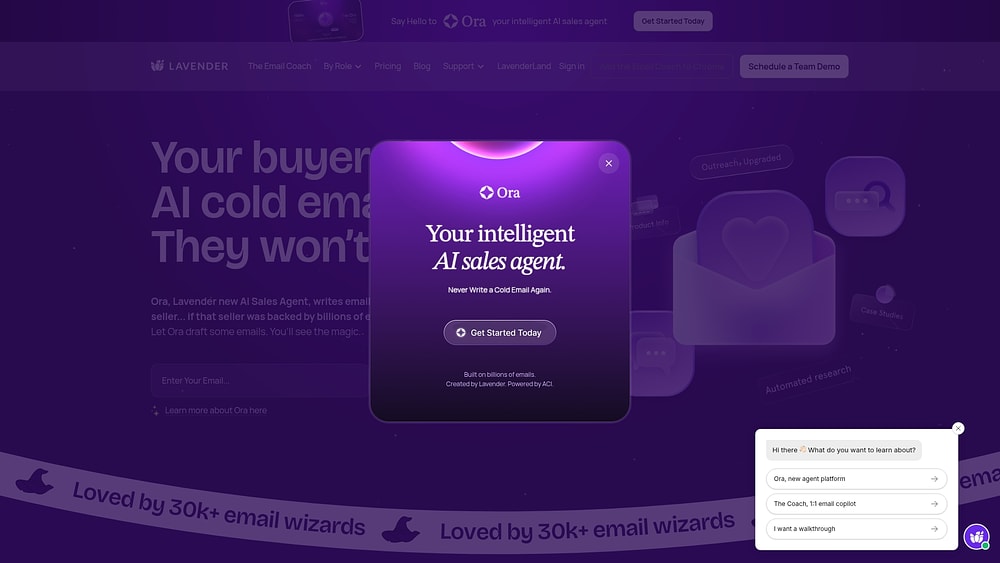
Lavender enhances email outreach with AI-driven coaching that scores and optimizes messages before sending. The platform supports sales teams aiming to improve email effectiveness through real-time guidance and personalized insights. With the Ora automation agent, Lavender bridges individual email coaching and automated outreach sequences.
Use case:
Lavender helps teams craft more effective emails and automate personalized outreach while maintaining deliverability and relevance through AI-driven suggestions and signal-based follow-ups.
Key features:
- Real-time email scoring and coaching: provides suggestions directly in Gmail, Outlook, and major sales engagement platforms.
- Personalization assistant: surfaces prospect and company insights to create relevant messages.
- Ora AI agent: automates outreach with controlled send volumes and signal-based follow-up triggers.
Pricing:
- Basic: free forever (five emails analyzed per month, five personalized per month).
- Starter: $27 per month billed annually ($29 monthly).
- Individual Pro: $45 per month billed annually ($49 monthly).
- Team plan: $89 per seat per month billed annually ($99 monthly).
- Discounts: annual billing offers savings across all paid tiers.
- Free access: available for students, job seekers, and bootstrapped entrepreneurs.
Considerations:
- Fixed follow-up cadence (Day one/four/eight) limits customization compared to full sales engagement platforms.
- Daily send volume caps at around fifty emails per campaign, which may not suit high-volume outreach strategies.
10. Clearout
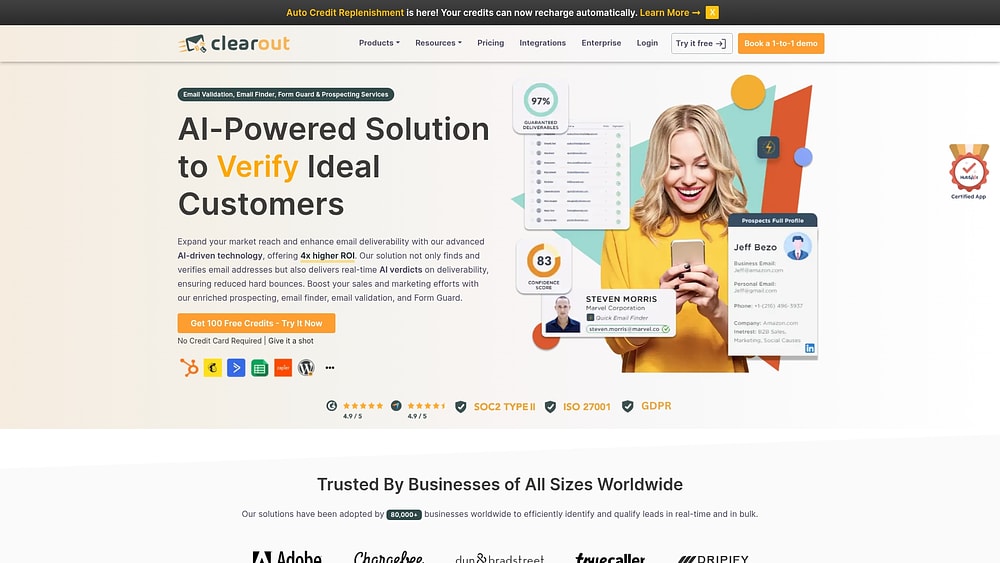
Clearout specializes in email verification and data hygiene to enable outreach campaigns with clean, deliverable contact lists. The platform handles pre-outreach automation by discovering, verifying, and enriching prospect data before sequences launch. With ISO 27001 and SOC 2 certifications, Clearout serves more than 80,000 businesses that require reliable contact validation at scale.
Use case:
Clearout automates upstream data work that ensures campaigns are scalable and safe by validating emails, enriching contact information, and confirming deliverability before outreach begins.
Key features:
- Email verification: conducts more than twenty validation checks and provides safe-to-send classifications to reduce bounce rates.
- AI-powered email finder: assigns confidence scores to prioritize high-deliverability contacts.
- Real-time form validation: prevents junk data from entering your pipeline while protecting against bots.
Pricing:
- Free tier: 100 credits upon signup.
- Pay-as-you-go: $21 for 3,000 verifications, $58 for 10,000, $350 for 100,000 verifications.
- Subscriptions: monthly and annual plans offer up to 20% discounts.
- Credit policy: credits never expire, and unknown results are not charged.
Considerations:
- Requires integration with separate outreach platforms, as Clearout does not manage sequences or send emails directly.
- Guaranteed deliverability excludes some free email providers, such as Yahoo and AOL, limiting coverage for certain prospect segments.
11. Smartlead.ai
Smartlead.ai delivers cold email automation with a focus on deliverability through inbox rotation and warm-up features. The platform supports agencies and high-volume sales teams sending thousands of emails without affecting sender reputation. It is well-suited for lead generation operations that prioritize scale over multichannel outreach.

Use case:
Teams managing large-scale cold email campaigns benefit from unlimited mailboxes and dedicated infrastructure to protect sender reputation while scaling outreach volume.
Key features:
- Inbox rotation: distributes emails across multiple accounts to maintain reputation and avoid throttling.
- AI-powered warm-up: gradually increases sending volume across a network of more than 110,000 mailboxes.
- Unified master inbox: centralizes all prospect replies with AI categorization, bulk actions, and team assignment capabilities.
Pricing:
- Basic: $39 per month ($32.50 monthly billed annually) — 2,000 active leads, 6,000 emails per month, unlimited mailboxes.
- Pro: $94 per month ($78.30 monthly billed annually) — 30,000 active leads, 150,000 emails per month, ChatGPT-4 integration.
- Custom: starting at $174 per month — multi-million lead capacity with all advanced features.
- Add-on modules: SmartDelivery ($49–$599 per month), SmartServers ($39 per server per month), and email verification credits.
Considerations:
- Focuses primarily on email deliverability, lacking native multichannel capabilities for LinkedIn or phone outreach.
- User reviews note occasional bugs with reply syncing and slower support response, which may affect campaign operations.
12. Seamless.ai
Seamless.ai combines contact discovery with AI-powered outreach automation, enabling sales teams to identify prospects and engage them in one platform. The solution focuses on real-time contact validation and multichannel campaign execution, supporting teams that want to reduce friction between prospecting and outreach.

Use case:
Sales teams seeking an all-in-one platform for contact discovery and automated engagement without switching between multiple tools or exporting data.
Key features:
- Real-time contact search: with AI confidence scoring to ensure data accuracy before outreach.
- Multichannel campaign builder: supporting automated emails, call sequences, LinkedIn outreach, and SMS steps.
- Native Gmail and Outlook integrations: with deliverability controls including send limits, domain caps, and compliance features.
Pricing:
- Free: one user, fifty credits for evaluation.
- Pro: daily credit refresh, contact sales for pricing.
- Enterprise: unlimited users, custom credits, contact sales for pricing.
- Premium add-ons: available for Autopilot, Buyer Intent, Job Changes, Data Enrichment, and API access.
- Discounts: annual billing options and a Switch and Save program offering up to fifty percent off current provider costs.
Considerations:
- Email integrations are limited to Gmail and Outlook, with advanced calling features requiring a separate Twilio connection.
- Customer reviews on BBB and Trustpilot note concerns around auto-renewal policies and variable data accuracy.
13. HubSpot Sales Hub
HubSpot Sales Hub delivers a comprehensive CRM and sales automation platform, serving teams ready to consolidate multiple tools. It combines contact management, deal tracking, and AI-powered outreach, making it ideal for scaling businesses that need a connected workflow. With over 267,000 customers and strong G2 ratings, it is widely adopted in SMB and mid-market organizations.

Use case:
Teams looking for integrated CRM, outreach automation, and sales analytics without managing multiple platforms or complex integrations.
Key features:
- Email sequences: with A/B testing, threading, and CRM-aware personalization directly from Gmail or Outlook.
- AI prospecting agent: monitors buying signals, researches accounts, and generates personalized outreach automatically.
- Unified sales workspace: with guided execution, task queues, and real-time analytics across the sales process.
Pricing:
- Starter: $20 per user/month for basic CRM and email tracking.
- Professional: $100 per user/month includes sequences, meeting scheduling, and sales analytics.
- Enterprise: $150 per user/month adds advanced reporting, predictive lead scoring, and custom objects.
- Limits: daily send caps of 500 emails (Professional) or 1,000 emails (Enterprise).
- Onboarding: Enterprise onboarding required at $3,500 one-time fee.
Considerations:
- Sequences are limited to one active per contact with fifty-contact bulk enrollment caps, potentially slowing large-scale outreach.
- Multi-channel steps like LinkedIn require manual completion rather than full automation, creating workflow gaps for complex sales processes.
14. ZoomInfo
ZoomInfo delivers B2B data intelligence combined with sales engagement automation for enterprise revenue teams. The platform pairs extensive contact databases with intent signals and embedded outreach, making it ideal for organizations that require prospecting power and execution in a single system. Over thirty-five thousand companies use ZoomInfo, establishing it as a leader in data-driven sales automation.

Use case:
Teams aiming to act on high-intent signals by identifying prospects and launching multi-touch outreach campaigns without switching platforms.
Key features:
- Extensive B2B database: includes millions of contacts plus intent signals that identify prospects actively researching solutions.
- Embedded sales engagement: Engage within SalesOS enables seamless transitions from research to multi-touch email and calling sequences.
- Workflow automation: triggers campaigns based on buying signals, account activity, and custom plays for scalable prospecting.
Pricing:
- Enterprise custom pricing: quote-based annual contracts typically starting around $15,995 per company/year.
- Sales packages: AWS Marketplace examples include $34,995 per twelve months for sales-focused configurations.
- Marketing packages: higher-tier options around $69,995 per twelve months for full marketing and sales intelligence.
- Add-ons: additional costs for credits, enrichment modules, intent data, and conversation intelligence.
Considerations:
- High total cost and quote-only pricing can limit accessibility for smaller teams, with enterprise-level commitments required.
- Platform complexity and Microsoft 365 integration issues may affect email deliverability and workflow reliability.
15. Conversica
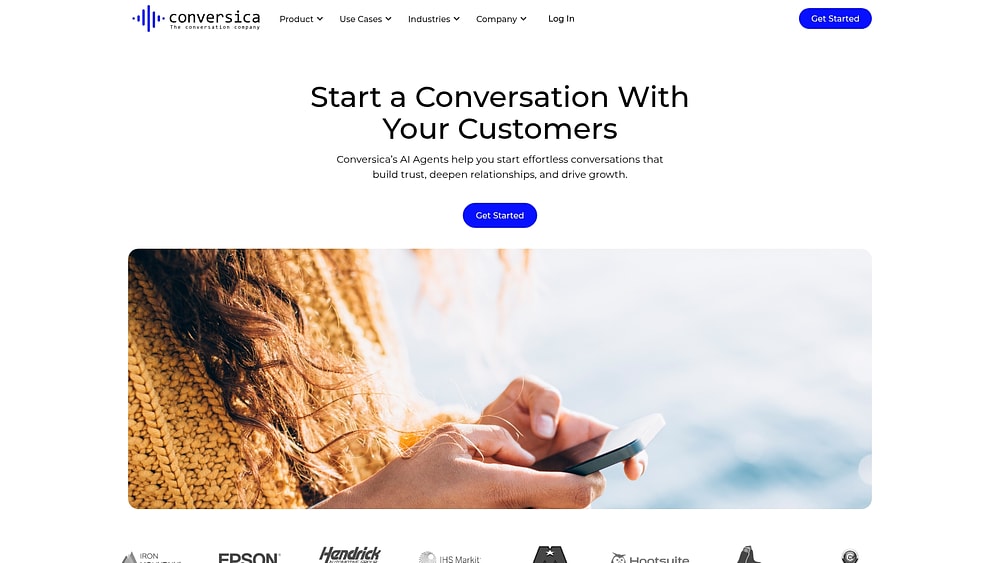
Conversica deploys AI sales assistants that qualify leads through natural conversations via email, SMS, and chat. The platform focuses on two-way dialogue automation, helping enterprise teams nurture prospects without overloading sales reps. Unlike basic chatbots, Conversica’s AI agents maintain conversations until leads are ready for handoff.
Use case:
Organizations converting one-way marketing campaigns into personalized conversations that qualify leads and schedule meetings automatically.
Key features:
- Two-way conversational AI: conducts natural language interactions across multiple channels.
- Lead nurturing automation: maintains engagement over extended periods without human intervention.
- Industry-specific AI assistants: trained to understand vertical-specific language and business challenges.
Pricing:
- Custom enterprise pricing: quote-based and tailored to conversation volume, channels, and integrations.
- Professional services: additional fees for onboarding, technical support, and API integrations.
- Premium support: named technical account managers and enhanced SLA packages available as add-ons.
Considerations:
- Web chat functionality is limited to English, which may constrain global outreach.
- Integrations with separate platforms are needed for complete sales processes, as the platform focuses on conversation and qualification rather than full revenue operations.
AI automation vs traditional outreach tools: Key differences
Understanding how legacy tools differ from AI platforms is crucial for modernizing your sales tech stack. The approaches vary significantly in execution, efficiency, and results. Here’s a breakdown of the key differences.
Difference 1: choose between copilot and autopilot models
AI in sales enhances human capabilities rather than replacing sales representatives. A copilot AI acts as a guide, offering suggestions on optimal send times, highlighting at-risk deals, and providing insights while allowing your team to retain decision authority.
An autopilot AI, by contrast, executes tasks automatically, sending follow-ups and switching channels without manual intervention. This approach is ideal for high-volume sales, while complex, relationship-driven sales benefit from a copilot model.
Intelligent guidance platforms like monday CRM combine AI insights with human judgment, giving your team enhanced capabilities without surrendering control to automation. This hybrid approach ensures efficiency and relationship management coexist.
Difference 2: feed your AI clean data
AI performance depends entirely on the quality of data it receives. Inaccurate or incomplete contact information can lead to personalization errors, wasted resources, and diminished sender reputation.
- The data cycle: bad data results in poor AI performance, which reduces the quality of feedback the AI receives, creating a negative loop.
- Automated hygiene: monday CRM enriches and validates contact details automatically, ensuring AI-powered outreach remains accurate, relevant, and effective.
Clean, organized data is the foundation for AI success and sustainable sales outcomes.
Difference 3: consolidate tools for better ROI
Many sales teams rely on multiple disconnected platforms for prospecting, outreach, CRM, and analytics. This fragmentation increases costs, complicates workflows, and slows down the customer journey.
- Unified truth: consolidating tools creates a single source of truth, allowing teams to spend more time selling rather than reconciling data.
- All-in-one value: platforms like monday CRM unify outreach automation, CRM, and analytics in one place, improving productivity and providing measurable ROI.
The right approach ensures your technology accelerates your team instead of holding them back.
How to select the right outreach platform for your organization
Choosing a platform requires looking beyond marketing claims. Focus on practical steps to ensure the solution delivers real value.
Verify these 5 essentials before committing
Flashy features alone do not close deals. A platform your team uses daily makes a measurable difference. Ask these questions before signing a contract:
- AI transparency: is the AI a partner or a black box? Ensure your team can understand its logic, adjust insights, and make informed decisions.
- Data security: can you trust it with your data? Look for built-in compliance, audit trails, and permission controls that safeguard information without slowing workflows.
- Scalability: will the platform grow with your team? Confirm performance under larger contact lists and simultaneous user activity.
- Customization: can your team adapt it without a developer? The system should match your unique sales processes while remaining easy to manage.
- Total cost: what is the real price tag? Consider license fees, implementation, training, and integration to understand the full cost of ownership.
Test integration capabilities
Effective integration goes beyond syncing contacts. Actions in one system should trigger automated updates across all connected workflows. For example, when a prospect replies to an email, CRM records should update, and relevant tasks should launch automatically.
- Seamless sync: avoiding integration errors prevents workflow delays and confusion.
- Native connection: monday CRM’s native integrations unify your workspace from the start, eliminating data conflicts and manual interventions.
Roll out the platform in phases
Phased deployment builds momentum and ensures quick wins, rather than attempting a six-month full-scale rollout.
- Phase one (weeks one to four): start with champions. Select a small group of power users to solve one key problem and demonstrate measurable improvement.
- Phase two (weeks five to twelve): expand to the full team. Use insights from champions to guide broader adoption and document productivity gains.
- Phase three (weeks thirteen to twenty): connect your entire revenue engine. Integrate with marketing, customer success, and finance to gain a complete view of the customer lifecycle.
Guided setup and pre-built templates in monday CRM help teams reach full productivity within weeks.
“With monday CRM, we’re finally able to adapt the platform to our needs — not the other way around. It gives us the flexibility to work smarter, cut costs, save time, and scale with confidence.”
Samuel Lobao | Contract Administrator & Special Projects, Strategix
“Now we have a lot less data, but it’s quality data. That change allows us to use AI confidently, without second-guessing the outputs.”
Elizabeth Gerbel | CEO
“Without monday CRM, we’d be chasing updates and fixing errors. Now we’re focused on growing the program — not just keeping up with it."
Quentin Williams | Head of Dropship, Freedom Furniture
“There’s probably about a 70% increase in efficiency in regards to the admin tasks that were removed and automated, which is a huge win for us.“
Kyle Dorman | Department Manager - Operations, Ray White
"monday CRM helps us make sure the right people have immediate visibility into the information they need so we're not wasting time."
Luca Pope | Global Client Solutions Manager at Black Mountain
“In a couple of weeks, all of the team members were using monday CRM fully. The automations and the many integrations, make monday CRM the best CRM in the market right now.”
Nuno Godinho | CIO at VelvUnify your revenue engine with a single AI platform
Moving to one AI-powered platform transforms how revenue teams operate. Consolidating outreach, CRM, and analytics removes silos, giving reps clarity and agility to focus on relationships and closing deals.
Benefits extend beyond cost savings, creating a faster, more predictable sales engine. Teams gain insights to forecast confidently and adapt instantly to market changes.
To start, review your current tech stack, identify friction points, audit costs, and evaluate workflows to select a solution that simplifies processes rather than adding noise.
Try monday CRMFrequently asked questions
What do enterprise outreach platforms typically cost?
Enterprise outreach platforms generally range from $50 to $200 or more per user, per month. Costs rise when separate tools are used for prospecting, engagement, and analytics, while unified platforms can help reduce total expenses.
How quickly can teams implement AI outreach automation?
Implementation usually takes two to twelve weeks, depending on data complexity and integration requirements. Clean, centralized data enables faster and more effective setup.
Will AI outreach tools replace human sales representatives?
AI outreach tools do not replace human sales reps. They automate repetitive tasks, allowing teams to focus on building relationships and closing deals.
What data infrastructure is required for AI success?
AI success relies on organized, accurate contact data stored in a central CRM. Without a single source of truth, AI generates unreliable recommendations that can hurt outreach performance.
How do platforms handle GDPR and privacy compliance?
Enterprise platforms maintain compliance through automatic opt-out management, data retention controls, and consent tracking. Quality platforms integrate privacy seamlessly into workflows.
Which outreach platforms offer the deepest CRM integrations?
Platforms with native CRM functionality provide the most robust integration, eliminating syncing issues. Other solutions connect via APIs, though data synchronization quality can vary.
How can teams measure ROI from AI outreach automation?
ROI can be measured by tracking response rates, meeting conversions, and pipeline velocity. Time saved on manual tasks also reflects significant productivity gains.
What happens to existing outreach campaigns during platform migration?
During migration, campaigns and contact lists transfer with available tools, but some manual rebuilding may be necessary. Running both systems in parallel briefly helps ensure a smooth transition.

 Get started