


Enterprise sales teams often struggle with fragmented data, inconsistent processes, and unpredictable pipelines. Even with a CRM in place, visibility into deal health and rep activity can remain limited, leading to missed opportunities and inefficient resource allocation. Teams frequently spend significant time on administrative tasks instead of engaging high-value prospects, which directly impacts growth and revenue performance.
Systematic sales growth strategies provide a way to address these challenges by aligning processes, technology, and data-driven insights. By analyzing historical performance, identifying bottlenecks, and prioritizing high-potential opportunities, organizations can turn scattered efforts into a coordinated approach. This structured methodology helps improve forecast accuracy, optimize lead conversion, and increase overall sales velocity while reducing wasted effort across the team.
This article explores actionable strategies for enterprise B2B sales growth, offering guidance on how to implement them and measure their impact. It will cover techniques for improving pipeline management, leveraging predictive insights, optimizing workflows, and ensuring adoption across the team, enabling revenue leaders to make informed, sustainable decisions.
Key takeaways:
- Enterprise AI goes beyond automation: these platforms analyze historical sales data, predict outcomes, and guide reps on which deals to prioritize, rather than simply executing tasks.
- Seven AI capabilities drive revenue: predictive lead scoring, conversation intelligence, accurate forecasting, workflow automation, smart outreach, centralized revenue data, and governance are essential for improving pipeline visibility and sales performance.
- Platform choice should align with real problems: organizations should match AI capabilities to challenges like forecasting errors, low-quality leads, or blind spots in pipeline visibility to ensure meaningful impact.
- Unified systems reduce tool chaos: consolidating CRM, forecasting, and communication insights in a single platform reduces admin work, improves data consistency, and increases adoption across teams.
- monday CRM enables fast, flexible AI adoption: its no-code, integrated approach allows teams to automate workflows, generate insights, and maintain a single source of truth without long implementation timelines.
What are enterprise AI tools for B2B sales workflows?
Forget the hype. Enterprise AI is not about chatbots writing poetry; it is about driving revenue. These platforms analyze your sales data, uncover patterns your team might miss, and predict which deals are most likely to close. Unlike basic automation that only follows rules, enterprise AI improves with every call, email, and deal.
What separates true enterprise AI from a simple add-on? It is how the platform handles the work. These solutions address core business challenges instead of creating extra busywork, focusing on three areas that matter most for enterprise success.
- Goes beyond basic automation: Simple platforms execute tasks. Enterprise AI learns from your sales history to predict outcomes, flag at-risk deals, and guide your team on the exact actions needed to close.
- Handles enterprise-grade needs: Your data is your business. Enterprise AI is built for security, compliance, and scale, integrating directly into your systems rather than existing in a separate, risky silo.
- Stops tool-switching chaos: Managing multiple apps slows teams down. A unified platform consolidates lead scoring, forecasting, and communication insights in one place, giving teams a single source of truth.
7 essential AI capabilities for enterprise sales success
Deals go dark, forecasts miss the mark, and top-performing reps cannot clone themselves. The gap between potential and performance is rarely effort; it is visibility. Teams need intelligence at the right moment.
AI delivers actionable insights that turn guesswork into closed deals. These seven capabilities empower sales teams to operate with confidence and precision.
- Predictive lead scoring that actually works: AI identifies leads that resemble your most successful deals, so your team focuses on high-value opportunities. It continuously learns from closed deals, refining predictions without manual updates.
- Conversation intelligence that coaches for you: Every rep can emulate top performers. AI analyzes calls and emails to identify what works and what does not, revealing successful patterns without hours of manual review.
- Revenue forecasting without the fiction: Move beyond gut feelings and spreadsheets. AI reviews pipeline and historical data to deliver forecasts you can trust, highlighting at-risk deals early enough to act.
- Automation your sales team can build: Skip IT tickets. Enable revenue and sales teams to automate workflows with visual, code-free tools, so reps spend more time selling and less time entering data.
- Smart outreach that feels human: AI coordinates follow-ups across email, phone, and LinkedIn to ensure messaging is relevant, timely, and memorable, reducing the risk of spammy outreach.
- All your revenue data in one place: Stop toggling between CRM, email, and multiple apps. AI consolidates all revenue data into a single dashboard, offering a clear view of pipeline health and team performance.
- Governance that keeps you safe: AI adoption does not need to be a compliance headache. Enterprise AI platforms include security and privacy by default, delivering insights without risking customer data.
10 best AI sales platforms for enterprise B2B teams
The AI sales platform market is crowded, but most solutions are not designed for how real B2B teams operate. The right platform integrates into workflows and provides actionable intelligence to close deals faster.
Here’s a look at 10 platforms, what they actually do, and who they’re built for.
| Platform | Primary AI strength | Use case | Starting price range |
|---|---|---|---|
| monday CRM | Unified AI across revenue workflows with no-code customization | Mid-market to enterprise teams needing flexible, adoptable AI | $12/user/month |
| Pipedrive | AI sales assistant for pipeline management | Small to mid-market teams focused on deal tracking | $14/user/month |
| Piper (Qualified) | AI SDR agent for lead qualification | Enterprise teams with high inbound volume | Custom pricing |
| Gong | Conversation intelligence and revenue insights | Enterprise teams prioritizing call analysis | $1,200+/user/year |
| Relevance AI | Custom AI workflow automation | Technical teams building bespoke sales processes | Custom pricing |
| Salesforce | Einstein AI for enterprise-scale operations | Large enterprises with complex requirements | $25-$500/user/month |
| HubSpot | AI-powered prospecting and content generation | SMB to mid-market teams using HubSpot ecosystem | $20-$3,600/month |
| Demandbase | Account-based marketing AI with intent data | Enterprise B2B teams running ABM programs | Custom pricing |
| 6sense | Predictive analytics for account identification | Enterprise teams with long sales cycles | Custom pricing |
| Outreach | AI-powered sales engagement sequences | Mid-market to enterprise sales development teams | Custom pricing |
Each platform has its specialty, from analyzing calls to predicting deals. Focus on the platform that solves your team’s challenges without adding complexity.
1. monday CRM
Revenue teams need a single platform to manage pipelines, accounts, and post-sales workflows without turning CRM into extra work. Built on the monday.com Work OS, monday CRM adapts to your process instead of requiring a new one. AI automates repetitive tasks — updating records, summarizing accounts, and drafting messages — so teams remain focused on revenue.

Example:
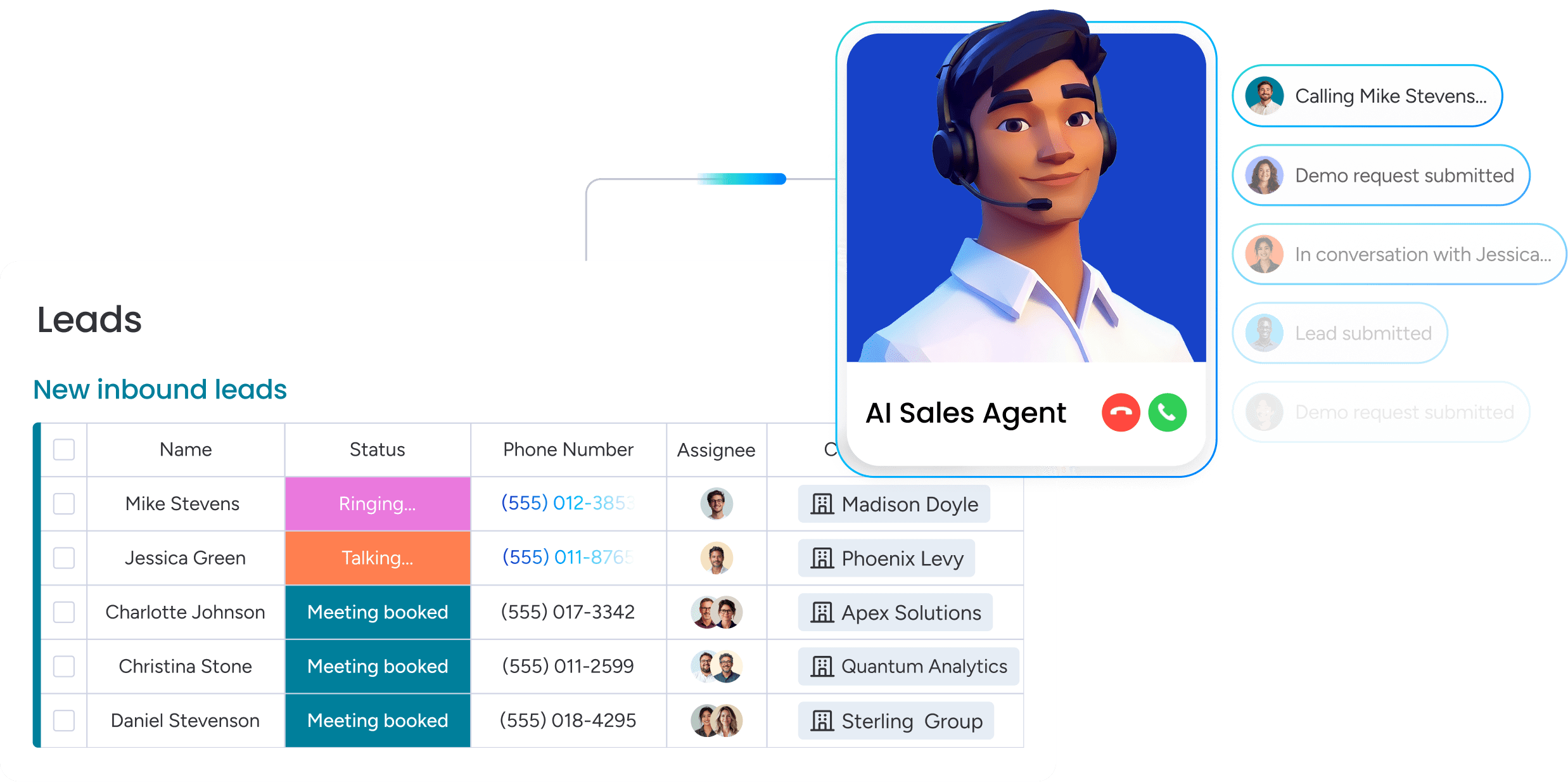
Revenue teams use monday CRM to run lead management, deal management, forecasting, and handoffs in one system, with AI support where it matters.
A few real examples teams lean on:
- Lead management: capture leads from web forms or social campaigns, auto-enrich with Crunchbase data, qualify, and assign.
- Deal management: track deals visually, customize stages with drag-and-drop, and trigger actions based on defined conditions.
- Account and contact management: access a complete timeline of contacts, deals, emails, meetings, and notes in one place.
Key features:
Keep deals moving without juggling tabs. monday CRM connects core revenue workflows in one place.
- Emails & Activities: email contacts directly from the CRM, and log and track every interaction in a single timeline.
- Mass email & tracking: send individual and mass emails using dynamic fields and templates, then track opens and link clicks.
- Sales reporting dashboards: build code-free dashboards for pipeline status, forecasting, activity, and team performance, including sales widgets like the Leaderboard widget and Sales funnel widget.
Advanced AI features:
monday CRM AI focuses on the work reps and managers actually perform every day: recap, write, and update.
- AI Timeline Summary: summarizes all communication events into a short, readable client history. Prepare for renewal calls in seconds, not hours.
- AI email assistance in Emails & Activities: compose emails inside Emails & Activities to respond faster without starting from scratch.
- Autofill with AI (column-level AI actions): apply AI actions to compatible columns to update records at scale.
Concrete B2B workflow examples:
- Renewal and legal review: upload a contract to the Files Column, then use Extract info to pull key fields into board columns.
- Inbound triage: use Detect sentiment on a Text Column sourced from Emails & Activities to prioritize accounts needing attention.
- Routing work fast: assign tasks on a People Column based on Emails & Activities, defining each team member’s skills for accurate AI assignment.
Automations:
Run your sales process without custom development. monday CRM supports automation and reporting that revenue teams control.
- Custom conditions for deal progression: trigger actions based on conditions your team defines, so deals move with less manual chasing.
- Conditional label change: keep statuses current as deal context changes, so dashboards remain useful.
- Sales ops workflows: manage headcount planning, onboarding, and collateral libraries in the same platform, keeping revenue operations connected to the pipeline.
Integrations:
Revenue work rarely lives in one place. monday CRM centralizes customer information while supporting cross-team collaboration across the monday product suite.
- Centralized CRM+ workflows: connect sales work to post-sales onboarding, client projects, renewals, and collection tracking so handoffs carry the full story.
- One platform beyond sales: use monday CRM alongside the broader monday suite to manage processes beyond the pipeline, in one connected system.
Enterprise AI tools for B2B sales workflows:
Enterprise teams benefit from less admin work, more consistent execution, and fewer “where is that info?” moments.
- Faster account context: AI Timeline Summary gives sales and support teams a snapshot of every interaction.
- More complete records: Autofill with AI extracts, summarizes, and labels key deal details across boards.
- More confident outreach: AI-assisted email writing helps reps move faster while keeping messages on-brand.
Pricing:
- Basic: $12/month per user (billed annually)
- Standard: $17/month per user (billed annually)
- Pro: $28/month per user (billed annually)
- Enterprise: contact sales for custom pricing
Annual billing provides 18% savings compared to monthly plans.
Three-user minimum for all paid plans.
AI credits included with trial; additional credits available for purchase.
Why it stands out:
Teams choose monday CRM for visibility and control without rebuilding their sales process. RevOps can adapt the CRM to their workflows, cutting costs and saving time.
- Easy to use and customizable: configure boards, deal stages, and workflows around your sales cycle.
- Automation and AI where it counts: email support, timeline summaries, and AI-powered column actions reduce manual updates.
- One stop shop, plus reporting: centralized customer info, code-free dashboards, and sales widgets keep leaders and reps aligned.
2. Pipedrive
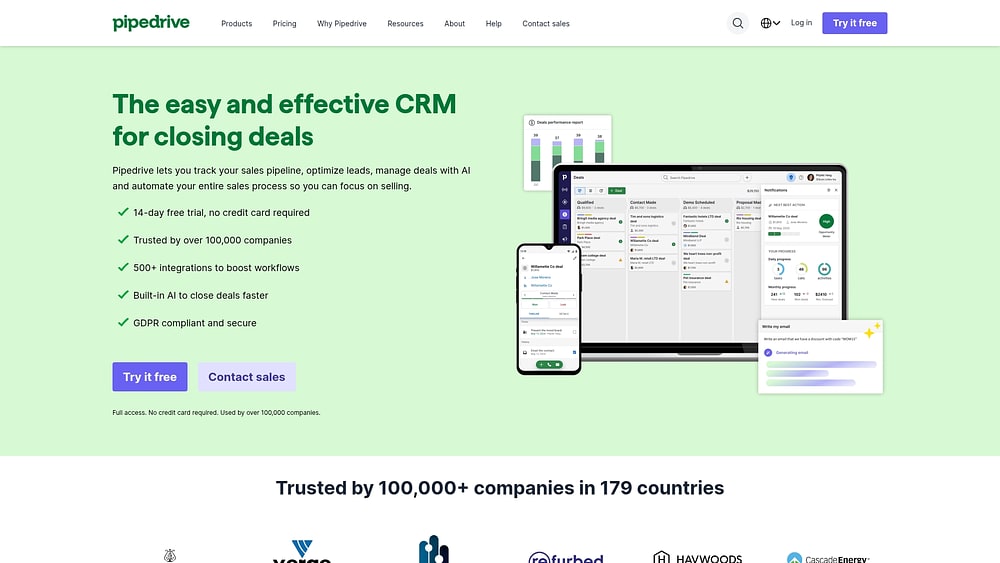
Pipedrive built its AI-powered pipeline management for small to mid-market sales teams. The platform focuses on visual deal tracking and automated insights, providing accessible CRM functionality without enterprise complexity. Over one hundred thousand companies use Pipedrive for its simple, sales-first design.
Use case:
Pipedrive is ideal for small to mid-market teams that require visual pipeline management with AI-driven deal prioritization and automated follow-up recommendations.
Key features:
- AI Sales Assistant: analyzes pipeline patterns, predicts win probability, and suggests next actions based on historical data.
- Automated activity logging: reduces manual administrative work through follow-up reminders and task tracking.
- Visual pipeline interface: drag-and-drop deal progression with AI-powered bottleneck identification.
Pricing:
- Lite: $14/month (billed annually).
- Growth: $39/month (billed annually).
- Premium: $59/month (billed annually).
- Ultimate: $79/month (billed annually).
- Trial: 14-day free trial available.
- Annual savings: billing annually saves up to 42% compared to monthly plans.
- Add-ons: include LeadBooster ($32.50/month), Web Visitors ($41-$299/month), and Campaigns (tiered pricing).
Considerations:
- Enterprise teams may find limitations in customization depth and advanced automation compared to more robust platforms.
- AI features perform best in straightforward sales processes but may struggle with complex, multi-stakeholder B2B deals requiring sophisticated workflow orchestration.
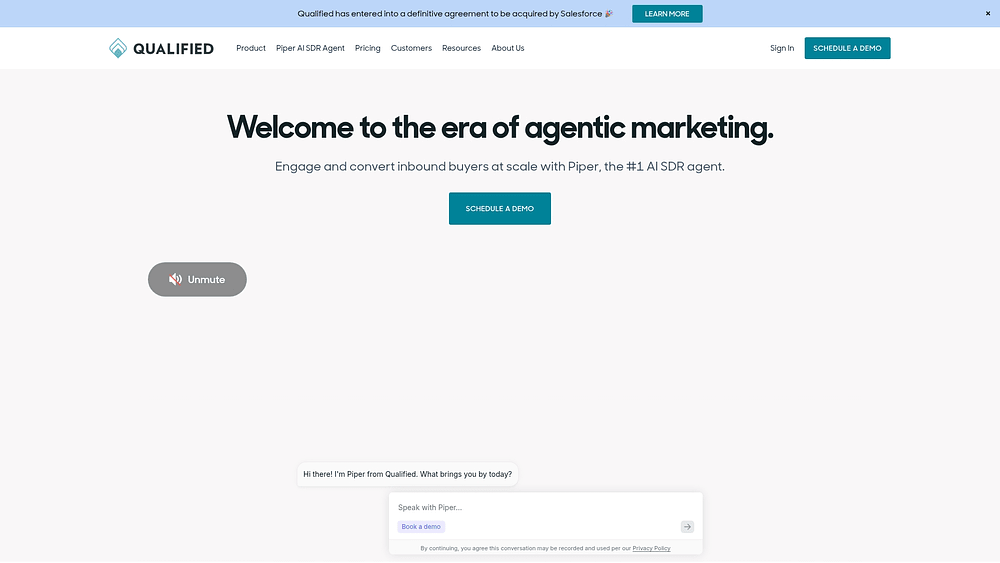
3. Piper (Qualified AI SDR Agent)
Piper is an always-on AI SDR that manages the entire inbound pipeline, from website chat to email follow-ups and meeting bookings. Designed for Salesforce customers only, Piper leverages intent signals and video, chat, and voice interactions to engage prospects. The agent learns from successful conversations and improves qualification over time, making it suitable for enterprises with high inbound volume seeking consistent lead engagement without additional SDR hires.
Use case:
Piper is best for mid-market and enterprise B2B teams using Salesforce that require automated inbound coverage and want to convert more website visitors into qualified opportunities.
Key features:
- Full-funnel automation: handles website conversations, email nurturing, meeting scheduling, and personalized offer delivery in one unified agent.
- Predictive signals integration: combines first-party site behavior, Salesforce data, and third-party research intent to prioritize high-value prospects.
- Multi-modal digital human: supports face-to-face video interactions, live chat in seventeen languages, and voice conversations for more engaging prospect experiences.
Pricing:
- Premier: quote-only pricing with core AI SDR capabilities, Salesforce integration, and basic analytics.
- Enterprise: adds SSO, reporting API, multi-language support, and research intent signals.
- Ultimate: includes multiple agent profiles, multi-brand support, high-volume site capabilities, and extended database support.
- Notes: all plans require custom quotes based on conversation volume and feature requirements.
Considerations:
- Requires significant upfront configuration and ongoing partnership with Qualified’s success team to optimize performance.
- Limited to Salesforce customers only, with data residency restricted to AWS US-East regions.
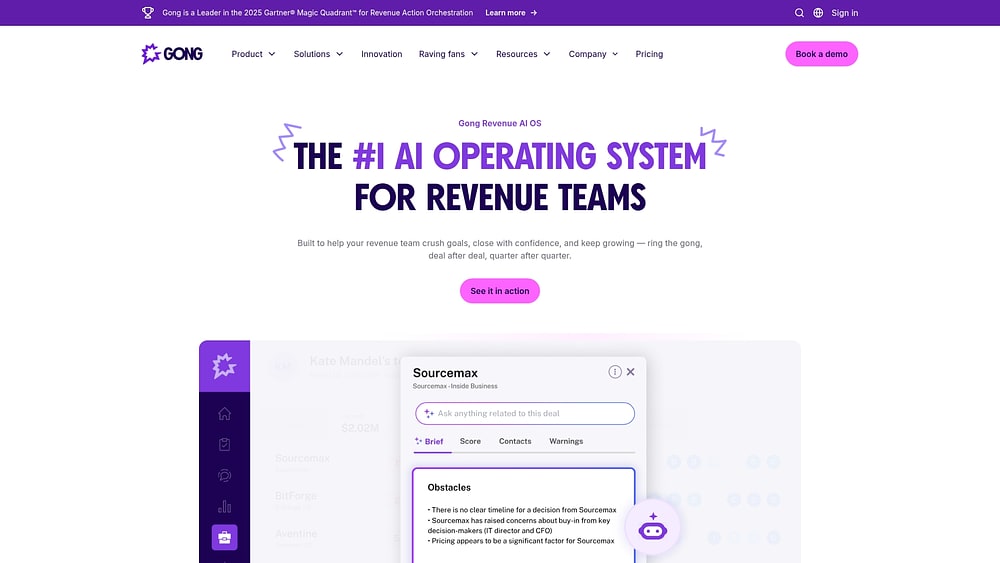
4. Gong
Gong transforms customer conversations into actionable revenue intelligence using AI-powered analysis of calls, emails, and meetings. The platform supports mid-market and enterprise B2B teams with its Revenue AI OS, capturing and analyzing thousands of interactions to identify deal risks, successful talk tracks, and coaching opportunities that improve team performance.
Use case:
Revenue teams rely on Gong to eliminate guesswork in sales by automatically recording, transcribing, and analyzing customer interactions to enhance rep performance and forecast accuracy.
Key features:
- Conversation intelligence: records and analyzes calls, emails, and meetings to identify patterns, objections, and competitive mentions across the sales organization.
- Smart Trackers: user-trainable AI that detects specific concepts and methodologies in conversations, with pre-built trackers for common scenarios and custom options for unique processes.
- Ask Anything AI: generative AI that answers questions about deals, accounts, and contacts by searching captured interactions, available on desktop and mobile.
Pricing:
- Custom pricing: quote-based model with per-user licensing plus platform fee.
- Integrations included: available at no additional cost.
- Trial: no free trial, demo-led sales process with custom quotes based on team size and modules.
Considerations:
- Ask Anything has data limits (up to sixty calls and five hundred emails for deals/accounts, ten calls and eighty emails for contacts).
- Requires significant investment in cost and change management, as teams must adopt new behaviors around call recording and analysis.
5. Relevance AI
Relevance AI builds custom AI agents that manage complete sales workflows, from prospecting to deal closure. Designed for technical teams and operations professionals, it enables flexible multi-agent systems that orchestrate across the entire GTM stack. With over two thousand integrations and model-agnostic architecture, it serves enterprises with complex needs that standard sales platforms cannot address.
Use case:
Relevance AI excels in creating end-to-end AI sales agents that research prospects, craft personalized outreach, manage conversations, qualify leads, and update CRMs automatically, operating 24/7 across email, chat, and voice channels.
Key features:
- Multi-agent workforce orchestration: deploy teams of AI agents that work together with reasoning capabilities and tool access across the sales stack.
- “Bosh” AI SDR/BDR agents: complete outbound and inbound automation covering research, personalized outreach, conversation management, meeting booking, and CRM updates.
- No-code “Invent” builder: create custom AI agents using natural language without technical expertise, with A/B testing and evaluation capabilities.
Pricing:
- Free: $0/month with two hundred actions monthly and unlimited agents.
- Pro: $29/month ($19/month annually) with 2,500 actions monthly and bring-your-own LLM capability.
- Team: $349/month ($234/month annually) with 7,000 actions monthly, calling agents, and analytics dashboard.
- Enterprise: custom pricing with unlimited users, advanced security, and dedicated support.
- Self-service top-ups: available at $40 per 1,000 actions.
Considerations:
- Advanced features like calling agents and A/B testing are limited to higher-tier plans, restricting functionality for smaller teams.
- Custom workflows require ongoing maintenance and technical oversight, even with the no-code interface, which can create additional resource demands.
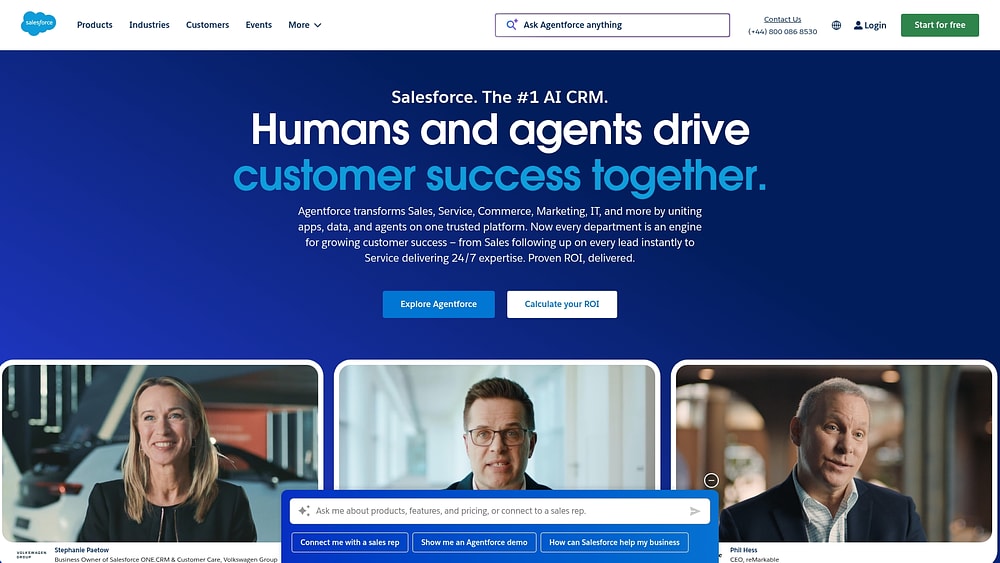
6. Salesforce
Salesforce brings Einstein AI to the world’s largest CRM platform, combining predictive lead scoring, automated activity capture, and AI-powered forecasting in one unified system. The platform is designed for enterprises already invested in complex sales ecosystems, offering extensive customization and thousands of integrations. With Agentforce autonomous agents and the Einstein Trust Layer, Salesforce positions itself as a comprehensive solution for organizations requiring enterprise-grade AI capabilities.
Use case:
Salesforce suits large enterprises that need deep CRM customization, extensive integrations, and AI-driven sales automation across complex, multi-departmental workflows.
Key features:
- Predictive AI insights: Einstein AI delivers lead scoring, opportunity insights, and automated forecasting to accelerate pipeline velocity.
- Autonomous engagement: Agentforce handles prospect engagement and sales coaching with permission-aware data retrieval.
- Conversation analysis: Einstein Conversation Insights provides call transcription, trend analysis, and embedded coaching moments across major calling platforms.
Pricing:
- Free Suite: $0/month for two users.
- Starter Suite: $25/user/month billed annually.
- Pro Suite: $100/user/month billed annually.
- Enterprise: $175/user/month billed annually.
- Unlimited: $350/user/month billed annually.
- Agentforce 1 Sales: $550/user/month billed annually.
- Sales Engagement add-on: $50/user/month.
- Einstein Conversation Insights: $50/user/month, included with higher tiers.
- Revenue Intelligence: $220–$250/user/month options.
Considerations:
- Implementation complexity: Specialized consultants and months of setup are required, making rapid deployment challenging.
- Cost escalation: Total ownership grows quickly with add-ons, advanced features, and ongoing administration that often requires dedicated Salesforce teams.
7. HubSpot
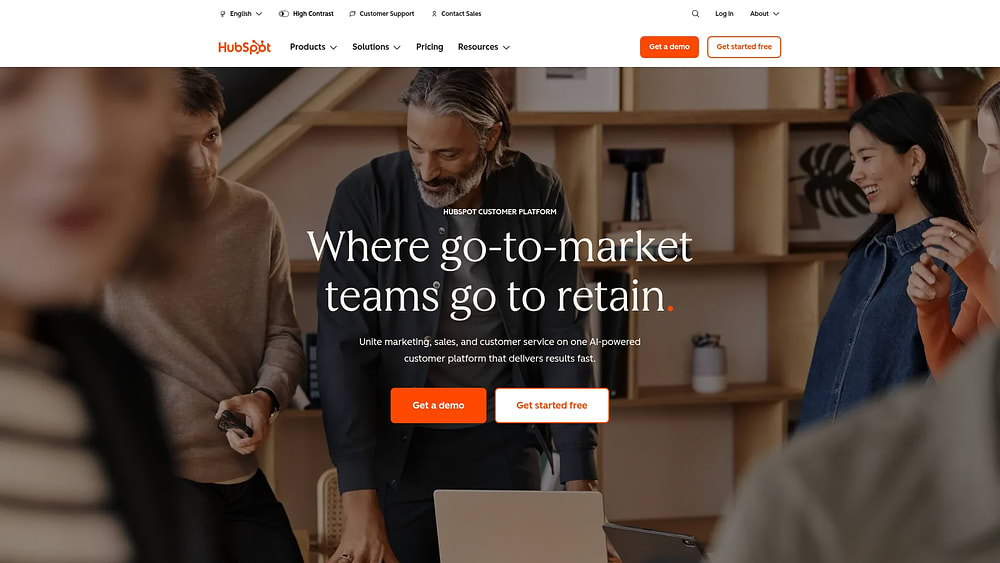
HubSpot delivers AI-powered sales automation through a unified customer platform, combining prospecting, content generation, and workflow automation across marketing, sales, and service functions. Designed for mid-market B2B companies, the platform features Breeze AI agents that monitor buying signals and automate routine sales tasks. With over 258,000 customers and transparent pricing starting from a free tier, HubSpot makes enterprise-grade AI accessible to growing revenue teams.
Use case:
HubSpot excels at unifying sales AI and CRM data in one platform, removing the need for multiple tools while offering agentic automation that tracks prospects and drafts personalized outreach.
Key features:
- Prospecting automation: Breeze Prospecting Agent monitors buying signals like leadership changes and funding events, crafting personalized outreach with up to two times higher response rates than traditional sequences.
- Predictive lead scoring: Machine learning calculates likelihood to close in 90 days and ranks contacts by priority, helping reps focus on high-probability opportunities.
- AI forecasting: Provides beta AI projections based on recent performance, color-coded deal tags, and automated conversation summaries to accelerate decision-making.
Pricing:
- Free: Core CRM and basic sales features.
- Starter: $20/seat/month for entry-level automation and analytics.
- Professional: $100/seat/month with advanced AI capabilities and workflow automation.
- Enterprise: $150/seat/month including conversation intelligence and predictive scoring.
- Onboarding fees: $3,500 for Professional and Enterprise tiers.
- Add-ons: Available for calling minutes, transcription hours, and workflow limits.
Considerations:
- AI forecasting in beta: Models may vary and features can change as the platform evolves.
- Advanced capabilities: Professional or Enterprise subscriptions are required, increasing total cost for full functionality.
8. Demandbase
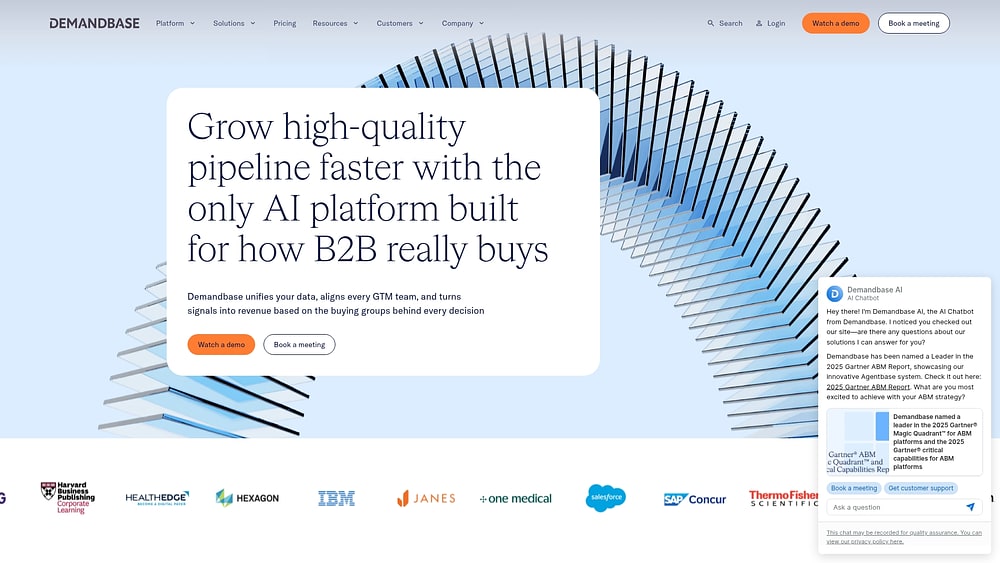
Demandbase provides AI-powered account-based marketing (ABM) to identify high-intent prospects and orchestrate personalized campaigns across channels. The platform combines intent data, predictive analytics, and automated workflows, helping enterprise B2B teams align marketing and sales efforts around target accounts. Built with connected AI agents, Demandbase unifies data, advertising, and sales intelligence in one system.
Use case:
Demandbase fits enterprise revenue teams running sophisticated ABM programs with long sales cycles, using AI agents to surface buying groups, predict pipeline outcomes, and automate cross-channel engagement.
Key features:
- Connected AI agents: Agentbase generates buying groups, filters prospects using natural language, and executes actions like syncing contacts and launching campaigns.
- Predictive analytics: Models auto-retrain to score pipeline likelihood and account fit with minimal data science setup.
- Embedded sales workflows: Native integrations with Salesforce Agentforce, Outreach, Salesloft, and Gong enable in-flow execution and automated follow-ups.
Pricing:
- Custom pricing: Quote-based platform fee plus flat per-user structure.
- Representative cost: AWS Marketplace shows $215,000 for a 12-month Demandbase One subscription.
- Discounts: G2 data indicates buyers negotiate an average 13% discount.
- Additional costs: Separate media budgets may be required for advertising and certain API access.
Considerations:
- Steep learning curve: Dedicated operations support is often needed.
- Enterprise pricing: High cost and implementation complexity may limit accessibility for smaller teams.
9. 6sense
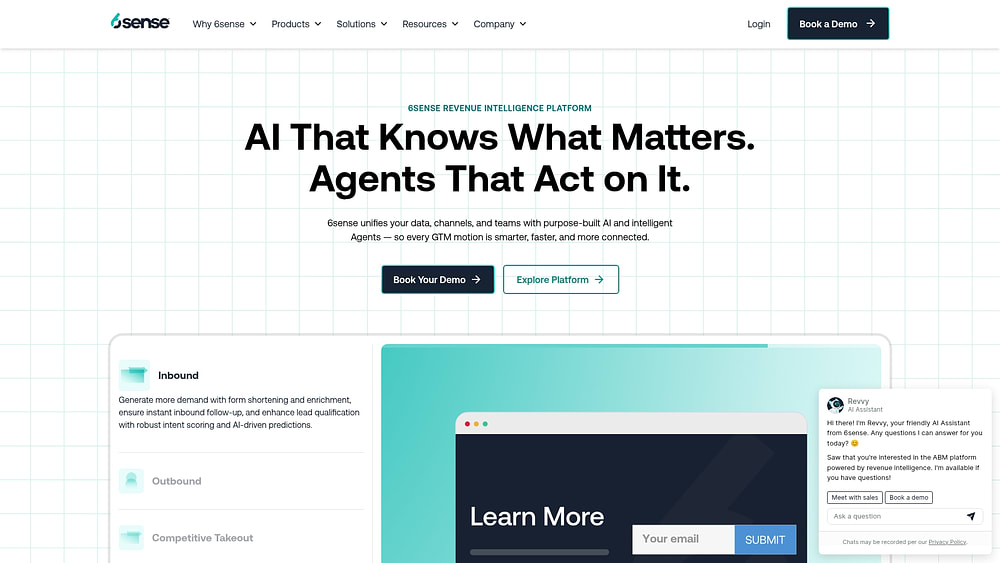
6sense transforms B2B sales with AI that predicts which accounts are ready to buy before they engage. The platform processes over one trillion buying signals daily, identifying in-market accounts, revealing anonymous website visitors, and orchestrating multi-channel campaigns. Designed for enterprise teams managing complex, multi-stakeholder sales cycles, 6sense turns intent data into actionable revenue insights.
Use case:
6sense helps enterprise sales teams focus on accounts showing genuine buying signals, improving close rates and shortening sales cycles.
Key features:
- AI email agents: Autonomous agents handle email writing, sending, follow-ups, and reply routing while maintaining personalized messaging at scale.
- Sales Copilot: Embedded AI delivers account summaries, recommended actions, and next steps directly in CRM, Chrome extension, and sales engagement platforms.
- Account qualification: 6QA identifies accounts using intent-rich data rather than traditional lead scoring.
Pricing:
- Sales Intelligence Free: 50 data credits/month with company and people search, sales alerts, list builder, and Chrome extension.
- Paid Sales Intelligence: Custom pricing with optional predictive add-on and organization-level credit pools.
- Additional costs: Credits are required for contact unlocks, AI-written emails, and enrichment features.
- Enterprise platform: Quote-based pricing for full Revenue AI capabilities.
Considerations:
- Investment: Custom enterprise pricing reflects premium positioning.
- Implementation complexity: Deployment typically requires several months and dedicated resources.
10. Outreach
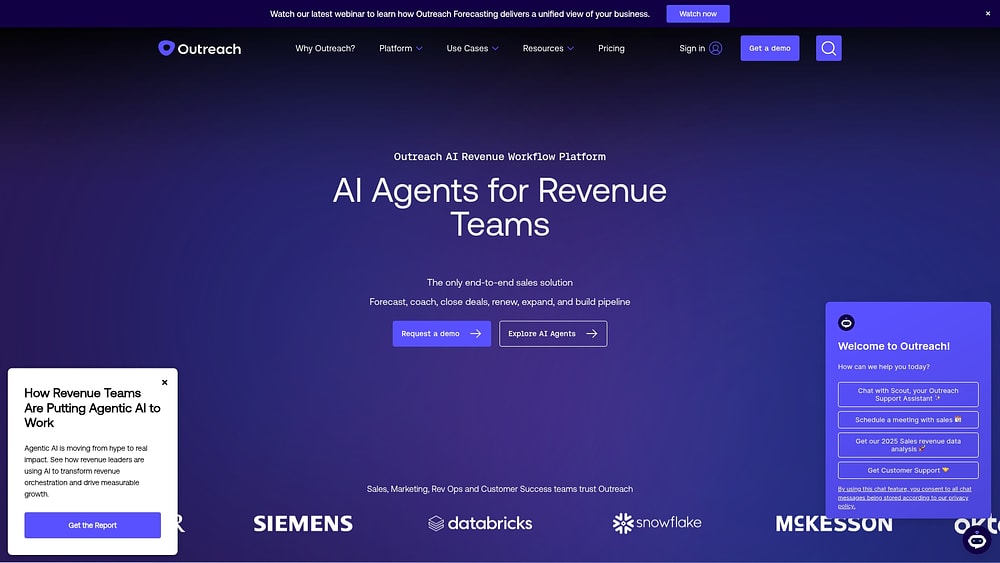
Outreach enhances sales engagement with AI that executes tasks, not just analyzes data. The platform combines prospecting, conversation intelligence, deal management, and forecasting, making it ideal for mid-market to enterprise teams managing high-volume outbound campaigns.
Use case:
Outreach automates multi-touch sequences while maintaining personalization at scale, helping sales development teams book more meetings and accelerate deal closure.
Key features:
- Conversation intelligence: Kaia provides real-time meeting transcription, live battlecards, and automated follow-ups, increasing booking rates by up to 36%.
- Smart email assist: AI drafts personalized emails, replies, and follow-ups while analyzing buyer sentiment and optimizing send times.
- Autonomous agents: Amplify agents automate research, targeting, personalization, and CRM updates using a credit-based consumption model.
Pricing:
- Custom pricing: Quote-only pricing for Engage, Call, Meet, Deal, Forecast, and Amplify packages.
- Voice add-on: Pay-per-use or $300/month for 10,000 global minutes plus $40 per additional 1,000 minutes.
- AI Amplify: Credit-based consumption model for agent actions.
- Licensing: No platform fees, per-user licensing with Plus support included.
Considerations:
- Learning curve: UI complexity and adoption are commonly cited in user reviews.
- Feature availability: Some AI agents and capabilities are still coming soon rather than fully released.
4 steps to select your enterprise AI sales platform
Choosing an AI sales platform is not about chasing shiny features. It is about finding a platform your team will actually use. Rushing into a decision can result in an expensive, frustrating solution for everyone involved.
Step 1: get real about your current tech and data
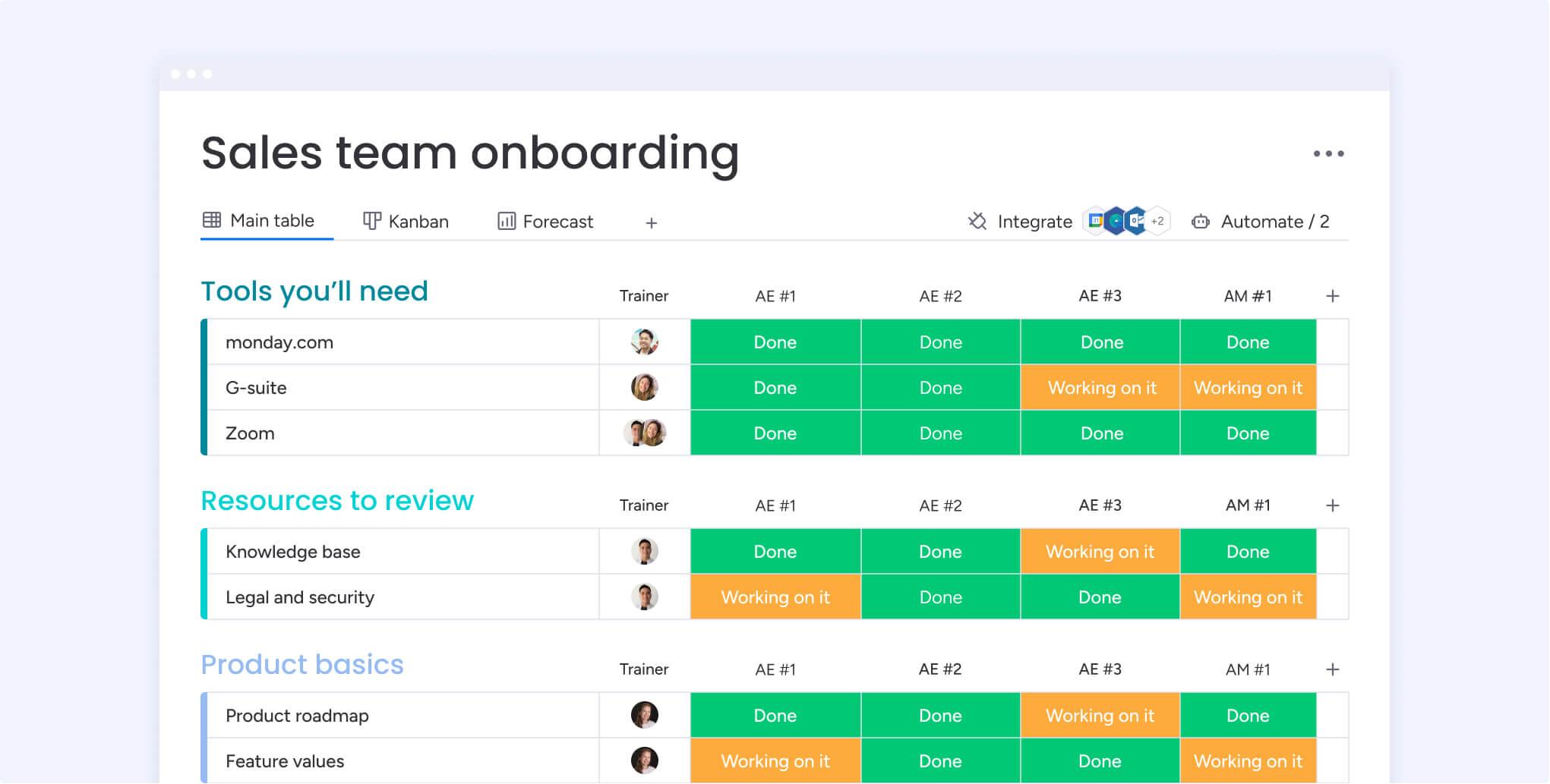
Map out every platform your revenue team interacts with. This includes your CRM, email, call software, and even platforms purchased last year. Identify where data gets stuck and where team members copy and paste to keep processes moving. This is not just an inventory list; it is a cost audit. Include licenses, maintenance, and hours spent on manual tasks.
A thorough audit clarifies your starting point and helps define what you actually need rather than what seems attractive. Consider these questions:
- Integration: what platforms must connect to your new AI platform.
- Data: how messy is your historical data.
- Pain points: where do manual tasks slow down deal momentum.
- Adoption: why does your team avoid using the tools they already have.
- Security: what are your non-negotiable compliance and security requirements.
Be honest about data quality. If your CRM data is inconsistent, AI will deliver unreliable results. Audits often reveal that thirty to forty percent of records contain errors. Fixing this foundation is essential before adding AI capabilities.
Step 2: connect AI capabilities to your actual problems
Avoid getting distracted by long feature lists. Focus on the specific challenges that hold your team back. Do forecasts feel like guesses? Are reps chasing poor-quality leads? Is pipeline visibility limited until it is too late?
Match tools to problems by focusing on capabilities that directly address your largest challenges and support your revenue goals.
- Unpredictable forecasts: choose AI that analyzes pipeline and deal velocity.
- Reps chasing poor leads: implement intelligent scoring and automated lead routing.
- Pipeline blind spots: use conversation intelligence and automated activity tracking.
- Excessive admin work: prioritize workflow automation and AI-powered content generation.
- Deals slipping: adopt AI that flags at-risk opportunities and monitors engagement.
Step 3: calculate the real ROI (and all the hidden costs)
A software license is only part of the expense. Professional services often add fifty to two hundred percent of the license cost. Internal resources for setup, testing, and training can take months to deploy.
Evaluate the upside by quantifying time saved and potential revenue gains. A full ROI calculation considers the complete picture.
- Upfront costs: software licenses, implementation services, internal setup resources, and data migration.
- Ongoing costs: maintenance, training, and future modules.
- Productivity gains: time saved on administrative tasks, faster sales cycles, and more efficient reps.
- Revenue impact: higher conversion rates, larger deals, and more accurate forecasts.
- Costs avoided: elimination of redundant platforms.
Step 4: create a roadmap for adoption
Do not attempt to implement everything at once. Phased rollouts build momentum and foster adoption. Start with high-impact wins, such as automated lead routing or AI-assisted email drafting. Early value builds trust and sets the stage for broader deployment.
Success depends on people, not just technology. Identify executive sponsors, empower power users to assist peers, and create channels for feedback. A balanced plan ensures steady adoption:
- Weeks one to four: configure your core CRM, migrate data, and build initial automations.
- Weeks five to eight: launch initial AI features, train users, and collect feedback.
- Weeks nine to twelve: implement advanced capabilities, complete integrations, and optimize workflows.
- Ongoing: continue improvements, deploy new features, and schedule regular training refreshers.
This process can feel daunting, particularly with legacy systems that may take three to six months to fully deploy. Revenue teams succeed when they leverage monday CRM to set up in weeks rather than months. Its no-code platform allows operations teams to adapt workflows independently, delivering results without extensive IT projects.
How to ensure your enterprise AI project succeeds
More than half of enterprise AI projects fail. According to Gartner’s 2023 “State of AI Implementation” report, the failure rate is fifty-one percent. The technology may function as expected, but poor data quality and inconsistent adoption often undermine results.
Projects stumble when data is unreliable, workflows are complex, or leaders expect instant success. True success begins with clean data, dependable systems, and solutions that empower teams rather than replace them. Revenue teams achieve better outcomes by using monday CRM to build a strong foundation before progressively introducing AI capabilities that employees will actually adopt.
Try monday CRMFrom tool chaos to unified revenue operations
Teams often juggle multiple platforms, with many left unused. This creates friction, hides insights, and reduces productivity.
The real cost of disconnected systems:
- Annual cost per rep: $3,000–5,000 across multiple platforms versus $1,500–2,500 for a unified solution.
- Training time required: forty+ hours across multiple tools versus ten to fifteen hours on a single platform.
- Data consistency: conflicting information across systems versus a single source of truth.
- Integration maintenance: ongoing IT resources versus built-in connections maintained by the vendor.
- Admin work: ten to fifteen hours per week per rep versus three to five hours per week per rep.
| Dimension | Fragmented approach | Unified platform |
|---|---|---|
| Annual cost per rep | $3,000-5,000 across multiple tools | $1,500-2,500 for one platform |
| Training time required | 40+ hours across different systems | 10-15 hours for a single interface |
| Data consistency | Conflicting information across systems | A single source of truth |
| Integration maintenance | Ongoing IT resources required | Built-in connections, maintained for you |
| Time spent on admin work | 10-15 hours per week per rep | 3-5 hours per week per rep |
You do not need to replace everything at once. Start by swapping out the one tool your team finds most frustrating. A small, manageable win builds momentum for larger changes.
Run your old and new systems side by side temporarily. This allows your team to adjust without creating disruptions. No dropped leads and no missed follow-ups ensures business continuity.
Building a tech stack that grows with you
Will your CRM support a team that doubles next year? Rigid platforms can limit growth. You need a flexible system that adapts as your business evolves rather than forcing another migration in eighteen months.
Revenue teams succeed by connecting the entire operation from first touch to final invoice. When AI, automation, and analytics work together, your reps can focus on what matters most: building relationships and closing deals.
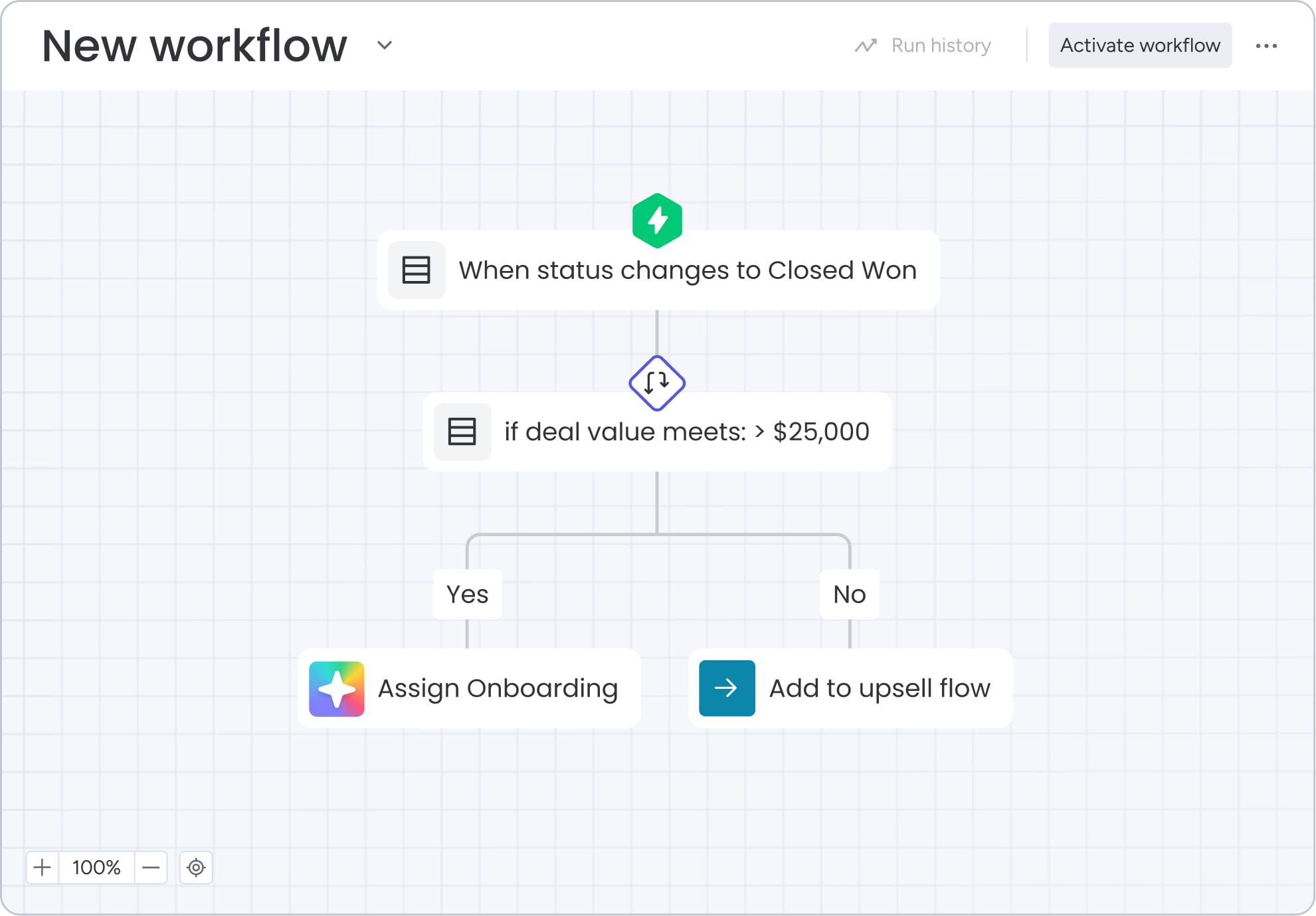
How monday CRM unifies AI across revenue workflows
Most CRMs add AI as an afterthought. This often results in fragmented features that create more work rather than reducing it. Platforms like monday CRM integrate AI into every workflow to connect data and automate tasks in ways that genuinely support sales.
Manual data entry slows progress. AI handles repetitive tasks, so teams focus on closing deals. It is designed to address real-world sales challenges:
- Automate data entry: forward an email or upload a contract, and AI extracts key details directly into records. No copy-pasting.
- Get deal intelligence: identify at-risk deals by analyzing engagement patterns, and suggest the right rep for each opportunity based on historical wins.
- Write better, faster: generate personalized emails based on deal context and previous conversations.
Imagine a CRM that advises your next steps. AI monitors pipelines, automates follow-ups, and coordinates handoffs. By connecting sales, marketing, and customer success on a single platform, every team member has the context they need without switching systems.
| Capability | monday CRM unified approach | Traditional point solutions |
|---|---|---|
| AI implementation time | 2-4 weeks, no-code configuration | 3-6 months, requires technical resources |
| Customization flexibility | Visual workflow builder, no code required | Limited options or code required |
| Cross-functional visibility | Single platform spans sales, success, operations | Data silos across separate tools |
| User adoption rate | 90%+ typical adoption | 40-60% typical adoption |
| Integration maintenance | Vendor-managed, built-in connections | Ongoing IT resources required |
| Total cost per user | $12-50/month comprehensive platform | $100-300/month across multiple tools |
When AI operates seamlessly, teams spend less time fighting software and more time selling. The difference lies between a few isolated AI features and a fully integrated AI-powered revenue operation.
“With monday CRM, we’re finally able to adapt the platform to our needs — not the other way around. It gives us the flexibility to work smarter, cut costs, save time, and scale with confidence.”
Samuel Lobao | Contract Administrator & Special Projects, Strategix
“Now we have a lot less data, but it’s quality data. That change allows us to use AI confidently, without second-guessing the outputs.”
Elizabeth Gerbel | CEO
“Without monday CRM, we’d be chasing updates and fixing errors. Now we’re focused on growing the program — not just keeping up with it."
Quentin Williams | Head of Dropship, Freedom Furniture
“There’s probably about a 70% increase in efficiency in regards to the admin tasks that were removed and automated, which is a huge win for us.“
Kyle Dorman | Department Manager - Operations, Ray White
"monday CRM helps us make sure the right people have immediate visibility into the information they need so we're not wasting time."
Luca Pope | Global Client Solutions Manager at Black Mountain
“In a couple of weeks, all of the team members were using monday CRM fully. The automations and the many integrations, make monday CRM the best CRM in the market right now.”
Nuno Godinho | CIO at Velv
“monday.com provides developmental flexibility, operational efficiency, and data transparency — all in one place. We became a company that moved from chasing data to leading with it.”
Hyunghan Lee | Team Lead, Sandbox Network
"monday.com brought every part of our business into one connected space. The harmony between work management and CRM has become our operating system — giving us the clarity and confidence to scale.”
Jennifer Chinburg | Executive Vice President of Corporate Development & Brand, Chinburg Properties
“We just weren’t getting value from our old CRM. With monday.com, it's a thousand times better. Our sales teams are more informed, more consistent, and far more connected."
James Arnold | Chief Operating Officer, CenversaStop buying AI promises. Start getting results.
Many AI tools assume perfect data and flawless workflows. Sales floors deal with messy data, inconsistent updates, and teams under pressure to hit their numbers.
Juggling multiple specialized AI platforms leads to burnout. Time lost to app-switching and chasing data is time not spent selling. Organizations achieve better outcomes by consolidating operations, converting complexity into clear forecasts.
AI can draft follow-ups, flag deals at risk, or guide focus. It does not replace skill — it eliminates manual work and human error, letting teams concentrate on what they do best: selling.
Try monday CRMFrequently asked questions
How quickly can enterprises see ROI from AI sales tools?
ROI often appears in stages. Workflow automation can produce quick wins within weeks, while strategic improvements, like forecast accuracy, may take several months as AI learns your sales cycle.
What level of data quality is required for AI implementation?
AI relies on data quality. Poor or inconsistent data leads to poor outcomes.
Can AI platforms integrate with existing Salesforce or HubSpot systems?
Yes. Enterprise AI platforms generally integrate with major CRMs. Confirm compatibility with the specific data you need to sync.
How do you measure AI impact beyond pipeline metrics?
Track hours saved on administrative work, speed of deal closures, and user adoption rates. If your team is not using AI, the platform is not delivering value.
What's the difference between robotic automation and agentic AI?
Robotic automation follows preset rules. Agentic AI learns from data, improves decision-making over time, and adapts to evolving workflows.
Do sales teams need technical skills to use enterprise AI platforms?
No. The most effective AI tools are built for sales teams, not engineers, and require no-code setup.
How does monday CRM's AI approach differ from traditional CRM platforms?
Revenue teams succeed with monday CRM because AI is customizable without code, enabling faster results. It consolidates operations, reducing cost and complexity compared with multiple platforms.
What security and compliance features should enterprises require in AI sales platforms?
Look for enterprise-grade security, including role-based access, full audit trails, and certifications such as SOC 2 and GDPR. Anything less is insufficient.

 Get started