Sales teams today face a growing challenge: balancing growth with efficiency in increasingly complex pipelines. Multiple stakeholders, fragmented data sources, and extended decision cycles make it difficult to identify which prospects are most likely to close. Without a systematic approach, organizations risk spending time on low-probability opportunities while high-potential deals slip through the cracks.
Structured growth strategies transform this uncertainty into actionable insights. By analyzing patterns in customer behavior, tracking engagement signals, and aligning sales activities with real buying intent, sales teams can focus efforts where they matter most. Behavior-driven strategies not only increase conversion rates but also improve forecast accuracy, shorten sales cycles, and ensure resources are allocated efficiently.
This article explores practical approaches for driving sustainable sales growth. It covers how to identify high-value prospects, implement structured processes, and measure results effectively. Readers will learn how to turn behavioral intelligence into actionable steps that accelerate deal velocity and boost overall revenue performance.
Key takeaways
- Behavioral signals predict purchase intent: tracking email engagement, pricing page visits, content downloads, and stakeholder involvement reveals which prospects are ready to buy.
- Customer behavior analysis improves forecasting: analyzing patterns across multiple interactions helps sales teams allocate resources and predict deal outcomes with confidence.
- Segment prospects by engagement style: grouping buyers by behavior rather than demographics allows tailored sales approaches for faster, more effective deal progression.
- Automate responses to key behaviors: setting workflows to trigger follow-ups based on observed actions ensures timely engagement and reduces deal delays.
- Centralize insights in monday CRM: unifying behavioral data in one platform creates a complete view of prospect activity, enabling teams to act on patterns efficiently.

What is customer behavior analysis?
Customer behavior analysis is the systematic customer tracking and interpretation of how prospects and customers interact with your sales team throughout the buying journey. This involves monitoring digital touchpoints such as email opens, website visits, and content downloads to identify who is ready to buy.
Think of it as reading digital body language through behavioral segmentation. Every click, time spent on a page, and forwarded email provides insight into where a prospect stands in their decision-making process. According to a 2023 McKinsey report, roughly 90% of US small and mid-size merchants now use integrated software solutions for payments and business management, meaning more customer interactions occur in digital systems that reveal intent and buying stages. This transforms scattered signals into actionable insights that improve forecasting accuracy.
For revenue teams, behavior analysis replaces guesswork with evidence. Sales leaders gain visibility into the actions that indicate genuine purchase intent, helping them prioritize resources and forecast with confidence.
Understanding buyer actions and patterns
Customer behavior analysis tracks three dimensions that reveal where prospects stand and how likely they are to buy. Together, these provide a complete picture of buyer engagement.
| Dimension | What it captures | Why it matters |
|---|---|---|
| Digital engagement patterns | Email opens, website visits, content downloads, page time | Reveals interest level and research depth |
| Communication behaviors | Response times, question types, conversation depth | Indicates urgency and decision-making stage |
| Buying signals | Stakeholder expansion, pricing inquiries, technical reviews | Shows movement toward purchase decision |
When prospects forward a proposal to colleagues, this signals internal buy-in and identifies warm leads. A sudden acceleration in response times indicates a shift in priority. These patterns form the foundation for smarter sales decisions.
A single email open provides limited insight. However, multiple opens over several days, along with pricing page visits and stakeholder expansion, signal serious evaluation.
Customer behavior analysis vs consumer analytics
Customer behavior analysis and consumer analytics serve different purposes. Knowing the distinction helps teams focus on the metrics that matter most.
| Aspect | Customer behavior analysis | Consumer analytics |
|---|---|---|
| Primary focus | Individual deal progression and sales outcomes | Aggregate market trends and campaign performance |
| Time horizon | Real-time to weekly (active deal cycles) | Monthly to quarterly (campaign cycles) |
| Key metrics | Email engagement, stakeholder involvement, response velocity | Website traffic, conversion rates, demographic segments |
| End goal | Close specific deals faster | Optimize marketing spend and brand awareness |
| Data granularity | Individual prospect and account level | Segment and cohort level |
Sales teams benefit from customer behavior analysis because deals require granular, real-time intelligence. Knowing that 30% of website visitors convert informs marketing, but knowing a specific prospect visited the pricing page three times today tells sales exactly when to engage.
Why customer behavioral analysis accelerates sales
Teams that leverage behavioral data close more deals and forecast more accurately. For CROs and VPs seeking predictability, these insights transform forecasting from guesswork into data-driven confidence.
Behavioral insights allow leaders to focus resources on deals with strong buying signals. Reporting to the board shifts from hope-based to evidence-based. By tracking actions rather than relying on rep optimism, sales leaders can forecast with confidence.
Predict deal outcomes with data
Certain behavior combinations strongly correlate with closed-won deals. Multiple stakeholder engagement, pricing page visits, and technical document downloads often signal high purchase intent.
Sales leaders can use these insights to:
- Allocate resources to high-probability opportunities: focus senior resources on deals showing strong buying signals rather than spreading effort evenly.
- Identify at-risk deals before they stall: detect declining engagement patterns early and intervene with targeted outreach.
- Coach reps on priority deals: provide guidance based on behavioral evidence, not subjective assessments.
When email engagement drops by 50% and response times double, historical data signals high likelihood of deal slippage. This insight comes from real deal patterns, not guesses.
Spot hidden buying signals early
Many buying signals appear before prospects express interest. Identifying these hidden cues gives a competitive advantage by revealing warm leads earlier than competitors.
Key hidden signals and recommended responses include:
- Competitor comparison page visits: prospect is building a vendor shortlist. Provide objective competitive analysis and customer references.
- Technical specification downloads: technical team is evaluating feasibility. Offer access to solutions engineers.
- Multiple pricing page engagements: budget discussions are underway. Share ROI documentation.
- Content forwarded to colleagues: internal buy-in is forming. Prepare materials for new stakeholders.
Shorten your average sales cycle
Behavior analysis reduces sales cycle length by showing the exact moment to follow up. When you know where prospects are in their decision process, you deliver the right information at the right time, removing delays caused by misalignment.
Traditional sales processes often follow arbitrary timelines. Behavior analysis replaces guesswork with real-time insights. When prospects review and share proposals with stakeholders, immediate outreach makes sense. This approach:
- Identifies when prospects are ready for next steps
- Eliminates unnecessary follow-ups that slow momentum
- Prioritizes deals actively progressing
7 customer behaviors that indicate purchase intent
Certain patterns in customer behavior provide strong signals of purchase intent in B2B sales. Recognizing these behaviors helps sales teams prioritize follow-ups, deliver relevant content, and advance deals efficiently. When these patterns appear together, they indicate a prospect is moving closer to a purchase decision.
1. Email opens and click patterns
Email engagement reveals a prospect’s level of interest and their position in the buying process. Single actions provide limited insight, but repeated patterns show intent. Multiple opens and specific link clicks indicate research or business case building.
For example, when a prospect opens a proposal email five times over three days and clicks the ROI calculator twice, behavioral tracking reveals they’re building an internal business case. Click patterns also indicate the information they value, such as technical details, pricing, or social proof, guiding the next content to provide.
2. Content downloads and revisits
Downloading gated content shows active research. Returning to content or downloading multiple resources signals growing interest. The progression matters:
- Initial content downloads: show awareness.
- Returning to review materials: signals movement toward evaluation.
- Downloading advanced content: indicates preparation for decision-making.
Prospects who first download an industry case study and return later for integration guides and security whitepapers are likely preparing for internal discussions.
3. Multiple stakeholder engagement
B2B purchases involve several decision-makers. When new stakeholders join discussions, it is a strong buying signal. New email addresses in threads, meeting invitations expanding to executives or technical teams, and internal sharing of proposals all show organizational buy-in. For example, when a primary contact forwards proposals to their VP of Operations and requests technical demos for IT, the deal is advancing from individual interest to organizational evaluation.
4. Faster response times
Response speed reflects urgency. Accelerating reply times indicate internal momentum. Observe the trend rather than a single interaction. Prospects who previously took two days to respond but now reply within ninety minutes and propose meetings likely have budget approval or approaching deadlines.
5. Technical documentation reviews
Engagement with API specs, integration guides, and security documents signals serious evaluation. These materials are typically reviewed during feasibility assessments and procurement preparation. Technical documentation often involves different stakeholders, such as IT and security teams, showing broader organizational buy-in.
6. Competitor research activity
Prospects investigating competitor comparison pages or asking questions about alternatives are in active evaluation mode. This behavior indicates serious buyers narrowing options. Reviewing comparison pages helps them create shortlists and prepare internal recommendations.
7. Pricing page visits and inquiries
Interest in pricing shows the transition from considering a solution type to assessing affordability. Early curiosity differs from late-stage focus. For instance, when prospects visit pricing pages multiple times in a week and inquire about annual contract discounts or payment terms, they are preparing budgets or purchase orders.
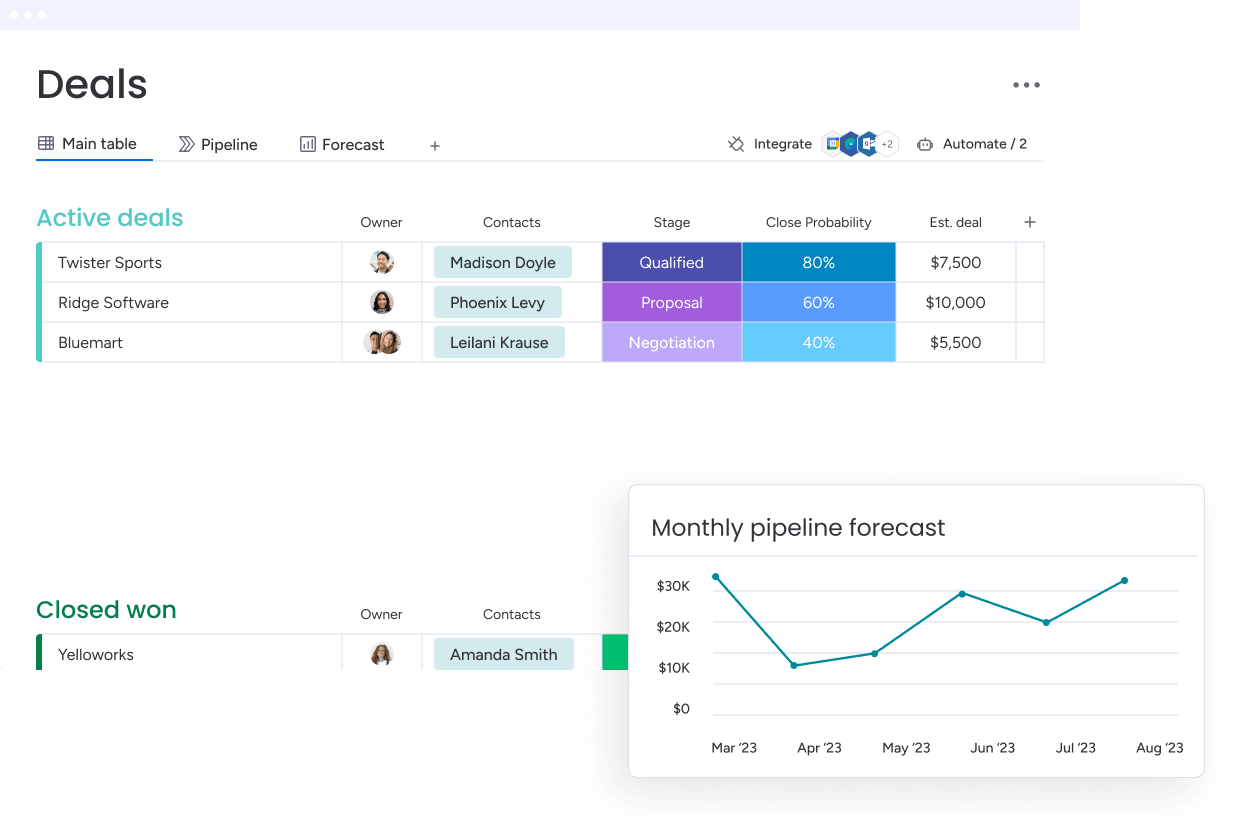
Many sales teams assume behavior analysis requires advanced data science resources. Effective tracking can begin with platforms already in use. Starting simple is better than waiting for complex systems.
Track CRM activities automatically
CRM systems log behaviors that reveal engagement and deal health. Configuring your CRM to consistently capture this data ensures visibility for sales teams.
- Email engagement: opens, clicks, and replies logged automatically with email integration.
- Meeting participation: attendance, no-shows, and reschedules reveal commitment.
- Opportunity progression: time spent in pipeline stages highlights bottlenecks.
- Contact expansion: new stakeholders added to opportunities signal organizational involvement.
Modern platforms like monday CRM centralize these signals in a single timeline, simplifying pattern recognition.
Monitor email engagement metrics
Advanced email platforms provide insights beyond open rates. Tracking patterns shows which content resonates.
- Open frequency: repeated opens indicate serious consideration.
- Click behavior: link order shows information priorities.
- Forwarding activity: sharing emails internally signals growing buy-in.
- Read time: duration with content indicates engagement depth.
For example, prospects opening proposals six times and clicking pricing links three times without replying are likely building business cases and need additional ROI support.
Capture website interaction data
Analytics reveal who is researching solutions, the content they explore, and evolving interest. Key behaviors include:
- Page visits: product pages, case studies, and resources reveal priorities.
- Visit frequency: repeated visits show sustained interest.
- Content depth: multiple pages indicate research intensity.
- Conversion actions: demo requests or form submissions signal active evaluation.
Record sales call insights
Conversations contain rich behavioral data. Documenting questions, objections, stakeholder mentions, and urgency signals provides actionable intelligence.
- Question types: technical, pricing, or process inquiries indicate decision stage.
- Stakeholder mentions: reveal organizational dynamics.
- Timeline indicators: deadlines or budget cycles signal urgency.
- Objection patterns: recurring concerns highlight areas needing attention.
Platforms like monday CRM log all interactions in one timeline, creating a complete behavioral picture without multiple systems.
5 steps to implement customer behavior analysis
This framework helps sales teams understand customer behavior without relying on data scientists or complex technical resources. Each step builds on the previous one and can be implemented in thirty to sixty days, enabling mid-market sales leaders to achieve predictable results.
Step 1: set sales-specific KPIs
Effective behavior analysis begins with identifying behaviors that correlate with closed deals in your sales environment. Generic metrics often provide little actionable insight.
Review the last twenty to thirty closed-won deals to detect recurring behavioral patterns. Prioritize behaviors that consistently appear across multiple deals and define measurable criteria for each behavior.
Examples of sales-specific KPIs:
- Email engagement threshold: prospects who open proposal emails three or more times within five days.
- Stakeholder expansion: opportunities with three or more active contacts engaged.
- Content consumption: prospects who download two or more technical resources.
- Response velocity: prospects whose reply time decreases by fifty percent or more.
Step 2: create behavioral segments
Prospects do not all follow the same patterns. Segmentation enables sales teams to tailor their approach based on engagement style, decision-making speed, and information needs.
| Segment | Behavioral pattern | Sales approach |
|---|---|---|
| High-engagement researchers | Download 4-5 resources before requesting demo | Provide comprehensive information packages |
| Fast-moving decision-makers | Schedule demos after viewing homepage and pricing | Offer immediate access to decision-makers |
| Committee buyers | Involve multiple stakeholders early, move methodically | Prepare multi-stakeholder presentations |
| Price-focused evaluators | Engage heavily with pricing and ROI content | Lead with ROI documentation and case studies |
Analyze your CRM to identify three to five recurring behavioral patterns. Base segments on observable behaviors through behavioral segmentation, not assumptions.
Step 3: link behaviors to pipeline stages
Customer behavior provides insight into where prospects are in the buying journey. Mapping behaviors to pipeline stages helps sales teams evaluate opportunities objectively.
| Pipeline stage | Required behaviors to enter | Typical behaviors in this stage |
|---|---|---|
| Evaluation | 2+ stakeholders engaged, technical documentation downloaded | Multiple pricing page visits, competitor research, demo requests |
| Proposal | Demo completed, budget confirmed, decision timeline established | Proposal opens 3+ times, stakeholder expansion, technical questions |
| Negotiation | Proposal reviewed by all stakeholders, verbal agreement on fit | Pricing discussions, contract questions, legal review requests |
This mapping establishes objective deal qualification criteria and enhances forecast accuracy by advancing opportunities only when behavioral evidence supports progression.
Step 4: build lead scoring models
Lead scoring assigns numerical values to specific behaviors, offering an objective measure of purchase intent and helping prioritize warm leads.
| Behavior category | Point value | Examples |
|---|---|---|
| High-value behaviors | 15-25 points | Multiple stakeholder engagement, technical documentation downloads, pricing inquiries |
| Medium-value behaviors | 5-10 points | Content downloads, multiple email opens, website return visits |
| Low-value behaviors | 1-3 points | Single email opens, initial website visits, social media engagement |
Leads scoring seventy-five or more points trigger immediate sales outreach. Leads scoring twenty-five to seventy-four points receive automated nurture sequences. Leads below twenty-five points remain in marketing programs.
Step 5: automate follow-up actions
Behavioral insights can drive automated sales actions. Predefined workflows respond to specific behaviors, ensuring timely follow-up without requiring constant monitoring.
Automation opportunities include:
- Behavior-triggered emails: when prospects download specific content, send related resources automatically.
- Alert notifications: when high-value behaviors occur, notify account owners immediately.
- Task creation: when prospects exhibit buying signals, create follow-up tasks with guidance.
- Pipeline updates: when behavioral criteria are met, advance opportunities automatically or prompt review.
Revenue teams using monday CRM can automate actions based on custom conditions, ensuring no behavioral signals are missed and enabling sales teams to respond at the optimal moment.
Try monday CRM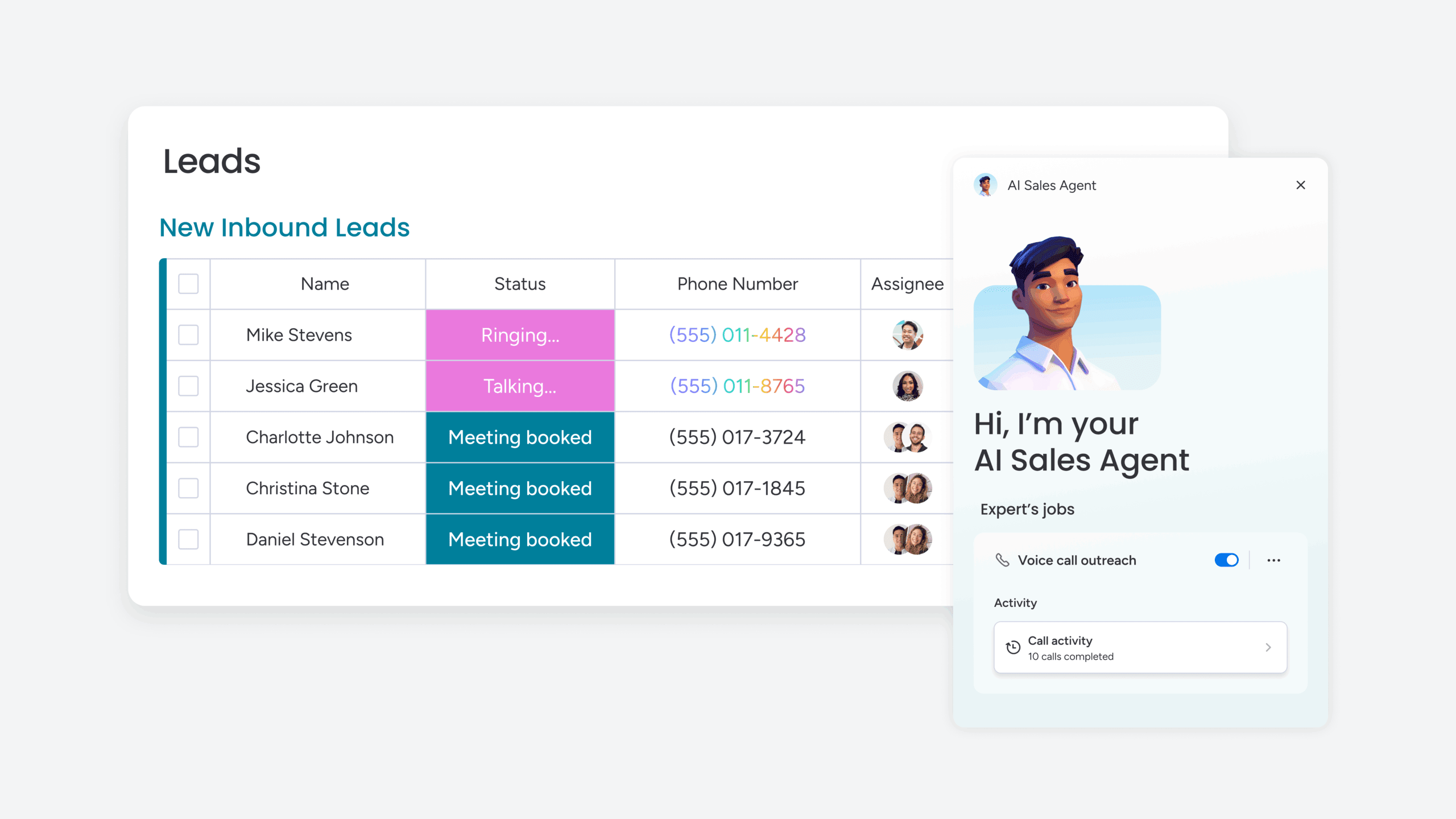
Use AI for analyzing customer behavior automation
AI amplifies customer behavior analysis by identifying patterns humans may miss, processing data at scale, and providing real-time insights. It accelerates the framework, making insights faster, more accurate, and actionable.
AI-powered deal predictions
AI examines historical behavioral patterns across hundreds or thousands of past deals to predict which opportunities are most likely to close. This goes beyond simple lead scoring by recognizing complex behavior combinations tied to outcomes.
How AI deal prediction works:
- analyzes all tracked behaviors across your deal history.
- identifies behavior combinations associated with closed-won versus closed-lost deals.
- applies these patterns to current opportunities to calculate close probability.
- updates predictions in real-time as new behavioral data emerges.
AI might discover that deals with 4+ stakeholders engaged, 2+ pricing page visits, and response times under 12 hours have exceptionally high close probability. However, 71% of merchants say AI merchandising tools have had limited to no effect so far, validating the importance of first centralizing behavior data and automating actions before AI can translate signals into revenue. This pattern recognition helps sales leaders allocate resources to the highest-probability opportunities.
Automatic sentiment detection
AI evaluates the tone of prospect communications to identify enthusiasm, concern, or hesitation that might not be explicitly stated. This provides emotional insights alongside behavioral signals.
Sentiment detection highlights:
- Enthusiasm indicators: language expressing urgency, strong interest, or excitement.
- Concern signals: questions about risk, implementation challenges, or competitors.
- Hesitation patterns: vague language, delayed responses, or requests for additional time.
- Stakeholder alignment: whether contacts express consistent or conflicting sentiment.
Teams using AI with monday CRM detect sentiment in communications, alerting sales reps to potential obstacles and prompting proactive engagement before deals stall.
Real-time pattern recognition
AI continuously monitors customer behavior, identifying patterns as they emerge. Insights are delivered in real-time, allowing sales teams to act when prospects are most engaged.
Real-time pattern recognition detects:
- Sudden engagement increases: prospects suddenly view multiple pages after a period of inactivity.
- Behavioral sequences: content download followed by pricing visit and stakeholder expansion.
- Anomalies: prospects who normally respond in twenty-four hours now take five days.
- Cross-channel patterns: website visit followed by email open and LinkedIn profile view.
Instant behavior change alerts
AI tracks baseline behavior for each prospect and alerts sales teams when deviations occur. These changes often indicate important buying developments.
| Change type | What it looks like | What it signals |
|---|---|---|
| Engagement spikes | Prospect suddenly increases activity after weeks of minimal interaction | Internal priority shift, budget approval, or competitive pressure |
| Engagement drops | Previously active prospect stops responding or engaging | Potential concerns, competing priorities, or lost champion |
| Stakeholder changes | New contacts appear or key contacts disengage | Organizational dynamics shifting |
| Velocity shifts | Deal progression speeds up or slows down significantly | Timeline changes, internal obstacles, or accelerated need |
The AI timeline summary in monday CRM condenses communication events, helping sales and support teams assess deal health efficiently and detect behavioral shifts early.
Advanced customer behavior analytics for revenue teams
These techniques represent the next level of sophistication for teams that have mastered basic behavior analysis. For CROs and VPs of Sales seeking predictability and strategic insights, advanced analytics guide resource allocation and revenue planning with greater precision.
Deal velocity analysis by segment
Deal velocity analysis measures how quickly opportunities move through your pipeline. Segmenting this analysis by customer type, deal size, or industry reveals which segments close fastest and where bottlenecks occur.
| Segment | Avg. days in evaluation | Avg. stakeholders | Key insight |
|---|---|---|---|
| Enterprise (>$100K) | 45 days | 5+ stakeholders | Stakeholder coordination drives velocity |
| Mid-market (<$50K) | 18 days | 2-3 stakeholders | Faster decisions with fewer approvals |
| Technology industry | 22 days | 3-4 stakeholders | Technical evaluation is thorough but efficient |
| Financial services | 38 days | 4-5 stakeholders | Compliance review adds time |
Velocity analysis improves forecast accuracy by providing segment-specific close timelines and identifying where process enhancements can accelerate revenue.
Multi-channel attribution tracking
Prospects engage with sales teams across multiple channels. Attribution tracking reveals which combinations of channels drive deal progression most effectively.
Multi-channel attribution provides insights into:
- Effective sequences: which touchpoint combinations correlate with closed deals.
- Channel preferences: which channels prospects prefer at different buying stages.
- Touchpoint requirements: how many touchpoints are typically required before deals advance.
- Channel ROI: which channel investments deliver the highest return.
Analysis may show that deals combining live demos with follow-up technical documentation close at twice the rate of deals with demos alone. This insight enables sales teams to proactively offer technical resources after every demo.
Account-level journey mapping
Account-level journey mapping visualizes the complete behavioral path from first contact to closed deal for each opportunity. This is especially valuable for complex B2B sales with long cycles and multiple stakeholders.
Journey mapping captures:
- Chronological sequence: all touchpoints and behaviors.
- Stakeholder engagement: which stakeholders participate at each stage.
- Content interaction: materials consumed and questions asked throughout the journey.
- Timeline: the duration from first contact to close.
Recognizing successful patterns allows sales teams to identify opportunities following similar paths and intervene when current deals deviate from proven sequences.
Early warning churn signals
Behavior analysis extends beyond new deals to identify at-risk customers showing early signs of churn. Detecting these signals enables proactive retention efforts.
| Signal | What it looks like | Risk level |
|---|---|---|
| Decreased product usage | Logging in less frequently, using fewer features | Medium |
| Reduced communication | Longer response times, less engagement with account management | Medium-High |
| Support ticket patterns | Increased complaints, unresolved issues | High |
| Stakeholder changes | Champion leaves, primary contact changes roles | High |
Churn prediction based on behavioral signals is more actionable than waiting for explicit cancellation requests.
Transform customer behavior insights into revenue with monday CRM
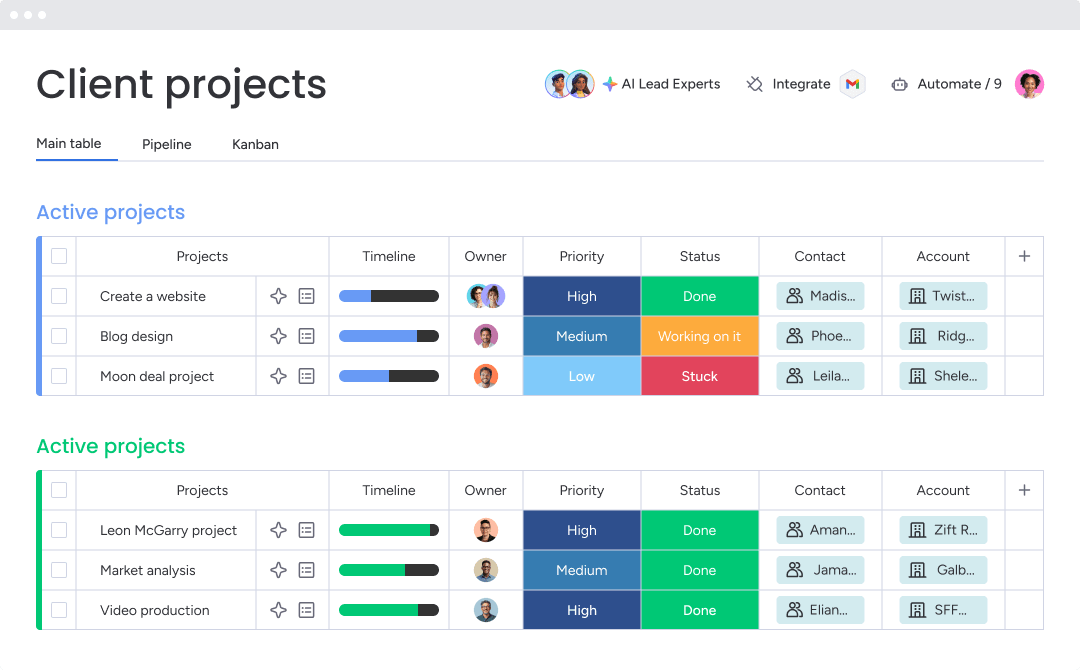
Behavior analysis can be implemented with various approaches, but centralized platforms simplify execution. monday CRM consolidates behavioral data, automates insights, and enables revenue teams to act on intelligence without technical complexity.
Unify all behavioral data in one platform
monday CRM brings all customer behavior data together, eliminating the need to manually compile information from multiple sources. Email engagement, website visits, CRM activities, call insights, and stakeholder interactions are visible in a single view.
How monday CRM captures behavioral data:
- Automatic email tracking: opens, clicks, and replies logged natively without additional setup.
- Activity logging: all customer interactions captured in one timeline.
- Stakeholder mapping: all contacts involved in each opportunity visible at a glance.
This unified view allows sales teams to see all behavioral signals for each opportunity without toggling between systems.
Behavioral workflow automation
monday CRM transforms behavioral insights into automated sales actions. When specific behaviors occur, predefined workflows trigger, ensuring timely follow-up without manual monitoring.
Automation capabilities include:
- Behavior-triggered sequences: when prospects download specific content, related resources send automatically.
- Real-time alerts: account owners receive immediate notifications when high-value behaviors occur.
- Automatic task creation: follow-up tasks appear with specific guidance when prospects exhibit buying signals.
- Pipeline automation: opportunities advance or prompt review when behavioral criteria are met.
Real-time analytics and dashboards
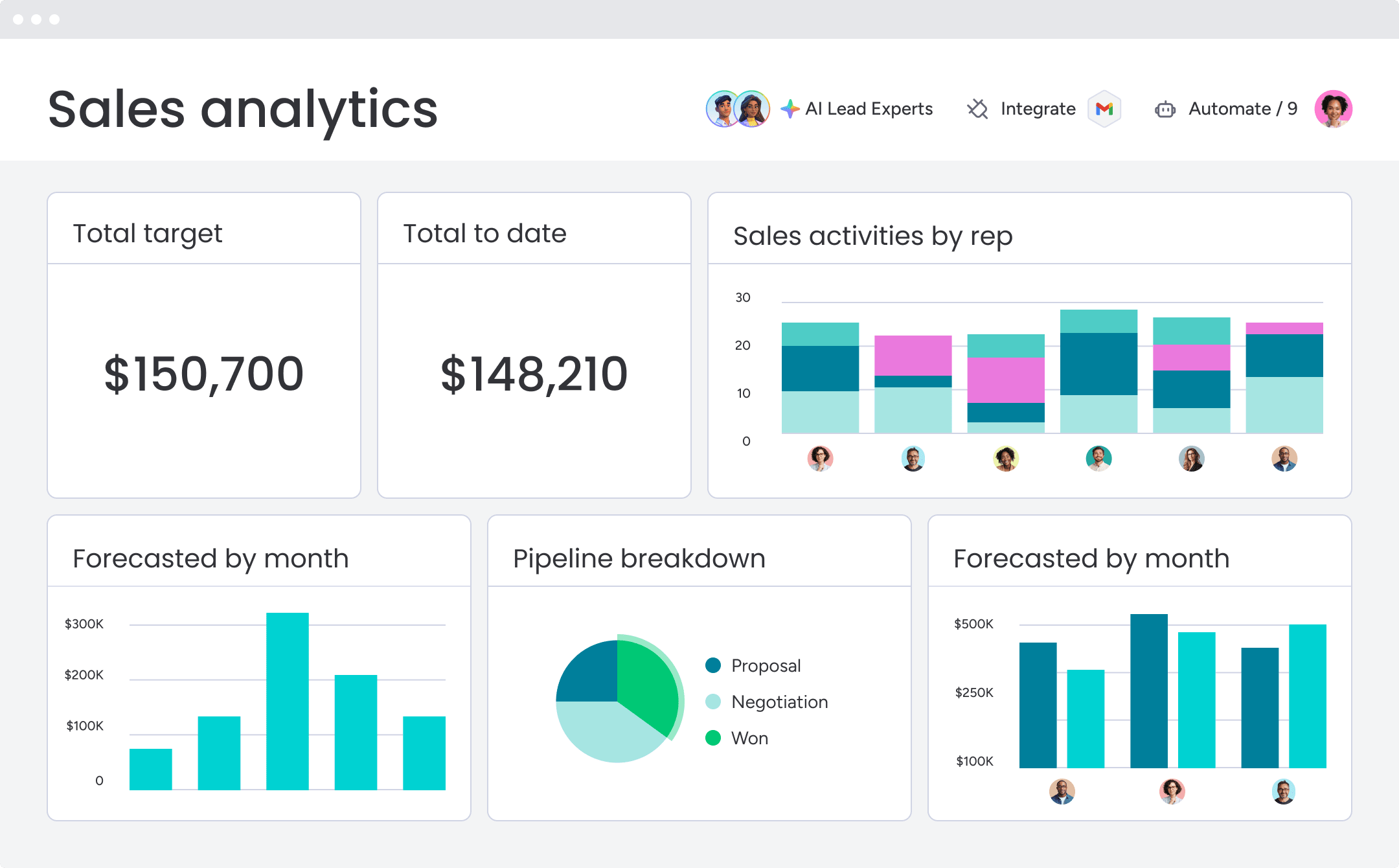
monday CRM provides real-time visibility into behavioral patterns across the pipeline. Dashboards surface insights without manual analysis.
| Dashboard element | What it shows | Who benefits |
|---|---|---|
| Deal health scores | AI-calculated probability based on behavioral patterns | Sales reps prioritizing outreach |
| Engagement trends | How prospect activity changes over time | Managers coaching reps |
| Pipeline velocity | How quickly deals move through stages by segment | Leaders forecasting revenue |
| At-risk alerts | Opportunities showing declining engagement | Teams preventing deal slippage |
Cross-team intelligence sharing
Behavioral intelligence travels with the opportunity, enabling seamless collaboration between sales, account management, legal, and finance teams.
Cross-team capabilities:
- Handoff documentation: complete behavioral history transfers with opportunities.
- Stakeholder visibility: all teams see which contacts are engaged and their communication history.
- Collaboration workflows: legal and finance receive automated notifications when deals reach relevant stages.
- Unified communication tracking: all customer interactions visible regardless of team member engagement.
monday CRM vs traditional approaches
| Dashboard element | What it shows | Who benefits |
|---|---|---|
| Deal health scores | AI-calculated probability based on behavioral patterns | Sales reps prioritizing outreach |
| Engagement trends | How prospect activity changes over time | Managers coaching reps |
| Pipeline velocity | How quickly deals move through stages by segment | Leaders forecasting revenue |
| At-risk alerts | Opportunities showing declining engagement | Teams preventing deal slippage |
Revenue teams gain predictable outcomes by transforming scattered behavioral signals into coordinated sales actions, without the complexity of traditional approaches.

“With monday CRM, we’re finally able to adapt the platform to our needs — not the other way around. It gives us the flexibility to work smarter, cut costs, save time, and scale with confidence.”
Samuel Lobao | Contract Administrator & Special Projects, Strategix
“Now we have a lot less data, but it’s quality data. That change allows us to use AI confidently, without second-guessing the outputs.”
Elizabeth Gerbel | CEO
“Without monday CRM, we’d be chasing updates and fixing errors. Now we’re focused on growing the program — not just keeping up with it."
Quentin Williams | Head of Dropship, Freedom Furniture
“There’s probably about a 70% increase in efficiency in regards to the admin tasks that were removed and automated, which is a huge win for us.“
Kyle Dorman | Department Manager - Operations, Ray White
"monday CRM helps us make sure the right people have immediate visibility into the information they need so we're not wasting time."
Luca Pope | Global Client Solutions Manager at Black Mountain
“In a couple of weeks, all of the team members were using monday CRM fully. The automations and the many integrations, make monday CRM the best CRM in the market right now.”
Nuno Godinho | CIO at Velv
“monday.com provides developmental flexibility, operational efficiency, and data transparency — all in one place. We became a company that moved from chasing data to leading with it.”
Hyunghan Lee | Team Lead, Sandbox Network
"monday.com brought every part of our business into one connected space. The harmony between work management and CRM has become our operating system — giving us the clarity and confidence to scale.”
Jennifer Chinburg | Executive Vice President of Corporate Development & Brand, Chinburg Properties
“We just weren’t getting value from our old CRM. With monday.com, it's a thousand times better. Our sales teams are more informed, more consistent, and far more connected."
James Arnold | Chief Operating Officer, CenversaTurn behavioral insights into predictable revenue growth
Customer behavior analysis shifts sales from reactive follow-ups to proactive engagement based on real buying signals. Tracking the right behaviors, segmenting prospects effectively, and automating responses allows teams to act with precision and drive consistent revenue growth.
Successful revenue teams combine behavioral intelligence with the right platform to act immediately. They do not wait for explicit interest — they detect hidden buying signals and respond with the right information at the optimal moment.
Teams using monday CRM centralize behavioral data, automate responses to buying signals, and gain real-time visibility into deal health across the pipeline. This approach removes guesswork and establishes a predictable sales process that CROs and VPs of Sales rely on for confident forecasting and resource allocation.
Try monday CRMFrequently asked questions
What is customer behavior analysis and why is it important for sales teams?
Customer behavior analysis systematically tracks and interprets how prospects interact with the sales team throughout the buying journey. It transforms scattered signals into actionable intelligence, enabling accurate forecasting, resource allocation, and timely follow-up based on data rather than guesswork.
How can AI and automation improve the accuracy and speed of customer behavior analysis?
AI and automation identify patterns across thousands of deals, process behavioral data in real-time, and trigger immediate follow-up actions. This allows sales teams to respond to buying signals instantly instead of waiting for manual analysis.
Which types of customer data should be tracked to understand buying decisions?
Teams should track email engagement, content downloads and revisits, stakeholder expansion, response times, technical documentation reviews, competitor research activity, and pricing page visits. These signals collectively reveal purchase intent and help predict which deals are most likely to close.
What are real-world examples of using AI in a CRM to analyze customer behavior?
AI can detect sentiment shifts in prospect emails, summarize months of communication history, predict deal close probability based on behavioral patterns, and alert sales reps when engagement changes. These capabilities help prioritize efforts and intervene at critical moments.
How can you operationalize customer behavior insights to close more deals?
Insights can be operationalized by mapping behaviors to pipeline stages, building lead scoring models, automating follow-up actions, and using real-time dashboards to identify at-risk deals before they stall. This ensures insights translate into revenue-generating actions.
What is the difference between customer behavior analysis and consumer analytics?
Customer behavior analysis focuses on individual deal progression and real-time outcomes at the prospect level, while consumer analytics examines aggregate market trends and campaign performance at the segment level. Sales teams need granular intelligence to close opportunities effectively.