


Hiring a first sales development representative can cost startups $60,000 a year or more before a single meeting is booked. AI-powered SDR platforms promise to change that equation, but many early adopters discover that “AI outreach” often amounts to automated emails with minimal intelligence behind them.
Effective AI SDR tools go beyond simple automation. They research prospects, personalize messaging based on real-time signals, and hand off leads to human reps when conversations require nuanced judgment. The difference between platforms that generate meaningful pipeline and those that risk damaging sender reputation often comes down to specific capabilities, CRM integration, and the speed at which a startup can see results.
This guide compares six AI SDR platforms for 2026, highlighting setup time, true costs, CRM integration complexity, and the features that actually convert cold outreach into conversations. It also outlines a practical 30-day roadmap for implementing AI-assisted sales at a startup.
Key takeaways
- AI SDR platforms reduce costs compared to hiring human SDRs: startups can scale outreach without the $50,000-$80,000 annual salary of a first sales rep.
- Integration quality is critical for efficiency: platforms with native CRM integration, like monday CRM, minimize data sync issues and speed up implementation.
- Multi-channel outreach drives better engagement: successful AI SDRs combine email, phone, and LinkedIn to reach prospects where they are most responsive.
- Lead scoring and personalization are essential for pipeline quality: AI that analyzes behavior and real-time signals ensures teams focus on qualified opportunities.
- Implementation time varies widely: native CRM solutions can be operational in three to seven days, while standalone tools may take four to eight weeks to deliver measurable results.
What an AI SDR platform actually does for your team
Scaling sales often feels like a trap. Teams must either hire more SDRs they cannot afford or overload current reps with repetitive work. AI SDR platforms promise a solution, but many operate only as email bots.
A platform that truly drives revenue creates opportunities instead of just automating tasks. Here’s what that looks like:
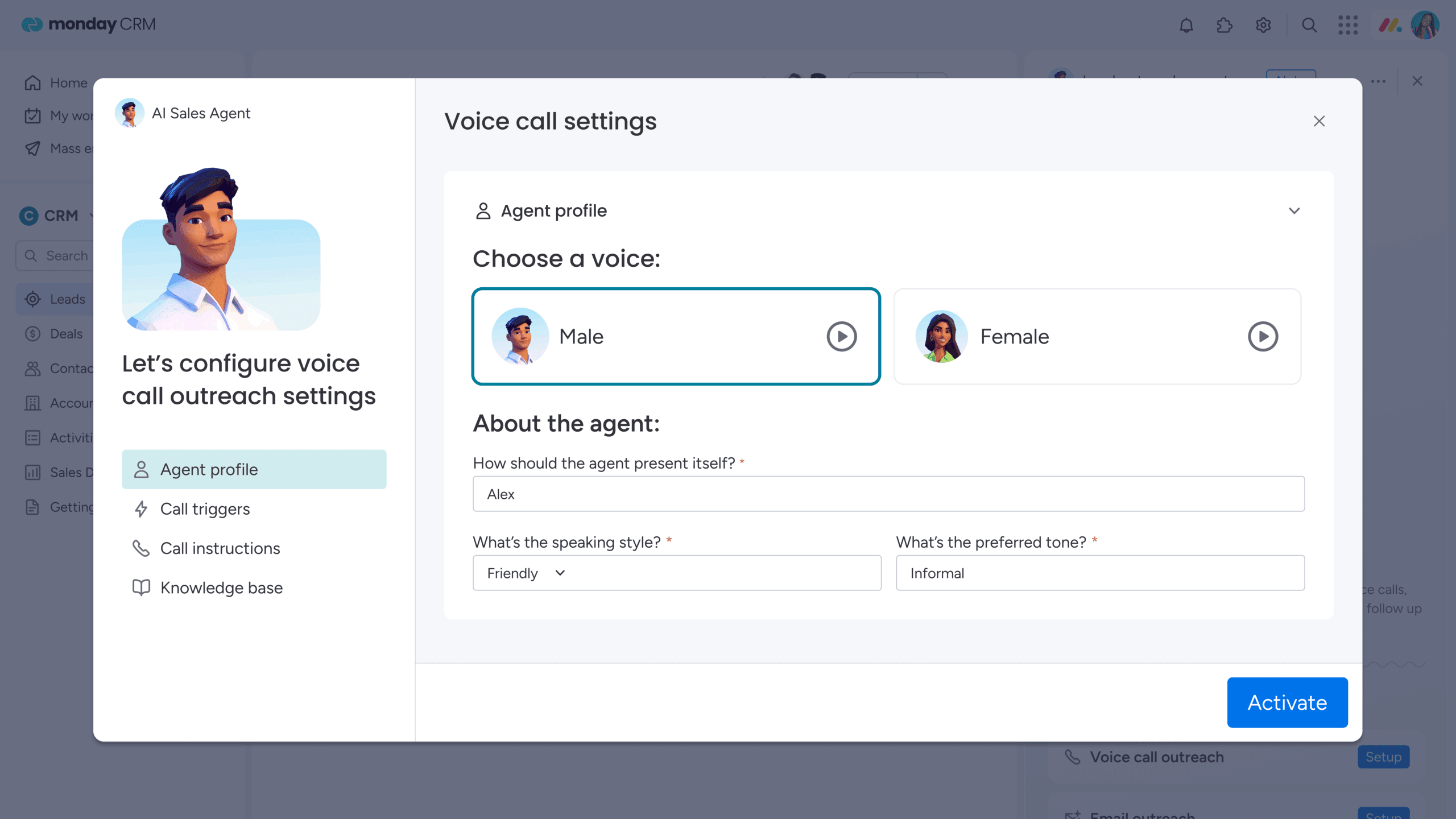
- Goes beyond email: it runs intelligent campaigns across email, LinkedIn, and phone calls. The system adapts in real time, adjusting messages based on how prospects engage.
- Personalizes without faking it: real personalization is more than inserting a first name. It leverages timely data, such as company news or a recent job change, to craft relevant outreach that encourages a reply.
- Keeps you out of the spam folder: it safeguards sender reputation with intelligent sending protocols that mimic human behavior. Messages reach inboxes instead of spam folders.
Revenue teams use monday CRM to unify these capabilities in a single workflow. Native AI assists with composing high-quality emails, scoring leads automatically, and summarizing interactions instantly. All of this happens within the same platform used to manage deals, creating a connected, end-to-end workflow.
6 AI SDR platforms startups should know about
Many AI SDR platforms fall into two frustrating categories: costly or requiring weeks of setup. Startups often lack the time or budget for either. What matters is AI that works immediately.
This list compares six popular AI SDR platforms on speed to value, setup effort, and actual cost.
| Platform | Best for | Key AI features | Starting price | CRM integration complexity |
|---|---|---|---|---|
| monday CRM | Teams wanting CRM-native AI without integration headaches | Email composition, lead scoring, timeline summarization, custom AI actions | $12/seat/month | Simple (native) |
| Drift | Conversational marketing with chat-first approach | Chatbot qualification, meeting scheduling, intent detection | $2,500/month | Moderate |
| Conversica | Autonomous two-way email conversations | Natural language processing, multi-touch follow-up, lead nurturing | $3,000/month | Moderate |
| Salesforce Einstein | Enterprise-scale AI across full sales cycle | Predictive scoring, opportunity insights, activity capture | $50/seat/month (add-on) | Complex |
| Zia by Zoho CRM | Budget-conscious teams in Zoho ecosystem | Sales predictions, anomaly detection, workflow suggestions | $20/seat/month | Simple (native) |
| Bounti.ai | Commission-based model for early-stage startups | Pay-per-meeting, multi-channel outreach, prospect research | $0 base + $100/meeting | Moderate |
Price varies widely — from pay-per-meeting structures to enterprise plans costing more than a first hire. The real cost often comes from complexity. Platforms with native CRM integration allow teams to get started quickly, reducing time spent toggling between tabs or troubleshooting data syncs.
1. monday CRM
monday CRM combines lead management, outreach, and pipeline tracking in a single environment with AI built into workflows reps already use. Instead of switching tabs to write emails, summarize account history, or enter data manually, teams can use AI directly within Emails & Activities and on their boards.

Use case:
Startups use monday CRM to capture inbound leads, qualify them quickly, and maintain organized outreach as volume grows. Leads from website forms or social campaigns can be auto-enriched using Crunchbase data, assigned to owners, and engaged with tracked emails.
Key features:
When building an SDR motion quickly, these capabilities matter most: less manual work, consistent outreach, and seamless handoffs. monday CRM does this with AI embedded where reps work, plus customizable workflows that adapt to your sales cycle.
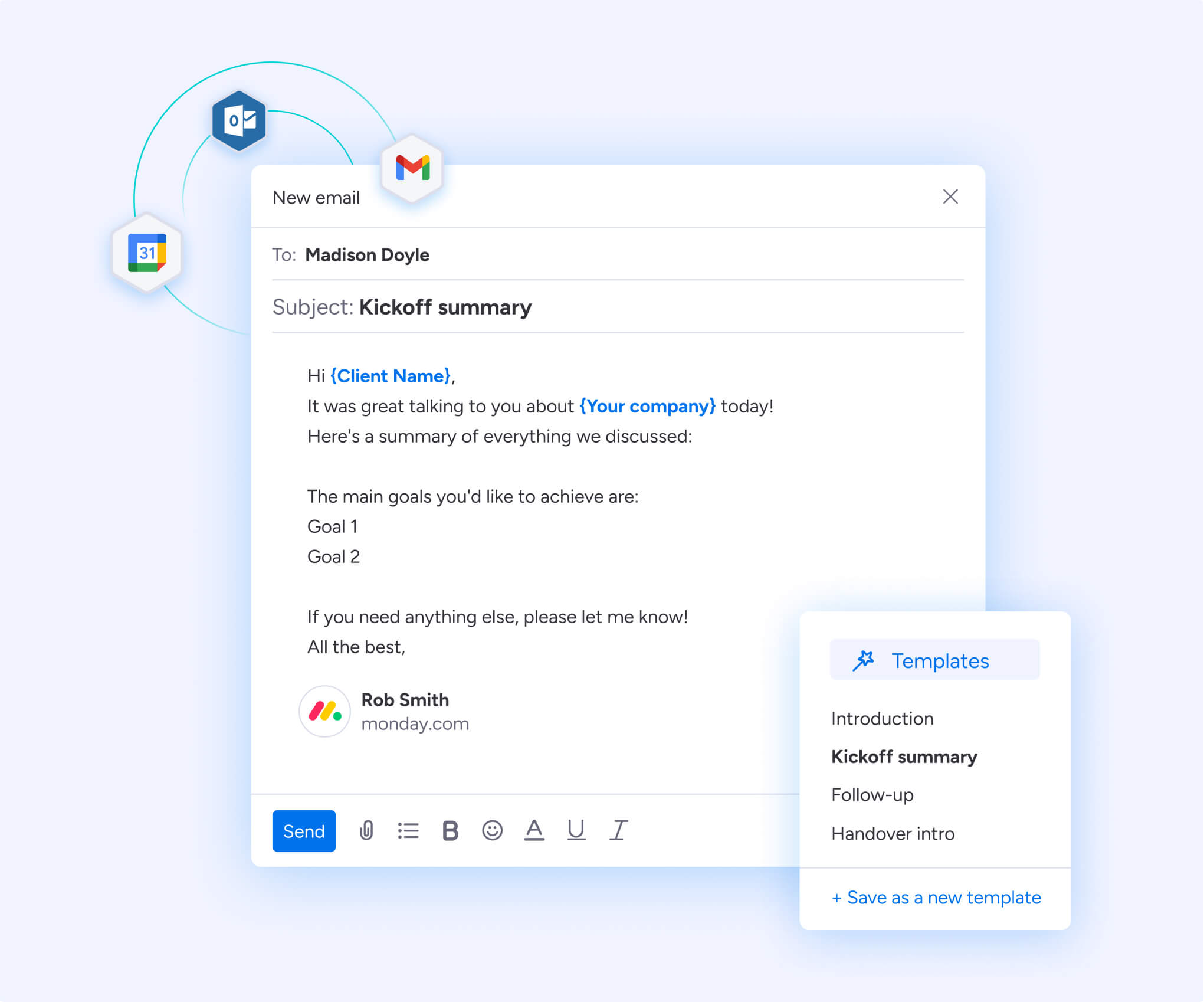
- Emails & Activities: AI email assistant: helps reps compose emails directly inside Emails & Activities, so outreach stays tied to the right lead, contact, or deal.
- Emails & Activities: timeline summary with AI: creates a short summary of all communication events (emails, calls, meetings, notes), so reps have context for the next conversation.
- Lead management and outreach tracking: collect and qualify leads. Send individual and mass emails using personalized fields and templates. Track engagement like open rates and link clicks.
Pricing:
- Basic: $12/seat/month (billed annually) – core CRM with limited AI features
- Standard: $17/seat/month (billed annually) – adds AI email composition and timeline summarization
- Pro: $28/seat/month (billed annually) – unlocks custom AI actions and advanced automation
- Ultimate: contact sales – full AI capabilities with enterprise features and dedicated support
Annual billing provides an 18% discount. Additional AI usage is approximately $0.01 per credit.
Advanced AI Features:
This is where monday CRM becomes practical for SDR teams — it converts unstructured information, like emails, notes, and files, into structured data your pipeline can use.
- Custom AI actions: give AI instructions and reference any column on your board as input. AI writes results into the column you choose based on your rules.
- Sentiment detection: categorizes text as positive, negative, or neutral, helping your team identify tone shifts in messages and prioritize follow-ups.
- Extract information: pulls key details from files such as invoices, resumes, or contracts, as well as text, images, and documents in the Files Column, then writes results into board columns.
Automations:
Consistency becomes critical as SDR workflows gain momentum. monday CRM automates actions based on defined conditions, freeing reps from repetitive tasks.
- Automate actions based on custom conditions: set follow-ups, stage changes, and internal notifications according to pipeline workflow.
- Conditional label change: keeps deal stages and statuses synchronized with actual progress, without manual updates.
- Team routing with AI actions: the Assign person AI action on a People Column suggests an owner based on a text source, including emails and activities, along with teammate roles and skills.
Integrations:
Startups often begin with simple systems and expand as they scale. monday CRM supports growth with native CRM workflows and optional enrichment tools.
- Crunchbase enrichment: automatically enhances lead data using Crunchbase information, providing stronger context for reps.
- Centralized customer information: keeps accounts, contacts, deals, and activity history connected to preserve context during handoffs.
- Part of the broader monday product suite: enables teams to manage processes beyond sales within a single platform.
Best AI SDR for startups features:
Selecting an AI SDR setup requires ensuring maintainability as volume increases. monday CRM keeps outreach, pipeline updates, and context unified, ensuring reliability under high demand.
- Fast prospect context before outreach: AI Timeline Summary converts the full Emails & Activities history into a concise brief for reps.
- AI-assisted qualification at scale: autofills columns with AI actions such as Assign label, Summarize, and Extract information to turn unstructured notes and files into structured fields.
- Sales analytics that teams actually use: code-free dashboards and widgets like the Sales funnel widget, Sales pipeline widget, and Leaderboard widget track pipeline movement and rep activity.
Why it stands out:
Startups benefit from a CRM that keeps pace and provides leadership visibility without separate reporting projects.
- AI where reps work: compose emails in Emails & Activities, summarize full activity timelines, and autofill columns using AI actions on boards.
- Flexible CRM: pipelines can be customized with drag-and-drop deal stages, and automation can follow defined process rules.
- Visibility and control for leaders: real-time dashboards and sales-specific widgets provide insights into pipeline health and team performance.
2. Drift
Drift transforms website visitors into qualified conversations using AI-powered chatbots that engage prospects in real time. The platform focuses on conversational marketing for B2B companies, automatically qualifying leads and routing high-intent buyers directly to sales representatives. Now part of Salesloft’s revenue orchestration ecosystem, Drift connects web engagement signals directly to seller workflows.
Use case:
B2B companies with high website traffic that want to convert anonymous visitors into qualified pipeline without relying on traditional lead forms.
Key features:
- Real-time visitor identification: deanonymizes website visitors using reverse IP lookup and firmographic data to personalize chat experiences at the account level.
- AI-powered qualification: bionic chatbots conduct natural conversations, ask contextual questions based on visitor behavior, and automatically qualify prospects using brand-trained knowledge.
- Instant meeting scheduling: fastlane technology routes qualified buyers directly to available sales representatives, checking calendar availability and sending confirmations without manual intervention.
Pricing:
- Premium: starting at $2,500/month.
- Custom pricing: exact pricing requires a quote through Salesloft’s sales team.
- Additional costs: enterprise features such as SSO/SCIM and advanced integrations may incur extra charges.
Considerations:
- Premium pricing: accessible primarily for established startups with significant inbound traffic and conversion infrastructure.
- Implementation complexity: technical setup is required to customize chatbot logic, integrate with existing CRM systems, and maintain ongoing tuning to avoid low-value conversations.
3. Conversica
Conversica deploys autonomous AI assistants capable of sustaining two-way email conversations with leads over extended periods. The platform excels at persistent, human-like follow-up sequences that maintain context across multiple exchanges, making it ideal for organizations managing complex sales cycles without overloading their sales teams.

Use case:
Mid-market companies with long sales cycles that need consistent lead engagement without consuming valuable sales team bandwidth.
Key features:
- Multi-channel conversation flows: span email, SMS, and chat with seamless handoffs between channels.
- AnswersIQ system: uses retrieval-augmented generation with fact management to deliver brand-safe, contextually accurate responses.
- Native integrations: works with major CRMs and marketing automation platforms, including Salesforce Marketing Cloud, HubSpot, and Marketo.
Pricing:
- Custom pricing: quote-based pricing starting around $3,000/month, depending on assistant types, channels, volume, and integrations.
- Average discount: approximately ten percent available according to G2 user reports.
- Additional costs: optional onboarding packages, chat setup with LLM training, and premium support services.
- ROI timeline: users report typical return on investment within nine months.
Considerations:
- High price point: better suited for mid-market and enterprise organizations rather than early-stage startups.
- Language support: website chat is currently limited to English, though email and SMS support multiple languages.
4. Salesforce Einstein
Salesforce Einstein embeds AI capabilities across the Salesforce ecosystem, offering predictive lead scoring, opportunity insights, and automated activity capture. The platform analyzes historical deal data to surface patterns predicting win probability and recommends next best actions for opportunities. It is designed for enterprise-focused startups that already use Salesforce and have resources to configure complex AI features.

Use case:
Enterprise-focused startups with existing Salesforce infrastructure that need comprehensive AI capabilities across their sales operations.
Key features:
- Einstein SDR Agent: autonomously engages inbound leads, answers questions using company knowledge, and routes qualified prospects with built-in guardrails.
- Predictive lead scoring and opportunity insights: analyze historical deal patterns to identify win probability and recommend next best actions.
- Conversation intelligence: provides call transcription, sentiment analysis, and trending sales signals across deals and competitors.
Pricing:
- Free Suite: $0/user/month.
- Starter Suite: $25/user/month, billed annually.
- Pro Suite: $100/user/month, billed annually.
- Enterprise: $175/user/month, billed annually.
- Unlimited: $350/user/month, adds predictive AI, sales engagement, full sandbox, and premier success plan.
- Agentforce 1 Sales: $550/user/month, full AI suite including Spiff, sales planning, maps, Tableau Next, and Slack Enterprise+.
- Agentforce add-on: starting at $125/user/month.
- Sales engagement: starting at $50/user/month.
- Einstein conversation insights: $50/user/month.
- Slack Sales Elevate: $60/user/month, requires Slack Business+ and Sales Cloud.
Considerations:
- Integration complexity: extensive customization is required to configure Einstein features for specific business processes.
- Cost: total expense can exceed $150/seat/month when combining base Salesforce licenses with AI add-ons, making it challenging for budget-conscious startups.
5. Zia by Zoho CRM
Zia transforms Zoho CRM into an AI-powered sales command center, predicting deal outcomes and automating prospect engagement. The platform provides conversational AI, predictive analytics, and autonomous sales agents within a privacy-first ecosystem — ideal for cost-conscious startups already using the Zoho suite.

Use case:
Startups using Zoho business applications who want embedded AI capabilities without switching platforms or managing multiple vendor relationships.
Key features:
- Conversational AI assistant: ask Zia handles data retrieval, task creation, and CRM navigation through chat or voice commands.
- Predictive deal scoring: analyzes historical data to forecast win probability and identify the best times to contact prospects.
- Autonomous sales agents: Zia Agents execute SDR workflows, schedule follow-ups, and analyze deals with minimal human oversight.
Pricing:
- Free: up to three users.
- Standard: pricing varies by region.
- Professional: $23/user/month (billed annually).
- Enterprise: $40/user/month (billed annually) — includes core Zia AI features.
- Ultimate: $52/user/month (billed annually) — adds advanced BI and higher AI limits.
- Annual billing: saves up to 34% compared to monthly plans.
- Support: premium support available at 20% of license cost; enterprise support at 25% with minimum user requirements.
Considerations:
- Advanced AI features: require the Enterprise tier or higher, which may price out smaller teams.
- Data center restrictions: some capabilities are limited to specific regions, affecting globally distributed startups.
6. Bounti.ai
Bounti.ai changes the traditional pricing model by charging only for meetings scheduled with qualified prospects. The platform manages multi-channel outreach, prospect research, and initial qualification conversations before delivering booked meetings to your sales team.

Use case:
Early-stage startups with limited upfront capital seeking AI SDR capabilities without monthly subscription commitments.
Key features:
- Multi-channel outreach automation: performs prospect research and initial qualification.
- Performance-based pricing: pay only for qualified meetings.
- Human-in-the-loop verification: ensures meeting quality before handoff.
Pricing:
- Quote-based: Bounti.ai uses a performance-based model. Contact the team for specific pricing details.
Considerations:
- Scaling costs: total expenses can surpass traditional subscription models for teams booking many meetings.
- Integration effort: requires moderate setup to connect with CRM systems and define qualification criteria.
Must-have AI SDR features for startup success
Lean teams and tight budgets require AI SDRs that deliver measurable results quickly. Choosing the wrong solution can drain resources and stall momentum. Essential features include:
- Integration that just works: engineering time wasted on third-party connectors that fail adds up. Platforms with native AI and CRM integration, like monday CRM, ensure data flows instantly and automations are easy to configure.
- Outreach across every channel: buyers respond best to coordinated touchpoints via email, LinkedIn, and phone. A capable AI SDR automates this process and triggers the right action at the right moment.
- Lead scoring that finds real buyers: traditional job title-based scoring is unreliable. AI-powered scoring analyzes behavior — email opens, site visits, and social engagement — to identify genuine buying intent.
- Compliance built-in: automated outreach must respect opt-outs and consent to avoid GDPR or CCPA penalties, allowing aggressive growth without legal bottlenecks.
These features create the foundation for a scalable sales process. When AI handles the heavy lifting, your team can focus on closing deals.
Try monday CRM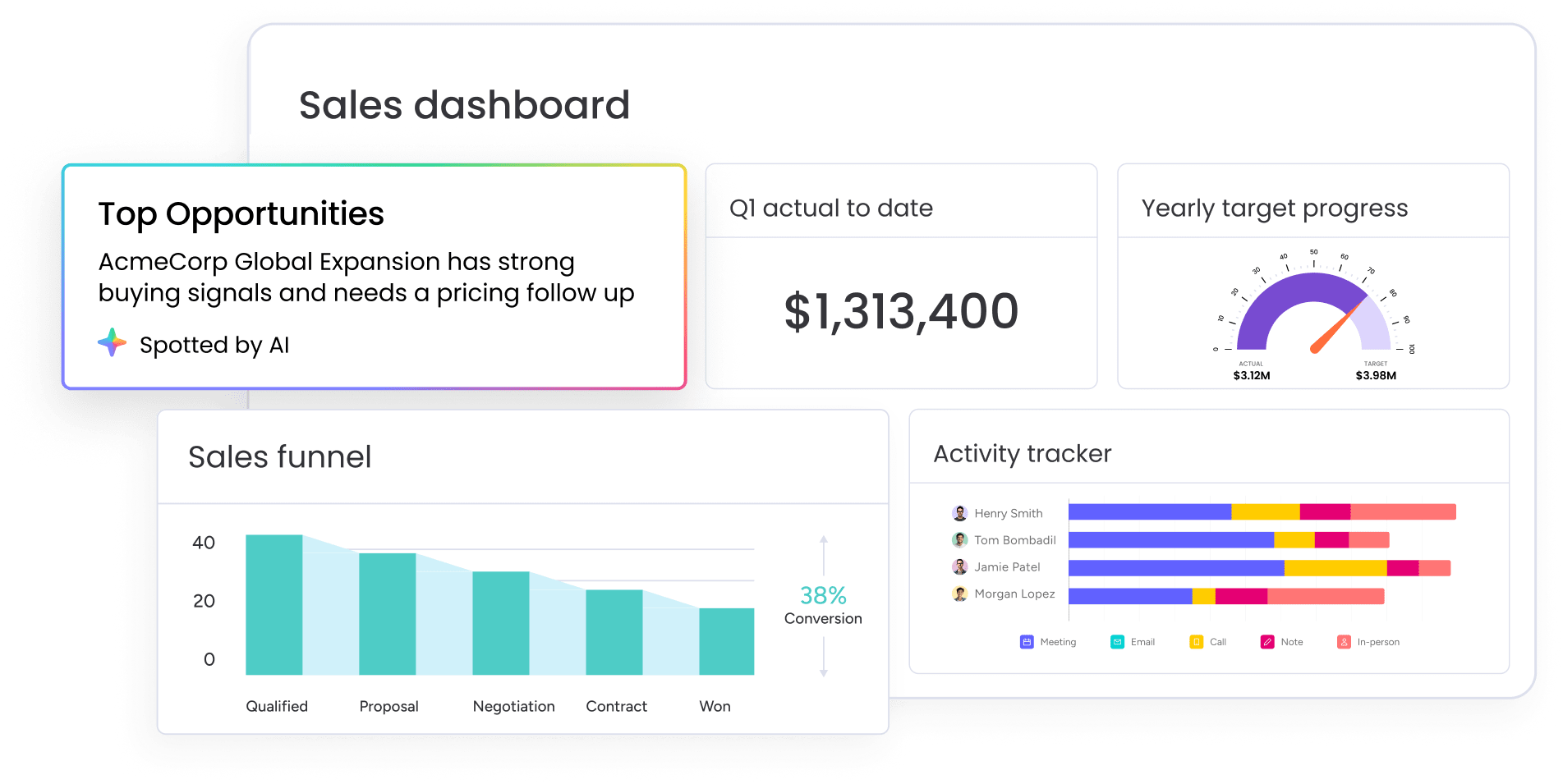
The real cost of AI SDR software for startups
Attractive monthly pricing often hides the true investment. Infrastructure, data management, and implementation can significantly increase costs. The total investment picture includes:
| Platform | Entry price | Email volume limit | Key restrictions | Hidden costs |
|---|---|---|---|---|
| monday CRM | $12/seat/month | Unlimited | Limited AI features at Basic tier | Minimal; native integration |
| Drift | $2,500/month | N/A (chat-based) | Single website domain | Custom chatbot development |
| Conversica | $3,000/month | Unlimited conversations | Minimum 3-month commitment | Integration setup, conversation design |
| Clara | $99/month | 50 meetings/month | Scheduling only, no outreach | None significant |
| Salesforce Einstein | $50/seat/month | Varies by package | Requires Salesforce licenses | Salesforce implementation, admin resources |
| Zia by Zoho | $20/seat/month | Tied to Zoho CRM limits | Requires Zoho ecosystem | Zoho CRM migration if switching |
| Bounti.ai | $0 base | Unlimited | $100 per booked meeting | High per-meeting costs at scale |
Entry-level plans open doors but rarely drive revenue. Advanced features like multi-domain support and lead qualification are usually behind premium tiers. Operational necessities to budget for include:
- Email delivery: domain setup and warming services ($50–200/month).
- Data quality: enrichment and verification tools ($600–2,300/month).
- Integrations: connectors linking software to CRM and systems ($50–500/month).
Startups with strong sales processes can achieve ROI within three to six months. A 2–5% response rate on cold outreach often yields four to fifteen qualified meetings weekly, assuming hidden costs and setup time are factored in.
Making AI SDRs work with your existing CRM
AI disconnected from a CRM creates distractions and technical debt. Third-party integrations demand ongoing maintenance and security navigation. Platforms like monday CRM, with pre-integrated AI, eliminate these headaches. Data cleaning and management are automated, delivering reliable results from day one.
Delegating email authority to AI is sensible when final approvals remain with the team. Rules and review protocols for high-value prospects maintain control while leveraging AI efficiency.
Your 30-day AI SDR implementation roadmap
Launching without a plan wastes time and money. This roadmap guides your team from setup to results in four weeks.
Step 1: set the foundation and test the tech
Define success metrics and select platforms aligned with your goals.
- Define success: identify targets for qualified meetings, response rates, and time saved.
- Start small: trial two to three platforms within your budget and import a list of 100–200 prospects.
- Run a test: create one basic outreach sequence to evaluate real-world platform performance.
Step 2: connect your systems and clean your data

Effective AI relies on clean, structured data.
- Integrate your CRM: ensure bidirectional data flow and correct field mapping.
- Clean your contact list: verify emails, merge duplicates, and standardize formatting.
- Build templates: platforms like monday CRM simplify this process with shared AI and data.
Step 3: launch, learn, and iterate
Begin your first real campaign and monitor engagement closely.
- Launch a test campaign: target 500–1,000 prospects and track deliverability and responses.
- Test everything: A/B test subject lines, copy, and calls to action to optimize messaging.
- Automate follow-ups: configure sequences based on engagement and define handoff protocols.
Step 4: optimize and train your team
Transform insights into repeatable growth while equipping your team.
- Analyze results: identify successful patterns in messages and timing.
- Refine lead scoring: adjust models according to actual conversions.
- Train your team: show how to leverage AI insights and pursue qualified leads for consistent pipeline growth.
AI doesn't close deals. Great reps do.
Top-performing sales teams refuse false choices: they deploy AI for repetitive, high-volume tasks while freeing reps to excel at relationship-building and deal closure.
The winning playbook combines technology and talent strategically. Knowing when to automate versus when to engage personally separates good teams from great ones.
Deploy AI for the grind: initial prospecting, automated email sequences, data entry.
Bring humans in for the win: reps take over when leads demonstrate genuine buying intent, ask detailed questions, or request demos.
This approach delivers seamless prospect experiences rather than robotic interactions.
Emerging AI SDR capabilities transforming outreach
AI SDR technology has evolved far beyond basic email automation. Modern platforms conduct genuine conversations to book meetings and seamlessly escalate to human reps when questions exceed their scope.
They operate around the clock, ensuring no lead goes cold while waiting for attention.
AI now identifies buyers before they identify you. By monitoring the web for intent signals — new funding announcements, key executive hires — teams can initiate smart conversations with people already primed to listen.
The most sophisticated implementations deploy full-stack AI sales teams where specialized agents handle research, outreach, and follow-up. They coordinate like a well-rehearsed unit, maintaining consistency and personalization in every interaction.
How to choose an AI SDR platform without the analysis paralysis
Trapped in an endless demo cycle? Excessive options can paralyze momentum before you begin. The objective is not finding a perfect platform — it is identifying the right one for your team quickly.
Ignore marketing fluff and feature overload. A straightforward scoring framework cuts through noise and highlights what genuinely drives deal closure.
Rate each option from 0 to 20 across these five dimensions:
- Implementation ease: how fast can your team actually use it? Platforms already embedded in your main workspace score highest. Revenue teams find that a native solution on monday CRM launches campaigns in hours, not weeks.
- Feature completeness: does it cover the entire SDR workflow? You need unified outreach, scoring, and personalization, not a patchwork system that creates extra work.
- Cost transparency: does the quoted price reflect actual costs? Watch for hidden fees, usage caps, or mandatory add-ons that surface later.
- CRM integration quality: this factor is non-negotiable. Poor data syncs breed chaos and destroy productivity. Native integration ensures perpetually accurate, automatically unified data.
- Support quality: who helps when problems arise? You want responsive support teams invested in your success, not just help center links.
After narrowing your list, run a focused thirty-day pilot with real prospects. Define success metrics upfront and involve the reps who will use the platform daily. Their feedback outweighs any sales pitch.
“With monday CRM, we’re finally able to adapt the platform to our needs — not the other way around. It gives us the flexibility to work smarter, cut costs, save time, and scale with confidence.”
Samuel Lobao | Contract Administrator & Special Projects, Strategix
“Now we have a lot less data, but it’s quality data. That change allows us to use AI confidently, without second-guessing the outputs.”
Elizabeth Gerbel | CEO
“Without monday CRM, we’d be chasing updates and fixing errors. Now we’re focused on growing the program — not just keeping up with it."
Quentin Williams | Head of Dropship, Freedom Furniture
“There’s probably about a 70% increase in efficiency in regards to the admin tasks that were removed and automated, which is a huge win for us.“
Kyle Dorman | Department Manager - Operations, Ray White
"monday CRM helps us make sure the right people have immediate visibility into the information they need so we're not wasting time."
Luca Pope | Global Client Solutions Manager at Black Mountain
“In a couple of weeks, all of the team members were using monday CRM fully. The automations and the many integrations, make monday CRM the best CRM in the market right now.”
Nuno Godinho | CIO at VelvScale your pipeline with AI that's built in, not bolted on
Juggling sales tools can feel productive, but it often leads to scattered data and inefficiencies. Scattered prospect data wastes time switching tabs instead of selling. Hot leads cool off, and forecasts become guesswork.
Rather than adding another standalone tool, teams find that monday CRM enables consolidation. With AI-powered email writing, instant call summaries, and automated lead scoring built directly in, reps gain complete customer visibility without platform juggling.
The result is speed — all the power of an AI sales assistant without integration headaches, enabling smarter sales plays in days rather than months.
| Dimension | monday CRM | Traditional AI SDR tools |
|---|---|---|
| Implementation time | 3-7 days | 4-8 weeks |
| Technical requirements | Zero — visual configuration | API integration, field mapping, webhook setup |
| Data integration | Native — instant sync | Third-party — sync delays, potential errors |
| Total cost of ownership | $12-28/seat/month | $50-150/seat/month |
| User experience | Single platform for all sales activities | Constant switching between AI platform and CRM |
Frequently asked questions
What does an AI SDR cost compared to a human SDR?
An AI SDR is approximately ninety to ninety-five percent cheaper, with platforms starting around twelve dollars monthly versus annual salaries of $50,000–$80,000. This enables immediate outreach scaling without significant hiring costs.
How quickly can startups implement AI SDR tools?
Implementation takes as little as three to seven days with a native CRM solution. Standalone platforms requiring complex integrations typically need four to eight weeks to become operational.
Do AI SDRs work with CRMs like monday CRM?
AI SDRs perform optimally when built directly into a CRM like monday CRM. Native architecture eliminates data sync issues and provides real-time customer context for more intelligent conversations.
What's the difference between AI SDRs and email automation?
AI SDRs dynamically adapt messaging based on prospect behavior, while standard email automation follows rigid, predetermined sequences regardless of engagement signals.
How do AI SDR platforms handle compliance requirements?
These platforms automatically manage opt-outs, consent records, and data deletion requests to satisfy GDPR and CCPA standards, eliminating manual compliance work and associated risks.
Can small startups afford enterprise-level AI SDR platforms?
Flexible pricing models starting as low as twelve dollars per seat monthly make advanced sales technology accessible without enterprise-level contracts.

 Get started