


Every revenue team wants the same thing: a steady pipeline filled with prospects who are actually likely to buy. Marketing creates visibility, sales closes deals, but the real challenge sits in between. Identifying the right prospects, engaging them early, and moving them toward a sales conversation in a consistent way is where many teams struggle.
That’s where B2B lead generation comes in. Done well, it replaces guesswork with repeatable systems that attract the right companies, earn their trust, and nurture interest long before a sales call happens. This matters more than ever, as most B2B buyers now do the majority of their research independently and involve multiple stakeholders before reaching out to sales.
This article breaks down how modern B2B lead generation actually works in practice. It covers how to define ideal customer profiles, choose the right channels, design effective nurturing journeys, and use lead scoring and AI to scale without sacrificing quality. Along the way, it also explores what to measure at each stage, and how the right tools can bring structure and momentum to your lead generation efforts.
Key takeaways
- Build predictable revenue with systematic lead generation: replace random marketing activities with a five-step process that creates consistent pipeline flow and forecasting accuracy within a range of 10-15%.
- Focus on lead quality over quantity for maximum ROI: one hundred high-quality leads converting at 10% deliver superior results compared to 1,000 low-quality leads converting at 1%.
- Align sales and marketing teams around shared lead definitions: create common goals and qualification criteria to eliminate wasted resources and improve handoff processes between departments.
- Track visual pipeline progression with customizable dashboards: see all leads and bottlenecks at a glance while automating follow-ups and routing. Platforms like monday CRM enable you to manage these workflows without requiring technical expertise or IT intervention.
- Leverage AI to scale personalized outreach without sacrificing quality: leverage AI-powered capabilities for lead enrichment, email composition, and qualification to handle more prospects while maintaining a human connection.
What is B2B sales lead generation?
At its core, B2B lead generation is about finding and engaging potential customers who are interested in what you sell and have the authority and budget to buy it. Unlike waiting for random inquiries, this approach involves actively finding, engaging, and qualifying prospects through strategic outreach and valuable content.
Picture a software company that sells to marketing directors at mid-sized businesses. Instead of waiting for the phone to ring, they proactively identify these decision-makers and share content that directly addresses their specific pain points. By doing so, they can determine exactly who is ready for a sales conversation. This systematic approach effectively transforms unpredictable pipelines into consistent, forecastable revenue streams.
The core components that make B2B lead generation work include:
- Targeting businesses that match your ideal customer profile: focus on organizations with the right size, industry, and challenges your solution addresses.
- Nurturing relationships over extended time frames: build trust through multiple touchpoints since B2B decisions often take months.
- Creating repeatable processes: develop systems that consistently identify prospects ready for sales conversations.
The difference between B2B and B2C lead generation
B2B and B2C lead generation operate on fundamentally different principles. While B2C companies might convert prospects with a single compelling ad, B2B organizations must guide buyers through complex evaluation processes over months of engagement.
| Dimension | B2B lead generation | B2C lead generation |
|---|---|---|
| Sales cycle length | 3-18 months with multiple touchpoints | Minutes to days with quick decisions |
| Decision makers | 6-10 stakeholders across departments | Individual or household decisions |
| Purchase value | Thousands to millions of dollars | Tens to hundreds of dollars |
| Relationship focus | Long-term partnerships with ongoing support | Transactional exchanges with limited follow-up |
| Content approach | Educational, detailed, ROI-focused | Emotional, quick, benefit-focused |
Because you are rarely convincing just one person, success in B2B requires a shift in focus. You’ll spend significantly more time nurturing, educating, and building relationships to address concerns from multiple stakeholders. Ultimately, your goal isn’t just a quick click — it’s proving long-term business value to an entire buying committee.
How modern buyers research and make decisions?
Modern B2B buyers complete 67% of their purchase journey before contacting sales representatives. This self-directed research fundamentally changes how lead generation must operate. Companies need to provide value at every stage of the buying journey.
Today’s B2B buyers move through specific stages, and you’ll need different tactics for each one:
- Problem recognition: buyers identify business challenges requiring solutions, often triggered by performance gaps or competitive pressures.
- Solution exploration: research begins with broad searches for potential approaches and solution types without commitment to specific products.
- Vendor evaluation: buyers narrow options to three to five vendors, comparing features, pricing, and customer success stories.
- Consensus building: stakeholders align on requirements, build business cases, and secure budget approvals.
- Purchase decision: final negotiations cover terms, implementation timelines, and success metrics.
Buyers consume 13+ pieces of content during this journey and involve six to ten stakeholders in final decisions. Your lead generation must provide valuable resources at each stage. Educational content during problem recognition, comparison guides during vendor evaluation, and ROI calculators during consensus building all play crucial roles.
Why does B2B lead generation drive revenue growth?
Effective lead generation creates predictable revenue streams and reduces the uncertainty that keeps sales leaders awake at night. Organizations with mature lead generation systems forecast revenue within 10-15% accuracy, allocate resources confidently, and scale growth without proportionally increasing sales headcount.
The business impact, however, extends beyond simply filling pipelines. Systematic lead generation transforms how companies approach growth. Sales teams spend time with qualified prospects instead of cold calling uninterested contacts. Marketing investments deliver measurable returns. Revenue becomes predictable rather than volatile.
Build a predictable sales pipeline
When your pipeline becomes predictable, you can forecast revenue within 10-15% accuracy. That’s not just a nice-to-have; it lets you allocate resources confidently, give your board accurate numbers, and build strategic plans that actually stick.
Systematic lead generation creates forecasting accuracy through three key components:
- Consistent lead volume: regular flow of qualified prospects maintains pipeline health regardless of seasonal fluctuations.
- Conversion rate stability: predictable progression through sales stages allows accurate revenue projections.
- Revenue forecasting: historical data on lead-to-customer conversion enables reliable predictions.
To maintain this visibility, lead management software helps sales teams track deal progression and identify bottlenecks before they impact revenue targets. When leads slow at specific stages, teams can diagnose root causes and implement targeted improvements.
With platforms like monday CRM, visual pipeline widgets act like a dedicated CRM for lead generation to provide immediate insights into performance: showing which stages have healthy lead volumes and which need attention.
Reduce customer acquisition costs
Customer acquisition cost (CAC) represents the total investment required to acquire a new customer. B2B companies with mature lead generation see 50% lower CAC than those relying on cold outreach alone. This directly improves profitability and growth sustainability.
Essentially, good lead generation cuts your CAC in a few key ways:
- Targeting ideal customers: higher conversion rates from qualified leads mean fewer resources wasted on poor-fit prospects.
- Shortening sales cycles: educated prospects who understand your value proposition move faster through the pipeline.
- Improving close rates: quality leads convert at higher percentages, meaning fewer leads needed to achieve revenue targets.
Companies that build systematic lead generation typically cut their CAC by 30-40% within 12-18 months as they refine their process and target more precisely.
Align sales and marketing teams
When sales and marketing teams aren’t aligned, it costs companies millions of waste and missed deals. To bridge this gap, lead generation provides both teams with shared definitions and common goals. Companies with strong sales and marketing alignment achieve 208% higher marketing revenue than those with misaligned teams.
Alignment delivers measurable benefits that impact the entire organization:
- Shared metrics: both teams focus on lead quality and conversion rather than vanity metrics.
- Improved handoffs: clear criteria for when marketing passes leads to sales eliminates confusion.
- Revenue accountability: joint responsibility for pipeline health ensures both teams optimize for business outcomes.
Centralized systems track lead progression and maintain communication between teams. A robust B2B CRM like monday CRM enables this alignment through shared dashboards and automated workflows that connect marketing campaigns directly to sales pipelines.

“With monday CRM, we’re finally able to adapt the platform to our needs — not the other way around. It gives us the flexibility to work smarter, cut costs, save time, and scale with confidence.”
Samuel Lobao | Contract Administrator & Special Projects, Strategix
“Now we have a lot less data, but it’s quality data. That change allows us to use AI confidently, without second-guessing the outputs.”
Elizabeth Gerbel | CEO
“Without monday CRM, we’d be chasing updates and fixing errors. Now we’re focused on growing the program — not just keeping up with it."
Quentin Williams | Head of Dropship, Freedom Furniture
“There’s probably about a 70% increase in efficiency in regards to the admin tasks that were removed and automated, which is a huge win for us.“
Kyle Dorman | Department Manager - Operations, Ray White
"monday CRM helps us make sure the right people have immediate visibility into the information they need so we're not wasting time."
Luca Pope | Global Client Solutions Manager at Black Mountain
“In a couple of weeks, all of the team members were using monday CRM fully. The automations and the many integrations, make monday CRM the best CRM in the market right now.”
Nuno Godinho | CIO at VelvTypes of B2B leads that drive results
Not all leads are created equal. Understanding different lead types and their readiness to buy enables teams to build qualification systems that prevent wasting time on unqualified prospects while accelerating high-potential opportunities.
Ultimately, a good lead classification system helps you focus resources where they’ll make the biggest impact, ensuring your sales team engages high-potential prospects while marketing nurtures leads until they are sales-ready.
Marketing qualified leads (MQLs)
Marketing qualified leads are prospects who have engaged with marketing content and shown interest but aren’t ready for direct sales contact. These leads demonstrate behavioral signals indicating potential fit but require additional nurturing before sales engagement makes sense.
MQLs exhibit specific characteristics that distinguish them from general website visitors:
- Engagement indicators: downloaded content, attended webinars, or visited pricing pages multiple times.
- Demographic fit: match ideal customer profile criteria for company size, industry, and role.
- Behavioral signals: multiple touchpoints with your brand over time, indicating sustained interest.
For example, a prospect who downloaded three whitepapers, attended a webinar, and visited your case studies page exemplifies an MQL. They’re researching solutions but haven’t indicated readiness for purchase conversations. MQLs require nurturing through educational content and thought leadership that builds trust.
Sales qualified leads (SQLs)
Sales qualified leads are prospects vetted by sales who meet criteria for active pursuit. These leads have moved beyond research and expressed genuine interest in purchasing, making them appropriate for direct sales engagement.
SQL qualification typically follows the BANT framework to ensure readiness:
- Budget: confirmed financial resources to make a purchase.
- Authority: access to or influence over decision-makers.
- Need: clear business problem your solution addresses.
- Timeline: defined timeframe for making a purchase decision.
The handoff process from marketing to sales requires clear SQL definitions to prevent pipeline confusion. Lead scoring systems help identify when MQLs become SQLs by tracking engagement patterns and buying signals.
Product qualified leads (PQLs)
Product qualified leads are prospects who have experienced value through product interaction, such as free trials or freemium features. These leads often convert at higher rates because they’ve experienced your solution first-hand.
PQLs demonstrate value realization through specific behaviors:
- Product experience: understand value proposition through hands-on usage.
- Usage patterns: demonstrate engagement through feature adoption and frequency of use.
- Conversion readiness: already familiar with product capabilities, reducing education requirements.
SaaS companies see particularly strong results from PQL strategies. Trial users who complete key actions convert at 3-5x higher rates than leads who only engage with marketing content.
The B2B lead generation process in 5 steps
Systematic lead generation transforms random marketing activities into predictable revenue engines. Following this five-step lead generation process helps avoid common mistakes like targeting everyone or measuring vanity metrics instead of business outcomes.
Each step builds on the previous one to create a cohesive system. Therefore, organizations that skip steps waste resources and struggle to generate consistent results.
Step 1: define your ideal customer profile
An ideal customer profile (ICP) describes the company that would get the most value from your solution. This foundation guides all subsequent lead generation activities, from channel selection to content creation.
Comprehensive ICPs include four key components that paint a complete picture:
- Firmographic data: company size, industry vertical, geographic location, and growth stage.
- Technographic data: current tools, technology stack, and technical capabilities.
- Behavioral patterns: buying process characteristics, decision-making structure, and typical sales cycle length.
- Success indicators: characteristics of your best customers, including retention rates and expansion potential.
Remember, ICPs should be based on data from existing successful customers, not assumptions. Analyze your top 20% of customers by lifetime value to identify common characteristics. Companies often discover their assumptions differ significantly from reality.
Step 2: select high-impact lead generation channels
Channel selection determines where you invest time and resources to reach prospects. Effective selection balances audience alignment, content format fit, resource requirements, and measurement capability.
Evaluate channels using this comprehensive framework:
- Audience alignment: where your prospects actively spend time and consume information.
- Content format fit: channels that support your content strengths and expertise.
- Resource requirements: time, budget, and skill needs matching your team’s capabilities.
- Measurement capability: ability to track performance and optimize based on data.
In practice, LinkedIn combined with email works well for reaching executives, while industry publications paired with events effectively target technical buyers. Start with two to three channels rather than spreading efforts thin. Depth of engagement matters more than breadth of presence.
Step 3: create compelling offers that convert
Compelling offers are valuable resources that prospects willingly exchange their contact information to access. The perceived value must exceed the cost of providing contact information, including concerns about spam and privacy.
Furthermore, effective offers address specific buyer journey stages and provide immediate value:
- Educational content: comprehensive guides and industry analysis providing unique insights.
- Tools and assessments: ROI calculators and diagnostic tools delivering immediate value.
- Exclusive access: live webinars with experts or early access to new features.
- Comparative resources: vendor comparison guides helping prospects make informed decisions.
Early-stage prospects need educational content about problems and solutions. Mid-stage prospects want comparison guides. Late-stage prospects value ROI calculators and implementation resources.
Step 4: implement lead scoring and qualification systems
Lead scoring assigns numerical values to leads based on conversion likelihood, enabling teams to prioritize high-potential prospects while nurturing others until ready for sales engagement.
Comprehensive scoring systems evaluate multiple dimensions:
- Demographic scoring: how well prospects match your ICP based on firmographic factors.
- Behavioral scoring: engagement with content, website visits, and email opens.
- Firmographic scoring: company characteristics like growth indicators and market position.
- Negative scoring: factors reducing lead quality, such as mismatched industries.
Scoring thresholds vary by organization. Leads scoring 80+ points might qualify as sales-ready, while those scoring 40-79 enter nurture campaigns. AI-powered lead scoring provided by solutions like monday CRM automatically prioritizes prospects based on conversion likelihood, reducing manual qualification work.
Step 5: measure and optimize lead generation performance
You can’t improve what you don’t measure. Therefore, keep a close eye on your numbers to spot what’s working, where you’re falling short, and how to invest your limited resources for the biggest return.
Track metrics across four essential categories:
- Volume metrics: lead quantity per period and conversion rates from visitor to lead.
- Quality metrics: lead-to-opportunity rate and sales velocity from lead to closed deal.
- Cost metrics: cost per lead and customer acquisition cost.
- Pipeline metrics: lead progression through stages and average deal size by source.
Regular review cycles ensure continuous improvement. Weekly reviews for tactical adjustments, monthly for strategic shifts, and quarterly for major program changes keep your lead generation evolving.
25 B2B sales lead generation strategies that work
These proven tactics help B2B companies generate qualified leads consistently. Each strategy provides actionable guidance for immediate implementation, from foundational approaches to advanced techniques.
1. Master social selling on LinkedIn
Social selling builds relationships through valuable social media interactions rather than direct pitches. This is critical, as 80% of B2B leads originate on LinkedIn.
Effective social selling requires several coordinated elements:
- Profile optimization: professional headlines and compelling summaries positioning you as an industry voice.
- Content strategy: share insights and engage authentically without constant self-promotion.
- Relationship building: connect with prospects and provide value before asking for anything.
- Sales integration: leverage warm introductions and relationship context when reaching out.
2. Build interactive assessment tools
Assessments generate leads by providing personalized insights in exchange for contact information. Interactive content captures attention more effectively than static resources.
Assessment tools deliver value through personalized experiences:
- High engagement: interactive experiences hold attention longer than passive content.
- Qualification data: responses reveal needs, priorities, and buying readiness.
- Personalized results: customized recommendations increase perceived value.
- Follow-up opportunities: results provide natural conversation starters.
3. Launch account-based marketing campaigns
Account-based marketing (ABM) focuses targeted campaigns on specific high-value accounts. This approach works best for companies with high-value deals and defined target lists.
ABM campaigns require coordinated execution across multiple elements:
- Account selection: identify high-potential targets based on fit and value.
- Stakeholder mapping: research decision-makers within target accounts.
- Personalized content: create account-specific messaging addressing unique challenges.
- Multi-channel coordination: align outreach across email, social, and advertising.
4. Create ungated high-value content
Ungated content provides valuable resources without requiring contact information. This builds trust, improves SEO, enables social sharing, and creates retargeting opportunities.
5. Optimize for voice and AI search
Voice search changes how people find information. Optimization requires targeting conversational keywords, structuring content for featured snippets, including location-based terms, and creating FAQ content.
6. Host virtual micro-events
Micro-events are focused virtual gatherings of 20-50 attendees. These intimate sessions enable meaningful interaction, address specific needs, build relationships, and create content for ongoing generation.
7. Leverage customer referral programs
Referral programs systematically generate leads from existing customers through incentives, easy processes, tracking systems, and appropriate follow-up for referred prospects.
8. Implement conversational marketing
Conversational marketing delivers real-time experiences through chatbots and live chat. Strategic placement on high-intent pages, qualification flows, human handoff, and lead capture during conversations drive effectiveness.
9. Use intent data
Intent data reveals purchase readiness through website behavior, research activity, technology changes, and firmographic shifts signaling buying intent.
10. Develop comparison guides
Comparison guides help prospects evaluate solutions through objective analysis, buyer education, trust building, and SEO value from comparison keywords.
11. Build strategic partnerships
Partner networks create mutual lead sharing with technology partners, channel partners, service partners, and industry partners serving similar customers.
12. Design email nurture sequences
Nurture sequences educate prospects over time through segmentation, value-first content, progressive profiling, and behavioral triggers.
13. Optimize conversion paths
Conversion paths from arrival to lead conversion require clear value propositions, strategic CTAs, form optimization, and fast page speed.
14. Use personalized video
Personalized video creates custom recordings for prospects, building connections, achieving higher engagement, explaining concepts clearly, and enabling scalable personalization.
15. Create benchmark reports
Benchmark reports provide industry performance metrics through original research, media attention, high-value lead magnets, and expert positioning.
16. Build online communities
Communities provide platforms for knowledge sharing through LinkedIn groups or custom platforms, focusing on value-first engagement and relationship building.
17. Implement progressive profiling
Progressive profiling gradually collects information over multiple interactions, increasing conversion rates while showing respect for prospect privacy.
18. Deploy predictive scoring
Predictive scoring uses machine learning to identify high-converting leads through data-driven insights, continuous improvement, and objective scoring.
19. Develop free tools
Free tools provide immediate value through ROI calculators, assessment tools, planning templates, and diagnostic tools.
20. Sponsor podcasts
Podcast sponsorship reaches target audiences through authentic integration, thought leadership, and tracking mechanisms.
21. Build topic clusters
Topic clusters organize content around themes through pillar content, cluster articles, internal linking, and keyword targeting.
22. Run retargeting campaigns
Retargeting shows ads to previous visitors. By using sequential messaging, you can stay top-of-mind and guide them back to your conversion pages.
23. Create buyer enablement content
Buyer enablement helps prospects navigate purchasing through business case templates, evaluation guides, and stakeholder presentations.
24. Add live chat
Live chat on key pages enables real-time communication through strategic placement, proactive engagement, and CRM integration.
25. Partner with influencers
Influencer partnerships involve collaborating with industry voices. Ultimately, co-created content lends external credibility to your brand and taps into established audiences.
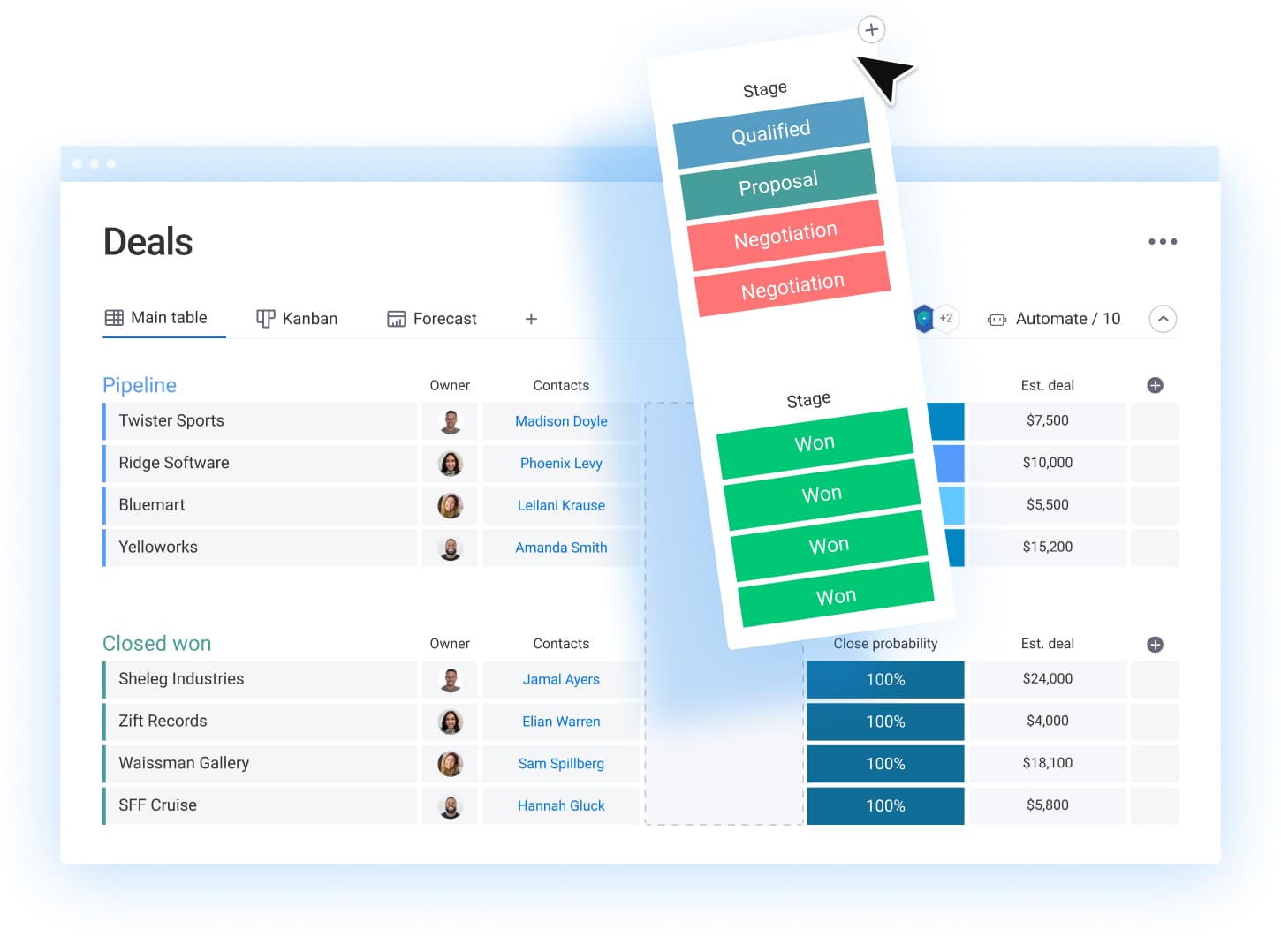
Leverage AI for B2B lead generation
AI is reshaping B2B lead generation by removing the manual work that slows teams down. Instead of replacing people, it helps revenue teams move faster, qualify leads more accurately, and personalize outreach at scale.
Used well, AI becomes a practical layer across the lead generation process, adding speed and clarity where it matters most. Here are the key ways teams are applying AI today:
- Automate lead enrichment and qualification: AI enhances lead data and determines qualification status automatically through data enrichment, consistent lead scoring, intelligent qualification routing, and duplicate detection. Modern CRM platforms like monday CRM can extract key details from files and documents directly into your system, eliminating hours of manual research.
- Scale personalized outreach: AI enables personalized communication without sacrificing quality through email composition assistance, message optimization, send time optimization, and follow-up automation. AI-powered writing tools generate customized email content based on simple prompts, adapting tone and length to match requirements while maintaining a personal touch.
- Prepare for AI-powered buyer agents: AI agents researching solutions for buyers represent an emerging trend — optimize content for AI consumption through clear structure, maintain data accuracy, emphasize human relationships, and articulate unique value propositions.
Track and optimize success
Measurement is the engine that drives continuous improvement in lead generation. Successful programs do not rely on guesswork; instead, they require constant monitoring based on data-driven insights. By focusing on the right indicators, you can make informed decisions about where to double down and where to pivot.
Essential metrics for lead generation
Comprehensive metrics tell the complete story across volume, quality, cost, and pipeline dimensions. Understanding these metrics helps teams make data-driven decisions about resource allocation.
Specifically, you should monitor:
-
Volume metrics: track total leads and source performance to understand which channels effectively capture interest.
-
Quality metrics: measure lead-to-opportunity rates and sales velocity to determine the true value of your incoming leads.
-
Cost metrics: calculate cost per lead and overall customer acquisition cost (CAC) to ensure your growth remains profitable.
-
Pipeline metrics: monitor deal size by source and lead progression to identify where the most valuable revenue is being generated.
Build real-time dashboards
Dashboards provide visibility through visual displays, historical trends, channel attribution, and pipeline visibility. Customizable views enable different stakeholders to monitor relevant metrics.
For instance, while sales leaders prioritize immediate pipeline health and marketing teams track source performance, executives can focus on high-level ROI and total revenue impact. By utilizing sales-specific widgets, your team gains these critical insights in real-time without the need for technical expertise or manual data manipulation.
Drive continuous improvement
Optimization requires regular review cycles analyzing performance. Weekly reviews enable tactical adjustments. Monthly reviews inform strategic shifts. Quarterly reviews guide major program changes.
Furthermore, by systematically incorporating A/B testing and attribution analysis, you can better understand the customer journey and integrate direct team feedback into your workflow. These small, consistent improvements compound over time; indeed, a mere 5% optimization at each funnel stage can increase your overall conversion rate by a staggering 28%.
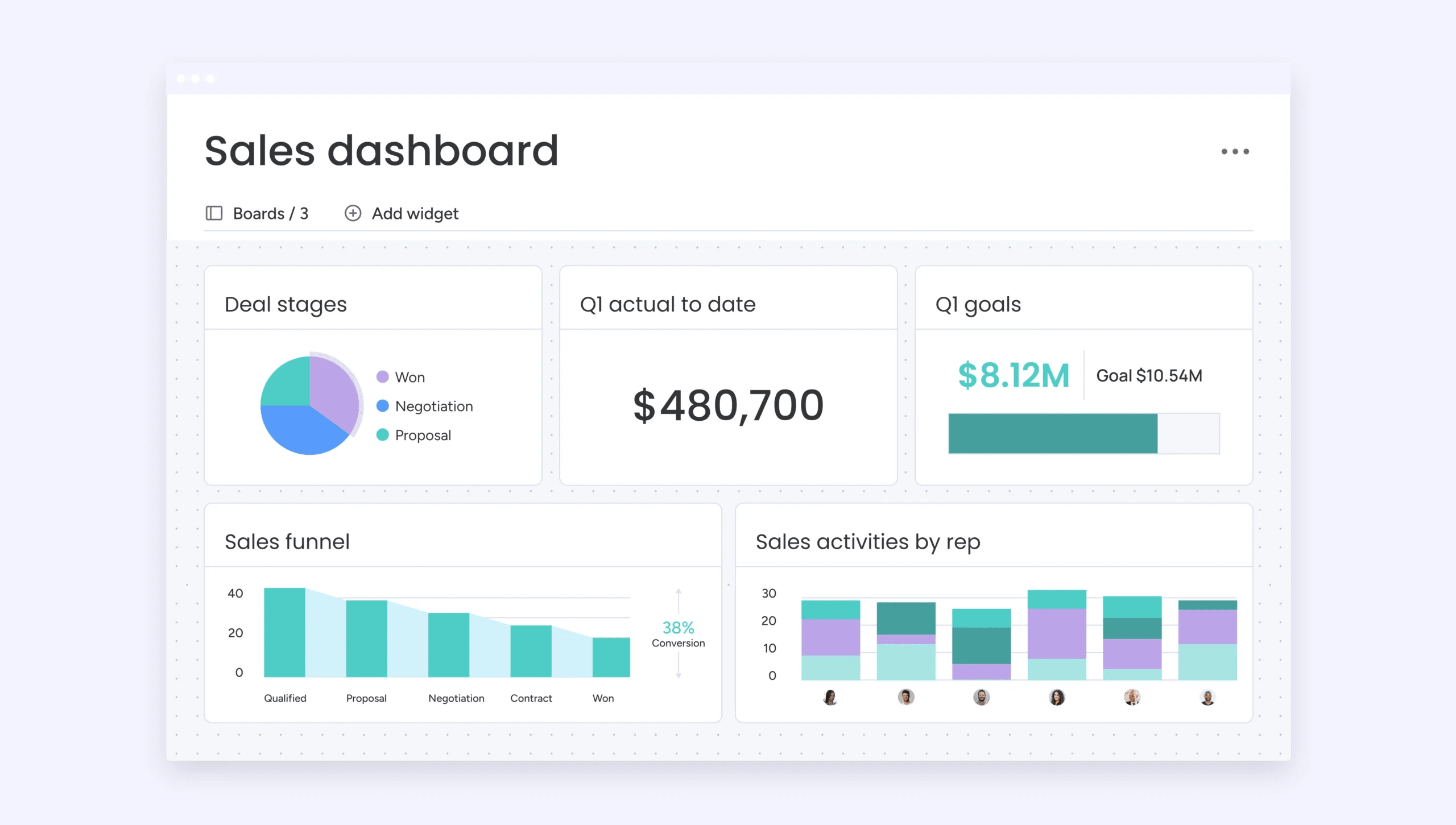
Master your pipeline from first touch to closed deal with monday CRM
You get everything you need to build a lead generation engine that actually works with monday CRM.
Instead of juggling spreadsheets, disconnected tools, and manual processes, you gain a unified platform that brings clarity to your entire pipeline while automating the repetitive work that slows your team down.
See your entire pipeline at a glance
Visual pipeline management transforms how teams understand lead generation performance. You’re not staring at rows of data trying to figure out what’s happening; you’re seeing your entire funnel in living color.
By using this visual approach, you benefit from:
- Customizable views that match your sales process: build boards that reflect how your team actually works, not how some software vendor thinks you should work.
- Real-time updates as leads move: watch progression happen live as your team engages prospects and moves deals forward.
- Instant bottleneck identification: spot exactly where leads get stuck so you can fix problems before they kill your quarter.
- Drag-and-drop simplicity: move leads between stages with a simple click, keeping your pipeline current without data entry headaches.
Automate the busy work without writing code
No-code automation enables sophisticated workflows without technical expertise or IT involvement. As a result, your sales and marketing teams can build exactly what they need, when they need it.
- Automatic lead assignment: route incoming leads based on territory, industry, company size, or any criteria that matters to your business.
- Behavior-triggered follow-ups: create automatic reminders when leads take specific actions or go quiet for too long.
- Adaptive email sequences: launch nurture campaigns that adjust based on engagement, sending the right message at the right time.
- Seamless tool integration: connect your marketing automation, email platform, and other tools so data flows automatically between systems.
- Smart notifications: alert the right people when high-value leads take important actions, ensuring nothing falls through the cracks.
Scale without the growing pains
Flexibility enables adaptation to your growing and evolving needs. What works for a 10-person team needs to scale when you hit 100 people, and monday CRM grows right alongside you.
To support this growth, you get:
- Scalable architecture: handle increasing lead volumes without performance degradation or system limitations.
- Process customization: adapt workflows as your sales process evolves, testing new approaches without rebuilding everything.
- Cross-team collaboration: coordinate seamlessly between marketing, sales, and customer success with shared visibility and aligned workflows.
- Reporting flexibility: create custom dashboards for different stakeholders — executives see revenue impact while managers track team performance.
- Permission controls: manage access levels as your team grows, ensuring everyone sees what they need without compromising data security.
The platform grows with your organization and adapts to changing strategies without requiring technical resources, lengthy implementation projects, or expensive consultants. You’re building a lead generation system that works today and scales for tomorrow.
Frequently asked questions
What is the most effective B2B lead generation strategy?
The most effective B2B lead generation strategy combines multiple approaches tailored to your specific audience and sales cycle. Content marketing paired with targeted outreach typically delivers the strongest results when supported by marketing automation and lead scoring systems.
How much should B2B companies budget for lead generation?
Most B2B companies allocate 2-5% of their revenue to lead generation activities. B2B firms with formal lead qualification processes convert leads to customers at a rate 63% higher than those without such processes. Technology and professional services companies often invest on the higher end of this range to maintain competitive advantage.
What is a good B2B lead conversion rate?
Average B2B lead-to-customer conversion rates range from 2-5%. Companies with mature lead qualification processes often achieve conversion rates of 10-15% or higher through precise targeting and strategic nurturing.
How long does B2B lead generation take to show results?
Most B2B lead generation strategies require three to six months to show meaningful results. SEO and content marketing take longer to mature, while paid advertising and direct outreach can generate leads more quickly.
What are the best lead generation tools for small businesses?
Small businesses benefit from integrated platforms combining lead capture, nurturing, and sales management in one system. Essential capabilities include email marketing, social media management, and basic marketing automation features.
How do you qualify B2B leads effectively?
Effective B2B lead qualification uses scoring systems based on demographic fit, behavioral engagement, and buying signals. The BANT framework (Budget, Authority, Need, Timeline) provides a foundation for determining sales readiness.
How can I automate lead scoring and enrichment for B2B SaaS free trial users in monday CRM?
You can use monday CRM’s AI-powered automations to instantly score and enrich leads the moment they sign up for a free trial. By setting up custom scoring rules based on buyer personas (e.g., job title or industry) and behavioral triggers (e.g., specific feature usage during the trial), the system automatically prioritizes high-intent "Product Qualified Leads" (PQLs). Additionally, you can integrate data enrichment tools to automatically pull in company firmographics, ensuring your sales team has a full profile of the lead's potential without manual data entry.

 Get started