
Sales teams generate more leads than ever, yet qualification remains a bottleneck. Manual research, inconsistent scoring, and delayed follow-ups slow response times and allow high-intent prospects to slip away. By the time a rep determines which leads are worth pursuing, competitors may have already engaged the most promising opportunities.
However, this is exactly where AI SDR platforms make a measurable difference. Instead of relying on manual research and delayed follow-ups, AI continuously analyzes prospect behavior, firmographics, and engagement signals to identify which leads deserve immediate attention. It prioritizes high-intent opportunities, triggers timely outreach, and ensures no qualified lead sits untouched in the pipeline.
In article below we explain how AI qualification works, the technology that powers it, and how to implement it without technical expertise. It covers automated scoring, behavioral triggers that identify high-intent prospects, and qualification systems designed to scale with business growth.
Key takeaways
- Replace manual lead review with instant AI scoring: AI evaluates hundreds of leads in seconds using behavioral patterns, engagement signals, and demographic fit that humans consistently miss.
- Focus sales energy on prospects most likely to convert: AI identifies the 20-30% of leads with genuine buying intent, letting reps spend time selling instead of researching unqualified prospects.
- Respond to high-intent leads before competitors do: real-time AI qualification scores and routes leads instantly, eliminating delays while prospects wait for manual review and follow-up.
- Scale lead management without hiring more staff: AI processes 5,000 leads as easily as 500, maintaining consistent qualification standards as your business grows without proportional cost increases.
- Deploy AI qualification without technical complexity: AI blocks provided by solutions like monday CRM let sales teams set up automated lead scoring, sentiment detection, and routing through simple configuration rather than coding.
What is AI-driven lead qualification?
AI-driven lead qualification uses artificial intelligence to automatically evaluate and score potential customers based on their likelihood to purchase.
Instead of sales reps manually reviewing each lead’s information to qualify sales leads, AI systems analyze multiple data points simultaneously. Website behavior, communication patterns, demographic fit, and engagement signals all feed into instant decisions about which prospects deserve immediate attention.
This technology processes hundreds of leads in the time it takes a human to review just one. The shift from manual to AI-driven approaches to qualify sales leads fundamentally changes how sales teams operate.
Rather than spending hours researching prospects and making subjective judgments about lead quality, teams receive instant, data-backed prioritization that tells them exactly where to focus their energy.
Automated lead scoring and prioritization
AI assigns numerical scores to leads by analyzing dozens of factors simultaneously. A prospect who visits pricing pages multiple times, downloads case studies, and matches your ideal customer profile automatically receives a higher score than someone who bounced after viewing a single blog post, demonstrating different types of sales leads. Scoring happens instantly when a lead enters your system.
The models learn as you close deals, getting sharper with every win. If leads from certain industries or company sizes consistently close faster, the AI automatically weights those factors more heavily in future scoring.
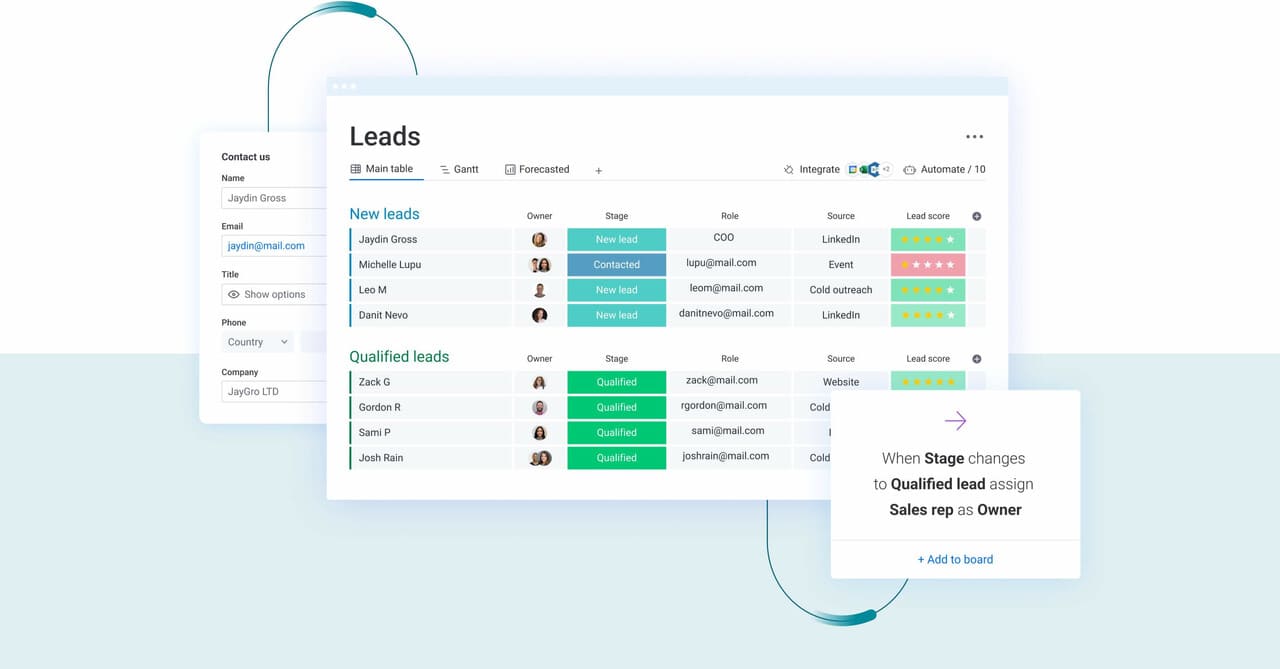
Revenue teams using solutions like monday CRM can implement automated lead scoring through AI blocks that categorize and prioritize leads based on multiple touchpoints. The Assign label action analyzes source text and assigns appropriate status labels, while scoring criteria adapt to your specific sales patterns without requiring technical configuration.
Real-time lead analysis
AI systems evaluate leads the instant they enter your pipeline, analyzing behavior and characteristics as they happen rather than in daily or weekly review cycles. When a prospect submits a contact form at 2 AM, AI immediately scores that lead, identifies buying signals in their form responses, and can trigger appropriate follow-up actions before your sales team even starts their workday.
This speed advantage means high-intent prospects never sit unattended while competitors reach them first. Real-time analysis changes how fast your team moves on hot leads. AI evaluates several critical factors as leads engage with your brand:
- Behavioral pattern recognition: identifying sequences of actions that indicate buying intent, such as viewing pricing followed by competitor comparison pages.
- Engagement velocity tracking: measuring how quickly prospects interact with your content and communications, with rapid engagement signaling higher interest.
- Sentiment detection: analyzing language in form submissions and emails to gauge enthusiasm, urgency, and purchase readiness.
- Cross-channel activity correlation: connecting website visits, email opens, and social media interactions to build comprehensive engagement profiles.
- Anomaly detection: flagging unusual patterns that might indicate either exceptional opportunity or potential issues requiring human review.
Multi-channel lead intelligence
AI aggregates data from every touchpoint where prospects interact with your brand. Email marketing platforms, social media channels, website analytics, CRM systems, sales communication tools, and customer support interactions all contribute to a unified view.
A single lead might visit your website three times, open two marketing emails, engage with your LinkedIn content, and chat with a sales rep. AI combines all these signals into one comprehensive qualification score rather than treating each interaction as an isolated data point.
That complete picture shows you what single-channel tracking can’t. A prospect who seems lukewarm based solely on email engagement might be highly engaged on your website, regularly consuming technical documentation and pricing information.
Modern platforms like monday CRM centralize this multi-channel intelligence automatically, eliminating the data silos that cause sales teams to miss important qualification signals scattered across disconnected systems.
How does AI driven lead qualification works?
AI qualification follows a structured process: the system continuously collects information from multiple sources, applies machine learning algorithms to identify patterns, generates predictive scores that rank lead quality, and refines its accuracy through ongoing learning from actual sales outcomes.
Data collection and integration
AI systems gather information from every digital touchpoint where prospects interact with your brand, creating unified profiles of sales leads that combine behavioral, demographic, and firmographic data. High-quality data produces more accurate scores.
| Data source | What it reveals | Qualification impact |
|---|---|---|
| Website behavior | Page views, time on content, pricing page visits | Research depth and buying intent |
| Communication history | Email opens, response times, call recordings | Engagement level and responsiveness |
| Demographic information | Company size, industry, revenue, contact seniority | Fit with ideal customer profile |
| Social signals | LinkedIn activity, company news, hiring patterns | Timing and organizational priorities |
| Intent data | Third-party research activity across the web | Active evaluation of solutions |
Solutions like monday CRM integrate multiple data sources through pre-built connectors and APIs, automatically enriching lead profiles as new information becomes available. The Extract Info AI action pulls key details from forms, emails, and documents into structured CRM fields, eliminating manual data entry and ensuring qualification decisions reflect the most current prospect information.
Machine learning algorithms
Machine learning analyzes historical deal data to identify which current leads demonstrate the highest probability of conversion. The system examines thousands of past leads to determine which characteristics and behaviors correlate with closed deals.
The technology identifies patterns that human reviewers often miss, such as specific website visit sequences or demographic combinations that indicate purchase readiness.
The algorithm functions as a pattern-recognition engine trained on actual sales outcomes. For example, if historical data shows that leads from manufacturing companies with 100-500 employees who visit integration documentation pages convert at 40% while other segments convert at 15%, the algorithm automatically prioritizes similar future leads.
This learning process occurs continuously without requiring manual rule updates.
Predictive scoring models
AI creates mathematical models that assign probability scores indicating each lead’s likelihood to convert within specific time frames. A lead might receive a score of 85/100, meaning the model predicts an 85% probability of conversion based on their characteristics and behavior patterns.
These predictive models work by:
- Incorporating dozens of weighted factors: the algorithm automatically determines which factors matter most based on your historical conversion data.
- Continuously recalibrating weights: as new conversion data becomes available, the models adjust to ensure scoring accuracy improves over time rather than degrading as market conditions change.
- Adapting to your specific sales patterns: the system learns from your actual outcomes, making predictions increasingly relevant to your unique business context.
Continuous learning and optimization
AI systems improve qualification accuracy through feedback loops that capture actual sales outcomes and adjust prediction models accordingly. When a high-scored lead converts quickly, the system reinforces the characteristics and behaviors that led to that prediction.
But if a highly-scored lead fails to convert, the algorithm investigates which factors were misleading and reduces their weight in future predictions.
This learning happens automatically without requiring manual intervention from sales or operations teams. The system tracks every lead from initial scoring through final outcome and uses this complete lifecycle data to refine its understanding of what truly predicts conversion.

“With monday CRM, we’re finally able to adapt the platform to our needs — not the other way around. It gives us the flexibility to work smarter, cut costs, save time, and scale with confidence.”
Samuel Lobao | Contract Administrator & Special Projects, Strategix
“Now we have a lot less data, but it’s quality data. That change allows us to use AI confidently, without second-guessing the outputs.”
Elizabeth Gerbel | CEO
“Without monday CRM, we’d be chasing updates and fixing errors. Now we’re focused on growing the program — not just keeping up with it."
Quentin Williams | Head of Dropship, Freedom Furniture
“There’s probably about a 70% increase in efficiency in regards to the admin tasks that were removed and automated, which is a huge win for us.“
Kyle Dorman | Department Manager - Operations, Ray White
"monday CRM helps us make sure the right people have immediate visibility into the information they need so we're not wasting time."
Luca Pope | Global Client Solutions Manager at Black Mountain
“In a couple of weeks, all of the team members were using monday CRM fully. The automations and the many integrations, make monday CRM the best CRM in the market right now.”
Nuno Godinho | CIO at Velv
“monday.com provides developmental flexibility, operational efficiency, and data transparency — all in one place. We became a company that moved from chasing data to leading with it.”
Hyunghan Lee | Team Lead, Sandbox Network
"monday.com brought every part of our business into one connected space. The harmony between work management and CRM has become our operating system — giving us the clarity and confidence to scale.”
Jennifer Chinburg | Executive Vice President of Corporate Development & Brand, Chinburg Properties
“We just weren’t getting value from our old CRM. With monday.com, it's a thousand times better. Our sales teams are more informed, more consistent, and far more connected."
James Arnold | Chief Operating Officer, CenversaAI vs manual lead qualification
The difference between AI and manual qualification isn’t just about speed. AI fundamentally changes what’s possible in lead evaluation, enabling analysis at scales and speeds that human teams cannot match while maintaining consistency that manual processes struggle to achieve.
Speed and scale differences
Manual lead qualification requires sales reps to individually review each prospect’s information, research their company, evaluate fit against ideal customer criteria, and make subjective judgments about priority. This process typically takes 10-30 minutes per lead for thorough evaluation, meaning a sales rep might qualify 15-25 leads per day while also handling other responsibilities.
| Qualification activity | Manual process | AI process |
|---|---|---|
| Initial lead scoring | 10-15 minutes per lead | two to three seconds per lead |
| Research and enrichment | 15-20 minutes per lead | Instant (automated) |
| Cross-reference with CRM data | five to ten minutes per lead | Real-time integration |
| Prioritization across 100 leads | four to six hours | Under five minutes |
| Re-scoring based on new activity | Rarely done | Continuous automatic updates |
If you get 200 leads a week, manual qualification puts you in an impossible spot. Teams must either spend 40+ hours on thorough evaluation or use superficial quick-scan methods that miss important signals.
However, AI eliminates this trade-off by providing thorough evaluation at scale.
Accuracy and consistency
AI provides consistent, objective scoring for every lead, applying the same criteria whether it’s the first lead of the day or the thousandth. A sales rep might score leads more generously on Monday morning than Friday afternoon, or unconsciously favor prospects from familiar industries while undervaluing opportunities in unfamiliar sectors.
AI scores every lead the same way, whether it’s lead #1 or lead #1,000. The algorithm applies the same weighted factors to lead #1 and lead #1,000, eliminating the drift and variation inherent in human judgment.
What patterns do your reps consistently miss? AI identifies subtle combinations of behavioral signals that predict conversion because it can simultaneously analyze dozens of variables that exceed human working memory capacity.
Cost and resource requirements
Manual qualification requires ongoing investment in sales rep time, training to maintain consistent evaluation standards, and opportunity costs from delayed follow-up while leads await review. In contrast, AI qualification involves upfront costs for platform licensing and initial configuration, but these costs remain relatively fixed as lead volume grows.
Resource requirements scale differently across organizational sizes:
- Small teams: processing 50-100 leads monthly might find manual qualification manageable.
- Growing teams: teams handling 500+ leads monthly face impossible manual qualification workloads without AI assistance.
- Enterprise teams: must either hire additional staff or accept superficial qualification that misses opportunities.
ROI comparison
Organizations implementing AI lead qualification typically see measurable improvements across multiple metrics within 60-90 days. Response times decrease as AI instantly scores and routes leads rather than waiting for manual review. Conversion rates improve as sales teams focus energy on genuinely high-probability prospects instead of spreading effort across unqualified leads.
The revenue boost comes from a few key things:
- Faster response: high-intent leads receive immediate attention.
- More selling time: reps spend less time on qualification research.
- Improved targeting: focus on prospects with highest conversion probability.
- Enhanced forecasting: more accurate pipeline predictions drive resource allocation.
7 benefits of AI-driven lead qualification
AI qualification delivers measurable improvements across every stage of the sales process, from initial lead generation through closed deals. The system’s accuracy improves over time as the AI learns from every deal to sharpen its predictions.
1. Faster lead response times
AI enables immediate lead scoring and routing the moment prospects enter your system, reducing response times from hours or days to minutes. When a high-intent lead submits a contact form, AI instantly evaluates their qualification score, identifies them as priority, and automatically alerts the appropriate sales rep.
Beyond speed, rapid response times demonstrate organizational responsiveness and establish a professional foundation for the entire customer relationship.
2. Higher conversion rates
By focusing on prospects who actually want to buy, you’ll close more deals. Instead of spreading energy equally across all leads, sales reps concentrate on the 20-30% of prospects that AI identifies as high-probability opportunities.
AI identifies buying signals that humans consistently miss, such as specific patterns of content consumption or subtle language in form submissions that indicate urgency. The Detect Sentiment action within monday CRM analyzes prospect communications to gauge interest and buying intent, enabling more timely and contextually relevant outreach.
3. Reduced manual work for sales teams
AI cuts out the manual work that eats up 30-40% of a rep’s day. These activities include:
- Research tasks: investigating prospect companies and contact backgrounds.
- Data entry: manually inputting lead information into CRM systems.
- Initial qualification: conducting basic discovery calls to gather information.
- Lead scoring: making subjective assessments about prospect priority.
Sales teams often find that representatives spend a disproportionate amount of time on qualification activities rather than actual selling conversations. Representatives who previously managed 20-25 prospect conversations monthly can handle 30-40 conversations with AI-powered qualification, maintaining the same level of effort while significantly increasing their sales capacity.
4. Improved lead prioritization
AI ranks lead by analyzing dozens of factors at once, weighing them based on what’s actually closed deals before. Unlike first-come-first-served approaches that treat all leads equally, AI considers:
- Engagement velocity: how quickly prospects respond and interact.
- Behavioral patterns: sequences of actions indicating buying intent.
- Demographic fit: alignment with ideal customer profiles.
- Intent signals: evidence of active solution evaluation.
- Timing factors: indicators of near-term purchase readiness.
It spots the difference between leads that look similar but have totally different odds of closing. The Assign person action within monday CRM matches leads with the most appropriate sales rep based on skills and expertise, ensuring optimal rep-lead pairing.
5. Enhanced sales forecasting
AI-scored leads produce more accurate and reliable pipeline forecasts. Higher scores mean higher odds of closing. Sales managers can forecast with greater confidence when they know how leads at different score levels typically convert.
What would it mean for your team to report pipeline numbers you actually trust? Better forecasts mean smarter decisions about where to spend resources. You’ll spot when your pipeline looks full but quality’s weak.
6. Scalable lead management
As AI scales with your growth, more leads don’t mean more hires or ballooning costs. The same AI system that handles 500 leads monthly can process 5,000 leads with equal effectiveness and minimal additional cost.
Teams using AI say growth gets easier. Those big jumps in lead volume don’t throw everything into chaos. Instead of scrambling to hire and train new qualification staff when lead volume doubles, they simply process more leads through existing AI systems.
7. Data-driven insights
AI shows you which lead sources work, what qualification factors matter, and how the market’s shifting — so sales and marketing can make smarter calls. The system reveals:
- Channel performance: which marketing sources produce highest-quality leads.
- Criteria effectiveness: which qualification factors actually predict conversion.
- Market trends: how lead quality and conversion patterns shift over time.
- Resource optimization: where to focus sales and marketing investments.
These insights drive continuous improvement across revenue operations. Marketing teams can reallocate budget from high-volume, low-quality sources to channels that generate fewer but higher-qualified leads.
AI technologies transforming lead qualification
Modern lead qualification has evolved into a sophisticated analysis of patterns that traditional systems often miss. By leveraging specialized AI, revenue teams can process massive amounts of unstructured data, such as conversational nuance and buyer urgency, at a scale impossible for humans alone.
Mastering these tools is essential for selecting a platform that achieves the goal of driving higher conversion rates through precision targeting.
Natural language processing for lead communication
Natural language processing (NLP) reads emails, chats, calls, and forms to spot buying signals and gauge sentiment. The technology detects urgency in prospect emails through language patterns, identifies budget discussions in call recordings, and recognizes decision-maker involvement when executives join email threads.
The Detect Sentiment action provided by monday CRM determines whether text input can be categorized as Positive, Negative, or Neutral, helping sales teams understand prospect engagement at a glance.
The Writing assistant action can generate personalized follow-up content based on lead data and communication history.
Agentic AI and autonomous qualification
Agentic AI doesn’t just analyze data; it qualifies leads on its own through automated conversations. These AI agents conduct initial qualification conversations, ask follow-up questions based on prospect responses, and make preliminary assessments about fit and priority.
The AI capabilities within monday CRM demonstrate how autonomous AI handles qualification activities. The Custom action allows teams to give specific instructions to AI, referencing any column on their board for input. AI then generates output per specifications into the selected column, enabling sophisticated qualification logic without coding.
Multi-modal analysis beyond text
AI analyzes various data types beyond text to create comprehensive lead profiles:
- Voice analysis: tone and sentiment in recorded calls.
- Document interaction: which proposal sections receive most attention.
- Behavioral signals: digital body language indicating hesitation or interest.
- Visual engagement: how prospects interact with video content and presentations.
Mix different data types, and you get sharper qualification than text alone.
Real-time behavioral tracking
AI watches how prospects behave across your digital channels, catching signals in real time. Real-time tracking means you respond to high-intent behavior immediately and not days later during a review.
The technology detects meaningful behavioral sequences that indicate buying readiness. A prospect who visits your homepage, then pricing page, then competitor comparison page, then returns to pricing within 24 hours demonstrates much higher intent than someone who views those same pages over three months.
7 AI-driven lead qualification strategies that drive results
Implementing AI qualification requires strategic planning around your specific sales process, clear qualification criteria that reflect your ideal customer profile, and thoughtful integration with existing workflows.
Effective implementation delivers measurable improvements: higher conversion rates, shorter sales cycles, and qualification accuracy that continuously improves with each closed deal.
Strategy 1: implement predictive lead scoring
Predictive scoring digs through your past deals to figure out which traits and behaviors signal a win. Start by analyzing six to twelve months of closed deals to identify common patterns among converted leads.
Good scoring models usually track eight to twelve factors across three buckets:
- Fit factors: demographic and firmographic alignment with your ideal customer profile.
- Interest indicators: behavioral engagement showing active research and evaluation.
- Timing signals: evidence suggesting near-term purchase intent or urgency.
Strategy 2: use behavioral trigger automation
Behavioral triggers fire automatic responses when prospects do things that show they’re qualified or ready to buy. High-value triggers include:
- Pricing engagement: downloading pricing information or visiting pricing pages multiple times.
- Competitive research: viewing competitor comparison content.
- Multi-touchpoint engagement: interacting with multiple team members across different channels.
- Content consumption: accessing technical documentation or case studies.
Align automated responses with the strength of each signal. Strong buying intent warrants immediate sales outreach, while softer signals should trigger automated nurturing sequences that develop the prospect over time.
Strategy 3: create automated lead routing rules
Dynamic routing sends leads to the right rep based on AI scores, specialization, workload, and past performance. Advanced AI systems allow teams to define each teammate’s role or key skills, helping accurately assign the right person for each opportunity based on qualification criteria and rep expertise.
Strategy 4: enable cross-channel lead tracking
Cross-channel tracking connects the dots including emails, social, website visits, sales calls, support chats, into one complete picture. Modern CRM platforms log and track every interaction including emails, meetings, and notes in unified timelines, giving sales teams complete visibility into prospect engagement across all touchpoints.
Strategy 5: set up continuous feedback loops
Feedback loops capture what closes and what doesn’t, teaching the AI to get better with every outcome. Robust AI qualification systems allow teams to review AI actions taken and the logic behind results, making it easy to understand and refine qualification criteria based on actual sales outcomes.
Strategy 6: integrate intent data signals
Intent data shows when prospects are researching solutions like yours even before they reach out. Weight intent signals appropriately in qualification scoring based on:
- Signal strength: how specific the research activity is to your solution category.
- Recency: how recently the research activity occurred.
- Volume: how much research activity the prospect is conducting.
- Progression: whether research activity is increasing or decreasing over time.
Strategy 7: deploy AI-powered lead nurturing
AI-powered nurturing personalizes content, timing, and channel selection based on lead scores and behavioral patterns. Advanced AI systems help compose personalized emails and create concise lead profiles by synthesizing data from multiple touchpoints across the customer journey.
Implementing AI-driven lead qualification without IT help
Many sales teams hesitate to adopt AI, assuming it requires a dedicated development team for implementation. However, the rise of no-code platforms has made AI accessible, allowing sales and marketing teams to set up sophisticated qualification systems without IT support.
No-code AI implementation platforms
No-code platforms use visual builders and templates to enable AI implementation without technical expertise. These platforms make sophisticated AI capabilities accessible to non-technical team members through intuitive configuration rather than coding.
The platform offers ready-made AI capabilities that integrate directly into CRM workflows through simple configuration:
- Categorize block: automatically sorts leads by industry, company size, or urgency level using natural language criteria.
- Extract Info block: pulls key details from lead forms, emails, and documents into structured CRM fields.
- Custom blocks: enable unique qualification criteria using natural language prompts.
Quick start templates and workflows
Starting from a blank page slows adoption and increases errors. Templates eliminate that friction by packaging proven qualification logic into ready-to-use workflows. Built on real-world sales data and best practices, they allow teams to deploy AI qualification quickly while maintaining flexibility to adjust as needed.
- Pre-configured scoring criteria: based on industry best practices and proven conversion patterns.
- Automated routing rules: distributing leads based on score, territory, and rep specialization.
- Reporting dashboards: tracking qualification performance and ROI metrics.
Use them right away, tweak what you need. No building from zero.
Integration with existing systems
AI qualification delivers value only when it works within your current tech stack. Modern platforms connect directly to CRM, marketing automation, and communication tools through pre-built integrations. Instead of disrupting workflows, AI enhances the systems your team already relies on — improving data flow and decision-making without adding operational overhead.
Measuring success from day one
AI qualification isn’t a “set it and forget it” system — it’s measurable from the start. Clear performance metrics allow revenue teams to track impact immediately, identify optimization opportunities, and prove ROI early in the rollout process.
- Lead response times: how quickly high-scored leads receive follow-up.
- Qualification accuracy: conversion rates by score range.
- Sales team adoption: how actively reps use AI recommendations.
- Conversion rate improvements: overall pipeline performance changes.

Choosing the right AI-driven lead qualification solution
Pick AI qualification tech based on what your business actually needs — not the longest feature list. Look for tools that solve your real qualification problems and fit into how you already work.
Key features to look for
Prioritize features that solve your specific business challenges and align with your sales team’s workflow. Pick features that match your qualification headaches and how your sales team works:
- Automated lead scoring: real-time evaluation based on multiple data points including behavioral signals, demographic fit, and engagement patterns.
- Behavioral tracking: monitoring prospect interactions across channels to identify buying signals and qualification status changes.
- Predictive analytics: forecasting lead conversion probability and optimal engagement timing based on historical patterns.
- Integration capabilities: seamless connections with existing CRM systems, marketing automation platforms, and communication systems.
- Customizable workflows: adapting qualification criteria, routing rules, and automated actions to specific business processes without technical configuration.
- Reporting and insights: visibility into qualification performance, conversion patterns, and ROI metrics through intuitive dashboards.
Integration capabilities
Seamless integration with your existing technology is critical for ensuring the AI solution enhances your workflow and drives efficiency. Ask vendors these integration questions:
- CRM compatibility: which systems connect through pre-built integrations?
- Data synchronization: how frequently does information sync between systems?
- Record enrichment: can the system enhance existing CRM data automatically?
- API flexibility: what custom integrations are possible for unique requirements?
Scalability and flexibility
The solution should scale with you, no rebuilding when your needs change. Test scalability with these scenarios:
- Volume handling: what happens when lead volume doubles or triples?
- Multi-product support: can the system handle different qualification criteria for various product lines?
- Geographic expansion: how does the solution adapt to new markets and regions?
- Team growth: does pricing and functionality scale appropriately with headcount increases?
Cost considerations
Total cost means more than licensing. Factor in setup, training, maintenance, and what delays cost you. Therefore, calculate ROI from the actual improvements you expect:
- Time savings: hours recovered from manual qualification work.
- Conversion improvements: revenue impact from focusing on higher-quality leads.
- Response speed: competitive advantages from faster lead follow-up.
- Forecasting accuracy: resource allocation improvements from predictable pipeline data.
How does monday CRM power the smarter lead qualification with AI?
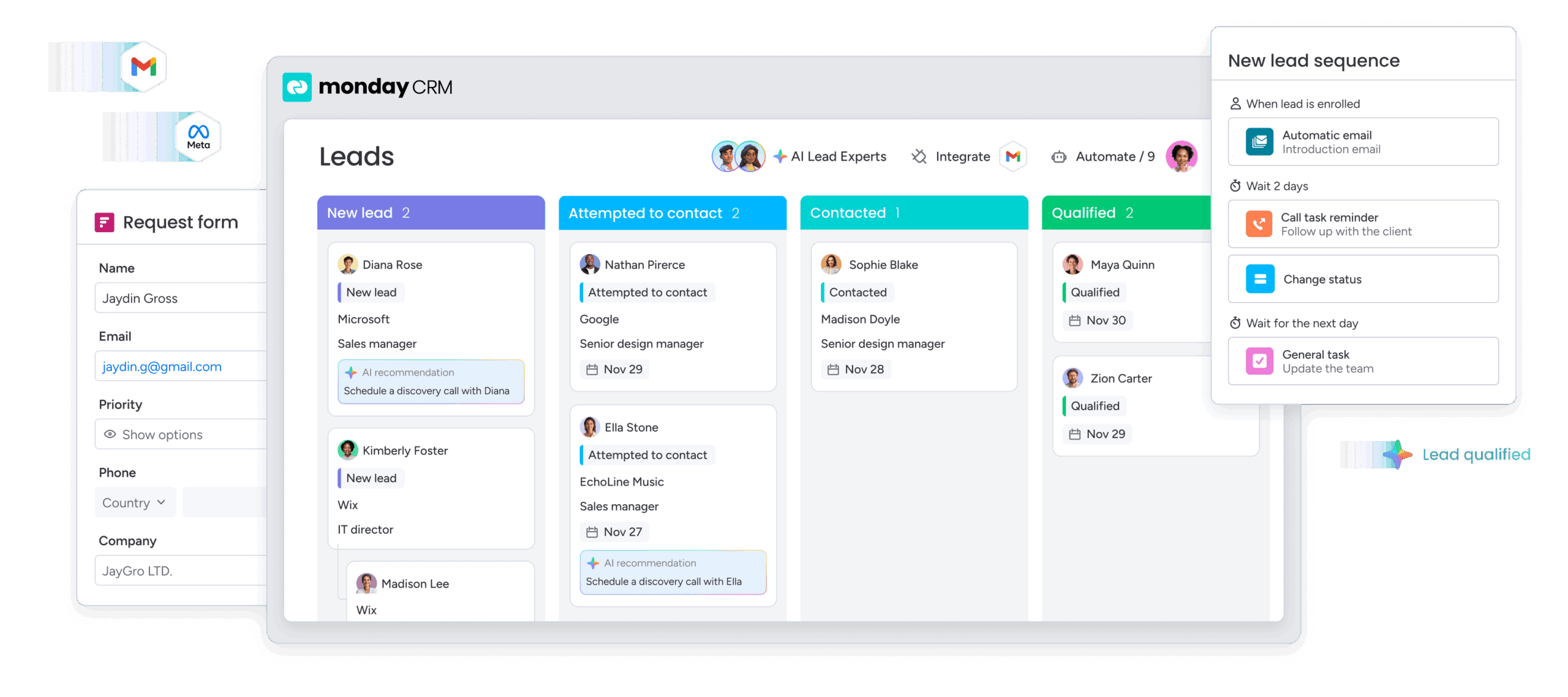
AI qualification comes right into your sales workflow with monday CRM with no jumping between tools needed. AI blocks handle every qualification stage: from first capture to closed deal.
All qualification data and tools are unified in a single, cohesive workspace. Your team gets AI right where they already work, in their boards and workflows.
AI blocks for lead qualification
AI blocks are pre-built tools that boost qualification. Set them up without code. They plug right into your CRM boards and automations:
- Categorize: automatically sorts leads by industry, company size, urgency level, or custom criteria using natural language rules.
- Extract Info: pulls key details from lead forms, emails, and documents into structured CRM fields automatically.
- Detect Sentiment: analyzes prospect communications to gauge interest level and buying intent.
- Summarize: creates concise lead profiles from multiple touchpoints and interactions.
- Custom block: enables teams to create tailored AI actions for unique qualification criteria using natural language prompts.
Autofill with AI for qualification automation
The Autofill with AI feature in monday CRM applies AI capabilities to columns on any CRM board. Teams can apply AI to Text, Date, Number, Dropdown, People, and Status columns. The system generates results using information from Emails & Activities, ensuring qualification decisions reflect complete prospect engagement history.
Timeline summary for instant context
AI Timeline Summary makes it easy for reps and managers to see the full client history. It summarizes every touchpoint: emails, calls, meetings, notes. Teams save time without losing context.
Transparent, auditable AI decisions
The Run history feature in monday CRM allows teams to review AI actions taken and the logic behind results. If a column shows “No result,” teams can check the Run history to understand why and refine their instructions accordingly. That transparency builds trust in AI and helps you keep improving.
Enhance your lead qualification with AI-powered precision
AI qualification changes how revenue teams find, rank, and engage prospects. It cuts manual work, speeds up responses, and gives revenue leaders the predictability they need for accurate forecasts.
The best setups blend AI speed with human judgment. AI handles the data work and scoring. Sales focuses on relationships, negotiations, and strategy. Together, they create a qualification system that scales and stays sharp.
When you’re shopping for AI qualification, look for transparency, flexibility, and easy setup. The right tool shows you why scores are what they are, adapts as your business changes, and fits into how you already work.
Frequently asked questions
What is AI in the lead generation?
AI-driven lead qualification costs vary based on features and scale, typically ranging from $50-500 per user monthly for comprehensive solutions, with entry-level plans starting around $50-100 per user and enterprise solutions reaching $300-500 per user for unlimited leads and custom AI models.
Can small businesses use AI lead qualification effectively?
Small businesses can effectively use AI lead qualification through no-code platforms and pre-built templates designed for limited technical resources, with many seeing ROI within 60-90 days through improved conversion rates and sales team productivity.
How long does it take to implement AI lead qualification?
Implementation timeframes range from days to weeks depending on solution complexity, with no-code platforms operational within hours for basic qualification workflows while custom implementations requiring extensive integrations may require several weeks for full deployment.
Is AI lead qualification more accurate than human qualification?
AI lead qualification typically achieves higher accuracy than manual processes by analyzing more data points consistently and eliminating human bias, though the most effective approaches combine AI efficiency with human insight for complex qualification decisions.
What happens to leads that don't meet AI qualification criteria?
Unqualified leads typically enter automated nurturing sequences designed to develop them over time or are archived for future reference, with most systems allowing manual review of borderline cases and options to adjust qualification criteria based on business needs.
Will AI lead qualification work with my current CRM system?
Most AI lead qualification solutions integrate with popular CRM platforms through APIs and pre-built connectors that enable seamless data synchronization, though organizations should verify specific CRM compatibility before committing to any solution.