

Sales organizations often face a constant tension between high-volume prospecting and delivering personalized engagement. Repetitive tasks such as lead qualification, follow-ups, and pipeline tracking consume significant time, leaving sales teams with limited bandwidth to focus on strategic relationship-building. As a result, opportunities can be missed, response times lag, and revenue growth slows despite skilled sales talent.
Systematic growth strategies provide a path to overcome these challenges by creating structured, repeatable processes that increase efficiency and consistency across the sales organization. When applied effectively, these strategies enable teams to prioritize high-value opportunities, engage prospects more effectively, and make data-driven decisions that improve conversion rates. Organizations that adopt a disciplined approach can scale their efforts without proportionally increasing headcount or operational complexity.
This article explores actionable strategies for driving sustainable sales growth, detailing how to implement them across the revenue cycle and measure their impact. Key topics include optimizing lead management, improving outreach effectiveness, leveraging automation and AI-driven tools for repetitive workflows, and establishing metrics to track performance. By following these approaches, sales teams can build a framework that supports predictable, scalable revenue growth.
Key takeaways
- Agentic AI transforms sales workflows: autonomous systems execute multi-step processes, make contextual decisions, and learn from outcomes, reducing reliance on manual intervention.
- True autonomy requires five characteristics: goal-oriented behavior, independent decision-making, environmental awareness, continuous learning, and adaptive execution distinguish agentic AI from traditional automation.
- High-impact applications drive quick results: lead qualification, follow-up management, meeting coordination, deal risk monitoring, and customer intelligence deliver measurable improvements within weeks.
- Digital sales forces complement human reps: specialized autonomous agents handle repetitive, data-intensive tasks while humans focus on relationships, strategy, and complex negotiations.
- monday CRM enables accessible agent deployment: visual AI actions and pre-built templates allow teams to configure autonomous agents without technical expertise, accelerating adoption and measurable ROI.
What is agentic AI for sales?
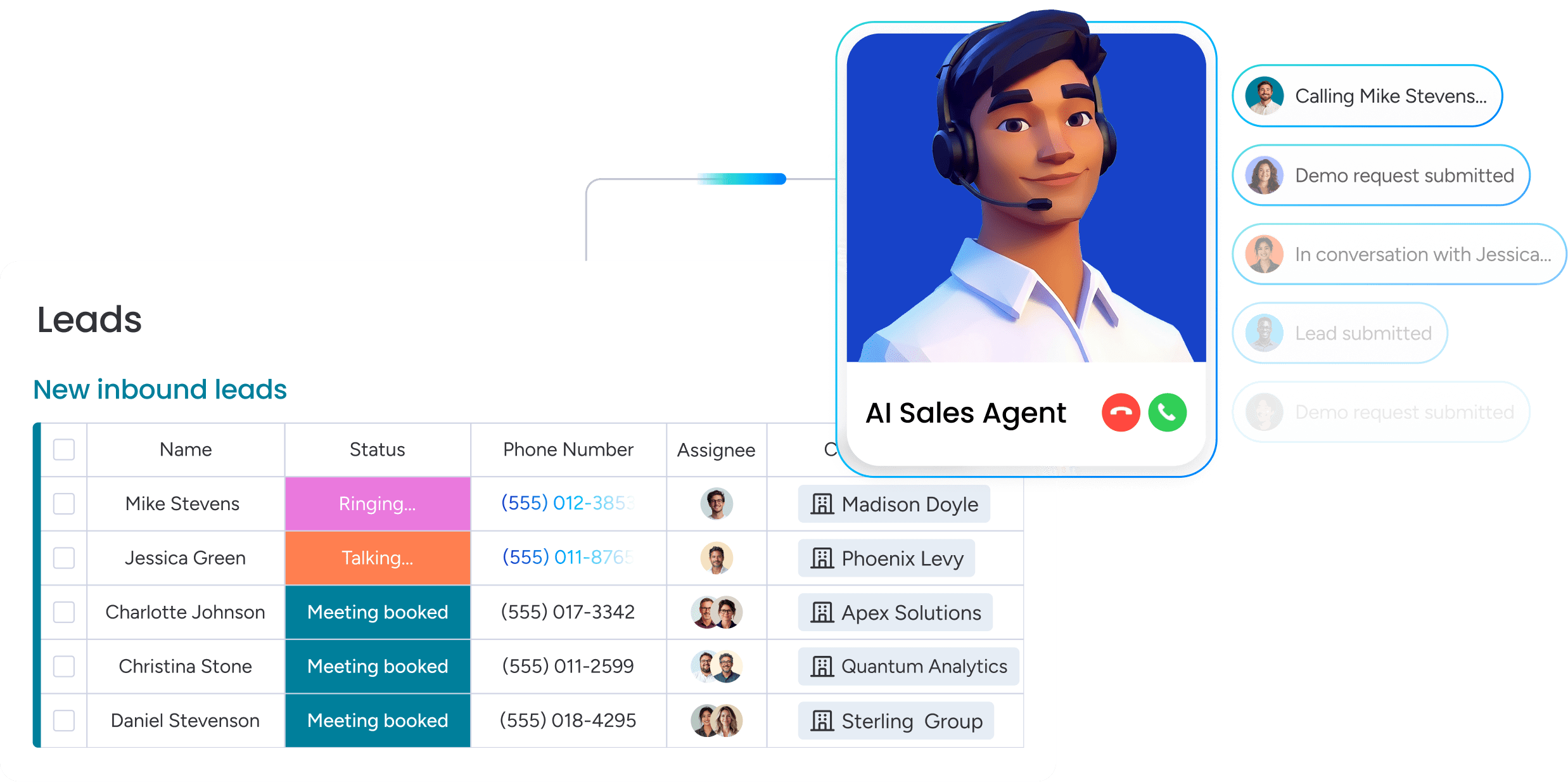
Agentic AI in sales refers to autonomous systems that independently execute sales tasks, make decisions, and adapt their behavior without constant human supervision. Unlike traditional automation or chatbots that follow predefined scripts, these systems function as digital sales team members capable of managing entire workflows from start to finish.
The shift from reactive tools to proactive systems changes how revenue teams operate. Traditional sales technology waits for human input before taking action. Agentic AI identifies opportunities, evaluates options, and executes tasks on its own, continuously working toward defined revenue goals while humans focus on relationship-building and strategic decision-making.
This shift is especially relevant now because sales teams face rising expectations and labor constraints. The Bureau of Labor Statistics recently reported 7.1 million job openings, highlighting ongoing workforce shortages. Buyers demand faster responses, more personalized engagement, and seamless experiences across every touchpoint. Agentic AI enables teams to meet these demands at scale without adding headcount or increasing burnout among team members.
Step 1: understand how autonomous sales agents work beyond chatbots
Chatbots respond to prompts and follow predefined scripts. They answer questions when asked and perform simple tasks when triggered. Autonomous sales agents operate differently: they take initiative, learn from outcomes, and navigate complex scenarios without waiting for human instructions.
To understand their impact, consider what makes these systems truly autonomous. Unlike basic automation, agentic systems take initiative and exercise judgment previously exclusive to humans.
- Initiate actions independently: autonomous agents proactively identify opportunities and execute tasks without human prompts. When a prospect visits a pricing page three times in one week, the agent recognizes the buying signal and initiates personalized outreach.
- Learn and adapt: these systems refine performance based on outcomes and evolving conditions. If email subject lines framed as questions generate higher open rates than statements, the agent adjusts its approach automatically.
- Make contextual decisions: autonomous agents evaluate multiple data points to select the best course of action. They consider deal size, prospect seniority, engagement history, competitive signals, and timing factors simultaneously.
- Execute multi-step workflows: these systems manage complex sequences that previously required human judgment at every step. They coordinate engagement across channels and adjust their strategy based on prospect responses.
For example, an autonomous agent may identify a high-value lead based on firmographic data and recent website behavior. It researches the prospect’s company, notes recent news about expansion plans, and crafts personalized outreach referencing that context. When the prospect opens but does not respond, the agent waits two days and tries LinkedIn with a different angle. Once the prospect engages, the agent sends a calendar link for a demo, coordinates with the appropriate sales rep’s schedule, and delivers relevant case studies before the meeting. Each step occurs without direct human intervention.
Step 2: identify the key characteristics that make AI truly agentic
Five attributes distinguish agentic AI from standard automation. These traits demonstrate true autonomy rather than well-marketed automation.
- Goal-oriented behavior: agents work toward defined objectives rather than merely completing tasks. Traditional automation might send one hundred emails per day because it is programmed to do so. An agentic system optimizes for qualified meetings booked, adjusting its approach to maximize that outcome.
- Autonomous decision-making: these systems select actions without human approval for each step. If a prospect is more likely to respond to a phone call than an email, the agent initiates the call independently.
- Environmental awareness: agents monitor and react to changing sales conditions in real-time. They track prospect activity, competitor signals, market trends, and internal team capacity.
- Continuous learning: performance improves through experience and feedback. Each interaction provides data that sharpens the agent’s understanding of effective strategies.
- Adaptive execution: agents modify their strategy based on outcomes. If a messaging approach stops generating responses, the agent tests alternatives without requiring human oversight.
Step 3: compare agentic AI with traditional CRM automation
The difference between traditional CRM automation and agentic AI lies in whether the technology supports the team or drives revenue independently.
| Dimension | Traditional CRM automation | Agentic AI for sales |
|---|---|---|
| Trigger mechanism | Rule-based, if-then logic | Autonomous initiation based on goals |
| Decision-making | Predetermined paths designed by humans | Contextual, adaptive choices based on current conditions |
| Learning capability | Static rules unchanged until manually updated | Continuous improvement through outcome analysis |
| Scope of action | Single-task execution | Multi-step workflow completion across channels |
| Human involvement | Constant oversight needed | Minimal supervision; humans set goals and review outcomes |
Traditional automation handles repetitive tasks efficiently but requires humans to design every scenario. When situations fall outside predefined rules, the system either fails or requires intervention. Agentic AI navigates novel situations by applying learned patterns and optimizing toward clearly defined objectives.
How sales agentic AI creates autonomous revenue systems
Autonomous revenue systems do more than assist salespeople. They actively drive revenue generation independently. Automation executes defined tasks faster, but autonomy manages complete workflows without human intervention. This distinction is critical. Automation still relies on humans to orchestrate processes and handle exceptions, while autonomous systems operate end-to-end on their own.
Transform manual tasks into self-running workflows
Manual sales processes evolve into autonomous systems in a few steps. Consider lead qualification as an example.
- Manual execution: A sales rep receives a lead notification, opens the CRM, reviews lead information, researches the company on LinkedIn and the website, evaluates fit with the ideal customer profile, assigns a priority, and decides next steps. This takes fifteen to thirty minutes per lead.
- Basic automation: A lead scoring system assigns points based on firmographic data and form responses. Leads above a threshold automatically route to sales reps. The rep still researches and decides on outreach, but prioritization occurs automatically.
- Agentic autonomy: An autonomous agent continuously monitors new leads, enriches data from multiple sources, evaluates fit using criteria updated from win/loss patterns, researches company context and news, identifies optimal outreach approach and timing, crafts personalized messaging, and initiates engagement. The sales rep receives a qualified meeting on their calendar with full context on the prospect’s needs.
Self-running workflows do more than accelerate execution. They operate continuously, adapt to changing conditions, and improve through experience.
Build your digital sales force
Organizations can create a “sales force” of autonomous agents, each specializing in a specific function. Digital workers handle high-volume, data-intensive work, while humans focus on strategy and relationships. Teams often deploy agents across four key functions that follow predictable patterns.
- Lead qualification specialist: continuously evaluates incoming leads, enriches data from multiple sources, and prioritizes opportunities based on fit and intent signals. It monitors website behavior, tracks engagement, and identifies buying committee members.
- Outreach coordinator: manages personalized communication across multiple channels. It researches prospect context, crafts relevant messaging, selects optimal channels and timing, and adapts sequences based on responses.
- Deal progression manager: monitors deal health, identifies risks, and takes action to move opportunities forward. It tracks engagement from key stakeholders, flags stalled deals, suggests next steps, and alerts sales reps when intervention is needed.
- Account intelligence analyst: tracks customer signals and identifies expansion opportunities. It monitors usage patterns, company news, hiring activity, and engagement trends.
Modern platforms like monday CRM allow teams to deploy these specialized digital workers. AI capabilities let revenue teams configure and customize agents for specific workflows. Features such as Autofill with AI enable actions like sentiment detection, information extraction, and custom prompts to be applied directly to board columns without technical expertise.
Enable real-time decision making without human input
Autonomous agents make decisions based on current conditions rather than waiting for human approval. Effective human-AI collaboration requires clear parameters. Here’s how agents work in real time.
- Data synthesis: agents analyze multiple data sources simultaneously to inform decisions. When determining the best time to send a follow-up email, an agent considers the prospect’s engagement history, time zone, industry norms, deal stage, and current pipeline capacity. All analysis happens in milliseconds.
- Contextual evaluation: agents assess the broader context, not just individual data points. A high-value enterprise deal receives different treatment than a smaller startup opportunity. Communication style, escalation thresholds, and persistence are adjusted based on strategic importance.
- Adaptive responses: agents modify actions based on outcomes. If an email sequence does not generate responses, the agent tests alternative subject lines, value propositions, or new channels without waiting for human intervention.
Autonomous agents operate within defined objectives. They execute tasks independently while aligning with organizational goals.
7 essential components of autonomous sales systems
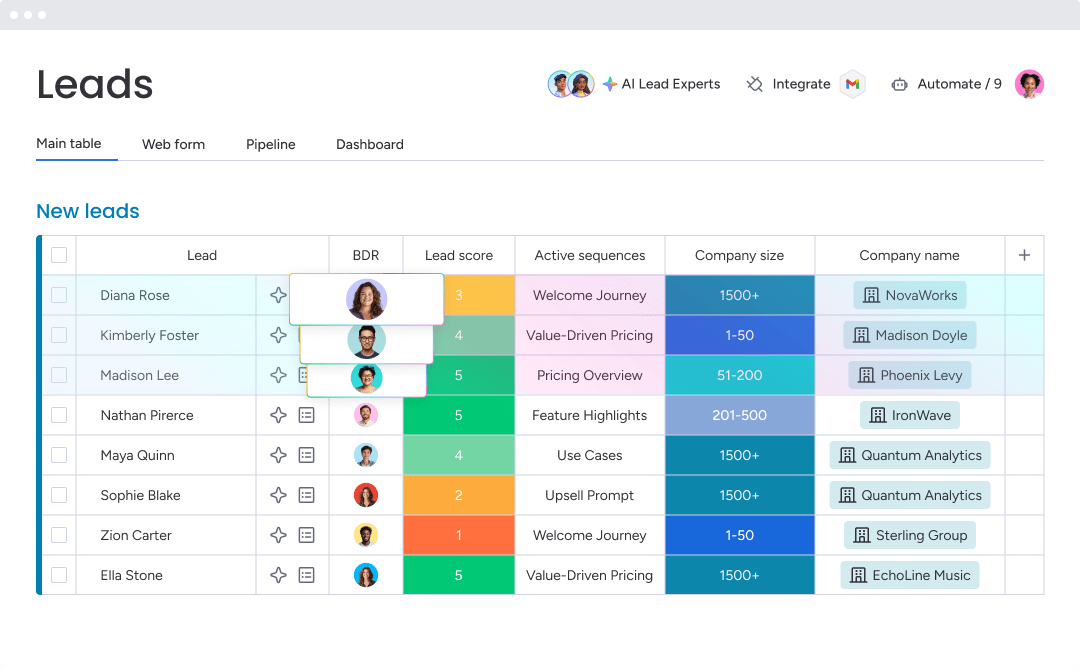
Autonomous revenue systems combine multiple interconnected components that work together to drive measurable sales outcomes. Each component focuses on a specific stage of the sales process while sharing data with the others. Together, they highlight where autonomous systems deliver the greatest value in a sales environment.
Component 1: intelligent lead scoring and qualification
Autonomous systems go beyond static lead scoring, continuously updating qualification as new signals emerge. Traditional lead scoring assigns fixed point values that remain unchanged until someone manually adjusts them. Intelligent qualification operates differently.
The system analyzes multiple signals simultaneously:
- Firmographic data: company size, industry, location, technology stack.
- Behavioral signals: website visits, content engagement, email interactions.
- Intent indicators: research patterns, competitive comparisons, buying committee formation.
- Timing factors: budget cycles, contract renewals, organizational changes.
Scores update in real time as new information becomes available. A prospect who downloaded a whitepaper last month may see a declining score if engagement drops, while a prospect who visits the pricing page three times in an hour experiences an immediate score increase.
Component 2: personalized outreach at scale
Autonomous systems create highly personalized messages for hundreds or thousands of prospects without manual intervention. This goes beyond mail merge personalization that only inserts names and companies into a template.
- Individual-level customization: the system researches each prospect’s context, including company news, role responsibilities, likely challenges, recent activities, and competitive position.
- Optimal channel and timing selection: it chooses whether to engage via email, LinkedIn, phone, or other channels based on prospect preferences and historical engagement.
- Response-based adaptation: follow-up messages adjust depending on how prospects engage. If emails are opened but links are not clicked, the system modifies the approach accordingly.
Teams leveraging monday CRM’s AI sales assistant can compose contextual emails directly within the Emails & Activities feature. The Writing assistant allows teams to provide prompts for AI-generated text, adjusting tone and length based on the prospect’s situation.
Component 3: adaptive pricing and deal optimization
Autonomous systems continuously optimize deal structure and pricing, moving beyond static price lists. They generate intelligent recommendations to maximize both close rates and deal value.
- Historical deal analysis: the system learns from past wins and losses to identify pricing patterns that lead to success.
- Customer value signals: it evaluates budget indicators, urgency, and strategic importance. Prospects with strong intent may not require discounts, while price-sensitive prospects may need flexibility.
- Discount impact prediction: the system estimates how different discount levels influence close probability, identifying when a small adjustment meaningfully increases the chance of winning.
Component 4: predictive pipeline management
Autonomous systems continuously forecast pipeline health and take proactive action to mitigate risks before deals are lost. Real-time monitoring surpasses periodic manual pipeline reviews based on intuition.
Here are common risk signals autonomous systems monitor and the actions they trigger:
| Dimension | Traditional CRM automation | Agentic AI for sales |
|---|---|---|
| Trigger mechanism | Rule-based, if-then logic | Autonomous initiation based on goals |
| Decision-making | Predetermined paths designed by humans | Contextual, adaptive choices based on current conditions |
| Learning capability | Static rules unchanged until manually updated | Continuous improvement through outcome analysis |
| Scope of action | Single-task execution | Multi-step workflow completion across channels |
| Human involvement | Constant oversight needed | Minimal supervision; humans set goals and review outcomes |
Using monday CRM’s AI Timeline Summary, teams gain concise overviews of all communication events, including emails, calls, meetings, and notes. This helps quickly identify patterns indicating deal health.
Component 5: automated multi-touch follow-up
Autonomous systems manage follow-up sequences that adapt to prospect behavior rather than rigid, time-based schedules.
- Behavioral triggers: follow-ups respond to actions such as email opens, website visits, content downloads, or social engagement.
- Multi-channel coordination: the system orchestrates touchpoints across email, phone, social media, and other channels based on responsiveness.
- Persistence optimization: frequency and duration of follow-up adjust according to engagement signals. Highly engaged prospects receive more frequent touchpoints, while less responsive prospects receive fewer before the system moves on.
Component 6: revenue expansion identification
Autonomous systems uncover upsell, cross-sell, and expansion opportunities within existing accounts that human account managers may overlook.
Key indicators that trigger expansion opportunities include:
- Usage approaching plan limits.
- New team members added to the account.
- New use cases emerging from feature adoption patterns.
- Budget cycle timing.
- Company growth signals, such as funding or hiring announcements.
Component 7: continuous performance optimization
Autonomous systems improve over time through ongoing learning and experimentation, without requiring manual intervention.
- Outcome pattern tracking: correlates actions with results to identify successful strategies, tracking which messaging approaches generate responses and which deal characteristics predict wins.
- Systematic variation testing: experiments with alternative subject lines, value propositions, channel sequences, and timing patterns to find optimal strategies.
- Cross-workflow learning: insights from one process enhance performance in related areas. For example, patterns identified in lead qualification inform outreach personalization, while engagement data from follow-up sequences improves scoring accuracy.
Building sales AI agents without technical complexity
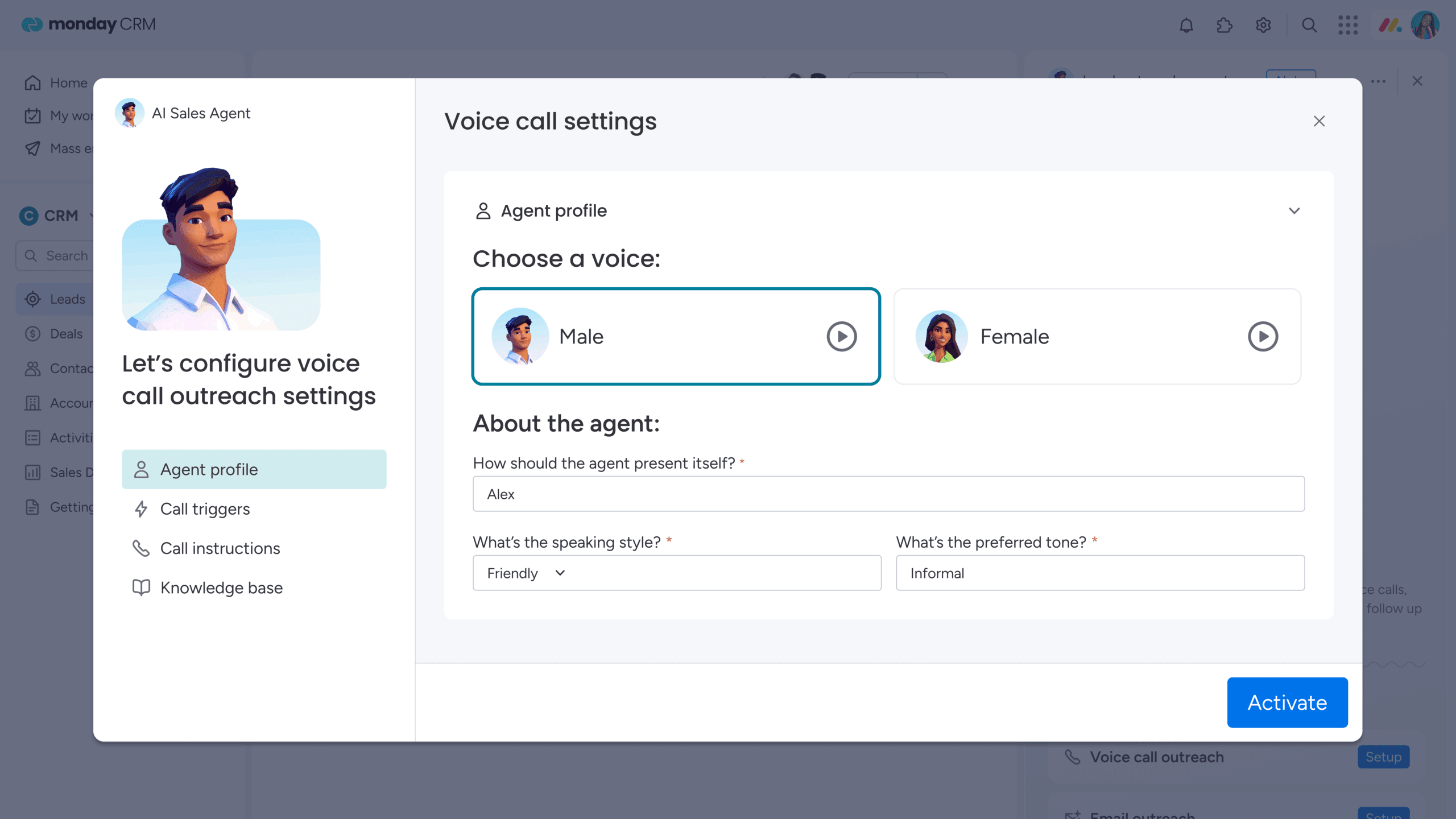
Deploying autonomous sales agents no longer requires months of custom development or a dedicated data science team. The barrier to entry has dropped significantly. What once demanded specialized engineering talent can now be implemented by sales operations professionals using visual interfaces and pre-built components. Revenue teams can launch agentic AI solutions quickly, efficiently, and cost-effectively.
Identify your first agent application
Selecting the right first example ensures meaningful results with minimal complexity. Focus on a high-value, manageable application to prove the concept and build confidence. Once the initial agent delivers results, you can expand into more complex scenarios.
When choosing your first example, look for:
- High-volume repetitive work: processes that occur frequently offer the best return on investment.
- Measurable success metrics: outcomes should be clear and trackable.
- Sufficient historical data: at least several months of activity data should be available.
- Defined decision parameters: rules and guidelines should already exist.
| Use case | Why it's ideal | Typical impact |
|---|---|---|
| Lead qualification and routing | High volume, established criteria, immediate efficiency gains | 60-80% reduction in qualification time |
| Follow-up sequence management | Frees significant sales time; improves consistency | 3-5 hours saved per rep per week |
| Meeting scheduling coordination | Common pain point; quick wins; high user satisfaction | 2-3 hours saved per rep per week |
| Deal risk identification | Immediate value; surfaces opportunities that might be missed | 20-35% reduction in deal slippage |
Use no-code platforms for agent development
Specialized platforms enable sales teams to build and deploy autonomous agents without writing code or involving IT extensively, using software with visual interfaces and a built-in AI assistant for sales teams. Visual interfaces and built-in AI functions enable teams to create sophisticated agent workflows quickly.
- Visual workflow builders: drag-and-drop interfaces map processes and define agent behavior without programming. Users connect triggers, actions, and decision points visually.
- Pre-built agent templates: ready-made agents for common sales scenarios can be customized to meet team needs.
- Integrated AI capabilities: built-in AI functions allow agents to perform complex tasks without custom development.
Revenue teams using monday CRM demonstrate this approach with AI actions that can be deployed and customized without technical expertise. Features like Autofill with AI enable teams to detect sentiment, extract information, assign labels, and create custom actions directly on board columns through a visual interface. Teams can preview results before saving, ensuring the AI behavior aligns with specific requirements.
Set measurable agent objectives
Autonomous agents perform best with clear, specific goals. Vague objectives often lead to unfocused behavior, while measurable targets allow agents to improve systematically.
- Alignment with business outcomes: objectives should connect to revenue metrics rather than activity metrics. For example, increasing qualified pipeline by 25% provides a clear target, whereas sending 100 emails per day may generate activity without results.
- Appropriate timeframes: goals should include deadlines to track performance effectively. For instance, improving response rates from eight percent to 12 percent within 60 days creates accountability.
Examples of well-defined agent objectives
- Qualifying and routing inbound leads: 95% of leads routed within five minutes of submission.
- Reducing time-to-first-meeting: qualified leads scheduled in three days instead of eight.
- Identifying at-risk deals: 90% of potential deal slippage flagged at least ten days before the projected close date.

5 high-impact applications of agentic AI in sales
Autonomous agents can handle a wide range of sales functions. Some applications deliver outsized impact. These high-value examples provide immediate, measurable results for most organizations. They illustrate where to invest in agentic AI for maximum return.
Application 1: round-the-clock lead engagement
Autonomous agents interact with leads continuously. Time zones and business hours no longer create delays. This transforms how organizations respond to inbound interest and engage global prospects.
- Immediate response to inbound leads: Agents engage new leads within seconds of form submission, website chat initiation, or content download. Research shows that faster responses directly improve conversion rates.
- Global coverage without global teams: A single agent can interact with prospects across all time zones during their local business hours. A prospect in Singapore submitting a request at 9 a.m. local time receives a personalized response immediately.
Application 2: hyper-personalized campaign automation
Autonomous agents craft truly personalized campaigns at scale. They adapt messaging, timing, and channel selection for every prospect. Unlike traditional automation that treats segments uniformly, agentic AI creates a unique journey for each individual.
- Contextual messaging: The agent identifies a healthcare company expanding into telehealth and crafts an email referencing this growth while sharing relevant insights from similar organizations.
- Adaptive follow-ups: When the prospect opens the email but does not respond, the agent sends a LinkedIn message two days later with a case study aligned to the prospect’s interests.
Application 3: intelligent meeting coordination
Autonomous agents manage the logistics of scheduling meetings efficiently. Teams no longer spend hours in back-and-forth communication.
- Contextual scheduling: Agents propose times based on prospect time zone, industry norms, sales rep availability, meeting type, and deal urgency.
- Multi-party coordination: Agents align schedules for meetings with multiple stakeholders from both the prospect organization and the sales team.
Application 4: proactive deal risk management
Autonomous agents monitor deals for risk signals and act before issues escalate. Reactive pipeline reviews often detect problems too late. A proactive approach can prevent lost deals.
- Early warning system: Agents identify at-risk deals well before the projected close date, giving sales teams time to intervene. Deals flagged thirty days prior can often be salvaged, unlike those identified on the close date.
- Actionable insights: Agents provide specific recommendations for mitigating risks, enabling more effective intervention.
Application 5: real-time customer intelligence
Autonomous agents continuously collect, analyze, and surface relevant intelligence about prospects and customers. Sales teams gain up-to-date insights for every interaction.
- Information tracking: Agents monitor company news, press releases, funding announcements, leadership changes, product launches, hiring patterns, and technology adoption signals.
- Signal filtering: Agents remove noise and surface only the insights relevant to the current sales opportunity.

“With monday CRM, we’re finally able to adapt the platform to our needs — not the other way around. It gives us the flexibility to work smarter, cut costs, save time, and scale with confidence.”
Samuel Lobao | Contract Administrator & Special Projects, Strategix
“Now we have a lot less data, but it’s quality data. That change allows us to use AI confidently, without second-guessing the outputs.”
Elizabeth Gerbel | CEO
“Without monday CRM, we’d be chasing updates and fixing errors. Now we’re focused on growing the program — not just keeping up with it."
Quentin Williams | Head of Dropship, Freedom Furniture
“There’s probably about a 70% increase in efficiency in regards to the admin tasks that were removed and automated, which is a huge win for us.“
Kyle Dorman | Department Manager - Operations, Ray White
"monday CRM helps us make sure the right people have immediate visibility into the information they need so we're not wasting time."
Luca Pope | Global Client Solutions Manager at Black Mountain
“In a couple of weeks, all of the team members were using monday CRM fully. The automations and the many integrations, make monday CRM the best CRM in the market right now.”
Nuno Godinho | CIO at Velv
“monday.com provides developmental flexibility, operational efficiency, and data transparency — all in one place. We became a company that moved from chasing data to leading with it.”
Hyunghan Lee | Team Lead, Sandbox Network
"monday.com brought every part of our business into one connected space. The harmony between work management and CRM has become our operating system — giving us the clarity and confidence to scale.”
Jennifer Chinburg | Executive Vice President of Corporate Development & Brand, Chinburg Properties
“We just weren’t getting value from our old CRM. With monday.com, it's a thousand times better. Our sales teams are more informed, more consistent, and far more connected."
James Arnold | Chief Operating Officer, CenversaHow to get started with your first autonomous sales agent
Agentic AI transforms sales teams from reactive to proactive operations. Modern platforms allow organizations to deploy agents quickly without extensive technical resources or long development cycles.
- Start with high-impact examples: Focus on lead qualification, follow-up automation, and deal risk management. These applications deliver measurable value while building confidence in autonomous systems.
- See results quickly: Teams typically achieve significant time savings and improved conversion rates within sixty days of agent deployment.
- Visual, no-code configuration: Platforms with drag-and-drop interfaces enable sales teams to build autonomous agents without technical expertise while using AI Timeline Summary and Writing assistant to provide intelligence and personalization.
monday CRM Agentic AI
Modern platforms like monday CRM integrate agentic AI directly into sales workflows, enabling revenue teams to deploy agents without coding expertise.
- AI-powered features that work together: Autofill with AI for sentiment detection, Writing assistant for contextual messaging, and AI Timeline Summary for deal insights create autonomous agents that operate 24/7.
- Simple configuration: Teams can set up AI actions via a visual interface, preview results, and customize agent behavior to match process needs and brand voice.
- Rapid deployment: Sales teams can launch sophisticated autonomous agents in days rather than months without relying on IT or specialized talent.
Frequently asked questions
What is agentic AI in sales and how does it differ from traditional sales automation?
Agentic AI in sales refers to autonomous systems that independently execute sales processes, make decisions, and adapt behavior without constant human supervision. In contrast, traditional sales automation follows preset rules and requires human input at each decision point, limiting adaptability and responsiveness.
How do autonomous sales agents handle personalization at scale?
Autonomous sales agents analyze each prospect’s unique context, including company updates, role responsibilities, and recent activities, then create messaging tailored to that situation. They also adjust follow-up messages based on prospect responses, maintaining relevance throughout the engagement.
What data do I need to implement agentic AI for my sales team?
Successful deployment requires complete CRM data: contact information, company details, interaction history, and deal information. Historical activity data, including several months of email engagement, meeting outcomes, and deal progression trends, is also essential. Integration with email platforms, calendar systems, and third-party data enrichment sources ensures smooth agent operations.
How long does it take to see ROI from autonomous sales agents?
Organizations typically observe measurable results within thirty to sixty days of deploying the first agent. Lead qualification agents often deliver immediate impact, significantly reducing qualification time while improving conversion rates and overall efficiency.
Will autonomous sales agents replace human salespeople?
Autonomous agents are designed to complement human sales talent rather than replace it. They manage high-volume, repetitive tasks, allowing humans to focus on high-value activities, such as relationship building, complex negotiations, and strategic decision-making.
How do I ensure autonomous agents align with my sales strategy and brand voice?
Alignment is achieved through governance standards and clearly defined objectives. Organizations set decision authority boundaries, implement quality assurance processes to audit agent-generated content, and track measurable outcomes that tie directly to business goals rather than simple activity metrics.

 Get started