


Building an effective system starts with the right lineup — a mix of tools and processes that work together toward a shared goal. Whether managing a project or personal finances, success often comes from coordination, not complexity. Automated trading follows the same pattern, where progress depends on assembling reliable digital teammates that handle specific tasks with precision.
Each AI trading bot plays a role, from tracking data to executing trades at just the right moment. Together, they turn what seems like an unpredictable field into a structured routine that can evolve over time. This teamwork-driven approach keeps trading grounded, efficient, and easier to navigate.
The following breakdown explores what makes the best AI trading bot for beginners in 2026 stand out — the key features to look for, how to choose a secure platform, and what to expect as automation becomes part of a daily rhythm.
Key takeaways
- Beginner success comes from structure: the best AI trading bots break trading into clear, repeatable tasks, making automation easier to understand and manage from day one.
- Automation supports learning, not shortcuts: AI handles execution and monitoring, while beginners build confidence by observing results and refining strategy over time.
- Risk control matters more than speed: strong beginner tools prioritize limits, permissions, and testing modes so mistakes stay small while experience grows.
- Custom AI assistants unlock flexibility: platforms like StockHero or CryptoHopper let beginners create simple, task-based AI helpers for monitoring, alerts, and analysis without handing over full control.
- Start small and scale intentionally: the smartest path is testing with demo accounts or low capital, then expanding automation only after consistency is proven.
What are AI trading bots for beginners?
An AI trading bot is the first step toward automated financial management — a digital assistant that monitors markets, executes chosen strategies, and improves through data-driven feedback. It helps traders stay active without constant monitoring, learning by watching automation at work instead of reacting to every market swing.
Why beginners start with AI trading
AI trading bots give beginners a structured way to learn. They handle repetitive execution while enforcing consistency, letting traders focus on strategy rather than emotion. This balance between automation and control helps turn uncertainty into a routine — one built on measurable performance instead of guesswork.
Crypto bots vs stock trading bots
Two of the most popular forms of trading automation are crypto bots and stock trading bots. A crypto bot acts as a 24/7 specialist, designed for a market that never sleeps and thrives on volatility. A stock trading bot operates more like a traditional professional, active during set market hours and tuned to steadier price movements.
Each approach has a different rhythm. Crypto bots appeal to those drawn to fast-paced, always-on markets, while stock bots suit traders who prefer structure and a predictable schedule. Both offer valuable ways to put AI to work — it all comes down to the environment that best fits the strategy.
Creating a strong foundation for your AI trading bot
Every trading system begins with a single, focused assistant. A beginner-friendly AI trading bot is designed to handle one clear task within your broader strategy, such as monitoring market signals, executing trades under defined rules, or enforcing risk limits. Think of it as a dependable digital teammate that works in the background while you stay focused on strategic decisions.
Setting up this first assistant is where automation starts to feel real. The goal isn’t to replace your judgment, but to support it by removing friction and repetition. Clear roles, sensible safeguards, and an interface that’s easy to understand all play a part in building confidence early on.
The sections below outline the foundations that make an AI trading bot effective:
A control panel that makes sense
Configuring an AI trading bot should feel like giving clear instructions, not wrestling with technical complexity. You shouldn’t need advanced knowledge or a lengthy manual just to get started. A clean, intuitive interface is essential.
The purpose of a good control panel is simple: it keeps your attention on strategic decisions rather than setup friction. When the controls are clear and logical, managing automation feels empowering instead of overwhelming.
Safety levers you actually control
Defining boundaries is non-negotiable. Reliable platforms give you direct control over what your bot can and cannot do, helping you avoid surprises and maintain trust from the start.
Look for safeguards such as:
- Clear permissions: you decide exactly what data and actions the bot can access.
- Action approvals: the bot knows when to pause and wait for confirmation.
- Sandbox or demo modes: a safe space to test behavior before real funds are involved.
These controls ensure automation works within your comfort zone, not beyond it.
A playbook for you, the coach
Technology alone doesn’t guarantee success. A strong platform also helps you learn how to guide and improve your system over time. That means clear documentation, practical examples, and guidance that grows with your confidence.
As you gain experience, your AI tools should evolve alongside you. The best platforms support this progression, helping you move from simple setups to more coordinated automation without losing clarity or control.
How to select your first AI trading bot
Selecting your first AI trading bot requires a clear objective: find a reliable tool that executes a specific job perfectly without constant supervision. This process is less about becoming a Wall Street expert overnight and more about applying sound logic to build an effective, automated system.
Your focus should be on starting with a clear, simple task and ensuring your chosen platform is trustworthy from day one. This foundational approach is key to building any effective automated strategy.
Security and legitimacy checks
Your first responsibility as the system architect is to conduct a thorough background check. Before granting any access, you must be absolutely certain your chosen bot platform is legitimate and secure, ensuring your assets remain protected.
A trustworthy platform will be upfront about its security, rules, and what other users think. Your checklist should include:
- Regulatory status: licensed and compliant platforms with clear oversight.
- Security measures: two-factor authentication, data encryption, and secure API connections.
- Transparency: clear fee structures and verifiable performance data.
- User feedback: verified reviews from real users and an active community.
Minimum investment requirements
Consider this the trial period for your new automated platform. Some bots permit a very small initial investment, which is perfect for testing the waters and confirming a good strategic fit without a major commitment. This aligns with a core philosophy: start small, then scale.
Others demand more capital upfront but often provide more advanced tools and support. The decision is yours: run a small-scale experiment first or commit more fully to a powerful, specialized player from the start.
Platform compatibility
A powerful tool is useless if it cannot integrate with your existing setup. Your bot must connect seamlessly with the exchanges you already use and trust, acting as a collaborative component of your financial ecosystem.
Most reputable bots integrate with major exchanges, but always double-check that yours is supported. The goal is a smooth connection where your bot executes the plays you call, while you maintain a clear view from the sidelines.
4 best AI trading bots for beginners
Entering the world of AI trading should be an empowering experience, not an intimidating one. The objective is to assemble a small, intelligent system of automated helpers that execute your trading strategy, freeing you from the complexities often associated with platforms built for institutional quants.
A great beginner bot is defined not by flashy promises but by clear, predictable actions. It enables you to start small with a single, focused task (like a simple buy order) and progressively build your confidence and your automated capabilities.
We’ve found five platforms that embody this philosophy. They’re designed to help you build your own trading system and delegate the repetitive work, giving you back time and focus.
1. StockHero
StockHero delivers automated stock trading through AI-powered bots designed to execute proven strategies around the clock. The platform specializes in high win-rate trading strategies and a marketplace of pre-built bots, making it ideal for beginners who want to leverage experienced traders’ expertise without creating their own algorithms.
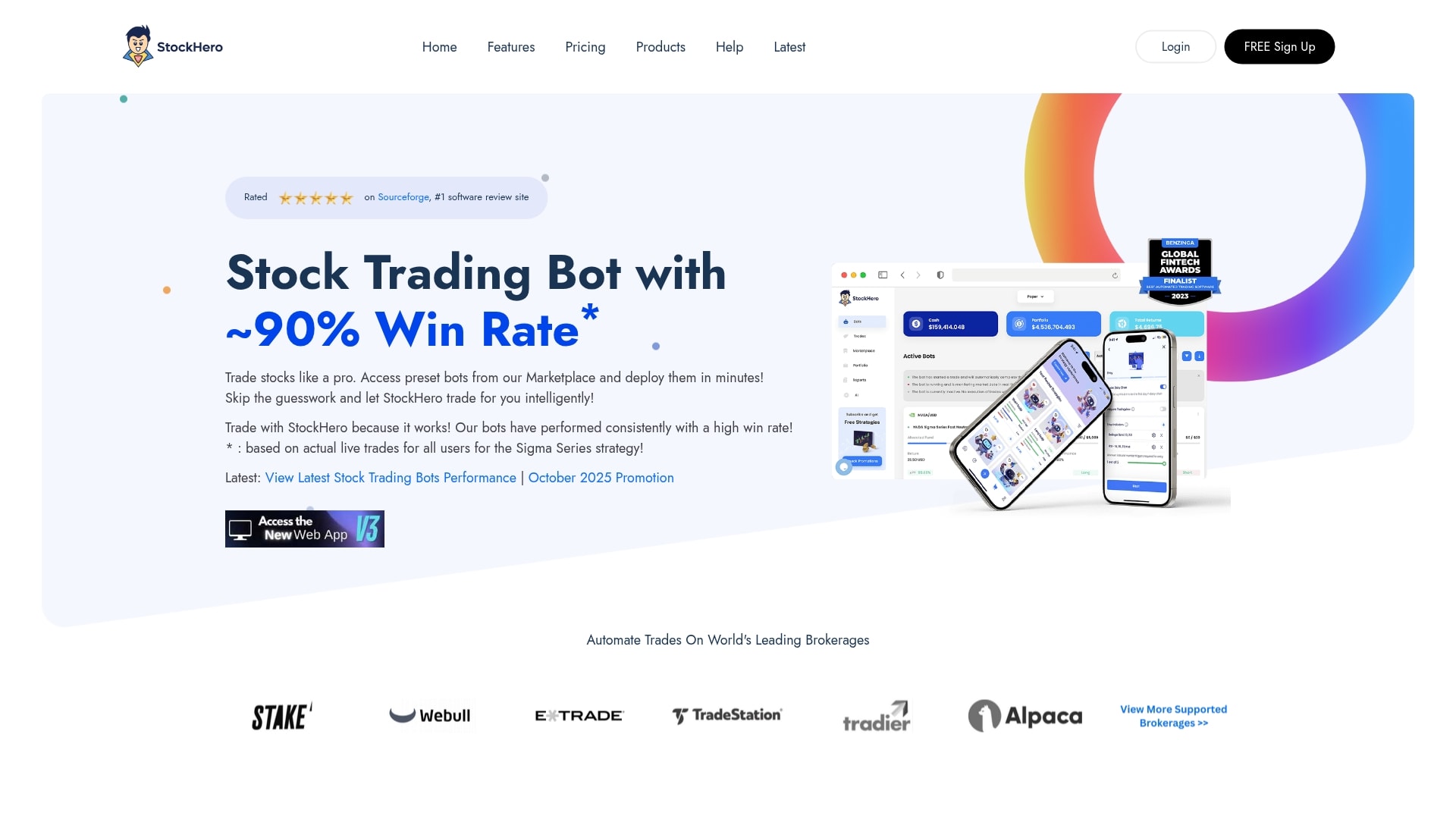
Use case: StockHero automates stock trading strategies through AI-powered bots that operate 24/7, allowing users to execute proven trading approaches without constant market monitoring.
Key features:
- Strategy marketplace: access pre-built trading bots created by experienced traders, including the Sigma Series with reported 90% win rates.
- No-code bot builder: create custom trading strategies using drag-and-drop interface with technical indicators like RSI, MACD, and Bollinger Bands.
- Multiple bot types: deploy DCA, Grid, Momentum, and Advanced bots for different market conditions and trading styles.
Pricing:
- Lite: $29.99/month or $299.99/annually (1 active bot, unlimited backtests, TradeStation support).
- Premium: $49.99/month or $499.99/annually (15 active bots, marketplace access, multiple broker support).
- Professional: $99.99/month or $999.99/annually (50 active bots, all marketplace strategies included with annual plan).
- Free-trial: 14-day free trial available for Lite plan.
- Annual plans save 20% compared to monthly billing.
Considerations:
- High win rates don’t guarantee profitability if losing trades exceed winning trade gains.
- Marketplace bots operate as “black boxes” without revealing underlying strategy logic, creating risk if market conditions change.
2. Cryptohopper
Cryptohopper transforms beginners into confident crypto traders through its social trading marketplace and Algorithm Intelligence system. The platform specializes in copy trading and automated strategy selection, making it ideal for newcomers who want to learn from experienced traders while their bots handle the heavy lifting.
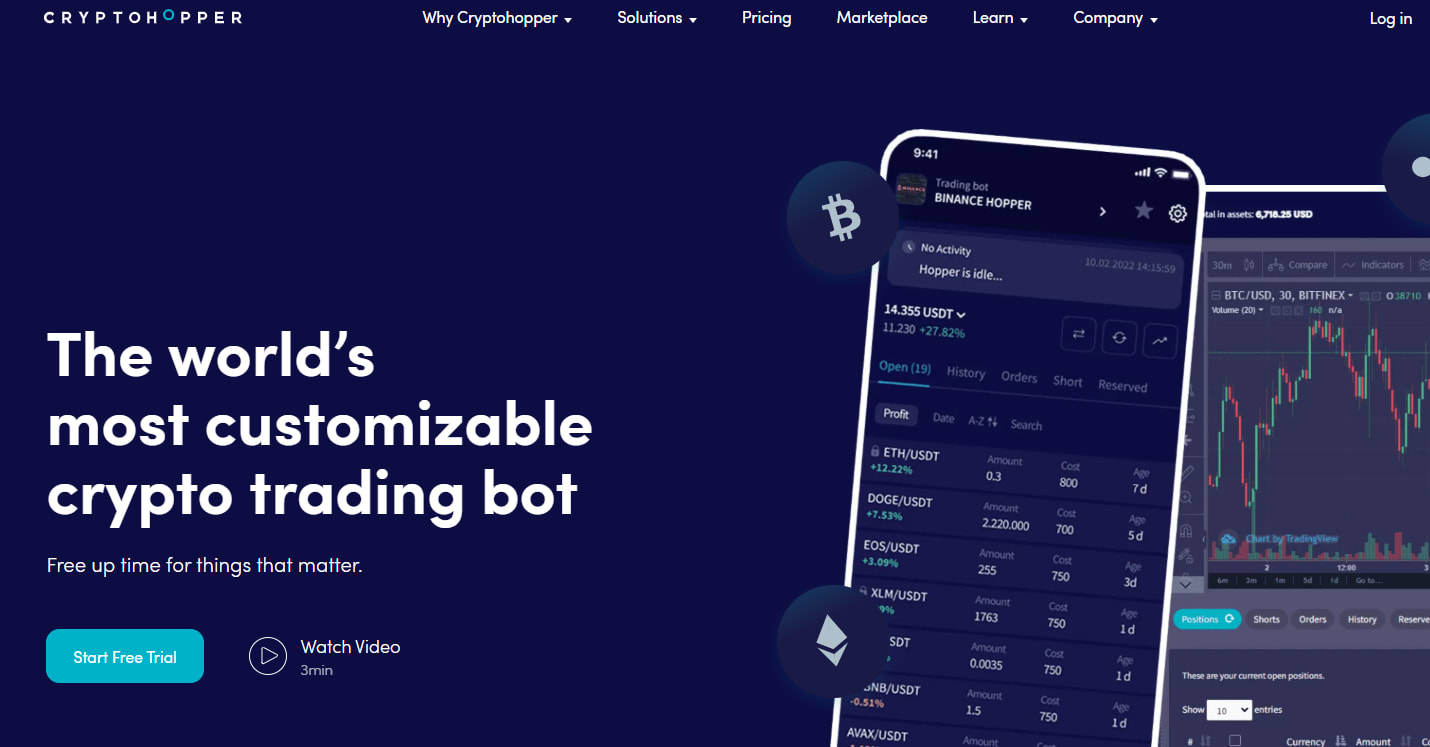
Use case: Cryptohopper enables beginners to start automated crypto trading by copying successful traders’ strategies while gradually learning to build their own through extensive educational resources and a user-friendly drag-and-drop interface.
Key features:
- Social trading marketplace: copy proven strategies from experienced traders and gradually learn their techniques.
- Algorithm Intelligence: automatically backtests and ranks multiple strategies, then switches between them based on market conditions.
- Comprehensive educational academy: tutorials, guides, and paper trading to help beginners understand crypto trading fundamentals.
Pricing:
- Pioneer: free (no payment details required, includes unlimited copy bots and 20 open positions per exchange).
- Explorer: $24.16/month with annual savings of $58 (includes 80 open positions, strategy designer, backtesting, and three-day free trial).
- Adventurer: $57.50/month with annual savings of $138 (includes 200 open positions and 5-minute strategy intervals).
- Hero: $107.50/month with annual savings of $258 (includes AI strategies, 500 open positions, and advanced features like market making).
- Copy Bot Trading: $9.99 to $99.99/month depending on the trader you choose to copy.
- All subscriptions include a two-week refund policy.
Considerations:
- The term “AI” can be misleading since it’s actually an algorithm that tests user-provided strategies rather than creating new ones.
- Full AI features are only available on the expensive Hero plan, which may be cost-prohibitive for beginners just starting out.
3. 3Commas
3Commas functions as a crypto command centre, offering a team of tireless trading bots that work 24/7 across all your favorite exchanges from a single dashboard. While not true self-learning AI, these bots use powerful, rule-based automation with some clever AI-assisted features.
With deep customization for DCA and grid trading, it’s a great way to put your crypto investing on autopilot without being glued to the charts.
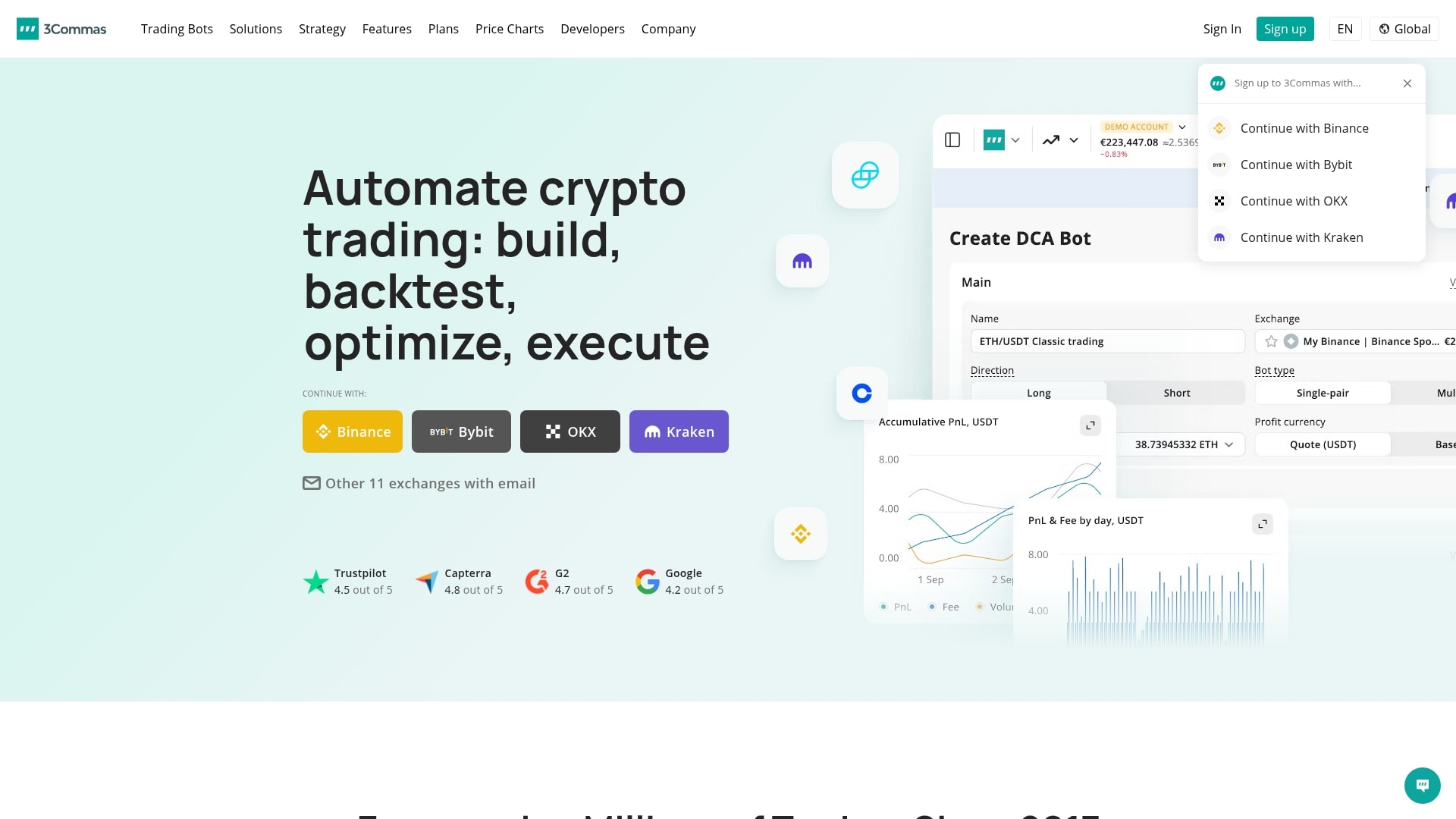
Use case: 3Commas lets you build a team of automated bots to handle your crypto trading. You set the rules and technical indicators, and they execute the trades, freeing you from the need to constantly watch the market. It’s like having a junior trader who never sleeps.
Key features:
- DCA Bots: specialists for buying low and selling high. They automatically average your entry price on both long and short trades, turning market movements into opportunities.
- Grid Bots: perfect for choppy markets. They place a grid of buy and sell orders to profit from price fluctuations. You can set it up yourself or let the AI Grid Bot suggest a strategy.
- Smart Trading Terminal: manage all your exchange accounts from one place with advanced order types like trailing stops and take-profits that you won’t find on most exchanges.
- TradingView Integration: send custom signals from TradingView to 3Commas to have your bots trade automatically.
Pricing:
- Free: $0/month to get your sea legs. Includes paper trading, 10 DCA bots, 10 Grid bots, and view-only access for two exchange accounts (no futures trading).
- Pro: $37/month (with annual discount). Unlocks 50 active DCA bots, 10 active Grid bots, and 50 active SmartTrades.
- Expert: $59/month (with annual discount). Go big with 250 active DCA bots, 50 active Grid bots, and unlimited SmartTrades.
- Asset Manager: $374/month (with annual discount). Built for pros managing multiple client accounts with advanced management tools.
- Custom Plan: contact sales for a tailored plan.
Considerations:
- While the interface is clean, mastering advanced bot configurations can feel like learning a new instrument. It takes time, but the platform offers a paper trading mode and educational resources to practice.
- The platform has faced security incidents in the past. While 3Commas has since implemented stronger security measures, it’s a reminder to always use best practices like 2FA to protect your accounts.
4. TradeSanta
TradeSanta delivers automated cryptocurrency trading through cloud-based bots that operate 24/7 without requiring technical expertise. The platform specializes in simplifying complex trading strategies for beginners, making it possible to set up profitable bots in under 10 minutes.
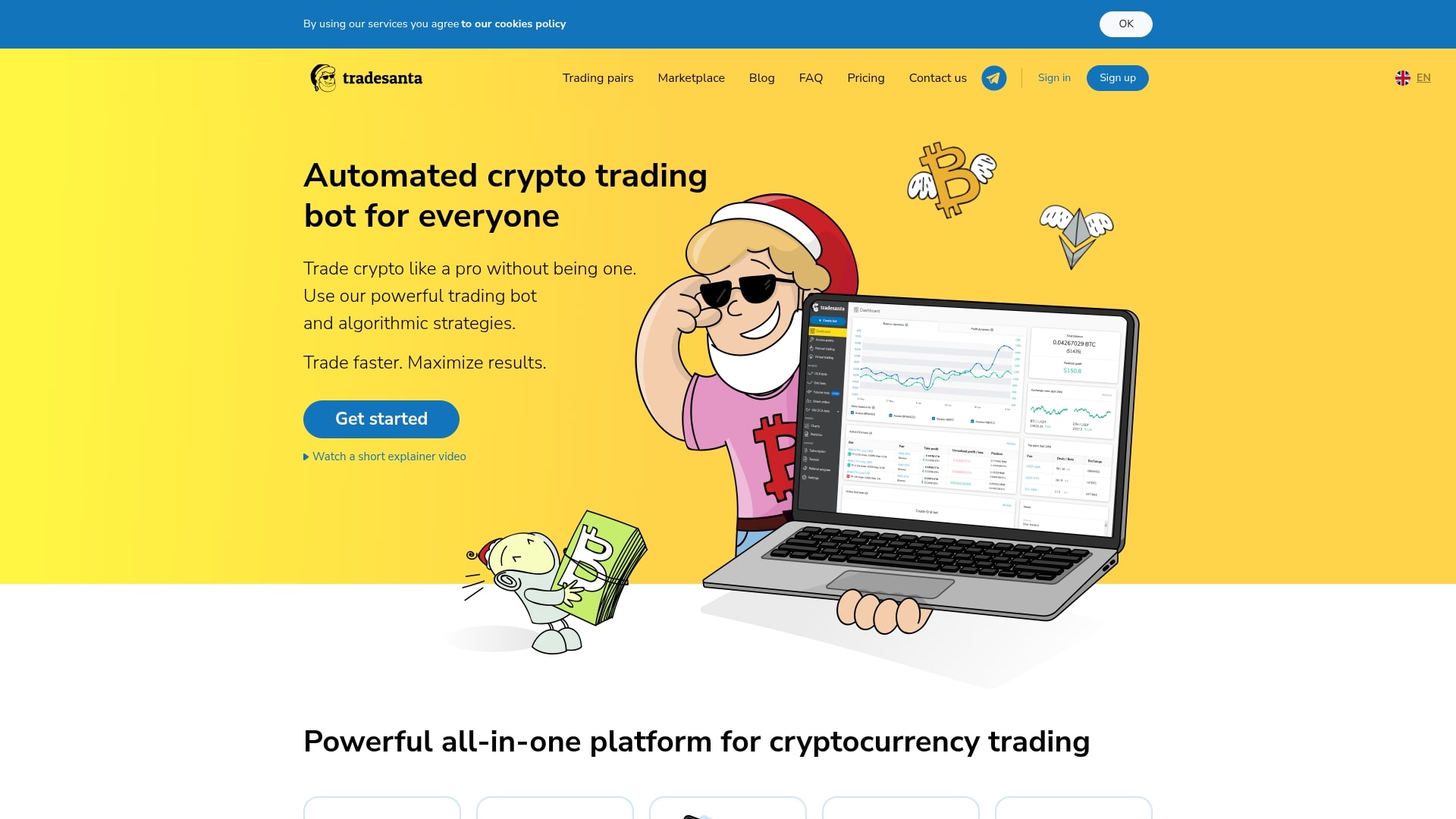
Use case: TradeSanta automates cryptocurrency trading across multiple exchanges using Dollar-Cost Averaging (DCA) and Grid strategies, allowing users to profit from both rising and falling markets without constant monitoring.
Key features:
- Cloud-based operation: bots run continuously in the cloud, executing trades 24/7 even when your computer is offline.
- Long and short trading: capitalize on both bull and bear markets with strategies designed for any market condition.
- Technical indicator integration: use RSI, MACD, and Bollinger Bands to automate entry and exit timing for more strategic trading.
Pricing:
- Basic: $18/month (regularly $25) – up to 49 bots with all core strategies.
- Advanced: $32/month (regularly $45) – up to 99 bots plus Trailing Take Profit and TradingView signals.
- Maximum: $45/month (regularly $90) – unlimited bots with futures trading and custom TradingView signals.
- Free-trial: available with no credit card required.
Considerations:
- Limited to primarily DCA and Grid strategies, which may not satisfy advanced traders seeking more complex algorithmic approaches.
- Mobile app has reported reliability issues with bot setup and login functionality.
Free AI trading bots vs paid options
Beginning with a free AI trading bot is a great initial step to take, enabling you to explore a low-risk environment and understand the fundamentals of automation, without a significant financial commitment.
However, free bots have inherent limitations, and recognizing when to graduate to a more powerful tool is key to building a winning long-term strategy.
As your strategy and portfolio grow, you’ll know when it’s time to bring in more advanced capabilities. Remember, you are the director of your financial strategy, and you decide when to expand the roster of tools at your disposal.
Free bot features
A free bot is your specialist for the basics. They excel at simple, repeatable strategies like dollar-cost averaging or basic portfolio rebalancing, which is the perfect way to get started. You’ll gain real-world experience watching automation in action.
Their focus comes with trade-offs, like limits on trading volume or the number of active strategies. These aren’t flaws; they’re the bot’s job description. They’re ideal for smaller portfolios where you’re learning risk tolerance, not chasing complex market indicators.
When to upgrade
You’ll know it’s time to invest in premium tools when you start feeling constrained. Hitting trade frequency limits or wishing you could backtest a new idea are clear signals that your strategy has outgrown your current setup: this is your cue to look for a more advanced player.
The upgrade makes sense when your portfolio grows and the potential gains from advanced features outweigh the subscription cost. For active traders, premium analytics and faster execution can pay for themselves. It’s about equipping your team with the right tools for the job you’re giving them.
The hidden price tag on “free”
“Free” rarely means zero cost, and it’s your job to read the fine print. Many free platforms make their money through higher trading fees, less favorable exchange rates, or by taking a small cut of your profits. These hidden costs can add up faster than a monthly subscription.
Before you commit, do the math. A “free” bot with a 0.5% trading fee will cost you more than a paid subscription if you’re trading actively. You’re in charge, so get the real numbers on all fees to see which option is truly the most cost-effective for your playbook.
How do AI Trading bots generate returns?
An AI trading bot functions as a dedicated market specialist, but it operates without secret insights or predictive magic. Its power lies in its ability to execute a chosen strategy with unwavering discipline, 24/7, free from human emotion. These bots are not a source of guaranteed riches; anyone promising that is selling hype, not a helpful tool.
Their real power is discipline. While you’re living your life, your bot is patiently watching the market, making moves based on the rules you set: freeing you from the stress of constant chart-watching.
Common trading strategies with bots
Your role is to assign the right mission to each component of your trading system. Most bots are designed to execute one core strategy with perfect focus.
Some strategies are about consistency. For example, a dollar-cost averaging bot provides a steady hand, buying a fixed amount on a regular schedule to smooth out market volatility. Others are about speed, like arbitrage bots that act as quick opportunists, exploiting tiny price differences between exchanges.
You can also play the momentum. Trend-following bots are designed to ride the wave by buying into rising assets. In contrast, mean reversion bots bet that what goes up must eventually come down (and vice-versa), buying dips and selling spikes.
Realistic profit expectations
Success with AI trading is about steady progress, not sudden windfalls. Most well-managed systems deliver consistent returns rather than dramatic spikes.
What to expect:
- Average returns: typically 5–15% per year, depending on market conditions and strategy.
- Consistency wins: small, steady trades usually outperform risky, high-volatility plays.
- Reliable systems: the best bots act like dependable teammates — precise, predictable, and focused on long-term gains.
Real progress comes from patience and structure, not shortcuts.
Risk vs reward for beginners
An AI bot doesn’t eliminate risk; it helps you manage it systematically. Higher potential returns always come with higher risk, which is why you remain in control of the equation. You set the rules and the limits.
The smartest way to start is to treat your first investment as tuition. Begin with an amount you’re comfortable learning with, and give your new AI helper a small, manageable task. As you see how it performs and gain confidence, you can gradually give it more responsibility.
How to train your first trading bot
Training your first trading bot is less about complex algorithms and more about setting clear, repeatable rules. Think of it as onboarding a junior trader: you define the scope, set boundaries, and test performance before trusting it with real capital.
The goal isn’t to predict the market. It’s to create a system that follows your logic consistently, supports strategic decisions, and removes emotional reactions from execution.
Step 1: pick your bot’s playground
Start by deciding where your bot will operate. Different markets require different expectations.
- Stock markets: structured hours, lower volatility, and clearer regulation.
- Crypto markets: 24/7 trading, faster price swings, and higher risk tolerance required.
Choose the environment that matches your experience level and availability. Beginners often benefit from the predictability of stocks before moving into always-on markets.
Step 2: set up a secure home base
Your bot needs a reliable exchange or brokerage account to operate. This account is your system’s foundation, so security comes first.
- Enable two-factor authentication immediately.
- Use API keys with limited permissions.
- Keep trading access separate from withdrawal rights.
A secure setup protects both your capital and your confidence as you start automating.
Step 3: give your bot the right access
Once connected, permissions should be minimal and deliberate. Your bot should only do what you explicitly allow.
- Trading access only, never withdrawals.
- Clear limits on order size and frequency.
- Defined assets or symbols it is allowed to monitor.
This keeps automation helpful rather than risky.
Step 4: define the rules clearly
Bots perform best when the rules are simple and precise. Avoid stacking too many indicators or conditions at the start.
Focus on:
- Entry signals you understand.
- Exit rules that protect downside.
- Position sizing that limits exposure per trade.
Clear rules support consistency and protect you from over-optimization early on.
Step 5: test before going live
Never skip testing. Paper trading or sandbox modes let you observe behavior without financial risk.
Run your bot in a simulated environment long enough to see how it reacts to both wins and losses. Look for discipline, not perfection. When the system behaves predictably and aligns with your strategy, you’re ready to move to live trading.
Training a trading bot is an iterative process. Start small, review results regularly, and refine rules over time. The strongest setups evolve alongside your understanding of the market — supporting smarter, more confident strategic decisions as you go.
Frequently asked questions
Can beginners really profit from AI trading bots?
Yes, beginners can profit from AI trading bots, but it's important to think of your bot as a platform, not a magic money machine. Your profitability depends on a smart strategy and understanding the market you're pointing it at.
How much money do beginners need to start AI bot trading?
The amount of money beginners need to start AI bot trading can be as low as $100 on some platforms, but the real rule is simple: only use money you're prepared to lose. This is your training ground, so treat it like one.
Are AI trading bots safe for beginners to use?
Safety comes from using reputable platforms and the rules you set for your bot. You're in charge, so build in safety nets like stop-losses that match your personal risk tolerance.
Do beginners need programming skills to use AI trading bots?
Not at all; most modern platforms are no-code and built for everyone. If you can set a filter in your email, you have the skills to build and manage a trading bot.
Which is more suitable for beginners: crypto or stock trading bots?
Stocks are generally a better starting point because the market has set hours and is less volatile. Think of it as learning to drive on a quiet street before hitting the 24/7 highway of crypto.
How do AI trading bots perform during market crashes?
A bot only performs as well as the strategy you give it, especially during a crash. It will follow your pre-set risk rules without panic, but it can't predict or prevent a market-wide downturn.

 Get started