


Trusting your team to learn, improve, and eventually run on their own is part of a manager’s job. Yet handing over control can feel more like losing it. If you worry about what happens when you loosen your grip, it’s worth asking what happens if you don’t.
Learning how to stop micromanaging is one of the highest-leverage shifts a leader can make. Global employee engagement fell to 20% in 2025, according to Gallup’s State of the Global Workplace. When people feel controlled instead of trusted, they check out, and the business feels it.
This guide breaks down what micromanaging really is, why capable managers fall into it, and the practical steps to lead through trust instead. You’ll also see how the monday AI Workspace gives you visibility into work without hovering over it.
Key takeaways
- Micromanaging is a control-heavy style where managers dictate how work gets done instead of setting clear outcomes.
- Most micromanagement comes from fear, low trust, or manager burnout rather than a fixed personality trait.
- The fastest way to stop is to delegate outcomes, set clear expectations, and replace constant check-ins with scheduled ones.
- You can hold people accountable without hovering by defining ownership up front and reviewing progress at milestones.
- The monday.com AI Work Platform gives managers real-time visibility through dashboards and automations, so oversight no longer means control.
What is micromanaging?
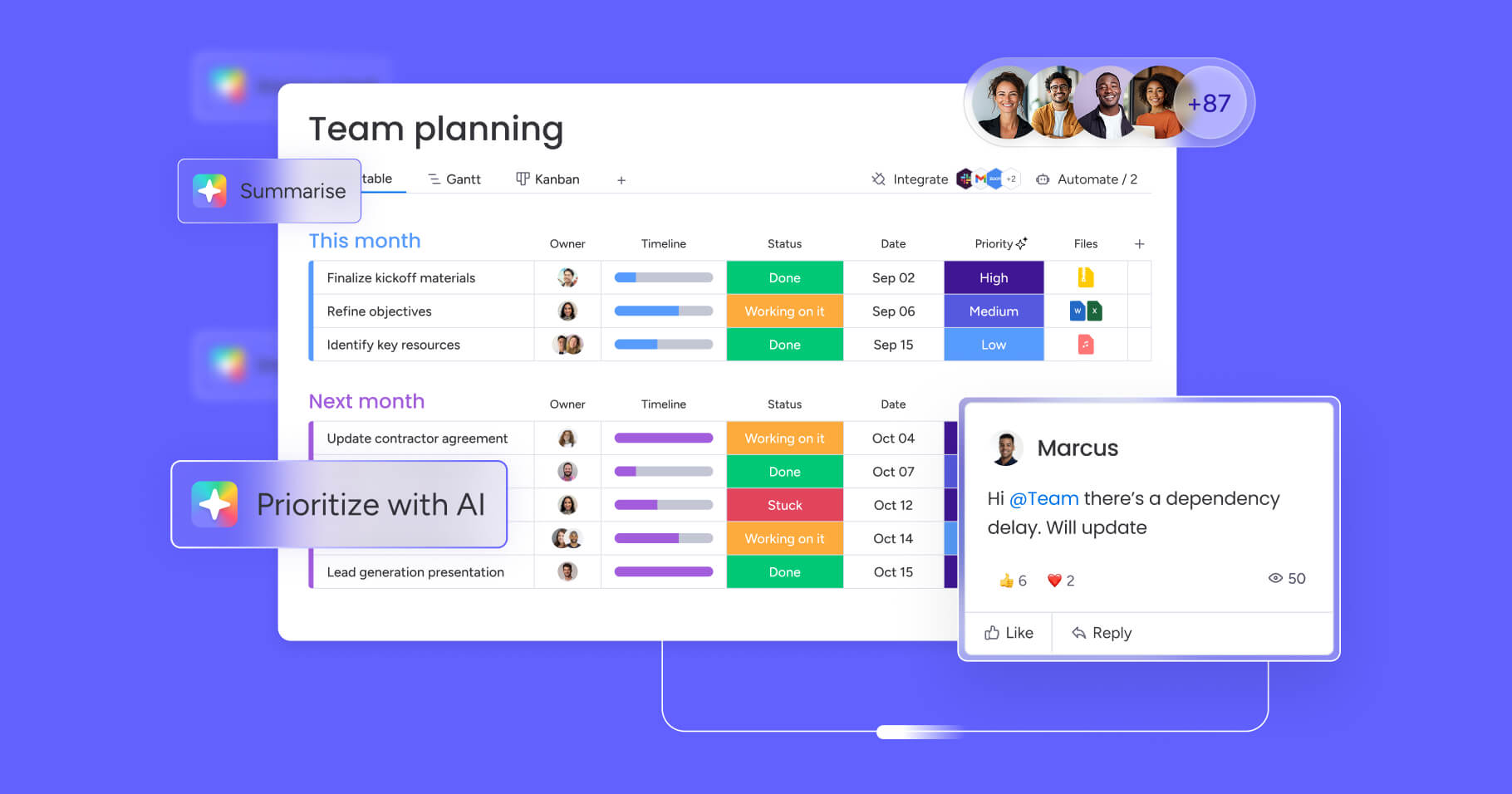
Micromanaging is a control-heavy management style where a leader over-involves themselves in how work gets done. Instead of setting a goal and trusting the team to reach it, a micromanager inspects each step and dictates the method. The focus shifts from results to process, and from ownership to oversight.
Effective management works the opposite way. A strong manager defines the outcome, agrees on what success looks like, then checks progress at sensible points. The team owns the “how,” while the manager stays accountable for the “what.” A micromanaging leader might rewrite a colleague’s email before it goes out. An empowering leader reviews the draft against the goal, flags anything off-track, and lets the person finish it their way.
The key difference is this: Staying close to important work is part of good leadership. The problem starts when involvement turns into control, and when your input is about preference rather than the outcome. Most managers slide toward control without ever deciding to. Once you can see the pattern clearly, you can start replacing it with something better.
Managing vs. micromanaging: How to tell the difference
The line between involved and over-involved can feel blurry in the moment. Laying the 2 styles side by side makes it easier to catch yourself and choose the leadership behavior instead. The difference is rarely about how much you care, and almost always about how much you control.
| Dimension | Micromanaging | Effective management |
|---|---|---|
| Delegation | Assigns tasks with strict, step-by-step instructions | Assigns outcomes and lets people choose the method |
| Feedback | Corrects small details and rewrites finished work | Coaches toward the goal and lets people finish it |
| Check-ins | Requests constant, unscheduled updates | Reviews progress at agreed milestones |
| Ownership | Keeps final say on every decision | Grants clear decision rights to the team |
| Adapting to context | Applies the same tight control to everyone | Adjusts support to each person's skill and the stakes |
Effective management still involves plenty of engagement. The manager sets direction, coaches, and reviews progress. What they don’t do is own the method or second-guess every choice. If you’re unsure which side of the line you’re on, look at where your energy goes. Time spent clarifying outcomes and removing blockers is leadership. Time spent inspecting and redoing is control.
7 signs you're micromanaging your team
Recognizing the pattern is the first step to changing it. Micromanagement rarely feels like micromanagement from the inside, since it often masquerades as being thorough or caring about quality. These 7 signs help you diagnose it honestly before it erodes trust.
- You need to approve every decision: Work stalls whenever you’re unavailable because nothing moves without your sign-off.
- You redo other people’s work: You routinely rewrite, reformat, or rebuild finished tasks to match exactly how you’d have done them.
- You hover over delegated tasks: You assign something, then check on it so often that you never really hand it over.
- You’re rarely satisfied: Good work still feels not-quite-right, and you struggle to call anything truly done.
- You discourage independent decisions: Your team asks permission for small choices they could easily make on their own.
- You require constant updates: You request status reports so frequently that people spend more time reporting than working.
- You fixate on tiny details: You focus on formatting and word choice while bigger priorities drift.
A useful gut check is to count how often your team asks for permission versus how often they inform you of a decision they’ve already made. Healthy teams lean toward the second. If almost everything routes through you for approval, that’s a clear sign the balance has tipped toward control.
If several of these feel familiar, you’re not a bad manager. You’re a busy one who’s defaulted to control. The good part is that every one of these habits is fixable with a different set of routines, and none of them require a personality change.
Why managers micromanage
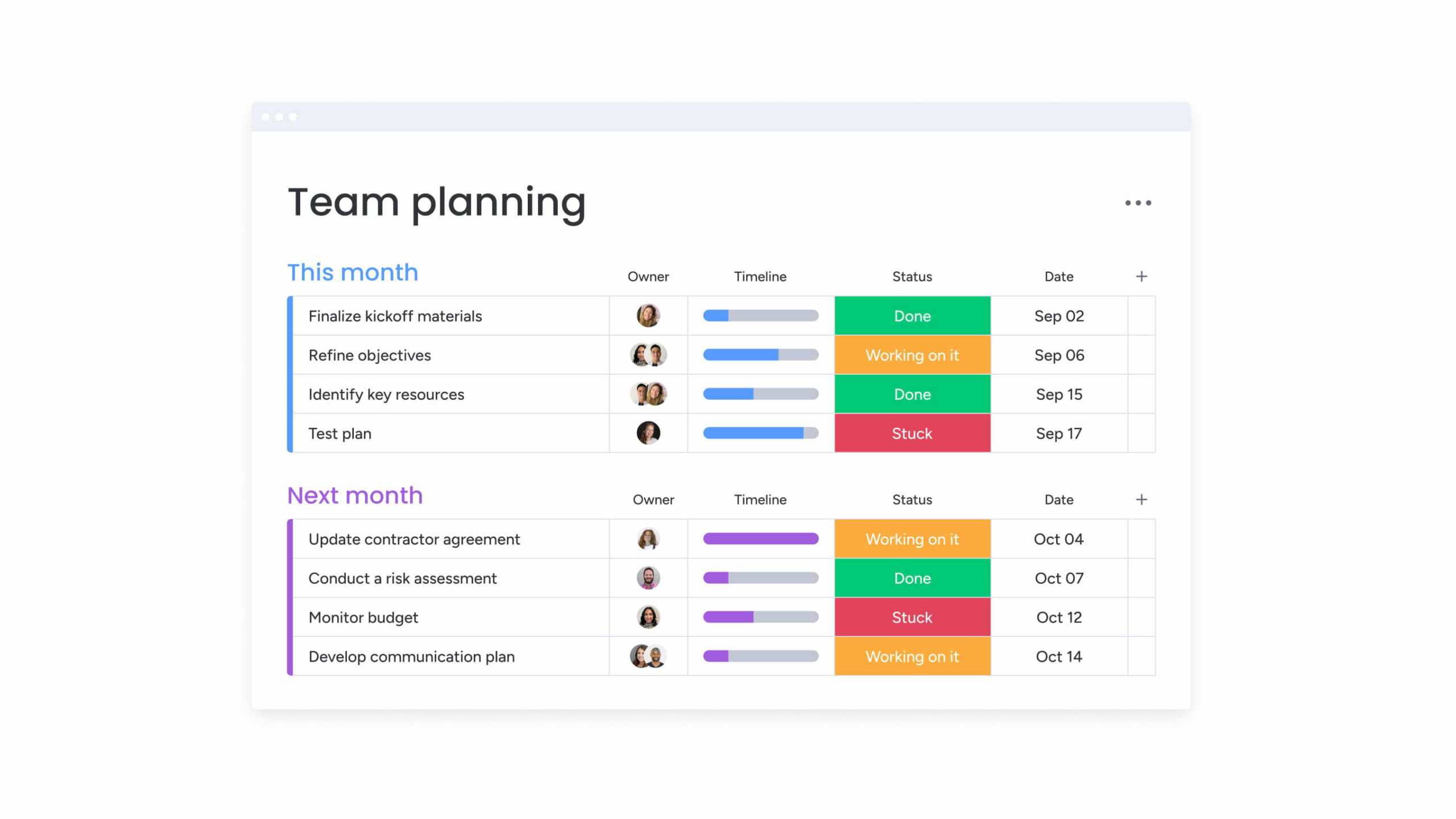
No one plans on becoming a micromanager. They dream of being a leader. So it helps to look honestly at what pulls you toward control in the first place.
Start with self-reflection. What goes through your mind when you second-guess your team’s work? Do you mistrust their judgment or attention to detail? Do you feel insecure about your own position, and worry there’s no room for mistakes? Ask where that pressure is really coming from, because the answer usually points to the fix.
A few root causes show up again and again:
- Fear and perfectionism: You equate quality with your own hands-on involvement, so letting go feels risky.
- Low trust: You haven’t yet seen the team deliver without you, so you assume they can’t.
- Unclear expectations: When no one agreed on what “good” looks like, you police the work instead.
- Manager burnout: Overloaded leaders default to control because it feels faster than coaching.
Burnout is a bigger contributing factor than most people realize. Manager engagement has dropped from 31% to 22%, according to Gallup’s report on global employee engagement. Micromanagement is often a symptom of an overstretched manager, not just a personality flaw, which means the cure is better systems as much as better willpower.
Get StartedThe hidden costs of micromanagement
The psychological effects of micromanagement are real. People who feel controlled report lower confidence, more stress, and less motivation, because the message underneath the behavior is “I don’t trust you.” Over time that quiet signal reshapes how a whole team works.
The damage spreads well beyond morale. Here’s what micromanagement quietly costs a business:
- Higher turnover: Talented people leave when they feel they can’t own their work or grow.
- Lower morale: Constant oversight drains enthusiasm and replaces it with caution.
- Stalled skill growth: People never develop judgment if every decision runs through you.
- Bottlenecked managers: You become the ceiling on everything, so nothing scales past your capacity.
- Widespread disengagement: Teams stop bringing ideas when they expect to be overruled.
There’s a cost to the manager, too. When you own every decision, your calendar fills with approvals and status checks, leaving no space for strategy or growth. The behavior that felt like protecting quality ends up capping how much your team, and you, can achieve.
The engagement picture makes the stakes clear. With global engagement sitting at just 20% in 2025, according to Gallup, few teams can afford a management style that pushes people further away. Trust isn’t a soft nicety here. It’s one of the most reliable ways to increase your team’s productivity and keep good people engaged.
7 strategies to stop micromanaging
Accepting that you may be micromanaging is half the battle, so the worst is already behind you. The next part is replacing old reflexes with new routines. These 7 strategies move you from controlling the work to leading the people who do it.

- Understand your triggers. Before you change what you do, understand why you do it. Notice the moments you reach for control, then take a few practical steps to shift your focus.
- Delegate outcomes, not tasks. Hand over the “what,” not the “how.” Tell people the result you need and why it matters, then let them choose the path. Learning to delegate and organize your team’s work is how ownership actually transfers.
- Set clear expectations and success criteria. Much micromanagement fills a vacuum left by vague direction. Agree up front on the outcome, the deadline, and what “done well” looks like, so you don’t need to police the details later.
- Focus on outcomes over process. Judge work by whether it hit the goal, not by whether it matches your exact approach. When results are strong, resist rewriting the method. Different paths to the same outcome are a sign of a healthy team.
- Replace constant check-ins with scheduled ones. Swap random status pings for a predictable rhythm, like a short weekly review. People work more freely between check-ins, and you still stay informed. Automations on monday.com can send those status updates and reminders for you, so you stop chasing progress manually.
- Gather feedback from your team. Let your team know you’ll schedule meetings to discuss internal processes and expectations, and that you’re committed to acting on what you hear. Learn about their strengths and interests, because understanding each person helps you structure the team to work better together.
- Keep yourself accountable. Changing your style is a shift in daily habits, not a one-time decision. When you hear the pull of micromanagement, ask yourself one question: “Am I being a leader, or a manager, right now?”
How to stay accountable while you shift
- Talk it through with your boss: Sit down to understand their KPIs for you and your team, so you know where you stand and what to prioritize.
- Empower your team with small initiatives: Assess individual strengths, then start with projects you feel comfortable letting go of and have people own them end to end.
- Focus on the big picture: Set your own goals for where you want to lead the team, and your priorities will shift from managing tasks to leading people.
How to hold your team accountable without micromanaging
Accountability and micromanagement often get confused, but they’re opposites. Micromanagement controls the how. Accountability clarifies the what and then trusts people to deliver it. You can stay firmly on top of outcomes without hovering over anyone’s keyboard.
The trick is to build accountability into the way work is set up, not to enforce it through pressure. When people know what they own and how progress will be checked, they hold themselves to the standard without you standing over them.
These habits keep standards high while leaving room to breathe:
- Define ownership up front: Make it clear who owns each outcome, so responsibility is never ambiguous. Giving every project task a single owner removes the confusion that tempts you to step in.
- Use milestones, not moments: Break work into visible slices and review progress at each one instead of watching continuously.
- Normalize 2-way feedback: Invite people to flag blockers early, and treat course-corrections as normal rather than as failures.
- Catch drift early: Address small gaps at the next milestone before they grow, which removes the excuse to hover.
When progress is transparent, you don’t need a status meeting to know where things stand. Dashboards on monday.com show real-time progress and workload, so you can check the “what” at a glance and save your attention for where it’s genuinely needed.
Get StartedHow to build an autonomous team
Stopping micromanagement clears the way, but autonomy still has to be built on purpose. Whether performance, a rough process, or unclear communication got you here, the way forward is to see the full picture and then hand over real ownership.
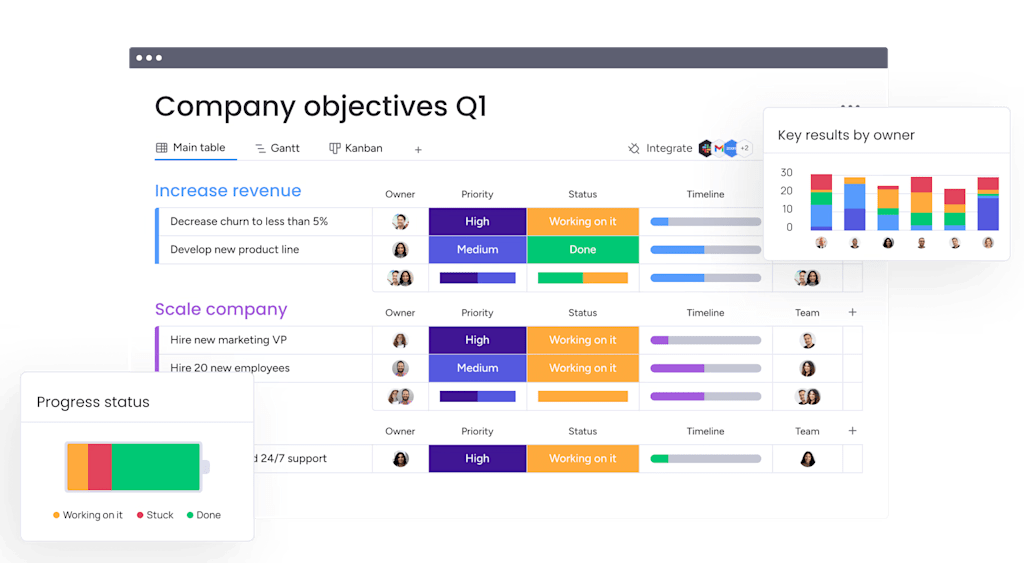 Your motivation should be to create an autonomous team. Think of this as sharing the end goal for your team, then letting them figure out how to best get there. When people are empowered with freedom and a clear goal, they’ll find ways to overcome hurdles, move faster, and hit their targets.
Opening the floor and letting others talk can lead to some unexpected discoveries, so be open to what you may find. The focus should be on building trust within your team in order to enable them to work autonomously.
From there, a few deliberate moves deepen autonomy:
- Clarify decision rights: Spell out which calls people can make on their own and which ones truly need you, so no one waits unnecessarily.
- Give stretch ownership: Hand capable people a project slightly bigger than their comfort zone, and let them grow into it. Pairing this with clear task management methods gives them structure to succeed.
- Celebrate independent wins: Recognize good outcomes that happened without your involvement, which reinforces that autonomy pays off.
Each time someone makes a good call without checking first, the team’s collective judgment sharpens and your need to intervene shrinks. Expect a few mistakes along the way, and treat them as learning rather than proof that you should take control back. The highest-performing teams are usually the ones whose managers gave them room early.
How monday's AI Work Platform helps you lead without micromanaging

Most micromanagement comes down to a visibility problem. Managers often hover because it’s the easiest way they know to stay informed. The monday.com AI Work Platform removes that need by making work transparent, so oversight no longer means control. You see status, progress, and risk in real time, and your team keeps the freedom to work their way.
Here’s how the platform replaces hands-on control with always-on visibility:
- Dashboards: real-time, no-code dashboards give you visibility into progress, workload, and risk across the team. AI-powered risk alerts and AI-generated summaries surface issues early, so you spot problems without chasing anyone for a status.
- Automations: no-code recipes handle status updates, reminders, and task handoffs automatically, which means you stop chasing progress by hand and your team stops fielding “any update?” pings.
- monday sidekick: this context-aware AI assistant answers questions like “what’s the status of the launch?” in plain language, so you get an instant read on work without interrupting the people doing it.
- monday agents: ready-made agents such as Risk Analyzer monitor work 24/7 and flag bottlenecks. They act as an extra set of eyes, so you don’t have to watch every board yourself.
- Governance and permissions: roles and access give you oversight without control. You decide who can see and change what, and you can invite external partners to contribute when needed.
Together these capabilities change what oversight feels like for both sides. You get earlier, clearer signals about where work stands, and your team gets to focus on the work itself instead of reporting on it. That’s the core idea: the platform absorbs the busywork of staying informed, so you can spend your attention on decisions and coaching.
The shift becomes clear when you compare the manual habits with the platform-led approach. As one example, a manager who once ran 3 status meetings a week can trade them for a live dashboard that’s always current.
| The old, hands-on way | Leading with monday's AI Work Platform |
|---|---|
| Recurring status meetings to learn where work stands | Live dashboards that show progress in real time |
| Chasing team members for manual updates | Automations that post updates and reminders for you |
| Spotting risks late, once they've become problems | AI risk insights that flag issues early |
| Digging through boards to answer a quick question | monday sidekick answering status questions in plain language |
| Controlling access by doing the work yourself | Governance and permissions that grant oversight without control |
By balancing independence with visibility, the platform lets your team run their daily workflows while you stay informed on the status, progress, and owners of every project. Try out a ready-made template to give your team a head start on working autonomously.
Start turning control into trust
Learning how to stop micromanaging means trading control over the how for clarity about the what. When you set clear outcomes, delegate ownership instead of tasks, and replace constant check-ins with scheduled milestones, your team gets room to grow and you get your time back for strategic work. The shift sticks when you ask yourself one question before every intervention: “Am I being a leader, or a manager, right now?”
The monday.com AI Work Platform makes that shift easier by giving you real-time visibility without the hovering. Dashboards, automations, and AI-powered insights show you progress, risk, and workload at a glance, so you can lead with confidence while your team owns the work.
Get StartedFAQs
Is micromanaging a form of bullying?
Micromanaging isn't the same as bullying, but it can cross the line when it becomes personal, constant, or intended to belittle. Persistent control that undermines someone's confidence may qualify as workplace harassment.
How do I deal with a micromanaging boss?
Proactively share regular progress updates so your manager feels informed before they have to ask. Then have a calm, specific conversation about the level of autonomy you'd like to earn.
What's the difference between delegating and micromanaging?
Delegating hands over an outcome and lets the person choose how to reach it. Micromanaging assigns the task but keeps controlling every step of the method.
Does micromanaging ever make sense?
Temporary close supervision — not micromanagement — can be appropriate for brand-new hires or high-stakes, high-risk work. The key is to treat it as temporary and step back as competence and trust grow.
How does monday's AI Work Platform help managers avoid micromanaging?
It gives real-time visibility through dashboards, automated status updates, and AI risk alerts, so you stay informed without hovering. That means you can oversee outcomes while your team owns the day-to-day work.

 Get started