Green efforts at Elevate: behind the scenes of a sustainable conference
- Elevate tracks carbon emissions across six categories before any offsetting begins, including staff travel, production transport, and venue energy use.
- At Elevate EMEA ’25, the team reduced carbon emissions per participant from 36.29 kgCO2e to 30.67 kgCO2e year-over-year, a reduction of 5.62 kgCO2e, measured by third-party tool TRACE.
- Waste per participant dropped from 7.36 kg to 5.48 kg at Elevate EMEA ’25. Only 0.3% of waste went to landfill.
- 100% of purchased items from Elevate EMEA ’25 were rehomed to staff or donated to Community Hospice for Greenwich and Bexley.
- By Elevate ’25, the cumulative tree planting effort had surpassed 500,000 trees globally through verified partners Trees for the Future and World Restoration Flagship.
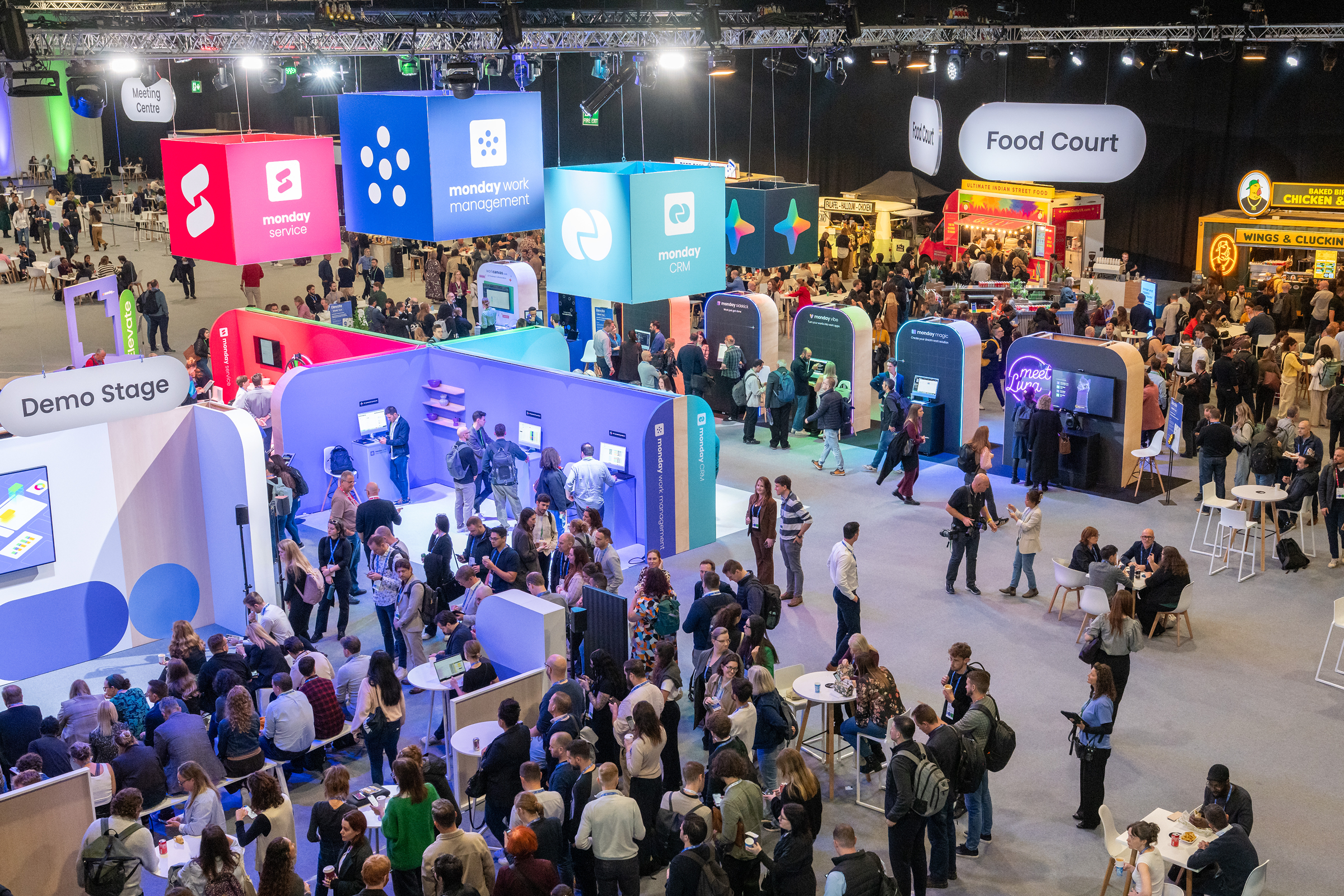
Here’s a detail you probably wouldn’t notice at Elevate unless someone pointed it out: at Elevate ’25 NYC, every plate, cup, and utensil was fully compostable. The signage was printed on 100% recycled materials with water-based inks. Beef and lamb didn’t appear on the menu at Elevate EMEA ’25 in London. And when the event wrapped, 100% of purchased furniture and props were donated to local community organizations rather than sent to a landfill.
None of this is incidental. It’s planned from the start, measured throughout, and reported after every event.
This post covers how Elevate approaches sustainability in practice: the measurement framework, the material and catering decisions, what happens to waste and leftover items after the event, and what the actual numbers looked like at Elevate ’25.
What does Elevate’s approach to sustainability actually look like?
It starts with a clear sequence: measure first, reduce what you can, divert what remains, offset what’s left over. Not a communications strategy. An operational framework that runs from initial planning through post-event reporting.
Elevate uses TRACE, a third-party carbon impact reporting tool, to measure its environmental footprint. That data informs decisions the following year. The year-over-year accountability is what separates a genuine effort from a checklist.
The measurement covers six categories: energy (grid power and generators across all event spaces), production build (stage construction and fabricated elements), graphics (signage, backdrops, and banners), waste (everything in and out, from food to landfill streams), production transport (vendor trucking and shipping), and staff travel and accommodations.
At Elevate EMEA ’25, measurement covered waste from supplier warehouses, production built items, graphics, catering, and crew and supplier travel. Venue energy and attendee travel were excluded from that event’s reporting due to data limitations, something the production team flagged transparently in their ESG report and is working to improve.
What gets reduced before anything is offset?
The approach is reduction first. Offsets are not a substitute for better decisions upfront.
- Recycled signage: At Elevate ’25 NYC, 100% recycled materials were used across all signage, printed with water-based inks on PVC-free vinyl.
- Reusable stage elements: Stage components are designed for reuse across future events, reducing new fabrication each year.
- Hired furniture, not purchased: At Elevate EMEA ’25, furniture was hired from UK suppliers rather than purchased. Fabric choices were natural, biodegradable, or made from recycled materials. Items that reached end of life were donated or sent to approved recycling centers.
- beMatrix booth system: In 2024, sponsor booths were built from scenic flats, heavier and single-use, requiring larger transport vehicles. In 2025, the team switched to the beMatrix frame system, a reusable modular alternative that contributed directly to a measurable drop in production waste.
- Exhibition carpet: The carpet at Elevate EMEA ’25 was 100% recyclable and latex-free, produced from a single high-grade mono-material. It generates 55% fewer emissions during manufacturing than standard event carpet and can be recycled up to 7 times without requiring virgin materials.
Food choices have a direct emissions impact. At Elevate EMEA ’25, beef and lamb were removed from all attendee catering. 50% of menus were plant-forward, vegan, or vegetarian. 80% of the menu featured British seasonal fruit and vegetables. Surplus food was donated to Community Food Enterprise, ExCeL London’s charity food partner.
At Elevate NYC ’25, 100% compostable serviceware was used across the entire event.
What happens to waste, food, and materials after the event?
Waste diversion
At Elevate ’25 NYC, the event achieved 90% waste diversion, keeping the vast majority of material out of landfill through recycling, composting, and donation.
At Elevate EMEA ’25 in London, waste was tracked by weight and destination using TRACE. 57.2% was recycled. 9.9% was re-used. Only 0.3% went to landfill. Waste per participant dropped from 7.36 kg in 2024 to 5.48 kg in 2025, a reduction of 1.88 kg per person, driven largely by switching from disposable booth builds to the reusable beMatrix system.
Material rehoming and food donation
At Elevate EMEA ’25, 100% of purchased items were rehomed. Furniture, props, and decor were returned to staff or donated to Community Hospice for Greenwich and Bexley. The original commitment was 90%. The team hit 100%.
Surplus food from attendee catering was donated to Community Food Enterprise. At Elevate ’25 NYC, food scraps that couldn’t be donated were composted and converted into energy that feeds back into the local power grid.
What did the numbers look like at Elevate EMEA ’25?
The ESG report produced after Elevate EMEA ’25 at ExCeL London gives a specific picture of what the measurement effort captured across 1,500 in-person attendees.
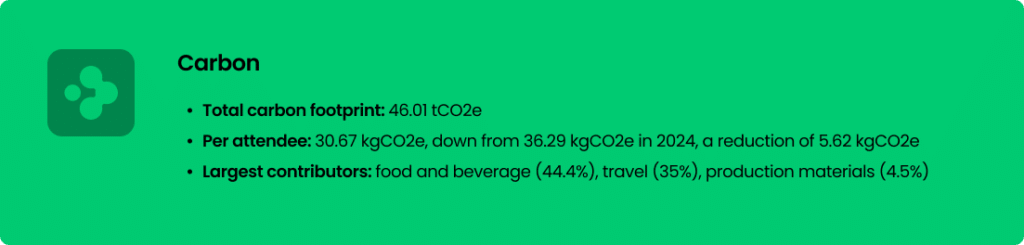


These numbers reflect Elevate EMEA ’25 specifically and don’t represent the NYC event, which operates at a different scale and venue. The methodology — measure everything, reduce before offsetting, report honestly — applies across both.
ExCeL London holds ISO 14001 and ISO 20121 certifications for sustainable event management, Carbon Neutral Certification, PlanetMark Business Certification, and is a signatory of the Net Zero Carbon Events Pledge. 100% of its electricity comes from renewable sources.
Secure your spot at Elevate ’26How has Elevate’s sustainability approach developed over time?
Each year builds on what the previous one measured. The ’24 tracking categories below reflect the six-area framework introduced in the CMS that year; confirm specifics with production if citing externally.
| Theme | Elevate ’23 | Elevate ’24 | Elevate ’25 |
| Carbon tracking | Introduced with South Pole/Climeet | Expanded measurement framework | TRACE reporting, year-on-year comparison |
| Tree planting | Brazil’s Atlantic Forest | Continued global planting | Surpassed 500K trees milestone |
| Waste diversion | Zero-waste solutions introduced | Monitored across all streams | 90% diversion (NYC); 0.3% to landfill (London) |
| Compostable serviceware | Introduced | Continued | 100% across NYC event |
| Material rehoming | Introduced | Continued | 100% of purchased items rehomed (London) |
By Elevate ’25, cumulative tree planting had surpassed 500,000 trees globally through verified partners Trees for the Future and World Restoration Flagship. Earlier years focused on Brazil’s Atlantic Forest, home to 70% of Brazil’s population. The effort has since expanded globally.
FAQs about sustainability at Elevate
-
Is Elevate a sustainable conference?
Elevate measures its environmental impact using TRACE, a third-party carbon reporting tool, tracks waste by weight and destination, removes high-emission foods from catering, and rehomes materials after every event. It publishes ESG reports after each event. The numbers aren’t perfect — food and travel remain the largest emissions contributors — but they’re measured, reported, and used to improve the next event.
-
How does Elevate measure its carbon footprint?
Using TRACE, covering energy, production, graphics, waste, transport, and travel. Measurement includes waste generated in supplier warehouses, not just on-site, which gives a more complete picture of the actual footprint.
-
Does Elevate offset its carbon emissions?
Yes. Emissions that can’t be reduced are offset through verified programs. At Elevate EMEA ’25, ExCeL London’s gas emissions were accounted for through Voluntary Carbon Offsets.
-
What happens to leftover food at Elevate?
Surplus food is donated to local food banks or community organizations. At Elevate EMEA ’25, the partner was Community Food Enterprise. At NYC events, food scraps that can’t be donated are composted and converted into energy for the local grid.
-
Are the sustainability stats in this article from Elevate ’26?
The confirmed statistics in this post come from Elevate ’23, ’24, and ’25. Elevate ’26 specifics will be published after the event.
-
How can I apply sustainable conference practices to my own events?
Start with measurement across energy, materials, waste, and travel. Prioritize reduction before offsetting. Work with venues that hold recognized environmental certifications. Design for reuse: hire rather than purchase where possible, and plan for where everything goes after the event.